Deck 13: Spectroscopy

ملء الشاشة (f)
exit full mode
سؤال
How many different types(sets) of hydrogens are there in 2,2-dimethylpentane?

A) 2
B) 3
C) 4
D) 5
استخدم زر المسافة أو
up arrow
down arrow
لقلب البطاقة.
سؤال
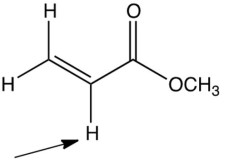
What is the multiplicity of the methylene hydrogens indicated in the proton NMR of the following compound?
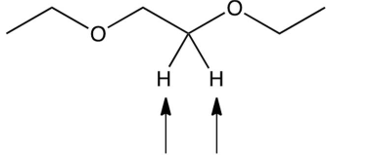
<strong>What is the multiplicity of the methylene hydrogens indicated in the proton NMR of the following compound?  </strong> A) singlet B) doublet C) triplet D) quartet <div style=padding-top: 35px>

A) singlet
B) doublet
C) triplet
D) quartet
سؤال
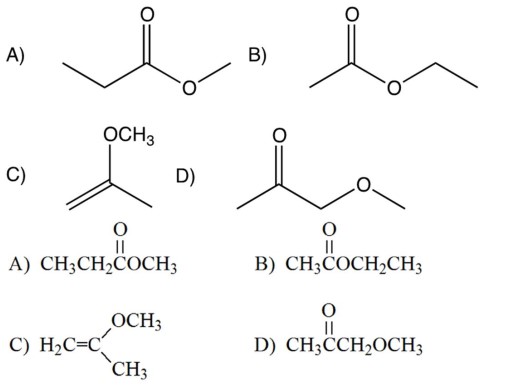
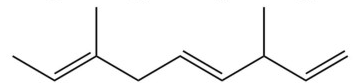
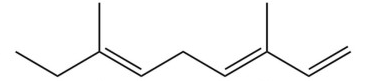
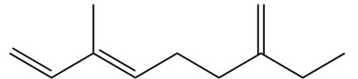
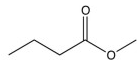
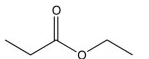
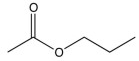
Which compound below fits the following proton NMR data?
Triplet \quad δ1.22(3H)\delta 1.22(3 \mathrm{H})
Singlet \quad δ1.98(3H)\delta 1.98(3 \mathrm{H})
Quartet \quad δ4.07(2H)\delta 4.07(2 \mathrm{H})
 <strong>Which compound below fits the following proton NMR data? Triplet \quad \delta 1.22(3 \mathrm{H})  Singlet \quad \delta 1.98(3 \mathrm{H})  Quartet \quad \delta 4.07(2 \mathrm{H})   </strong> A) A B) B C) C D) D <div style=padding-top: 35px>

A) A
B) B
C) C
D) D
سؤال
The proton NMR of 1,1-dibromoethane would appear as a

A) downfield doublet and upfield quartet.
B) downfield quartet and upfield doublet.
C) downfield doublet and upfield triplet.
D) downfield triplet and upfield doublet.
سؤال
A large doublet and a small septet pattern in 1H{ }^{1} \mathrm{H} NMR is usually indicative of a(n)

A) ethyl group.
B) propyl group.
C) isopropyl group.
D) phenyl group.
سؤال
Which of the following describes the spin-spin splitting of the indicated H\mathrm{H} in the 1H{ }^{1} \mathrm{H} NMR of the compound shown below?
 <strong>Which of the following describes the spin-spin splitting of the indicated  \mathrm{H}  in the  { }^{1} \mathrm{H}  NMR of the compound shown below?  </strong> A) singlet B) doublet of doublets C) triplet D) doublet of triplets <div style=padding-top: 35px>

A) singlet
B) doublet of doublets
C) triplet
D) doublet of triplets
سؤال
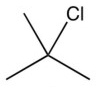
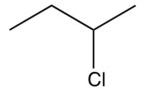
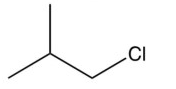
Identify the C4H9Cl\mathrm{C}_{4} \mathrm{H}_{9} \mathrm{Cl} isomer given the following proton NMR data:
Doublet δ1.04(6H)\quad \delta 1.04(6 \mathrm{H})
Multiplet \quad δ1.95(1H)\delta 1.95(1 \mathrm{H})
Doublet \quad δ3.35(2H)\delta 3.35(2 \mathrm{H})

A)
 <strong>Identify the  \mathrm{C}_{4} \mathrm{H}_{9} \mathrm{Cl}  isomer given the following proton NMR data: Doublet  \quad \delta 1.04(6 \mathrm{H})  Multiplet  \quad \delta 1.95(1 \mathrm{H})  Doublet  \quad \delta 3.35(2 \mathrm{H})  </strong> A)   B)   C)   D)   <div style=padding-top: 35px>
B)
 <strong>Identify the  \mathrm{C}_{4} \mathrm{H}_{9} \mathrm{Cl}  isomer given the following proton NMR data: Doublet  \quad \delta 1.04(6 \mathrm{H})  Multiplet  \quad \delta 1.95(1 \mathrm{H})  Doublet  \quad \delta 3.35(2 \mathrm{H})  </strong> A)   B)   C)   D)   <div style=padding-top: 35px>
C)
 <strong>Identify the  \mathrm{C}_{4} \mathrm{H}_{9} \mathrm{Cl}  isomer given the following proton NMR data: Doublet  \quad \delta 1.04(6 \mathrm{H})  Multiplet  \quad \delta 1.95(1 \mathrm{H})  Doublet  \quad \delta 3.35(2 \mathrm{H})  </strong> A)   B)   C)   D)   <div style=padding-top: 35px>
D)
 <strong>Identify the  \mathrm{C}_{4} \mathrm{H}_{9} \mathrm{Cl}  isomer given the following proton NMR data: Doublet  \quad \delta 1.04(6 \mathrm{H})  Multiplet  \quad \delta 1.95(1 \mathrm{H})  Doublet  \quad \delta 3.35(2 \mathrm{H})  </strong> A)   B)   C)   D)   <div style=padding-top: 35px>
سؤال
Which of the compounds below fit the following C-13 NMR?
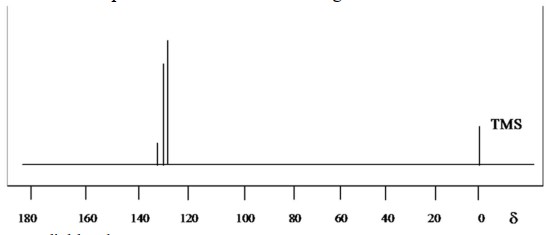
<strong>Which of the compounds below fit the following C-13 NMR?  </strong> A) para-dichlorobenzene B) meta-dichlorobenzene C) ortho-dichlorobenzene D) chlorobenzene <div style=padding-top: 35px>

A) para-dichlorobenzene
B) meta-dichlorobenzene
C) ortho-dichlorobenzene
D) chlorobenzene
سؤال
A C-13 NMR spectrum of a compound, C10H14\mathrm{C}_{10} \mathrm{H}_{14} , has five peaks. Two peaks are in the 103010-30 ppm region and the other three are in the 120-140 ppm area. Which of the following compounds fits the data?
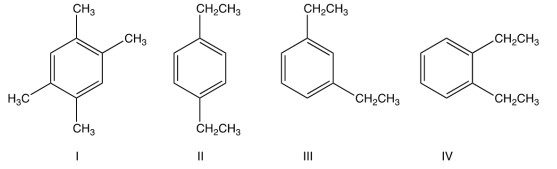
 <strong>A C-13 NMR spectrum of a compound,  \mathrm{C}_{10} \mathrm{H}_{14} , has five peaks. Two peaks are in the  10-30  ppm region and the other three are in the 120-140 ppm area. Which of the following compounds fits the data?  </strong> A) I B) II C) III D) IV <div style=padding-top: 35px>

A) I
B) II
C) III
D) IV
سؤال
Which one of the following has a λmax\lambda_{\max } in its UV-visible spectrum with the longest wavelength?

A)
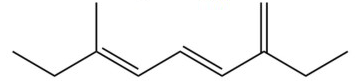
 <strong>Which one of the following has a  \lambda_{\max }  in its UV-visible spectrum with the longest wavelength? </strong> A)   B)   C)   D)   <div style=padding-top: 35px>
B)
 <strong>Which one of the following has a  \lambda_{\max }  in its UV-visible spectrum with the longest wavelength? </strong> A)   B)   C)   D)   <div style=padding-top: 35px>
C)
 <strong>Which one of the following has a  \lambda_{\max }  in its UV-visible spectrum with the longest wavelength? </strong> A)   B)   C)   D)   <div style=padding-top: 35px>
D)
 <strong>Which one of the following has a  \lambda_{\max }  in its UV-visible spectrum with the longest wavelength? </strong> A)   B)   C)   D)   <div style=padding-top: 35px>
سؤال
The reaction shown below gave two products in a ratio of approximately 1:21: 2 . The mass spectrum of the major product has a base peak at m/z119\mathrm{m} / \mathrm{z} 119 . The minor product gave a base peak at m/z133\mathrm{m} / \mathrm{z} 133 . Based on the reaction given and the information on the mass spectra, which of the following is the major product?
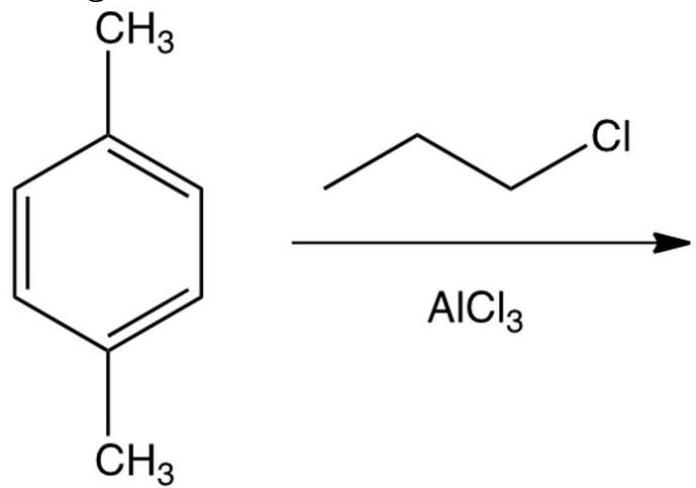
 <strong>The reaction shown below gave two products in a ratio of approximately  1: 2 . The mass spectrum of the major product has a base peak at  \mathrm{m} / \mathrm{z} 119 . The minor product gave a base peak at  \mathrm{m} / \mathrm{z} 133 . Based on the reaction given and the information on the mass spectra, which of the following is the major product?    </strong> A) A B) B C) C D) D <div style=padding-top: 35px>
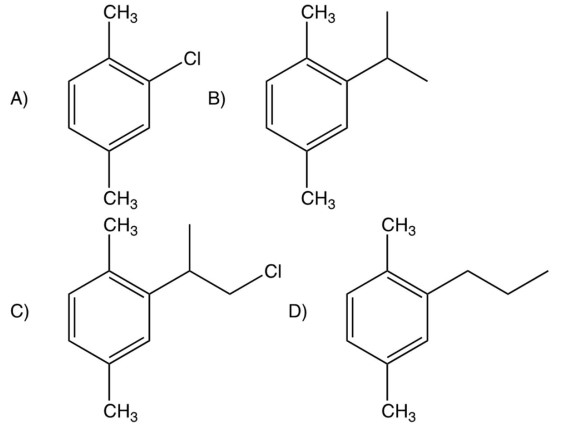
 <strong>The reaction shown below gave two products in a ratio of approximately  1: 2 . The mass spectrum of the major product has a base peak at  \mathrm{m} / \mathrm{z} 119 . The minor product gave a base peak at  \mathrm{m} / \mathrm{z} 133 . Based on the reaction given and the information on the mass spectra, which of the following is the major product?    </strong> A) A B) B C) C D) D <div style=padding-top: 35px>

A) A
B) B
C) C
D) D
سؤال
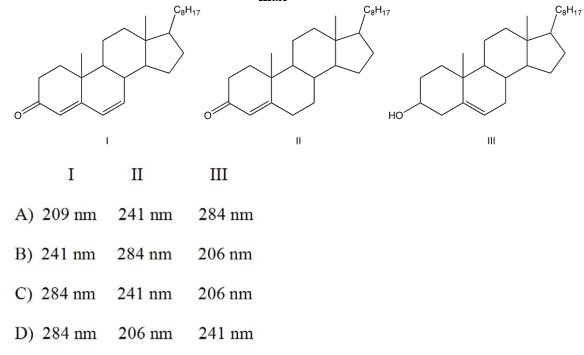
Match each steroid below with its λmax\lambda_{\max } in its UV-visible spectrum.
 <strong>Match each steroid below with its  \lambda_{\max }  in its UV-visible spectrum.  </strong> A) A B) B C) C D) D <div style=padding-top: 35px>

A) A
B) B
C) C
D) D
سؤال
Which of the following compounds fits the proton NMR shown below?
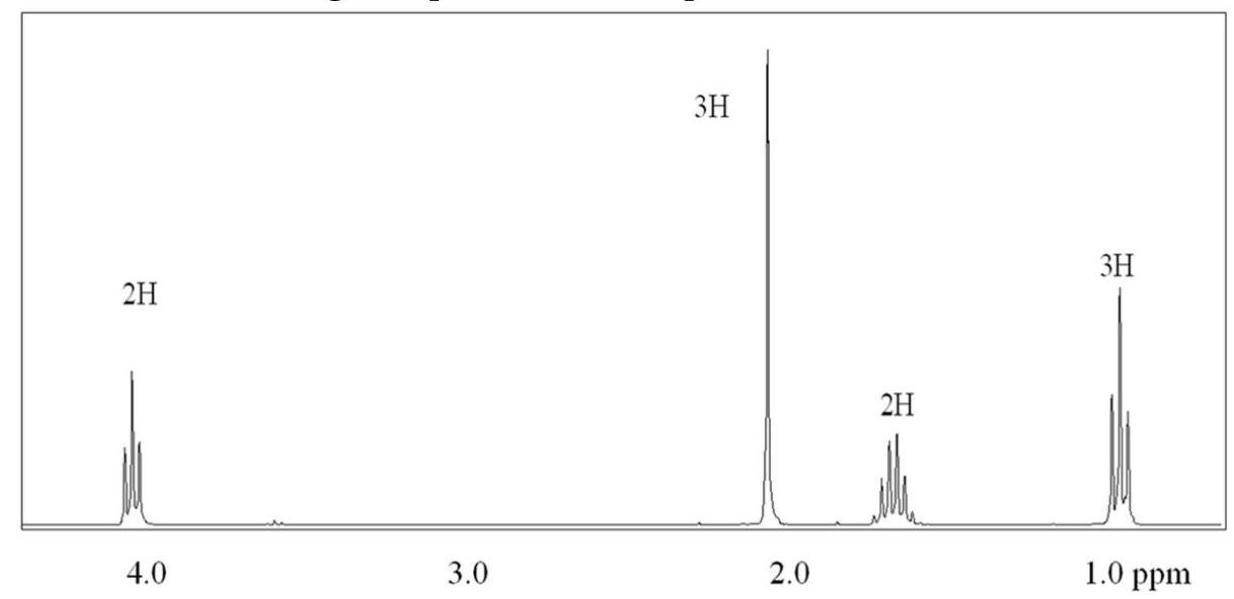
<strong>Which of the following compounds fits the proton NMR shown below?   </strong> A)   B)   C)   D)   <div style=padding-top: 35px>

A)
<strong>Which of the following compounds fits the proton NMR shown below?   </strong> A)   B)   C)   D)   <div style=padding-top: 35px>
B)
<strong>Which of the following compounds fits the proton NMR shown below?   </strong> A)   B)   C)   D)   <div style=padding-top: 35px>
C)
<strong>Which of the following compounds fits the proton NMR shown below?   </strong> A)   B)   C)   D)   <div style=padding-top: 35px>
D)
<strong>Which of the following compounds fits the proton NMR shown below?   </strong> A)   B)   C)   D)   <div style=padding-top: 35px>
سؤال
A compound, C20H30\mathrm{C}_{20} \mathrm{H}_{30} , can be hydrogenated with platinum metal and hydrogen to give a compound C20H38\mathrm{C}_{20} \mathrm{H}_{38} . How many double bonds (DB) and rings (R) does the original compound have? (The original compound has no triple bonds.)

A) 4DB,2R4 \mathrm{DB}, 2 \mathrm{R}
B) 4DB,1R4 \mathrm{DB}, 1 \mathrm{R}
C) 3DB,3R3 \mathrm{DB}, 3 \mathrm{R}
D) 2DB,4R2 \mathrm{DB}, 4 \mathrm{R}
سؤال
Determine the SODAR (sum of double bonds and rings) for a compound with the formula of C6H9BrO\mathrm{C}_{6} \mathrm{H}_{9} \mathrm{BrO} .

A) one
B) two
C) three
D) four
فتح الحزمة
قم بالتسجيل لفتح البطاقات في هذه المجموعة!
Unlock Deck
Unlock Deck
1/15
auto play flashcards
العب
simple tutorial
ملء الشاشة (f)
exit full mode
Deck 13: Spectroscopy
1
How many different types(sets) of hydrogens are there in 2,2-dimethylpentane?

A) 2
B) 3
C) 4
D) 5
4
2
What is the multiplicity of the methylene hydrogens indicated in the proton NMR of the following compound?
<strong>What is the multiplicity of the methylene hydrogens indicated in the proton NMR of the following compound?  </strong> A) singlet B) doublet C) triplet D) quartet

A) singlet
B) doublet
C) triplet
D) quartet
singlet
3
Which compound below fits the following proton NMR data?
Triplet \quad δ1.22(3H)\delta 1.22(3 \mathrm{H})
Singlet \quad δ1.98(3H)\delta 1.98(3 \mathrm{H})
Quartet \quad δ4.07(2H)\delta 4.07(2 \mathrm{H})
 <strong>Which compound below fits the following proton NMR data? Triplet \quad \delta 1.22(3 \mathrm{H})  Singlet \quad \delta 1.98(3 \mathrm{H})  Quartet \quad \delta 4.07(2 \mathrm{H})   </strong> A) A B) B C) C D) D

A) A
B) B
C) C
D) D
B
4
The proton NMR of 1,1-dibromoethane would appear as a

A) downfield doublet and upfield quartet.
B) downfield quartet and upfield doublet.
C) downfield doublet and upfield triplet.
D) downfield triplet and upfield doublet.
فتح الحزمة
افتح القفل للوصول البطاقات البالغ عددها 15 في هذه المجموعة.
فتح الحزمة
k this deck
5
A large doublet and a small septet pattern in 1H{ }^{1} \mathrm{H} NMR is usually indicative of a(n)

A) ethyl group.
B) propyl group.
C) isopropyl group.
D) phenyl group.
فتح الحزمة
افتح القفل للوصول البطاقات البالغ عددها 15 في هذه المجموعة.
فتح الحزمة
k this deck
6
Which of the following describes the spin-spin splitting of the indicated H\mathrm{H} in the 1H{ }^{1} \mathrm{H} NMR of the compound shown below?
 <strong>Which of the following describes the spin-spin splitting of the indicated  \mathrm{H}  in the  { }^{1} \mathrm{H}  NMR of the compound shown below?  </strong> A) singlet B) doublet of doublets C) triplet D) doublet of triplets

A) singlet
B) doublet of doublets
C) triplet
D) doublet of triplets
فتح الحزمة
افتح القفل للوصول البطاقات البالغ عددها 15 في هذه المجموعة.
فتح الحزمة
k this deck
7
Identify the C4H9Cl\mathrm{C}_{4} \mathrm{H}_{9} \mathrm{Cl} isomer given the following proton NMR data:
Doublet δ1.04(6H)\quad \delta 1.04(6 \mathrm{H})
Multiplet \quad δ1.95(1H)\delta 1.95(1 \mathrm{H})
Doublet \quad δ3.35(2H)\delta 3.35(2 \mathrm{H})

A)
 <strong>Identify the  \mathrm{C}_{4} \mathrm{H}_{9} \mathrm{Cl}  isomer given the following proton NMR data: Doublet  \quad \delta 1.04(6 \mathrm{H})  Multiplet  \quad \delta 1.95(1 \mathrm{H})  Doublet  \quad \delta 3.35(2 \mathrm{H})  </strong> A)   B)   C)   D)
B)
 <strong>Identify the  \mathrm{C}_{4} \mathrm{H}_{9} \mathrm{Cl}  isomer given the following proton NMR data: Doublet  \quad \delta 1.04(6 \mathrm{H})  Multiplet  \quad \delta 1.95(1 \mathrm{H})  Doublet  \quad \delta 3.35(2 \mathrm{H})  </strong> A)   B)   C)   D)
C)
 <strong>Identify the  \mathrm{C}_{4} \mathrm{H}_{9} \mathrm{Cl}  isomer given the following proton NMR data: Doublet  \quad \delta 1.04(6 \mathrm{H})  Multiplet  \quad \delta 1.95(1 \mathrm{H})  Doublet  \quad \delta 3.35(2 \mathrm{H})  </strong> A)   B)   C)   D)
D)
 <strong>Identify the  \mathrm{C}_{4} \mathrm{H}_{9} \mathrm{Cl}  isomer given the following proton NMR data: Doublet  \quad \delta 1.04(6 \mathrm{H})  Multiplet  \quad \delta 1.95(1 \mathrm{H})  Doublet  \quad \delta 3.35(2 \mathrm{H})  </strong> A)   B)   C)   D)
فتح الحزمة
افتح القفل للوصول البطاقات البالغ عددها 15 في هذه المجموعة.

فتح الحزمة
k this deck
8
Which of the compounds below fit the following C-13 NMR?
<strong>Which of the compounds below fit the following C-13 NMR?  </strong> A) para-dichlorobenzene B) meta-dichlorobenzene C) ortho-dichlorobenzene D) chlorobenzene

A) para-dichlorobenzene
B) meta-dichlorobenzene
C) ortho-dichlorobenzene
D) chlorobenzene
فتح الحزمة
افتح القفل للوصول البطاقات البالغ عددها 15 في هذه المجموعة.

فتح الحزمة
k this deck
9
A C-13 NMR spectrum of a compound, C10H14\mathrm{C}_{10} \mathrm{H}_{14} , has five peaks. Two peaks are in the 103010-30 ppm region and the other three are in the 120-140 ppm area. Which of the following compounds fits the data?
 <strong>A C-13 NMR spectrum of a compound,  \mathrm{C}_{10} \mathrm{H}_{14} , has five peaks. Two peaks are in the  10-30  ppm region and the other three are in the 120-140 ppm area. Which of the following compounds fits the data?  </strong> A) I B) II C) III D) IV

A) I
B) II
C) III
D) IV
فتح الحزمة
افتح القفل للوصول البطاقات البالغ عددها 15 في هذه المجموعة.
فتح الحزمة
k this deck
10
Which one of the following has a λmax\lambda_{\max } in its UV-visible spectrum with the longest wavelength?

A)
 <strong>Which one of the following has a  \lambda_{\max }  in its UV-visible spectrum with the longest wavelength? </strong> A)   B)   C)   D)
B)
 <strong>Which one of the following has a  \lambda_{\max }  in its UV-visible spectrum with the longest wavelength? </strong> A)   B)   C)   D)
C)
 <strong>Which one of the following has a  \lambda_{\max }  in its UV-visible spectrum with the longest wavelength? </strong> A)   B)   C)   D)
D)
 <strong>Which one of the following has a  \lambda_{\max }  in its UV-visible spectrum with the longest wavelength? </strong> A)   B)   C)   D)
فتح الحزمة
افتح القفل للوصول البطاقات البالغ عددها 15 في هذه المجموعة.
فتح الحزمة
k this deck
11
The reaction shown below gave two products in a ratio of approximately 1:21: 2 . The mass spectrum of the major product has a base peak at m/z119\mathrm{m} / \mathrm{z} 119 . The minor product gave a base peak at m/z133\mathrm{m} / \mathrm{z} 133 . Based on the reaction given and the information on the mass spectra, which of the following is the major product?
 <strong>The reaction shown below gave two products in a ratio of approximately  1: 2 . The mass spectrum of the major product has a base peak at  \mathrm{m} / \mathrm{z} 119 . The minor product gave a base peak at  \mathrm{m} / \mathrm{z} 133 . Based on the reaction given and the information on the mass spectra, which of the following is the major product?    </strong> A) A B) B C) C D) D
 <strong>The reaction shown below gave two products in a ratio of approximately  1: 2 . The mass spectrum of the major product has a base peak at  \mathrm{m} / \mathrm{z} 119 . The minor product gave a base peak at  \mathrm{m} / \mathrm{z} 133 . Based on the reaction given and the information on the mass spectra, which of the following is the major product?    </strong> A) A B) B C) C D) D

A) A
B) B
C) C
D) D
فتح الحزمة
افتح القفل للوصول البطاقات البالغ عددها 15 في هذه المجموعة.
فتح الحزمة
k this deck
12
Match each steroid below with its λmax\lambda_{\max } in its UV-visible spectrum.
 <strong>Match each steroid below with its  \lambda_{\max }  in its UV-visible spectrum.  </strong> A) A B) B C) C D) D

A) A
B) B
C) C
D) D
فتح الحزمة
افتح القفل للوصول البطاقات البالغ عددها 15 في هذه المجموعة.
فتح الحزمة
k this deck
13
Which of the following compounds fits the proton NMR shown below?
<strong>Which of the following compounds fits the proton NMR shown below?   </strong> A)   B)   C)   D)

A)
<strong>Which of the following compounds fits the proton NMR shown below?   </strong> A)   B)   C)   D)
B)
<strong>Which of the following compounds fits the proton NMR shown below?   </strong> A)   B)   C)   D)
C)
<strong>Which of the following compounds fits the proton NMR shown below?   </strong> A)   B)   C)   D)
D)
<strong>Which of the following compounds fits the proton NMR shown below?   </strong> A)   B)   C)   D)
فتح الحزمة
افتح القفل للوصول البطاقات البالغ عددها 15 في هذه المجموعة.
فتح الحزمة
k this deck
14
A compound, C20H30\mathrm{C}_{20} \mathrm{H}_{30} , can be hydrogenated with platinum metal and hydrogen to give a compound C20H38\mathrm{C}_{20} \mathrm{H}_{38} . How many double bonds (DB) and rings (R) does the original compound have? (The original compound has no triple bonds.)

A) 4DB,2R4 \mathrm{DB}, 2 \mathrm{R}
B) 4DB,1R4 \mathrm{DB}, 1 \mathrm{R}
C) 3DB,3R3 \mathrm{DB}, 3 \mathrm{R}
D) 2DB,4R2 \mathrm{DB}, 4 \mathrm{R}
فتح الحزمة
افتح القفل للوصول البطاقات البالغ عددها 15 في هذه المجموعة.
فتح الحزمة
k this deck
15
Determine the SODAR (sum of double bonds and rings) for a compound with the formula of C6H9BrO\mathrm{C}_{6} \mathrm{H}_{9} \mathrm{BrO} .

A) one
B) two
C) three
D) four
فتح الحزمة
افتح القفل للوصول البطاقات البالغ عددها 15 في هذه المجموعة.
فتح الحزمة
k this deck
locked card icon
فتح الحزمة
افتح القفل للوصول البطاقات البالغ عددها 15 في هذه المجموعة.