Deck 27: Synthetic Polymers

ملء الشاشة (f)
exit full mode
سؤال
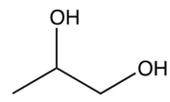
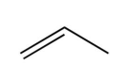
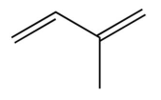
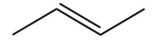
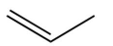
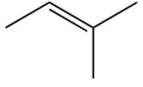
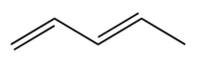
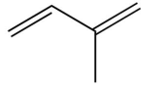
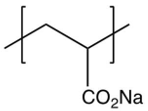
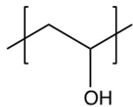
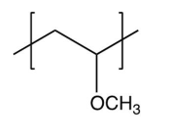
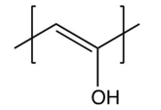
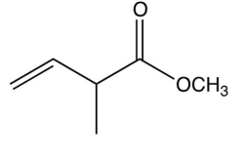
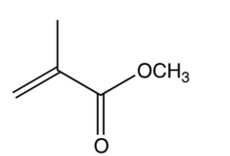
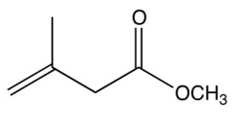
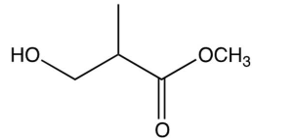
Which of the following is the monomer that gives the polymer shown below? <strong>Which of the following is the monomer that gives the polymer shown below?  </strong> A)   B)   C)   D)   <div style=padding-top: 35px>

A)
<strong>Which of the following is the monomer that gives the polymer shown below?  </strong> A)   B)   C)   D)   <div style=padding-top: 35px>
B)
<strong>Which of the following is the monomer that gives the polymer shown below?  </strong> A)   B)   C)   D)   <div style=padding-top: 35px>
C)
<strong>Which of the following is the monomer that gives the polymer shown below?  </strong> A)   B)   C)   D)   <div style=padding-top: 35px>
D)
<strong>Which of the following is the monomer that gives the polymer shown below?  </strong> A)   B)   C)   D)   <div style=padding-top: 35px>
استخدم زر المسافة أو
up arrow
down arrow
لقلب البطاقة.
سؤال
Which one of the following monomers undergoes cationic polymerization most readily?

 <strong>Which one of the following monomers undergoes cationic polymerization most readily?  </strong> A)  \mathrm{H}_{2} \mathrm{C}=\mathrm{CH}_{2}  B)  \mathrm{H}_{2} \mathrm{C}=\mathrm{CHCH}_{3}  C)  \mathrm{H}_{2} \mathrm{C}=\mathrm{C}\left(\mathrm{CH}_{3}\right)_{2}  D)  \mathrm{H}_{2} \mathrm{C}=\mathrm{CHCN}  <div style=padding-top: 35px>

A) H2C=CH2\mathrm{H}_{2} \mathrm{C}=\mathrm{CH}_{2}
B) H2C=CHCH3\mathrm{H}_{2} \mathrm{C}=\mathrm{CHCH}_{3}
C) H2C=C(CH3)2\mathrm{H}_{2} \mathrm{C}=\mathrm{C}\left(\mathrm{CH}_{3}\right)_{2}
D) H2C=CHCN\mathrm{H}_{2} \mathrm{C}=\mathrm{CHCN}
سؤال
Which one of the following monomers undergoes anionic polymerization most readily?

 <strong>Which one of the following monomers undergoes anionic polymerization most readily?  </strong> A)  \mathrm{H}_{2} \mathrm{C}=\mathrm{CH}_{2}  B)  \mathrm{H}_{2} \mathrm{C}=\mathrm{CHCH}_{3}  C)  \mathrm{H}_{2} \mathrm{C}=\mathrm{C}\left(\mathrm{CH}_{3}\right)_{2}  D)  \mathrm{H}_{2} \mathrm{C}=\mathrm{CHCN}  <div style=padding-top: 35px>

A) H2C=CH2\mathrm{H}_{2} \mathrm{C}=\mathrm{CH}_{2}
B) H2C=CHCH3\mathrm{H}_{2} \mathrm{C}=\mathrm{CHCH}_{3}
C) H2C=C(CH3)2\mathrm{H}_{2} \mathrm{C}=\mathrm{C}\left(\mathrm{CH}_{3}\right)_{2}
D) H2C=CHCN\mathrm{H}_{2} \mathrm{C}=\mathrm{CHCN}
سؤال
The monomer used to make superglue is shown below. Which one of the following methods of polymerization is most suitable for this type of monomer?
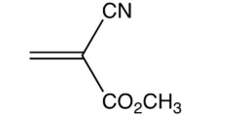
<strong>The monomer used to make superglue is shown below. Which one of the following methods of polymerization is most suitable for this type of monomer?  </strong> A) free-radical chain-growth B) cationic chain-growth C) anionic chain-growth D) acid-catalyzed step-growth <div style=padding-top: 35px>

A) free-radical chain-growth
B) cationic chain-growth
C) anionic chain-growth
D) acid-catalyzed step-growth
سؤال
Which one of the following is the monomer that gives the polymer shown below?

<strong>Which one of the following is the monomer that gives the polymer shown below?  </strong> A)   B)   C)   D)   <div style=padding-top: 35px>

A)
<strong>Which one of the following is the monomer that gives the polymer shown below?  </strong> A)   B)   C)   D)   <div style=padding-top: 35px>
B)
<strong>Which one of the following is the monomer that gives the polymer shown below?  </strong> A)   B)   C)   D)   <div style=padding-top: 35px>
C)
<strong>Which one of the following is the monomer that gives the polymer shown below?  </strong> A)   B)   C)   D)   <div style=padding-top: 35px>
D)
<strong>Which one of the following is the monomer that gives the polymer shown below?  </strong> A)   B)   C)   D)   <div style=padding-top: 35px>
سؤال
Identify the repeating unit in the polymer formed from the following reaction sequence. <strong>Identify the repeating unit in the polymer formed from the following reaction sequence.  </strong> A)   B)   C)   D)   <div style=padding-top: 35px>

A)
<strong>Identify the repeating unit in the polymer formed from the following reaction sequence.  </strong> A)   B)   C)   D)   <div style=padding-top: 35px>
B)
<strong>Identify the repeating unit in the polymer formed from the following reaction sequence.  </strong> A)   B)   C)   D)   <div style=padding-top: 35px>
C)
<strong>Identify the repeating unit in the polymer formed from the following reaction sequence.  </strong> A)   B)   C)   D)   <div style=padding-top: 35px>
D)
<strong>Identify the repeating unit in the polymer formed from the following reaction sequence.  </strong> A)   B)   C)   D)   <div style=padding-top: 35px>
سؤال
The acid-catalyzed dimerization of isobutylene gives a mixture of two isomeric alkenes (A and B\mathrm{B} ). Hydrogenation of this mixture gives a single C8H18\mathrm{C}_{8} \mathrm{H}_{18} hydrocarbon. What is the hydrocarbon?
 <strong>The acid-catalyzed dimerization of isobutylene gives a mixture of two isomeric alkenes (A and  \mathrm{B}  ). Hydrogenation of this mixture gives a single  \mathrm{C}_{8} \mathrm{H}_{18}  hydrocarbon. What is the hydrocarbon?  </strong> A) 2,2,4-trimethylpentane B) 2,3,4-trimethylpentane C) 2,4-dimethylhexane D) 2,5-dimethyhexane <div style=padding-top: 35px>

A) 2,2,4-trimethylpentane
B) 2,3,4-trimethylpentane
C) 2,4-dimethylhexane
D) 2,5-dimethyhexane
سؤال
The repeating unit of poly (methyl methacrylate) is shown below. Which one of the following is the monomer used to make poly (methyl methacrylate)?
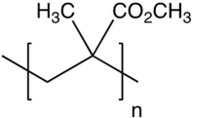
<strong> The repeating unit of poly (methyl methacrylate) is shown below. Which one of the following is the monomer used to make poly (methyl methacrylate)?  </strong> A)   B)   C)   D)  <sub></sub> <div style=padding-top: 35px>

A)
<strong> The repeating unit of poly (methyl methacrylate) is shown below. Which one of the following is the monomer used to make poly (methyl methacrylate)?  </strong> A)   B)   C)   D)  <sub></sub> <div style=padding-top: 35px>
B)
<strong> The repeating unit of poly (methyl methacrylate) is shown below. Which one of the following is the monomer used to make poly (methyl methacrylate)?  </strong> A)   B)   C)   D)  <sub></sub> <div style=padding-top: 35px>
C)
<strong> The repeating unit of poly (methyl methacrylate) is shown below. Which one of the following is the monomer used to make poly (methyl methacrylate)?  </strong> A)   B)   C)   D)  <sub></sub> <div style=padding-top: 35px>
D)
<strong> The repeating unit of poly (methyl methacrylate) is shown below. Which one of the following is the monomer used to make poly (methyl methacrylate)?  </strong> A)   B)   C)   D)  <sub></sub> <div style=padding-top: 35px>
سؤال
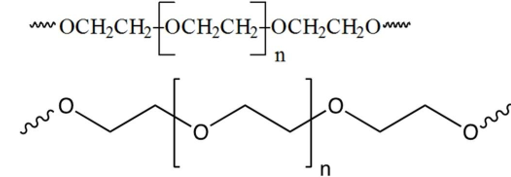
Which one of the following monomers is used to make the polymer carbowax, shown below? <strong>Which one of the following monomers is used to make the polymer carbowax, shown below?  </strong> A)   B)   C)   D)   <div style=padding-top: 35px>
A)
<strong>Which one of the following monomers is used to make the polymer carbowax, shown below?  </strong> A)   B)   C)   D)   <div style=padding-top: 35px>
B)
<strong>Which one of the following monomers is used to make the polymer carbowax, shown below?  </strong> A)   B)   C)   D)   <div style=padding-top: 35px>
C)
<strong>Which one of the following monomers is used to make the polymer carbowax, shown below?  </strong> A)   B)   C)   D)   <div style=padding-top: 35px>
D)
<strong>Which one of the following monomers is used to make the polymer carbowax, shown below?  </strong> A)   B)   C)   D)   <div style=padding-top: 35px>
سؤال
Which one of the following initiators can be used for anionic chain-growth polymerization?

A) benzoyl peroxide
B) CH3CH2CH2CH2Li\mathrm{CH}_{3} \mathrm{CH}_{2} \mathrm{CH}_{2} \mathrm{CH}_{2} \mathrm{Li}
C) BF3\mathrm{BF}_{3}
D) Al(CH2CH3)3,TiCl4\mathrm{Al}\left(\mathrm{CH}_{2} \mathrm{CH}_{3}\right)_{3}, \mathrm{TiCl}_{4}
سؤال
Which one of the following initiators can be used for free radical chain-growth polymerization?

A) benzoyl peroxide
B) CH3CH2CH2CH2Li\mathrm{CH}_{3} \mathrm{CH}_{2} \mathrm{CH}_{2} \mathrm{CH}_{2} \mathrm{Li}
C) BF3\mathrm{BF}_{3}
D) Al(CH2CH3)3,TiCl4\mathrm{Al}\left(\mathrm{CH}_{2} \mathrm{CH}_{3}\right)_{3}, \mathrm{TiCl}_{4}
سؤال
Which one of the following initiators is used to make isotactic polypropylene?

A) benzoyl peroxide
B) CH3CH2CH2CH2Li\mathrm{CH}_{3} \mathrm{CH}_{2} \mathrm{CH}_{2} \mathrm{CH}_{2} \mathrm{Li}
C) BF3\mathrm{BF}_{3}
D) Al(CH2CH3)3,TiCl4\mathrm{Al}\left(\mathrm{CH}_{2} \mathrm{CH}_{3}\right)_{3}, \mathrm{TiCl}_{4}
فتح الحزمة
قم بالتسجيل لفتح البطاقات في هذه المجموعة!
Unlock Deck
Unlock Deck
1/12
auto play flashcards
العب
simple tutorial
ملء الشاشة (f)
exit full mode
Deck 27: Synthetic Polymers
1
Which of the following is the monomer that gives the polymer shown below? <strong>Which of the following is the monomer that gives the polymer shown below?  </strong> A)   B)   C)   D)

A)
<strong>Which of the following is the monomer that gives the polymer shown below?  </strong> A)   B)   C)   D)
B)
<strong>Which of the following is the monomer that gives the polymer shown below?  </strong> A)   B)   C)   D)
C)
<strong>Which of the following is the monomer that gives the polymer shown below?  </strong> A)   B)   C)   D)
D)
<strong>Which of the following is the monomer that gives the polymer shown below?  </strong> A)   B)   C)   D)

2
Which one of the following monomers undergoes cationic polymerization most readily?
 <strong>Which one of the following monomers undergoes cationic polymerization most readily?  </strong> A)  \mathrm{H}_{2} \mathrm{C}=\mathrm{CH}_{2}  B)  \mathrm{H}_{2} \mathrm{C}=\mathrm{CHCH}_{3}  C)  \mathrm{H}_{2} \mathrm{C}=\mathrm{C}\left(\mathrm{CH}_{3}\right)_{2}  D)  \mathrm{H}_{2} \mathrm{C}=\mathrm{CHCN}

A) H2C=CH2\mathrm{H}_{2} \mathrm{C}=\mathrm{CH}_{2}
B) H2C=CHCH3\mathrm{H}_{2} \mathrm{C}=\mathrm{CHCH}_{3}
C) H2C=C(CH3)2\mathrm{H}_{2} \mathrm{C}=\mathrm{C}\left(\mathrm{CH}_{3}\right)_{2}
D) H2C=CHCN\mathrm{H}_{2} \mathrm{C}=\mathrm{CHCN}
H2C=C(CH3)2\mathrm{H}_{2} \mathrm{C}=\mathrm{C}\left(\mathrm{CH}_{3}\right)_{2}
3
Which one of the following monomers undergoes anionic polymerization most readily?
 <strong>Which one of the following monomers undergoes anionic polymerization most readily?  </strong> A)  \mathrm{H}_{2} \mathrm{C}=\mathrm{CH}_{2}  B)  \mathrm{H}_{2} \mathrm{C}=\mathrm{CHCH}_{3}  C)  \mathrm{H}_{2} \mathrm{C}=\mathrm{C}\left(\mathrm{CH}_{3}\right)_{2}  D)  \mathrm{H}_{2} \mathrm{C}=\mathrm{CHCN}

A) H2C=CH2\mathrm{H}_{2} \mathrm{C}=\mathrm{CH}_{2}
B) H2C=CHCH3\mathrm{H}_{2} \mathrm{C}=\mathrm{CHCH}_{3}
C) H2C=C(CH3)2\mathrm{H}_{2} \mathrm{C}=\mathrm{C}\left(\mathrm{CH}_{3}\right)_{2}
D) H2C=CHCN\mathrm{H}_{2} \mathrm{C}=\mathrm{CHCN}
H2C=CHCN\mathrm{H}_{2} \mathrm{C}=\mathrm{CHCN}
4
The monomer used to make superglue is shown below. Which one of the following methods of polymerization is most suitable for this type of monomer?
<strong>The monomer used to make superglue is shown below. Which one of the following methods of polymerization is most suitable for this type of monomer?  </strong> A) free-radical chain-growth B) cationic chain-growth C) anionic chain-growth D) acid-catalyzed step-growth

A) free-radical chain-growth
B) cationic chain-growth
C) anionic chain-growth
D) acid-catalyzed step-growth
فتح الحزمة
افتح القفل للوصول البطاقات البالغ عددها 12 في هذه المجموعة.
فتح الحزمة
k this deck
5
Which one of the following is the monomer that gives the polymer shown below?
<strong>Which one of the following is the monomer that gives the polymer shown below?  </strong> A)   B)   C)   D)

A)
<strong>Which one of the following is the monomer that gives the polymer shown below?  </strong> A)   B)   C)   D)
B)
<strong>Which one of the following is the monomer that gives the polymer shown below?  </strong> A)   B)   C)   D)
C)
<strong>Which one of the following is the monomer that gives the polymer shown below?  </strong> A)   B)   C)   D)
D)
<strong>Which one of the following is the monomer that gives the polymer shown below?  </strong> A)   B)   C)   D)
فتح الحزمة
افتح القفل للوصول البطاقات البالغ عددها 12 في هذه المجموعة.
فتح الحزمة
k this deck
6
Identify the repeating unit in the polymer formed from the following reaction sequence. <strong>Identify the repeating unit in the polymer formed from the following reaction sequence.  </strong> A)   B)   C)   D)

A)
<strong>Identify the repeating unit in the polymer formed from the following reaction sequence.  </strong> A)   B)   C)   D)
B)
<strong>Identify the repeating unit in the polymer formed from the following reaction sequence.  </strong> A)   B)   C)   D)
C)
<strong>Identify the repeating unit in the polymer formed from the following reaction sequence.  </strong> A)   B)   C)   D)
D)
<strong>Identify the repeating unit in the polymer formed from the following reaction sequence.  </strong> A)   B)   C)   D)
فتح الحزمة
افتح القفل للوصول البطاقات البالغ عددها 12 في هذه المجموعة.
فتح الحزمة
k this deck
7
The acid-catalyzed dimerization of isobutylene gives a mixture of two isomeric alkenes (A and B\mathrm{B} ). Hydrogenation of this mixture gives a single C8H18\mathrm{C}_{8} \mathrm{H}_{18} hydrocarbon. What is the hydrocarbon?
 <strong>The acid-catalyzed dimerization of isobutylene gives a mixture of two isomeric alkenes (A and  \mathrm{B}  ). Hydrogenation of this mixture gives a single  \mathrm{C}_{8} \mathrm{H}_{18}  hydrocarbon. What is the hydrocarbon?  </strong> A) 2,2,4-trimethylpentane B) 2,3,4-trimethylpentane C) 2,4-dimethylhexane D) 2,5-dimethyhexane

A) 2,2,4-trimethylpentane
B) 2,3,4-trimethylpentane
C) 2,4-dimethylhexane
D) 2,5-dimethyhexane
فتح الحزمة
افتح القفل للوصول البطاقات البالغ عددها 12 في هذه المجموعة.

فتح الحزمة
k this deck
8
The repeating unit of poly (methyl methacrylate) is shown below. Which one of the following is the monomer used to make poly (methyl methacrylate)?
<strong> The repeating unit of poly (methyl methacrylate) is shown below. Which one of the following is the monomer used to make poly (methyl methacrylate)?  </strong> A)   B)   C)   D)  <sub></sub>

A)
<strong> The repeating unit of poly (methyl methacrylate) is shown below. Which one of the following is the monomer used to make poly (methyl methacrylate)?  </strong> A)   B)   C)   D)  <sub></sub>
B)
<strong> The repeating unit of poly (methyl methacrylate) is shown below. Which one of the following is the monomer used to make poly (methyl methacrylate)?  </strong> A)   B)   C)   D)  <sub></sub>
C)
<strong> The repeating unit of poly (methyl methacrylate) is shown below. Which one of the following is the monomer used to make poly (methyl methacrylate)?  </strong> A)   B)   C)   D)  <sub></sub>
D)
<strong> The repeating unit of poly (methyl methacrylate) is shown below. Which one of the following is the monomer used to make poly (methyl methacrylate)?  </strong> A)   B)   C)   D)  <sub></sub>
فتح الحزمة
افتح القفل للوصول البطاقات البالغ عددها 12 في هذه المجموعة.

فتح الحزمة
k this deck
9
Which one of the following monomers is used to make the polymer carbowax, shown below? <strong>Which one of the following monomers is used to make the polymer carbowax, shown below?  </strong> A)   B)   C)   D)

A)
<strong>Which one of the following monomers is used to make the polymer carbowax, shown below?  </strong> A)   B)   C)   D)
B)
<strong>Which one of the following monomers is used to make the polymer carbowax, shown below?  </strong> A)   B)   C)   D)
C)
<strong>Which one of the following monomers is used to make the polymer carbowax, shown below?  </strong> A)   B)   C)   D)
D)
<strong>Which one of the following monomers is used to make the polymer carbowax, shown below?  </strong> A)   B)   C)   D)
فتح الحزمة
افتح القفل للوصول البطاقات البالغ عددها 12 في هذه المجموعة.
فتح الحزمة
k this deck
10
Which one of the following initiators can be used for anionic chain-growth polymerization?

A) benzoyl peroxide
B) CH3CH2CH2CH2Li\mathrm{CH}_{3} \mathrm{CH}_{2} \mathrm{CH}_{2} \mathrm{CH}_{2} \mathrm{Li}
C) BF3\mathrm{BF}_{3}
D) Al(CH2CH3)3,TiCl4\mathrm{Al}\left(\mathrm{CH}_{2} \mathrm{CH}_{3}\right)_{3}, \mathrm{TiCl}_{4}
فتح الحزمة
افتح القفل للوصول البطاقات البالغ عددها 12 في هذه المجموعة.
فتح الحزمة
k this deck
11
Which one of the following initiators can be used for free radical chain-growth polymerization?

A) benzoyl peroxide
B) CH3CH2CH2CH2Li\mathrm{CH}_{3} \mathrm{CH}_{2} \mathrm{CH}_{2} \mathrm{CH}_{2} \mathrm{Li}
C) BF3\mathrm{BF}_{3}
D) Al(CH2CH3)3,TiCl4\mathrm{Al}\left(\mathrm{CH}_{2} \mathrm{CH}_{3}\right)_{3}, \mathrm{TiCl}_{4}
فتح الحزمة
افتح القفل للوصول البطاقات البالغ عددها 12 في هذه المجموعة.
فتح الحزمة
k this deck
12
Which one of the following initiators is used to make isotactic polypropylene?

A) benzoyl peroxide
B) CH3CH2CH2CH2Li\mathrm{CH}_{3} \mathrm{CH}_{2} \mathrm{CH}_{2} \mathrm{CH}_{2} \mathrm{Li}
C) BF3\mathrm{BF}_{3}
D) Al(CH2CH3)3,TiCl4\mathrm{Al}\left(\mathrm{CH}_{2} \mathrm{CH}_{3}\right)_{3}, \mathrm{TiCl}_{4}
فتح الحزمة
افتح القفل للوصول البطاقات البالغ عددها 12 في هذه المجموعة.
فتح الحزمة
k this deck
locked card icon
فتح الحزمة
افتح القفل للوصول البطاقات البالغ عددها 12 في هذه المجموعة.