







 تكلم مع الذكاء الاصطناعي


Deck 6: Where It Starts - Photosynthesis
ملء الشاشة (f)

سؤال
Figure 6.5B
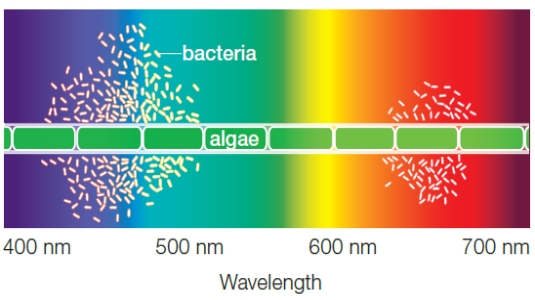
Following Questions refer to the figure above illustrating the results from Engelmann's investigation.
The best light to grow the alga in is ____, according to the figure.
A) blue-violet
B) blue-green
C) green-yellow
D) yellow-orange
E) orange-red
Following Questions refer to the figure above illustrating the results from Engelmann's investigation.
The best light to grow the alga in is ____, according to the figure.
A) blue-violet
B) blue-green
C) green-yellow
D) yellow-orange
E) orange-red

سؤال
سؤال
سؤال
سؤال
Figure 6.5B
Following Questions refer to the figure above illustrating the results from Engelmann's investigation.
In plant cells, chloroplasts are found ____.
A) on the cell membrane
B) in the cytoplasm of the cell
C) in the stroma
D) in the thylakoids
E) in the central vacuole
Following Questions refer to the figure above illustrating the results from Engelmann's investigation.
In plant cells, chloroplasts are found ____.
A) on the cell membrane
B) in the cytoplasm of the cell
C) in the stroma
D) in the thylakoids
E) in the central vacuole
سؤال
سؤال
Figure 6.5B
Following Questions refer to the figure above illustrating the results from Engelmann's investigation.
According to the figure, the most effective wavelength for photosynthesis is revealed by algae exposed to ____ nanometers.
A) 680
B) 700
C) 400
D) 425
E) 550
Following Questions refer to the figure above illustrating the results from Engelmann's investigation.
According to the figure, the most effective wavelength for photosynthesis is revealed by algae exposed to ____ nanometers.
A) 680
B) 700
C) 400
D) 425
E) 550
سؤال
سؤال
سؤال
سؤال
Figure 6.5B
Following Questions refer to the figure above illustrating the results from Engelmann's investigation.
Englemann's experiment was designed to determine ____.
A) what wavelengths comprise visible light
B) what colors are contained in visible light
C) if bacteria are attracted to oxygen
D) if photosynthesis releases oxygen
E) if photosynthesis is impacted by the color of light
Following Questions refer to the figure above illustrating the results from Engelmann's investigation.
Englemann's experiment was designed to determine ____.
A) what wavelengths comprise visible light
B) what colors are contained in visible light
C) if bacteria are attracted to oxygen
D) if photosynthesis releases oxygen
E) if photosynthesis is impacted by the color of light
سؤال
سؤال
سؤال
سؤال
سؤال
سؤال
سؤال
سؤال
سؤال
سؤال
سؤال
سؤال
سؤال
سؤال
سؤال
سؤال
سؤال
سؤال
سؤال
سؤال
سؤال
سؤال
سؤال
سؤال
سؤال
سؤال
سؤال
سؤال
سؤال
سؤال
سؤال
سؤال
سؤال
سؤال
سؤال
سؤال
سؤال
سؤال
سؤال
سؤال
سؤال
سؤال
سؤال
سؤال
سؤال
سؤال
سؤال
سؤال
Use the figure below to match the pigments with their absorption spectra.
Figure 6.5C

a.Peak A
b.Peak B
c.Peak C
d.Peak D
e.Peak E
beta-carotene
Figure 6.5C
a.Peak A
b.Peak B
c.Peak C
d.Peak D
e.Peak E
beta-carotene
سؤال
سؤال
سؤال
سؤال
Use the figure below to match the pigments with their absorption spectra.
Figure 6.5C
a.Peak A
b.Peak B
c.Peak C
d.Peak D
e.Peak E
phycoerythrobilin
Figure 6.5C
a.Peak A
b.Peak B
c.Peak C
d.Peak D
e.Peak E
phycoerythrobilin
سؤال
سؤال
سؤال
Use the figure below to match the pigments with their absorption spectra.
Figure 6.5C
a.Peak A
b.Peak B
c.Peak C
d.Peak D
e.Peak E
phycocyanobilin
Figure 6.5C
a.Peak A
b.Peak B
c.Peak C
d.Peak D
e.Peak E
phycocyanobilin
سؤال
Use the figure below to match the pigments with their absorption spectra.
Figure 6.5C
a.Peak A
b.Peak B
c.Peak C
d.Peak D
e.Peak E
chlorophyll a
Figure 6.5C
a.Peak A
b.Peak B
c.Peak C
d.Peak D
e.Peak E
chlorophyll a
سؤال
سؤال
Use the figure below to match the pigments with their absorption spectra.
Figure 6.5C
a.Peak A
b.Peak B
c.Peak C
d.Peak D
e.Peak E
chlorophyll b
Figure 6.5C
a.Peak A
b.Peak B
c.Peak C
d.Peak D
e.Peak E
chlorophyll b

فتح الحزمة
قم بالتسجيل لفتح البطاقات في هذه المجموعة!
Unlock Deck
Unlock Deck
1/69

العب

ملء الشاشة (f)
Deck 6: Where It Starts - Photosynthesis
1
Figure 6.5B
Following Questions refer to the figure above illustrating the results from Engelmann's investigation.
The best light to grow the alga in is ____, according to the figure.
A) blue-violet
B) blue-green
C) green-yellow
D) yellow-orange
E) orange-red
Following Questions refer to the figure above illustrating the results from Engelmann's investigation.
The best light to grow the alga in is ____, according to the figure.
A) blue-violet
B) blue-green
C) green-yellow
D) yellow-orange
E) orange-red
A
2
A pigment absorbs a photon if the energy of the photon is ____.
A) exactly enough to boost an electron of the pigment to a higher energy level
B) slightly more than the energy of the electron absorbing the photon
C) significantly more than the energy of the electron absorbing the photon
D) exactly twice the energy of the electron absorbing the photon
E) significantly less than the energy of the electron absorbing the photon
A) exactly enough to boost an electron of the pigment to a higher energy level
B) slightly more than the energy of the electron absorbing the photon
C) significantly more than the energy of the electron absorbing the photon
D) exactly twice the energy of the electron absorbing the photon
E) significantly less than the energy of the electron absorbing the photon
A
3
Ethanol can be easily produced from ____.
A) photosynthetic pigments
B) crystalline cellulose
C) root systems of plants
D) plant sugars
E) stems of plants
A) photosynthetic pigments
B) crystalline cellulose
C) root systems of plants
D) plant sugars
E) stems of plants
D
4
When an electron in a pigment molecule is absorbed by a photon, it ____.
A) is always shared with another atom via a double bond
B) is always shared with another atom via a single bond
C) emits its extra energy and returns to its original energy level
D) moves to a higher energy level and remains there
E) moves to a lower energy level and remains there
A) is always shared with another atom via a double bond
B) is always shared with another atom via a single bond
C) emits its extra energy and returns to its original energy level
D) moves to a higher energy level and remains there
E) moves to a lower energy level and remains there
فتح الحزمة
افتح القفل للوصول البطاقات البالغ عددها 69 في هذه المجموعة.
فتح الحزمة
k this deck
5
Figure 6.5B
Following Questions refer to the figure above illustrating the results from Engelmann's investigation.
In plant cells, chloroplasts are found ____.
A) on the cell membrane
B) in the cytoplasm of the cell
C) in the stroma
D) in the thylakoids
E) in the central vacuole
Following Questions refer to the figure above illustrating the results from Engelmann's investigation.
In plant cells, chloroplasts are found ____.
A) on the cell membrane
B) in the cytoplasm of the cell
C) in the stroma
D) in the thylakoids
E) in the central vacuole
فتح الحزمة
افتح القفل للوصول البطاقات البالغ عددها 69 في هذه المجموعة.
فتح الحزمة
k this deck
6
The ____ a photon's wavelength, the ____ its energy.
A) shorter; greater
B) longer; greater
C) shorter; less
D) longer; more variable
E) shorter; more variable
A) shorter; greater
B) longer; greater
C) shorter; less
D) longer; more variable
E) shorter; more variable
فتح الحزمة
افتح القفل للوصول البطاقات البالغ عددها 69 في هذه المجموعة.
فتح الحزمة
k this deck
7
Figure 6.5B
Following Questions refer to the figure above illustrating the results from Engelmann's investigation.
According to the figure, the most effective wavelength for photosynthesis is revealed by algae exposed to ____ nanometers.
A) 680
B) 700
C) 400
D) 425
E) 550
Following Questions refer to the figure above illustrating the results from Engelmann's investigation.
According to the figure, the most effective wavelength for photosynthesis is revealed by algae exposed to ____ nanometers.
A) 680
B) 700
C) 400
D) 425
E) 550
فتح الحزمة
افتح القفل للوصول البطاقات البالغ عددها 69 في هذه المجموعة.
فتح الحزمة
k this deck
8
Photosynthetic plants readily ____.
A) get carbon from their food
B) obtain energy from water
C) consume other organisms as food
D) provide food for others
E) do not need gases to make food
A) get carbon from their food
B) obtain energy from water
C) consume other organisms as food
D) provide food for others
E) do not need gases to make food
فتح الحزمة
افتح القفل للوصول البطاقات البالغ عددها 69 في هذه المجموعة.
فتح الحزمة
k this deck
9
____ are accessory pigments in photosynthesis that reflect blue and red wavelengths best.
A) Carotenoids
B) Phycobilins
C) Anthocyanins
D) Chlorophyll b
E) Chlorophyll a
A) Carotenoids
B) Phycobilins
C) Anthocyanins
D) Chlorophyll b
E) Chlorophyll a
فتح الحزمة
افتح القفل للوصول البطاقات البالغ عددها 69 في هذه المجموعة.
فتح الحزمة
k this deck
10
In the electromagnetic spectrum, ____.
A) infrared energy has the shortest wavelength
B) infrared radiation has more energy than red radiation
C) visible light has more energy than ultraviolet radiation
D) near-infrared radiation provides the energy for photosynthesis
E) visible light provides the energy for photosynthesis
A) infrared energy has the shortest wavelength
B) infrared radiation has more energy than red radiation
C) visible light has more energy than ultraviolet radiation
D) near-infrared radiation provides the energy for photosynthesis
E) visible light provides the energy for photosynthesis
فتح الحزمة
افتح القفل للوصول البطاقات البالغ عددها 69 في هذه المجموعة.
فتح الحزمة
k this deck
11
Figure 6.5B
Following Questions refer to the figure above illustrating the results from Engelmann's investigation.
Englemann's experiment was designed to determine ____.
A) what wavelengths comprise visible light
B) what colors are contained in visible light
C) if bacteria are attracted to oxygen
D) if photosynthesis releases oxygen
E) if photosynthesis is impacted by the color of light
Following Questions refer to the figure above illustrating the results from Engelmann's investigation.
Englemann's experiment was designed to determine ____.
A) what wavelengths comprise visible light
B) what colors are contained in visible light
C) if bacteria are attracted to oxygen
D) if photosynthesis releases oxygen
E) if photosynthesis is impacted by the color of light
فتح الحزمة
افتح القفل للوصول البطاقات البالغ عددها 69 في هذه المجموعة.
فتح الحزمة
k this deck
12
Sugars are formed in the chloroplasts ____.
A) on the outer membrane
B) on the inner membrane
C) in the thylakoid compartment
D) in the stroma
E) within the thylakoid membrane
A) on the outer membrane
B) on the inner membrane
C) in the thylakoid compartment
D) in the stroma
E) within the thylakoid membrane
فتح الحزمة
افتح القفل للوصول البطاقات البالغ عددها 69 في هذه المجموعة.
فتح الحزمة
k this deck
13
During the light dependent reactions, NADPH ____.
A) is an enzyme
B) is the oxidized form of NADP+
C) accepts hydrogen and electrons from water
D) accepts hydrogen and electrons from carbohydrates
E) obtains energy from ATP
A) is an enzyme
B) is the oxidized form of NADP+
C) accepts hydrogen and electrons from water
D) accepts hydrogen and electrons from carbohydrates
E) obtains energy from ATP
فتح الحزمة
افتح القفل للوصول البطاقات البالغ عددها 69 في هذه المجموعة.
فتح الحزمة
k this deck
14
Carotenoids are accessory pigments that ____.
A) absorb yellow and red light to assist in photosynthesis
B) capture energy from light and use it directly in cellular respiration
C) are masked by the presence of chlorophyll throughout the growing season
D) absorb blue and violet wavelengths and reflect green and yellow
E) reflect blue wavelengths
A) absorb yellow and red light to assist in photosynthesis
B) capture energy from light and use it directly in cellular respiration
C) are masked by the presence of chlorophyll throughout the growing season
D) absorb blue and violet wavelengths and reflect green and yellow
E) reflect blue wavelengths
فتح الحزمة
افتح القفل للوصول البطاقات البالغ عددها 69 في هذه المجموعة.
فتح الحزمة
k this deck
15
The light dependent reactions do not produce ____.
A) glucose
B) oxygen
C) ATP
D) NADPH
E) H+
A) glucose
B) oxygen
C) ATP
D) NADPH
E) H+
فتح الحزمة
افتح القفل للوصول البطاقات البالغ عددها 69 في هذه المجموعة.
فتح الحزمة
k this deck
16
Actual assembly of sugars during photosynthesis ____.
A) occurs during light-dependent reactions
B) takes place in the mitochondria
C) requires NADPH
D) yields ATP
E) requires oxygen
A) occurs during light-dependent reactions
B) takes place in the mitochondria
C) requires NADPH
D) yields ATP
E) requires oxygen
فتح الحزمة
افتح القفل للوصول البطاقات البالغ عددها 69 في هذه المجموعة.
فتح الحزمة
k this deck
17
What statement below characterizes pigments' function?
A) They absorb some photons.
B) They reflect all photons.
C) They absorb photons of all colors.
D) They absorb photons of all wavelengths.
E) They absorb ultraviolet wavelengths.
A) They absorb some photons.
B) They reflect all photons.
C) They absorb photons of all colors.
D) They absorb photons of all wavelengths.
E) They absorb ultraviolet wavelengths.
فتح الحزمة
افتح القفل للوصول البطاقات البالغ عددها 69 في هذه المجموعة.
فتح الحزمة
k this deck
18
Chlorophyll does not absorb ____ wavelengths of light.
A) red
B) yellow
C) orange
D) green
E) blue
A) red
B) yellow
C) orange
D) green
E) blue
فتح الحزمة
افتح القفل للوصول البطاقات البالغ عددها 69 في هذه المجموعة.
فتح الحزمة
k this deck
19
Plants are considered to be ____.
A) heterotrophs
B) chemotrophs
C) carbotrophs
D) autotrophs
E) thermotrophs
A) heterotrophs
B) chemotrophs
C) carbotrophs
D) autotrophs
E) thermotrophs
فتح الحزمة
افتح القفل للوصول البطاقات البالغ عددها 69 في هذه المجموعة.
فتح الحزمة
k this deck
20
What is NOT a product of the light-independent reactions?
A) ADP
B) NADP+
C) oxygen
D) glucose
E) free phosphates
A) ADP
B) NADP+
C) oxygen
D) glucose
E) free phosphates
فتح الحزمة
افتح القفل للوصول البطاقات البالغ عددها 69 في هذه المجموعة.
فتح الحزمة
k this deck
21
What product of the light-dependent reactions is released directly into the environment?
A) O₂
B) electrons
C) NADPH
D) ATP
E) hydrogen ions
A) O₂
B) electrons
C) NADPH
D) ATP
E) hydrogen ions
فتح الحزمة
افتح القفل للوصول البطاقات البالغ عددها 69 في هذه المجموعة.
فتح الحزمة
k this deck
22
A high concentration of H+ in the thylakoid compartment provides potential energy for the ____ by ____.
A) breakdown of water; oxidation
B) production of ATP; ATP synthases
C) reduction of NADP+; an electron transfer chain
D) production of sugars; the light-independent reactions
E) production of O₂; photolysis
A) breakdown of water; oxidation
B) production of ATP; ATP synthases
C) reduction of NADP+; an electron transfer chain
D) production of sugars; the light-independent reactions
E) production of O₂; photolysis
فتح الحزمة
افتح القفل للوصول البطاقات البالغ عددها 69 في هذه المجموعة.
فتح الحزمة
k this deck
23
Plant cells release hydrogen ions and oxygen from H₂O molecules in ____.
A) photosystem I
B) photosystem II
C) cyclic photophosphorylation
D) the light independent reaction
E) carbon fixation
A) photosystem I
B) photosystem II
C) cyclic photophosphorylation
D) the light independent reaction
E) carbon fixation
فتح الحزمة
افتح القفل للوصول البطاقات البالغ عددها 69 في هذه المجموعة.
فتح الحزمة
k this deck
24
The two photosystems of light-dependent reactions are designated ____.
A) type 1 and type 2
B) type I and type II
C) photosystem A and photosystem B
D) photosystem 680 and photosystem 700
E) photosystem I and photosystem II
A) type 1 and type 2
B) type I and type II
C) photosystem A and photosystem B
D) photosystem 680 and photosystem 700
E) photosystem I and photosystem II
فتح الحزمة
افتح القفل للوصول البطاقات البالغ عددها 69 في هذه المجموعة.
فتح الحزمة
k this deck
25
What is present in both the light-dependent and light-independent reactions?
A) ATP
B) oxygen
C) glucose
D) rubisco
E) water
A) ATP
B) oxygen
C) glucose
D) rubisco
E) water
فتح الحزمة
افتح القفل للوصول البطاقات البالغ عددها 69 في هذه المجموعة.
فتح الحزمة
k this deck
26
The light-independent reactions of photosynthesis ____.
A) fix carbon dioxide
B) release oxygen
C) cannot occur in light
D) generate ATP
E) use ADP
A) fix carbon dioxide
B) release oxygen
C) cannot occur in light
D) generate ATP
E) use ADP
فتح الحزمة
افتح القفل للوصول البطاقات البالغ عددها 69 في هذه المجموعة.
فتح الحزمة
k this deck
27
cyclic pathway of ATP formation
فتح الحزمة
افتح القفل للوصول البطاقات البالغ عددها 69 في هذه المجموعة.
فتح الحزمة
k this deck
28
Which of the following has the most energy?
A) phosphoglycerate (PGA)
B) ribulose bisphosphate (RuBP)
C) phosphoglyceraldehyde (PGAL)
D) glucose
E) rubisco
A) phosphoglycerate (PGA)
B) ribulose bisphosphate (RuBP)
C) phosphoglyceraldehyde (PGAL)
D) glucose
E) rubisco
فتح الحزمة
افتح القفل للوصول البطاقات البالغ عددها 69 في هذه المجموعة.
فتح الحزمة
k this deck
29
The proteins associated with the light-dependent reactions of photosynthesis are located ____.
A) on the outer membranes of the chloroplast
B) in the stroma
C) on the thylakoid membrane
D) throughout the cytoplasm of plant cells
E) in the thylakoid compartment
A) on the outer membranes of the chloroplast
B) in the stroma
C) on the thylakoid membrane
D) throughout the cytoplasm of plant cells
E) in the thylakoid compartment
فتح الحزمة
افتح القفل للوصول البطاقات البالغ عددها 69 في هذه المجموعة.
فتح الحزمة
k this deck
30
What is formed during the light dependent reactions of photosynthesis?
A) H+ and H₂O
B) excited electrons and H+
C) ATP and O₂
D) O₂ and NADPH
E) NADPH and ATP
A) H+ and H₂O
B) excited electrons and H+
C) ATP and O₂
D) O₂ and NADPH
E) NADPH and ATP
فتح الحزمة
افتح القفل للوصول البطاقات البالغ عددها 69 في هذه المجموعة.
فتح الحزمة
k this deck
31
What is a required input for the light-independent reactions?
A) NADPH
B) phosphoglyceric acid (PGA)
C) phosphoglyceraldehyde (PGAL)
D) glucose
E) ribulose bisphosphate
A) NADPH
B) phosphoglyceric acid (PGA)
C) phosphoglyceraldehyde (PGAL)
D) glucose
E) ribulose bisphosphate
فتح الحزمة
افتح القفل للوصول البطاقات البالغ عددها 69 في هذه المجموعة.
فتح الحزمة
k this deck
32
The process of photolysis ____.
A) is a function of the cyclic pathway
B) involves photosystem I
C) occurs in the light-independent reactions
D) is the source of water in photosynthesis
E) directly replaces electrons lost by P680
A) is a function of the cyclic pathway
B) involves photosystem I
C) occurs in the light-independent reactions
D) is the source of water in photosynthesis
E) directly replaces electrons lost by P680
فتح الحزمة
افتح القفل للوصول البطاقات البالغ عددها 69 في هذه المجموعة.
فتح الحزمة
k this deck
33
Which statement best describes an electron transfer chain?
A) It generates energy from carbohydrates.
B) It is used by cells to dispose of excess electrons.
C) It utilizes ATP to synthesize nutrients.
D) It transfers energy, stepwise, from one compound to another.
E) It requires activation by oxygen.
A) It generates energy from carbohydrates.
B) It is used by cells to dispose of excess electrons.
C) It utilizes ATP to synthesize nutrients.
D) It transfers energy, stepwise, from one compound to another.
E) It requires activation by oxygen.
فتح الحزمة
افتح القفل للوصول البطاقات البالغ عددها 69 في هذه المجموعة.
فتح الحزمة
k this deck
34
The CAM pathway ____.
A) involves only the Calvin-Benson cycle
B) involves only the C₄ cycle
C) is used by plants in humid regions
D) is also known as photorespiration
E) needs day and night for completion
A) involves only the Calvin-Benson cycle
B) involves only the C₄ cycle
C) is used by plants in humid regions
D) is also known as photorespiration
E) needs day and night for completion
فتح الحزمة
افتح القفل للوصول البطاقات البالغ عددها 69 في هذه المجموعة.
فتح الحزمة
k this deck
35
The electrons for photosynthesis come from ____.
A) ATP
B) glucose
C) NADP+
D) chlorophyll a
E) H₂O
A) ATP
B) glucose
C) NADP+
D) chlorophyll a
E) H₂O
فتح الحزمة
افتح القفل للوصول البطاقات البالغ عددها 69 في هذه المجموعة.
فتح الحزمة
k this deck
36
The first stable compound produced from CO₂ in the light-independent reaction is ____.
A) phosphoglycerate (PGA)
B) ribulose bisphosphate (RuBP)
C) phosphoglyceraldehyde (PGAL)
D) O₂
E) NADP+
A) phosphoglycerate (PGA)
B) ribulose bisphosphate (RuBP)
C) phosphoglyceraldehyde (PGAL)
D) O₂
E) NADP+
فتح الحزمة
افتح القفل للوصول البطاقات البالغ عددها 69 في هذه المجموعة.
فتح الحزمة
k this deck
37
Which chemical has five carbon atoms?
A) phosphoglycerate (PGA)
B) ribulose bisphosphate (RuBP)
C) phosphoglyceraldehyde (PGAL)
D) glucose
E) starch
A) phosphoglycerate (PGA)
B) ribulose bisphosphate (RuBP)
C) phosphoglyceraldehyde (PGAL)
D) glucose
E) starch
فتح الحزمة
افتح القفل للوصول البطاقات البالغ عددها 69 في هذه المجموعة.
فتح الحزمة
k this deck
38
With regard to photosynthesis, photorespiration ____.
A) is more efficient in producing carbohydrates
B) predominates in C₃ plants in cool weather when water is plentiful
C) predominates in C₄ plants on hot days
D) produces the same amount of PGA
E) is less efficient in producing carbohydrates
A) is more efficient in producing carbohydrates
B) predominates in C₃ plants in cool weather when water is plentiful
C) predominates in C₄ plants on hot days
D) produces the same amount of PGA
E) is less efficient in producing carbohydrates
فتح الحزمة
افتح القفل للوصول البطاقات البالغ عددها 69 في هذه المجموعة.
فتح الحزمة
k this deck
39
The oxygen released in photosynthesis comes from ____.
A) carbon dioxide
B) glucose
C) ribulose bisphosphate
D) water
E) atmospheric oxygen
A) carbon dioxide
B) glucose
C) ribulose bisphosphate
D) water
E) atmospheric oxygen
فتح الحزمة
افتح القفل للوصول البطاقات البالغ عددها 69 في هذه المجموعة.
فتح الحزمة
k this deck
40
The C₄ pathway ____.
A) produces large amounts of carbohydrates
B) is less efficient than the C₃ pathway
C) is the mechanism of photorespiration
D) involves the activity of rubisco
E) fixes carbon twice
A) produces large amounts of carbohydrates
B) is less efficient than the C₃ pathway
C) is the mechanism of photorespiration
D) involves the activity of rubisco
E) fixes carbon twice
فتح الحزمة
افتح القفل للوصول البطاقات البالغ عددها 69 في هذه المجموعة.
فتح الحزمة
k this deck
41
Classification. The five reactions listed below occur during the noncyclic pathway of ATP formation. Use them to respond to the following statements.
a.reduction of NADP+
b.phosphorylation of ADP
c.photolysis of water
d.oxidation of chlorophyll
e.reduction of chlorophyll
When light energy is absorbed by a leaf, this will be the first result.
a.reduction of NADP+
b.phosphorylation of ADP
c.photolysis of water
d.oxidation of chlorophyll
e.reduction of chlorophyll
When light energy is absorbed by a leaf, this will be the first result.
فتح الحزمة
افتح القفل للوصول البطاقات البالغ عددها 69 في هذه المجموعة.
فتح الحزمة
k this deck
42
Classification. The processes listed below represent major chemical pathways in photosynthesis. Respond to the following statements with reference to these five processes.
a.light-dependent reactions
b.CAM pathway
c.carbon fixation
d.Calvin-Benson cycle
e.C₄ pathway
This is a carbon-fixing system that separates two carbon fixations into night and day activities.
a.light-dependent reactions
b.CAM pathway
c.carbon fixation
d.Calvin-Benson cycle
e.C₄ pathway
This is a carbon-fixing system that separates two carbon fixations into night and day activities.
فتح الحزمة
افتح القفل للوصول البطاقات البالغ عددها 69 في هذه المجموعة.
فتح الحزمة
k this deck
43
Match the pigment with its relationship to sunlight.
a.chlorophyll b
b.chlorophyll a
c.phycoerythrobilin
d.phycocyanobilin
e.beta-carotene
causes some protists to appear blue
a.chlorophyll b
b.chlorophyll a
c.phycoerythrobilin
d.phycocyanobilin
e.beta-carotene
causes some protists to appear blue
فتح الحزمة
افتح القفل للوصول البطاقات البالغ عددها 69 في هذه المجموعة.
فتح الحزمة
k this deck
44
Classification. The five reactions listed below occur during the noncyclic pathway of ATP formation. Use them to respond to the following statements.
a.reduction of NADP+
b.phosphorylation of ADP
c.photolysis of water
d.oxidation of chlorophyll
e.reduction of chlorophyll
This results when chlorophyll gains electrons from water molecules.
a.reduction of NADP+
b.phosphorylation of ADP
c.photolysis of water
d.oxidation of chlorophyll
e.reduction of chlorophyll
This results when chlorophyll gains electrons from water molecules.
فتح الحزمة
افتح القفل للوصول البطاقات البالغ عددها 69 في هذه المجموعة.
فتح الحزمة
k this deck
45
Classification. The processes listed below represent major chemical pathways in photosynthesis. Respond to the following statements with reference to these five processes.
a.light-dependent reactions
b.CAM pathway
c.carbon fixation
d.Calvin-Benson cycle
e.C₄ pathway
This yields NADPH as well as ATP.
a.light-dependent reactions
b.CAM pathway
c.carbon fixation
d.Calvin-Benson cycle
e.C₄ pathway
This yields NADPH as well as ATP.
فتح الحزمة
افتح القفل للوصول البطاقات البالغ عددها 69 في هذه المجموعة.
فتح الحزمة
k this deck
46
Match the pigment with its relationship to sunlight.
a.chlorophyll b
b.chlorophyll a
c.phycoerythrobilin
d.phycocyanobilin
e.beta-carotene
is the primary pigment in photosynthetic plants
a.chlorophyll b
b.chlorophyll a
c.phycoerythrobilin
d.phycocyanobilin
e.beta-carotene
is the primary pigment in photosynthetic plants
فتح الحزمة
افتح القفل للوصول البطاقات البالغ عددها 69 في هذه المجموعة.
فتح الحزمة
k this deck
47
Match the pigment with its relationship to sunlight.
a.chlorophyll b
b.chlorophyll a
c.phycoerythrobilin
d.phycocyanobilin
e.beta-carotene
responsible for red bacteria
a.chlorophyll b
b.chlorophyll a
c.phycoerythrobilin
d.phycocyanobilin
e.beta-carotene
responsible for red bacteria
فتح الحزمة
افتح القفل للوصول البطاقات البالغ عددها 69 في هذه المجموعة.
فتح الحزمة
k this deck
48
Classification. The processes listed below represent major chemical pathways in photosynthesis. Respond to the following statements with reference to these five processes.
a.light-dependent reactions
b.CAM pathway
c.carbon fixation
d.Calvin-Benson cycle
e.C₄ pathway
In this process, carbon dioxide is incorporated first into an unstable intermediate compound and then into phosphoglycerate.
a.light-dependent reactions
b.CAM pathway
c.carbon fixation
d.Calvin-Benson cycle
e.C₄ pathway
In this process, carbon dioxide is incorporated first into an unstable intermediate compound and then into phosphoglycerate.
فتح الحزمة
افتح القفل للوصول البطاقات البالغ عددها 69 في هذه المجموعة.
فتح الحزمة
k this deck
49
the PGA to PGAL conversion
فتح الحزمة
افتح القفل للوصول البطاقات البالغ عددها 69 في هذه المجموعة.
فتح الحزمة
k this deck
50
Classification. The processes listed below represent major chemical pathways in photosynthesis. Respond to the following statements with reference to these five processes.
a.light-dependent reactions
b.CAM pathway
c.carbon fixation
d.Calvin-Benson cycle
e.C₄ pathway
PGAL molecules are formed from the reaction of PGA molecules with ATP and NADPH in this pathway.
a.light-dependent reactions
b.CAM pathway
c.carbon fixation
d.Calvin-Benson cycle
e.C₄ pathway
PGAL molecules are formed from the reaction of PGA molecules with ATP and NADPH in this pathway.
فتح الحزمة
افتح القفل للوصول البطاقات البالغ عددها 69 في هذه المجموعة.
فتح الحزمة
k this deck
51
Classification. The processes listed below represent major chemical pathways in photosynthesis. Respond to the following statements with reference to these five processes.
a.light-dependent reactions
b.CAM pathway
c.carbon fixation
d.Calvin-Benson cycle
e.C₄ pathway
This carbon-fixing system uses CO₂ from inside the plant, and precedes the Calvin-Benson cycle.
a.light-dependent reactions
b.CAM pathway
c.carbon fixation
d.Calvin-Benson cycle
e.C₄ pathway
This carbon-fixing system uses CO₂ from inside the plant, and precedes the Calvin-Benson cycle.
فتح الحزمة
افتح القفل للوصول البطاقات البالغ عددها 69 في هذه المجموعة.
فتح الحزمة
k this deck
52
Match the pigment with its relationship to sunlight.
a.chlorophyll b
b.chlorophyll a
c.phycoerythrobilin
d.phycocyanobilin
e.beta-carotene
absorbs only blue light
a.chlorophyll b
b.chlorophyll a
c.phycoerythrobilin
d.phycocyanobilin
e.beta-carotene
absorbs only blue light
فتح الحزمة
افتح القفل للوصول البطاقات البالغ عددها 69 في هذه المجموعة.
فتح الحزمة
k this deck
53
Classification. The five reactions listed below occur during the noncyclic pathway of ATP formation. Use them to respond to the following statements.
a.reduction of NADP+
b.phosphorylation of ADP
c.photolysis of water
d.oxidation of chlorophyll
e.reduction of chlorophyll
High-energy phosphate bonds are formed during this process.
a.reduction of NADP+
b.phosphorylation of ADP
c.photolysis of water
d.oxidation of chlorophyll
e.reduction of chlorophyll
High-energy phosphate bonds are formed during this process.
فتح الحزمة
افتح القفل للوصول البطاقات البالغ عددها 69 في هذه المجموعة.
فتح الحزمة
k this deck
54
carbon fixation
فتح الحزمة
افتح القفل للوصول البطاقات البالغ عددها 69 في هذه المجموعة.
فتح الحزمة
k this deck
55
Classification. The five reactions listed below occur during the noncyclic pathway of ATP formation. Use them to respond to the following statements.
a.reduction of NADP+
b.phosphorylation of ADP
c.photolysis of water
d.oxidation of chlorophyll
e.reduction of chlorophyll
This process releases electrons to replace those lost from chlorophyll in noncyclic ATP formation.
a.reduction of NADP+
b.phosphorylation of ADP
c.photolysis of water
d.oxidation of chlorophyll
e.reduction of chlorophyll
This process releases electrons to replace those lost from chlorophyll in noncyclic ATP formation.
فتح الحزمة
افتح القفل للوصول البطاقات البالغ عددها 69 في هذه المجموعة.
فتح الحزمة
k this deck
56
the formation of glucose
فتح الحزمة
افتح القفل للوصول البطاقات البالغ عددها 69 في هذه المجموعة.
فتح الحزمة
k this deck
57
Classification. The five reactions listed below occur during the noncyclic pathway of ATP formation. Use them to respond to the following statements.
a.reduction of NADP+
b.phosphorylation of ADP
c.photolysis of water
d.oxidation of chlorophyll
e.reduction of chlorophyll
The final step that occurs during noncyclic ATP formation.
a.reduction of NADP+
b.phosphorylation of ADP
c.photolysis of water
d.oxidation of chlorophyll
e.reduction of chlorophyll
The final step that occurs during noncyclic ATP formation.
فتح الحزمة
افتح القفل للوصول البطاقات البالغ عددها 69 في هذه المجموعة.
فتح الحزمة
k this deck
58
Match the pigment with its relationship to sunlight.
a.chlorophyll b
b.chlorophyll a
c.phycoerythrobilin
d.phycocyanobilin
e.beta-carotene
causes some fruits and vegetables to appear orange or yellow
a.chlorophyll b
b.chlorophyll a
c.phycoerythrobilin
d.phycocyanobilin
e.beta-carotene
causes some fruits and vegetables to appear orange or yellow
فتح الحزمة
افتح القفل للوصول البطاقات البالغ عددها 69 في هذه المجموعة.
فتح الحزمة
k this deck
59
Use the figure below to match the pigments with their absorption spectra.
Figure 6.5C
a.Peak A
b.Peak B
c.Peak C
d.Peak D
e.Peak E
beta-carotene
Figure 6.5C
a.Peak A
b.Peak B
c.Peak C
d.Peak D
e.Peak E
beta-carotene
فتح الحزمة
افتح القفل للوصول البطاقات البالغ عددها 69 في هذه المجموعة.
فتح الحزمة
k this deck
60
noncyclic pathway of ATP formation
فتح الحزمة
افتح القفل للوصول البطاقات البالغ عددها 69 في هذه المجموعة.
فتح الحزمة
k this deck
61
A trip to space finds a planet rich with green light. Scientists hope to introduce a photosynthetic organism to this planet. What sort of organism should they choose?
فتح الحزمة
افتح القفل للوصول البطاقات البالغ عددها 69 في هذه المجموعة.
فتح الحزمة
k this deck
62
Consider the Calvin-Benson cycle and the noncyclic photosynthetic pathway. Why is the cyclic pathway so important?
فتح الحزمة
افتح القفل للوصول البطاقات البالغ عددها 69 في هذه المجموعة.
فتح الحزمة
k this deck
63
Use the figure below to match the pigments with their absorption spectra.
Figure 6.5C
a.Peak A
b.Peak B
c.Peak C
d.Peak D
e.Peak E
phycoerythrobilin
Figure 6.5C
a.Peak A
b.Peak B
c.Peak C
d.Peak D
e.Peak E
phycoerythrobilin
فتح الحزمة
افتح القفل للوصول البطاقات البالغ عددها 69 في هذه المجموعة.
فتح الحزمة
k this deck
64
The splitting of water produces three products. Name and discuss the role of each.
فتح الحزمة
افتح القفل للوصول البطاقات البالغ عددها 69 في هذه المجموعة.
فتح الحزمة
k this deck
65
Both C₄ and CAM plants have modified carbon fixation. How do they each perform carbon fixation and what is the benefit of each of these types of carbon fixation?
فتح الحزمة
افتح القفل للوصول البطاقات البالغ عددها 69 في هذه المجموعة.
فتح الحزمة
k this deck
66
Use the figure below to match the pigments with their absorption spectra.
Figure 6.5C
a.Peak A
b.Peak B
c.Peak C
d.Peak D
e.Peak E
phycocyanobilin
Figure 6.5C
a.Peak A
b.Peak B
c.Peak C
d.Peak D
e.Peak E
phycocyanobilin
فتح الحزمة
افتح القفل للوصول البطاقات البالغ عددها 69 في هذه المجموعة.
فتح الحزمة
k this deck
67
Use the figure below to match the pigments with their absorption spectra.
Figure 6.5C
a.Peak A
b.Peak B
c.Peak C
d.Peak D
e.Peak E
chlorophyll a
Figure 6.5C
a.Peak A
b.Peak B
c.Peak C
d.Peak D
e.Peak E
chlorophyll a
فتح الحزمة
افتح القفل للوصول البطاقات البالغ عددها 69 في هذه المجموعة.
فتح الحزمة
k this deck
68
Any light-driven reaction that attaches phosphate to a molecule is called ____________________.
فتح الحزمة
افتح القفل للوصول البطاقات البالغ عددها 69 في هذه المجموعة.
فتح الحزمة
k this deck
69
Use the figure below to match the pigments with their absorption spectra.
Figure 6.5C
a.Peak A
b.Peak B
c.Peak C
d.Peak D
e.Peak E
chlorophyll b
Figure 6.5C
a.Peak A
b.Peak B
c.Peak C
d.Peak D
e.Peak E
chlorophyll b
فتح الحزمة
افتح القفل للوصول البطاقات البالغ عددها 69 في هذه المجموعة.
فتح الحزمة
k this deck
فتح الحزمة
افتح القفل للوصول البطاقات البالغ عددها 69 في هذه المجموعة.






