







 تكلم مع الذكاء الاصطناعي


Deck 19: Economic Inequality
ملء الشاشة (f)

سؤال

سؤال
سؤال
Use the figure below to answer the following questions.
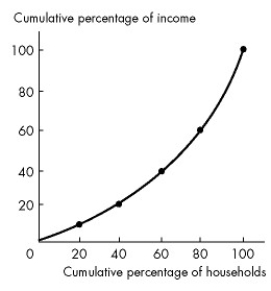
Figure 19.1.1
Refer to Figure 19.1.1. The middle 20 percent of households receive what share of total income?
A)20 percent
B)25 percent
C)35 percent
D)15 percent
E)60 percent
Figure 19.1.1
Refer to Figure 19.1.1. The middle 20 percent of households receive what share of total income?
A)20 percent
B)25 percent
C)35 percent
D)15 percent
E)60 percent
سؤال
سؤال
Use the figure below to answer the following questions.
Figure 19.1.1
Refer to Figure 19.1.1. The poorest 20 percent of households receive what share of total income?
A)40 percent
B)60 percent
C)20 percent
D)5 percent
E)10 percent
Figure 19.1.1
Refer to Figure 19.1.1. The poorest 20 percent of households receive what share of total income?
A)40 percent
B)60 percent
C)20 percent
D)5 percent
E)10 percent
سؤال
سؤال
Use the figure below to answer the following questions.
Figure 19.1.1
Refer to Figure 19.1.1. The richest 20 percent of households receive what share of total income?
A)10 percent
B)30 percent
C)40 percent
D)60 percent
E)100 percent
Figure 19.1.1
Refer to Figure 19.1.1. The richest 20 percent of households receive what share of total income?
A)10 percent
B)30 percent
C)40 percent
D)60 percent
E)100 percent
سؤال
سؤال
سؤال
سؤال
سؤال
سؤال
سؤال
سؤال
سؤال
سؤال
سؤال
سؤال
سؤال
سؤال
سؤال
سؤال
سؤال
سؤال
Use the figure below to answer the following questions.
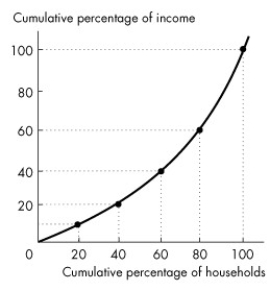
Figure 19.1.3
The curve in Figure 19.1.3 is the
A)line of fairness.
B)line of equality.
C)learning curve.
D)wage differential curve.
E)Lorenz curve.
Figure 19.1.3
The curve in Figure 19.1.3 is the
A)line of fairness.
B)line of equality.
C)learning curve.
D)wage differential curve.
E)Lorenz curve.
سؤال
Use the figure below to answer the following questions.
Figure 19.1.3
In Figure 19.1.3, the second poorest 20 percent of all families receive what share of income?
A)10 percent
B)20 percent
C)30 percent
D)40 percent
E)50 percent
Figure 19.1.3
In Figure 19.1.3, the second poorest 20 percent of all families receive what share of income?
A)10 percent
B)20 percent
C)30 percent
D)40 percent
E)50 percent
سؤال
Use the figure below to answer the following questions.
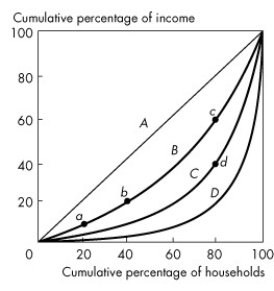
Figure 19.1.2
Consider the Lorenz curves in Figure 19.1.2. Which Lorenz curve corresponds to the greatest income inequality?
A)A
B)B
C)C
D)D
E)impossible to tell without additional information
Figure 19.1.2
Consider the Lorenz curves in Figure 19.1.2. Which Lorenz curve corresponds to the greatest income inequality?
A)A
B)B
C)C
D)D
E)impossible to tell without additional information
سؤال
سؤال
Use the figure below to answer the following questions.
Figure 19.1.3
In Figure 19.1.3, the poorest 20 percent of all families receive what share of income?
A)10 percent
B)20 percent
C)30 percent
D)40 percent
E)50 percent
Figure 19.1.3
In Figure 19.1.3, the poorest 20 percent of all families receive what share of income?
A)10 percent
B)20 percent
C)30 percent
D)40 percent
E)50 percent
سؤال
Use the figure below to answer the following questions.
Figure 19.1.3
In Figure 19.1.3, the richest 20 percent of all families receive what share of all income?
A)10 percent
B)20 percent
C)30 percent
D)40 percent
E)80 percent
Figure 19.1.3
In Figure 19.1.3, the richest 20 percent of all families receive what share of all income?
A)10 percent
B)20 percent
C)30 percent
D)40 percent
E)80 percent
سؤال
سؤال
سؤال
سؤال
سؤال
سؤال
Use the figure below to answer the following questions.
Figure 19.1.3
In Figure 19.1.3, the middle 20 percent of all families receive what share of income?
A)10 percent
B)20 percent
C)30 percent
D)40 percent
E)50 percent
Figure 19.1.3
In Figure 19.1.3, the middle 20 percent of all families receive what share of income?
A)10 percent
B)20 percent
C)30 percent
D)40 percent
E)50 percent
سؤال
Use the figure below to answer the following questions.
Figure 19.1.3
In Figure 19.1.3, the second richest 20 percent of all families receive what share of income?
A)10 percent
B)20 percent
C)30 percent
D)40 percent
E)50 percent
Figure 19.1.3
In Figure 19.1.3, the second richest 20 percent of all families receive what share of income?
A)10 percent
B)20 percent
C)30 percent
D)40 percent
E)50 percent
سؤال
سؤال
Use the figure below to answer the following questions.
Figure 19.1.2
Refer to Figure 19.1.2. What is curve A called?
A)market distribution line
B)line of equality
C)fairness line
D)low-income cut-off line
E)after-tax income
Figure 19.1.2
Refer to Figure 19.1.2. What is curve A called?
A)market distribution line
B)line of equality
C)fairness line
D)low-income cut-off line
E)after-tax income
سؤال
سؤال
سؤال
سؤال
سؤال
سؤال
سؤال
سؤال
سؤال
سؤال
سؤال
سؤال
سؤال
Use the figure below to answer the following questions.
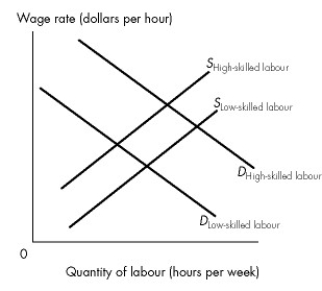
Figure 19.3.1
Refer to Figure 19.3.1. At any given employment level, the vertical distance between the demand curves of the high-skilled and low-skilled workers
A)is equal to the difference in the value of marginal product of the workers.
B)is equal to the difference in the work ethic of the workers.
C)is caused by discrimination against minorities.
D)is caused by discrimination against women.
E)equals the cost of acquiring the skills.
Figure 19.3.1
Refer to Figure 19.3.1. At any given employment level, the vertical distance between the demand curves of the high-skilled and low-skilled workers
A)is equal to the difference in the value of marginal product of the workers.
B)is equal to the difference in the work ethic of the workers.
C)is caused by discrimination against minorities.
D)is caused by discrimination against women.
E)equals the cost of acquiring the skills.
سؤال
سؤال
سؤال
سؤال
سؤال
Use the figure below to answer the following questions.
Figure 19.3.1
Refer to Figure 19.3.1. For any given quantity of labour employed,
A)the elasticity of demand for high-skilled labourers is less than the elasticity of demand for low-skilled labourers.
B)high-skilled labourers will receive a lower wage than low-skilled labourers.
C)high-skilled labourers will receive a greater wage than low-skilled labourers.
D)the vertical distance between the two demand curves is the compensation for the cost of acquiring the skill.
E)the vertical distance between the two curves is the present value of human capital.
Figure 19.3.1
Refer to Figure 19.3.1. For any given quantity of labour employed,
A)the elasticity of demand for high-skilled labourers is less than the elasticity of demand for low-skilled labourers.
B)high-skilled labourers will receive a lower wage than low-skilled labourers.
C)high-skilled labourers will receive a greater wage than low-skilled labourers.
D)the vertical distance between the two demand curves is the compensation for the cost of acquiring the skill.
E)the vertical distance between the two curves is the present value of human capital.
سؤال
سؤال
سؤال
سؤال
Use the figure below to answer the following questions.
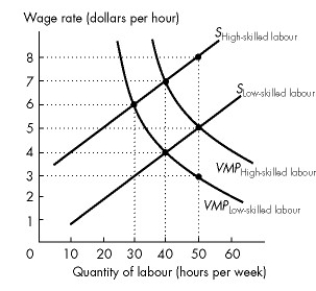
Figure 19.3.5
Refer to Figure 19.3.5. This figure shows the labour supply curves and the value of marginal product curves for high-skilled and low-skilled workers. If there is an increase in the supply of high-skilled workers and the supply of high-skilled workers is now equal to the supply of low-skilled workers, then employment of high-skilled labour would
A)remain the same.
B)decrease.
C)increase to 40 hours per week.
D)increase to 50 hours per week.
E)none of the above
Figure 19.3.5
Refer to Figure 19.3.5. This figure shows the labour supply curves and the value of marginal product curves for high-skilled and low-skilled workers. If there is an increase in the supply of high-skilled workers and the supply of high-skilled workers is now equal to the supply of low-skilled workers, then employment of high-skilled labour would
A)remain the same.
B)decrease.
C)increase to 40 hours per week.
D)increase to 50 hours per week.
E)none of the above
سؤال
Use the figure below to answer the following questions.
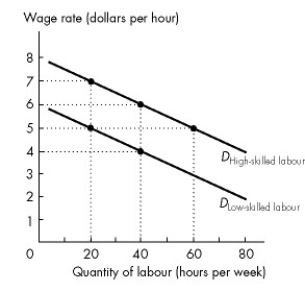
Figure 19.3.2
Refer to Figure 19.3.2. For the employer to hire 40 hours per week of both high-skilled and low-skilled labour,
A)high-skilled workers would have to earn a wage rate that is twice that of the low-skilled workers.
B)high-skilled workers would have to earn a wage rate that is less than that of the low-skilled workers.
C)high-skilled workers would have to earn a wage that is $2 more than the wage paid to low-skilled workers.
D)low-skilled workers would have to earn a wage that is $2 more than the wage paid to high-skilled workers.
E)high-skilled workers need to earn a wage that is between zero and $2 more than low-skilled workers.
Figure 19.3.2
Refer to Figure 19.3.2. For the employer to hire 40 hours per week of both high-skilled and low-skilled labour,
A)high-skilled workers would have to earn a wage rate that is twice that of the low-skilled workers.
B)high-skilled workers would have to earn a wage rate that is less than that of the low-skilled workers.
C)high-skilled workers would have to earn a wage that is $2 more than the wage paid to low-skilled workers.
D)low-skilled workers would have to earn a wage that is $2 more than the wage paid to high-skilled workers.
E)high-skilled workers need to earn a wage that is between zero and $2 more than low-skilled workers.
سؤال
سؤال
سؤال
سؤال
سؤال
Use the figure below to answer the following questions.
Figure 19.3.5
Refer to Figure 19.3.5. This figure shows the labour supply curves and the value of marginal product curves for high-skilled and low-skilled workers. The equilibrium wage rate for low-skilled workers is
A)$3 an hour.
B)$7 an hour.
C)$6 an hour.
D)$5 an hour.
E)$4 an hour.
Figure 19.3.5
Refer to Figure 19.3.5. This figure shows the labour supply curves and the value of marginal product curves for high-skilled and low-skilled workers. The equilibrium wage rate for low-skilled workers is
A)$3 an hour.
B)$7 an hour.
C)$6 an hour.
D)$5 an hour.
E)$4 an hour.
سؤال
سؤال
Use the figure below to answer the following question.
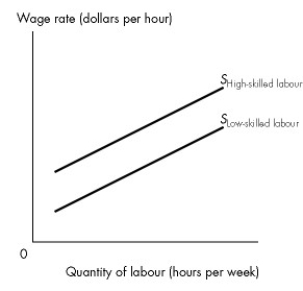
Figure 19.3.3
Refer to Figure 19.3.3. At any given level of employment for high-skilled and low-skilled workers, the vertical distance between the two supply curves
A)disappears if there is free entry into the skill market.
B)disappears if there is equal pay for work of equal value.
C)is created by discrimination against low-skilled workers.
D)is the compensation required for the cost of acquiring human capital.
E)equals the value of marginal product of skill.
Figure 19.3.3
Refer to Figure 19.3.3. At any given level of employment for high-skilled and low-skilled workers, the vertical distance between the two supply curves
A)disappears if there is free entry into the skill market.
B)disappears if there is equal pay for work of equal value.
C)is created by discrimination against low-skilled workers.
D)is the compensation required for the cost of acquiring human capital.
E)equals the value of marginal product of skill.
سؤال
سؤال
سؤال
Use the figure below to answer the following questions.
Figure 19.3.5
Refer to Figure 19.3.5. This figure shows the labour supply curves and the value of marginal product curves for high-skilled and low-skilled workers. The equilibrium wage rate for high-skilled workers is
A)$5 an hour.
B)$4 an hour.
C)$6 an hour.
D)$8 an hour.
E)$7 an hour.
Figure 19.3.5
Refer to Figure 19.3.5. This figure shows the labour supply curves and the value of marginal product curves for high-skilled and low-skilled workers. The equilibrium wage rate for high-skilled workers is
A)$5 an hour.
B)$4 an hour.
C)$6 an hour.
D)$8 an hour.
E)$7 an hour.
سؤال
Use the figure below to answer the following questions.
Figure 19.3.2
Refer to Figure 19.3.2. At an employment level of 40 hours per week, the difference in the value of marginal product of high-skilled workers and low-skilled workers is
A)$0.
B)$2 an hour.
C)$6 an hour.
D)$4 an hour.
E)$3 an hour.
Figure 19.3.2
Refer to Figure 19.3.2. At an employment level of 40 hours per week, the difference in the value of marginal product of high-skilled workers and low-skilled workers is
A)$0.
B)$2 an hour.
C)$6 an hour.
D)$4 an hour.
E)$3 an hour.
سؤال
Use the figure below to answer the following questions.
Figure 19.3.2
Refer to Figure 19.3.2. At a wage rate of $5, an employer would hire
A)the same amount of high-skilled workers and low-skilled workers.
B)20 hours of low-skilled labour and 40 hours of high-skilled labour.
C)60 hours of low-skilled labour and 20 hours of high-skilled labour.
D)20 hours of low-skilled labour and 60 hours of high-skilled labour.
E)40 hours of low-skilled labour and 60 hours of high-skilled labour.
Figure 19.3.2
Refer to Figure 19.3.2. At a wage rate of $5, an employer would hire
A)the same amount of high-skilled workers and low-skilled workers.
B)20 hours of low-skilled labour and 40 hours of high-skilled labour.
C)60 hours of low-skilled labour and 20 hours of high-skilled labour.
D)20 hours of low-skilled labour and 60 hours of high-skilled labour.
E)40 hours of low-skilled labour and 60 hours of high-skilled labour.
سؤال
Use the figure below to answer the following question.
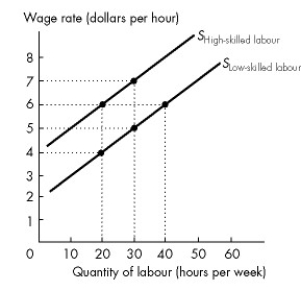
Figure 19.3.4
Refer to Figure 19.3.4. At an employment level of 30 hours per week, the compensation required for the cost of acquiring human capital is
A)$0.
B)$2 an hour.
C)$4 an hour.
D)$6 an hour.
E)cannot be determined without knowing the demand for labour.
Figure 19.3.4
Refer to Figure 19.3.4. At an employment level of 30 hours per week, the compensation required for the cost of acquiring human capital is
A)$0.
B)$2 an hour.
C)$4 an hour.
D)$6 an hour.
E)cannot be determined without knowing the demand for labour.
سؤال
سؤال
سؤال
Use the figure below to answer the following questions.
Figure 19.3.5
Refer to Figure 19.3.5. This figure shows the labour supply curves and the value of marginal product curves for high-skilled and low-skilled workers. If there is an increase in the supply of high-skilled workers and the supply of high-skilled workers is now equal to the supply of low-skilled workers, then
A)wages paid to high-skilled workers would fall to $4 an hour.
B)wages paid to high-skilled workers would fall to $5 an hour.
C)wages paid to high-skilled workers would fall to $6 an hour.
D)there would be no change in the wages of high-skilled workers, because high-skilled workers always earn more than low-skilled workers.
E)there would be no change in the wages of high-skilled workers, because their value of marginal product is unchanged.
Figure 19.3.5
Refer to Figure 19.3.5. This figure shows the labour supply curves and the value of marginal product curves for high-skilled and low-skilled workers. If there is an increase in the supply of high-skilled workers and the supply of high-skilled workers is now equal to the supply of low-skilled workers, then
A)wages paid to high-skilled workers would fall to $4 an hour.
B)wages paid to high-skilled workers would fall to $5 an hour.
C)wages paid to high-skilled workers would fall to $6 an hour.
D)there would be no change in the wages of high-skilled workers, because high-skilled workers always earn more than low-skilled workers.
E)there would be no change in the wages of high-skilled workers, because their value of marginal product is unchanged.
سؤال
Use the figure below to answer the following questions.
Figure 19.3.5
Refer to Figure 19.3.5. This figure shows the labour supply curves and the value of marginal product curves for high-skilled and low-skilled workers. If the labour markets are competitive, then for a 40-hour work week, high-skilled workers must be paid
A)an extra $3 to compensate for the cost of acquiring their human capital and for their increased productivity.
B)an extra $20 to compensate for the cost of acquiring their human capital and for their increased productivity.
C)an extra $120 to compensate for the cost of acquiring their human capital and for their increased productivity.
D)an extra $300 to compensate for the cost of acquiring their human capital and for their enhanced productivity.
E)an extra $180 to compensate for the cost of acquiring their human capital and for their increased productivity.
Figure 19.3.5
Refer to Figure 19.3.5. This figure shows the labour supply curves and the value of marginal product curves for high-skilled and low-skilled workers. If the labour markets are competitive, then for a 40-hour work week, high-skilled workers must be paid
A)an extra $3 to compensate for the cost of acquiring their human capital and for their increased productivity.
B)an extra $20 to compensate for the cost of acquiring their human capital and for their increased productivity.
C)an extra $120 to compensate for the cost of acquiring their human capital and for their increased productivity.
D)an extra $300 to compensate for the cost of acquiring their human capital and for their enhanced productivity.
E)an extra $180 to compensate for the cost of acquiring their human capital and for their increased productivity.
سؤال
Use the figure below to answer the following questions.
Figure 19.3.2
Refer to Figure 19.3.2. At an employment level of 20 hours per week, firms are willing to pay
A)a wage rate of $7 an hour to low-skilled workers.
B)a maximum of $5 an hour to high-skilled workers.
C)up to $7 an hour for high-skilled workers.
D)the same for high-skilled workers as for low-skilled workers.
E)$3 an hour more for high-skilled workers.
Figure 19.3.2
Refer to Figure 19.3.2. At an employment level of 20 hours per week, firms are willing to pay
A)a wage rate of $7 an hour to low-skilled workers.
B)a maximum of $5 an hour to high-skilled workers.
C)up to $7 an hour for high-skilled workers.
D)the same for high-skilled workers as for low-skilled workers.
E)$3 an hour more for high-skilled workers.

فتح الحزمة
قم بالتسجيل لفتح البطاقات في هذه المجموعة!
Unlock Deck
Unlock Deck
1/124

العب

ملء الشاشة (f)
Deck 19: Economic Inequality
1
Which of the following does Statistics Canada use to provide measures of economic inequality?
A)market income only
B)market income and after-tax income only
C)after-tax income only
D)total market and after-tax income only
E)market income, total income, and after-tax income
A)market income only
B)market income and after-tax income only
C)after-tax income only
D)total market and after-tax income only
E)market income, total income, and after-tax income
market income, total income, and after-tax income
2
In 2011, the median household income in Canada was
A)$5,000.
B)$25,000.
C)$50,700.
D)$59,700.
E)$63,000.
A)$5,000.
B)$25,000.
C)$50,700.
D)$59,700.
E)$63,000.
$50,700.
3
Use the figure below to answer the following questions.
Figure 19.1.1
Refer to Figure 19.1.1. The middle 20 percent of households receive what share of total income?
A)20 percent
B)25 percent
C)35 percent
D)15 percent
E)60 percent
Figure 19.1.1
Refer to Figure 19.1.1. The middle 20 percent of households receive what share of total income?
A)20 percent
B)25 percent
C)35 percent
D)15 percent
E)60 percent
20 percent
4
In 2011, what percentage of households received the mode income in Canada?
A)5 percent
B)6 percent
C)7 percent
D)17.4 percent
E)20 percent
A)5 percent
B)6 percent
C)7 percent
D)17.4 percent
E)20 percent
فتح الحزمة
افتح القفل للوصول البطاقات البالغ عددها 124 في هذه المجموعة.
فتح الحزمة
k this deck
5
Use the figure below to answer the following questions.
Figure 19.1.1
Refer to Figure 19.1.1. The poorest 20 percent of households receive what share of total income?
A)40 percent
B)60 percent
C)20 percent
D)5 percent
E)10 percent
Figure 19.1.1
Refer to Figure 19.1.1. The poorest 20 percent of households receive what share of total income?
A)40 percent
B)60 percent
C)20 percent
D)5 percent
E)10 percent
فتح الحزمة
افتح القفل للوصول البطاقات البالغ عددها 124 في هذه المجموعة.
فتح الحزمة
k this deck
6
In 2011, the mode income received by 6.0 percent of households in Canada was between
A)$18,500 and $21,999.
B)$15,000 and $19,999.
C)$30,000 and $34,999.
D)$16,000 and $22,500.
E)$18,000 and $24,999.
A)$18,500 and $21,999.
B)$15,000 and $19,999.
C)$30,000 and $34,999.
D)$16,000 and $22,500.
E)$18,000 and $24,999.
فتح الحزمة
افتح القفل للوصول البطاقات البالغ عددها 124 في هذه المجموعة.
فتح الحزمة
k this deck
7
Use the figure below to answer the following questions.
Figure 19.1.1
Refer to Figure 19.1.1. The richest 20 percent of households receive what share of total income?
A)10 percent
B)30 percent
C)40 percent
D)60 percent
E)100 percent
Figure 19.1.1
Refer to Figure 19.1.1. The richest 20 percent of households receive what share of total income?
A)10 percent
B)30 percent
C)40 percent
D)60 percent
E)100 percent
فتح الحزمة
افتح القفل للوصول البطاقات البالغ عددها 124 في هذه المجموعة.
فتح الحزمة
k this deck
8
In 2011, the middle 20 percent of households received what percentage of total Canadian after-tax income?
A)10.6 percent
B)16.3 percent
C)25 percent
D)43 percent
E)52 percent
A)10.6 percent
B)16.3 percent
C)25 percent
D)43 percent
E)52 percent
فتح الحزمة
افتح القفل للوصول البطاقات البالغ عددها 124 في هذه المجموعة.
فتح الحزمة
k this deck
9
In 2011, the 20 percent of households with the highest incomes received what percentage of the total after-tax income?
A)14 percent
B)2 percent
C)71 percent
D)44.2 percent
E)55.8 percent
A)14 percent
B)2 percent
C)71 percent
D)44.2 percent
E)55.8 percent
فتح الحزمة
افتح القفل للوصول البطاقات البالغ عددها 124 في هذه المجموعة.
فتح الحزمة
k this deck
10
The closer the Lorenz curve is to the line of equality,
A)the more equal is the distribution.
B)the less equal is the distribution.
C)the more unfair is the income distribution.
D)the richer are the highest 5 percent of households.
E)the poorer are the highest 5 percent of households.
A)the more equal is the distribution.
B)the less equal is the distribution.
C)the more unfair is the income distribution.
D)the richer are the highest 5 percent of households.
E)the poorer are the highest 5 percent of households.
فتح الحزمة
افتح القفل للوصول البطاقات البالغ عددها 124 في هذه المجموعة.
فتح الحزمة
k this deck
11
If each household made the same amount of income, then the Lorenz curve would be
A)not defined, because it measures income inequality not income equality.
B)the line of poverty.
C)the line of equality.
D)a right angle.
E)horizontal.
A)not defined, because it measures income inequality not income equality.
B)the line of poverty.
C)the line of equality.
D)a right angle.
E)horizontal.
فتح الحزمة
افتح القفل للوصول البطاقات البالغ عددها 124 في هذه المجموعة.
فتح الحزمة
k this deck
12
After-tax income equals
A)total income minus tax payments by households to governments.
B)total income minus tax payments by households to firms.
C)total income plus tax payments by households to governments.
D)market income plus cash payments to households by governments.
E)market income minus tax payments by households to governments.
A)total income minus tax payments by households to governments.
B)total income minus tax payments by households to firms.
C)total income plus tax payments by households to governments.
D)market income plus cash payments to households by governments.
E)market income minus tax payments by households to governments.
فتح الحزمة
افتح القفل للوصول البطاقات البالغ عددها 124 في هذه المجموعة.
فتح الحزمة
k this deck
13
Household characteristics that stand out when determining the incidence of poverty include all of the following except
A)household type.
B)education.
C)age of householder.
D)ethnic background.
E)number of children.
A)household type.
B)education.
C)age of householder.
D)ethnic background.
E)number of children.
فتح الحزمة
افتح القفل للوصول البطاقات البالغ عددها 124 في هذه المجموعة.
فتح الحزمة
k this deck
14
An income Lorenz curve
A)graphs the cumulative percentage of income against the cumulative percentage of households.
B)measures the income among households ranked from the poorest to the richest.
C)measures the income among households ranked from the richest to the poorest.
D)measures the factor prices earned by the rich compared with the poor.
E)is a downward-sloping curve.
A)graphs the cumulative percentage of income against the cumulative percentage of households.
B)measures the income among households ranked from the poorest to the richest.
C)measures the income among households ranked from the richest to the poorest.
D)measures the factor prices earned by the rich compared with the poor.
E)is a downward-sloping curve.
فتح الحزمة
افتح القفل للوصول البطاقات البالغ عددها 124 في هذه المجموعة.
فتح الحزمة
k this deck
15
Market income equals
A)the wages, interest, rent, and profit earned in factor markets after paying income taxes.
B)the wages, interest, and profit earned in factor markets before paying income taxes.
C)the wages, interest, and rent earned in factor markets before paying income taxes.
D)the wages, interest, rent, and profit earned in factor markets before paying income taxes.
E)the wages, rent, and profit earned in factor markets before paying income taxes.
A)the wages, interest, rent, and profit earned in factor markets after paying income taxes.
B)the wages, interest, and profit earned in factor markets before paying income taxes.
C)the wages, interest, and rent earned in factor markets before paying income taxes.
D)the wages, interest, rent, and profit earned in factor markets before paying income taxes.
E)the wages, rent, and profit earned in factor markets before paying income taxes.
فتح الحزمة
افتح القفل للوصول البطاقات البالغ عددها 124 في هذه المجموعة.
فتح الحزمة
k this deck
16
The larger the gap between the Lorenz curve and the line of equality,
A)the greater is the equality in the income distribution.
B)the less is the inequality in the income distribution.
C)the poorer are the top 50 percent of households.
D)the richer are the lowest 50 percent of households.
E)the greater is the inequality in the income distribution.
A)the greater is the equality in the income distribution.
B)the less is the inequality in the income distribution.
C)the poorer are the top 50 percent of households.
D)the richer are the lowest 50 percent of households.
E)the greater is the inequality in the income distribution.
فتح الحزمة
افتح القفل للوصول البطاقات البالغ عددها 124 في هذه المجموعة.
فتح الحزمة
k this deck
17
A Lorenz curve illustrates the distribution of income by graphing the
A)cumulative percentage of income received and the cumulative percentage of households.
B)chance of a family earning a specific income.
C)wealth earned by a cumulative percentage of households.
D)cumulative frequency of specific incomes.
E)percentage change in income for a percentage change in population.
A)cumulative percentage of income received and the cumulative percentage of households.
B)chance of a family earning a specific income.
C)wealth earned by a cumulative percentage of households.
D)cumulative frequency of specific incomes.
E)percentage change in income for a percentage change in population.
فتح الحزمة
افتح القفل للوصول البطاقات البالغ عددها 124 في هذه المجموعة.
فتح الحزمة
k this deck
18
In 2011, the poorest 20 percent of households received what percentage of the nation's after-tax income?
A)10.6 percent
B)4.8 percent
C)24.1 percent
D)16.3 percent
E)17.4 percent
A)10.6 percent
B)4.8 percent
C)24.1 percent
D)16.3 percent
E)17.4 percent
فتح الحزمة
افتح القفل للوصول البطاقات البالغ عددها 124 في هذه المجموعة.
فتح الحزمة
k this deck
19
In 2011, the mean household income in Canada was
A)$63,000.
B)$50,700.
C)$25,000.
D)$48,300.
E)$65,000.
A)$63,000.
B)$50,700.
C)$25,000.
D)$48,300.
E)$65,000.
فتح الحزمة
افتح القفل للوصول البطاقات البالغ عددها 124 في هذه المجموعة.
فتح الحزمة
k this deck
20
Total income equals
A)market income minus payments to firms by governments.
B)market income plus cash payments to households by governments.
C)the wages, interest, rent, and profit earned in factor markets before paying income taxes.
D)the wages, interest, rent, and profit earned in factor markets after paying income taxes.
E)market income minus cash payments to households by governments.
A)market income minus payments to firms by governments.
B)market income plus cash payments to households by governments.
C)the wages, interest, rent, and profit earned in factor markets before paying income taxes.
D)the wages, interest, rent, and profit earned in factor markets after paying income taxes.
E)market income minus cash payments to households by governments.
فتح الحزمة
افتح القفل للوصول البطاقات البالغ عددها 124 في هذه المجموعة.
فتح الحزمة
k this deck
21
The wealthiest 10 percent of Canadian families own approximately
A)10 percent of the wealth.
B)17 percent of the wealth.
C)56 percent of the wealth.
D)67 percent of the wealth.
E)80 percent of the wealth.
A)10 percent of the wealth.
B)17 percent of the wealth.
C)56 percent of the wealth.
D)67 percent of the wealth.
E)80 percent of the wealth.
فتح الحزمة
افتح القفل للوصول البطاقات البالغ عددها 124 في هذه المجموعة.
فتح الحزمة
k this deck
22
From an examination of data on income and wealth, it can be concluded that
A)wealth distribution is more equal than income distribution.
B)income distribution is more equal than wealth distribution.
C)wealth distribution is equal to income distribution.
D)income and wealth are the same.
E)income and wealth are unrelated.
A)wealth distribution is more equal than income distribution.
B)income distribution is more equal than wealth distribution.
C)wealth distribution is equal to income distribution.
D)income and wealth are the same.
E)income and wealth are unrelated.
فتح الحزمة
افتح القفل للوصول البطاقات البالغ عددها 124 في هذه المجموعة.
فتح الحزمة
k this deck
23
Consider the Lorenz curves in Figure 19.1.2. Which point indicates that the poorest 20 percent of families earn 9 percent of the income?
A)a
B)b
C)c
D)d
E)the origin
A)a
B)b
C)c
D)d
E)the origin
فتح الحزمة
افتح القفل للوصول البطاقات البالغ عددها 124 في هذه المجموعة.
فتح الحزمة
k this deck
24
In Canada, the low-income cut-off level for a family is when ________ or more of income is spent on food, shelter, and clothing.
A)33.6 percent
B)43.6 percent
C)53.6 percent
D)63.6 percent
E)73.6 percent
A)33.6 percent
B)43.6 percent
C)53.6 percent
D)63.6 percent
E)73.6 percent
فتح الحزمة
افتح القفل للوصول البطاقات البالغ عددها 124 في هذه المجموعة.
فتح الحزمة
k this deck
25
Use the figure below to answer the following questions.
Figure 19.1.3
The curve in Figure 19.1.3 is the
A)line of fairness.
B)line of equality.
C)learning curve.
D)wage differential curve.
E)Lorenz curve.
Figure 19.1.3
The curve in Figure 19.1.3 is the
A)line of fairness.
B)line of equality.
C)learning curve.
D)wage differential curve.
E)Lorenz curve.
فتح الحزمة
افتح القفل للوصول البطاقات البالغ عددها 124 في هذه المجموعة.
فتح الحزمة
k this deck
26
Use the figure below to answer the following questions.
Figure 19.1.3
In Figure 19.1.3, the second poorest 20 percent of all families receive what share of income?
A)10 percent
B)20 percent
C)30 percent
D)40 percent
E)50 percent
Figure 19.1.3
In Figure 19.1.3, the second poorest 20 percent of all families receive what share of income?
A)10 percent
B)20 percent
C)30 percent
D)40 percent
E)50 percent
فتح الحزمة
افتح القفل للوصول البطاقات البالغ عددها 124 في هذه المجموعة.
فتح الحزمة
k this deck
27
Use the figure below to answer the following questions.
Figure 19.1.2
Consider the Lorenz curves in Figure 19.1.2. Which Lorenz curve corresponds to the greatest income inequality?
A)A
B)B
C)C
D)D
E)impossible to tell without additional information
Figure 19.1.2
Consider the Lorenz curves in Figure 19.1.2. Which Lorenz curve corresponds to the greatest income inequality?
A)A
B)B
C)C
D)D
E)impossible to tell without additional information
فتح الحزمة
افتح القفل للوصول البطاقات البالغ عددها 124 في هذه المجموعة.
فتح الحزمة
k this deck
28
Which diagram is used by economists to illustrate the distribution of income or wealth?
A)Lorenz curve
B)normal bell-shaped distribution
C)wage differential curve
D)low-income cut-off curve
E)marginal revenue product diagram
A)Lorenz curve
B)normal bell-shaped distribution
C)wage differential curve
D)low-income cut-off curve
E)marginal revenue product diagram
فتح الحزمة
افتح القفل للوصول البطاقات البالغ عددها 124 في هذه المجموعة.
فتح الحزمة
k this deck
29
Use the figure below to answer the following questions.
Figure 19.1.3
In Figure 19.1.3, the poorest 20 percent of all families receive what share of income?
A)10 percent
B)20 percent
C)30 percent
D)40 percent
E)50 percent
Figure 19.1.3
In Figure 19.1.3, the poorest 20 percent of all families receive what share of income?
A)10 percent
B)20 percent
C)30 percent
D)40 percent
E)50 percent
فتح الحزمة
افتح القفل للوصول البطاقات البالغ عددها 124 في هذه المجموعة.
فتح الحزمة
k this deck
30
Use the figure below to answer the following questions.
Figure 19.1.3
In Figure 19.1.3, the richest 20 percent of all families receive what share of all income?
A)10 percent
B)20 percent
C)30 percent
D)40 percent
E)80 percent
Figure 19.1.3
In Figure 19.1.3, the richest 20 percent of all families receive what share of all income?
A)10 percent
B)20 percent
C)30 percent
D)40 percent
E)80 percent
فتح الحزمة
افتح القفل للوصول البطاقات البالغ عددها 124 في هذه المجموعة.
فتح الحزمة
k this deck
31
Which point in Figure 19.1.2 indicates that the richest 20 percent of families earn 40 percent of the income?
A)a
B)b
C)c
D)d
E)the origin
A)a
B)b
C)c
D)d
E)the origin
فتح الحزمة
افتح القفل للوصول البطاقات البالغ عددها 124 في هذه المجموعة.
فتح الحزمة
k this deck
32
The distribution of annual income
A)understates the degree of inequality because it does not take into account the family's stage in its life cycle.
B)understates the degree of inequality because it does not take into account the distribution of human capital.
C)overstates the degree of inequality because it does not take into account the family's stage in its life cycle.
D)overstates the degree of inequality because it does not take into account the distribution of human capital.
E)is an accurate measure of the degree of inequality.
A)understates the degree of inequality because it does not take into account the family's stage in its life cycle.
B)understates the degree of inequality because it does not take into account the distribution of human capital.
C)overstates the degree of inequality because it does not take into account the family's stage in its life cycle.
D)overstates the degree of inequality because it does not take into account the distribution of human capital.
E)is an accurate measure of the degree of inequality.
فتح الحزمة
افتح القفل للوصول البطاقات البالغ عددها 124 في هذه المجموعة.
فتح الحزمة
k this deck
33
The inequality in the distribution of wealth is
A)less than the inequality in the distribution of income.
B)decreased by the existence of assortative mating.
C)a better measure of the inequality in the distribution of economic resources than is the inequality in the distribution of income.
D)shown by a Lorenz curve that is farther away from the line of equality than the Lorenz curve for income.
E)the result of an increasing Gini coefficient.
A)less than the inequality in the distribution of income.
B)decreased by the existence of assortative mating.
C)a better measure of the inequality in the distribution of economic resources than is the inequality in the distribution of income.
D)shown by a Lorenz curve that is farther away from the line of equality than the Lorenz curve for income.
E)the result of an increasing Gini coefficient.
فتح الحزمة
افتح القفل للوصول البطاقات البالغ عددها 124 في هذه المجموعة.
فتح الحزمة
k this deck
34
Consider the Lorenz curves in Figure 19.1.2. Which point indicates that the richest 20 percent of families earn 60 percent of the income?
A)a
B)b
C)c
D)d
E)the origin
A)a
B)b
C)c
D)d
E)the origin
فتح الحزمة
افتح القفل للوصول البطاقات البالغ عددها 124 في هذه المجموعة.
فتح الحزمة
k this deck
35
The Gini coefficient for a perfectly equal distribution of income is
A)equal to zero.
B)equal to 1.
C)equal to 100.
D)equal to infinity.
E)negative.
A)equal to zero.
B)equal to 1.
C)equal to 100.
D)equal to infinity.
E)negative.
فتح الحزمة
افتح القفل للوصول البطاقات البالغ عددها 124 في هذه المجموعة.
فتح الحزمة
k this deck
36
Use the figure below to answer the following questions.
Figure 19.1.3
In Figure 19.1.3, the middle 20 percent of all families receive what share of income?
A)10 percent
B)20 percent
C)30 percent
D)40 percent
E)50 percent
Figure 19.1.3
In Figure 19.1.3, the middle 20 percent of all families receive what share of income?
A)10 percent
B)20 percent
C)30 percent
D)40 percent
E)50 percent
فتح الحزمة
افتح القفل للوصول البطاقات البالغ عددها 124 في هذه المجموعة.
فتح الحزمة
k this deck
37
Use the figure below to answer the following questions.
Figure 19.1.3
In Figure 19.1.3, the second richest 20 percent of all families receive what share of income?
A)10 percent
B)20 percent
C)30 percent
D)40 percent
E)50 percent
Figure 19.1.3
In Figure 19.1.3, the second richest 20 percent of all families receive what share of income?
A)10 percent
B)20 percent
C)30 percent
D)40 percent
E)50 percent
فتح الحزمة
افتح القفل للوصول البطاقات البالغ عددها 124 في هذه المجموعة.
فتح الحزمة
k this deck
38
The low-income cutoff level is
A)a level of housing and food provided by the government.
B)a fixed real income used to determine whether or not a household may qualify for welfare.
C)the income level below which a family normally spends 73.6 percent or more of its income on food, shelter, and clothing.
D)the income level below which a family normally spends 63.6 percent or more of its income on food, shelter, and clothing.
E)a level of income below which starvation occurs.
A)a level of housing and food provided by the government.
B)a fixed real income used to determine whether or not a household may qualify for welfare.
C)the income level below which a family normally spends 73.6 percent or more of its income on food, shelter, and clothing.
D)the income level below which a family normally spends 63.6 percent or more of its income on food, shelter, and clothing.
E)a level of income below which starvation occurs.
فتح الحزمة
افتح القفل للوصول البطاقات البالغ عددها 124 في هذه المجموعة.
فتح الحزمة
k this deck
39
Use the figure below to answer the following questions.
Figure 19.1.2
Refer to Figure 19.1.2. What is curve A called?
A)market distribution line
B)line of equality
C)fairness line
D)low-income cut-off line
E)after-tax income
Figure 19.1.2
Refer to Figure 19.1.2. What is curve A called?
A)market distribution line
B)line of equality
C)fairness line
D)low-income cut-off line
E)after-tax income
فتح الحزمة
افتح القفل للوصول البطاقات البالغ عددها 124 في هذه المجموعة.
فتح الحزمة
k this deck
40
Poverty is
A)an income below the national average income level.
B)an income below the national median income level.
C)a state in which a family's income is too low to be able to buy the quantities of food, shelter, and clothing that are deemed necessary.
D)the income earned by the poorest 20 percent of households.
E)a state in which a family spends more than 50 percent of its income on food, shelter, and clothing.
A)an income below the national average income level.
B)an income below the national median income level.
C)a state in which a family's income is too low to be able to buy the quantities of food, shelter, and clothing that are deemed necessary.
D)the income earned by the poorest 20 percent of households.
E)a state in which a family spends more than 50 percent of its income on food, shelter, and clothing.
فتح الحزمة
افتح القفل للوصول البطاقات البالغ عددها 124 في هذه المجموعة.
فتح الحزمة
k this deck
41
The world distribution of income has become more equal since 1970 because
A)average incomes in poorer countries are rising much faster than average incomes in rich countries.
B)the distribution of income within most countries has become more equal.
C)foreign aid programs from rich nations have increased in size and especially in effectiveness.
D)technology is used similarly in all countries.
E)the world population is increasing.
A)average incomes in poorer countries are rising much faster than average incomes in rich countries.
B)the distribution of income within most countries has become more equal.
C)foreign aid programs from rich nations have increased in size and especially in effectiveness.
D)technology is used similarly in all countries.
E)the world population is increasing.
فتح الحزمة
افتح القفل للوصول البطاقات البالغ عددها 124 في هذه المجموعة.
فتح الحزمة
k this deck
42
The distribution of world income is ________ the distribution of Canadian income.
A)more equal than
B)equal to
C)not comparable to
D)equal to the distribution of Canadian wealth and more equal than
E)less equal than
A)more equal than
B)equal to
C)not comparable to
D)equal to the distribution of Canadian wealth and more equal than
E)less equal than
فتح الحزمة
افتح القفل للوصول البطاقات البالغ عددها 124 في هذه المجموعة.
فتح الحزمة
k this deck
43
If the supply of labour curve is upward sloping but not vertical, and if the value of marginal product of labour increases,
A)the supply of labour increases.
B)the wage rate rises.
C)the marginal cost of production increases.
D)the exploitation of workers decreases.
E)employment is unchanged.
A)the supply of labour increases.
B)the wage rate rises.
C)the marginal cost of production increases.
D)the exploitation of workers decreases.
E)employment is unchanged.
فتح الحزمة
افتح القفل للوصول البطاقات البالغ عددها 124 في هذه المجموعة.
فتح الحزمة
k this deck
44
Between 1970 and 2005, the world Gini ratio ________ indicating ________ in the world distribution of income.
A)fell; greater equality
B)fell; greater inequality
C)did not change; no change
D)rose; greater equality
E)rose; greater inequality
A)fell; greater equality
B)fell; greater inequality
C)did not change; no change
D)rose; greater equality
E)rose; greater inequality
فتح الحزمة
افتح القفل للوصول البطاقات البالغ عددها 124 في هذه المجموعة.
فتح الحزمة
k this deck
45
If the area between the line of equality and the Lorenz curve is 1,250 and the entire area beneath the line of equality is 5,000, the Gini ratio is
A)1,250.
B)0.80.
C)0.25.
D)0.33.
E)4.00.
A)1,250.
B)0.80.
C)0.25.
D)0.33.
E)4.00.
فتح الحزمة
افتح القفل للوصول البطاقات البالغ عددها 124 في هذه المجموعة.
فتح الحزمة
k this deck
46
The distribution of wealth
A)understates the degree of inequality because it does not take into account the family's stage in its life cycle.
B)understates the degree of inequality because it does not take into account the distribution of human capital.
C)overstates the degree of inequality because it does not take into account the family's stage in its life cycle.
D)overstates the degree of inequality because it does not take into account the distribution of human capital.
E)is an accurate measure of the degree of inequality.
A)understates the degree of inequality because it does not take into account the family's stage in its life cycle.
B)understates the degree of inequality because it does not take into account the distribution of human capital.
C)overstates the degree of inequality because it does not take into account the family's stage in its life cycle.
D)overstates the degree of inequality because it does not take into account the distribution of human capital.
E)is an accurate measure of the degree of inequality.
فتح الحزمة
افتح القفل للوصول البطاقات البالغ عددها 124 في هذه المجموعة.
فتح الحزمة
k this deck
47
Incomes in China and India are a small fraction of incomes in Canada. But incomes in China and India are growing at more than twice the rate of those in Canada. As a result, the inequality in income between the people in China and India and people in Canada is ________ and the world Gini ratio is ________.
A)staying relatively constant; remaining constant
B)increasing in some years and decreasing in other years; remaining constant
C)decreasing; decreasing
D)increasing; increasing
E)decreasing; increasing
A)staying relatively constant; remaining constant
B)increasing in some years and decreasing in other years; remaining constant
C)decreasing; decreasing
D)increasing; increasing
E)decreasing; increasing
فتح الحزمة
افتح القفل للوصول البطاقات البالغ عددها 124 في هذه المجموعة.
فتح الحزمة
k this deck
48
The demand for low-skilled labour is derived from the
A)work left undone by the high-skilled workers.
B)marginal cost of production.
C)lower wage rate of the labour.
D)supply of the high-skilled labourers.
E)value of marginal product of low-skilled labour.
A)work left undone by the high-skilled workers.
B)marginal cost of production.
C)lower wage rate of the labour.
D)supply of the high-skilled labourers.
E)value of marginal product of low-skilled labour.
فتح الحزمة
افتح القفل للوصول البطاقات البالغ عددها 124 في هذه المجموعة.
فتح الحزمة
k this deck
49
The greater the value of marginal product of labour,
A)the greater is the supply of labour.
B)the greater is the demand for labour.
C)the greater is the marginal cost of production.
D)the greater is unemployment.
E)the lower is the wage rate.
A)the greater is the supply of labour.
B)the greater is the demand for labour.
C)the greater is the marginal cost of production.
D)the greater is unemployment.
E)the lower is the wage rate.
فتح الحزمة
افتح القفل للوصول البطاقات البالغ عددها 124 في هذه المجموعة.
فتح الحزمة
k this deck
50
Wealth differs from income because
A)income is a stock and wealth is a flow.
B)wealth is derived from income.
C)income is what you earn and wealth is what you own.
D)income is what you own and wealth is what you earn.
E)wealth is preferable to income.
A)income is a stock and wealth is a flow.
B)wealth is derived from income.
C)income is what you earn and wealth is what you own.
D)income is what you own and wealth is what you earn.
E)wealth is preferable to income.
فتح الحزمة
افتح القفل للوصول البطاقات البالغ عددها 124 في هذه المجموعة.
فتح الحزمة
k this deck
51
The Gini ratio in Brazil was over 0.6 in 1990 and fell to 0.5 in 2010. This change means that between 1990 and 2010, income inequality ________ and the Lorenz curve moved ________ the 45-degree line.
A)decreased; closer to
B)decreased; further away from
C)increased; closer to
D)increased; further away from
E)increased; so that it was the same as
A)decreased; closer to
B)decreased; further away from
C)increased; closer to
D)increased; further away from
E)increased; so that it was the same as
فتح الحزمة
افتح القفل للوصول البطاقات البالغ عددها 124 في هذه المجموعة.
فتح الحزمة
k this deck
52
Use the figure below to answer the following questions.
Figure 19.3.1
Refer to Figure 19.3.1. At any given employment level, the vertical distance between the demand curves of the high-skilled and low-skilled workers
A)is equal to the difference in the value of marginal product of the workers.
B)is equal to the difference in the work ethic of the workers.
C)is caused by discrimination against minorities.
D)is caused by discrimination against women.
E)equals the cost of acquiring the skills.
Figure 19.3.1
Refer to Figure 19.3.1. At any given employment level, the vertical distance between the demand curves of the high-skilled and low-skilled workers
A)is equal to the difference in the value of marginal product of the workers.
B)is equal to the difference in the work ethic of the workers.
C)is caused by discrimination against minorities.
D)is caused by discrimination against women.
E)equals the cost of acquiring the skills.
فتح الحزمة
افتح القفل للوصول البطاقات البالغ عددها 124 في هذه المجموعة.
فتح الحزمة
k this deck
53
Among Canada, Finland, and South Africa, income is distributed most equally in ________ and least equally in ________.
A)South Africa; Finland
B)Canada; South Africa
C)South Africa; Canada
D)Finland; Canada
E)Finland; South Africa
A)South Africa; Finland
B)Canada; South Africa
C)South Africa; Canada
D)Finland; Canada
E)Finland; South Africa
فتح الحزمة
افتح القفل للوصول البطاقات البالغ عددها 124 في هذه المجموعة.
فتح الحزمة
k this deck
54
The vertical distance between the two supply curves in Figure 19.3.1
A)is the compensation for the cost of acquiring human capital.
B)is the VMP of skill.
C)is the result of discrimination against low-skilled workers.
D)is the result of subsidies for high-skilled workers.
E)will disappear if there is free entry in the high-skilled market.
A)is the compensation for the cost of acquiring human capital.
B)is the VMP of skill.
C)is the result of discrimination against low-skilled workers.
D)is the result of subsidies for high-skilled workers.
E)will disappear if there is free entry in the high-skilled market.
فتح الحزمة
افتح القفل للوصول البطاقات البالغ عددها 124 في هذه المجموعة.
فتح الحزمة
k this deck
55
The demand for high-skilled labour is derived from the
A)exploitation of the low-skilled workers.
B)marginal cost of production.
C)lower wage of the labour.
D)supply of the high-skilled labourers.
E)value of marginal product of high-skilled labour.
A)exploitation of the low-skilled workers.
B)marginal cost of production.
C)lower wage of the labour.
D)supply of the high-skilled labourers.
E)value of marginal product of high-skilled labour.
فتح الحزمة
افتح القفل للوصول البطاقات البالغ عددها 124 في هذه المجموعة.
فتح الحزمة
k this deck
56
Between 1976 and 2011, the Canadian Gini ratio ________, which means income inequality in Canada ________.
A)increased; increased
B)increased; decreased
C)increased; did not change
D)decreased; decreased
E)decreased; did not change
A)increased; increased
B)increased; decreased
C)increased; did not change
D)decreased; decreased
E)decreased; did not change
فتح الحزمة
افتح القفل للوصول البطاقات البالغ عددها 124 في هذه المجموعة.
فتح الحزمة
k this deck
57
Use the figure below to answer the following questions.
Figure 19.3.1
Refer to Figure 19.3.1. For any given quantity of labour employed,
A)the elasticity of demand for high-skilled labourers is less than the elasticity of demand for low-skilled labourers.
B)high-skilled labourers will receive a lower wage than low-skilled labourers.
C)high-skilled labourers will receive a greater wage than low-skilled labourers.
D)the vertical distance between the two demand curves is the compensation for the cost of acquiring the skill.
E)the vertical distance between the two curves is the present value of human capital.
Figure 19.3.1
Refer to Figure 19.3.1. For any given quantity of labour employed,
A)the elasticity of demand for high-skilled labourers is less than the elasticity of demand for low-skilled labourers.
B)high-skilled labourers will receive a lower wage than low-skilled labourers.
C)high-skilled labourers will receive a greater wage than low-skilled labourers.
D)the vertical distance between the two demand curves is the compensation for the cost of acquiring the skill.
E)the vertical distance between the two curves is the present value of human capital.
فتح الحزمة
افتح القفل للوصول البطاقات البالغ عددها 124 في هذه المجموعة.
فتح الحزمة
k this deck
58
Since 1976 the Canadian Gini ratio has
A)decreased and then increased.
B)decreased.
C)increased.
D)been approximately equal to zero.
E)increased and then decreased.
A)decreased and then increased.
B)decreased.
C)increased.
D)been approximately equal to zero.
E)increased and then decreased.
فتح الحزمة
افتح القفل للوصول البطاقات البالغ عددها 124 في هذه المجموعة.
فتح الحزمة
k this deck
59
The income distribution in Canada is
A)bell-shaped.
B)positively skewed.
C)negatively skewed.
D)uniform.
E)unfair.
A)bell-shaped.
B)positively skewed.
C)negatively skewed.
D)uniform.
E)unfair.
فتح الحزمة
افتح القفل للوصول البطاقات البالغ عددها 124 في هذه المجموعة.
فتح الحزمة
k this deck
60
Measured wealth distributions that do not consider the distribution of human capital
A)overstate the equality of the income distribution.
B)understate the inequality of the income distribution.
C)are correct since human capital is difficult to accurately measure.
D)overstate the inequality of the wealth distribution.
E)are correct because the distribution of human capital is about the same as the distribution of non-human wealth.
A)overstate the equality of the income distribution.
B)understate the inequality of the income distribution.
C)are correct since human capital is difficult to accurately measure.
D)overstate the inequality of the wealth distribution.
E)are correct because the distribution of human capital is about the same as the distribution of non-human wealth.
فتح الحزمة
افتح القفل للوصول البطاقات البالغ عددها 124 في هذه المجموعة.
فتح الحزمة
k this deck
61
Use the figure below to answer the following questions.
Figure 19.3.5
Refer to Figure 19.3.5. This figure shows the labour supply curves and the value of marginal product curves for high-skilled and low-skilled workers. If there is an increase in the supply of high-skilled workers and the supply of high-skilled workers is now equal to the supply of low-skilled workers, then employment of high-skilled labour would
A)remain the same.
B)decrease.
C)increase to 40 hours per week.
D)increase to 50 hours per week.
E)none of the above
Figure 19.3.5
Refer to Figure 19.3.5. This figure shows the labour supply curves and the value of marginal product curves for high-skilled and low-skilled workers. If there is an increase in the supply of high-skilled workers and the supply of high-skilled workers is now equal to the supply of low-skilled workers, then employment of high-skilled labour would
A)remain the same.
B)decrease.
C)increase to 40 hours per week.
D)increase to 50 hours per week.
E)none of the above
فتح الحزمة
افتح القفل للوصول البطاقات البالغ عددها 124 في هذه المجموعة.
فتح الحزمة
k this deck
62
Use the figure below to answer the following questions.
Figure 19.3.2
Refer to Figure 19.3.2. For the employer to hire 40 hours per week of both high-skilled and low-skilled labour,
A)high-skilled workers would have to earn a wage rate that is twice that of the low-skilled workers.
B)high-skilled workers would have to earn a wage rate that is less than that of the low-skilled workers.
C)high-skilled workers would have to earn a wage that is $2 more than the wage paid to low-skilled workers.
D)low-skilled workers would have to earn a wage that is $2 more than the wage paid to high-skilled workers.
E)high-skilled workers need to earn a wage that is between zero and $2 more than low-skilled workers.
Figure 19.3.2
Refer to Figure 19.3.2. For the employer to hire 40 hours per week of both high-skilled and low-skilled labour,
A)high-skilled workers would have to earn a wage rate that is twice that of the low-skilled workers.
B)high-skilled workers would have to earn a wage rate that is less than that of the low-skilled workers.
C)high-skilled workers would have to earn a wage that is $2 more than the wage paid to low-skilled workers.
D)low-skilled workers would have to earn a wage that is $2 more than the wage paid to high-skilled workers.
E)high-skilled workers need to earn a wage that is between zero and $2 more than low-skilled workers.
فتح الحزمة
افتح القفل للوصول البطاقات البالغ عددها 124 في هذه المجموعة.
فتح الحزمة
k this deck
63
Complete the following sentence. Passing on wealth from one generation to another
A)can decrease the inequality of wealth.
B)will decrease the inequality of income.
C)is limited since the government taxes this at a very high marginal tax rate.
D)is one of the main causes of social unrest.
E)will make the distribution of wealth more closely match the distribution of human capital.
A)can decrease the inequality of wealth.
B)will decrease the inequality of income.
C)is limited since the government taxes this at a very high marginal tax rate.
D)is one of the main causes of social unrest.
E)will make the distribution of wealth more closely match the distribution of human capital.
فتح الحزمة
افتح القفل للوصول البطاقات البالغ عددها 124 في هذه المجموعة.
فتح الحزمة
k this deck
64
A generation that is wealthy and leaves assets to another generation that is not wealthy
A)increases the inequality of the income distribution.
B)decreases the inequality of the income distribution.
C)does not change the distribution of income.
D)proves that inheritance taxes are needed.
E)is improving efficiency.
A)increases the inequality of the income distribution.
B)decreases the inequality of the income distribution.
C)does not change the distribution of income.
D)proves that inheritance taxes are needed.
E)is improving efficiency.
فتح الحزمة
افتح القفل للوصول البطاقات البالغ عددها 124 في هذه المجموعة.
فتح الحزمة
k this deck
65
Refer to Figure 19.3.1. At the equilibrium wage rates,
A)more high-skilled workers will be hired than low-skilled workers.
B)more low-skilled workers will be hired than high-skilled workers.
C)the horizontal distance between the two demand curves is the compensation for the cost of acquiring human capital.
D)the horizontal distance between the two supply curves is the value of marginal product of skill.
E)value of marginal product is maximized.
A)more high-skilled workers will be hired than low-skilled workers.
B)more low-skilled workers will be hired than high-skilled workers.
C)the horizontal distance between the two demand curves is the compensation for the cost of acquiring human capital.
D)the horizontal distance between the two supply curves is the value of marginal product of skill.
E)value of marginal product is maximized.
فتح الحزمة
افتح القفل للوصول البطاقات البالغ عددها 124 في هذه المجموعة.
فتح الحزمة
k this deck
66
Refer only to the information in Figure 19.3.1. At any given wage rate,
A)more hours of low-skilled labour will be demanded than high-skilled labour.
B)more hours of high-skilled labour will be demanded than low-skilled labour.
C)more hours of low-skilled labour will be supplied than high-skilled labour.
D)more hours of high-skilled labour will be supplied than low-skilled labour.
E)both B and C are correct.
A)more hours of low-skilled labour will be demanded than high-skilled labour.
B)more hours of high-skilled labour will be demanded than low-skilled labour.
C)more hours of low-skilled labour will be supplied than high-skilled labour.
D)more hours of high-skilled labour will be supplied than low-skilled labour.
E)both B and C are correct.
فتح الحزمة
افتح القفل للوصول البطاقات البالغ عددها 124 في هذه المجموعة.
فتح الحزمة
k this deck
67
Use the figure below to answer the following questions.
Figure 19.3.5
Refer to Figure 19.3.5. This figure shows the labour supply curves and the value of marginal product curves for high-skilled and low-skilled workers. The equilibrium wage rate for low-skilled workers is
A)$3 an hour.
B)$7 an hour.
C)$6 an hour.
D)$5 an hour.
E)$4 an hour.
Figure 19.3.5
Refer to Figure 19.3.5. This figure shows the labour supply curves and the value of marginal product curves for high-skilled and low-skilled workers. The equilibrium wage rate for low-skilled workers is
A)$3 an hour.
B)$7 an hour.
C)$6 an hour.
D)$5 an hour.
E)$4 an hour.
فتح الحزمة
افتح القفل للوصول البطاقات البالغ عددها 124 في هذه المجموعة.
فتح الحزمة
k this deck
68
Which of the following three statements is true? Human capital
A)decreases your value of marginal product.
B)lowers your wages.
C)may reduce your income while you are accumulating it.
D)All of the above statements are true.
E)None of the above three statements is true.
A)decreases your value of marginal product.
B)lowers your wages.
C)may reduce your income while you are accumulating it.
D)All of the above statements are true.
E)None of the above three statements is true.
فتح الحزمة
افتح القفل للوصول البطاقات البالغ عددها 124 في هذه المجموعة.
فتح الحزمة
k this deck
69
Use the figure below to answer the following question.
Figure 19.3.3
Refer to Figure 19.3.3. At any given level of employment for high-skilled and low-skilled workers, the vertical distance between the two supply curves
A)disappears if there is free entry into the skill market.
B)disappears if there is equal pay for work of equal value.
C)is created by discrimination against low-skilled workers.
D)is the compensation required for the cost of acquiring human capital.
E)equals the value of marginal product of skill.
Figure 19.3.3
Refer to Figure 19.3.3. At any given level of employment for high-skilled and low-skilled workers, the vertical distance between the two supply curves
A)disappears if there is free entry into the skill market.
B)disappears if there is equal pay for work of equal value.
C)is created by discrimination against low-skilled workers.
D)is the compensation required for the cost of acquiring human capital.
E)equals the value of marginal product of skill.
فتح الحزمة
افتح القفل للوصول البطاقات البالغ عددها 124 في هذه المجموعة.
فتح الحزمة
k this deck
70
Other things remaining the same, if education costs rise substantially, we would expect to see
A)a decrease in the value of marginal product of high-skilled workers.
B)a decrease in the demand for high-skilled workers.
C)an increase in the supply of high-skilled workers.
D)an increase in the number of high-skilled workers employed.
E)an increase in the wages received by high-skilled workers.
A)a decrease in the value of marginal product of high-skilled workers.
B)a decrease in the demand for high-skilled workers.
C)an increase in the supply of high-skilled workers.
D)an increase in the number of high-skilled workers employed.
E)an increase in the wages received by high-skilled workers.
فتح الحزمة
افتح القفل للوصول البطاقات البالغ عددها 124 في هذه المجموعة.
فتح الحزمة
k this deck
71
Which one of the following is not a reason why the wages of high-skilled workers exceed the wages of low-skilled workers?
A)The market for high-skilled workers is more competitive than the market for low-skilled labour.
B)The value of marginal product of high-skilled workers is greater than that of low-skilled workers.
C)The cost of obtaining the human capital required for high-skilled workers is greater than the cost of obtaining the human capital required for low-skilled workers.
D)High-skilled workers have acquired more human capital than low-skilled workers.
E)The demand curve for high-skilled workers lies to the right of the demand curve for low-skilled workers.
A)The market for high-skilled workers is more competitive than the market for low-skilled labour.
B)The value of marginal product of high-skilled workers is greater than that of low-skilled workers.
C)The cost of obtaining the human capital required for high-skilled workers is greater than the cost of obtaining the human capital required for low-skilled workers.
D)High-skilled workers have acquired more human capital than low-skilled workers.
E)The demand curve for high-skilled workers lies to the right of the demand curve for low-skilled workers.
فتح الحزمة
افتح القفل للوصول البطاقات البالغ عددها 124 في هذه المجموعة.
فتح الحزمة
k this deck
72
Use the figure below to answer the following questions.
Figure 19.3.5
Refer to Figure 19.3.5. This figure shows the labour supply curves and the value of marginal product curves for high-skilled and low-skilled workers. The equilibrium wage rate for high-skilled workers is
A)$5 an hour.
B)$4 an hour.
C)$6 an hour.
D)$8 an hour.
E)$7 an hour.
Figure 19.3.5
Refer to Figure 19.3.5. This figure shows the labour supply curves and the value of marginal product curves for high-skilled and low-skilled workers. The equilibrium wage rate for high-skilled workers is
A)$5 an hour.
B)$4 an hour.
C)$6 an hour.
D)$8 an hour.
E)$7 an hour.
فتح الحزمة
افتح القفل للوصول البطاقات البالغ عددها 124 في هذه المجموعة.
فتح الحزمة
k this deck
73
Use the figure below to answer the following questions.
Figure 19.3.2
Refer to Figure 19.3.2. At an employment level of 40 hours per week, the difference in the value of marginal product of high-skilled workers and low-skilled workers is
A)$0.
B)$2 an hour.
C)$6 an hour.
D)$4 an hour.
E)$3 an hour.
Figure 19.3.2
Refer to Figure 19.3.2. At an employment level of 40 hours per week, the difference in the value of marginal product of high-skilled workers and low-skilled workers is
A)$0.
B)$2 an hour.
C)$6 an hour.
D)$4 an hour.
E)$3 an hour.
فتح الحزمة
افتح القفل للوصول البطاقات البالغ عددها 124 في هذه المجموعة.
فتح الحزمة
k this deck
74
Use the figure below to answer the following questions.
Figure 19.3.2
Refer to Figure 19.3.2. At a wage rate of $5, an employer would hire
A)the same amount of high-skilled workers and low-skilled workers.
B)20 hours of low-skilled labour and 40 hours of high-skilled labour.
C)60 hours of low-skilled labour and 20 hours of high-skilled labour.
D)20 hours of low-skilled labour and 60 hours of high-skilled labour.
E)40 hours of low-skilled labour and 60 hours of high-skilled labour.
Figure 19.3.2
Refer to Figure 19.3.2. At a wage rate of $5, an employer would hire
A)the same amount of high-skilled workers and low-skilled workers.
B)20 hours of low-skilled labour and 40 hours of high-skilled labour.
C)60 hours of low-skilled labour and 20 hours of high-skilled labour.
D)20 hours of low-skilled labour and 60 hours of high-skilled labour.
E)40 hours of low-skilled labour and 60 hours of high-skilled labour.
فتح الحزمة
افتح القفل للوصول البطاقات البالغ عددها 124 في هذه المجموعة.
فتح الحزمة
k this deck
75
Use the figure below to answer the following question.
Figure 19.3.4
Refer to Figure 19.3.4. At an employment level of 30 hours per week, the compensation required for the cost of acquiring human capital is
A)$0.
B)$2 an hour.
C)$4 an hour.
D)$6 an hour.
E)cannot be determined without knowing the demand for labour.
Figure 19.3.4
Refer to Figure 19.3.4. At an employment level of 30 hours per week, the compensation required for the cost of acquiring human capital is
A)$0.
B)$2 an hour.
C)$4 an hour.
D)$6 an hour.
E)cannot be determined without knowing the demand for labour.
فتح الحزمة
افتح القفل للوصول البطاقات البالغ عددها 124 في هذه المجموعة.
فتح الحزمة
k this deck
76
Complete the following sentence. Assortative mating
A)tends to break down barriers between the social classes.
B)tends to increase the equality of the income distribution.
C)tends to increase the equality of the distribution of wealth.
D)tends to keep the income and wealth distributions from becoming more equal.
E)occurs rarely these days due to changes in social values.
A)tends to break down barriers between the social classes.
B)tends to increase the equality of the income distribution.
C)tends to increase the equality of the distribution of wealth.
D)tends to keep the income and wealth distributions from becoming more equal.
E)occurs rarely these days due to changes in social values.
فتح الحزمة
افتح القفل للوصول البطاقات البالغ عددها 124 في هذه المجموعة.
فتح الحزمة
k this deck
77
Which of the following statements is false? Human capital
A)is the accumulated skill and knowledge of human beings.
B)is costly to acquire.
C)increases from on-the-job training.
D)increases from higher wages.
E)increases from education.
A)is the accumulated skill and knowledge of human beings.
B)is costly to acquire.
C)increases from on-the-job training.
D)increases from higher wages.
E)increases from education.
فتح الحزمة
افتح القفل للوصول البطاقات البالغ عددها 124 في هذه المجموعة.
فتح الحزمة
k this deck
78
Use the figure below to answer the following questions.
Figure 19.3.5
Refer to Figure 19.3.5. This figure shows the labour supply curves and the value of marginal product curves for high-skilled and low-skilled workers. If there is an increase in the supply of high-skilled workers and the supply of high-skilled workers is now equal to the supply of low-skilled workers, then
A)wages paid to high-skilled workers would fall to $4 an hour.
B)wages paid to high-skilled workers would fall to $5 an hour.
C)wages paid to high-skilled workers would fall to $6 an hour.
D)there would be no change in the wages of high-skilled workers, because high-skilled workers always earn more than low-skilled workers.
E)there would be no change in the wages of high-skilled workers, because their value of marginal product is unchanged.
Figure 19.3.5
Refer to Figure 19.3.5. This figure shows the labour supply curves and the value of marginal product curves for high-skilled and low-skilled workers. If there is an increase in the supply of high-skilled workers and the supply of high-skilled workers is now equal to the supply of low-skilled workers, then
A)wages paid to high-skilled workers would fall to $4 an hour.
B)wages paid to high-skilled workers would fall to $5 an hour.
C)wages paid to high-skilled workers would fall to $6 an hour.
D)there would be no change in the wages of high-skilled workers, because high-skilled workers always earn more than low-skilled workers.
E)there would be no change in the wages of high-skilled workers, because their value of marginal product is unchanged.
فتح الحزمة
افتح القفل للوصول البطاقات البالغ عددها 124 في هذه المجموعة.
فتح الحزمة
k this deck
79
Use the figure below to answer the following questions.
Figure 19.3.5
Refer to Figure 19.3.5. This figure shows the labour supply curves and the value of marginal product curves for high-skilled and low-skilled workers. If the labour markets are competitive, then for a 40-hour work week, high-skilled workers must be paid
A)an extra $3 to compensate for the cost of acquiring their human capital and for their increased productivity.
B)an extra $20 to compensate for the cost of acquiring their human capital and for their increased productivity.
C)an extra $120 to compensate for the cost of acquiring their human capital and for their increased productivity.
D)an extra $300 to compensate for the cost of acquiring their human capital and for their enhanced productivity.
E)an extra $180 to compensate for the cost of acquiring their human capital and for their increased productivity.
Figure 19.3.5
Refer to Figure 19.3.5. This figure shows the labour supply curves and the value of marginal product curves for high-skilled and low-skilled workers. If the labour markets are competitive, then for a 40-hour work week, high-skilled workers must be paid
A)an extra $3 to compensate for the cost of acquiring their human capital and for their increased productivity.
B)an extra $20 to compensate for the cost of acquiring their human capital and for their increased productivity.
C)an extra $120 to compensate for the cost of acquiring their human capital and for their increased productivity.
D)an extra $300 to compensate for the cost of acquiring their human capital and for their enhanced productivity.
E)an extra $180 to compensate for the cost of acquiring their human capital and for their increased productivity.
فتح الحزمة
افتح القفل للوصول البطاقات البالغ عددها 124 في هذه المجموعة.
فتح الحزمة
k this deck
80
Use the figure below to answer the following questions.
Figure 19.3.2
Refer to Figure 19.3.2. At an employment level of 20 hours per week, firms are willing to pay
A)a wage rate of $7 an hour to low-skilled workers.
B)a maximum of $5 an hour to high-skilled workers.
C)up to $7 an hour for high-skilled workers.
D)the same for high-skilled workers as for low-skilled workers.
E)$3 an hour more for high-skilled workers.
Figure 19.3.2
Refer to Figure 19.3.2. At an employment level of 20 hours per week, firms are willing to pay
A)a wage rate of $7 an hour to low-skilled workers.
B)a maximum of $5 an hour to high-skilled workers.
C)up to $7 an hour for high-skilled workers.
D)the same for high-skilled workers as for low-skilled workers.
E)$3 an hour more for high-skilled workers.
فتح الحزمة
افتح القفل للوصول البطاقات البالغ عددها 124 في هذه المجموعة.
فتح الحزمة
k this deck
فتح الحزمة
افتح القفل للوصول البطاقات البالغ عددها 124 في هذه المجموعة.






