







 تكلم مع الذكاء الاصطناعي


Deck 34: Vertebrates
ملء الشاشة (f)

سؤال

سؤال
سؤال
سؤال
سؤال
سؤال
سؤال
سؤال
سؤال
سؤال
سؤال
سؤال
سؤال
سؤال
سؤال
سؤال
سؤال
سؤال
سؤال
سؤال
سؤال
سؤال
سؤال
سؤال
سؤال
سؤال
سؤال
سؤال
سؤال
سؤال
سؤال
سؤال
سؤال
سؤال
سؤال
سؤال
سؤال
سؤال
سؤال
سؤال
سؤال
The following questions refer to the phylogenetic tree shown in Figure 34.1.
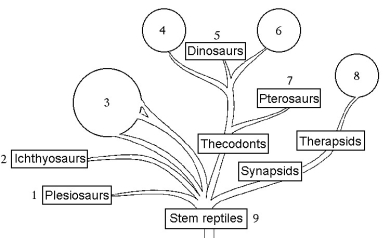
Figure 34.1
Which pair of numbers most likely represents extant, nonbird reptiles?
A)1 and 2
B)3 and 4
C)5 and 7
D)6 and 8
E)7 and 9
Figure 34.1
Which pair of numbers most likely represents extant, nonbird reptiles?
A)1 and 2
B)3 and 4
C)5 and 7
D)6 and 8
E)7 and 9
سؤال
سؤال
سؤال
سؤال
سؤال
سؤال
سؤال
سؤال
سؤال
سؤال
سؤال
سؤال
سؤال
سؤال
سؤال
The following questions refer to the phylogenetic tree shown in Figure 34.1.
Figure 34.1
The organisms represented by 8 most likely are
A)birds.
B)mammals.
C)nonbird, terrestrial reptiles.
D)aquatic reptiles.
E)all mammals except humans.
Figure 34.1
The organisms represented by 8 most likely are
A)birds.
B)mammals.
C)nonbird, terrestrial reptiles.
D)aquatic reptiles.
E)all mammals except humans.
سؤال
The following questions refer to the phylogenetic tree shown in Figure 34.1.
Figure 34.1
Which organisms are represented by 6?
A)birds
B)mammals
C)nonbird, terrestrial reptiles
D)aquatic reptiles
E)all mammals except humans
Figure 34.1
Which organisms are represented by 6?
A)birds
B)mammals
C)nonbird, terrestrial reptiles
D)aquatic reptiles
E)all mammals except humans
سؤال
سؤال
The following questions refer to the phylogenetic tree shown in Figure 34.1.
Figure 34.1
Which pair of numbers represents extinct reptiles that had returned to an aquatic life?
A)1 and 2
B)3 and 4
C)5 and 7
D)6 and 8
E)7 and 9
Figure 34.1
Which pair of numbers represents extinct reptiles that had returned to an aquatic life?
A)1 and 2
B)3 and 4
C)5 and 7
D)6 and 8
E)7 and 9
سؤال
سؤال
سؤال
The following questions refer to the phylogenetic tree shown in Figure 34.1.
Figure 34.1
During chordate evolution, what is the sequence (from earliest to most recent)in which the following structures arose?
1) amniotic egg
2) paired fins
3) jaws
4) swim bladder
5) four-chambered heart
A)2, 3, 4, 1, 5
B)3, 2, 4, 1, 5
C)3, 2, 1, 4, 5
D)2, 1, 4, 3, 5
E)2, 4, 3, 1, 5
Figure 34.1
During chordate evolution, what is the sequence (from earliest to most recent)in which the following structures arose?
1) amniotic egg
2) paired fins
3) jaws
4) swim bladder
5) four-chambered heart
A)2, 3, 4, 1, 5
B)3, 2, 4, 1, 5
C)3, 2, 1, 4, 5
D)2, 1, 4, 3, 5
E)2, 4, 3, 1, 5
سؤال
The following questions refer to the phylogenetic tree shown in Figure 34.1.
Figure 34.1
Which pair of numbers includes extant endotherms?
A)3 and 4
B)4 and 5
C)6 and 8
D)3 and 8
E)6 and 7
Figure 34.1
Which pair of numbers includes extant endotherms?
A)3 and 4
B)4 and 5
C)6 and 8
D)3 and 8
E)6 and 7
سؤال
The following questions refer to the phylogenetic tree shown in Figure 34.1.
Figure 34.1
Whose forelimbs are most analogous to those of keeled birds and bats?
A)1
B)2
C)3
D)7
E)9
Figure 34.1
Whose forelimbs are most analogous to those of keeled birds and bats?
A)1
B)2
C)3
D)7
E)9
سؤال
The following questions refer to the phylogenetic tree shown in Figure 34.1.
Figure 34.1
Whose DNA would have had the most sequence homologies with amphibian DNA?
A)5
B)6
C)7
D)8
E)9
Figure 34.1
Whose DNA would have had the most sequence homologies with amphibian DNA?
A)5
B)6
C)7
D)8
E)9
سؤال
The following questions refer to the phylogenetic tree shown in Figure 34.1.
Figure 34.1
Which of these is a trend in hominin evolution?
A)increased ability to switch back and forth between bipedalism and quadrupedalism
B)well-developed claws for clinging to trees
C)a shoulder joint increasingly adapted to brachiation
D)increased brain to body ratio
E)a shortened period of parental care of offspring
Figure 34.1
Which of these is a trend in hominin evolution?
A)increased ability to switch back and forth between bipedalism and quadrupedalism
B)well-developed claws for clinging to trees
C)a shoulder joint increasingly adapted to brachiation
D)increased brain to body ratio
E)a shortened period of parental care of offspring
سؤال
The following questions refer to the phylogenetic tree shown in Figure 34.1.
Figure 34.1
Which of these would a paleontologist be most likely to do in order to determine whether a fossil represents a reptile or a mammal?
A)Look for the presence of milk-producing glands.
B)Look for the mammalian characteristics of a four-chambered heart and a diaphragm.
C)Because mammals are eutherians, look for evidence of a placenta.
D)Use molecular analysis to look for the protein keratin.
E)Examine the teeth.
Figure 34.1
Which of these would a paleontologist be most likely to do in order to determine whether a fossil represents a reptile or a mammal?
A)Look for the presence of milk-producing glands.
B)Look for the mammalian characteristics of a four-chambered heart and a diaphragm.
C)Because mammals are eutherians, look for evidence of a placenta.
D)Use molecular analysis to look for the protein keratin.
E)Examine the teeth.
سؤال
سؤال
The following questions refer to the phylogenetic tree shown in Figure 34.1.
Figure 34.1
Differentiation of teeth is observed in
A)sharks.
B)bony fishes.
C)amphibians.
D)reptiles.
E)mammals.
Figure 34.1
Differentiation of teeth is observed in
A)sharks.
B)bony fishes.
C)amphibians.
D)reptiles.
E)mammals.
سؤال
سؤال
سؤال
The following questions refer to the phylogenetic tree shown in Figure 34.1.
Figure 34.1
Which is characteristic of all mammals, and only of mammals?
A)a four-chambered heart that prevents mixing of oxygenated and deoxygenated blood
B)giving birth to live young (viviparous)
C)parental care of offspring
D)having glands to produce nourishing milk for offspring
E)using the rib cage to assist in ventilating the lungs
Figure 34.1
Which is characteristic of all mammals, and only of mammals?
A)a four-chambered heart that prevents mixing of oxygenated and deoxygenated blood
B)giving birth to live young (viviparous)
C)parental care of offspring
D)having glands to produce nourishing milk for offspring
E)using the rib cage to assist in ventilating the lungs
سؤال
سؤال
سؤال
The following questions refer to the phylogenetic tree shown in Figure 34.1.
Figure 34.1
In which vertebrates is fertilization exclusively internal?
A)chondrichthyans, osteichthyans, and mammals
B)amphibians, mammals, and reptiles
C)chondrichthyans, osteichthyans, and reptiles
D)reptiles and mammals
E)reptiles and amphibians
Figure 34.1
In which vertebrates is fertilization exclusively internal?
A)chondrichthyans, osteichthyans, and mammals
B)amphibians, mammals, and reptiles
C)chondrichthyans, osteichthyans, and reptiles
D)reptiles and mammals
E)reptiles and amphibians
سؤال
The following questions refer to the phylogenetic tree shown in Figure 34.1.
Figure 34.1
Among extant vertebrates, a sheet of muscle called the diaphragm is found in
A)birds.
B)mammals.
C)nonbird reptiles.
D)both A and B
E)A, B, and C
Figure 34.1
Among extant vertebrates, a sheet of muscle called the diaphragm is found in
A)birds.
B)mammals.
C)nonbird reptiles.
D)both A and B
E)A, B, and C
سؤال
The following questions refer to the phylogenetic tree shown in Figure 34.1.
Figure 34.1
How are primates different from all other mammals?
A)placental embryonic development
B)hairy bodies
C)arboreal lifestyles
D)ability to produce milk
E)opposable thumbs in many species
Figure 34.1
How are primates different from all other mammals?
A)placental embryonic development
B)hairy bodies
C)arboreal lifestyles
D)ability to produce milk
E)opposable thumbs in many species
سؤال
سؤال
سؤال

فتح الحزمة
قم بالتسجيل لفتح البطاقات في هذه المجموعة!
Unlock Deck
Unlock Deck
1/112

العب

ملء الشاشة (f)
Deck 34: Vertebrates
1
The following questions refer to the description below.
Terry catches a ray-finned fish from the ocean and notices that, attached to its flank, there is an equally long, snakelike organism. The attached organism has no external segmentation, no scales, a round mouth surrounded by a sucker and two small eyes. Terry thinks it might be a marine leech, a hagfish, or a lamprey.
Terry takes the body of the snakelike organism and slices it open along its dorsal side. If it is a hagfish, what should Terry see?
A)a well-developed series of bony vertebrae surrounding the spinal cord
B)a well-developed series of cartilaginous vertebrae surrounding the spinal cord
C)a tube of cartilage (surrounding the notochord)with dorsal projections on both sides of the spinal cord
D)a notochord, located underneath the spinal cord
Terry catches a ray-finned fish from the ocean and notices that, attached to its flank, there is an equally long, snakelike organism. The attached organism has no external segmentation, no scales, a round mouth surrounded by a sucker and two small eyes. Terry thinks it might be a marine leech, a hagfish, or a lamprey.
Terry takes the body of the snakelike organism and slices it open along its dorsal side. If it is a hagfish, what should Terry see?
A)a well-developed series of bony vertebrae surrounding the spinal cord
B)a well-developed series of cartilaginous vertebrae surrounding the spinal cord
C)a tube of cartilage (surrounding the notochord)with dorsal projections on both sides of the spinal cord
D)a notochord, located underneath the spinal cord
D
2
A new species of aquatic chordate is discovered that closely resembles an ancient form. It has the following characteristics: external armor of bony plates, no paired lateral fins, and a suspension-feeding mode of nutrition. In addition to these, it will probably have which of the following characteristics?
A)legs
B)no jaws
C)an amniotic egg
D)endothermy
A)legs
B)no jaws
C)an amniotic egg
D)endothermy
B
3
The following questions refer to the description below.
Terry catches a ray-finned fish from the ocean and notices that, attached to its flank, there is an equally long, snakelike organism. The attached organism has no external segmentation, no scales, a round mouth surrounded by a sucker and two small eyes. Terry thinks it might be a marine leech, a hagfish, or a lamprey.
Having caught and handled a hagfish, what will Terry's shipmates most likely require Terry to do before returning to further fishing?
A)Spend some time below deck; only someone who'd spent too much time in the sun would remove hagfish denticles for later "analysis."
B)Clean the bucketsful of hagfish slime from the deck of the boat.
C)Dispose of the fishing tackle that had been poisoned by coming into contact with the hagfish.
D)Cut up the remaining hagfish and share pieces of this highly sought-after baitfish.
Terry catches a ray-finned fish from the ocean and notices that, attached to its flank, there is an equally long, snakelike organism. The attached organism has no external segmentation, no scales, a round mouth surrounded by a sucker and two small eyes. Terry thinks it might be a marine leech, a hagfish, or a lamprey.
Having caught and handled a hagfish, what will Terry's shipmates most likely require Terry to do before returning to further fishing?
A)Spend some time below deck; only someone who'd spent too much time in the sun would remove hagfish denticles for later "analysis."
B)Clean the bucketsful of hagfish slime from the deck of the boat.
C)Dispose of the fishing tackle that had been poisoned by coming into contact with the hagfish.
D)Cut up the remaining hagfish and share pieces of this highly sought-after baitfish.
B
4
The following questions refer to the description below.
Terry catches a ray-finned fish from the ocean and notices that, attached to its flank, there is an equally long, snakelike organism. The attached organism has no external segmentation, no scales, a round mouth surrounded by a sucker and two small eyes. Terry thinks it might be a marine leech, a hagfish, or a lamprey.
The earliest known mineralized structures in vertebrates are associated with which function?
A)reproduction
B)feeding
C)locomotion
D)defense
E)respiration
Terry catches a ray-finned fish from the ocean and notices that, attached to its flank, there is an equally long, snakelike organism. The attached organism has no external segmentation, no scales, a round mouth surrounded by a sucker and two small eyes. Terry thinks it might be a marine leech, a hagfish, or a lamprey.
The earliest known mineralized structures in vertebrates are associated with which function?
A)reproduction
B)feeding
C)locomotion
D)defense
E)respiration
فتح الحزمة
افتح القفل للوصول البطاقات البالغ عددها 112 في هذه المجموعة.
فتح الحزمة
k this deck
5
The following questions refer to the description below.
Terry catches a ray-finned fish from the ocean and notices that, attached to its flank, there is an equally long, snakelike organism. The attached organism has no external segmentation, no scales, a round mouth surrounded by a sucker and two small eyes. Terry thinks it might be a marine leech, a hagfish, or a lamprey.
Terry saved some of the tooth-like objects within the hagfish's round mouth to analyze their composition in his mentor's biochemistry research lab. Terry will find that they are composed of the same protein found in reptilian
A)scales.
B)teeth.
C)bones.
D)blood.
E)muscles.
Terry catches a ray-finned fish from the ocean and notices that, attached to its flank, there is an equally long, snakelike organism. The attached organism has no external segmentation, no scales, a round mouth surrounded by a sucker and two small eyes. Terry thinks it might be a marine leech, a hagfish, or a lamprey.
Terry saved some of the tooth-like objects within the hagfish's round mouth to analyze their composition in his mentor's biochemistry research lab. Terry will find that they are composed of the same protein found in reptilian
A)scales.
B)teeth.
C)bones.
D)blood.
E)muscles.
فتح الحزمة
افتح القفل للوصول البطاقات البالغ عددها 112 في هذه المجموعة.
فتح الحزمة
k this deck
6
Which of the following statements about craniates is (are)correct?
1) Craniates are more highly cephalized than are non-craniates.
2) Craniates' genomic evolution includes duplication of clusters of genes that code for transcription factors.
3) The craniate clade is synonymous with the vertebrate clade.
4) Pharyngeal slits that can assist in gas exchange originated in craniates,
5) The two-chambered heart originated with the early craniates.
A)1 only
B)1 and 3
C)2, 4, and 5
D)1, 2, 4, and 5
E)1, 3, 4, and 5
1) Craniates are more highly cephalized than are non-craniates.
2) Craniates' genomic evolution includes duplication of clusters of genes that code for transcription factors.
3) The craniate clade is synonymous with the vertebrate clade.
4) Pharyngeal slits that can assist in gas exchange originated in craniates,
5) The two-chambered heart originated with the early craniates.
A)1 only
B)1 and 3
C)2, 4, and 5
D)1, 2, 4, and 5
E)1, 3, 4, and 5
فتح الحزمة
افتح القفل للوصول البطاقات البالغ عددها 112 في هذه المجموعة.
فتح الحزمة
k this deck
7
The origin of the craniates occurred at roughly the same time as the
A)origin of the Ediacaran fauna.
B)Cambrian explosion.
C)Permian extinctions.
D)first invertebrates invaded land.
E)origin of lancelets.
A)origin of the Ediacaran fauna.
B)Cambrian explosion.
C)Permian extinctions.
D)first invertebrates invaded land.
E)origin of lancelets.
فتح الحزمة
افتح القفل للوصول البطاقات البالغ عددها 112 في هذه المجموعة.
فتح الحزمة
k this deck
8
Chordate pharyngeal slits appear to have functioned first as
A)the digestive system's opening.
B)suspension-feeding devices.
C)components of the jaw.
D)gill slits for respiration.
E)portions of the inner ear.
A)the digestive system's opening.
B)suspension-feeding devices.
C)components of the jaw.
D)gill slits for respiration.
E)portions of the inner ear.
فتح الحزمة
افتح القفل للوصول البطاقات البالغ عددها 112 في هذه المجموعة.
فتح الحزمة
k this deck
9
The following questions refer to the description below.
Terry catches a ray-finned fish from the ocean and notices that, attached to its flank, there is an equally long, snakelike organism. The attached organism has no external segmentation, no scales, a round mouth surrounded by a sucker and two small eyes. Terry thinks it might be a marine leech, a hagfish, or a lamprey.
The snakelike organism turned out to be a hagfish. Consequently, why should Terry throw the fish he caught overboard, rather than having it for dinner?
A)It has mucus on its skin.
B)If it had an ectoparasite, then it must also have endoparasites.
C)The bite of the hagfish introduces paralytic neurotoxins, which Terry wants to avoid.
D)It was already sick or dying; otherwise, the hagfish would probably not have attacked it.
Terry catches a ray-finned fish from the ocean and notices that, attached to its flank, there is an equally long, snakelike organism. The attached organism has no external segmentation, no scales, a round mouth surrounded by a sucker and two small eyes. Terry thinks it might be a marine leech, a hagfish, or a lamprey.
The snakelike organism turned out to be a hagfish. Consequently, why should Terry throw the fish he caught overboard, rather than having it for dinner?
A)It has mucus on its skin.
B)If it had an ectoparasite, then it must also have endoparasites.
C)The bite of the hagfish introduces paralytic neurotoxins, which Terry wants to avoid.
D)It was already sick or dying; otherwise, the hagfish would probably not have attacked it.
فتح الحزمة
افتح القفل للوصول البطاقات البالغ عددها 112 في هذه المجموعة.
فتح الحزمة
k this deck
10
Which of the following statements would be least acceptable to most zoologists?
A)The extant cephalochordates (lancelets)are contemporaries, not ancestors, of vertebrates.
B)The first fossils resembling cephalochordates appeared in the fossil record around 550 million years ago.
C)Recent work in molecular systematics supports the hypothesis that cephalochordates are the most recent common ancestor of all vertebrates.
D)The extant cephalochordates are the immediate ancestors of the fishes.
E)Cephalochordates display the same method of swimming as do fishes.
A)The extant cephalochordates (lancelets)are contemporaries, not ancestors, of vertebrates.
B)The first fossils resembling cephalochordates appeared in the fossil record around 550 million years ago.
C)Recent work in molecular systematics supports the hypothesis that cephalochordates are the most recent common ancestor of all vertebrates.
D)The extant cephalochordates are the immediate ancestors of the fishes.
E)Cephalochordates display the same method of swimming as do fishes.
فتح الحزمة
افتح القفل للوصول البطاقات البالغ عددها 112 في هذه المجموعة.
فتح الحزمة
k this deck
11
Which extant chordates are postulated to be most like the earliest chordates in appearance?
A)lancelets
B)adult tunicates
C)amphibians
D)reptiles
E)chondrichthyans
A)lancelets
B)adult tunicates
C)amphibians
D)reptiles
E)chondrichthyans
فتح الحزمة
افتح القفل للوصول البطاقات البالغ عددها 112 في هذه المجموعة.
فتح الحزمة
k this deck
12
The following questions refer to the description below.
Terry catches a ray-finned fish from the ocean and notices that, attached to its flank, there is an equally long, snakelike organism. The attached organism has no external segmentation, no scales, a round mouth surrounded by a sucker and two small eyes. Terry thinks it might be a marine leech, a hagfish, or a lamprey.
Which feature excludes it from possibly being a leech?
A)its elongate shape
B)its lack of scales
C)its lack of external segmentation
D)its round mouth
E)its anterior sucker
Terry catches a ray-finned fish from the ocean and notices that, attached to its flank, there is an equally long, snakelike organism. The attached organism has no external segmentation, no scales, a round mouth surrounded by a sucker and two small eyes. Terry thinks it might be a marine leech, a hagfish, or a lamprey.
Which feature excludes it from possibly being a leech?
A)its elongate shape
B)its lack of scales
C)its lack of external segmentation
D)its round mouth
E)its anterior sucker
فتح الحزمة
افتح القفل للوصول البطاقات البالغ عددها 112 في هذه المجموعة.
فتح الحزمة
k this deck
13
The following questions refer to the description below.
Terry catches a ray-finned fish from the ocean and notices that, attached to its flank, there is an equally long, snakelike organism. The attached organism has no external segmentation, no scales, a round mouth surrounded by a sucker and two small eyes. Terry thinks it might be a marine leech, a hagfish, or a lamprey.
The feeding mode of the extinct conodonts was
A)herbivory.
B)suspension feeding.
C)predation.
D)filter feeding.
E)absorptive feeding.
Terry catches a ray-finned fish from the ocean and notices that, attached to its flank, there is an equally long, snakelike organism. The attached organism has no external segmentation, no scales, a round mouth surrounded by a sucker and two small eyes. Terry thinks it might be a marine leech, a hagfish, or a lamprey.
The feeding mode of the extinct conodonts was
A)herbivory.
B)suspension feeding.
C)predation.
D)filter feeding.
E)absorptive feeding.
فتح الحزمة
افتح القفل للوصول البطاقات البالغ عددها 112 في هذه المجموعة.
فتح الحزمة
k this deck
14
Which of the following is a shared characteristic of all chordates?
A)scales
B)jaws
C)vertebrae
D)dorsal, hollow nerve cord
E)four-chambered heart
A)scales
B)jaws
C)vertebrae
D)dorsal, hollow nerve cord
E)four-chambered heart
فتح الحزمة
افتح القفل للوصول البطاقات البالغ عددها 112 في هذه المجموعة.
فتح الحزمة
k this deck
15
What is one characteristic that separates chordates from all other animals?
A)True coelom
B)post-anal tail
C)blastopore, which becomes the anus
D)bilateral symmetry
E)segmentation
A)True coelom
B)post-anal tail
C)blastopore, which becomes the anus
D)bilateral symmetry
E)segmentation
فتح الحزمة
افتح القفل للوصول البطاقات البالغ عددها 112 في هذه المجموعة.
فتح الحزمة
k this deck
16
What do craniates have that earlier chordates did not have?
A)brain
B)vertebrae
C)post-anal tail
D)partial or complete skull
E)bone
A)brain
B)vertebrae
C)post-anal tail
D)partial or complete skull
E)bone
فتح الحزمة
افتح القفل للوصول البطاقات البالغ عددها 112 في هذه المجموعة.
فتح الحزمة
k this deck
17
The following questions refer to the description below.
Terry catches a ray-finned fish from the ocean and notices that, attached to its flank, there is an equally long, snakelike organism. The attached organism has no external segmentation, no scales, a round mouth surrounded by a sucker and two small eyes. Terry thinks it might be a marine leech, a hagfish, or a lamprey.
Lampreys differ from hagfishes in
A)lacking jaws.
B)having a cranium.
C)having pharyngeal clefts that develop into pharyngeal slits.
D)having a notochord throughout life.
E)having a notochord that is surrounded by a tube of cartilage.
Terry catches a ray-finned fish from the ocean and notices that, attached to its flank, there is an equally long, snakelike organism. The attached organism has no external segmentation, no scales, a round mouth surrounded by a sucker and two small eyes. Terry thinks it might be a marine leech, a hagfish, or a lamprey.
Lampreys differ from hagfishes in
A)lacking jaws.
B)having a cranium.
C)having pharyngeal clefts that develop into pharyngeal slits.
D)having a notochord throughout life.
E)having a notochord that is surrounded by a tube of cartilage.
فتح الحزمة
افتح القفل للوصول البطاقات البالغ عددها 112 في هذه المجموعة.
فتح الحزمة
k this deck
18
Which of these are characteristics of all chordates during at least a portion of their development?
A)a dorsal, hollow nerve cord
B)pharyngeal clefts
C)post-anal tail
D)A and B only
E)A, B, and C
A)a dorsal, hollow nerve cord
B)pharyngeal clefts
C)post-anal tail
D)A and B only
E)A, B, and C
فتح الحزمة
افتح القفل للوصول البطاقات البالغ عددها 112 في هذه المجموعة.
فتح الحزمة
k this deck
19
The following questions refer to the description below.
Terry catches a ray-finned fish from the ocean and notices that, attached to its flank, there is an equally long, snakelike organism. The attached organism has no external segmentation, no scales, a round mouth surrounded by a sucker and two small eyes. Terry thinks it might be a marine leech, a hagfish, or a lamprey.
Terry detaches the snakelike organism from the fish and uses a knife to cut off its head. In doing so, its brain slides out onto the deck of the boat. Terry peers into the cut end of the head and notices that the brain had lain in a sort of pan-like structure that only partially surrounded the brain. What is the structure Terry is observing, and what is it made of?
A)skull, bone
B)cranium, bone
C)cranium, cartilage
D)vertebral column, bone
E)vertebral column, cartilage
Terry catches a ray-finned fish from the ocean and notices that, attached to its flank, there is an equally long, snakelike organism. The attached organism has no external segmentation, no scales, a round mouth surrounded by a sucker and two small eyes. Terry thinks it might be a marine leech, a hagfish, or a lamprey.
Terry detaches the snakelike organism from the fish and uses a knife to cut off its head. In doing so, its brain slides out onto the deck of the boat. Terry peers into the cut end of the head and notices that the brain had lain in a sort of pan-like structure that only partially surrounded the brain. What is the structure Terry is observing, and what is it made of?
A)skull, bone
B)cranium, bone
C)cranium, cartilage
D)vertebral column, bone
E)vertebral column, cartilage
فتح الحزمة
افتح القفل للوصول البطاقات البالغ عددها 112 في هذه المجموعة.
فتح الحزمة
k this deck
20
The following questions refer to the description below.
Terry catches a ray-finned fish from the ocean and notices that, attached to its flank, there is an equally long, snakelike organism. The attached organism has no external segmentation, no scales, a round mouth surrounded by a sucker and two small eyes. Terry thinks it might be a marine leech, a hagfish, or a lamprey.
What do hagfishes and lampreys have in common with the extinct conodonts?
A)lungs
B)the jawless condition
C)bony vertebrae
D)their mode of feeding
E)swim bladders
Terry catches a ray-finned fish from the ocean and notices that, attached to its flank, there is an equally long, snakelike organism. The attached organism has no external segmentation, no scales, a round mouth surrounded by a sucker and two small eyes. Terry thinks it might be a marine leech, a hagfish, or a lamprey.
What do hagfishes and lampreys have in common with the extinct conodonts?
A)lungs
B)the jawless condition
C)bony vertebrae
D)their mode of feeding
E)swim bladders
فتح الحزمة
افتح القفل للوصول البطاقات البالغ عددها 112 في هذه المجموعة.
فتح الحزمة
k this deck
21
What should be True of fossils of the earliest tetrapods?
A)They should show evidence of internal fertilization.
B)They should show evidence of having produced shelled eggs.
C)They should indicate limited adaptation to life on land.
D)They should be transitional forms with the fossils of chondrichthyans that lived at the same time.
E)They should feature the earliest indications of the appearance of jaws.
A)They should show evidence of internal fertilization.
B)They should show evidence of having produced shelled eggs.
C)They should indicate limited adaptation to life on land.
D)They should be transitional forms with the fossils of chondrichthyans that lived at the same time.
E)They should feature the earliest indications of the appearance of jaws.
فتح الحزمة
افتح القفل للوصول البطاقات البالغ عددها 112 في هذه المجموعة.
فتح الحزمة
k this deck
22
Which of these statements accurately describes a similarity between sharks and ray-finned fishes?
A)The skin is typically covered by flattened bony scales.
B)They are equally able to exchange gases with the environment while stationary.
C)They are highly maneuverable due to their flexibility.
D)They have a lateral line that is sensitive to changes in water pressure.
E)A swim bladder helps control buoyancy.
A)The skin is typically covered by flattened bony scales.
B)They are equally able to exchange gases with the environment while stationary.
C)They are highly maneuverable due to their flexibility.
D)They have a lateral line that is sensitive to changes in water pressure.
E)A swim bladder helps control buoyancy.
فتح الحزمة
افتح القفل للوصول البطاقات البالغ عددها 112 في هذه المجموعة.
فتح الحزمة
k this deck
23
Arrange these taxonomic terms from most inclusive (i.e., most general)to least inclusive (i.e., most specific). 1. lobe-fins
2) amphibians
3) gnathostomes
4) osteichthyans
5) tetrapods
A)4, 3, 1, 5, 2
B)4, 3, 2, 5, 1
C)4, 2, 3, 5, 1
D)3, 4, 1, 5, 2
E)3, 4, 5, 1, 2
2) amphibians
3) gnathostomes
4) osteichthyans
5) tetrapods
A)4, 3, 1, 5, 2
B)4, 3, 2, 5, 1
C)4, 2, 3, 5, 1
D)3, 4, 1, 5, 2
E)3, 4, 5, 1, 2
فتح الحزمة
افتح القفل للوصول البطاقات البالغ عددها 112 في هذه المجموعة.
فتح الحزمة
k this deck
24
All of these might have been observed in the common ancestor of chondrichthyans and osteichthyans, except
A)a mineralized, bony skeleton.
B)scales.
C)lungs.
D)gills.
E)a swim bladder.
A)a mineralized, bony skeleton.
B)scales.
C)lungs.
D)gills.
E)a swim bladder.
فتح الحزمة
افتح القفل للوصول البطاقات البالغ عددها 112 في هذه المجموعة.
فتح الحزمة
k this deck
25
A trend first observed in the evolution of the earliest tetrapods was
A)the appearance of jaws.
B)the appearance of bony vertebrae.
C)feet with digits.
D)the mineralization of the endoskeleton.
E)the ability to move in a fishlike manner.
A)the appearance of jaws.
B)the appearance of bony vertebrae.
C)feet with digits.
D)the mineralization of the endoskeleton.
E)the ability to move in a fishlike manner.
فتح الحزمة
افتح القفل للوصول البطاقات البالغ عددها 112 في هذه المجموعة.
فتح الحزمة
k this deck
26
To which of these are the scales of chondrichthyans most closely related in a structural sense?
A)osteichthyan scales
B)reptilian scales
C)mammalian scales
D)bird scales
E)chondrichthyan teeth
A)osteichthyan scales
B)reptilian scales
C)mammalian scales
D)bird scales
E)chondrichthyan teeth
فتح الحزمة
افتح القفل للوصول البطاقات البالغ عددها 112 في هذه المجموعة.
فتح الحزمة
k this deck
27
A team of researchers has developed a poison that has proven effective against lamprey larvae in freshwater cultures. The poison is ingested and causes paralysis by detaching segmental muscles from the skeletal elements. The team wants to test the poison's effectiveness in streams feeding Lake Michigan, but one critic worries about potential effects on lancelets, which are similar to lampreys in many ways. Why is this concern misplaced?
A)A chemical poisonous to lampreys could not also be toxic to organisms as ancestral as lancelets.
B)Lamprey larvae and lancelets have very different feeding mechanisms.
C)Lancelets do not have segmental muscles.
D)Lancelets live only in saltwater environments.
E)Lancelets and lamprey larvae eat different kinds of food.
A)A chemical poisonous to lampreys could not also be toxic to organisms as ancestral as lancelets.
B)Lamprey larvae and lancelets have very different feeding mechanisms.
C)Lancelets do not have segmental muscles.
D)Lancelets live only in saltwater environments.
E)Lancelets and lamprey larvae eat different kinds of food.
فتح الحزمة
افتح القفل للوصول البطاقات البالغ عددها 112 في هذه المجموعة.
فتح الحزمة
k this deck
28
In which of these extant classes did jaws occur earliest?
A)lampreys
B)chondrichthyans
C)ray-finned fishes
D)lungfishes
E)placoderms
A)lampreys
B)chondrichthyans
C)ray-finned fishes
D)lungfishes
E)placoderms
فتح الحزمة
افتح القفل للوصول البطاقات البالغ عددها 112 في هذه المجموعة.
فتح الحزمة
k this deck
29
All of the following belong to the lobe-fin clade, except
A)chondrichthyans.
B)Australian lungfishes.
C)African lungfishes.
D)coelacanths.
E)tetrapods.
A)chondrichthyans.
B)Australian lungfishes.
C)African lungfishes.
D)coelacanths.
E)tetrapods.
فتح الحزمة
افتح القفل للوصول البطاقات البالغ عددها 112 في هذه المجموعة.
فتح الحزمة
k this deck
30
The lamprey species whose larvae live in freshwater streams, but whose adults live most of their lives in seawater, are similar in this respect to certain species of
A)chondrichthyans.
B)actinopterygians.
C)lungfishes.
D)coelacanths.
E)hagfishes.
A)chondrichthyans.
B)actinopterygians.
C)lungfishes.
D)coelacanths.
E)hagfishes.
فتح الحزمة
افتح القفل للوصول البطاقات البالغ عددها 112 في هذه المجموعة.
فتح الحزمة
k this deck
31
The swim bladder of ray-finned fishes
A)was probably modified from simple lungs of freshwater fishes.
B)developed into lungs in saltwater fishes.
C)first appeared in sharks.
D)provides buoyancy, but at a high energy cost.
E)both C and D
A)was probably modified from simple lungs of freshwater fishes.
B)developed into lungs in saltwater fishes.
C)first appeared in sharks.
D)provides buoyancy, but at a high energy cost.
E)both C and D
فتح الحزمة
افتح القفل للوصول البطاقات البالغ عددها 112 في هذه المجموعة.
فتح الحزمة
k this deck
32
There is evidence that ray-finned fishes originally evolved
A)in response to a crisis that wiped out the chondrichthyans.
B)directly from lampreys and hagfish.
C)early in the Cambrian period.
D)directly from cephalochordates.
E)in freshwater environments.
A)in response to a crisis that wiped out the chondrichthyans.
B)directly from lampreys and hagfish.
C)early in the Cambrian period.
D)directly from cephalochordates.
E)in freshwater environments.
فتح الحزمة
افتح القفل للوصول البطاقات البالغ عددها 112 في هذه المجموعة.
فتح الحزمة
k this deck
33
Which group's members had (have)both lungs and gills during their adult lives?
A)sharks, skates, and rays
B)lungfishes
C)lancelets
D)amphibians
E)ichthyosaurs and plesiosaurs
A)sharks, skates, and rays
B)lungfishes
C)lancelets
D)amphibians
E)ichthyosaurs and plesiosaurs
فتح الحزمة
افتح القفل للوصول البطاقات البالغ عددها 112 في هذه المجموعة.
فتح الحزمة
k this deck
34
The following questions refer to the description below.
While on an intersession course in tropical ecology, Kris pulls a large, snakelike organism from a burrow (the class was granted a collecting permit). The 1-m-long organism has smooth skin, which appears to be segmented. It has two tiny eyes that are hard to see because they seem to be covered by skin. Kris brings it back to the lab at the field station, where it is a source of puzzlement to the class. Kris says that it is a giant oligochaete worm; Shaun suggests it is a legless amphibian; Kelly proposes it belongs to a snake species that is purely fossorial (lives in a burrow).
The organism was found to have two lungs, but the left lung was much smaller than the right lung. Kelly added that the herpetology instructor had said that in most snakes, the same condition exists. If the size difference between the lungs in this organism is not a shared ancestral characteristic with its occurrence in snakes, then its existence in this organism is explained as a(n) 1. result of convergent evolution.
2) example of homologous structures.
3) similar adaptation to a shared lifestyle or body-plan.
4) result of having identical Hox genes.
5) homoplasy.
A)3 only
B)1 and 5
C)1, 3, and 5
D)2, 3, and 5
E)3, 4, and 5
While on an intersession course in tropical ecology, Kris pulls a large, snakelike organism from a burrow (the class was granted a collecting permit). The 1-m-long organism has smooth skin, which appears to be segmented. It has two tiny eyes that are hard to see because they seem to be covered by skin. Kris brings it back to the lab at the field station, where it is a source of puzzlement to the class. Kris says that it is a giant oligochaete worm; Shaun suggests it is a legless amphibian; Kelly proposes it belongs to a snake species that is purely fossorial (lives in a burrow).
The organism was found to have two lungs, but the left lung was much smaller than the right lung. Kelly added that the herpetology instructor had said that in most snakes, the same condition exists. If the size difference between the lungs in this organism is not a shared ancestral characteristic with its occurrence in snakes, then its existence in this organism is explained as a(n) 1. result of convergent evolution.
2) example of homologous structures.
3) similar adaptation to a shared lifestyle or body-plan.
4) result of having identical Hox genes.
5) homoplasy.
A)3 only
B)1 and 5
C)1, 3, and 5
D)2, 3, and 5
E)3, 4, and 5
فتح الحزمة
افتح القفل للوصول البطاقات البالغ عددها 112 في هذه المجموعة.
فتح الحزمة
k this deck
35
The following questions refer to the description below.
While on an intersession course in tropical ecology, Kris pulls a large, snakelike organism from a burrow (the class was granted a collecting permit). The 1-m-long organism has smooth skin, which appears to be segmented. It has two tiny eyes that are hard to see because they seem to be covered by skin. Kris brings it back to the lab at the field station, where it is a source of puzzlement to the class. Kris says that it is a giant oligochaete worm; Shaun suggests it is a legless amphibian; Kelly proposes it belongs to a snake species that is purely fossorial (lives in a burrow).
Which characteristic should permit the class to conclude that it is probably not a snake?
A)its length
B)the number of eyes
C)the size and condition of its eyes
D)its presence in a burrow
E)the absence of scales on its surface
While on an intersession course in tropical ecology, Kris pulls a large, snakelike organism from a burrow (the class was granted a collecting permit). The 1-m-long organism has smooth skin, which appears to be segmented. It has two tiny eyes that are hard to see because they seem to be covered by skin. Kris brings it back to the lab at the field station, where it is a source of puzzlement to the class. Kris says that it is a giant oligochaete worm; Shaun suggests it is a legless amphibian; Kelly proposes it belongs to a snake species that is purely fossorial (lives in a burrow).
Which characteristic should permit the class to conclude that it is probably not a snake?
A)its length
B)the number of eyes
C)the size and condition of its eyes
D)its presence in a burrow
E)the absence of scales on its surface
فتح الحزمة
افتح القفل للوصول البطاقات البالغ عددها 112 في هذه المجموعة.
فتح الحزمة
k this deck
36
What is a distinctive feature of the chondrichthyans?
A)an amniotic egg
B)unpaired fins
C)an acute sense of vision that includes the ability to distinguish colors
D)a mostly cartilaginous endoskeleton
E)lack of jaws
A)an amniotic egg
B)unpaired fins
C)an acute sense of vision that includes the ability to distinguish colors
D)a mostly cartilaginous endoskeleton
E)lack of jaws
فتح الحزمة
افتح القفل للوصول البطاقات البالغ عددها 112 في هذه المجموعة.
فتح الحزمة
k this deck
37
The following questions refer to the description below.
While on an intersession course in tropical ecology, Kris pulls a large, snakelike organism from a burrow (the class was granted a collecting permit). The 1-m-long organism has smooth skin, which appears to be segmented. It has two tiny eyes that are hard to see because they seem to be covered by skin. Kris brings it back to the lab at the field station, where it is a source of puzzlement to the class. Kris says that it is a giant oligochaete worm; Shaun suggests it is a legless amphibian; Kelly proposes it belongs to a snake species that is purely fossorial (lives in a burrow).
The class decided to humanely euthanize the organism and subsequently dissect it. Having decided that it was probably not a reptile, two of their original hypotheses regarding its identity remained. Which of the following, if observed, should help them arrive at a conclusive answer?
A)presence of a closed circulatory system
B)presence of moist, highly vascularized skin
C)presence of lungs
D)presence of a nerve chord
E)presence of a digestive system with two openings
While on an intersession course in tropical ecology, Kris pulls a large, snakelike organism from a burrow (the class was granted a collecting permit). The 1-m-long organism has smooth skin, which appears to be segmented. It has two tiny eyes that are hard to see because they seem to be covered by skin. Kris brings it back to the lab at the field station, where it is a source of puzzlement to the class. Kris says that it is a giant oligochaete worm; Shaun suggests it is a legless amphibian; Kelly proposes it belongs to a snake species that is purely fossorial (lives in a burrow).
The class decided to humanely euthanize the organism and subsequently dissect it. Having decided that it was probably not a reptile, two of their original hypotheses regarding its identity remained. Which of the following, if observed, should help them arrive at a conclusive answer?
A)presence of a closed circulatory system
B)presence of moist, highly vascularized skin
C)presence of lungs
D)presence of a nerve chord
E)presence of a digestive system with two openings
فتح الحزمة
افتح القفل للوصول البطاقات البالغ عددها 112 في هذه المجموعة.
فتح الحزمة
k this deck
38
According to one hypothesis, the jaws of vertebrates were derived by the modification of
A)scales of the lower lip.
B)skeletal rods that had supported pharyngeal (gill)slits.
C)one or more gill slits.
D)one or more of the bones of the cranium.
E)one or more of the vertebrae.
A)scales of the lower lip.
B)skeletal rods that had supported pharyngeal (gill)slits.
C)one or more gill slits.
D)one or more of the bones of the cranium.
E)one or more of the vertebrae.
فتح الحزمة
افتح القفل للوصول البطاقات البالغ عددها 112 في هذه المجموعة.
فتح الحزمة
k this deck
39
The following questions refer to the description below.
Terry catches a ray-finned fish from the ocean and notices that, attached to its flank, there is an equally long, snakelike organism. The attached organism has no external segmentation, no scales, a round mouth surrounded by a sucker and two small eyes. Terry thinks it might be a marine leech, a hagfish, or a lamprey.
The endoskeletons of most vertebrates are composed of calcified
A)cartilage.
B)silica.
C)chitin.
D)dentin.
E)enamel.
Terry catches a ray-finned fish from the ocean and notices that, attached to its flank, there is an equally long, snakelike organism. The attached organism has no external segmentation, no scales, a round mouth surrounded by a sucker and two small eyes. Terry thinks it might be a marine leech, a hagfish, or a lamprey.
The endoskeletons of most vertebrates are composed of calcified
A)cartilage.
B)silica.
C)chitin.
D)dentin.
E)enamel.
فتح الحزمة
افتح القفل للوصول البطاقات البالغ عددها 112 في هذه المجموعة.
فتح الحزمة
k this deck
40
The ray-finned fishes are characterized by
A)a bony endoskeleton, operculum, and usually a swim bladder.
B)a cartilaginous endoskeleton.
C)an amniotic egg.
D)teeth that are replaced regularly.
E)a lateral line system and ears with three semicircular canals.
A)a bony endoskeleton, operculum, and usually a swim bladder.
B)a cartilaginous endoskeleton.
C)an amniotic egg.
D)teeth that are replaced regularly.
E)a lateral line system and ears with three semicircular canals.
فتح الحزمة
افتح القفل للوصول البطاقات البالغ عددها 112 في هذه المجموعة.
فتح الحزمة
k this deck
41
The following questions refer to the phylogenetic tree shown in Figure 34.1.
Figure 34.1
Which pair of numbers most likely represents extant, nonbird reptiles?
A)1 and 2
B)3 and 4
C)5 and 7
D)6 and 8
E)7 and 9
Figure 34.1
Which pair of numbers most likely represents extant, nonbird reptiles?
A)1 and 2
B)3 and 4
C)5 and 7
D)6 and 8
E)7 and 9
فتح الحزمة
افتح القفل للوصول البطاقات البالغ عددها 112 في هذه المجموعة.
فتح الحزمة
k this deck
42
The following questions refer to the description below.
While on an intersession course in tropical ecology, Kris pulls a large, snakelike organism from a burrow (the class was granted a collecting permit). The 1-m-long organism has smooth skin, which appears to be segmented. It has two tiny eyes that are hard to see because they seem to be covered by skin. Kris brings it back to the lab at the field station, where it is a source of puzzlement to the class. Kris says that it is a giant oligochaete worm; Shaun suggests it is a legless amphibian; Kelly proposes it belongs to a snake species that is purely fossorial (lives in a burrow).
What permits reptiles to thrive in arid environments?
A)Their bright coloration reflects the intense UV radiation.
B)A large number of prey and a limited number of predators are available in the desert.
C)A cartilaginous endoskeleton provides needed flexibility for locomotion on sand.
D)Their scales contain the protein keratin, which helps prevent dehydration.
E)They have an acute sense of sight, especially in bright sunlight.
While on an intersession course in tropical ecology, Kris pulls a large, snakelike organism from a burrow (the class was granted a collecting permit). The 1-m-long organism has smooth skin, which appears to be segmented. It has two tiny eyes that are hard to see because they seem to be covered by skin. Kris brings it back to the lab at the field station, where it is a source of puzzlement to the class. Kris says that it is a giant oligochaete worm; Shaun suggests it is a legless amphibian; Kelly proposes it belongs to a snake species that is purely fossorial (lives in a burrow).
What permits reptiles to thrive in arid environments?
A)Their bright coloration reflects the intense UV radiation.
B)A large number of prey and a limited number of predators are available in the desert.
C)A cartilaginous endoskeleton provides needed flexibility for locomotion on sand.
D)Their scales contain the protein keratin, which helps prevent dehydration.
E)They have an acute sense of sight, especially in bright sunlight.
فتح الحزمة
افتح القفل للوصول البطاقات البالغ عددها 112 في هذه المجموعة.
فتح الحزمة
k this deck
43
The following questions refer to the description below.
While on an intersession course in tropical ecology, Kris pulls a large, snakelike organism from a burrow (the class was granted a collecting permit). The 1-m-long organism has smooth skin, which appears to be segmented. It has two tiny eyes that are hard to see because they seem to be covered by skin. Kris brings it back to the lab at the field station, where it is a source of puzzlement to the class. Kris says that it is a giant oligochaete worm; Shaun suggests it is a legless amphibian; Kelly proposes it belongs to a snake species that is purely fossorial (lives in a burrow).
Why is the discovery of the fossil Archaeopteryx significant? It supports the
A)phylogenetic relatedness of birds and reptiles.
B)contention that birds are much older than we originally thought.
C)claim that some dinosaurs had feathers well before birds had evolved.
D)idea that the first birds were ratites.
E)hypothesis that the earliest birds were ectothermic.
While on an intersession course in tropical ecology, Kris pulls a large, snakelike organism from a burrow (the class was granted a collecting permit). The 1-m-long organism has smooth skin, which appears to be segmented. It has two tiny eyes that are hard to see because they seem to be covered by skin. Kris brings it back to the lab at the field station, where it is a source of puzzlement to the class. Kris says that it is a giant oligochaete worm; Shaun suggests it is a legless amphibian; Kelly proposes it belongs to a snake species that is purely fossorial (lives in a burrow).
Why is the discovery of the fossil Archaeopteryx significant? It supports the
A)phylogenetic relatedness of birds and reptiles.
B)contention that birds are much older than we originally thought.
C)claim that some dinosaurs had feathers well before birds had evolved.
D)idea that the first birds were ratites.
E)hypothesis that the earliest birds were ectothermic.
فتح الحزمة
افتح القفل للوصول البطاقات البالغ عددها 112 في هذه المجموعة.
فتح الحزمة
k this deck
44
The following questions refer to the description below.
While on an intersession course in tropical ecology, Kris pulls a large, snakelike organism from a burrow (the class was granted a collecting permit). The 1-m-long organism has smooth skin, which appears to be segmented. It has two tiny eyes that are hard to see because they seem to be covered by skin. Kris brings it back to the lab at the field station, where it is a source of puzzlement to the class. Kris says that it is a giant oligochaete worm; Shaun suggests it is a legless amphibian; Kelly proposes it belongs to a snake species that is purely fossorial (lives in a burrow).
The mystery organism probably belongs to which order, in which class?
A)order Anura, class Amphibia
B)order Apoda, class Amphibia
C)order Urodela, class Ampihibia
D)order Squamates, class Reptilia
E)order Tuatara, class Reptilia
While on an intersession course in tropical ecology, Kris pulls a large, snakelike organism from a burrow (the class was granted a collecting permit). The 1-m-long organism has smooth skin, which appears to be segmented. It has two tiny eyes that are hard to see because they seem to be covered by skin. Kris brings it back to the lab at the field station, where it is a source of puzzlement to the class. Kris says that it is a giant oligochaete worm; Shaun suggests it is a legless amphibian; Kelly proposes it belongs to a snake species that is purely fossorial (lives in a burrow).
The mystery organism probably belongs to which order, in which class?
A)order Anura, class Amphibia
B)order Apoda, class Amphibia
C)order Urodela, class Ampihibia
D)order Squamates, class Reptilia
E)order Tuatara, class Reptilia
فتح الحزمة
افتح القفل للوصول البطاقات البالغ عددها 112 في هذه المجموعة.
فتح الحزمة
k this deck
45
The following questions refer to the description below.
While on an intersession course in tropical ecology, Kris pulls a large, snakelike organism from a burrow (the class was granted a collecting permit). The 1-m-long organism has smooth skin, which appears to be segmented. It has two tiny eyes that are hard to see because they seem to be covered by skin. Kris brings it back to the lab at the field station, where it is a source of puzzlement to the class. Kris says that it is a giant oligochaete worm; Shaun suggests it is a legless amphibian; Kelly proposes it belongs to a snake species that is purely fossorial (lives in a burrow).
Which era is known as the "age of reptiles"?
A)Cenozoic
B)Mesozoic
C)Paleozoic
D)Precambrian
E)Cambrian
While on an intersession course in tropical ecology, Kris pulls a large, snakelike organism from a burrow (the class was granted a collecting permit). The 1-m-long organism has smooth skin, which appears to be segmented. It has two tiny eyes that are hard to see because they seem to be covered by skin. Kris brings it back to the lab at the field station, where it is a source of puzzlement to the class. Kris says that it is a giant oligochaete worm; Shaun suggests it is a legless amphibian; Kelly proposes it belongs to a snake species that is purely fossorial (lives in a burrow).
Which era is known as the "age of reptiles"?
A)Cenozoic
B)Mesozoic
C)Paleozoic
D)Precambrian
E)Cambrian
فتح الحزمة
افتح القفل للوصول البطاقات البالغ عددها 112 في هذه المجموعة.
فتح الحزمة
k this deck
46
The following questions refer to the description below.
While on an intersession course in tropical ecology, Kris pulls a large, snakelike organism from a burrow (the class was granted a collecting permit). The 1-m-long organism has smooth skin, which appears to be segmented. It has two tiny eyes that are hard to see because they seem to be covered by skin. Kris brings it back to the lab at the field station, where it is a source of puzzlement to the class. Kris says that it is a giant oligochaete worm; Shaun suggests it is a legless amphibian; Kelly proposes it belongs to a snake species that is purely fossorial (lives in a burrow).
Most dinosaurs and pterosaurs become extinct at the close of the __________ era.
A)Cretaceous
B)Permian
C)Devonian
D)Ordovician
E)Triassic
While on an intersession course in tropical ecology, Kris pulls a large, snakelike organism from a burrow (the class was granted a collecting permit). The 1-m-long organism has smooth skin, which appears to be segmented. It has two tiny eyes that are hard to see because they seem to be covered by skin. Kris brings it back to the lab at the field station, where it is a source of puzzlement to the class. Kris says that it is a giant oligochaete worm; Shaun suggests it is a legless amphibian; Kelly proposes it belongs to a snake species that is purely fossorial (lives in a burrow).
Most dinosaurs and pterosaurs become extinct at the close of the __________ era.
A)Cretaceous
B)Permian
C)Devonian
D)Ordovician
E)Triassic
فتح الحزمة
افتح القفل للوصول البطاقات البالغ عددها 112 في هذه المجموعة.
فتح الحزمة
k this deck
47
The following questions refer to the description below.
While on an intersession course in tropical ecology, Kris pulls a large, snakelike organism from a burrow (the class was granted a collecting permit). The 1-m-long organism has smooth skin, which appears to be segmented. It has two tiny eyes that are hard to see because they seem to be covered by skin. Kris brings it back to the lab at the field station, where it is a source of puzzlement to the class. Kris says that it is a giant oligochaete worm; Shaun suggests it is a legless amphibian; Kelly proposes it belongs to a snake species that is purely fossorial (lives in a burrow).
Which of the following are the only extant animals that descended directly from dinosaurs?
A)lizards
B)crocodiles
C)snakes
D)birds
E)mammals
While on an intersession course in tropical ecology, Kris pulls a large, snakelike organism from a burrow (the class was granted a collecting permit). The 1-m-long organism has smooth skin, which appears to be segmented. It has two tiny eyes that are hard to see because they seem to be covered by skin. Kris brings it back to the lab at the field station, where it is a source of puzzlement to the class. Kris says that it is a giant oligochaete worm; Shaun suggests it is a legless amphibian; Kelly proposes it belongs to a snake species that is purely fossorial (lives in a burrow).
Which of the following are the only extant animals that descended directly from dinosaurs?
A)lizards
B)crocodiles
C)snakes
D)birds
E)mammals
فتح الحزمة
افتح القفل للوصول البطاقات البالغ عددها 112 في هذه المجموعة.
فتح الحزمة
k this deck
48
The following questions refer to the description below.
While on an intersession course in tropical ecology, Kris pulls a large, snakelike organism from a burrow (the class was granted a collecting permit). The 1-m-long organism has smooth skin, which appears to be segmented. It has two tiny eyes that are hard to see because they seem to be covered by skin. Kris brings it back to the lab at the field station, where it is a source of puzzlement to the class. Kris says that it is a giant oligochaete worm; Shaun suggests it is a legless amphibian; Kelly proposes it belongs to a snake species that is purely fossorial (lives in a burrow).
Examination of the fossils of Archaeopteryx reveals that, in common with extant birds, it had
A)a long tail containing vertebrae.
B)feathers.
C)teeth.
D)both A and B
E)A, B, and C
While on an intersession course in tropical ecology, Kris pulls a large, snakelike organism from a burrow (the class was granted a collecting permit). The 1-m-long organism has smooth skin, which appears to be segmented. It has two tiny eyes that are hard to see because they seem to be covered by skin. Kris brings it back to the lab at the field station, where it is a source of puzzlement to the class. Kris says that it is a giant oligochaete worm; Shaun suggests it is a legless amphibian; Kelly proposes it belongs to a snake species that is purely fossorial (lives in a burrow).
Examination of the fossils of Archaeopteryx reveals that, in common with extant birds, it had
A)a long tail containing vertebrae.
B)feathers.
C)teeth.
D)both A and B
E)A, B, and C
فتح الحزمة
افتح القفل للوصول البطاقات البالغ عددها 112 في هذه المجموعة.
فتح الحزمة
k this deck
49
The following questions refer to the description below.
While on an intersession course in tropical ecology, Kris pulls a large, snakelike organism from a burrow (the class was granted a collecting permit). The 1-m-long organism has smooth skin, which appears to be segmented. It has two tiny eyes that are hard to see because they seem to be covered by skin. Kris brings it back to the lab at the field station, where it is a source of puzzlement to the class. Kris says that it is a giant oligochaete worm; Shaun suggests it is a legless amphibian; Kelly proposes it belongs to a snake species that is purely fossorial (lives in a burrow).
From which of the following groups are snakes most likely descended?
A)dinosaurs
B)plesiosaurs
C)lizards
D)crocodiles
E)synapsids
While on an intersession course in tropical ecology, Kris pulls a large, snakelike organism from a burrow (the class was granted a collecting permit). The 1-m-long organism has smooth skin, which appears to be segmented. It has two tiny eyes that are hard to see because they seem to be covered by skin. Kris brings it back to the lab at the field station, where it is a source of puzzlement to the class. Kris says that it is a giant oligochaete worm; Shaun suggests it is a legless amphibian; Kelly proposes it belongs to a snake species that is purely fossorial (lives in a burrow).
From which of the following groups are snakes most likely descended?
A)dinosaurs
B)plesiosaurs
C)lizards
D)crocodiles
E)synapsids
فتح الحزمة
افتح القفل للوصول البطاقات البالغ عددها 112 في هذه المجموعة.
فتح الحزمة
k this deck
50
The following questions refer to the description below.
While on an intersession course in tropical ecology, Kris pulls a large, snakelike organism from a burrow (the class was granted a collecting permit). The 1-m-long organism has smooth skin, which appears to be segmented. It has two tiny eyes that are hard to see because they seem to be covered by skin. Kris brings it back to the lab at the field station, where it is a source of puzzlement to the class. Kris says that it is a giant oligochaete worm; Shaun suggests it is a legless amphibian; Kelly proposes it belongs to a snake species that is purely fossorial (lives in a burrow).
Which of these is not considered an amniote?
A)amphibians
B)nonbird reptiles
C)birds
D)egg-laying mammals
E)placental mammals
While on an intersession course in tropical ecology, Kris pulls a large, snakelike organism from a burrow (the class was granted a collecting permit). The 1-m-long organism has smooth skin, which appears to be segmented. It has two tiny eyes that are hard to see because they seem to be covered by skin. Kris brings it back to the lab at the field station, where it is a source of puzzlement to the class. Kris says that it is a giant oligochaete worm; Shaun suggests it is a legless amphibian; Kelly proposes it belongs to a snake species that is purely fossorial (lives in a burrow).
Which of these is not considered an amniote?
A)amphibians
B)nonbird reptiles
C)birds
D)egg-laying mammals
E)placental mammals
فتح الحزمة
افتح القفل للوصول البطاقات البالغ عددها 112 في هذه المجموعة.
فتح الحزمة
k this deck
51
The following questions refer to the description below.
While on an intersession course in tropical ecology, Kris pulls a large, snakelike organism from a burrow (the class was granted a collecting permit). The 1-m-long organism has smooth skin, which appears to be segmented. It has two tiny eyes that are hard to see because they seem to be covered by skin. Kris brings it back to the lab at the field station, where it is a source of puzzlement to the class. Kris says that it is a giant oligochaete worm; Shaun suggests it is a legless amphibian; Kelly proposes it belongs to a snake species that is purely fossorial (lives in a burrow).
Which one of these, if found, should clear up any remaining doubt as to the identity of the organism?
A)vestigial pelvic girdle
B)blood vessels carrying oxygenated blood from both the skin and the functional lung to the heart
C)closed circulatory system
D)ability to produce toxins from glands located on the skin, or that empty into the mouth
E)two-chambered heart
While on an intersession course in tropical ecology, Kris pulls a large, snakelike organism from a burrow (the class was granted a collecting permit). The 1-m-long organism has smooth skin, which appears to be segmented. It has two tiny eyes that are hard to see because they seem to be covered by skin. Kris brings it back to the lab at the field station, where it is a source of puzzlement to the class. Kris says that it is a giant oligochaete worm; Shaun suggests it is a legless amphibian; Kelly proposes it belongs to a snake species that is purely fossorial (lives in a burrow).
Which one of these, if found, should clear up any remaining doubt as to the identity of the organism?
A)vestigial pelvic girdle
B)blood vessels carrying oxygenated blood from both the skin and the functional lung to the heart
C)closed circulatory system
D)ability to produce toxins from glands located on the skin, or that empty into the mouth
E)two-chambered heart
فتح الحزمة
افتح القفل للوصول البطاقات البالغ عددها 112 في هذه المجموعة.
فتح الحزمة
k this deck
52
The following questions refer to the description below.
While on an intersession course in tropical ecology, Kris pulls a large, snakelike organism from a burrow (the class was granted a collecting permit). The 1-m-long organism has smooth skin, which appears to be segmented. It has two tiny eyes that are hard to see because they seem to be covered by skin. Kris brings it back to the lab at the field station, where it is a source of puzzlement to the class. Kris says that it is a giant oligochaete worm; Shaun suggests it is a legless amphibian; Kelly proposes it belongs to a snake species that is purely fossorial (lives in a burrow).
The condition of the eyes in this organism is similar to that seen in placental and marsupial moles. It is also most similar in functional significance to the
A)posterior-directed opening of the female bandicoot's marsupium.
B)honeycombed bones of carinates.
C)diaphragm of mammals.
D)lateral line systems of chondrichthyans and actinopterygians.
E)parapodia of polychaetes.
While on an intersession course in tropical ecology, Kris pulls a large, snakelike organism from a burrow (the class was granted a collecting permit). The 1-m-long organism has smooth skin, which appears to be segmented. It has two tiny eyes that are hard to see because they seem to be covered by skin. Kris brings it back to the lab at the field station, where it is a source of puzzlement to the class. Kris says that it is a giant oligochaete worm; Shaun suggests it is a legless amphibian; Kelly proposes it belongs to a snake species that is purely fossorial (lives in a burrow).
The condition of the eyes in this organism is similar to that seen in placental and marsupial moles. It is also most similar in functional significance to the
A)posterior-directed opening of the female bandicoot's marsupium.
B)honeycombed bones of carinates.
C)diaphragm of mammals.
D)lateral line systems of chondrichthyans and actinopterygians.
E)parapodia of polychaetes.
فتح الحزمة
افتح القفل للوصول البطاقات البالغ عددها 112 في هذه المجموعة.
فتح الحزمة
k this deck
53
The following questions refer to the description below.
While on an intersession course in tropical ecology, Kris pulls a large, snakelike organism from a burrow (the class was granted a collecting permit). The 1-m-long organism has smooth skin, which appears to be segmented. It has two tiny eyes that are hard to see because they seem to be covered by skin. Kris brings it back to the lab at the field station, where it is a source of puzzlement to the class. Kris says that it is a giant oligochaete worm; Shaun suggests it is a legless amphibian; Kelly proposes it belongs to a snake species that is purely fossorial (lives in a burrow).
The adaptation of snakes to their body shape has resulted in one of their lungs having become vestigial. Another adaptation (to a fossorial lifestyle)is snakes' absence of limbs. If the "mystery organism" has also become adapted to a fossorial lifestyle, though its ancestors moved about on the surface, then which structures should one expect to find upon dissecting the organism?
1) reduced or absent pelvic and/or pectoral girdles
2) metanephridia
3) hydrostatic skeleton
A)1 only
B)1 and 2
C)1 and 3
D)2 and 3
E)1, 2, and 3
While on an intersession course in tropical ecology, Kris pulls a large, snakelike organism from a burrow (the class was granted a collecting permit). The 1-m-long organism has smooth skin, which appears to be segmented. It has two tiny eyes that are hard to see because they seem to be covered by skin. Kris brings it back to the lab at the field station, where it is a source of puzzlement to the class. Kris says that it is a giant oligochaete worm; Shaun suggests it is a legless amphibian; Kelly proposes it belongs to a snake species that is purely fossorial (lives in a burrow).
The adaptation of snakes to their body shape has resulted in one of their lungs having become vestigial. Another adaptation (to a fossorial lifestyle)is snakes' absence of limbs. If the "mystery organism" has also become adapted to a fossorial lifestyle, though its ancestors moved about on the surface, then which structures should one expect to find upon dissecting the organism?
1) reduced or absent pelvic and/or pectoral girdles
2) metanephridia
3) hydrostatic skeleton
A)1 only
B)1 and 2
C)1 and 3
D)2 and 3
E)1, 2, and 3
فتح الحزمة
افتح القفل للوصول البطاقات البالغ عددها 112 في هذه المجموعة.
فتح الحزمة
k this deck
54
The following questions refer to the description below.
While on an intersession course in tropical ecology, Kris pulls a large, snakelike organism from a burrow (the class was granted a collecting permit). The 1-m-long organism has smooth skin, which appears to be segmented. It has two tiny eyes that are hard to see because they seem to be covered by skin. Kris brings it back to the lab at the field station, where it is a source of puzzlement to the class. Kris says that it is a giant oligochaete worm; Shaun suggests it is a legless amphibian; Kelly proposes it belongs to a snake species that is purely fossorial (lives in a burrow).
Which of the following structures are possessed only by birds?
A)enlarged pectoral muscles and heavy bones
B)a four-chambered heart
C)feathers and keeled sternum
D)a short tail and scales
E)a large brain and endothermy
While on an intersession course in tropical ecology, Kris pulls a large, snakelike organism from a burrow (the class was granted a collecting permit). The 1-m-long organism has smooth skin, which appears to be segmented. It has two tiny eyes that are hard to see because they seem to be covered by skin. Kris brings it back to the lab at the field station, where it is a source of puzzlement to the class. Kris says that it is a giant oligochaete worm; Shaun suggests it is a legless amphibian; Kelly proposes it belongs to a snake species that is purely fossorial (lives in a burrow).
Which of the following structures are possessed only by birds?
A)enlarged pectoral muscles and heavy bones
B)a four-chambered heart
C)feathers and keeled sternum
D)a short tail and scales
E)a large brain and endothermy
فتح الحزمة
افتح القفل للوصول البطاقات البالغ عددها 112 في هذه المجموعة.
فتح الحزمة
k this deck
55
The following questions refer to the description below.
While on an intersession course in tropical ecology, Kris pulls a large, snakelike organism from a burrow (the class was granted a collecting permit). The 1-m-long organism has smooth skin, which appears to be segmented. It has two tiny eyes that are hard to see because they seem to be covered by skin. Kris brings it back to the lab at the field station, where it is a source of puzzlement to the class. Kris says that it is a giant oligochaete worm; Shaun suggests it is a legless amphibian; Kelly proposes it belongs to a snake species that is purely fossorial (lives in a burrow).
Why is the amniotic egg considered an important evolutionary breakthrough?
A)It has a shell that increases gas exchange.
B)It allows incubation of eggs in a terrestrial environment.
C)It prolongs embryonic development.
D)It provides insulation to conserve heat.
E)It permits internal fertilization to be replaced by external fertilization.
While on an intersession course in tropical ecology, Kris pulls a large, snakelike organism from a burrow (the class was granted a collecting permit). The 1-m-long organism has smooth skin, which appears to be segmented. It has two tiny eyes that are hard to see because they seem to be covered by skin. Kris brings it back to the lab at the field station, where it is a source of puzzlement to the class. Kris says that it is a giant oligochaete worm; Shaun suggests it is a legless amphibian; Kelly proposes it belongs to a snake species that is purely fossorial (lives in a burrow).
Why is the amniotic egg considered an important evolutionary breakthrough?
A)It has a shell that increases gas exchange.
B)It allows incubation of eggs in a terrestrial environment.
C)It prolongs embryonic development.
D)It provides insulation to conserve heat.
E)It permits internal fertilization to be replaced by external fertilization.
فتح الحزمة
افتح القفل للوصول البطاقات البالغ عددها 112 في هذه المجموعة.
فتح الحزمة
k this deck
56
The following questions refer to the phylogenetic tree shown in Figure 34.1.
Figure 34.1
The organisms represented by 8 most likely are
A)birds.
B)mammals.
C)nonbird, terrestrial reptiles.
D)aquatic reptiles.
E)all mammals except humans.
Figure 34.1
The organisms represented by 8 most likely are
A)birds.
B)mammals.
C)nonbird, terrestrial reptiles.
D)aquatic reptiles.
E)all mammals except humans.
فتح الحزمة
افتح القفل للوصول البطاقات البالغ عددها 112 في هذه المجموعة.
فتح الحزمة
k this deck
57
The following questions refer to the phylogenetic tree shown in Figure 34.1.
Figure 34.1
Which organisms are represented by 6?
A)birds
B)mammals
C)nonbird, terrestrial reptiles
D)aquatic reptiles
E)all mammals except humans
Figure 34.1
Which organisms are represented by 6?
A)birds
B)mammals
C)nonbird, terrestrial reptiles
D)aquatic reptiles
E)all mammals except humans
فتح الحزمة
افتح القفل للوصول البطاقات البالغ عددها 112 في هذه المجموعة.
فتح الحزمة
k this deck
58
The following questions refer to the description below.
While on an intersession course in tropical ecology, Kris pulls a large, snakelike organism from a burrow (the class was granted a collecting permit). The 1-m-long organism has smooth skin, which appears to be segmented. It has two tiny eyes that are hard to see because they seem to be covered by skin. Kris brings it back to the lab at the field station, where it is a source of puzzlement to the class. Kris says that it is a giant oligochaete worm; Shaun suggests it is a legless amphibian; Kelly proposes it belongs to a snake species that is purely fossorial (lives in a burrow).
Which of these characteristics added most to vertebrate success in relatively dry environments?
A)the amniotic egg
B)the ability to maintain a constant body temperature
C)two pairs of appendages
D)claws
E)a four-chambered heart
While on an intersession course in tropical ecology, Kris pulls a large, snakelike organism from a burrow (the class was granted a collecting permit). The 1-m-long organism has smooth skin, which appears to be segmented. It has two tiny eyes that are hard to see because they seem to be covered by skin. Kris brings it back to the lab at the field station, where it is a source of puzzlement to the class. Kris says that it is a giant oligochaete worm; Shaun suggests it is a legless amphibian; Kelly proposes it belongs to a snake species that is purely fossorial (lives in a burrow).
Which of these characteristics added most to vertebrate success in relatively dry environments?
A)the amniotic egg
B)the ability to maintain a constant body temperature
C)two pairs of appendages
D)claws
E)a four-chambered heart
فتح الحزمة
افتح القفل للوصول البطاقات البالغ عددها 112 في هذه المجموعة.
فتح الحزمة
k this deck
59
The following questions refer to the phylogenetic tree shown in Figure 34.1.
Figure 34.1
Which pair of numbers represents extinct reptiles that had returned to an aquatic life?
A)1 and 2
B)3 and 4
C)5 and 7
D)6 and 8
E)7 and 9
Figure 34.1
Which pair of numbers represents extinct reptiles that had returned to an aquatic life?
A)1 and 2
B)3 and 4
C)5 and 7
D)6 and 8
E)7 and 9
فتح الحزمة
افتح القفل للوصول البطاقات البالغ عددها 112 في هذه المجموعة.
فتح الحزمة
k this deck
60
The following questions refer to the description below.
While on an intersession course in tropical ecology, Kris pulls a large, snakelike organism from a burrow (the class was granted a collecting permit). The 1-m-long organism has smooth skin, which appears to be segmented. It has two tiny eyes that are hard to see because they seem to be covered by skin. Kris brings it back to the lab at the field station, where it is a source of puzzlement to the class. Kris says that it is a giant oligochaete worm; Shaun suggests it is a legless amphibian; Kelly proposes it belongs to a snake species that is purely fossorial (lives in a burrow).
Which of the following is characteristic of most extant reptiles and most extant mammals?
A)ectothermy
B)diaphragm
C)shelled eggs
D)keratinized skin
E)conical teeth that are relatively uniform in size.
While on an intersession course in tropical ecology, Kris pulls a large, snakelike organism from a burrow (the class was granted a collecting permit). The 1-m-long organism has smooth skin, which appears to be segmented. It has two tiny eyes that are hard to see because they seem to be covered by skin. Kris brings it back to the lab at the field station, where it is a source of puzzlement to the class. Kris says that it is a giant oligochaete worm; Shaun suggests it is a legless amphibian; Kelly proposes it belongs to a snake species that is purely fossorial (lives in a burrow).
Which of the following is characteristic of most extant reptiles and most extant mammals?
A)ectothermy
B)diaphragm
C)shelled eggs
D)keratinized skin
E)conical teeth that are relatively uniform in size.
فتح الحزمة
افتح القفل للوصول البطاقات البالغ عددها 112 في هذه المجموعة.
فتح الحزمة
k this deck
61
For the following items, match the extant vertebrate groups with the descriptions.
Internal fertilization, amniotic egg, skin that resists drying, heavy bones
A)amphibians
B)nonbird reptiles
C)chondrichthyans
D)mammals
E)birds
Internal fertilization, amniotic egg, skin that resists drying, heavy bones
A)amphibians
B)nonbird reptiles
C)chondrichthyans
D)mammals
E)birds
فتح الحزمة
افتح القفل للوصول البطاقات البالغ عددها 112 في هذه المجموعة.
فتح الحزمة
k this deck
62
The following questions refer to the phylogenetic tree shown in Figure 34.1.
Figure 34.1
During chordate evolution, what is the sequence (from earliest to most recent)in which the following structures arose?
1) amniotic egg
2) paired fins
3) jaws
4) swim bladder
5) four-chambered heart
A)2, 3, 4, 1, 5
B)3, 2, 4, 1, 5
C)3, 2, 1, 4, 5
D)2, 1, 4, 3, 5
E)2, 4, 3, 1, 5
Figure 34.1
During chordate evolution, what is the sequence (from earliest to most recent)in which the following structures arose?
1) amniotic egg
2) paired fins
3) jaws
4) swim bladder
5) four-chambered heart
A)2, 3, 4, 1, 5
B)3, 2, 4, 1, 5
C)3, 2, 1, 4, 5
D)2, 1, 4, 3, 5
E)2, 4, 3, 1, 5
فتح الحزمة
افتح القفل للوصول البطاقات البالغ عددها 112 في هذه المجموعة.
فتح الحزمة
k this deck
63
The following questions refer to the phylogenetic tree shown in Figure 34.1.
Figure 34.1
Which pair of numbers includes extant endotherms?
A)3 and 4
B)4 and 5
C)6 and 8
D)3 and 8
E)6 and 7
Figure 34.1
Which pair of numbers includes extant endotherms?
A)3 and 4
B)4 and 5
C)6 and 8
D)3 and 8
E)6 and 7
فتح الحزمة
افتح القفل للوصول البطاقات البالغ عددها 112 في هذه المجموعة.
فتح الحزمة
k this deck
64
The following questions refer to the phylogenetic tree shown in Figure 34.1.
Figure 34.1
Whose forelimbs are most analogous to those of keeled birds and bats?
A)1
B)2
C)3
D)7
E)9
Figure 34.1
Whose forelimbs are most analogous to those of keeled birds and bats?
A)1
B)2
C)3
D)7
E)9
فتح الحزمة
افتح القفل للوصول البطاقات البالغ عددها 112 في هذه المجموعة.
فتح الحزمة
k this deck
65
The following questions refer to the phylogenetic tree shown in Figure 34.1.
Figure 34.1
Whose DNA would have had the most sequence homologies with amphibian DNA?
A)5
B)6
C)7
D)8
E)9
Figure 34.1
Whose DNA would have had the most sequence homologies with amphibian DNA?
A)5
B)6
C)7
D)8
E)9
فتح الحزمة
افتح القفل للوصول البطاقات البالغ عددها 112 في هذه المجموعة.
فتح الحزمة
k this deck
66
The following questions refer to the phylogenetic tree shown in Figure 34.1.
Figure 34.1
Which of these is a trend in hominin evolution?
A)increased ability to switch back and forth between bipedalism and quadrupedalism
B)well-developed claws for clinging to trees
C)a shoulder joint increasingly adapted to brachiation
D)increased brain to body ratio
E)a shortened period of parental care of offspring
Figure 34.1
Which of these is a trend in hominin evolution?
A)increased ability to switch back and forth between bipedalism and quadrupedalism
B)well-developed claws for clinging to trees
C)a shoulder joint increasingly adapted to brachiation
D)increased brain to body ratio
E)a shortened period of parental care of offspring
فتح الحزمة
افتح القفل للوصول البطاقات البالغ عددها 112 في هذه المجموعة.
فتح الحزمة
k this deck
67
The following questions refer to the phylogenetic tree shown in Figure 34.1.
Figure 34.1
Which of these would a paleontologist be most likely to do in order to determine whether a fossil represents a reptile or a mammal?
A)Look for the presence of milk-producing glands.
B)Look for the mammalian characteristics of a four-chambered heart and a diaphragm.
C)Because mammals are eutherians, look for evidence of a placenta.
D)Use molecular analysis to look for the protein keratin.
E)Examine the teeth.
Figure 34.1
Which of these would a paleontologist be most likely to do in order to determine whether a fossil represents a reptile or a mammal?
A)Look for the presence of milk-producing glands.
B)Look for the mammalian characteristics of a four-chambered heart and a diaphragm.
C)Because mammals are eutherians, look for evidence of a placenta.
D)Use molecular analysis to look for the protein keratin.
E)Examine the teeth.
فتح الحزمة
افتح القفل للوصول البطاقات البالغ عددها 112 في هذه المجموعة.
فتح الحزمة
k this deck
68
For the following items, match the extant vertebrate groups with the descriptions.
No urinary bladder, females with one ovary, no teeth
A)amphibians
B)nonbird reptiles
C)chondrichthyans
D)mammals
E)birds
No urinary bladder, females with one ovary, no teeth
A)amphibians
B)nonbird reptiles
C)chondrichthyans
D)mammals
E)birds
فتح الحزمة
افتح القفل للوصول البطاقات البالغ عددها 112 في هذه المجموعة.
فتح الحزمة
k this deck
69
The following questions refer to the phylogenetic tree shown in Figure 34.1.
Figure 34.1
Differentiation of teeth is observed in
A)sharks.
B)bony fishes.
C)amphibians.
D)reptiles.
E)mammals.
Figure 34.1
Differentiation of teeth is observed in
A)sharks.
B)bony fishes.
C)amphibians.
D)reptiles.
E)mammals.
فتح الحزمة
افتح القفل للوصول البطاقات البالغ عددها 112 في هذه المجموعة.
فتح الحزمة
k this deck
70
Which of these hominin traits seems to have occurred before the others?
A)tool use
B)increased brain size
C)symbolic thought
D)language
E)bipedalism
A)tool use
B)increased brain size
C)symbolic thought
D)language
E)bipedalism
فتح الحزمة
افتح القفل للوصول البطاقات البالغ عددها 112 في هذه المجموعة.
فتح الحزمة
k this deck
71
Which are the most abundant and diverse of the extant vertebrates?
A)ray-finned fishes
B)birds
C)amphibians
D)nonbird reptiles
E)mammals
A)ray-finned fishes
B)birds
C)amphibians
D)nonbird reptiles
E)mammals
فتح الحزمة
افتح القفل للوصول البطاقات البالغ عددها 112 في هذه المجموعة.
فتح الحزمة
k this deck
72
The following questions refer to the phylogenetic tree shown in Figure 34.1.
Figure 34.1
Which is characteristic of all mammals, and only of mammals?
A)a four-chambered heart that prevents mixing of oxygenated and deoxygenated blood
B)giving birth to live young (viviparous)
C)parental care of offspring
D)having glands to produce nourishing milk for offspring
E)using the rib cage to assist in ventilating the lungs
Figure 34.1
Which is characteristic of all mammals, and only of mammals?
A)a four-chambered heart that prevents mixing of oxygenated and deoxygenated blood
B)giving birth to live young (viviparous)
C)parental care of offspring
D)having glands to produce nourishing milk for offspring
E)using the rib cage to assist in ventilating the lungs
فتح الحزمة
افتح القفل للوصول البطاقات البالغ عددها 112 في هذه المجموعة.
فتح الحزمة
k this deck
73
For the following items, match the extant vertebrate groups with the descriptions.
Their scales closely resemble teeth in both structure and origin.
A)amphibians
B)nonbird reptiles
C)chondrichthyans
D)mammals
E)birds
Their scales closely resemble teeth in both structure and origin.
A)amphibians
B)nonbird reptiles
C)chondrichthyans
D)mammals
E)birds
فتح الحزمة
افتح القفل للوصول البطاقات البالغ عددها 112 في هذه المجموعة.
فتح الحزمة
k this deck
74
For the following items, match the extant vertebrate groups with the descriptions.
May have lungs, or gills, and may use skin as a respiratory surface
A)amphibians
B)nonbird reptiles
C)chondrichthyans
D)mammals
E)birds
May have lungs, or gills, and may use skin as a respiratory surface
A)amphibians
B)nonbird reptiles
C)chondrichthyans
D)mammals
E)birds
فتح الحزمة
افتح القفل للوصول البطاقات البالغ عددها 112 في هذه المجموعة.
فتح الحزمة
k this deck
75
The following questions refer to the phylogenetic tree shown in Figure 34.1.
Figure 34.1
In which vertebrates is fertilization exclusively internal?
A)chondrichthyans, osteichthyans, and mammals
B)amphibians, mammals, and reptiles
C)chondrichthyans, osteichthyans, and reptiles
D)reptiles and mammals
E)reptiles and amphibians
Figure 34.1
In which vertebrates is fertilization exclusively internal?
A)chondrichthyans, osteichthyans, and mammals
B)amphibians, mammals, and reptiles
C)chondrichthyans, osteichthyans, and reptiles
D)reptiles and mammals
E)reptiles and amphibians
فتح الحزمة
افتح القفل للوصول البطاقات البالغ عددها 112 في هذه المجموعة.
فتح الحزمة
k this deck
76
The following questions refer to the phylogenetic tree shown in Figure 34.1.
Figure 34.1
Among extant vertebrates, a sheet of muscle called the diaphragm is found in
A)birds.
B)mammals.
C)nonbird reptiles.
D)both A and B
E)A, B, and C
Figure 34.1
Among extant vertebrates, a sheet of muscle called the diaphragm is found in
A)birds.
B)mammals.
C)nonbird reptiles.
D)both A and B
E)A, B, and C
فتح الحزمة
افتح القفل للوصول البطاقات البالغ عددها 112 في هذه المجموعة.
فتح الحزمة
k this deck
77
The following questions refer to the phylogenetic tree shown in Figure 34.1.
Figure 34.1
How are primates different from all other mammals?
A)placental embryonic development
B)hairy bodies
C)arboreal lifestyles
D)ability to produce milk
E)opposable thumbs in many species
Figure 34.1
How are primates different from all other mammals?
A)placental embryonic development
B)hairy bodies
C)arboreal lifestyles
D)ability to produce milk
E)opposable thumbs in many species
فتح الحزمة
افتح القفل للوصول البطاقات البالغ عددها 112 في هذه المجموعة.
فتح الحزمة
k this deck
78
For the following items, match the extant vertebrate groups with the descriptions.
Three major groups: egg-laying, pouched, and placental
A)amphibians
B)nonbird reptiles
C)chondrichthyans
D)mammals
E)birds
Three major groups: egg-laying, pouched, and placental
A)amphibians
B)nonbird reptiles
C)chondrichthyans
D)mammals
E)birds
فتح الحزمة
افتح القفل للوصول البطاقات البالغ عددها 112 في هذه المجموعة.
فتح الحزمة
k this deck
79
Arrange the following taxonomic terms from most inclusive (i.e., most general)to least inclusive (i.e., most specific): 1. hominoids
2) hominins
3) Homo
4 anthropoids
5) primates
A)5, 1, 4, 2, 3
B)5, 4, 1, 2, 3
C)5, 4, 2, 1, 3
D)5, 2, 1, 4, 3
E)5, 2, 4, 1, 3
2) hominins
3) Homo
4 anthropoids
5) primates
A)5, 1, 4, 2, 3
B)5, 4, 1, 2, 3
C)5, 4, 2, 1, 3
D)5, 2, 1, 4, 3
E)5, 2, 4, 1, 3
فتح الحزمة
افتح القفل للوصول البطاقات البالغ عددها 112 في هذه المجموعة.
فتح الحزمة
k this deck
80
What is the single unique characteristic that distinguishes extant birds from other extant vertebrates?
A)a hinged jaw
B)feathers
C)an amniotic egg
D)flight
E)a four-chambered heart
A)a hinged jaw
B)feathers
C)an amniotic egg
D)flight
E)a four-chambered heart
فتح الحزمة
افتح القفل للوصول البطاقات البالغ عددها 112 في هذه المجموعة.
فتح الحزمة
k this deck
فتح الحزمة
افتح القفل للوصول البطاقات البالغ عددها 112 في هذه المجموعة.






