







 تكلم مع الذكاء الاصطناعي


Deck 24: The Urinary System
ملء الشاشة (f)

سؤال
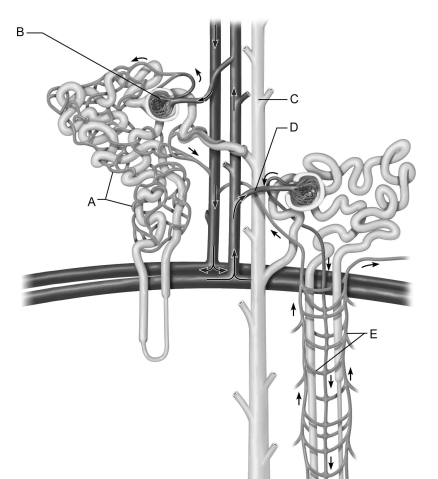
Figure 24.2
Use the diagram above to answer the following questions.
Identify the letter that indicates the region of the nephron with receptors sensitive to antidiuretic hormone (ADH).
A) A
B) B
C) C
D) D
E) E

سؤال
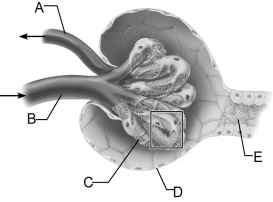
Figure 24.3
Use the diagram above to answer the following questions.
Identify the letter that indicates blood vessels covered by podocytes.
A) A
B) B
C) C
D) D
E) E
سؤال
Figure 24.2
Use the diagram above to answer the following questions.
Identify the letter that indicates the afferent arteriole.
A) A
B) B
C) C
D) D
E) E
سؤال
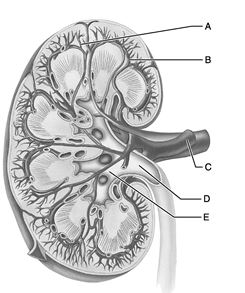
Figure 24.1
Use the diagram above to answer the following questions.
Identify the letter that indicates a cortical radiate artery.
A) A
B) B
C) C
D) D
E) E
سؤال
Figure 24.2
Use the diagram above to answer the following questions.
Identify the letter that indicates the glomerulus.
A) A
B) B
C) C
D) D
E) E
سؤال
Figure 24.1
Use the diagram above to answer the following questions.
Identify the letter that indicates an expanded portion of the ureter.
A) A
B) B
C) C
D) D
E) E
سؤال
Figure 24.3
Use the diagram above to answer the following questions.
Identify the letter that indicates the proximal convoluted tubule.
A) A
B) B
C) C
D) D
E) E
سؤال
Figure 24.3
Use the diagram above to answer the following questions.
Identify the letter that indicates the efferent arteriole.
A) A
B) B
C) C
D) D
E) E
سؤال
سؤال
سؤال
Figure 24.3
Use the diagram above to answer the following questions.
Identify the letter that indicates the parietal layer of glomerular capsule.
A) A
B) B
C) C
D) D
E) E
سؤال
Figure 24.1
Use the diagram above to answer the following questions.
Identify the letter that indicates the blood vessel that branches from the abdominal aorta carrying oxygenated blood to the kidney.
A) A
B) B
C) C
D) D
E) E
سؤال
سؤال
Figure 24.3
Use the diagram above to answer the following questions.
Identify the letter that indicates the visceral layer of the glomerular capsule.
A) A
B) B
C) C
D) D
E) E
سؤال
سؤال
Figure 24.2
Use the diagram above to answer the following questions.
Identify the letter that indicates the vasa recta.
A) A
B) B
C) C
D) D
E) E
سؤال
Figure 24.2
Use the diagram above to answer the following questions.
Identify the letter that indicates blood vessels that absorb solutes from the convoluted tubules.
A) A
B) B
C) C
D) D
E) E
سؤال
Figure 24.1
Use the diagram above to answer the following questions.
Identify the letter that indicates the major calyx.
A) A
B) B
C) C
D) D
E) E
سؤال
Figure 24.1
Use the diagram above to answer the following questions.
Identify the letter that indicates the blood vessels that delineate the cortex from the medulla.
A) A
B) B
C) C
D) D
E) E
سؤال
سؤال
سؤال
سؤال
سؤال
سؤال
سؤال
سؤال
سؤال
سؤال
سؤال
سؤال
سؤال
سؤال
سؤال
سؤال
سؤال
سؤال
سؤال
سؤال
سؤال
سؤال
سؤال
سؤال
سؤال
سؤال
سؤال
سؤال
سؤال
سؤال
سؤال
سؤال
سؤال
سؤال
سؤال
سؤال
سؤال
سؤال
سؤال
سؤال
سؤال
سؤال
سؤال
سؤال
سؤال
سؤال
سؤال
سؤال
سؤال
سؤال
سؤال
سؤال
سؤال
سؤال
سؤال
سؤال
سؤال
سؤال
سؤال
سؤال
سؤال

فتح الحزمة
قم بالتسجيل لفتح البطاقات في هذه المجموعة!
Unlock Deck
Unlock Deck
1/116

العب

ملء الشاشة (f)
Deck 24: The Urinary System
1
Figure 24.2
Use the diagram above to answer the following questions.
Identify the letter that indicates the region of the nephron with receptors sensitive to antidiuretic hormone (ADH).
A) A
B) B
C) C
D) D
E) E
C
2
Figure 24.3
Use the diagram above to answer the following questions.
Identify the letter that indicates blood vessels covered by podocytes.
A) A
B) B
C) C
D) D
E) E
C
3
Figure 24.2
Use the diagram above to answer the following questions.
Identify the letter that indicates the afferent arteriole.
A) A
B) B
C) C
D) D
E) E
D
4
Figure 24.1
Use the diagram above to answer the following questions.
Identify the letter that indicates a cortical radiate artery.
A) A
B) B
C) C
D) D
E) E
فتح الحزمة
افتح القفل للوصول البطاقات البالغ عددها 116 في هذه المجموعة.
فتح الحزمة
k this deck
5
Figure 24.2
Use the diagram above to answer the following questions.
Identify the letter that indicates the glomerulus.
A) A
B) B
C) C
D) D
E) E
فتح الحزمة
افتح القفل للوصول البطاقات البالغ عددها 116 في هذه المجموعة.
فتح الحزمة
k this deck
6
Figure 24.1
Use the diagram above to answer the following questions.
Identify the letter that indicates an expanded portion of the ureter.
A) A
B) B
C) C
D) D
E) E
فتح الحزمة
افتح القفل للوصول البطاقات البالغ عددها 116 في هذه المجموعة.
فتح الحزمة
k this deck
7
Figure 24.3
Use the diagram above to answer the following questions.
Identify the letter that indicates the proximal convoluted tubule.
A) A
B) B
C) C
D) D
E) E
فتح الحزمة
افتح القفل للوصول البطاقات البالغ عددها 116 في هذه المجموعة.
فتح الحزمة
k this deck
8
Figure 24.3
Use the diagram above to answer the following questions.
Identify the letter that indicates the efferent arteriole.
A) A
B) B
C) C
D) D
E) E
فتح الحزمة
افتح القفل للوصول البطاقات البالغ عددها 116 في هذه المجموعة.
فتح الحزمة
k this deck
9
85% of nephrons are described by this term that relates to their location in the kidney.
A) sinusoidal
B) trabecular
C) medullary
D) cortical
E) extrinsic
A) sinusoidal
B) trabecular
C) medullary
D) cortical
E) extrinsic
فتح الحزمة
افتح القفل للوصول البطاقات البالغ عددها 116 في هذه المجموعة.
فتح الحزمة
k this deck
10
The medial concave cleft in which vessels, ureters, and nerves enter/leave the kidney.
A) cortex
B) hilum
C) renal corpuscle
D) renal capsule
E) sinus
A) cortex
B) hilum
C) renal corpuscle
D) renal capsule
E) sinus
فتح الحزمة
افتح القفل للوصول البطاقات البالغ عددها 116 في هذه المجموعة.
فتح الحزمة
k this deck
11
Figure 24.3
Use the diagram above to answer the following questions.
Identify the letter that indicates the parietal layer of glomerular capsule.
A) A
B) B
C) C
D) D
E) E
فتح الحزمة
افتح القفل للوصول البطاقات البالغ عددها 116 في هذه المجموعة.
فتح الحزمة
k this deck
12
Figure 24.1
Use the diagram above to answer the following questions.
Identify the letter that indicates the blood vessel that branches from the abdominal aorta carrying oxygenated blood to the kidney.
A) A
B) B
C) C
D) D
E) E
فتح الحزمة
افتح القفل للوصول البطاقات البالغ عددها 116 في هذه المجموعة.
فتح الحزمة
k this deck
13
Knot of capillaries that directs blood into the efferent arteriole.
A) arcuate arteries
B) cortical radiate arteries
C) glomerulus
D) afferent arterioles
E) peritubular capillaries
A) arcuate arteries
B) cortical radiate arteries
C) glomerulus
D) afferent arterioles
E) peritubular capillaries
فتح الحزمة
افتح القفل للوصول البطاقات البالغ عددها 116 في هذه المجموعة.
فتح الحزمة
k this deck
14
Figure 24.3
Use the diagram above to answer the following questions.
Identify the letter that indicates the visceral layer of the glomerular capsule.
A) A
B) B
C) C
D) D
E) E
فتح الحزمة
افتح القفل للوصول البطاقات البالغ عددها 116 في هذه المجموعة.
فتح الحزمة
k this deck
15
Cup-shaped tubes that enclose the papillae of the pyramids.
A) major calyx
B) minor calyx
C) renal sinus
D) renal pelvis
E) cortical columns
A) major calyx
B) minor calyx
C) renal sinus
D) renal pelvis
E) cortical columns
فتح الحزمة
افتح القفل للوصول البطاقات البالغ عددها 116 في هذه المجموعة.
فتح الحزمة
k this deck
16
Figure 24.2
Use the diagram above to answer the following questions.
Identify the letter that indicates the vasa recta.
A) A
B) B
C) C
D) D
E) E
فتح الحزمة
افتح القفل للوصول البطاقات البالغ عددها 116 في هذه المجموعة.
فتح الحزمة
k this deck
17
Figure 24.2
Use the diagram above to answer the following questions.
Identify the letter that indicates blood vessels that absorb solutes from the convoluted tubules.
A) A
B) B
C) C
D) D
E) E
فتح الحزمة
افتح القفل للوصول البطاقات البالغ عددها 116 في هذه المجموعة.
فتح الحزمة
k this deck
18
Figure 24.1
Use the diagram above to answer the following questions.
Identify the letter that indicates the major calyx.
A) A
B) B
C) C
D) D
E) E
فتح الحزمة
افتح القفل للوصول البطاقات البالغ عددها 116 في هذه المجموعة.
فتح الحزمة
k this deck
19
Figure 24.1
Use the diagram above to answer the following questions.
Identify the letter that indicates the blood vessels that delineate the cortex from the medulla.
A) A
B) B
C) C
D) D
E) E
فتح الحزمة
افتح القفل للوصول البطاقات البالغ عددها 116 في هذه المجموعة.
فتح الحزمة
k this deck
20
A large fat-filled space within the kidney that also contains the renal pelvis, blood vessels, and nerves.
A) sinus
B) convoluted tubules
C) renal corpuscle
D) renal pyramids
E) cortical columns
A) sinus
B) convoluted tubules
C) renal corpuscle
D) renal pyramids
E) cortical columns
فتح الحزمة
افتح القفل للوصول البطاقات البالغ عددها 116 في هذه المجموعة.
فتح الحزمة
k this deck
21
How much of the fluid filtered by the kidney actually becomes urine?
A) 1%
B) 10%
C) 50%
D) 99%
A) 1%
B) 10%
C) 50%
D) 99%
فتح الحزمة
افتح القفل للوصول البطاقات البالغ عددها 116 في هذه المجموعة.
فتح الحزمة
k this deck
22
Which of the following is not normally found in urine?
A) urea
B) glucose
C) uric acid
D) creatinine
A) urea
B) glucose
C) uric acid
D) creatinine
فتح الحزمة
افتح القفل للوصول البطاقات البالغ عددها 116 في هذه المجموعة.
فتح الحزمة
k this deck
23
The most superficial layer of the kidney is the
A) cortex.
B) medulla.
C) renal pyramids.
D) renal papilla.
A) cortex.
B) medulla.
C) renal pyramids.
D) renal papilla.
فتح الحزمة
افتح القفل للوصول البطاقات البالغ عددها 116 في هذه المجموعة.
فتح الحزمة
k this deck
24
Which of the following supportive tissues is most superficial?
A) fibrous capsule
B) pararenal fat
C) perirenal fat
D) renal fascia
A) fibrous capsule
B) pararenal fat
C) perirenal fat
D) renal fascia
فتح الحزمة
افتح القفل للوصول البطاقات البالغ عددها 116 في هذه المجموعة.
فتح الحزمة
k this deck
25
Region of the distal tubule that monitors concentration of the filtrate.
A) vasa recta
B) collecting duct
C) macula densa
D) mesangial
E) extraglomerular
A) vasa recta
B) collecting duct
C) macula densa
D) mesangial
E) extraglomerular
فتح الحزمة
افتح القفل للوصول البطاقات البالغ عددها 116 في هذه المجموعة.
فتح الحزمة
k this deck
26
Which of the following processes does not participate in the production of urine in the kidney?
A) filtration
B) secretion
C) evaporation
D) resorption
A) filtration
B) secretion
C) evaporation
D) resorption
فتح الحزمة
افتح القفل للوصول البطاقات البالغ عددها 116 في هذه المجموعة.
فتح الحزمة
k this deck
27
The function of the collecting duct is to
A) contract its muscular walls to expel urine from the cortex.
B) determine the final volume and concentration of urine.
C) drain blood from the kidney and deliver it to the renal vein.
D) transport resorbed water back into the cardiovascular system.
A) contract its muscular walls to expel urine from the cortex.
B) determine the final volume and concentration of urine.
C) drain blood from the kidney and deliver it to the renal vein.
D) transport resorbed water back into the cardiovascular system.
فتح الحزمة
افتح القفل للوصول البطاقات البالغ عددها 116 في هذه المجموعة.
فتح الحزمة
k this deck
28
Contraction of this muscle forces urine from the bladder.
A) cremaster
B) detrusor
C) diaphragm
D) vesicular
E) dartos
A) cremaster
B) detrusor
C) diaphragm
D) vesicular
E) dartos
فتح الحزمة
افتح القفل للوصول البطاقات البالغ عددها 116 في هذه المجموعة.
فتح الحزمة
k this deck
29
The only embryonic kidney that survives into adulthood is the
A) pronephros.
B) mesonephros.
C) metanephros.
D) paranephros.
A) pronephros.
B) mesonephros.
C) metanephros.
D) paranephros.
فتح الحزمة
افتح القفل للوصول البطاقات البالغ عددها 116 في هذه المجموعة.
فتح الحزمة
k this deck
30
Which of the following is not part of the filtration membrane?
A) basement membrane
B) capillary endothelium
C) filtration slit diaphragm
D) granular cells
A) basement membrane
B) capillary endothelium
C) filtration slit diaphragm
D) granular cells
فتح الحزمة
افتح القفل للوصول البطاقات البالغ عددها 116 في هذه المجموعة.
فتح الحزمة
k this deck
31
Which vessels lie within the renal columns?
A) arcuate arteries
B) cortical radiate arteries
C) interlobar arteries
D) segmental arteries
A) arcuate arteries
B) cortical radiate arteries
C) interlobar arteries
D) segmental arteries
فتح الحزمة
افتح القفل للوصول البطاقات البالغ عددها 116 في هذه المجموعة.
فتح الحزمة
k this deck
32
Ladderlike looping blood vessels within the medulla.
A) vasa vasorum
B) peritubular capillaries
C) cortical radiate
D) vasa recta
E) interlobular
A) vasa vasorum
B) peritubular capillaries
C) cortical radiate
D) vasa recta
E) interlobular
فتح الحزمة
افتح القفل للوصول البطاقات البالغ عددها 116 في هذه المجموعة.
فتح الحزمة
k this deck
33
Vessels and nerves enter and leave the kidney through the
A) fibrous capsule.
B) lateral convex surface.
C) inferior surface.
D) medial hilum.
A) fibrous capsule.
B) lateral convex surface.
C) inferior surface.
D) medial hilum.
فتح الحزمة
افتح القفل للوصول البطاقات البالغ عددها 116 في هذه المجموعة.
فتح الحزمة
k this deck
34
Before it enters the ureter, urine collects in the
A) renal sinus.
B) renal pelvis.
C) renal cortex.
D) renal pyramids.
A) renal sinus.
B) renal pelvis.
C) renal cortex.
D) renal pyramids.
فتح الحزمة
افتح القفل للوصول البطاقات البالغ عددها 116 في هذه المجموعة.
فتح الحزمة
k this deck
35
The descriptive term for the location of the kidneys relative to the abdominal cavity.
A) retroperitoneal
B) intraperitoneal
C) extraabdominal
D) supraperitoneal
E) subcapsular
A) retroperitoneal
B) intraperitoneal
C) extraabdominal
D) supraperitoneal
E) subcapsular
فتح الحزمة
افتح القفل للوصول البطاقات البالغ عددها 116 في هذه المجموعة.
فتح الحزمة
k this deck
36
Blood vessel that contains granular cells involved in blood pressure regulation.
A) afferent arteriole
B) efferent arteriole
C) segmental artery
D) macula densa
E) extraglomerular mesangial
A) afferent arteriole
B) efferent arteriole
C) segmental artery
D) macula densa
E) extraglomerular mesangial
فتح الحزمة
افتح القفل للوصول البطاقات البالغ عددها 116 في هذه المجموعة.
فتح الحزمة
k this deck
37
If you looked closely at the tip of a renal papilla with a hand lens, the hundreds of little openings you would see on its surface are
A) minor calyces.
B) renal sinuses.
C) openings of papillary ducts.
D) glomeruli.
A) minor calyces.
B) renal sinuses.
C) openings of papillary ducts.
D) glomeruli.
فتح الحزمة
افتح القفل للوصول البطاقات البالغ عددها 116 في هذه المجموعة.
فتح الحزمة
k this deck
38
Which of the following is not found in the renal corpuscle?
A) the glomerulus
B) the nephron loop
C) glomerular capsule
D) podocytes
A) the glomerulus
B) the nephron loop
C) glomerular capsule
D) podocytes
فتح الحزمة
افتح القفل للوصول البطاقات البالغ عددها 116 في هذه المجموعة.
فتح الحزمة
k this deck
39
The kidneys lie behind the ________ cavity.
A) abdominal
B) pelvic
C) thoracic
D) cranial
A) abdominal
B) pelvic
C) thoracic
D) cranial
فتح الحزمة
افتح القفل للوصول البطاقات البالغ عددها 116 في هذه المجموعة.
فتح الحزمة
k this deck
40
Infection of the renal pelvic and calyces is known as
A) nephritis.
B) cystitis.
C) hydronephritis.
D) pyelitis.
A) nephritis.
B) cystitis.
C) hydronephritis.
D) pyelitis.
فتح الحزمة
افتح القفل للوصول البطاقات البالغ عددها 116 في هذه المجموعة.
فتح الحزمة
k this deck
41
The mucosal folds in the bladder (rugae)
A) act to increase the surface area for absorption.
B) thicken the bladder wall so that it does not burst.
C) are not present in life, only in cadavers.
D) have the same basic function as transitional epithelium-accommodating stretch as the bladder fills.
A) act to increase the surface area for absorption.
B) thicken the bladder wall so that it does not burst.
C) are not present in life, only in cadavers.
D) have the same basic function as transitional epithelium-accommodating stretch as the bladder fills.
فتح الحزمة
افتح القفل للوصول البطاقات البالغ عددها 116 في هذه المجموعة.
فتح الحزمة
k this deck
42
Based on what you know about the location of the kidneys in the posterior abdominal wall, the hilum of the kidney must be at the level of which vertebra?
A) T₁₁ or T₁₂
B) L₁ or L₂
C) L₄
D) T₈
A) T₁₁ or T₁₂
B) L₁ or L₂
C) L₄
D) T₈
فتح الحزمة
افتح القفل للوصول البطاقات البالغ عددها 116 في هذه المجموعة.
فتح الحزمة
k this deck
43
Which of the following conditions is most often seen in elderly males with prostatic hyperplasia?
A) urge incontinence
B) overflow incontinence
C) urinary retention
D) stress incontinence
A) urge incontinence
B) overflow incontinence
C) urinary retention
D) stress incontinence
فتح الحزمة
افتح القفل للوصول البطاقات البالغ عددها 116 في هذه المجموعة.
فتح الحزمة
k this deck
44
Renin is produced in
A) the glomerulus.
B) the renal medulla.
C) the granular cells.
D) glomerular capsules.
A) the glomerulus.
B) the renal medulla.
C) the granular cells.
D) glomerular capsules.
فتح الحزمة
افتح القفل للوصول البطاقات البالغ عددها 116 في هذه المجموعة.
فتح الحزمة
k this deck
45
The name of the inferior of the three openings in the trigone of the bladder is the
A) ureteric orifice.
B) urachus opening.
C) internal urethral orifice.
D) detrusor.
A) ureteric orifice.
B) urachus opening.
C) internal urethral orifice.
D) detrusor.
فتح الحزمة
افتح القفل للوصول البطاقات البالغ عددها 116 في هذه المجموعة.
فتح الحزمة
k this deck
46
The left renal vein ________ the right renal vein.
A) is shorter than
B) is the same length as
C) is longer than
D) carries less blood than
A) is shorter than
B) is the same length as
C) is longer than
D) carries less blood than
فتح الحزمة
افتح القفل للوصول البطاقات البالغ عددها 116 في هذه المجموعة.
فتح الحزمة
k this deck
47
From which embryonic tissue layer(s) does the kidney arise?
A) ectoderm
B) mesoderm
C) endoderm
D) all three layers
A) ectoderm
B) mesoderm
C) endoderm
D) all three layers
فتح الحزمة
افتح القفل للوصول البطاقات البالغ عددها 116 في هذه المجموعة.
فتح الحزمة
k this deck
48
The part of the nephron whose epithelial cells are most responsible for resorption and secretion is the
A) glomerular capsule (podocytes).
B) proximal tubule.
C) thin segment.
D) distal tubule.
A) glomerular capsule (podocytes).
B) proximal tubule.
C) thin segment.
D) distal tubule.
فتح الحزمة
افتح القفل للوصول البطاقات البالغ عددها 116 في هذه المجموعة.
فتح الحزمة
k this deck
49
Why are urinary tract infections more common in females than in males?
A) In males the urethra is made up of three regions, whereas in females it is made of only one.
B) In females the urethra is attached to the anterior vaginal wall by connective tissue.
C) In females the urethra is shorter than in males.
D) In males the urethra is shared by the both the reproductive and the urinary systems, whereas in females it is part of the urinary system only.
A) In males the urethra is made up of three regions, whereas in females it is made of only one.
B) In females the urethra is attached to the anterior vaginal wall by connective tissue.
C) In females the urethra is shorter than in males.
D) In males the urethra is shared by the both the reproductive and the urinary systems, whereas in females it is part of the urinary system only.
فتح الحزمة
افتح القفل للوصول البطاقات البالغ عددها 116 في هذه المجموعة.
فتح الحزمة
k this deck
50
Which of the following is found exclusively in the renal medulla?
A) nephron loop of juxtamedullary nephrons
B) cortical radiate arteries
C) peritubular capillaries
D) proximal convoluted tubules
A) nephron loop of juxtamedullary nephrons
B) cortical radiate arteries
C) peritubular capillaries
D) proximal convoluted tubules
فتح الحزمة
افتح القفل للوصول البطاقات البالغ عددها 116 في هذه المجموعة.
فتح الحزمة
k this deck
51
Which segment of the nephron has a simple squamous epithelium?
A) ascending limb of the nephron loop
B) descending limb of the nephron loop
C) distal convoluted tubule
D) proximal convoluted tubule
A) ascending limb of the nephron loop
B) descending limb of the nephron loop
C) distal convoluted tubule
D) proximal convoluted tubule
فتح الحزمة
افتح القفل للوصول البطاقات البالغ عددها 116 في هذه المجموعة.
فتح الحزمة
k this deck
52
Pyelography is
A) kinking of the ureter.
B) a type of X-ray procedure (radiology).
C) a way to cure kidney stones.
D) failure of the embryonic kidney to ascend.
A) kinking of the ureter.
B) a type of X-ray procedure (radiology).
C) a way to cure kidney stones.
D) failure of the embryonic kidney to ascend.
فتح الحزمة
افتح القفل للوصول البطاقات البالغ عددها 116 في هذه المجموعة.
فتح الحزمة
k this deck
53
Of the following, the only epithelial type that does not line the urethra is
A) simple squamous.
B) pseudostratified columnar.
C) stratified squamous.
D) stratified columnar.
A) simple squamous.
B) pseudostratified columnar.
C) stratified squamous.
D) stratified columnar.
فتح الحزمة
افتح القفل للوصول البطاقات البالغ عددها 116 في هذه المجموعة.
فتح الحزمة
k this deck
54
Which of the following statements about the urinary bladder is False?
A) In females, the bladder lies posterior to the uterus but anterior to the rectum.
B) The ureters attach to the bladder through oblique posterolateral orifices.
C) Two ureteral openings and the internal urethral orifice bound the trigone of the bladder.
D) When empty, the bladder lies inferior to the abdominal cavity.
A) In females, the bladder lies posterior to the uterus but anterior to the rectum.
B) The ureters attach to the bladder through oblique posterolateral orifices.
C) Two ureteral openings and the internal urethral orifice bound the trigone of the bladder.
D) When empty, the bladder lies inferior to the abdominal cavity.
فتح الحزمة
افتح القفل للوصول البطاقات البالغ عددها 116 في هذه المجموعة.
فتح الحزمة
k this deck
55
The layer of podocytes is the same as the
A) parietal layer.
B) glomerulus.
C) visceral layer of glomerular capsule.
D) capsular space.
A) parietal layer.
B) glomerulus.
C) visceral layer of glomerular capsule.
D) capsular space.
فتح الحزمة
افتح القفل للوصول البطاقات البالغ عددها 116 في هذه المجموعة.
فتح الحزمة
k this deck
56
An important difference between the peritubular capillaries and the vasa recta in the kidney is that
A) only the vasa recta are supplied by efferent arterioles.
B) the vasa recta drain into arterioles, whereas the peritubular capillaries drain into venules.
C) the vasa recta are involved in filtration, whereas the peritubular capillaries are involved in resorption.
D) the vasa recta are in the medulla, whereas the peritubular capillaries are in the cortex.
A) only the vasa recta are supplied by efferent arterioles.
B) the vasa recta drain into arterioles, whereas the peritubular capillaries drain into venules.
C) the vasa recta are involved in filtration, whereas the peritubular capillaries are involved in resorption.
D) the vasa recta are in the medulla, whereas the peritubular capillaries are in the cortex.
فتح الحزمة
افتح القفل للوصول البطاقات البالغ عددها 116 في هذه المجموعة.
فتح الحزمة
k this deck
57
An important difference between a cuboidal epithelial cell of the proximal versus the distal convoluted tubules is that
A) the former only secretes, the latter only filters.
B) one lies in the renal cortex, the other in the medulla.
C) only one has a folded basolateral membrane containing enzymes for ion transport.
D) the proximal tubule cells have long microvilli that are fewer than or absent from the distal tubule cells.
A) the former only secretes, the latter only filters.
B) one lies in the renal cortex, the other in the medulla.
C) only one has a folded basolateral membrane containing enzymes for ion transport.
D) the proximal tubule cells have long microvilli that are fewer than or absent from the distal tubule cells.
فتح الحزمة
افتح القفل للوصول البطاقات البالغ عددها 116 في هذه المجموعة.
فتح الحزمة
k this deck
58
Which of the following statements about the internal urethral sphincter is False?
A) It is a thickening of the detrusor muscle.
B) It is located superior to the prostatic urethra in males.
C) It is not consciously controlled.
D) It is surrounded by the urogential diaphragm.
A) It is a thickening of the detrusor muscle.
B) It is located superior to the prostatic urethra in males.
C) It is not consciously controlled.
D) It is surrounded by the urogential diaphragm.
فتح الحزمة
افتح القفل للوصول البطاقات البالغ عددها 116 في هذه المجموعة.
فتح الحزمة
k this deck
59
Which of the following is not usually associated with the formation of renal calculi?
A) increased intake of calcium
B) polyurea
C) dehydration
D) bacterial infection
A) increased intake of calcium
B) polyurea
C) dehydration
D) bacterial infection
فتح الحزمة
افتح القفل للوصول البطاقات البالغ عددها 116 في هذه المجموعة.
فتح الحزمة
k this deck
60
Which of the following would not inhibit micturition?
A) stimulation of the somatic motor neurons to the external urethral sphincter
B) activation of the sympathetic pathways
C) relaxation of the internal urethal sphincter
D) relaxation of the detrusor muscles
A) stimulation of the somatic motor neurons to the external urethral sphincter
B) activation of the sympathetic pathways
C) relaxation of the internal urethal sphincter
D) relaxation of the detrusor muscles
فتح الحزمة
افتح القفل للوصول البطاقات البالغ عددها 116 في هذه المجموعة.
فتح الحزمة
k this deck
61
The micturition center is located in the
A) cerebellum.
B) detrusor muscle layer of the bladder wall.
C) pons of the brain stem.
D) sacral spinal cord.
A) cerebellum.
B) detrusor muscle layer of the bladder wall.
C) pons of the brain stem.
D) sacral spinal cord.
فتح الحزمة
افتح القفل للوصول البطاقات البالغ عددها 116 في هذه المجموعة.
فتح الحزمة
k this deck
62
In the micturition reflex, the detrusor muscle is stimulated to contract by
A) sphincter neurons from the brain.
B) sympathetic fibers.
C) parasympathetic fibers.
D) visceral sensory fibers from the vagus.
A) sphincter neurons from the brain.
B) sympathetic fibers.
C) parasympathetic fibers.
D) visceral sensory fibers from the vagus.
فتح الحزمة
افتح القفل للوصول البطاقات البالغ عددها 116 في هذه المجموعة.
فتح الحزمة
k this deck
63
The parts of the nephron whose epithelial cells contain the most mitochondria are the
A) renal corpuscle and distal tubule.
B) proximal and distal tubules.
C) thin segment and glomerular capsule.
D) vasa recta and collecting tubules.
A) renal corpuscle and distal tubule.
B) proximal and distal tubules.
C) thin segment and glomerular capsule.
D) vasa recta and collecting tubules.
فتح الحزمة
افتح القفل للوصول البطاقات البالغ عددها 116 في هذه المجموعة.
فتح الحزمة
k this deck
64
Another name for the neck of the bladder is the
A) superior surface.
B) anterior angle.
C) inferior angle.
D) trigone.
A) superior surface.
B) anterior angle.
C) inferior angle.
D) trigone.
فتح الحزمة
افتح القفل للوصول البطاقات البالغ عددها 116 في هذه المجموعة.
فتح الحزمة
k this deck
65
In the juxtaglomerular apparatus, the macula densa belongs to the
A) terminal nephron loop.
B) glomerulus.
C) efferent arteriole.
D) visceral layer of the glomerular capsule (podocytes).
A) terminal nephron loop.
B) glomerulus.
C) efferent arteriole.
D) visceral layer of the glomerular capsule (podocytes).
فتح الحزمة
افتح القفل للوصول البطاقات البالغ عددها 116 في هذه المجموعة.
فتح الحزمة
k this deck
66
The external urethral sphincter is located
A) at the external urethral orifice.
B) at the junction of the bladder wall and urethra.
C) at the ureteral orifice.
D) at the urogenital diaphragm.
A) at the external urethral orifice.
B) at the junction of the bladder wall and urethra.
C) at the ureteral orifice.
D) at the urogenital diaphragm.
فتح الحزمة
افتح القفل للوصول البطاقات البالغ عددها 116 في هذه المجموعة.
فتح الحزمة
k this deck
67
Which structure(s) is (are) most important for holding the kidney in place in the abdomen?
A) renal vessels
B) renal ligaments
C) renal fascia
D) the diaphragm, through its muscle tone
A) renal vessels
B) renal ligaments
C) renal fascia
D) the diaphragm, through its muscle tone
فتح الحزمة
افتح القفل للوصول البطاقات البالغ عددها 116 في هذه المجموعة.
فتح الحزمة
k this deck
68
An increase in the permeability of collecting tubule cells to water is due to
A) a decrease in the production of ADH.
B) an increase in the production of ADH.
C) a decrease in the concentration of solutes in the blood plasma.
D) the presence of a salty urine in the bladder.
A) a decrease in the production of ADH.
B) an increase in the production of ADH.
C) a decrease in the concentration of solutes in the blood plasma.
D) the presence of a salty urine in the bladder.
فتح الحزمة
افتح القفل للوصول البطاقات البالغ عددها 116 في هذه المجموعة.
فتح الحزمة
k this deck
69
Which of the following structures is most numerous within a kidney?
A) cortical radiate arteries
B) minor calyces
C) renal corpuscles
D) renal papillae
A) cortical radiate arteries
B) minor calyces
C) renal corpuscles
D) renal papillae
فتح الحزمة
افتح القفل للوصول البطاقات البالغ عددها 116 في هذه المجموعة.
فتح الحزمة
k this deck
70
When Melinda was asked to identify a "mystery" slide on a histology test, she immediately identified it as renal cortex because of the presence of scattered
A) renal corpuscles.
B) thin segments.
C) renal papillae.
D) vasa recta.
A) renal corpuscles.
B) thin segments.
C) renal papillae.
D) vasa recta.
فتح الحزمة
افتح القفل للوصول البطاقات البالغ عددها 116 في هذه المجموعة.
فتح الحزمة
k this deck
71
Which of the following regions of the nephron is most likely to be found in the renal medulla?
A) glomerulus
B) proximal convoluted tubule
C) distal convoluted tubule
D) collecting duct
A) glomerulus
B) proximal convoluted tubule
C) distal convoluted tubule
D) collecting duct
فتح الحزمة
افتح القفل للوصول البطاقات البالغ عددها 116 في هذه المجموعة.
فتح الحزمة
k this deck
72
The condition in which the metanephros has failed to ascend is
A) horseshoe kidney.
B) polycystic renal disease.
C) hydronephrosis.
D) pelvic kidney.
A) horseshoe kidney.
B) polycystic renal disease.
C) hydronephrosis.
D) pelvic kidney.
فتح الحزمة
افتح القفل للوصول البطاقات البالغ عددها 116 في هذه المجموعة.
فتح الحزمة
k this deck
73
The longest of the three parts of the male urethra is the
A) prostatic.
B) membranous.
C) spongy urethra.
D) neck.
A) prostatic.
B) membranous.
C) spongy urethra.
D) neck.
فتح الحزمة
افتح القفل للوصول البطاقات البالغ عددها 116 في هذه المجموعة.
فتح الحزمة
k this deck
74
Cortical nephrons are different from juxtamedullary nephrons in that
A) they are much less abundant.
B) they produce urine, whereas juxtamedullary nephrons do not.
C) their nephron loop is shorter, with a shorter thin segment.
D) they do not have a proximal convoluted tubule.
A) they are much less abundant.
B) they produce urine, whereas juxtamedullary nephrons do not.
C) their nephron loop is shorter, with a shorter thin segment.
D) they do not have a proximal convoluted tubule.
فتح الحزمة
افتح القفل للوصول البطاقات البالغ عددها 116 في هذه المجموعة.
فتح الحزمة
k this deck
75
Urine passes through the
A) kidney hilum to the bladder to the ureter.
B) renal pelvis to the ureter to the bladder to the urethra.
C) glomerulus to the ureter to the nephron.
D) hilus to the urethra to the bladder.
A) kidney hilum to the bladder to the ureter.
B) renal pelvis to the ureter to the bladder to the urethra.
C) glomerulus to the ureter to the nephron.
D) hilus to the urethra to the bladder.
فتح الحزمة
افتح القفل للوصول البطاقات البالغ عددها 116 في هذه المجموعة.
فتح الحزمة
k this deck
76
The epithelium lining the urinary bladder that permits distension is
A) stratified squamous.
B) transitional.
C) simple squamous.
D) pseudostratified columnar.
A) stratified squamous.
B) transitional.
C) simple squamous.
D) pseudostratified columnar.
فتح الحزمة
افتح القفل للوصول البطاقات البالغ عددها 116 في هذه المجموعة.
فتح الحزمة
k this deck
77
The embryonic urogenital sinus
A) derives from the cloaca.
B) gives rise to the anus.
C) gives rise to the rectum.
D) gives rise to the ureters.
A) derives from the cloaca.
B) gives rise to the anus.
C) gives rise to the rectum.
D) gives rise to the ureters.
فتح الحزمة
افتح القفل للوصول البطاقات البالغ عددها 116 في هذه المجموعة.
فتح الحزمة
k this deck
78
Arteries that branch to form the afferent arterioles to the glomeruli are
A) segmental arteries.
B) arcuate arteries.
C) cortical radiate arteries.
D) interlobar arteries.
A) segmental arteries.
B) arcuate arteries.
C) cortical radiate arteries.
D) interlobar arteries.
فتح الحزمة
افتح القفل للوصول البطاقات البالغ عددها 116 في هذه المجموعة.
فتح الحزمة
k this deck
79
During a dissection, Arnie saw the ureters entering the lateral corners of the bladder but found the internal openings of the ureters in the trigone near the midline of the bladder. His observation necessarily means that
A) the ureters run medially for some distance within the posterior bladder wall.
B) the ureters and urethra are really the same tube.
C) each ureter must have four distinct openings into the bladder.
D) this bladder had a congenital defect.
A) the ureters run medially for some distance within the posterior bladder wall.
B) the ureters and urethra are really the same tube.
C) each ureter must have four distinct openings into the bladder.
D) this bladder had a congenital defect.
فتح الحزمة
افتح القفل للوصول البطاقات البالغ عددها 116 في هذه المجموعة.
فتح الحزمة
k this deck
80
The ureters develop from
A) the cloaca.
B) the urogenital sinus.
C) pronephric nephrons.
D) a duct that branches from the mesonephric duct.
A) the cloaca.
B) the urogenital sinus.
C) pronephric nephrons.
D) a duct that branches from the mesonephric duct.
فتح الحزمة
افتح القفل للوصول البطاقات البالغ عددها 116 في هذه المجموعة.
فتح الحزمة
k this deck
فتح الحزمة
افتح القفل للوصول البطاقات البالغ عددها 116 في هذه المجموعة.






