







 تكلم مع الذكاء الاصطناعي


Deck 22: Gas Exchange
ملء الشاشة (f)

سؤال

سؤال
سؤال
سؤال
سؤال
سؤال
سؤال
سؤال
سؤال
سؤال
سؤال
سؤال
سؤال
سؤال
سؤال
سؤال
سؤال
سؤال
سؤال
سؤال
سؤال
سؤال
سؤال
سؤال
سؤال
سؤال
سؤال
سؤال
سؤال
سؤال
سؤال
سؤال
سؤال
سؤال
سؤال
سؤال
سؤال
سؤال
سؤال
سؤال
سؤال
At which point(s)in the figure below would the blood have the highest concentration of CO₂? 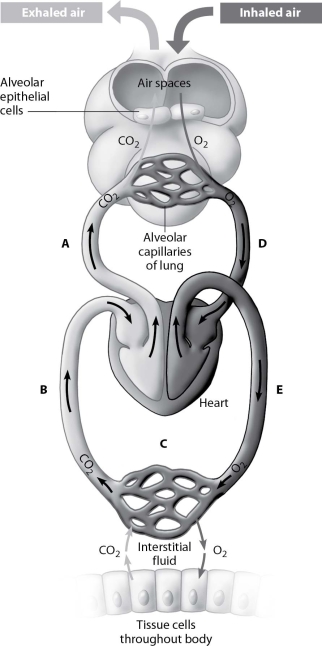
A)point A only
B)points B and C
C)point D only
D)points C and E
A)point A only
B)points B and C
C)point D only
D)points C and E
سؤال
سؤال
Which part of the diagram shows alveoli? 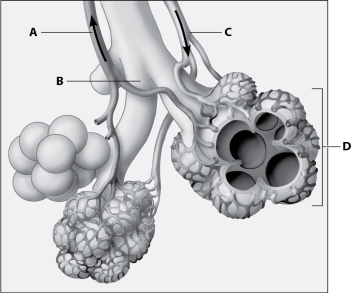
A)part A
B)part B
C)part C
D)part D
A)part A
B)part B
C)part C
D)part D
سؤال
سؤال
سؤال
سؤال
سؤال
سؤال
سؤال
At which point(s)in the figure is blood oxygen-rich? 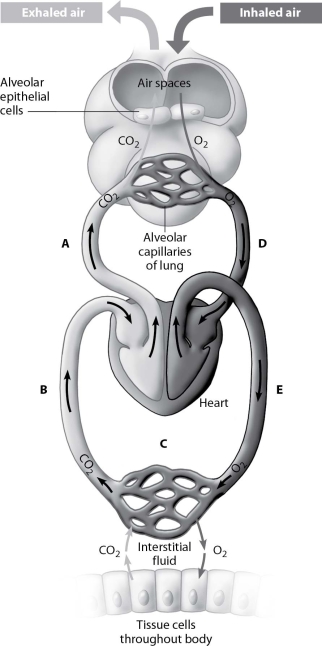
A)points A and B
B)points A and D
C)point C only
D)points D and E
A)points A and B
B)points A and D
C)point C only
D)points D and E
سؤال
After reading the paragraphs below, answer the questions that follow.
Many amphibians (including many frogs, toads, and salamanders) spend the early part of their lives in water but live on land as adults. The adults of many species return to water to breed and lay their eggs. Frogs have small lungs and supplement their oxygen intake by breathing through the skin. Although large frogs have more total surface area than smaller frogs, the larger frogs have a lower surface area/volume ratio (less skin surface relative to their total body volume). To keep their respiratory surfaces moist, frogs are generally found in wet or very moist locations.
In an experiment designed to investigate oxygen consumption in relation to body size, frogs from five different species were weighed and placed in a respirometer (a machine that measures oxygen consumption) for 1 hour. The table shows the results of the experiment.
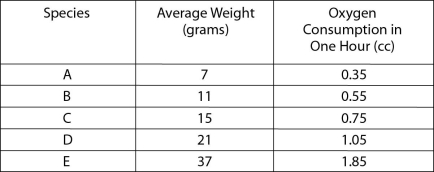
From the data in the table, it is reasonable to conclude that
A)smaller frogs consume less oxygen per gram of body weight.
B)each tested species consumes a different amount of oxygen per gram of body weight.
C)oxygen consumption per gram of body weight is the same for all tested species.
D)oxygen consumption per gram of body weight for the largest species is much higher than that for the smallest species.
Many amphibians (including many frogs, toads, and salamanders) spend the early part of their lives in water but live on land as adults. The adults of many species return to water to breed and lay their eggs. Frogs have small lungs and supplement their oxygen intake by breathing through the skin. Although large frogs have more total surface area than smaller frogs, the larger frogs have a lower surface area/volume ratio (less skin surface relative to their total body volume). To keep their respiratory surfaces moist, frogs are generally found in wet or very moist locations.
In an experiment designed to investigate oxygen consumption in relation to body size, frogs from five different species were weighed and placed in a respirometer (a machine that measures oxygen consumption) for 1 hour. The table shows the results of the experiment.
From the data in the table, it is reasonable to conclude that
A)smaller frogs consume less oxygen per gram of body weight.
B)each tested species consumes a different amount of oxygen per gram of body weight.
C)oxygen consumption per gram of body weight is the same for all tested species.
D)oxygen consumption per gram of body weight for the largest species is much higher than that for the smallest species.
سؤال
Which of the figures below represents countercurrent exchange? The arrows indicate direction of flow, and the numbers indicate temperatures in degrees Celsius. 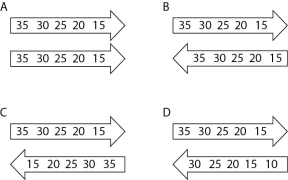
A)figure A
B)figure B
C)figure C
D)figure D
A)figure A
B)figure B
C)figure C
D)figure D
سؤال
سؤال
سؤال
سؤال
سؤال
سؤال
After reading the paragraphs below, answer the questions that follow.
Many amphibians (including many frogs, toads, and salamanders) spend the early part of their lives in water but live on land as adults. The adults of many species return to water to breed and lay their eggs. Frogs have small lungs and supplement their oxygen intake by breathing through the skin. Although large frogs have more total surface area than smaller frogs, the larger frogs have a lower surface area/volume ratio (less skin surface relative to their total body volume). To keep their respiratory surfaces moist, frogs are generally found in wet or very moist locations.
In an experiment designed to investigate oxygen consumption in relation to body size, frogs from five different species were weighed and placed in a respirometer (a machine that measures oxygen consumption) for 1 hour. The table shows the results of the experiment.
If you could alter the shape of a frog so that it was long and thin instead of compact, the frog's oxygen transfer efficiency would
A)increase, because the frog would be larger.
B)decrease, because there would be more skin area to keep moist.
C)increase, because the frog would have more surface area in relation to body volume.
D)not change at all, because the body volume would remain constant.
Many amphibians (including many frogs, toads, and salamanders) spend the early part of their lives in water but live on land as adults. The adults of many species return to water to breed and lay their eggs. Frogs have small lungs and supplement their oxygen intake by breathing through the skin. Although large frogs have more total surface area than smaller frogs, the larger frogs have a lower surface area/volume ratio (less skin surface relative to their total body volume). To keep their respiratory surfaces moist, frogs are generally found in wet or very moist locations.
In an experiment designed to investigate oxygen consumption in relation to body size, frogs from five different species were weighed and placed in a respirometer (a machine that measures oxygen consumption) for 1 hour. The table shows the results of the experiment.
If you could alter the shape of a frog so that it was long and thin instead of compact, the frog's oxygen transfer efficiency would
A)increase, because the frog would be larger.
B)decrease, because there would be more skin area to keep moist.
C)increase, because the frog would have more surface area in relation to body volume.
D)not change at all, because the body volume would remain constant.
سؤال
سؤال
سؤال
After reading the paragraphs below, answer the questions that follow.
Many amphibians (including many frogs, toads, and salamanders) spend the early part of their lives in water but live on land as adults. The adults of many species return to water to breed and lay their eggs. Frogs have small lungs and supplement their oxygen intake by breathing through the skin. Although large frogs have more total surface area than smaller frogs, the larger frogs have a lower surface area/volume ratio (less skin surface relative to their total body volume). To keep their respiratory surfaces moist, frogs are generally found in wet or very moist locations.
In an experiment designed to investigate oxygen consumption in relation to body size, frogs from five different species were weighed and placed in a respirometer (a machine that measures oxygen consumption) for 1 hour. The table shows the results of the experiment.
You have obtained a frog from a species closely related to the frogs used in the preceding study. If the frog weighs 30 grams, what do you expect its oxygen consumption in 1 hour to be?
A)0)30 cc
B)1)00 cc
C)1)50 cc
D)2)00 cc
Many amphibians (including many frogs, toads, and salamanders) spend the early part of their lives in water but live on land as adults. The adults of many species return to water to breed and lay their eggs. Frogs have small lungs and supplement their oxygen intake by breathing through the skin. Although large frogs have more total surface area than smaller frogs, the larger frogs have a lower surface area/volume ratio (less skin surface relative to their total body volume). To keep their respiratory surfaces moist, frogs are generally found in wet or very moist locations.
In an experiment designed to investigate oxygen consumption in relation to body size, frogs from five different species were weighed and placed in a respirometer (a machine that measures oxygen consumption) for 1 hour. The table shows the results of the experiment.
You have obtained a frog from a species closely related to the frogs used in the preceding study. If the frog weighs 30 grams, what do you expect its oxygen consumption in 1 hour to be?
A)0)30 cc
B)1)00 cc
C)1)50 cc
D)2)00 cc
سؤال
After reading the paragraphs below, answer the questions that follow.
Physicians routinely give their patients pulmonary function tests in order to measure characteristics of lung function. The most common of these tests, spirometry, measures both the volume and the speed of air entering and exiting the lungs. In this test, a person first breathes normally while breathing into a spirometer, a machine that measures air volume and air speed. Then the person takes the deepest breath possible and exhales as hard as possible for 6 seconds into the spirometer. The resulting data are plotted on a graph of volume (y axis) versus time (x axis). Spirometry is useful not only for assessing lung function in healthy patients but also for characterizing patients with lung conditions such as pulmonary fibrosis, asthma, or emphysema.
A sample graph for a healthy adult male is shown below. Normal breathing occurs between points A and B, a maximal inhalation occurs at point C, and a maximal exhalation occurs at point D. Normal breathing resumes between points E and F.
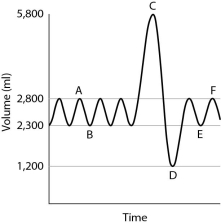
How is spirometry a potentially flawed experimental method to measure lung volume?
A)The test does not sample data for when the patient is breathing normally.
B)There is no way to calculate vital capacity using this method.
C)Patients with lung diseases or disorders cannot take spirometry tests.
D)The patient may be noncompliant and not put forth their best effort in the test.
Physicians routinely give their patients pulmonary function tests in order to measure characteristics of lung function. The most common of these tests, spirometry, measures both the volume and the speed of air entering and exiting the lungs. In this test, a person first breathes normally while breathing into a spirometer, a machine that measures air volume and air speed. Then the person takes the deepest breath possible and exhales as hard as possible for 6 seconds into the spirometer. The resulting data are plotted on a graph of volume (y axis) versus time (x axis). Spirometry is useful not only for assessing lung function in healthy patients but also for characterizing patients with lung conditions such as pulmonary fibrosis, asthma, or emphysema.
A sample graph for a healthy adult male is shown below. Normal breathing occurs between points A and B, a maximal inhalation occurs at point C, and a maximal exhalation occurs at point D. Normal breathing resumes between points E and F.
How is spirometry a potentially flawed experimental method to measure lung volume?
A)The test does not sample data for when the patient is breathing normally.
B)There is no way to calculate vital capacity using this method.
C)Patients with lung diseases or disorders cannot take spirometry tests.
D)The patient may be noncompliant and not put forth their best effort in the test.
سؤال
After reading the paragraphs below, answer the questions that follow.
Physicians routinely give their patients pulmonary function tests in order to measure characteristics of lung function. The most common of these tests, spirometry, measures both the volume and the speed of air entering and exiting the lungs. In this test, a person first breathes normally while breathing into a spirometer, a machine that measures air volume and air speed. Then the person takes the deepest breath possible and exhales as hard as possible for 6 seconds into the spirometer. The resulting data are plotted on a graph of volume (y axis) versus time (x axis). Spirometry is useful not only for assessing lung function in healthy patients but also for characterizing patients with lung conditions such as pulmonary fibrosis, asthma, or emphysema.
A sample graph for a healthy adult male is shown below. Normal breathing occurs between points A and B, a maximal inhalation occurs at point C, and a maximal exhalation occurs at point D. Normal breathing resumes between points E and F.
Patients with emphysema have lungs that are less elastic than normal. As a result, they cannot exhale as much air as a healthy person can, thereby leaving additional residual volume in the lungs. How would the preceding graph differ if an emphysema patient's data were plotted instead of a healthy person's?
A)The difference in volume between points A and B would be larger.
B)The difference in volume between points C and D would be larger.
C)Point A would be at a smaller volume.
D)Point D would be at a larger volume.
Physicians routinely give their patients pulmonary function tests in order to measure characteristics of lung function. The most common of these tests, spirometry, measures both the volume and the speed of air entering and exiting the lungs. In this test, a person first breathes normally while breathing into a spirometer, a machine that measures air volume and air speed. Then the person takes the deepest breath possible and exhales as hard as possible for 6 seconds into the spirometer. The resulting data are plotted on a graph of volume (y axis) versus time (x axis). Spirometry is useful not only for assessing lung function in healthy patients but also for characterizing patients with lung conditions such as pulmonary fibrosis, asthma, or emphysema.
A sample graph for a healthy adult male is shown below. Normal breathing occurs between points A and B, a maximal inhalation occurs at point C, and a maximal exhalation occurs at point D. Normal breathing resumes between points E and F.
Patients with emphysema have lungs that are less elastic than normal. As a result, they cannot exhale as much air as a healthy person can, thereby leaving additional residual volume in the lungs. How would the preceding graph differ if an emphysema patient's data were plotted instead of a healthy person's?
A)The difference in volume between points A and B would be larger.
B)The difference in volume between points C and D would be larger.
C)Point A would be at a smaller volume.
D)Point D would be at a larger volume.
سؤال
After reading the paragraphs below, answer the questions that follow.
Physicians routinely give their patients pulmonary function tests in order to measure characteristics of lung function. The most common of these tests, spirometry, measures both the volume and the speed of air entering and exiting the lungs. In this test, a person first breathes normally while breathing into a spirometer, a machine that measures air volume and air speed. Then the person takes the deepest breath possible and exhales as hard as possible for 6 seconds into the spirometer. The resulting data are plotted on a graph of volume (y axis) versus time (x axis). Spirometry is useful not only for assessing lung function in healthy patients but also for characterizing patients with lung conditions such as pulmonary fibrosis, asthma, or emphysema.
A sample graph for a healthy adult male is shown below. Normal breathing occurs between points A and B, a maximal inhalation occurs at point C, and a maximal exhalation occurs at point D. Normal breathing resumes between points E and F.
For this data set, how much air is exhaled during a normal breath?
A)500 mL
B)1,200 mL
C)2,300 mL
D)2,800 mL
Physicians routinely give their patients pulmonary function tests in order to measure characteristics of lung function. The most common of these tests, spirometry, measures both the volume and the speed of air entering and exiting the lungs. In this test, a person first breathes normally while breathing into a spirometer, a machine that measures air volume and air speed. Then the person takes the deepest breath possible and exhales as hard as possible for 6 seconds into the spirometer. The resulting data are plotted on a graph of volume (y axis) versus time (x axis). Spirometry is useful not only for assessing lung function in healthy patients but also for characterizing patients with lung conditions such as pulmonary fibrosis, asthma, or emphysema.
A sample graph for a healthy adult male is shown below. Normal breathing occurs between points A and B, a maximal inhalation occurs at point C, and a maximal exhalation occurs at point D. Normal breathing resumes between points E and F.
For this data set, how much air is exhaled during a normal breath?
A)500 mL
B)1,200 mL
C)2,300 mL
D)2,800 mL
سؤال
After reading the paragraphs below, answer the questions that follow.
Physicians routinely give their patients pulmonary function tests in order to measure characteristics of lung function. The most common of these tests, spirometry, measures both the volume and the speed of air entering and exiting the lungs. In this test, a person first breathes normally while breathing into a spirometer, a machine that measures air volume and air speed. Then the person takes the deepest breath possible and exhales as hard as possible for 6 seconds into the spirometer. The resulting data are plotted on a graph of volume (y axis) versus time (x axis). Spirometry is useful not only for assessing lung function in healthy patients but also for characterizing patients with lung conditions such as pulmonary fibrosis, asthma, or emphysema.
A sample graph for a healthy adult male is shown below. Normal breathing occurs between points A and B, a maximal inhalation occurs at point C, and a maximal exhalation occurs at point D. Normal breathing resumes between points E and F.
For this data set, what is the residual volume?
A)500 mL
B)1,200 mL
C)2,300 mL
D)2,800 mL
Physicians routinely give their patients pulmonary function tests in order to measure characteristics of lung function. The most common of these tests, spirometry, measures both the volume and the speed of air entering and exiting the lungs. In this test, a person first breathes normally while breathing into a spirometer, a machine that measures air volume and air speed. Then the person takes the deepest breath possible and exhales as hard as possible for 6 seconds into the spirometer. The resulting data are plotted on a graph of volume (y axis) versus time (x axis). Spirometry is useful not only for assessing lung function in healthy patients but also for characterizing patients with lung conditions such as pulmonary fibrosis, asthma, or emphysema.
A sample graph for a healthy adult male is shown below. Normal breathing occurs between points A and B, a maximal inhalation occurs at point C, and a maximal exhalation occurs at point D. Normal breathing resumes between points E and F.
For this data set, what is the residual volume?
A)500 mL
B)1,200 mL
C)2,300 mL
D)2,800 mL
سؤال
After reading the paragraphs below, answer the questions that follow.
Physicians routinely give their patients pulmonary function tests in order to measure characteristics of lung function. The most common of these tests, spirometry, measures both the volume and the speed of air entering and exiting the lungs. In this test, a person first breathes normally while breathing into a spirometer, a machine that measures air volume and air speed. Then the person takes the deepest breath possible and exhales as hard as possible for 6 seconds into the spirometer. The resulting data are plotted on a graph of volume (y axis) versus time (x axis). Spirometry is useful not only for assessing lung function in healthy patients but also for characterizing patients with lung conditions such as pulmonary fibrosis, asthma, or emphysema.
A sample graph for a healthy adult male is shown below. Normal breathing occurs between points A and B, a maximal inhalation occurs at point C, and a maximal exhalation occurs at point D. Normal breathing resumes between points E and F.
For this data set, what is the vital capacity?
A)1,200 mL
B)2,800 mL
C)4,600 mL
D)5,800 mL
Physicians routinely give their patients pulmonary function tests in order to measure characteristics of lung function. The most common of these tests, spirometry, measures both the volume and the speed of air entering and exiting the lungs. In this test, a person first breathes normally while breathing into a spirometer, a machine that measures air volume and air speed. Then the person takes the deepest breath possible and exhales as hard as possible for 6 seconds into the spirometer. The resulting data are plotted on a graph of volume (y axis) versus time (x axis). Spirometry is useful not only for assessing lung function in healthy patients but also for characterizing patients with lung conditions such as pulmonary fibrosis, asthma, or emphysema.
A sample graph for a healthy adult male is shown below. Normal breathing occurs between points A and B, a maximal inhalation occurs at point C, and a maximal exhalation occurs at point D. Normal breathing resumes between points E and F.
For this data set, what is the vital capacity?
A)1,200 mL
B)2,800 mL
C)4,600 mL
D)5,800 mL

فتح الحزمة
قم بالتسجيل لفتح البطاقات في هذه المجموعة!
Unlock Deck
Unlock Deck
1/66

العب

ملء الشاشة (f)
Deck 22: Gas Exchange
1
Which of the following statements about fish gills is true?
A)They have a large surface area.
B)Because of their efficiency, they only need a small surface area.
C)They have a poor blood supply.
D)Like lungs, they have an exhale/inhale function.
A)They have a large surface area.
B)Because of their efficiency, they only need a small surface area.
C)They have a poor blood supply.
D)Like lungs, they have an exhale/inhale function.
A
2
A waste product of respiration is
A)electrons.
B)hydrogen peroxide.
C)carbon dioxide.
D)glucose.
A)electrons.
B)hydrogen peroxide.
C)carbon dioxide.
D)glucose.
C
3
Which of the following is likely to have the lowest concentration of O₂?
A)warm salt water
B)cool salt water
C)cool fresh water
D)air
A)warm salt water
B)cool salt water
C)cool fresh water
D)air
A
4
Which of the following organisms has a respiratory system that does not require assistance from a circulatory system for gas exchange?
A)grasshopper
B)mouse
C)carp
D)crayfish
A)grasshopper
B)mouse
C)carp
D)crayfish
فتح الحزمة
افتح القفل للوصول البطاقات البالغ عددها 66 في هذه المجموعة.
فتح الحزمة
k this deck
5
Evolutionary adaptations for survival on land produced tetrapods, which later evolved into
A)only amphibians.
B)amphibians, reptiles, and mammals.
C)only reptiles.
D)only birds.
A)only amphibians.
B)amphibians, reptiles, and mammals.
C)only reptiles.
D)only birds.
فتح الحزمة
افتح القفل للوصول البطاقات البالغ عددها 66 في هذه المجموعة.
فتح الحزمة
k this deck
6
Gills are unsuitable for animals living on land because
A)the large surface area of gills would allow dehydration of the animal.
B)air cannot diffuse across the gill surface.
C)there is no way to get air into the gills.
D)gills require high blood pressure.
A)the large surface area of gills would allow dehydration of the animal.
B)air cannot diffuse across the gill surface.
C)there is no way to get air into the gills.
D)gills require high blood pressure.
فتح الحزمة
افتح القفل للوصول البطاقات البالغ عددها 66 في هذه المجموعة.
فتح الحزمة
k this deck
7
In the countercurrent exchange system of fish gills,
A)blood and water flow in the same direction.
B)blood and water flow in opposite directions.
C)blood and water are separated by a thick polysaccharide barrier.
D)blood flow in the gills reverses direction with every heartbeat.
A)blood and water flow in the same direction.
B)blood and water flow in opposite directions.
C)blood and water are separated by a thick polysaccharide barrier.
D)blood flow in the gills reverses direction with every heartbeat.
فتح الحزمة
افتح القفل للوصول البطاقات البالغ عددها 66 في هذه المجموعة.
فتح الحزمة
k this deck
8
Which of the following animals requires the largest and most complex lungs proportional to its overall body size?
A)frog
B)turtle
C)bear
D)newt
A)frog
B)turtle
C)bear
D)newt
فتح الحزمة
افتح القفل للوصول البطاقات البالغ عددها 66 في هذه المجموعة.
فتح الحزمة
k this deck
9
The tracheal system of an insect is most like which of the following?
A)the exhaust system of an automobile
B)the electrical wiring in a home
C)the air duct system in a building
D)leaves on a tree
A)the exhaust system of an automobile
B)the electrical wiring in a home
C)the air duct system in a building
D)leaves on a tree
فتح الحزمة
افتح القفل للوصول البطاقات البالغ عددها 66 في هذه المجموعة.
فتح الحزمة
k this deck
10
During gas exchange, body cells
A)take up CO₂ from red blood cells.
B)release O₂ to red blood cells.
C)increase in size to accommodate the reuptake of O₂.
D)release CO₂ and take up O₂.
A)take up CO₂ from red blood cells.
B)release O₂ to red blood cells.
C)increase in size to accommodate the reuptake of O₂.
D)release CO₂ and take up O₂.
فتح الحزمة
افتح القفل للوصول البطاقات البالغ عددها 66 في هذه المجموعة.
فتح الحزمة
k this deck
11
Which of the following animals would be most likely to be able to effectively exchange gases when placed in a dry desert environment?
A)an earthworm
B)a dolphin
C)a sea snail
D)a tuna fish
A)an earthworm
B)a dolphin
C)a sea snail
D)a tuna fish
فتح الحزمة
افتح القفل للوصول البطاقات البالغ عددها 66 في هذه المجموعة.
فتح الحزمة
k this deck
12
Which of the following statements regarding breathing and circulation in insects is false?
A)Insects lose very little water by using a tracheal system to breathe.
B)The tracheal system of insects consists of a series of branching air tubes that extend from the surface to deep inside the body.
C)Terrestrial animals such as insects spend much more energy than aquatic animals to ventilate their respiratory surfaces.
D)The circulatory system of insects is not involved in transporting oxygen.
A)Insects lose very little water by using a tracheal system to breathe.
B)The tracheal system of insects consists of a series of branching air tubes that extend from the surface to deep inside the body.
C)Terrestrial animals such as insects spend much more energy than aquatic animals to ventilate their respiratory surfaces.
D)The circulatory system of insects is not involved in transporting oxygen.
فتح الحزمة
افتح القفل للوصول البطاقات البالغ عددها 66 في هذه المجموعة.
فتح الحزمة
k this deck
13
The organization of blood and water flow in a fish's gills increases the fish's ability to
A)extract oxygen from the water.
B)extract carbon dioxide from the water.
C)detect toxic materials in the water.
D)transport blood throughout the fish's body.
A)extract oxygen from the water.
B)extract carbon dioxide from the water.
C)detect toxic materials in the water.
D)transport blood throughout the fish's body.
فتح الحزمة
افتح القفل للوصول البطاقات البالغ عددها 66 في هذه المجموعة.
فتح الحزمة
k this deck
14
When you exhale, you
A)exchange CO₂ for O₂.
B)take up oxygen and release carbon dioxide to the blood.
C)take up carbon dioxide and release oxygen.
D)remove CO₂ from the body.
A)exchange CO₂ for O₂.
B)take up oxygen and release carbon dioxide to the blood.
C)take up carbon dioxide and release oxygen.
D)remove CO₂ from the body.
فتح الحزمة
افتح القفل للوصول البطاقات البالغ عددها 66 في هذه المجموعة.
فتح الحزمة
k this deck
15
One advantage of gas exchange in water is that
A)water can contain more oxygen than air.
B)carbon dioxide is easier to eliminate in water than in air.
C)it is easy to keep the exchange surface wet.
D)ventilating gills in water requires very little energy.
A)water can contain more oxygen than air.
B)carbon dioxide is easier to eliminate in water than in air.
C)it is easy to keep the exchange surface wet.
D)ventilating gills in water requires very little energy.
فتح الحزمة
افتح القفل للوصول البطاقات البالغ عددها 66 في هذه المجموعة.
فتح الحزمة
k this deck
16
The body structure where gas exchange occurs is called the
A)integumentary surface.
B)respiratory surface.
C)exchange network.
D)capillary network.
A)integumentary surface.
B)respiratory surface.
C)exchange network.
D)capillary network.
فتح الحزمة
افتح القفل للوصول البطاقات البالغ عددها 66 في هذه المجموعة.
فتح الحزمة
k this deck
17
The reason animals need a continuous supply of oxygen is to
A)make carbon dioxide.
B)dispose of carbon dioxide.
C)carry out glycolysis.
D)obtain energy from their food.
A)make carbon dioxide.
B)dispose of carbon dioxide.
C)carry out glycolysis.
D)obtain energy from their food.
فتح الحزمة
افتح القفل للوصول البطاقات البالغ عددها 66 في هذه المجموعة.
فتح الحزمة
k this deck
18
Evolutionary movement of aquatic vertebrates to land involved an intermediate individual that
A)could fly.
B)had a single lung.
C)had a tracheal system of branching internal tubes.
D)had both gills and lungs.
A)could fly.
B)had a single lung.
C)had a tracheal system of branching internal tubes.
D)had both gills and lungs.
فتح الحزمة
افتح القفل للوصول البطاقات البالغ عددها 66 في هذه المجموعة.
فتح الحزمة
k this deck
19
Animals that effectively use their body surface for gas exchange must
A)be terrestrial.
B)have a high ratio of body surface area to volume.
C)have a low ratio of body surface area to volume.
D)have a special kind of hemoglobin.
A)be terrestrial.
B)have a high ratio of body surface area to volume.
C)have a low ratio of body surface area to volume.
D)have a special kind of hemoglobin.
فتح الحزمة
افتح القفل للوصول البطاقات البالغ عددها 66 في هذه المجموعة.
فتح الحزمة
k this deck
20
Which of the following options correctly lists the direction of carbon dioxide travel as it leaves the body?
A)alveoli, bronchioles, bronchi, trachea, pharynx, larynx
B)alveoli, bronchi, bronchioles, trachea, larynx, pharynx
C)alveoli, bronchioles, bronchi, trachea, larynx, pharynx
D)alveoli, bronchi, bronchioles, trachea, pharynx, larynx
A)alveoli, bronchioles, bronchi, trachea, pharynx, larynx
B)alveoli, bronchi, bronchioles, trachea, larynx, pharynx
C)alveoli, bronchioles, bronchi, trachea, larynx, pharynx
D)alveoli, bronchi, bronchioles, trachea, pharynx, larynx
فتح الحزمة
افتح القفل للوصول البطاقات البالغ عددها 66 في هذه المجموعة.
فتح الحزمة
k this deck
21
In a mammal, blood leaving the lungs goes to
A)the heart.
B)the limbs.
C)the liver.
D)the brain.
A)the heart.
B)the limbs.
C)the liver.
D)the brain.
فتح الحزمة
افتح القفل للوصول البطاقات البالغ عددها 66 في هذه المجموعة.
فتح الحزمة
k this deck
22
Consider an animal that exchanges gases through its skin. Which of the following body shapes would provide the most surface area for gas exchange?
A)a flat rectangle with sides measuring 3 inches and 4 inches
B)a flat square with sides measuring 2 inches each
C)a flat rectangle with sides measuring 2 inches and 9 inches
D)a flat square with sides measuring 4 inches each
A)a flat rectangle with sides measuring 3 inches and 4 inches
B)a flat square with sides measuring 2 inches each
C)a flat rectangle with sides measuring 2 inches and 9 inches
D)a flat square with sides measuring 4 inches each
فتح الحزمة
افتح القفل للوصول البطاقات البالغ عددها 66 في هذه المجموعة.
فتح الحزمة
k this deck
23
What part of the human brain contains the primary breathing control center?
A)neocortex
B)cerebellum
C)medulla oblongata
D)thalamus
A)neocortex
B)cerebellum
C)medulla oblongata
D)thalamus
فتح الحزمة
افتح القفل للوصول البطاقات البالغ عددها 66 في هذه المجموعة.
فتح الحزمة
k this deck
24
Which of the following is a function of the nasal cavities in humans?
A)secreting enzymes for digestion
B)warming inhaled air
C)secreting excess carbon dioxide into exhaled air
D)determining O₂ content in inhaled air
A)secreting enzymes for digestion
B)warming inhaled air
C)secreting excess carbon dioxide into exhaled air
D)determining O₂ content in inhaled air
فتح الحزمة
افتح القفل للوصول البطاقات البالغ عددها 66 في هذه المجموعة.
فتح الحزمة
k this deck
25
Inhalation in humans is achieved by
A)contraction of muscles in the lungs.
B)relaxation of muscles in the lungs.
C)relaxation of the diaphragm and chest muscles.
D)contraction of the diaphragm and chest muscles.
A)contraction of muscles in the lungs.
B)relaxation of muscles in the lungs.
C)relaxation of the diaphragm and chest muscles.
D)contraction of the diaphragm and chest muscles.
فتح الحزمة
افتح القفل للوصول البطاقات البالغ عددها 66 في هذه المجموعة.
فتح الحزمة
k this deck
26
Labored breathing, coughing, lung infections, and respiratory failure are characteristics defining
A)asthma.
B)meningitis.
C)chronic obstructive pulmonary diseases.
D)myasthenia gravis.
A)asthma.
B)meningitis.
C)chronic obstructive pulmonary diseases.
D)myasthenia gravis.
فتح الحزمة
افتح القفل للوصول البطاقات البالغ عددها 66 في هذه المجموعة.
فتح الحزمة
k this deck
27
Within the lungs, gas exchange occurs across
A)alveoli.
B)bronchioles.
C)diaphragms.
D)bronchi.
A)alveoli.
B)bronchioles.
C)diaphragms.
D)bronchi.
فتح الحزمة
افتح القفل للوصول البطاقات البالغ عددها 66 في هذه المجموعة.
فتح الحزمة
k this deck
28
Why do cigarette smokers cough more than nonsmokers?
A)The tar in cigarette smoke tends to make alveoli stick together, and coughing separates them.
B)Cigarette smoke harms the cilia that normally move debris out of the lungs, and coughing is the remaining way to clean the lungs.
C)Cigarette smoking partially paralyzes the muscles in the lungs, resulting in an increased residual volume, and coughing exchanges this "dead air."
D)By raising the pressure in the lungs, coughing forces more oxygen into the blood.
A)The tar in cigarette smoke tends to make alveoli stick together, and coughing separates them.
B)Cigarette smoke harms the cilia that normally move debris out of the lungs, and coughing is the remaining way to clean the lungs.
C)Cigarette smoking partially paralyzes the muscles in the lungs, resulting in an increased residual volume, and coughing exchanges this "dead air."
D)By raising the pressure in the lungs, coughing forces more oxygen into the blood.
فتح الحزمة
افتح القفل للوصول البطاقات البالغ عددها 66 في هذه المجموعة.
فتح الحزمة
k this deck
29
The ________ is a passageway shared by both food and air.
A)trachea
B)pharynx
C)larynx
D)nasal cavity
A)trachea
B)pharynx
C)larynx
D)nasal cavity
فتح الحزمة
افتح القفل للوصول البطاقات البالغ عددها 66 في هذه المجموعة.
فتح الحزمة
k this deck
30
When you are breathing normally, exhalation results mainly from
A)the contraction of muscles in the chest.
B)the contraction of the diaphragm.
C)the relaxation of the chest muscles and diaphragm.
D)low pressure in the lungs.
A)the contraction of muscles in the chest.
B)the contraction of the diaphragm.
C)the relaxation of the chest muscles and diaphragm.
D)low pressure in the lungs.
فتح الحزمة
افتح القفل للوصول البطاقات البالغ عددها 66 في هذه المجموعة.
فتح الحزمة
k this deck
31
Oxygen is mostly transported through the body in which of the following forms?
A)dissolved in the blood
B)dissolved in red blood cells
C)bound to hemoglobin
D)bound to dissolved iron
A)dissolved in the blood
B)dissolved in red blood cells
C)bound to hemoglobin
D)bound to dissolved iron
فتح الحزمة
افتح القفل للوصول البطاقات البالغ عددها 66 في هذه المجموعة.
فتح الحزمة
k this deck
32
Air leaving human lungs during exhalation contains
A)no oxygen.
B)no carbon dioxide.
C)mostly carbon dioxide and carbon monoxide.
D)carbon dioxide and unused oxygen.
A)no oxygen.
B)no carbon dioxide.
C)mostly carbon dioxide and carbon monoxide.
D)carbon dioxide and unused oxygen.
فتح الحزمة
افتح القفل للوصول البطاقات البالغ عددها 66 في هذه المجموعة.
فتح الحزمة
k this deck
33
When you hold your breath, which of the following blood gas changes leads initially to the urge to breathe again?
A)rising oxygen concentration
B)rising carbon dioxide concentration
C)falling oxygen concentration
D)falling carbon dioxide concentration
A)rising oxygen concentration
B)rising carbon dioxide concentration
C)falling oxygen concentration
D)falling carbon dioxide concentration
فتح الحزمة
افتح القفل للوصول البطاقات البالغ عددها 66 في هذه المجموعة.
فتح الحزمة
k this deck
34
What name is given to the sheet of muscle that helps move air in and out of the lungs?
A)trachea
B)alveolus
C)diaphragm
D)bronchus
A)trachea
B)alveolus
C)diaphragm
D)bronchus
فتح الحزمة
افتح القفل للوصول البطاقات البالغ عددها 66 في هذه المجموعة.
فتح الحزمة
k this deck
35
The maximum amount of air that a human can inhale and exhale is called the
A)tidal volume.
B)vital capacity.
C)residual volume.
D)inhalation capacity.
A)tidal volume.
B)vital capacity.
C)residual volume.
D)inhalation capacity.
فتح الحزمة
افتح القفل للوصول البطاقات البالغ عددها 66 في هذه المجموعة.
فتح الحزمة
k this deck
36
Compared to the vital capacity, how much air can lungs actually hold?
A)always less
B)sometimes less
C)always more
D)sometimes more
A)always less
B)sometimes less
C)always more
D)sometimes more
فتح الحزمة
افتح القفل للوصول البطاقات البالغ عددها 66 في هذه المجموعة.
فتح الحزمة
k this deck
37
Cigarette smoking and secondhand smoke cause cancer due to the
A)effects they have on our breathing mechanisms.
B)chemical compounds in the smoke.
C)fact that the chemical compounds are resistant to human immune systems.
D)immunosuppressive effects they display.
A)effects they have on our breathing mechanisms.
B)chemical compounds in the smoke.
C)fact that the chemical compounds are resistant to human immune systems.
D)immunosuppressive effects they display.
فتح الحزمة
افتح القفل للوصول البطاقات البالغ عددها 66 في هذه المجموعة.
فتح الحزمة
k this deck
38
Medullary breathing centers directly sense and respond to
A)blood pH and CO₂ concentration.
B)blood O₂ concentration.
C)alveolar O₂ concentration.
D)blood pH and O₂ concentration.
A)blood pH and CO₂ concentration.
B)blood O₂ concentration.
C)alveolar O₂ concentration.
D)blood pH and O₂ concentration.
فتح الحزمة
افتح القفل للوصول البطاقات البالغ عددها 66 في هذه المجموعة.
فتح الحزمة
k this deck
39
Oxygen moves from blood into the interstitial fluid and then to body cells because
A)it diffuses from a region of higher partial pressure to a region of lower partial pressure.
B)it diffuses from a region of lower partial pressure to a region of higher partial pressure.
C)it descends down an osmotic gradient, following the movement of water.
D)it diffuses from a higher to a lower pH.
A)it diffuses from a region of higher partial pressure to a region of lower partial pressure.
B)it diffuses from a region of lower partial pressure to a region of higher partial pressure.
C)it descends down an osmotic gradient, following the movement of water.
D)it diffuses from a higher to a lower pH.
فتح الحزمة
افتح القفل للوصول البطاقات البالغ عددها 66 في هذه المجموعة.
فتح الحزمة
k this deck
40
Cigarette smoke can affect the white blood cells that reside in our lungs, whose function is to
A)prevent emphysema.
B)engulf foreign particles.
C)enhance oxygen and carbon dioxide exchange.
D)maintain appropriate pH and moisture levels within the lungs.
A)prevent emphysema.
B)engulf foreign particles.
C)enhance oxygen and carbon dioxide exchange.
D)maintain appropriate pH and moisture levels within the lungs.
فتح الحزمة
افتح القفل للوصول البطاقات البالغ عددها 66 في هذه المجموعة.
فتح الحزمة
k this deck
41
At which point(s)in the figure below would the blood have the highest concentration of CO₂?
A)point A only
B)points B and C
C)point D only
D)points C and E
A)point A only
B)points B and C
C)point D only
D)points C and E
فتح الحزمة
افتح القفل للوصول البطاقات البالغ عددها 66 في هذه المجموعة.
فتح الحزمة
k this deck
42
The oxygen-carrying component in red blood cells is
A)hemoglobin.
B)bicarbonate ions.
C)iron.
D)the cell membrane.
A)hemoglobin.
B)bicarbonate ions.
C)iron.
D)the cell membrane.
فتح الحزمة
افتح القفل للوصول البطاقات البالغ عددها 66 في هذه المجموعة.
فتح الحزمة
k this deck
43
Which part of the diagram shows alveoli?
A)part A
B)part B
C)part C
D)part D
A)part A
B)part B
C)part C
D)part D
فتح الحزمة
افتح القفل للوصول البطاقات البالغ عددها 66 في هذه المجموعة.
فتح الحزمة
k this deck
44
Most CO₂ is transported to the lungs in which of the following ways?
A)dissolved in the plasma
B)as carbonic anhydrase
C)as carboxyl
D)attached to hemoglobin or as bicarbonate ions
A)dissolved in the plasma
B)as carbonic anhydrase
C)as carboxyl
D)attached to hemoglobin or as bicarbonate ions
فتح الحزمة
افتح القفل للوصول البطاقات البالغ عددها 66 في هذه المجموعة.
فتح الحزمة
k this deck
45
Sometime after a human baby is born, the expression of fetal hemoglobin ceases and the expression of adult hemoglobin begins. Imagine that a baby is born and this switch from fetal to adult hemoglobin does not occur. In which part of the world would this baby be well-adapted to living?
A)high-altitude cities
B)open grasslands
C)sea level at the beach
D)a tropical rain forest
A)high-altitude cities
B)open grasslands
C)sea level at the beach
D)a tropical rain forest
فتح الحزمة
افتح القفل للوصول البطاقات البالغ عددها 66 في هذه المجموعة.
فتح الحزمة
k this deck
46
When bar-headed geese fly at very high altitudes (possibly over Mount Everest!), they breathe very thin air where the partial pressure of oxygen is very low compared to that at sea level. They are able to do this because they have a modified version of the hemoglobin protein. Which of the following is their hemoglobin protein most likely similar to in terms of its ability to bind oxygen?
A)an adult human
B)a human fetus
C)a bird that lives at sea level
D)an earthworm
A)an adult human
B)a human fetus
C)a bird that lives at sea level
D)an earthworm
فتح الحزمة
افتح القفل للوصول البطاقات البالغ عددها 66 في هذه المجموعة.
فتح الحزمة
k this deck
47
What prompts a newborn baby to start to breathe?
A)an increase in the concentration of carbon dioxide in the baby's blood
B)a decrease in the concentration of oxygen in the baby's blood
C)a change in the temperature on the surface of the skin
D)exposure to air
A)an increase in the concentration of carbon dioxide in the baby's blood
B)a decrease in the concentration of oxygen in the baby's blood
C)a change in the temperature on the surface of the skin
D)exposure to air
فتح الحزمة
افتح القفل للوصول البطاقات البالغ عددها 66 في هذه المجموعة.
فتح الحزمة
k this deck
48
When bar-headed geese fly at very high altitudes (possibly over Mount Everest!), they breathe very thin air where the partial pressure of oxygen is very low compared to that at sea level. Which of the following adaptions would help the geese efficiently exchange gases when flying at high altitudes?
A)hemoglobin that has a high affinity for oxygen
B)hemoglobin that has a low affinity for oxygen
C)hemoglobin that has a high affinity for carbon dioxide
D)hemoglobin that has a low affinity for carbon dioxide
A)hemoglobin that has a high affinity for oxygen
B)hemoglobin that has a low affinity for oxygen
C)hemoglobin that has a high affinity for carbon dioxide
D)hemoglobin that has a low affinity for carbon dioxide
فتح الحزمة
افتح القفل للوصول البطاقات البالغ عددها 66 في هذه المجموعة.
فتح الحزمة
k this deck
49
Some crocodiles and turtles have an exceptional ability to divert blood flow through the heart when they are diving and no longer breathing and exchanging gases. Which of the following most likely occurs when these animals dive?
A)Instead of flowing to the lungs, blood travels to the rest of the body to support bodily functions.
B)Instead of flowing to the body, blood travels to the lungs to exchange gases.
C)Instead of flowing to the capillaries, blood travels alveoli to exchange gases.
D)Blood flow ceases altogether since gases cannot be exchanged while diving.
A)Instead of flowing to the lungs, blood travels to the rest of the body to support bodily functions.
B)Instead of flowing to the body, blood travels to the lungs to exchange gases.
C)Instead of flowing to the capillaries, blood travels alveoli to exchange gases.
D)Blood flow ceases altogether since gases cannot be exchanged while diving.
فتح الحزمة
افتح القفل للوصول البطاقات البالغ عددها 66 في هذه المجموعة.
فتح الحزمة
k this deck
50
At which point(s)in the figure is blood oxygen-rich?
A)points A and B
B)points A and D
C)point C only
D)points D and E
A)points A and B
B)points A and D
C)point C only
D)points D and E
فتح الحزمة
افتح القفل للوصول البطاقات البالغ عددها 66 في هذه المجموعة.
فتح الحزمة
k this deck
51
After reading the paragraphs below, answer the questions that follow.
Many amphibians (including many frogs, toads, and salamanders) spend the early part of their lives in water but live on land as adults. The adults of many species return to water to breed and lay their eggs. Frogs have small lungs and supplement their oxygen intake by breathing through the skin. Although large frogs have more total surface area than smaller frogs, the larger frogs have a lower surface area/volume ratio (less skin surface relative to their total body volume). To keep their respiratory surfaces moist, frogs are generally found in wet or very moist locations.
In an experiment designed to investigate oxygen consumption in relation to body size, frogs from five different species were weighed and placed in a respirometer (a machine that measures oxygen consumption) for 1 hour. The table shows the results of the experiment.
From the data in the table, it is reasonable to conclude that
A)smaller frogs consume less oxygen per gram of body weight.
B)each tested species consumes a different amount of oxygen per gram of body weight.
C)oxygen consumption per gram of body weight is the same for all tested species.
D)oxygen consumption per gram of body weight for the largest species is much higher than that for the smallest species.
Many amphibians (including many frogs, toads, and salamanders) spend the early part of their lives in water but live on land as adults. The adults of many species return to water to breed and lay their eggs. Frogs have small lungs and supplement their oxygen intake by breathing through the skin. Although large frogs have more total surface area than smaller frogs, the larger frogs have a lower surface area/volume ratio (less skin surface relative to their total body volume). To keep their respiratory surfaces moist, frogs are generally found in wet or very moist locations.
In an experiment designed to investigate oxygen consumption in relation to body size, frogs from five different species were weighed and placed in a respirometer (a machine that measures oxygen consumption) for 1 hour. The table shows the results of the experiment.
From the data in the table, it is reasonable to conclude that
A)smaller frogs consume less oxygen per gram of body weight.
B)each tested species consumes a different amount of oxygen per gram of body weight.
C)oxygen consumption per gram of body weight is the same for all tested species.
D)oxygen consumption per gram of body weight for the largest species is much higher than that for the smallest species.
فتح الحزمة
افتح القفل للوصول البطاقات البالغ عددها 66 في هذه المجموعة.
فتح الحزمة
k this deck
52
Which of the figures below represents countercurrent exchange? The arrows indicate direction of flow, and the numbers indicate temperatures in degrees Celsius.
A)figure A
B)figure B
C)figure C
D)figure D
A)figure A
B)figure B
C)figure C
D)figure D
فتح الحزمة
افتح القفل للوصول البطاقات البالغ عددها 66 في هذه المجموعة.
فتح الحزمة
k this deck
53
Which of the following contributes to gas exchange in the human fetus?
A)the lower blood pH of the embryo
B)the lack of turbulence in fetal blood
C)the high oxygen levels maintained in the amniotic fluid by the placenta
D)the stronger attraction that fetal hemoglobin has for oxygen when compared to adult hemoglobin
A)the lower blood pH of the embryo
B)the lack of turbulence in fetal blood
C)the high oxygen levels maintained in the amniotic fluid by the placenta
D)the stronger attraction that fetal hemoglobin has for oxygen when compared to adult hemoglobin
فتح الحزمة
افتح القفل للوصول البطاقات البالغ عددها 66 في هذه المجموعة.
فتح الحزمة
k this deck
54
If the hemoglobin molecules in your red blood cells suddenly were unable to bind carbon dioxide and hydrogen ions, what would happen to your blood pH?
A)It would increase.
B)It would stay the same.
C)It would decrease.
D)There is not enough information to answer this question.
A)It would increase.
B)It would stay the same.
C)It would decrease.
D)There is not enough information to answer this question.
فتح الحزمة
افتح القفل للوصول البطاقات البالغ عددها 66 في هذه المجموعة.
فتح الحزمة
k this deck
55
Pulmonary fibrosis is a lung disease that is characterized by damage and scarring of lung tissue. This results in the lungs becoming stiff and inelastic. What function is most likely to be impaired in someone with pulmonary fibrosis?
A)contraction of the diaphragm
B)relaxation of the diaphragm
C)gas exchange at the alveoli
D)expansion of the lungs
A)contraction of the diaphragm
B)relaxation of the diaphragm
C)gas exchange at the alveoli
D)expansion of the lungs
فتح الحزمة
افتح القفل للوصول البطاقات البالغ عددها 66 في هذه المجموعة.
فتح الحزمة
k this deck
56
The flow rate of a gas through a tube is proportional to the diameter of the tube. Through which structure in the human respiratory system does air flow the fastest?
A)bronchiole
B)trachea
C)bronchus
D)alveoli
A)bronchiole
B)trachea
C)bronchus
D)alveoli
فتح الحزمة
افتح القفل للوصول البطاقات البالغ عددها 66 في هذه المجموعة.
فتح الحزمة
k this deck
57
Which respiratory structure likely has the largest surface area for gas exchange to occur?
A)the body surface of a worm
B)the alveoli of a pig
C)the tracheal system of a house fly
D)the gills of a trout
A)the body surface of a worm
B)the alveoli of a pig
C)the tracheal system of a house fly
D)the gills of a trout
فتح الحزمة
افتح القفل للوصول البطاقات البالغ عددها 66 في هذه المجموعة.
فتح الحزمة
k this deck
58
After reading the paragraphs below, answer the questions that follow.
Many amphibians (including many frogs, toads, and salamanders) spend the early part of their lives in water but live on land as adults. The adults of many species return to water to breed and lay their eggs. Frogs have small lungs and supplement their oxygen intake by breathing through the skin. Although large frogs have more total surface area than smaller frogs, the larger frogs have a lower surface area/volume ratio (less skin surface relative to their total body volume). To keep their respiratory surfaces moist, frogs are generally found in wet or very moist locations.
In an experiment designed to investigate oxygen consumption in relation to body size, frogs from five different species were weighed and placed in a respirometer (a machine that measures oxygen consumption) for 1 hour. The table shows the results of the experiment.
If you could alter the shape of a frog so that it was long and thin instead of compact, the frog's oxygen transfer efficiency would
A)increase, because the frog would be larger.
B)decrease, because there would be more skin area to keep moist.
C)increase, because the frog would have more surface area in relation to body volume.
D)not change at all, because the body volume would remain constant.
Many amphibians (including many frogs, toads, and salamanders) spend the early part of their lives in water but live on land as adults. The adults of many species return to water to breed and lay their eggs. Frogs have small lungs and supplement their oxygen intake by breathing through the skin. Although large frogs have more total surface area than smaller frogs, the larger frogs have a lower surface area/volume ratio (less skin surface relative to their total body volume). To keep their respiratory surfaces moist, frogs are generally found in wet or very moist locations.
In an experiment designed to investigate oxygen consumption in relation to body size, frogs from five different species were weighed and placed in a respirometer (a machine that measures oxygen consumption) for 1 hour. The table shows the results of the experiment.
If you could alter the shape of a frog so that it was long and thin instead of compact, the frog's oxygen transfer efficiency would
A)increase, because the frog would be larger.
B)decrease, because there would be more skin area to keep moist.
C)increase, because the frog would have more surface area in relation to body volume.
D)not change at all, because the body volume would remain constant.
فتح الحزمة
افتح القفل للوصول البطاقات البالغ عددها 66 في هذه المجموعة.
فتح الحزمة
k this deck
59
When you hyperventilate (breathe too fast), respiratory alkalosis (elevated blood pH)can occur, which can cause you to faint. A common but potentially dangerous method to reverse respiratory alkalosis is to hold a paper bag over your mouth and take normal breaths, thereby rebreathing the exhaled air. How might this method reverse respiratory alkalosis?
A)Inhaling oxygen exhaled into the bag will cause oxygen to diffuse back into the blood and react with water to form carbonic acid, and blood pH will decrease.
B)Inhaling oxygen exhaled into the bag will cause oxygen to diffuse back into the blood and react with water to form carbonic acid, and blood pH will increase.
C)Inhaling carbon dioxide exhaled into the bag will cause carbon dioxide to diffuse back into the blood and react with water to form carbonic acid, and blood pH will increase.
D)Inhaling carbon dioxide exhaled into the bag will cause carbon dioxide to diffuse back into the blood and react with water to form carbonic acid, and blood pH will decrease.
A)Inhaling oxygen exhaled into the bag will cause oxygen to diffuse back into the blood and react with water to form carbonic acid, and blood pH will decrease.
B)Inhaling oxygen exhaled into the bag will cause oxygen to diffuse back into the blood and react with water to form carbonic acid, and blood pH will increase.
C)Inhaling carbon dioxide exhaled into the bag will cause carbon dioxide to diffuse back into the blood and react with water to form carbonic acid, and blood pH will increase.
D)Inhaling carbon dioxide exhaled into the bag will cause carbon dioxide to diffuse back into the blood and react with water to form carbonic acid, and blood pH will decrease.
فتح الحزمة
افتح القفل للوصول البطاقات البالغ عددها 66 في هذه المجموعة.
فتح الحزمة
k this deck
60
Cigarette smoking can sometimes lead to development of a "smoker's cough," which results from paralysis of cilia in the airways. Why would the paralysis of cilia lead to smoker's cough?
A)Paralyzed cilia can no longer clear the airways of mucus so coughing helps remove it.
B)Paralyzed cilia can no longer provide an immune response to protect the airways from harmful compounds in the smoke, so coughing is used to try to prevent the compounds from damaging the airways.
C)Paralyzed cilia lead to a nervous response that "tickles" the airways and induces coughing.
D)Paralyzed cilia push mucus downward into the alveoli, which coughing attempts to remove.
A)Paralyzed cilia can no longer clear the airways of mucus so coughing helps remove it.
B)Paralyzed cilia can no longer provide an immune response to protect the airways from harmful compounds in the smoke, so coughing is used to try to prevent the compounds from damaging the airways.
C)Paralyzed cilia lead to a nervous response that "tickles" the airways and induces coughing.
D)Paralyzed cilia push mucus downward into the alveoli, which coughing attempts to remove.
فتح الحزمة
افتح القفل للوصول البطاقات البالغ عددها 66 في هذه المجموعة.
فتح الحزمة
k this deck
61
After reading the paragraphs below, answer the questions that follow.
Many amphibians (including many frogs, toads, and salamanders) spend the early part of their lives in water but live on land as adults. The adults of many species return to water to breed and lay their eggs. Frogs have small lungs and supplement their oxygen intake by breathing through the skin. Although large frogs have more total surface area than smaller frogs, the larger frogs have a lower surface area/volume ratio (less skin surface relative to their total body volume). To keep their respiratory surfaces moist, frogs are generally found in wet or very moist locations.
In an experiment designed to investigate oxygen consumption in relation to body size, frogs from five different species were weighed and placed in a respirometer (a machine that measures oxygen consumption) for 1 hour. The table shows the results of the experiment.
You have obtained a frog from a species closely related to the frogs used in the preceding study. If the frog weighs 30 grams, what do you expect its oxygen consumption in 1 hour to be?
A)0)30 cc
B)1)00 cc
C)1)50 cc
D)2)00 cc
Many amphibians (including many frogs, toads, and salamanders) spend the early part of their lives in water but live on land as adults. The adults of many species return to water to breed and lay their eggs. Frogs have small lungs and supplement their oxygen intake by breathing through the skin. Although large frogs have more total surface area than smaller frogs, the larger frogs have a lower surface area/volume ratio (less skin surface relative to their total body volume). To keep their respiratory surfaces moist, frogs are generally found in wet or very moist locations.
In an experiment designed to investigate oxygen consumption in relation to body size, frogs from five different species were weighed and placed in a respirometer (a machine that measures oxygen consumption) for 1 hour. The table shows the results of the experiment.
You have obtained a frog from a species closely related to the frogs used in the preceding study. If the frog weighs 30 grams, what do you expect its oxygen consumption in 1 hour to be?
A)0)30 cc
B)1)00 cc
C)1)50 cc
D)2)00 cc
فتح الحزمة
افتح القفل للوصول البطاقات البالغ عددها 66 في هذه المجموعة.
فتح الحزمة
k this deck
62
After reading the paragraphs below, answer the questions that follow.
Physicians routinely give their patients pulmonary function tests in order to measure characteristics of lung function. The most common of these tests, spirometry, measures both the volume and the speed of air entering and exiting the lungs. In this test, a person first breathes normally while breathing into a spirometer, a machine that measures air volume and air speed. Then the person takes the deepest breath possible and exhales as hard as possible for 6 seconds into the spirometer. The resulting data are plotted on a graph of volume (y axis) versus time (x axis). Spirometry is useful not only for assessing lung function in healthy patients but also for characterizing patients with lung conditions such as pulmonary fibrosis, asthma, or emphysema.
A sample graph for a healthy adult male is shown below. Normal breathing occurs between points A and B, a maximal inhalation occurs at point C, and a maximal exhalation occurs at point D. Normal breathing resumes between points E and F.
How is spirometry a potentially flawed experimental method to measure lung volume?
A)The test does not sample data for when the patient is breathing normally.
B)There is no way to calculate vital capacity using this method.
C)Patients with lung diseases or disorders cannot take spirometry tests.
D)The patient may be noncompliant and not put forth their best effort in the test.
Physicians routinely give their patients pulmonary function tests in order to measure characteristics of lung function. The most common of these tests, spirometry, measures both the volume and the speed of air entering and exiting the lungs. In this test, a person first breathes normally while breathing into a spirometer, a machine that measures air volume and air speed. Then the person takes the deepest breath possible and exhales as hard as possible for 6 seconds into the spirometer. The resulting data are plotted on a graph of volume (y axis) versus time (x axis). Spirometry is useful not only for assessing lung function in healthy patients but also for characterizing patients with lung conditions such as pulmonary fibrosis, asthma, or emphysema.
A sample graph for a healthy adult male is shown below. Normal breathing occurs between points A and B, a maximal inhalation occurs at point C, and a maximal exhalation occurs at point D. Normal breathing resumes between points E and F.
How is spirometry a potentially flawed experimental method to measure lung volume?
A)The test does not sample data for when the patient is breathing normally.
B)There is no way to calculate vital capacity using this method.
C)Patients with lung diseases or disorders cannot take spirometry tests.
D)The patient may be noncompliant and not put forth their best effort in the test.
فتح الحزمة
افتح القفل للوصول البطاقات البالغ عددها 66 في هذه المجموعة.
فتح الحزمة
k this deck
63
After reading the paragraphs below, answer the questions that follow.
Physicians routinely give their patients pulmonary function tests in order to measure characteristics of lung function. The most common of these tests, spirometry, measures both the volume and the speed of air entering and exiting the lungs. In this test, a person first breathes normally while breathing into a spirometer, a machine that measures air volume and air speed. Then the person takes the deepest breath possible and exhales as hard as possible for 6 seconds into the spirometer. The resulting data are plotted on a graph of volume (y axis) versus time (x axis). Spirometry is useful not only for assessing lung function in healthy patients but also for characterizing patients with lung conditions such as pulmonary fibrosis, asthma, or emphysema.
A sample graph for a healthy adult male is shown below. Normal breathing occurs between points A and B, a maximal inhalation occurs at point C, and a maximal exhalation occurs at point D. Normal breathing resumes between points E and F.
Patients with emphysema have lungs that are less elastic than normal. As a result, they cannot exhale as much air as a healthy person can, thereby leaving additional residual volume in the lungs. How would the preceding graph differ if an emphysema patient's data were plotted instead of a healthy person's?
A)The difference in volume between points A and B would be larger.
B)The difference in volume between points C and D would be larger.
C)Point A would be at a smaller volume.
D)Point D would be at a larger volume.
Physicians routinely give their patients pulmonary function tests in order to measure characteristics of lung function. The most common of these tests, spirometry, measures both the volume and the speed of air entering and exiting the lungs. In this test, a person first breathes normally while breathing into a spirometer, a machine that measures air volume and air speed. Then the person takes the deepest breath possible and exhales as hard as possible for 6 seconds into the spirometer. The resulting data are plotted on a graph of volume (y axis) versus time (x axis). Spirometry is useful not only for assessing lung function in healthy patients but also for characterizing patients with lung conditions such as pulmonary fibrosis, asthma, or emphysema.
A sample graph for a healthy adult male is shown below. Normal breathing occurs between points A and B, a maximal inhalation occurs at point C, and a maximal exhalation occurs at point D. Normal breathing resumes between points E and F.
Patients with emphysema have lungs that are less elastic than normal. As a result, they cannot exhale as much air as a healthy person can, thereby leaving additional residual volume in the lungs. How would the preceding graph differ if an emphysema patient's data were plotted instead of a healthy person's?
A)The difference in volume between points A and B would be larger.
B)The difference in volume between points C and D would be larger.
C)Point A would be at a smaller volume.
D)Point D would be at a larger volume.
فتح الحزمة
افتح القفل للوصول البطاقات البالغ عددها 66 في هذه المجموعة.
فتح الحزمة
k this deck
64
After reading the paragraphs below, answer the questions that follow.
Physicians routinely give their patients pulmonary function tests in order to measure characteristics of lung function. The most common of these tests, spirometry, measures both the volume and the speed of air entering and exiting the lungs. In this test, a person first breathes normally while breathing into a spirometer, a machine that measures air volume and air speed. Then the person takes the deepest breath possible and exhales as hard as possible for 6 seconds into the spirometer. The resulting data are plotted on a graph of volume (y axis) versus time (x axis). Spirometry is useful not only for assessing lung function in healthy patients but also for characterizing patients with lung conditions such as pulmonary fibrosis, asthma, or emphysema.
A sample graph for a healthy adult male is shown below. Normal breathing occurs between points A and B, a maximal inhalation occurs at point C, and a maximal exhalation occurs at point D. Normal breathing resumes between points E and F.
For this data set, how much air is exhaled during a normal breath?
A)500 mL
B)1,200 mL
C)2,300 mL
D)2,800 mL
Physicians routinely give their patients pulmonary function tests in order to measure characteristics of lung function. The most common of these tests, spirometry, measures both the volume and the speed of air entering and exiting the lungs. In this test, a person first breathes normally while breathing into a spirometer, a machine that measures air volume and air speed. Then the person takes the deepest breath possible and exhales as hard as possible for 6 seconds into the spirometer. The resulting data are plotted on a graph of volume (y axis) versus time (x axis). Spirometry is useful not only for assessing lung function in healthy patients but also for characterizing patients with lung conditions such as pulmonary fibrosis, asthma, or emphysema.
A sample graph for a healthy adult male is shown below. Normal breathing occurs between points A and B, a maximal inhalation occurs at point C, and a maximal exhalation occurs at point D. Normal breathing resumes between points E and F.
For this data set, how much air is exhaled during a normal breath?
A)500 mL
B)1,200 mL
C)2,300 mL
D)2,800 mL
فتح الحزمة
افتح القفل للوصول البطاقات البالغ عددها 66 في هذه المجموعة.
فتح الحزمة
k this deck
65
After reading the paragraphs below, answer the questions that follow.
Physicians routinely give their patients pulmonary function tests in order to measure characteristics of lung function. The most common of these tests, spirometry, measures both the volume and the speed of air entering and exiting the lungs. In this test, a person first breathes normally while breathing into a spirometer, a machine that measures air volume and air speed. Then the person takes the deepest breath possible and exhales as hard as possible for 6 seconds into the spirometer. The resulting data are plotted on a graph of volume (y axis) versus time (x axis). Spirometry is useful not only for assessing lung function in healthy patients but also for characterizing patients with lung conditions such as pulmonary fibrosis, asthma, or emphysema.
A sample graph for a healthy adult male is shown below. Normal breathing occurs between points A and B, a maximal inhalation occurs at point C, and a maximal exhalation occurs at point D. Normal breathing resumes between points E and F.
For this data set, what is the residual volume?
A)500 mL
B)1,200 mL
C)2,300 mL
D)2,800 mL
Physicians routinely give their patients pulmonary function tests in order to measure characteristics of lung function. The most common of these tests, spirometry, measures both the volume and the speed of air entering and exiting the lungs. In this test, a person first breathes normally while breathing into a spirometer, a machine that measures air volume and air speed. Then the person takes the deepest breath possible and exhales as hard as possible for 6 seconds into the spirometer. The resulting data are plotted on a graph of volume (y axis) versus time (x axis). Spirometry is useful not only for assessing lung function in healthy patients but also for characterizing patients with lung conditions such as pulmonary fibrosis, asthma, or emphysema.
A sample graph for a healthy adult male is shown below. Normal breathing occurs between points A and B, a maximal inhalation occurs at point C, and a maximal exhalation occurs at point D. Normal breathing resumes between points E and F.
For this data set, what is the residual volume?
A)500 mL
B)1,200 mL
C)2,300 mL
D)2,800 mL
فتح الحزمة
افتح القفل للوصول البطاقات البالغ عددها 66 في هذه المجموعة.
فتح الحزمة
k this deck
66
After reading the paragraphs below, answer the questions that follow.
Physicians routinely give their patients pulmonary function tests in order to measure characteristics of lung function. The most common of these tests, spirometry, measures both the volume and the speed of air entering and exiting the lungs. In this test, a person first breathes normally while breathing into a spirometer, a machine that measures air volume and air speed. Then the person takes the deepest breath possible and exhales as hard as possible for 6 seconds into the spirometer. The resulting data are plotted on a graph of volume (y axis) versus time (x axis). Spirometry is useful not only for assessing lung function in healthy patients but also for characterizing patients with lung conditions such as pulmonary fibrosis, asthma, or emphysema.
A sample graph for a healthy adult male is shown below. Normal breathing occurs between points A and B, a maximal inhalation occurs at point C, and a maximal exhalation occurs at point D. Normal breathing resumes between points E and F.
For this data set, what is the vital capacity?
A)1,200 mL
B)2,800 mL
C)4,600 mL
D)5,800 mL
Physicians routinely give their patients pulmonary function tests in order to measure characteristics of lung function. The most common of these tests, spirometry, measures both the volume and the speed of air entering and exiting the lungs. In this test, a person first breathes normally while breathing into a spirometer, a machine that measures air volume and air speed. Then the person takes the deepest breath possible and exhales as hard as possible for 6 seconds into the spirometer. The resulting data are plotted on a graph of volume (y axis) versus time (x axis). Spirometry is useful not only for assessing lung function in healthy patients but also for characterizing patients with lung conditions such as pulmonary fibrosis, asthma, or emphysema.
A sample graph for a healthy adult male is shown below. Normal breathing occurs between points A and B, a maximal inhalation occurs at point C, and a maximal exhalation occurs at point D. Normal breathing resumes between points E and F.
For this data set, what is the vital capacity?
A)1,200 mL
B)2,800 mL
C)4,600 mL
D)5,800 mL
فتح الحزمة
افتح القفل للوصول البطاقات البالغ عددها 66 في هذه المجموعة.
فتح الحزمة
k this deck
فتح الحزمة
افتح القفل للوصول البطاقات البالغ عددها 66 في هذه المجموعة.






