







 تكلم مع الذكاء الاصطناعي


Deck 9: Noninvasive Monitoring in Neonatal and Pediatric Care
ملء الشاشة (f)

سؤال

سؤال
سؤال
سؤال
سؤال
سؤال
سؤال
Where on the following normal capnogram is the end-tidal carbon dioxide (PetCO₂)represented?
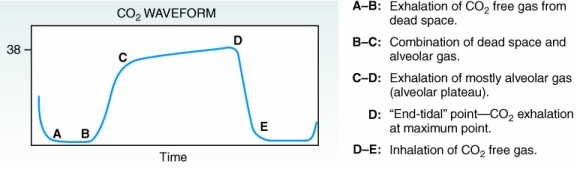
A)A
B)B
C)C
D)D
A)A
B)B
C)C
D)D
سؤال
While working in the NICU with a mechanically ventilated newborn who is being monitored for PetCO₂,the therapist observes the following capnogram: 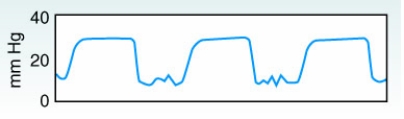 What interpretation should the therapist make of this capnogram?
A) This capnogram is normal.
B) The patient is receiving about 10 cm H₂O positive end-expiratory pressure.
C) The patient is rebreathing his own exhaled gas.
D) The neonate is being hyperventilated.
What interpretation should the therapist make of this capnogram?A) This capnogram is normal.
B) The patient is receiving about 10 cm H₂O positive end-expiratory pressure.
C) The patient is rebreathing his own exhaled gas.
D) The neonate is being hyperventilated.
سؤال
سؤال
سؤال
سؤال
سؤال
The following capnogram was obtained from a newborn infant receiving mechanical ventilation.
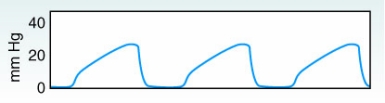
How should the therapist evaluate this capnogram?
A)Airway obstruction
B)Hypoventilation
C)Hyperventilation
D)Increased dead space ventilation
How should the therapist evaluate this capnogram?
A)Airway obstruction
B)Hypoventilation
C)Hyperventilation
D)Increased dead space ventilation
سؤال
سؤال
An infant demonstrates the following capnogram while being mechanically ventilated.
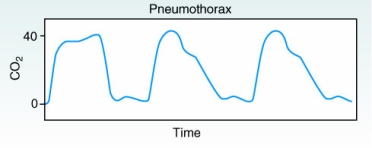
How should the therapist interpret this capnogram?
A)The patient has received a paralytic agent.
B)A paralytic agent is indicated for this patient because of the spontaneous breathing efforts represented by the downward deflections.
C)The patient may have developed a pneumothorax.
D)A leak has developed in the patient-ventilator system.
How should the therapist interpret this capnogram?
A)The patient has received a paralytic agent.
B)A paralytic agent is indicated for this patient because of the spontaneous breathing efforts represented by the downward deflections.
C)The patient may have developed a pneumothorax.
D)A leak has developed in the patient-ventilator system.
سؤال
سؤال
سؤال

فتح الحزمة
قم بالتسجيل لفتح البطاقات في هذه المجموعة!
Unlock Deck
Unlock Deck
1/18

العب

ملء الشاشة (f)
Deck 9: Noninvasive Monitoring in Neonatal and Pediatric Care
1
The therapist has been asked to measure preductal oxygen saturation.Where could the therapist place the pulse oximeter probe?
A)Right thumb
B)Left thumb
C)Forehead
D)Left earlobe
A)Right thumb
B)Left thumb
C)Forehead
D)Left earlobe
C
Sensor placement on right arm or head will reflect preductal values while the left arm and the lower parts of the body will reflect postductal oxygen saturation values.
Sensor placement on right arm or head will reflect preductal values while the left arm and the lower parts of the body will reflect postductal oxygen saturation values.
2
While attending to a neonatal patient in the neonatal intensive care unit (NICU),the therapist notices that a transcutaneous electrode is affixed to the upper chest of the neonate.What should the therapist do at this time?
A)The therapist should only continue monitoring the patient since the transcutaneous electrode is properly placed.
B)The therapist should reposition the electrode on the neonate's abdomen.
C)The therapist needs to move the transcutaneous electrode to the infant's right shoulder.
D)The therapist should relocate the electrode on the sternum as close as possible to the heart.
A)The therapist should only continue monitoring the patient since the transcutaneous electrode is properly placed.
B)The therapist should reposition the electrode on the neonate's abdomen.
C)The therapist needs to move the transcutaneous electrode to the infant's right shoulder.
D)The therapist should relocate the electrode on the sternum as close as possible to the heart.
A
The site should be a highly vascular area such as the earlobe,upper chest,abdomen,thighs,or the lower back if the patient is supine;bony areas and those with limited perfusion,such as over the spine,should be avoided.
The site should be a highly vascular area such as the earlobe,upper chest,abdomen,thighs,or the lower back if the patient is supine;bony areas and those with limited perfusion,such as over the spine,should be avoided.
3
A therapist is monitoring a child on the mechanical ventilator who is hemodynamically stable.The PetCO₂ is 48 mm Hg.If accurate,what should be the PaCO₂?
A)43-48 mm Hg
B)45-48 mm Hg
C)50-53 mm Hg
D)Exactly the same as PetCO₂
A)43-48 mm Hg
B)45-48 mm Hg
C)50-53 mm Hg
D)Exactly the same as PetCO₂
C
PetCO₂ can be used as a surrogate for the arterial partial pressure of CO₂ (PaCO₂)within physiologic limits.Normally,PetCO₂ is 2-5 mmHg below PaCO₂.The reason for this is the proportion dead-space ventilation.
PetCO₂ can be used as a surrogate for the arterial partial pressure of CO₂ (PaCO₂)within physiologic limits.Normally,PetCO₂ is 2-5 mmHg below PaCO₂.The reason for this is the proportion dead-space ventilation.
4
How is the percentage of functional hemoglobin that is saturated with oxygen determined via pulse oximetry?
A)The percentage of red light that lands on the photodiode represents the SPo₂ (oxygen saturation as determined by pulse oximetry).
B)The percentage of infrared light that reaches the photodetector reflects the SPo₂.
C)The ratio of the red and infrared light that reaches the photodiode signifies the SPo₂.
D)The sum of the amount of red and infrared absorbed by the tissue determines the SPo₂.
A)The percentage of red light that lands on the photodiode represents the SPo₂ (oxygen saturation as determined by pulse oximetry).
B)The percentage of infrared light that reaches the photodetector reflects the SPo₂.
C)The ratio of the red and infrared light that reaches the photodiode signifies the SPo₂.
D)The sum of the amount of red and infrared absorbed by the tissue determines the SPo₂.
فتح الحزمة
افتح القفل للوصول البطاقات البالغ عددها 18 في هذه المجموعة.
فتح الحزمة
k this deck
5
The therapist has applied a bandage-type pulse oximetry probe too tightly to an infant's finger.What problem can be expected to occur in this situation?
A)The SPo₂ will read erroneously low.
B)The SPo₂ will read erroneously high.
C)The monitor will display a message indicating inadequate pulse.
D)The monitor will display fluctuating SPo₂ values between being erroneously low and high.
A)The SPo₂ will read erroneously low.
B)The SPo₂ will read erroneously high.
C)The monitor will display a message indicating inadequate pulse.
D)The monitor will display fluctuating SPo₂ values between being erroneously low and high.
فتح الحزمة
افتح القفل للوصول البطاقات البالغ عددها 18 في هذه المجموعة.
فتح الحزمة
k this deck
6
What is volumetric capnography able to determine?
I)Airway dead space
II)Alveolar tidal volume
III)Shunt fraction
IV)Alveolar minute volume
A)II,III,and IV only
B)I only
C)I,II,and IV only
D)I,II,III,and IV
I)Airway dead space
II)Alveolar tidal volume
III)Shunt fraction
IV)Alveolar minute volume
A)II,III,and IV only
B)I only
C)I,II,and IV only
D)I,II,III,and IV
فتح الحزمة
افتح القفل للوصول البطاقات البالغ عددها 18 في هذه المجموعة.
فتح الحزمة
k this deck
7
Where on the following normal capnogram is the end-tidal carbon dioxide (PetCO₂)represented?
A)A
B)B
C)C
D)D
A)A
B)B
C)C
D)D
فتح الحزمة
افتح القفل للوصول البطاقات البالغ عددها 18 في هذه المجموعة.
فتح الحزمة
k this deck
8
While working in the NICU with a mechanically ventilated newborn who is being monitored for PetCO₂,the therapist observes the following capnogram: What interpretation should the therapist make of this capnogram?
A) This capnogram is normal.
B) The patient is receiving about 10 cm H₂O positive end-expiratory pressure.
C) The patient is rebreathing his own exhaled gas.
D) The neonate is being hyperventilated.
What interpretation should the therapist make of this capnogram?A) This capnogram is normal.
B) The patient is receiving about 10 cm H₂O positive end-expiratory pressure.
C) The patient is rebreathing his own exhaled gas.
D) The neonate is being hyperventilated.
فتح الحزمة
افتح القفل للوصول البطاقات البالغ عددها 18 في هذه المجموعة.
فتح الحزمة
k this deck
9
What clinical parameter is critically important to monitor when mechanical ventilation is administered?
A)Blood pressure
B)Heart rate
C)Temperature
D)Respiratory rate
A)Blood pressure
B)Heart rate
C)Temperature
D)Respiratory rate
فتح الحزمة
افتح القفل للوصول البطاقات البالغ عددها 18 في هذه المجموعة.
فتح الحزمة
k this deck
10
The therapist is assessing a mechanically ventilated infant and observes that the transcutaneous electrode temperature is set between 41° C and 44° C.What action does the therapist need to take at this time?
A)The temperature range set is appropriate;therefore,no action is necessary.
B)The therapist should increase the temperature range to 47° C to 48° C.
C)The temperature of the transcutaneous electrode needs to be reduced to 36° C to 38° C.
D)The electrode needs to be repositioned and maintained at the same temperature.
A)The temperature range set is appropriate;therefore,no action is necessary.
B)The therapist should increase the temperature range to 47° C to 48° C.
C)The temperature of the transcutaneous electrode needs to be reduced to 36° C to 38° C.
D)The electrode needs to be repositioned and maintained at the same temperature.
فتح الحزمة
افتح القفل للوصول البطاقات البالغ عددها 18 في هذه المجموعة.
فتح الحزمة
k this deck
11
Which of the following conditions will preclude the use of indirect calorimetry?
I)Cuffed endotracheal tubes
II)Circuit leaks
III)FiO₂ 40%
IV)HFOV
A)I,II,and III only
B)II and III only
C)II and IV only
D)I,III,and IV only
I)Cuffed endotracheal tubes
II)Circuit leaks
III)FiO₂ 40%
IV)HFOV
A)I,II,and III only
B)II and III only
C)II and IV only
D)I,III,and IV only
فتح الحزمة
افتح القفل للوصول البطاقات البالغ عددها 18 في هذه المجموعة.
فتح الحزمة
k this deck
12
What is the purpose of indirect calorimetry?
A)To measure heat produced and lost from the body
B)To calculate energy expenditure by measuring VO₂ and VCO₂
C)To calculate resting energy expenditure
D)To measure gas exchange
A)To measure heat produced and lost from the body
B)To calculate energy expenditure by measuring VO₂ and VCO₂
C)To calculate resting energy expenditure
D)To measure gas exchange
فتح الحزمة
افتح القفل للوصول البطاقات البالغ عددها 18 في هذه المجموعة.
فتح الحزمة
k this deck
13
The following capnogram was obtained from a newborn infant receiving mechanical ventilation.
How should the therapist evaluate this capnogram?
A)Airway obstruction
B)Hypoventilation
C)Hyperventilation
D)Increased dead space ventilation
How should the therapist evaluate this capnogram?
A)Airway obstruction
B)Hypoventilation
C)Hyperventilation
D)Increased dead space ventilation
فتح الحزمة
افتح القفل للوصول البطاقات البالغ عددها 18 في هذه المجموعة.
فتح الحزمة
k this deck
14
Which of the following is the main physiologic factor responsible for deriving accurate transcutaneous data?
A)Heart rate
B)Minute ventilation
C)Peripheral perfusion
D)Ventilation-perfusion ratios
A)Heart rate
B)Minute ventilation
C)Peripheral perfusion
D)Ventilation-perfusion ratios
فتح الحزمة
افتح القفل للوصول البطاقات البالغ عددها 18 في هذه المجموعة.
فتح الحزمة
k this deck
15
An infant demonstrates the following capnogram while being mechanically ventilated.
How should the therapist interpret this capnogram?
A)The patient has received a paralytic agent.
B)A paralytic agent is indicated for this patient because of the spontaneous breathing efforts represented by the downward deflections.
C)The patient may have developed a pneumothorax.
D)A leak has developed in the patient-ventilator system.
How should the therapist interpret this capnogram?
A)The patient has received a paralytic agent.
B)A paralytic agent is indicated for this patient because of the spontaneous breathing efforts represented by the downward deflections.
C)The patient may have developed a pneumothorax.
D)A leak has developed in the patient-ventilator system.
فتح الحزمة
افتح القفل للوصول البطاقات البالغ عددها 18 في هذه المجموعة.
فتح الحزمة
k this deck
16
As the therapist applies a pulse oximeter finger probe to a neonate who is receiving supplemental oxygen,she notices that the SpO₂ reading is 100%.What should the therapist do in this situation?
A)The therapist should continue monitoring the patient because the reading is accurate.
B)The therapist should obtain an arterial blood sample to confirm P2 level.
C)The therapist should switch to using a capnometer.
D)The therapist should reduce the fraction of inspired oxygen.
A)The therapist should continue monitoring the patient because the reading is accurate.
B)The therapist should obtain an arterial blood sample to confirm P2 level.
C)The therapist should switch to using a capnometer.
D)The therapist should reduce the fraction of inspired oxygen.
فتح الحزمة
افتح القفل للوصول البطاقات البالغ عددها 18 في هذه المجموعة.
فتح الحزمة
k this deck
17
Why do transcutaneous oxygen tension (PO₂)and carbon dioxide tension (PCO₂)values differ from PaO₂ and PaCO₂ measurements?
A)Because of the lag time between the cardiac output and the time the blood reaches the transcutaneous electrode site
B)Because the skin is much more permeable to oxygen than carbon dioxide
C)Because oxygen is consumed and carbon dioxide is produced in transit from the left ventricle to the electrode site
D)Because metabolism in the tissue consumes oxygen and produces carbon dioxide at the site of the electrode
A)Because of the lag time between the cardiac output and the time the blood reaches the transcutaneous electrode site
B)Because the skin is much more permeable to oxygen than carbon dioxide
C)Because oxygen is consumed and carbon dioxide is produced in transit from the left ventricle to the electrode site
D)Because metabolism in the tissue consumes oxygen and produces carbon dioxide at the site of the electrode
فتح الحزمة
افتح القفل للوصول البطاقات البالغ عددها 18 في هذه المجموعة.
فتح الحزمة
k this deck
18
Which of the following features or characteristics apply to mainstream capnography?
I)The mainstream capnograph contains narrow tubing that can become occluded with mucus.
II)Mainstream capnography generally employs infrared spectrometers.
III)The mainstream capnograph does not add much weight to the breathing circuit.
IV)The mainstream capnograph is placed at the proximal end of the endotracheal tube.
A)I and II only
B)II and IV only
C)I,II,and III only
D)I,III,and IV only
I)The mainstream capnograph contains narrow tubing that can become occluded with mucus.
II)Mainstream capnography generally employs infrared spectrometers.
III)The mainstream capnograph does not add much weight to the breathing circuit.
IV)The mainstream capnograph is placed at the proximal end of the endotracheal tube.
A)I and II only
B)II and IV only
C)I,II,and III only
D)I,III,and IV only
فتح الحزمة
افتح القفل للوصول البطاقات البالغ عددها 18 في هذه المجموعة.
فتح الحزمة
k this deck
فتح الحزمة
افتح القفل للوصول البطاقات البالغ عددها 18 في هذه المجموعة.






