







 تكلم مع الذكاء الاصطناعي


Deck 51: Salt and Water Balance and Nitrogen Excretion
ملء الشاشة (f)

سؤال

سؤال
سؤال
سؤال
سؤال
سؤال
Refer to the figure showing waste products of metabolism. 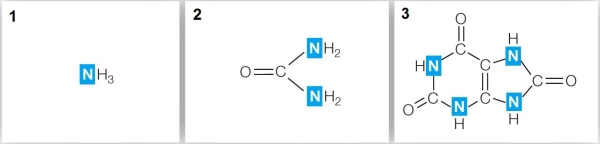 Based on the figure, which statement is false?
A) The nitrogenous wastes labeled 1, 2, and 3 are produced by metabolism of proteins and nucleic acids.
B) Humans primarily excrete the nitrogenous waste labeled 2.
C) The nitrogenous waste labeled 1 is the most toxic and soluble of the three shown.
D) Ureotelic animals, such as most amphibians, excrete the nitrogenous waste labeled 3.
E) Whereas bony fishes excrete the nitrogenous waste labeled 1, cartilaginous fishes excrete the nitrogenous waste labeled 2.
Based on the figure, which statement is false?A) The nitrogenous wastes labeled 1, 2, and 3 are produced by metabolism of proteins and nucleic acids.
B) Humans primarily excrete the nitrogenous waste labeled 2.
C) The nitrogenous waste labeled 1 is the most toxic and soluble of the three shown.
D) Ureotelic animals, such as most amphibians, excrete the nitrogenous waste labeled 3.
E) Whereas bony fishes excrete the nitrogenous waste labeled 1, cartilaginous fishes excrete the nitrogenous waste labeled 2.
سؤال
سؤال
سؤال
سؤال
سؤال
سؤال
سؤال
سؤال
سؤال
سؤال
Refer to the figure showing waste products of metabolism. 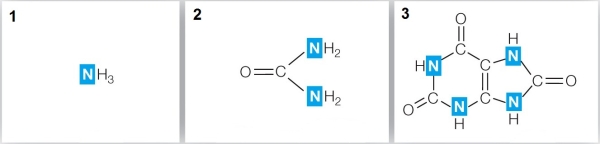 Based on the figure, which statement is false?
A) The nitrogenous waste labeled 3 allows animals such as reptiles and insects to live in very arid environments.
B) The nitrogenous waste labeled 1 diffuses from the gills of tadpoles.
C) The nitrogenous waste labeled 3 is excreted as a liquid and can result in significant water loss.
D) Aquatic invertebrates excrete the nitrogenous waste labeled 1.
E) Sharks and rays retain the nitrogenous waste labeled 2 in their extracellular fluids.
Based on the figure, which statement is false?A) The nitrogenous waste labeled 3 allows animals such as reptiles and insects to live in very arid environments.
B) The nitrogenous waste labeled 1 diffuses from the gills of tadpoles.
C) The nitrogenous waste labeled 3 is excreted as a liquid and can result in significant water loss.
D) Aquatic invertebrates excrete the nitrogenous waste labeled 1.
E) Sharks and rays retain the nitrogenous waste labeled 2 in their extracellular fluids.
سؤال
سؤال
سؤال
سؤال
سؤال
سؤال
سؤال
سؤال
سؤال
سؤال
سؤال
سؤال
سؤال
سؤال
سؤال
Refer to the figure showing the excretory systems of flatworms. 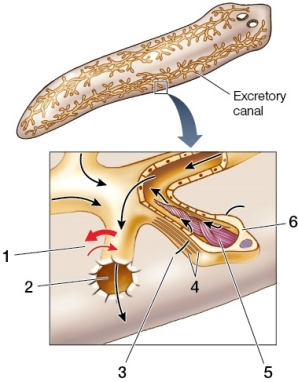 Based on the figure, which statement is false?
A) Secretion occurs at point 1.
B) The fluid at point 2 is less concentrated than the extracellular fluid.
C) At point 3, solutes are actively transported into the protonephridium.
D) Structures at point 5 help move the fluid through the excretory system.
E) The processes occurring at point 1 in flatworms occur in the metanephridium of earthworms.
Based on the figure, which statement is false?A) Secretion occurs at point 1.
B) The fluid at point 2 is less concentrated than the extracellular fluid.
C) At point 3, solutes are actively transported into the protonephridium.
D) Structures at point 5 help move the fluid through the excretory system.
E) The processes occurring at point 1 in flatworms occur in the metanephridium of earthworms.
سؤال
سؤال
سؤال
سؤال
سؤال
سؤال
سؤال
Refer to the figure showing the excretory systems of flatworms. 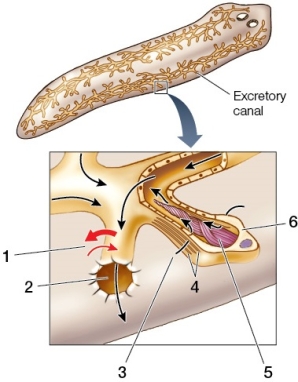 Based on the figure, which statement is false?
A) The structures at point 5 cause slight negative pressure within the tubules.
B) Extracellular fluid enters the protonephridium at point 2.
C) Filtration occurs at point 3.
D) The structure at point 6 is a flame cell.
E) Reabsorption of solutes occurs at point 1.
Based on the figure, which statement is false?A) The structures at point 5 cause slight negative pressure within the tubules.
B) Extracellular fluid enters the protonephridium at point 2.
C) Filtration occurs at point 3.
D) The structure at point 6 is a flame cell.
E) Reabsorption of solutes occurs at point 1.
سؤال
سؤال
سؤال
سؤال
سؤال
سؤال
سؤال
سؤال
سؤال
سؤال
Refer to the figure showing the vertebrate nephron. 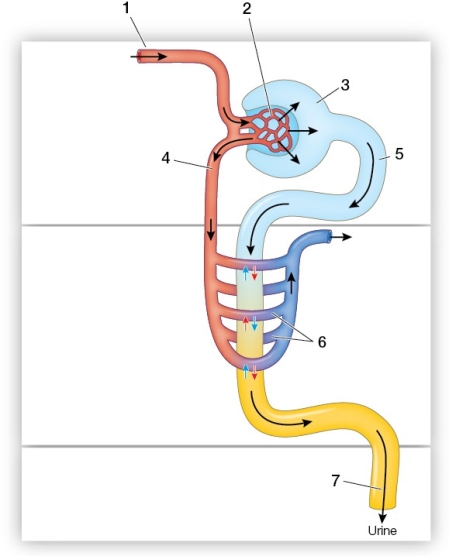 Based on the figure, which statement is false?
A) The structure at point 1 is the afferent arteriole.
B) The structures at point 6 carry away reabsorbed substances.
C) The fluid at point 7 contains all the substances that were filtered from the blood and not reabsorbed, plus those that were secreted.
D) Proteins and red blood cells that are typically found in the fluid at point 5 will be reabsorbed later.
E) Fenestrations are present in the structure at point 2.
Based on the figure, which statement is false?A) The structure at point 1 is the afferent arteriole.
B) The structures at point 6 carry away reabsorbed substances.
C) The fluid at point 7 contains all the substances that were filtered from the blood and not reabsorbed, plus those that were secreted.
D) Proteins and red blood cells that are typically found in the fluid at point 5 will be reabsorbed later.
E) Fenestrations are present in the structure at point 2.
سؤال
سؤال
سؤال
سؤال
سؤال
سؤال
سؤال
Refer to the figure showing the vertebrate nephron. 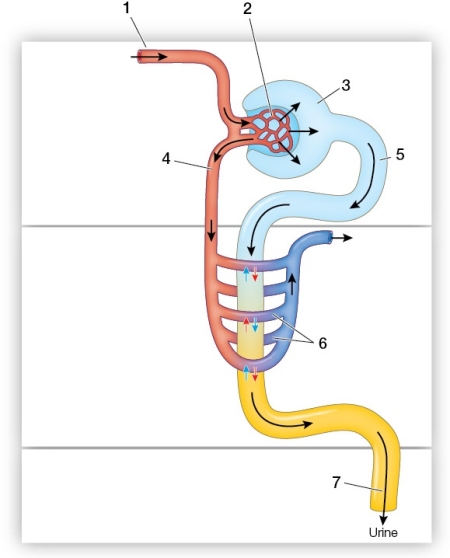 Based on the figure, which statement is false?
A) The structure at point 3 receives the glomerular filtrate.
B) Reabsorption and secretion occur along the structure at point 5.
C) The structure at point 4 is the efferent arteriole.
D) The structures at point 6 bring substances to be secreted to the nephron.
E) Blood pressure at point 2 is low, as is typical of capillaries.
Based on the figure, which statement is false?A) The structure at point 3 receives the glomerular filtrate.
B) Reabsorption and secretion occur along the structure at point 5.
C) The structure at point 4 is the efferent arteriole.
D) The structures at point 6 bring substances to be secreted to the nephron.
E) Blood pressure at point 2 is low, as is typical of capillaries.
سؤال
سؤال
سؤال
سؤال
سؤال
سؤال
سؤال
سؤال
Refer to the figure of the countercurrent multiplier mechanism in the mammalian kidney. 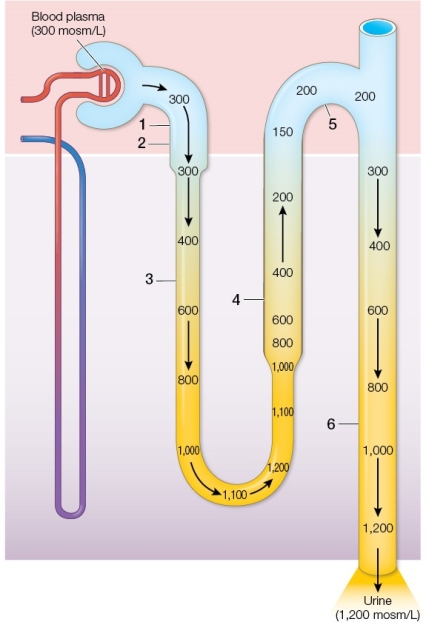 Based on the figure, which statement is true?
A) Water leaves the renal tubule by osmosis between points 5 and 6.
B) Reabsorption of sodium chloride occurs at point 3.
C) Aquaporins are especially scarce at point 1.
D) Sodium chloride is actively transported into the tubule at point 4.
E) Aquaporins are especially numerous at point 4.
Based on the figure, which statement is true?A) Water leaves the renal tubule by osmosis between points 5 and 6.
B) Reabsorption of sodium chloride occurs at point 3.
C) Aquaporins are especially scarce at point 1.
D) Sodium chloride is actively transported into the tubule at point 4.
E) Aquaporins are especially numerous at point 4.
سؤال
سؤال
سؤال
سؤال
سؤال
سؤال
سؤال
سؤال
Refer to the figure of the human kidney. 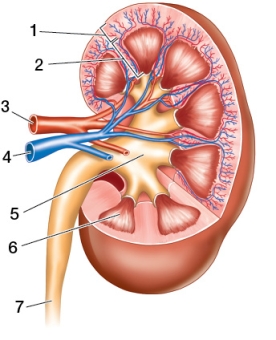 Based on the figure, which statement is false?
A) Filtration by nephrons occurs within the structure at point 1.
B) The structure at point 2 contains distal convoluted tubules.
C) Bowman's capsules occur within the structure at point 1.
D) The structure at point 5 receives urine from collecting ducts.
E) The structure at point 1 contains proximal convoluted tubules.
Based on the figure, which statement is false?A) Filtration by nephrons occurs within the structure at point 1.
B) The structure at point 2 contains distal convoluted tubules.
C) Bowman's capsules occur within the structure at point 1.
D) The structure at point 5 receives urine from collecting ducts.
E) The structure at point 1 contains proximal convoluted tubules.
سؤال
سؤال
سؤال
Refer to the figure of the human kidney. 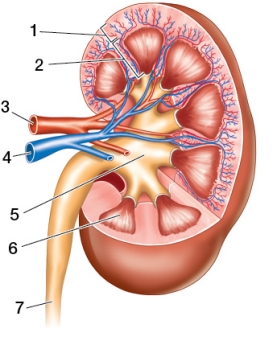 Based on the figure, which statement is false?
A) The solute concentration of the interstitial fluid in the region marked 2 decreases as you move deeper into the kidney.
B) Structures at points 3 and 4 occur on the side of the kidney facing the midline of the body.
C) Loops of Henle occur within the structure at point 2.
D) The structure at point 7 transports urine to the urinary bladder.
E) Glomeruli are found within the structure at point 1.
Based on the figure, which statement is false?A) The solute concentration of the interstitial fluid in the region marked 2 decreases as you move deeper into the kidney.
B) Structures at points 3 and 4 occur on the side of the kidney facing the midline of the body.
C) Loops of Henle occur within the structure at point 2.
D) The structure at point 7 transports urine to the urinary bladder.
E) Glomeruli are found within the structure at point 1.
سؤال
سؤال
سؤال
سؤال
Refer to the figure of the countercurrent multiplier mechanism in the mammalian kidney. 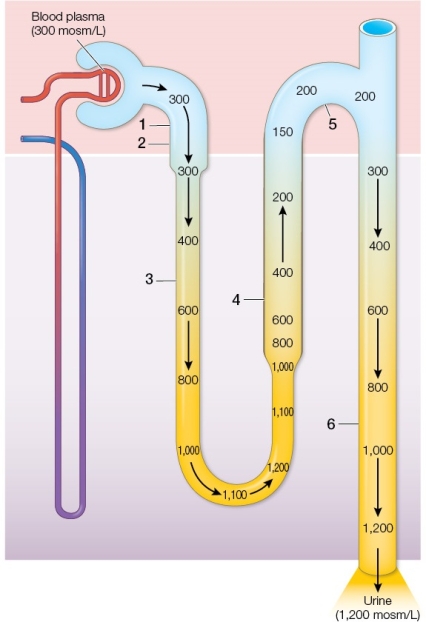 Based on the figure, which statement is true?
A) Water leaves the tubule by active transport at points 2, 3, and 5.
B) Water enters the tubule by osmosis at point 3.
C) Sodium chloride leaves the tubule by diffusion at points 1 and 3.
D) Sodium chloride leaves the tubule by active transport at point 6.
E) Urea leaves the tubule by diffusion at point 6.
Based on the figure, which statement is true?A) Water leaves the tubule by active transport at points 2, 3, and 5.
B) Water enters the tubule by osmosis at point 3.
C) Sodium chloride leaves the tubule by diffusion at points 1 and 3.
D) Sodium chloride leaves the tubule by active transport at point 6.
E) Urea leaves the tubule by diffusion at point 6.
سؤال
سؤال

فتح الحزمة
قم بالتسجيل لفتح البطاقات في هذه المجموعة!
Unlock Deck
Unlock Deck
1/251

العب

ملء الشاشة (f)
Deck 51: Salt and Water Balance and Nitrogen Excretion
1
If a red blood cell is in blood plasma with a solute concentration of 270 mosm/l, and the cytoplasm of the red blood cell is 300 mosm/l, then
A) the volume of the red blood cell will not change.
B) water will move into the red blood cell, causing it to swell.
C) water will move out of the red blood cell, causing it to shrivel.
D) there will be no net movement of water into or out of the red blood cell.
E) solutes will be actively transported out of the red blood cell.
A) the volume of the red blood cell will not change.
B) water will move into the red blood cell, causing it to swell.
C) water will move out of the red blood cell, causing it to shrivel.
D) there will be no net movement of water into or out of the red blood cell.
E) solutes will be actively transported out of the red blood cell.
B
2
Cartilaginous fishes (sharks and rays) have a specialized gland that excretes excess salt taken in with their food.Which organisms also possess a gland for excreting excess salt acquired through their food?
A) Terrestrial herbivores
B) Marine mammals
C) Marine birds
D) Brine shrimp
E) Freshwater bony fishes
A) Terrestrial herbivores
B) Marine mammals
C) Marine birds
D) Brine shrimp
E) Freshwater bony fishes
C
3
Brine shrimp Artemia that normally live in salt ponds are experimentally moved to an environment of dilute seawater.What will be the most likely physiological response of the shrimp to this change?
A) They will transport salt out of their extracellular fluids to the environment.
B) They will move water across their gill membranes by means of active transport.
C) They will maintain osmolarity of their extracellular fluids below environmental levels.
D) They will osmoconform with their surroundings.
E) They will transport salt from the environment to their extracellular fluids.
A) They will transport salt out of their extracellular fluids to the environment.
B) They will move water across their gill membranes by means of active transport.
C) They will maintain osmolarity of their extracellular fluids below environmental levels.
D) They will osmoconform with their surroundings.
E) They will transport salt from the environment to their extracellular fluids.
E
4
Organisms living in a freshwater environment normally
A) excrete copious amounts of dilute urine and retain salts.
B) excrete a small volume of dilute urine and retain salts.
C) excrete copious amounts of concentrated urine.
D) excrete small amounts of concentrated urine.
E) conserve both water and salts.
A) excrete copious amounts of dilute urine and retain salts.
B) excrete a small volume of dilute urine and retain salts.
C) excrete copious amounts of concentrated urine.
D) excrete small amounts of concentrated urine.
E) conserve both water and salts.
فتح الحزمة
افتح القفل للوصول البطاقات البالغ عددها 251 في هذه المجموعة.
فتح الحزمة
k this deck
5
Which represents the correct ranking of the water solubility of nitrogenous wastes, from least to most soluble?
A) Ammonia, urea, uric acid
B) Urea, uric acid, ammonia
C) Uric acid, ammonia, urea
D) Uric acid, urea, ammonia
E) Ammonia, uric acid, urea
A) Ammonia, urea, uric acid
B) Urea, uric acid, ammonia
C) Uric acid, ammonia, urea
D) Uric acid, urea, ammonia
E) Ammonia, uric acid, urea
فتح الحزمة
افتح القفل للوصول البطاقات البالغ عددها 251 في هذه المجموعة.
فتح الحزمة
k this deck
6
Refer to the figure showing waste products of metabolism. Based on the figure, which statement is false?
A) The nitrogenous wastes labeled 1, 2, and 3 are produced by metabolism of proteins and nucleic acids.
B) Humans primarily excrete the nitrogenous waste labeled 2.
C) The nitrogenous waste labeled 1 is the most toxic and soluble of the three shown.
D) Ureotelic animals, such as most amphibians, excrete the nitrogenous waste labeled 3.
E) Whereas bony fishes excrete the nitrogenous waste labeled 1, cartilaginous fishes excrete the nitrogenous waste labeled 2.
Based on the figure, which statement is false?A) The nitrogenous wastes labeled 1, 2, and 3 are produced by metabolism of proteins and nucleic acids.
B) Humans primarily excrete the nitrogenous waste labeled 2.
C) The nitrogenous waste labeled 1 is the most toxic and soluble of the three shown.
D) Ureotelic animals, such as most amphibians, excrete the nitrogenous waste labeled 3.
E) Whereas bony fishes excrete the nitrogenous waste labeled 1, cartilaginous fishes excrete the nitrogenous waste labeled 2.
فتح الحزمة
افتح القفل للوصول البطاقات البالغ عددها 251 في هذه المجموعة.
فتح الحزمة
k this deck
7
Mechanisms for the active transport of water
A) are widespread among animals.
B) rely on the sodium-potassium pump.
C) allow for a higher rate of water transport than other transport methods provide.
D) are responsible for reabsorption and secretion.
E) do not exist; the movement of water occurs in response to differences in either pressure or solute concentration.
A) are widespread among animals.
B) rely on the sodium-potassium pump.
C) allow for a higher rate of water transport than other transport methods provide.
D) are responsible for reabsorption and secretion.
E) do not exist; the movement of water occurs in response to differences in either pressure or solute concentration.
فتح الحزمة
افتح القفل للوصول البطاقات البالغ عددها 251 في هذه المجموعة.
فتح الحزمة
k this deck
8
Which statement about the movement of water is false?
A) During filtration, water moves due to a difference in pressure.
B) There are no mechanisms for the active transport of water.
C) Water molecules move down a solute concentration gradient.
D) During osmosis, water moves due to a difference in solute concentration.
E) Water molecules move down a pressure gradient.
A) During filtration, water moves due to a difference in pressure.
B) There are no mechanisms for the active transport of water.
C) Water molecules move down a solute concentration gradient.
D) During osmosis, water moves due to a difference in solute concentration.
E) Water molecules move down a pressure gradient.
فتح الحزمة
افتح القفل للوصول البطاقات البالغ عددها 251 في هذه المجموعة.
فتح الحزمة
k this deck
9
Unlike most vertebrates, hagfishes are
A) hypotonic regulators.
B) osmoconformers and ionic conformers.
C) osmoconformers and ionic regulators.
D) osmoregulators and ionic regulators.
E) osmoregulators and ionic conformers.
A) hypotonic regulators.
B) osmoconformers and ionic conformers.
C) osmoconformers and ionic regulators.
D) osmoregulators and ionic regulators.
E) osmoregulators and ionic conformers.
فتح الحزمة
افتح القفل للوصول البطاقات البالغ عددها 251 في هذه المجموعة.
فتح الحزمة
k this deck
10
Of the molecules listed, which is the most toxic to cells?
A) Water
B) Sodium chloride
C) Ammonia
D) Urea
E) Uric acid
A) Water
B) Sodium chloride
C) Ammonia
D) Urea
E) Uric acid
فتح الحزمة
افتح القفل للوصول البطاقات البالغ عددها 251 في هذه المجموعة.
فتح الحزمة
k this deck
11
A scientist wishing to study a vertebrate animal that is an osmoconformer might choose a study species from which group?
A) Marine bony fishes
B) Marine mammals
C) Hagfishes
D) Birds
E) Freshwater bony fishes
A) Marine bony fishes
B) Marine mammals
C) Hagfishes
D) Birds
E) Freshwater bony fishes
فتح الحزمة
افتح القفل للوصول البطاقات البالغ عددها 251 في هذه المجموعة.
فتح الحزمة
k this deck
12
Which statement about the filtration process of the excretory systems of animals with closed circulatory systems is false?
A) The filter consists of walls of capillaries and associated tubules.
B) It is driven by blood pressure.
C) It produces filtrate without large molecules.
D) It processes filtrate by moving valuable solutes back into blood.
E) It produces filtrate that does not contain cells.
A) The filter consists of walls of capillaries and associated tubules.
B) It is driven by blood pressure.
C) It produces filtrate without large molecules.
D) It processes filtrate by moving valuable solutes back into blood.
E) It produces filtrate that does not contain cells.
فتح الحزمة
افتح القفل للوصول البطاقات البالغ عددها 251 في هذه المجموعة.
فتح الحزمة
k this deck
13
Which statement about osmosis and ionic concentrations is false?
A) Osmosis involves the movement of water across cell membranes.
B) When the solute concentration of extracellular fluid is less than that of the cytoplasm, then water moves into cells.
C) When the solute concentration of extracellular fluid is greater than that of the cytoplasm, then water moves out of cells.
D) The solute concentration of extracellular fluid influences cell volume and solute concentration.
E) Excretory systems actively transport water back into the extracellular fluid.
A) Osmosis involves the movement of water across cell membranes.
B) When the solute concentration of extracellular fluid is less than that of the cytoplasm, then water moves into cells.
C) When the solute concentration of extracellular fluid is greater than that of the cytoplasm, then water moves out of cells.
D) The solute concentration of extracellular fluid influences cell volume and solute concentration.
E) Excretory systems actively transport water back into the extracellular fluid.
فتح الحزمة
افتح القفل للوصول البطاقات البالغ عددها 251 في هذه المجموعة.
فتح الحزمة
k this deck
14
Which feature does not characterize the salt glands of marine birds?
A) They consist of secretory tubules served by arterioles and venules.
B) Their secretions drain into the nasal cavity.
C) Chloride ions move from the extracellular fluid into tubule cells via osmosis.
D) Chloride ions move from the tubule cell into tubule fluid, and sodium ions and water follow.
E) They are in depressions of the skull.
A) They consist of secretory tubules served by arterioles and venules.
B) Their secretions drain into the nasal cavity.
C) Chloride ions move from the extracellular fluid into tubule cells via osmosis.
D) Chloride ions move from the tubule cell into tubule fluid, and sodium ions and water follow.
E) They are in depressions of the skull.
فتح الحزمة
افتح القفل للوصول البطاقات البالغ عددها 251 في هذه المجموعة.
فتح الحزمة
k this deck
15
A long period of dry, hot weather has caused evaporation of water, resulting in an increase in salt concentrations in the ponds inhabited by the brine shrimp Artemia.How will the shrimp respond physiologically?
A) They will transport salt out of their extracellular fluids to the environment.
B) They will move water across their gill membranes by means of active transport.
C) They will maintain osmolarity of their extracellular fluids above environmental levels.
D) They will osmoconform with their surroundings.
E) They will transport salt from the environment to their extracellular fluids.
A) They will transport salt out of their extracellular fluids to the environment.
B) They will move water across their gill membranes by means of active transport.
C) They will maintain osmolarity of their extracellular fluids above environmental levels.
D) They will osmoconform with their surroundings.
E) They will transport salt from the environment to their extracellular fluids.
فتح الحزمة
افتح القفل للوصول البطاقات البالغ عددها 251 في هذه المجموعة.
فتح الحزمة
k this deck
16
Refer to the figure showing waste products of metabolism. Based on the figure, which statement is false?
A) The nitrogenous waste labeled 3 allows animals such as reptiles and insects to live in very arid environments.
B) The nitrogenous waste labeled 1 diffuses from the gills of tadpoles.
C) The nitrogenous waste labeled 3 is excreted as a liquid and can result in significant water loss.
D) Aquatic invertebrates excrete the nitrogenous waste labeled 1.
E) Sharks and rays retain the nitrogenous waste labeled 2 in their extracellular fluids.
Based on the figure, which statement is false?A) The nitrogenous waste labeled 3 allows animals such as reptiles and insects to live in very arid environments.
B) The nitrogenous waste labeled 1 diffuses from the gills of tadpoles.
C) The nitrogenous waste labeled 3 is excreted as a liquid and can result in significant water loss.
D) Aquatic invertebrates excrete the nitrogenous waste labeled 1.
E) Sharks and rays retain the nitrogenous waste labeled 2 in their extracellular fluids.
فتح الحزمة
افتح القفل للوصول البطاقات البالغ عددها 251 في هذه المجموعة.
فتح الحزمة
k this deck
17
Organisms that are ionic regulators maintain their extracellular fluids at an _______ concentration that _______ that of the environment.
A) osmotic; is lower than
B) osmotic; is the same as
C) ion; may differ from
D) ion; is the same as
E) osmotic; is higher than
A) osmotic; is lower than
B) osmotic; is the same as
C) ion; may differ from
D) ion; is the same as
E) osmotic; is higher than
فتح الحزمة
افتح القفل للوصول البطاقات البالغ عددها 251 في هذه المجموعة.
فتح الحزمة
k this deck
18
Marine invertebrates in which the osmolarity of the extracellular fluids equilibrates with the environment are known as
A) osmoconformers.
B) osmoregulators.
C) ionic regulators.
D) hypotonic.
E) hypertonic.
A) osmoconformers.
B) osmoregulators.
C) ionic regulators.
D) hypotonic.
E) hypertonic.
فتح الحزمة
افتح القفل للوصول البطاقات البالغ عددها 251 في هذه المجموعة.
فتح الحزمة
k this deck
19
Which represents the correct ranking of the amount of nitrogenous wastes in a molecule, from least to most nitrogen?
A) Ammonia, urea, uric acid
B) Urea, uric acid, ammonia
C) Uric acid, ammonia, urea
D) Uric acid, urea, ammonia
E) Ammonia, uric acid, urea
A) Ammonia, urea, uric acid
B) Urea, uric acid, ammonia
C) Uric acid, ammonia, urea
D) Uric acid, urea, ammonia
E) Ammonia, uric acid, urea
فتح الحزمة
افتح القفل للوصول البطاقات البالغ عددها 251 في هذه المجموعة.
فتح الحزمة
k this deck
20
A scientist wishing to study a species that conserves body water would not choose a species from which group?
A) Birds
B) Mammals
C) Lizards and snakes
D) Marine bony fishes
E) Freshwater bony fishes
A) Birds
B) Mammals
C) Lizards and snakes
D) Marine bony fishes
E) Freshwater bony fishes
فتح الحزمة
افتح القفل للوصول البطاقات البالغ عددها 251 في هذه المجموعة.
فتح الحزمة
k this deck
21
Which statement about the nitrogenous wastes of humans is true?
A) Humans can excrete urea, uric acid, and ammonia.
B) The uric acid produced by humans comes mainly from the metabolism of carbohydrates.
C) Humans are uricotelic.
D) Solubility of uric acid increases with decreasing temperature.
E) Risk for developing gout decreases as body weight increases.
A) Humans can excrete urea, uric acid, and ammonia.
B) The uric acid produced by humans comes mainly from the metabolism of carbohydrates.
C) Humans are uricotelic.
D) Solubility of uric acid increases with decreasing temperature.
E) Risk for developing gout decreases as body weight increases.
فتح الحزمة
افتح القفل للوصول البطاقات البالغ عددها 251 في هذه المجموعة.
فتح الحزمة
k this deck
22
An animal that excretes ammonia lives in a(n) _______ habitat and has respiratory structures called _______through which this nitrogenous waste diffuses.
A) terrestrial; lungs
B) aquatic; gills
C) aquatic; lungs
D) aquatic; skin extensions
E) terrestrial; skin extensions
A) terrestrial; lungs
B) aquatic; gills
C) aquatic; lungs
D) aquatic; skin extensions
E) terrestrial; skin extensions
فتح الحزمة
افتح القفل للوصول البطاقات البالغ عددها 251 في هذه المجموعة.
فتح الحزمة
k this deck
23
In what way are flatworms and annelids not similar?
A) Ammonia diffuses directly from tissues into the coelom.
B) Excretory products leave through a pore.
C) Tubule cells modify composition of fluid.
D) Filtration occurs due to pressure differences.
E) Cilia help sweep fluid into the excretory system.
A) Ammonia diffuses directly from tissues into the coelom.
B) Excretory products leave through a pore.
C) Tubule cells modify composition of fluid.
D) Filtration occurs due to pressure differences.
E) Cilia help sweep fluid into the excretory system.
فتح الحزمة
افتح القفل للوصول البطاقات البالغ عددها 251 في هذه المجموعة.
فتح الحزمة
k this deck
24
You are a physician, and a patient presents with pain in his big toe.His diet includes significant amounts of caffeine and nucleic acids.You suspect gout and draw fluid from the inflamed joint.The presence of _______ would help confirm your diagnosis.
A) carbon dioxide
B) water
C) ammonia
D) uric acid
E) urea
A) carbon dioxide
B) water
C) ammonia
D) uric acid
E) urea
فتح الحزمة
افتح القفل للوصول البطاقات البالغ عددها 251 في هذه المجموعة.
فتح الحزمة
k this deck
25
Choose the correct pairing of a similarity of marine and freshwater bony fishes, and a difference between them.
A) Both lose uric acid across their gills — marine bony fishes produce a minimal amount of urine, whereas freshwater bony fishes produce a copious amount of dilute urine
B) Both lose ammonia across their gills — marine bony fishes produce a minimal amount of urine, whereas freshwater bony fishes produce a copious amount of dilute urine
C) Both raise osmolarity of their body fluids — marine bony fishes produce a minimal amount of urine, whereas freshwater bony fishes produce a copious amount of dilute urine
D) Both raise osmolarity of their body fluids — marine bony fishes excrete excess salt across their gills, whereas freshwater bony fishes conserve salt
E) Both lose ammonia across their gills — freshwater bony fishes produce a minimal amount of urine, whereas marine bony fishes produce a copious amount of dilute urine
A) Both lose uric acid across their gills — marine bony fishes produce a minimal amount of urine, whereas freshwater bony fishes produce a copious amount of dilute urine
B) Both lose ammonia across their gills — marine bony fishes produce a minimal amount of urine, whereas freshwater bony fishes produce a copious amount of dilute urine
C) Both raise osmolarity of their body fluids — marine bony fishes produce a minimal amount of urine, whereas freshwater bony fishes produce a copious amount of dilute urine
D) Both raise osmolarity of their body fluids — marine bony fishes excrete excess salt across their gills, whereas freshwater bony fishes conserve salt
E) Both lose ammonia across their gills — freshwater bony fishes produce a minimal amount of urine, whereas marine bony fishes produce a copious amount of dilute urine
فتح الحزمة
افتح القفل للوصول البطاقات البالغ عددها 251 في هذه المجموعة.
فتح الحزمة
k this deck
26
Cartilaginous fishes get rid of excess salt taken in when feeding by
A) excretion via their nasal glands.
B) drinking large amounts of seawater.
C) concentrating salts in their blood.
D) excretion via the rectal gland.
E) excreting salts at their gills.
A) excretion via their nasal glands.
B) drinking large amounts of seawater.
C) concentrating salts in their blood.
D) excretion via the rectal gland.
E) excreting salts at their gills.
فتح الحزمة
افتح القفل للوصول البطاقات البالغ عددها 251 في هذه المجموعة.
فتح الحزمة
k this deck
27
Which group of animals would be most suitable for a study of ammonia excretion?
A) Cartilaginous fishes
B) Bony fishes
C) Mammals
D) Birds
E) Insects
A) Cartilaginous fishes
B) Bony fishes
C) Mammals
D) Birds
E) Insects
فتح الحزمة
افتح القفل للوصول البطاقات البالغ عددها 251 في هذه المجموعة.
فتح الحزمة
k this deck
28
Which statement about excretion in animals is false?
A) Gills and kidneys serve as excretory organs in bony fishes.
B) Whereas tadpoles excrete ammonia, adult frogs typically excrete urea.
C) Bony fishes retain high concentrations of urea in their extracellular fluids.
D) Humans are ureotelic.
E) Terrestrial animals convert ammonia to urea or uric acid.
A) Gills and kidneys serve as excretory organs in bony fishes.
B) Whereas tadpoles excrete ammonia, adult frogs typically excrete urea.
C) Bony fishes retain high concentrations of urea in their extracellular fluids.
D) Humans are ureotelic.
E) Terrestrial animals convert ammonia to urea or uric acid.
فتح الحزمة
افتح القفل للوصول البطاقات البالغ عددها 251 في هذه المجموعة.
فتح الحزمة
k this deck
29
An experimental procedure that temporarily immobilizes cilia of flame cells in flatworms would impair all of the following except
A) filtration of extracellular fluid.
B) reabsorption from filtrate.
C) excretion of excess water.
D) creation of a slight positive pressure in the extracellular fluid.
E) creation of a slight negative pressure in the tubule portion of the protonephridium.
A) filtration of extracellular fluid.
B) reabsorption from filtrate.
C) excretion of excess water.
D) creation of a slight positive pressure in the extracellular fluid.
E) creation of a slight negative pressure in the tubule portion of the protonephridium.
فتح الحزمة
افتح القفل للوصول البطاقات البالغ عددها 251 في هذه المجموعة.
فتح الحزمة
k this deck
30
Which feature does not characterize the Malpighian tubules of insects?
A) They allow insects to excrete nitrogenous wastes with very little loss of water.
B) They rely on pressure differences to filter extracellular fluid into them.
C) Active transport brings solutes into them.
D) Water moves into tubules due to the high concentration of solutes within tubules.
E) Water helps flush tubule contents toward the gut.
A) They allow insects to excrete nitrogenous wastes with very little loss of water.
B) They rely on pressure differences to filter extracellular fluid into them.
C) Active transport brings solutes into them.
D) Water moves into tubules due to the high concentration of solutes within tubules.
E) Water helps flush tubule contents toward the gut.
فتح الحزمة
افتح القفل للوصول البطاقات البالغ عددها 251 في هذه المجموعة.
فتح الحزمة
k this deck
31
Refer to the figure showing the excretory systems of flatworms. Based on the figure, which statement is false?
A) Secretion occurs at point 1.
B) The fluid at point 2 is less concentrated than the extracellular fluid.
C) At point 3, solutes are actively transported into the protonephridium.
D) Structures at point 5 help move the fluid through the excretory system.
E) The processes occurring at point 1 in flatworms occur in the metanephridium of earthworms.
Based on the figure, which statement is false?A) Secretion occurs at point 1.
B) The fluid at point 2 is less concentrated than the extracellular fluid.
C) At point 3, solutes are actively transported into the protonephridium.
D) Structures at point 5 help move the fluid through the excretory system.
E) The processes occurring at point 1 in flatworms occur in the metanephridium of earthworms.
فتح الحزمة
افتح القفل للوصول البطاقات البالغ عددها 251 في هذه المجموعة.
فتح الحزمة
k this deck
32
Which statement about metanephridia is false?
A) Urine flows out the nephridiopore.
B) Blood is filtered as it passes through capillary walls into the coelom.
C) Each metanephridium is contained within a single segment of an earthworm.
D) Reabsorption and secretion occur in the metanephridium.
E) The nephrostome is a ciliated opening to the metanephridium.
A) Urine flows out the nephridiopore.
B) Blood is filtered as it passes through capillary walls into the coelom.
C) Each metanephridium is contained within a single segment of an earthworm.
D) Reabsorption and secretion occur in the metanephridium.
E) The nephrostome is a ciliated opening to the metanephridium.
فتح الحزمة
افتح القفل للوصول البطاقات البالغ عددها 251 في هذه المجموعة.
فتح الحزمة
k this deck
33
Anadromous bony fish, such as shad, leave the ocean and return to their natal freshwater streams to breed.Given this change in environment from salt water to freshwater, you would expect to see all of the following changes in their osmoregulation except
A) increased drinking rate.
B) decreased concentration of urine.
C) change in the direction of ion-pumping across gills to draw more ions from the water, moving them into the blood.
D) increased absorption of ions in their guts.
E) increased amount of urine.
A) increased drinking rate.
B) decreased concentration of urine.
C) change in the direction of ion-pumping across gills to draw more ions from the water, moving them into the blood.
D) increased absorption of ions in their guts.
E) increased amount of urine.
فتح الحزمة
افتح القفل للوصول البطاقات البالغ عددها 251 في هذه المجموعة.
فتح الحزمة
k this deck
34
A person experiencing the first symptoms of gout usually develops inflammation in joints of the extremities rather than in joints closer to the body core because
A) urea is more soluble at lower temperatures.
B) uric acid is less soluble at lower temperatures.
C) urea is more rapidly converted to uric acid at lower temperatures.
D) uric acid is more soluble at lower temperatures.
E) ammonia is less soluble at lower temperatures.
A) urea is more soluble at lower temperatures.
B) uric acid is less soluble at lower temperatures.
C) urea is more rapidly converted to uric acid at lower temperatures.
D) uric acid is more soluble at lower temperatures.
E) ammonia is less soluble at lower temperatures.
فتح الحزمة
افتح القفل للوصول البطاقات البالغ عددها 251 في هذه المجموعة.
فتح الحزمة
k this deck
35
Which statement about Malpighian tubules is false?
A) They make up the excretory system of insects.
B) An individual organism may have from 2 to 100 Malpighian tubules.
C) They empty into the gut.
D) They filter nitrogenous wastes by means of a pressure gradient.
E) They rely on active transport.
A) They make up the excretory system of insects.
B) An individual organism may have from 2 to 100 Malpighian tubules.
C) They empty into the gut.
D) They filter nitrogenous wastes by means of a pressure gradient.
E) They rely on active transport.
فتح الحزمة
افتح القفل للوصول البطاقات البالغ عددها 251 في هذه المجموعة.
فتح الحزمة
k this deck
36
Which statement about excretory tubules of flatworms, annelids, or insects is false?
A) In flatworms and annelids, tubule cells modify the composition of fluid by reabsorption and secretion.
B) In insects, cells of Malpighian tubules actively transport solute into tubules.
C) Tubules of flatworms receive fluid from the coelom.
D) The tubules of annelids are surrounded by capillaries.
E) In annelids, cilia of the nephrostome sweep fluid into the metanephridia, which lead into tubules.
A) In flatworms and annelids, tubule cells modify the composition of fluid by reabsorption and secretion.
B) In insects, cells of Malpighian tubules actively transport solute into tubules.
C) Tubules of flatworms receive fluid from the coelom.
D) The tubules of annelids are surrounded by capillaries.
E) In annelids, cilia of the nephrostome sweep fluid into the metanephridia, which lead into tubules.
فتح الحزمة
افتح القفل للوصول البطاقات البالغ عددها 251 في هذه المجموعة.
فتح الحزمة
k this deck
37
Which statement about an excretory system consisting of Malpighian tubules is false?
A) As ions move into the tubules, water moves out.
B) Uric acid is excreted from the rectum.
C) There is active transport of ions and uric acid into excretory system.
D) There is active transport of ions from hindgut back to extracellular fluid.
E) They allow insects to inhabit arid environments.
A) As ions move into the tubules, water moves out.
B) Uric acid is excreted from the rectum.
C) There is active transport of ions and uric acid into excretory system.
D) There is active transport of ions from hindgut back to extracellular fluid.
E) They allow insects to inhabit arid environments.
فتح الحزمة
افتح القفل للوصول البطاقات البالغ عددها 251 في هذه المجموعة.
فتح الحزمة
k this deck
38
Refer to the figure showing the excretory systems of flatworms. Based on the figure, which statement is false?
A) The structures at point 5 cause slight negative pressure within the tubules.
B) Extracellular fluid enters the protonephridium at point 2.
C) Filtration occurs at point 3.
D) The structure at point 6 is a flame cell.
E) Reabsorption of solutes occurs at point 1.
Based on the figure, which statement is false?A) The structures at point 5 cause slight negative pressure within the tubules.
B) Extracellular fluid enters the protonephridium at point 2.
C) Filtration occurs at point 3.
D) The structure at point 6 is a flame cell.
E) Reabsorption of solutes occurs at point 1.
فتح الحزمة
افتح القفل للوصول البطاقات البالغ عددها 251 في هذه المجموعة.
فتح الحزمة
k this deck
39
In the excretory systems of both flatworms and annelids,
A) flame cells drive reabsorption.
B) pressure differences drive filtration.
C) nephridiostomes open into the coelom of the animal.
D) there is active transport of nitrogenous wastes into excretory tubules.
E) there is a close association between excretory tubules and capillaries.
A) flame cells drive reabsorption.
B) pressure differences drive filtration.
C) nephridiostomes open into the coelom of the animal.
D) there is active transport of nitrogenous wastes into excretory tubules.
E) there is a close association between excretory tubules and capillaries.
فتح الحزمة
افتح القفل للوصول البطاقات البالغ عددها 251 في هذه المجموعة.
فتح الحزمة
k this deck
40
Which statement about protonephridia in a freshwater flatworm is false?
A) A protonephridium consists of a flame cell and tubule.
B) Extracellular fluid moves into a protonephridium because pressure is lower inside the tubule than it is outside it.
C) Tubule cells reabsorb solutes.
D) Fewer ions are reabsorbed than secreted.
E) Filtrate flows out the excretory pore.
A) A protonephridium consists of a flame cell and tubule.
B) Extracellular fluid moves into a protonephridium because pressure is lower inside the tubule than it is outside it.
C) Tubule cells reabsorb solutes.
D) Fewer ions are reabsorbed than secreted.
E) Filtrate flows out the excretory pore.
فتح الحزمة
افتح القفل للوصول البطاقات البالغ عددها 251 في هذه المجموعة.
فتح الحزمة
k this deck
41
Considering the arrangement of blood vessels in the vertebrate kidney bringing blood to and from the glomerulus, a(n) _______ in the diameter of the _______ could result in an increased rate of filtration.
A) increase; afferent arteriole
B) decrease; afferent arteriole
C) decrease; renal venule
D) increase; efferent arteriole
E) increase; peritubular capillaries
A) increase; afferent arteriole
B) decrease; afferent arteriole
C) decrease; renal venule
D) increase; efferent arteriole
E) increase; peritubular capillaries
فتح الحزمة
افتح القفل للوصول البطاقات البالغ عددها 251 في هذه المجموعة.
فتح الحزمة
k this deck
42
With respect to osmoregulation, marine bony fishes do not
A) produce urine that is less concentrated than their extracellular fluids.
B) maintain extracellular fluids at one-third to one-half the osmolarity of seawater.
C) absorb some ions from their gut that they take in.
D) actively excrete NaCl across gill membranes.
E) produce little urine.
A) produce urine that is less concentrated than their extracellular fluids.
B) maintain extracellular fluids at one-third to one-half the osmolarity of seawater.
C) absorb some ions from their gut that they take in.
D) actively excrete NaCl across gill membranes.
E) produce little urine.
فتح الحزمة
افتح القفل للوصول البطاقات البالغ عددها 251 في هذه المجموعة.
فتح الحزمة
k this deck
43
Which feature does not characterize reptiles?
A) They have internal fertilization.
B) Their epidermis slows water loss.
C) They excrete uric acid, thereby limiting water loss.
D) They lay shelled eggs and don't need water for reproduction.
E) They retain urea to raise the osmolarity of their extracellular fluids.
A) They have internal fertilization.
B) Their epidermis slows water loss.
C) They excrete uric acid, thereby limiting water loss.
D) They lay shelled eggs and don't need water for reproduction.
E) They retain urea to raise the osmolarity of their extracellular fluids.
فتح الحزمة
افتح القفل للوصول البطاقات البالغ عددها 251 في هذه المجموعة.
فتح الحزمة
k this deck
44
During urine formation in the vertebrate kidney, the processes of filtration and tubular secretion are similar in that both
A) involve substances moving from the filtrate into the blood.
B) rely on pressure differences.
C) involve substances moving from the blood into the filtrate.
D) rely on active transport.
E) occur at Bowman's capsule.
A) involve substances moving from the filtrate into the blood.
B) rely on pressure differences.
C) involve substances moving from the blood into the filtrate.
D) rely on active transport.
E) occur at Bowman's capsule.
فتح الحزمة
افتح القفل للوصول البطاقات البالغ عددها 251 في هذه المجموعة.
فتح الحزمة
k this deck
45
Once pathogenic bacteria have infected the urethra (in the urinary tract), they can move directly to the
A) urinary bladder.
B) ureter.
C) proximal convoluted tubule.
D) kidney.
E) collecting duct.
A) urinary bladder.
B) ureter.
C) proximal convoluted tubule.
D) kidney.
E) collecting duct.
فتح الحزمة
افتح القفل للوصول البطاقات البالغ عددها 251 في هذه المجموعة.
فتح الحزمة
k this deck
46
Which of these substance(s) would you expect to find in a urine specimen collected from a healthy person?
A) Water
B) Glucose
C) Red blood cells
D) Large molecules
E) Amino acids
A) Water
B) Glucose
C) Red blood cells
D) Large molecules
E) Amino acids
فتح الحزمة
افتح القفل للوصول البطاقات البالغ عددها 251 في هذه المجموعة.
فتح الحزمة
k this deck
47
Which structures do not play a role in renal filtration?
A) Walls of glomerular capillaries
B) Podocytes
C) Basal laminae of glomerular capillaries
D) Collecting ducts
E) Bowman's capsules
A) Walls of glomerular capillaries
B) Podocytes
C) Basal laminae of glomerular capillaries
D) Collecting ducts
E) Bowman's capsules
فتح الحزمة
افتح القفل للوصول البطاقات البالغ عددها 251 في هذه المجموعة.
فتح الحزمة
k this deck
48
Refer to the figure showing the vertebrate nephron. Based on the figure, which statement is false?
A) The structure at point 1 is the afferent arteriole.
B) The structures at point 6 carry away reabsorbed substances.
C) The fluid at point 7 contains all the substances that were filtered from the blood and not reabsorbed, plus those that were secreted.
D) Proteins and red blood cells that are typically found in the fluid at point 5 will be reabsorbed later.
E) Fenestrations are present in the structure at point 2.
Based on the figure, which statement is false?A) The structure at point 1 is the afferent arteriole.
B) The structures at point 6 carry away reabsorbed substances.
C) The fluid at point 7 contains all the substances that were filtered from the blood and not reabsorbed, plus those that were secreted.
D) Proteins and red blood cells that are typically found in the fluid at point 5 will be reabsorbed later.
E) Fenestrations are present in the structure at point 2.
فتح الحزمة
افتح القفل للوصول البطاقات البالغ عددها 251 في هذه المجموعة.
فتح الحزمة
k this deck
49
Which adaptation is not one of the water conservation adaptations of amphibians living in dry environments?
A) Waxy secretions on the skin
B) Estivation during dry periods
C) Kidneys produce concentrated urine
D) Burrowing into the ground
E) Large urinary bladders
A) Waxy secretions on the skin
B) Estivation during dry periods
C) Kidneys produce concentrated urine
D) Burrowing into the ground
E) Large urinary bladders
فتح الحزمة
افتح القفل للوصول البطاقات البالغ عددها 251 في هذه المجموعة.
فتح الحزمة
k this deck
50
Considering the arrangement of blood vessels in the vertebrate kidney bringing blood to and from the glomerulus, a(n) _______ in the diameter of the _______ could result in a decreased rate of filtration.
A) decrease; renal venule
B) decrease; efferent arteriole
C) increase; afferent arteriole
D) increase; efferent arteriole
E) increase; peritubular capillaries
A) decrease; renal venule
B) decrease; efferent arteriole
C) increase; afferent arteriole
D) increase; efferent arteriole
E) increase; peritubular capillaries
فتح الحزمة
افتح القفل للوصول البطاقات البالغ عددها 251 في هذه المجموعة.
فتح الحزمة
k this deck
51
Blood enters the glomerulus by way of the
A) peritubular capillaries.
B) vasa recta.
C) efferent arteriole.
D) afferent arteriole.
E) renal vein.
A) peritubular capillaries.
B) vasa recta.
C) efferent arteriole.
D) afferent arteriole.
E) renal vein.
فتح الحزمة
افتح القفل للوصول البطاقات البالغ عددها 251 في هذه المجموعة.
فتح الحزمة
k this deck
52
Which feature is not one of the adaptations that allows reptiles to live in terrestrial environments where water must be conserved?
A) Scaly skin
B) Excretion of uric acid
C) Shelled eggs
D) Reproduction involving internal fertilization
E) Excretion of salts
A) Scaly skin
B) Excretion of uric acid
C) Shelled eggs
D) Reproduction involving internal fertilization
E) Excretion of salts
فتح الحزمة
افتح القفل للوصول البطاقات البالغ عددها 251 في هذه المجموعة.
فتح الحزمة
k this deck
53
The presence of _______ in a person's urine sample might suggest problems with glomerular filtration.
A) water
B) glucose
C) ions
D) amino acids
E) red blood cells
A) water
B) glucose
C) ions
D) amino acids
E) red blood cells
فتح الحزمة
افتح القفل للوصول البطاقات البالغ عددها 251 في هذه المجموعة.
فتح الحزمة
k this deck
54
In the vertebrate kidney, the process of filtration from the capillaries into Bowman's capsule is driven by
A) active transport.
B) arterial blood pressure.
C) venous blood pressure.
D) osmotic pressure.
E) secretion.
A) active transport.
B) arterial blood pressure.
C) venous blood pressure.
D) osmotic pressure.
E) secretion.
فتح الحزمة
افتح القفل للوصول البطاقات البالغ عددها 251 في هذه المجموعة.
فتح الحزمة
k this deck
55
Refer to the figure showing the vertebrate nephron. Based on the figure, which statement is false?
A) The structure at point 3 receives the glomerular filtrate.
B) Reabsorption and secretion occur along the structure at point 5.
C) The structure at point 4 is the efferent arteriole.
D) The structures at point 6 bring substances to be secreted to the nephron.
E) Blood pressure at point 2 is low, as is typical of capillaries.
Based on the figure, which statement is false?A) The structure at point 3 receives the glomerular filtrate.
B) Reabsorption and secretion occur along the structure at point 5.
C) The structure at point 4 is the efferent arteriole.
D) The structures at point 6 bring substances to be secreted to the nephron.
E) Blood pressure at point 2 is low, as is typical of capillaries.
فتح الحزمة
افتح القفل للوصول البطاقات البالغ عددها 251 في هذه المجموعة.
فتح الحزمة
k this deck
56
While studying histological sections of a mammalian kidney, you come across a slide labeled "inner medulla." Which structure might you see on this slide?
A) Bowman's capsule
B) Proximal convoluted tubule
C) Glomerulus
D) Loop of Henle
E) Distal convoluted tubule
A) Bowman's capsule
B) Proximal convoluted tubule
C) Glomerulus
D) Loop of Henle
E) Distal convoluted tubule
فتح الحزمة
افتح القفل للوصول البطاقات البالغ عددها 251 في هذه المجموعة.
فتح الحزمة
k this deck
57
Regarding renal clearance in humans, foreign substances such as drugs would most likely be
A) reabsorbed at Bowman's capsule.
B) secreted into the renal tubule.
C) reabsorbed at the glomerulus.
D) secreted into the blood.
E) reabsorbed into the filtrate.
A) reabsorbed at Bowman's capsule.
B) secreted into the renal tubule.
C) reabsorbed at the glomerulus.
D) secreted into the blood.
E) reabsorbed into the filtrate.
فتح الحزمة
افتح القفل للوصول البطاقات البالغ عددها 251 في هذه المجموعة.
فتح الحزمة
k this deck
58
Which structure plays an increasing role in urination as toddlers develop?
A) Smooth muscle sphincter at the base of the urethra
B) Ureter
C) Skeletal muscle sphincter at the base of the urethra
D) Urethra
E) Urinary bladder
A) Smooth muscle sphincter at the base of the urethra
B) Ureter
C) Skeletal muscle sphincter at the base of the urethra
D) Urethra
E) Urinary bladder
فتح الحزمة
افتح القفل للوصول البطاقات البالغ عددها 251 في هذه المجموعة.
فتح الحزمة
k this deck
59
Marine bony fishes acquire salt when they feed.They handle this salt load by
A) producing very dilute urine.
B) excreting it via the rectal gland.
C) excreting ions from gills and not absorbing some ions from the gut.
D) becoming ionic conformers after eating.
E) excreting it from nasal salt glands.
A) producing very dilute urine.
B) excreting it via the rectal gland.
C) excreting ions from gills and not absorbing some ions from the gut.
D) becoming ionic conformers after eating.
E) excreting it from nasal salt glands.
فتح الحزمة
افتح القفل للوصول البطاقات البالغ عددها 251 في هذه المجموعة.
فتح الحزمة
k this deck
60
Which substance would be reabsorbed in the smallest amounts by the renal tubule?
A) Water
B) Glucose
C) Urea
D) Sodium ions
E) Amino acids
A) Water
B) Glucose
C) Urea
D) Sodium ions
E) Amino acids
فتح الحزمة
افتح القفل للوصول البطاقات البالغ عددها 251 في هذه المجموعة.
فتح الحزمة
k this deck
61
Which structure functions as a countercurrent multiplier?
A) Renal pyramid
B) Proximal convoluted tubule
C) Distal convoluted tubule
D) Loop of Henle
E) Glomerulus
A) Renal pyramid
B) Proximal convoluted tubule
C) Distal convoluted tubule
D) Loop of Henle
E) Glomerulus
فتح الحزمة
افتح القفل للوصول البطاقات البالغ عددها 251 في هذه المجموعة.
فتح الحزمة
k this deck
62
What is the structure into which filtrate flows from Bowman's capsule?
A) Renal pyramid
B) Proximal convoluted tubule
C) Distal convoluted tubule
D) Loop of Henle
E) Collecting duct
A) Renal pyramid
B) Proximal convoluted tubule
C) Distal convoluted tubule
D) Loop of Henle
E) Collecting duct
فتح الحزمة
افتح القفل للوصول البطاقات البالغ عددها 251 في هذه المجموعة.
فتح الحزمة
k this deck
63
Refer to the figure of the countercurrent multiplier mechanism in the mammalian kidney. Based on the figure, which statement is true?
A) Water leaves the renal tubule by osmosis between points 5 and 6.
B) Reabsorption of sodium chloride occurs at point 3.
C) Aquaporins are especially scarce at point 1.
D) Sodium chloride is actively transported into the tubule at point 4.
E) Aquaporins are especially numerous at point 4.
Based on the figure, which statement is true?A) Water leaves the renal tubule by osmosis between points 5 and 6.
B) Reabsorption of sodium chloride occurs at point 3.
C) Aquaporins are especially scarce at point 1.
D) Sodium chloride is actively transported into the tubule at point 4.
E) Aquaporins are especially numerous at point 4.
فتح الحزمة
افتح القفل للوصول البطاقات البالغ عددها 251 في هذه المجموعة.
فتح الحزمة
k this deck
64
The loop of Henle functions as a countercurrent multiplier mechanism.In this context, "countercurrent" refers to the flow of filtrate in opposite directions in the descending and ascending limbs of the Loop of Henle, and "multiplier" refers to the
A) different permeabilities of the descending and ascending limbs.
B) amount of water conserved as a multiple of the length of the loop.
C) creation of a solute concentration gradient in the interstitial fluids of the medulla.
D) increasing concentration of filtrate as it flows through the loop.
E) process by which active transport in the descending and ascending limbs multiplies the concentration gradient within the filtrate.
A) different permeabilities of the descending and ascending limbs.
B) amount of water conserved as a multiple of the length of the loop.
C) creation of a solute concentration gradient in the interstitial fluids of the medulla.
D) increasing concentration of filtrate as it flows through the loop.
E) process by which active transport in the descending and ascending limbs multiplies the concentration gradient within the filtrate.
فتح الحزمة
افتح القفل للوصول البطاقات البالغ عددها 251 في هذه المجموعة.
فتح الحزمة
k this deck
65
The _______ is characterized by numerous microvilli on its cells.
A) renal pyramid
B) proximal convoluted tubule
C) distal convoluted tubule
D) loop of Henle
E) collecting duct
A) renal pyramid
B) proximal convoluted tubule
C) distal convoluted tubule
D) loop of Henle
E) collecting duct
فتح الحزمة
افتح القفل للوصول البطاقات البالغ عددها 251 في هذه المجموعة.
فتح الحزمة
k this deck
66
Which features make up the internal core, or medulla, of the mammalian kidneys?
A) Renal pyramids
B) Proximal convoluted tubules
C) Distal convoluted tubules
D) Loops of Henle
E) Glomeruli
A) Renal pyramids
B) Proximal convoluted tubules
C) Distal convoluted tubules
D) Loops of Henle
E) Glomeruli
فتح الحزمة
افتح القفل للوصول البطاقات البالغ عددها 251 في هذه المجموعة.
فتح الحزمة
k this deck
67
In a human, about 180 liters of filtrate enter Bowman's capsule each day.Approximately how much of this fluid is typically returned to the blood?
A) 2 liters
B) 18 liters
C) 40 liters
D) 90 liters
E) 178 liters
A) 2 liters
B) 18 liters
C) 40 liters
D) 90 liters
E) 178 liters
فتح الحزمة
افتح القفل للوصول البطاقات البالغ عددها 251 في هذه المجموعة.
فتح الحزمة
k this deck
68
The cells lining the proximal convoluted tubule have numerous microvilli and mitochondria.This indicates that these cells
A) engage in the rapid diffusion of water.
B) carry out reabsorption and active transport.
C) store salts.
D) produce urea.
E) are metabolically inactive.
A) engage in the rapid diffusion of water.
B) carry out reabsorption and active transport.
C) store salts.
D) produce urea.
E) are metabolically inactive.
فتح الحزمة
افتح القفل للوصول البطاقات البالغ عددها 251 في هذه المجموعة.
فتح الحزمة
k this deck
69
A scientist interested in studying aquaporins plans to examine the parts of mammalian nephrons in which large numbers of aquaporins can be found.This researcher might choose to examine all of the following except the
A) thick ascending limb of the loop of Henle.
B) collecting duct.
C) descending limb of the loop of Henle.
D) distal convoluted tubule.
E) proximal convoluted tubule.
A) thick ascending limb of the loop of Henle.
B) collecting duct.
C) descending limb of the loop of Henle.
D) distal convoluted tubule.
E) proximal convoluted tubule.
فتح الحزمة
افتح القفل للوصول البطاقات البالغ عددها 251 في هذه المجموعة.
فتح الحزمة
k this deck
70
A scientist interested in studying active transport mechanisms could be advised to examine the process in the
A) thin ascending limb of the loop of Henle.
B) collecting duct.
C) descending limb of the loop of Henle.
D) distal convoluted tubule.
E) proximal convoluted tubule.
A) thin ascending limb of the loop of Henle.
B) collecting duct.
C) descending limb of the loop of Henle.
D) distal convoluted tubule.
E) proximal convoluted tubule.
فتح الحزمة
افتح القفل للوصول البطاقات البالغ عددها 251 في هذه المجموعة.
فتح الحزمة
k this deck
71
Refer to the figure of the human kidney. Based on the figure, which statement is false?
A) Filtration by nephrons occurs within the structure at point 1.
B) The structure at point 2 contains distal convoluted tubules.
C) Bowman's capsules occur within the structure at point 1.
D) The structure at point 5 receives urine from collecting ducts.
E) The structure at point 1 contains proximal convoluted tubules.
Based on the figure, which statement is false?A) Filtration by nephrons occurs within the structure at point 1.
B) The structure at point 2 contains distal convoluted tubules.
C) Bowman's capsules occur within the structure at point 1.
D) The structure at point 5 receives urine from collecting ducts.
E) The structure at point 1 contains proximal convoluted tubules.
فتح الحزمة
افتح القفل للوصول البطاقات البالغ عددها 251 في هذه المجموعة.
فتح الحزمة
k this deck
72
In the mammalian kidney, the filtrate flows through the _______ immediately before entering a collecting duct.
A) renal pyramid
B) proximal convoluted tubule
C) distal convoluted tubule
D) loop of Henle
E) glomerulus
A) renal pyramid
B) proximal convoluted tubule
C) distal convoluted tubule
D) loop of Henle
E) glomerulus
فتح الحزمة
افتح القفل للوصول البطاقات البالغ عددها 251 في هذه المجموعة.
فتح الحزمة
k this deck
73
The lower portion of the _______ is permeable to urea, which diffuses into the interstitial fluid of the medulla.
A) renal pyramid
B) proximal convoluted tubule
C) distal convoluted tubule
D) loop of Henle
E) collecting duct
A) renal pyramid
B) proximal convoluted tubule
C) distal convoluted tubule
D) loop of Henle
E) collecting duct
فتح الحزمة
افتح القفل للوصول البطاقات البالغ عددها 251 في هذه المجموعة.
فتح الحزمة
k this deck
74
Refer to the figure of the human kidney. Based on the figure, which statement is false?
A) The solute concentration of the interstitial fluid in the region marked 2 decreases as you move deeper into the kidney.
B) Structures at points 3 and 4 occur on the side of the kidney facing the midline of the body.
C) Loops of Henle occur within the structure at point 2.
D) The structure at point 7 transports urine to the urinary bladder.
E) Glomeruli are found within the structure at point 1.
Based on the figure, which statement is false?A) The solute concentration of the interstitial fluid in the region marked 2 decreases as you move deeper into the kidney.
B) Structures at points 3 and 4 occur on the side of the kidney facing the midline of the body.
C) Loops of Henle occur within the structure at point 2.
D) The structure at point 7 transports urine to the urinary bladder.
E) Glomeruli are found within the structure at point 1.
فتح الحزمة
افتح القفل للوصول البطاقات البالغ عددها 251 في هذه المجموعة.
فتح الحزمة
k this deck
75
The length of the _______ relative to overall kidney size indicates potential maximum urine concentration.
A) renal pyramid
B) proximal convoluted tubule
C) distal convoluted tubule
D) loop of Henle
E) collecting duct
A) renal pyramid
B) proximal convoluted tubule
C) distal convoluted tubule
D) loop of Henle
E) collecting duct
فتح الحزمة
افتح القفل للوصول البطاقات البالغ عددها 251 في هذه المجموعة.
فتح الحزمة
k this deck
76
Which statement regarding the human kidneys is false?
A) As urine passes through collecting ducts, water leaves due to the concentration gradient established in the medulla.
B) Sodium chloride diffuses out of the thin ascending limb of the loop of Henle.
C) Sodium chloride is actively transported out of the thick ascending limb of the loop of Henle.
D) Although the descending limb of the loop of Henle is permeable to water, the ascending limb is not.
E) The urine passing through the collecting ducts is more concentrated than the surrounding interstitial fluid in the medulla, so water moves out of collecting ducts.
A) As urine passes through collecting ducts, water leaves due to the concentration gradient established in the medulla.
B) Sodium chloride diffuses out of the thin ascending limb of the loop of Henle.
C) Sodium chloride is actively transported out of the thick ascending limb of the loop of Henle.
D) Although the descending limb of the loop of Henle is permeable to water, the ascending limb is not.
E) The urine passing through the collecting ducts is more concentrated than the surrounding interstitial fluid in the medulla, so water moves out of collecting ducts.
فتح الحزمة
افتح القفل للوصول البطاقات البالغ عددها 251 في هذه المجموعة.
فتح الحزمة
k this deck
77
Renal failure results in acidosis, which is a decrease in blood pH, because the kidneys normally
A) secrete H+ and reabsorb HCO3-.
B) secrete Na+.
C) reabsorb H+.
D) secrete HCO3-.
E) reabsorb Na+.
A) secrete H+ and reabsorb HCO3-.
B) secrete Na+.
C) reabsorb H+.
D) secrete HCO3-.
E) reabsorb Na+.
فتح الحزمة
افتح القفل للوصول البطاقات البالغ عددها 251 في هذه المجموعة.
فتح الحزمة
k this deck
78
Refer to the figure of the countercurrent multiplier mechanism in the mammalian kidney. Based on the figure, which statement is true?
A) Water leaves the tubule by active transport at points 2, 3, and 5.
B) Water enters the tubule by osmosis at point 3.
C) Sodium chloride leaves the tubule by diffusion at points 1 and 3.
D) Sodium chloride leaves the tubule by active transport at point 6.
E) Urea leaves the tubule by diffusion at point 6.
Based on the figure, which statement is true?A) Water leaves the tubule by active transport at points 2, 3, and 5.
B) Water enters the tubule by osmosis at point 3.
C) Sodium chloride leaves the tubule by diffusion at points 1 and 3.
D) Sodium chloride leaves the tubule by active transport at point 6.
E) Urea leaves the tubule by diffusion at point 6.
فتح الحزمة
افتح القفل للوصول البطاقات البالغ عددها 251 في هذه المجموعة.
فتح الحزمة
k this deck
79
Which feature is the main site of glucose and amino acid reabsorption in the mammalian kidney?
A) Renal pyramid
B) Proximal convoluted tubule
C) Distal convoluted tubule
D) Loop of Henle
E) Collecting duct
A) Renal pyramid
B) Proximal convoluted tubule
C) Distal convoluted tubule
D) Loop of Henle
E) Collecting duct
فتح الحزمة
افتح القفل للوصول البطاقات البالغ عددها 251 في هذه المجموعة.
فتح الحزمة
k this deck
80
Which structure connects the proximal and distal convoluted tubules?
A) Renal pyramid
B) Proximal convoluted tubule
C) Distal convoluted tubule
D) Loop of Henle
E) Collecting duct
A) Renal pyramid
B) Proximal convoluted tubule
C) Distal convoluted tubule
D) Loop of Henle
E) Collecting duct
فتح الحزمة
افتح القفل للوصول البطاقات البالغ عددها 251 في هذه المجموعة.
فتح الحزمة
k this deck
فتح الحزمة
افتح القفل للوصول البطاقات البالغ عددها 251 في هذه المجموعة.






