







 تكلم مع الذكاء الاصطناعي


Deck 2: Supply and Demand
ملء الشاشة (f)

سؤال

سؤال
سؤال
سؤال
سؤال
سؤال
سؤال
سؤال
سؤال
سؤال
سؤال
سؤال
سؤال
سؤال
سؤال
سؤال
سؤال
سؤال
سؤال
سؤال
سؤال
In Figure 2.1, a "P" for price would go in 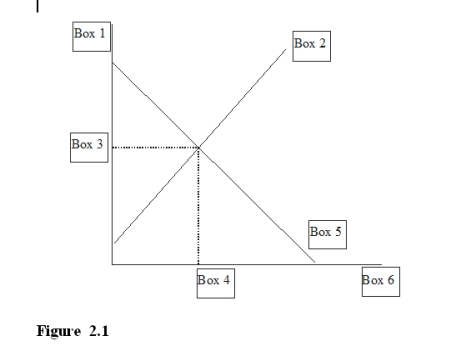
A)Box 1.
B)Box 2.
C)Box 4.
D)Box 6.
A)Box 1.
B)Box 2.
C)Box 4.
D)Box 6.
سؤال
From Table 2.1, and under the most likely scenario where columns A and B are assigned to represent quantity demanded and quantity supplied, which is the equilibrium price? 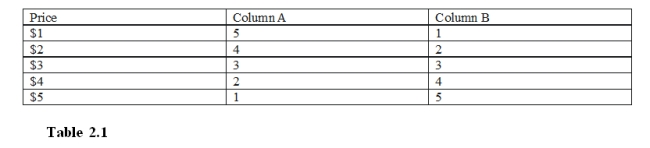
A)$1
B)$2
C)$3
D)$4
A)$1
B)$2
C)$3
D)$4
سؤال
سؤال
سؤال
From Table 2.1, which column is likely to be the one for quantity supplied? 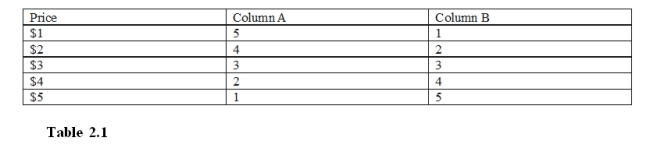
A)column A
B)neither A nor B
C)column B
D)either A or B are equally likely
A)column A
B)neither A nor B
C)column B
D)either A or B are equally likely
سؤال
In Figure 2.1, Box 6 would be labeled 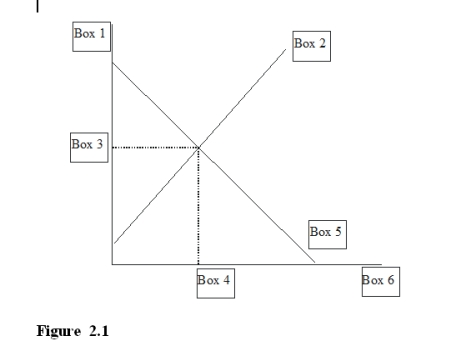
A)P* for equilibrium price.
B)S for supply.
C)P for price.
D)Q/t for quantity per unit of time.
A)P* for equilibrium price.
B)S for supply.
C)P for price.
D)Q/t for quantity per unit of time.
سؤال
In Figure 2.1, Box 1 would be labeled 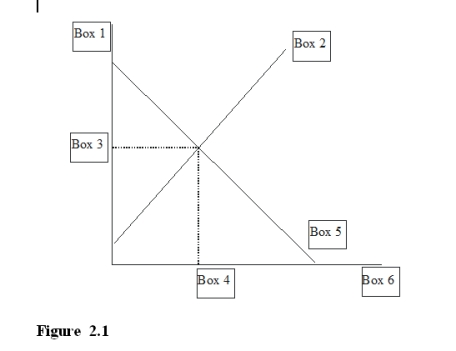
A)P* for equilibrium price.
B)P for price.
C)S for supply.
D)D for demand.
A)P* for equilibrium price.
B)P for price.
C)S for supply.
D)D for demand.
سؤال
In Figure 2.1, Box 3 would be labeled 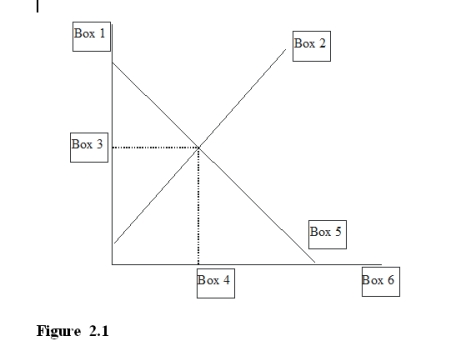
A)P* for equilibrium price.
B)P for price.
C)S for supply.
D)D for demand.
A)P* for equilibrium price.
B)P for price.
C)S for supply.
D)D for demand.
سؤال
From Table 2.1, which column is likely to be the one for quantity demanded? 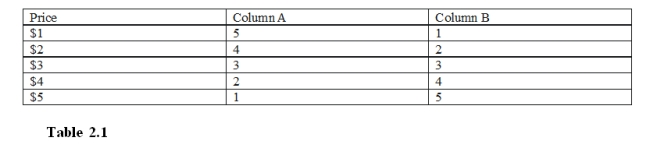
A)column A
B)neither A nor B
C)column B
D)either A or B are equally likely
A)column A
B)neither A nor B
C)column B
D)either A or B are equally likely
سؤال
سؤال
سؤال
In Figure 2.1, a "D" for Demand would go in 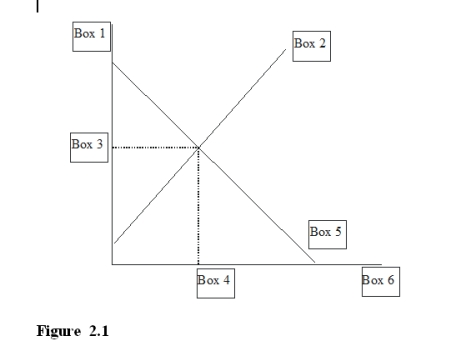
A)Box 2.
B)Box 4.
C)Box 5.
D)Box 6.
A)Box 2.
B)Box 4.
C)Box 5.
D)Box 6.
سؤال
In Figure 2.1, Box 2 would be labeled 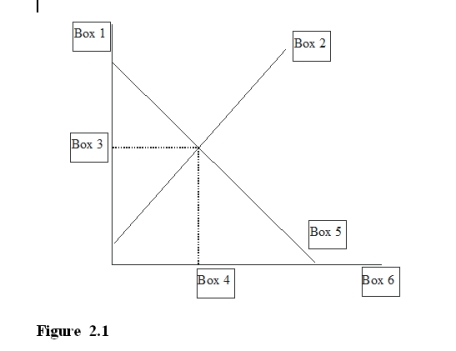
A)P* for equilibrium price.
B)P for price.
C)S for supply.
D)D for demand.
A)P* for equilibrium price.
B)P for price.
C)S for supply.
D)D for demand.
سؤال
From Table 2.1, and under the most likely scenario where columns A and B are assigned to represent quantity demanded and quantity supplied, which is the equilibrium quantity? 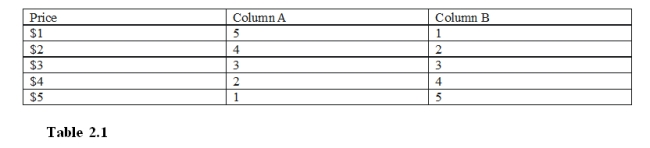
A)1 unit
B)2 units
C)3 units
D)4 units
A)1 unit
B)2 units
C)3 units
D)4 units
سؤال
سؤال
سؤال
In Figure 2.1, Box 4 would be labeled 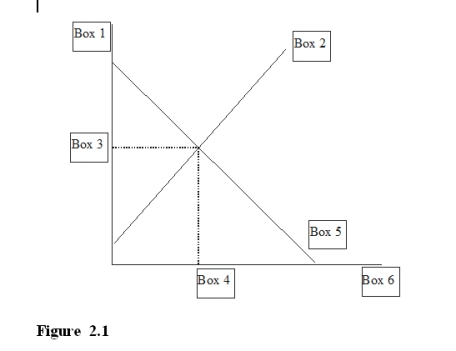
A)Q* for equilibrium quantity.
B)S for supply.
C)P for price.
D)D for demand.
A)Q* for equilibrium quantity.
B)S for supply.
C)P for price.
D)D for demand.
سؤال
In Figure 2.1, a "P*" for equilibrium price would go in 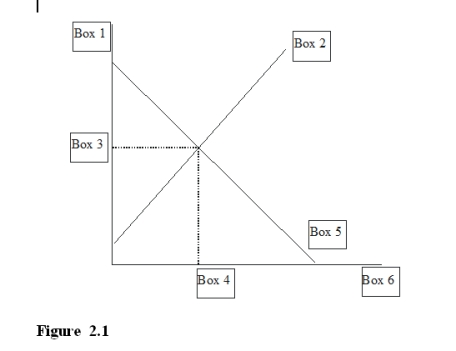
A)Box 1.
B)Box 2.
C)Box 3.
D)Box 4.
A)Box 1.
B)Box 2.
C)Box 3.
D)Box 4.
سؤال
سؤال
In Figure 2.1, Box 5 would be labeled 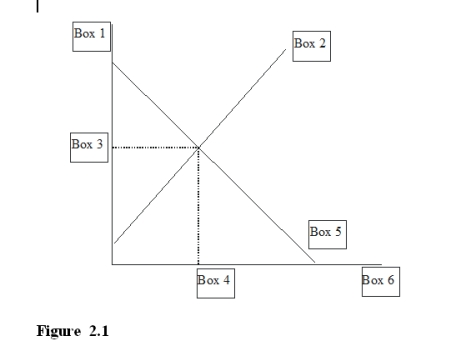
A)P* for equilibrium price.
B)P for price.
C)S for supply.
D)D for demand.
A)P* for equilibrium price.
B)P for price.
C)S for supply.
D)D for demand.
سؤال
سؤال
سؤال
In Figure 2.1, a "q/t" for quantity per unit time price would go in 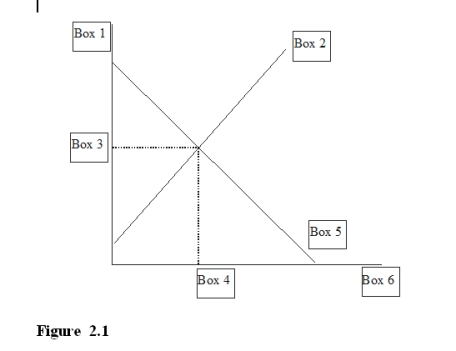
A)Box 1.
B)Box 2.
C)Box 4.
D)Box 6.
A)Box 1.
B)Box 2.
C)Box 4.
D)Box 6.
سؤال
From Table 2.3, at the price of $1 there is a 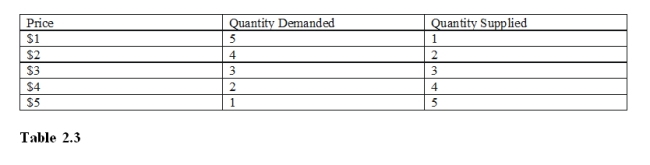
A)shortage of 5
B)neither a shortage nor a surplus.
C)shortage of 4.
D)surplus of 4.
A)shortage of 5
B)neither a shortage nor a surplus.
C)shortage of 4.
D)surplus of 4.
سؤال
سؤال
From Table 2.3, at the price of $4 there is a 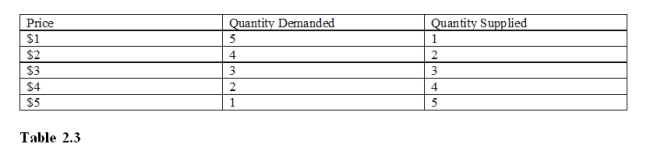
A)shortage of 2.
B)surplus of 2.
C)neither a shortage nor a surplus.
D)surplus of 4.
A)shortage of 2.
B)surplus of 2.
C)neither a shortage nor a surplus.
D)surplus of 4.
سؤال
سؤال
From Table 2.3, at the price of $3 there is a 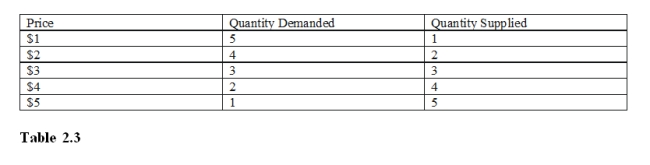
A)shortage of 2
B)neither a shortage nor a surplus.
C)shortage of 4.
D)surplus of 4.
A)shortage of 2
B)neither a shortage nor a surplus.
C)shortage of 4.
D)surplus of 4.
سؤال
From Table 2.2, which column is the one for shortage? 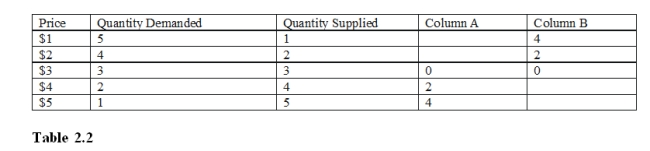
A)column A
B)neither A nor B
C)column B
D)either A or B are equally likely
A)column A
B)neither A nor B
C)column B
D)either A or B are equally likely
سؤال
From Table 2.3, at the price of $5 there is a 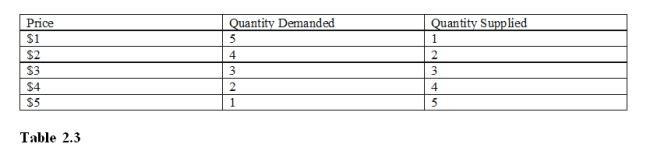
A)shortage of 4.
B)surplus of 2.
C)neither a shortage nor a surplus.
D)surplus of 4.
A)shortage of 4.
B)surplus of 2.
C)neither a shortage nor a surplus.
D)surplus of 4.
سؤال
سؤال
سؤال
سؤال
سؤال
From Table 2.2, which column is the one for surplus? 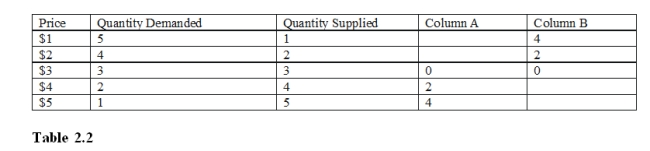
A)column A
B)neither A nor B
C)column B
D)either A or B are equally likely
A)column A
B)neither A nor B
C)column B
D)either A or B are equally likely
سؤال
سؤال
From Table 2.3, at the price of $2 there is a 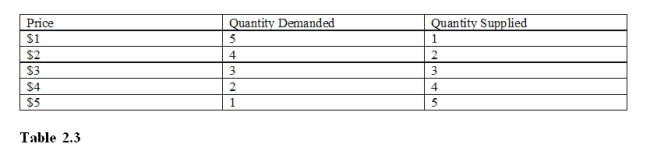
A)shortage of 2.
B)neither a shortage nor a surplus.
C)shortage of 4.
D)surplus of 4.
A)shortage of 2.
B)neither a shortage nor a surplus.
C)shortage of 4.
D)surplus of 4.
سؤال
In Figure 2.1, a "Q*" for equilibrium quantity would go in 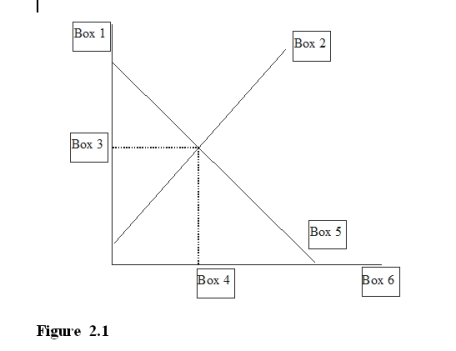
A)Box 1.
B)Box 2.
C)Box 3.
D)Box 4.
A)Box 1.
B)Box 2.
C)Box 3.
D)Box 4.
سؤال
سؤال
In Figure 2.1, a "S" for Supply would go in 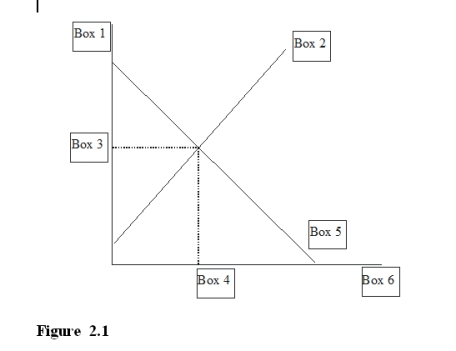
A)Box 2.
B)Box 4.
C)Box 5.
D)Box 6.
A)Box 2.
B)Box 4.
C)Box 5.
D)Box 6.
سؤال
سؤال
سؤال
سؤال
سؤال
سؤال
سؤال
سؤال
سؤال
سؤال
سؤال
سؤال
سؤال
سؤال
سؤال
سؤال
سؤال
سؤال
سؤال
سؤال

فتح الحزمة
قم بالتسجيل لفتح البطاقات في هذه المجموعة!
Unlock Deck
Unlock Deck
1/204

العب

ملء الشاشة (f)
Deck 2: Supply and Demand
1
The equilibrium quantity is
A)the amount exchanged at the equilibrium price.
B)an amount higher than consumers were wanted to buy.
C)an amount lower than producers wanted to sell.
D)always less than the equilibrium price.
A)the amount exchanged at the equilibrium price.
B)an amount higher than consumers were wanted to buy.
C)an amount lower than producers wanted to sell.
D)always less than the equilibrium price.
A
2
Economists argue that markets serve the interests of society primarily because
A)consumers are made better off (regardless of whether producers are made better off).
B)producers are made better off (regardless of whether consumers are made better off).
C)both consumers and producers are made better off.
D)money is made available for government.
A)consumers are made better off (regardless of whether producers are made better off).
B)producers are made better off (regardless of whether consumers are made better off).
C)both consumers and producers are made better off.
D)money is made available for government.
C
3
The group of people who are willing to provide goods and services in exchange for money are called
A)profiteers.
B)benefactors.
C)consumers.
D)producers.
A)profiteers.
B)benefactors.
C)consumers.
D)producers.
D
4
The price at which the amount consumers wish to purchase equals the amount firms wish to sell is called the
A)equilibrium quantity.
B)equilibrium price.
C)optimal quantity.
D)optimal result.
A)equilibrium quantity.
B)equilibrium price.
C)optimal quantity.
D)optimal result.
فتح الحزمة
افتح القفل للوصول البطاقات البالغ عددها 204 في هذه المجموعة.
فتح الحزمة
k this deck
5
The amount that firms are willing and able to sell at a particular price during a particular period of time is the
A)demand.
B)supply.
C)quantity demanded.
D)quantity supplied.
A)demand.
B)supply.
C)quantity demanded.
D)quantity supplied.
فتح الحزمة
افتح القفل للوصول البطاقات البالغ عددها 204 في هذه المجموعة.
فتح الحزمة
k this deck
6
Ceteris paribus is Latin for
A)all is lost.
B)at equilibrium.
C)equilibrium is optimal.
D)holding all other things constant.
A)all is lost.
B)at equilibrium.
C)equilibrium is optimal.
D)holding all other things constant.
فتح الحزمة
افتح القفل للوصول البطاقات البالغ عددها 204 في هذه المجموعة.
فتح الحزمة
k this deck
7
The quantity demanded is the amount households wish to purchase
A)at all possible prices during a specified period of time.
B)at a particular price during a specified period of time.
C)at a particular price (the timeframe is irrelevant).
D)at all possible prices (the timeframe is irrelevant).
A)at all possible prices during a specified period of time.
B)at a particular price during a specified period of time.
C)at a particular price (the timeframe is irrelevant).
D)at all possible prices (the timeframe is irrelevant).
فتح الحزمة
افتح القفل للوصول البطاقات البالغ عددها 204 في هذه المجموعة.
فتح الحزمة
k this deck
8
The amount of money that must be paid per unit of output is called the
A)market.
B)equilibrium.
C)wage.
D)price.
A)market.
B)equilibrium.
C)wage.
D)price.
فتح الحزمة
افتح القفل للوصول البطاقات البالغ عددها 204 في هذه المجموعة.
فتح الحزمة
k this deck
9
The underlying reason for the upward sloping nature of the supply curve is that
A)the production of most goods comes with increasing marginal benefits.
B)the production of most goods comes with increasing marginal costs.
C)the consumption of most goods comes with decreasing marginal utility.
D)the consumption of most goods comes with increasing marginal utility.
A)the production of most goods comes with increasing marginal benefits.
B)the production of most goods comes with increasing marginal costs.
C)the consumption of most goods comes with decreasing marginal utility.
D)the consumption of most goods comes with increasing marginal utility.
فتح الحزمة
افتح القفل للوصول البطاقات البالغ عددها 204 في هذه المجموعة.
فتح الحزمة
k this deck
10
At the equilibrium price
A)quantity demanded exceeds quantity supplied.
B)quantity demanded equals quantity supplied.
C)quantity demanded is less than quantity supplied.
D)quantity demanded is unrelated to quantity supplied.
A)quantity demanded exceeds quantity supplied.
B)quantity demanded equals quantity supplied.
C)quantity demanded is less than quantity supplied.
D)quantity demanded is unrelated to quantity supplied.
فتح الحزمة
افتح القفل للوصول البطاقات البالغ عددها 204 في هذه المجموعة.
فتح الحزمة
k this deck
11
The Latin phrase "ceteris paribus" is used by economists to mean
A)"all other things being equal" or "all other things held constant".
B)all is lost.
C)freedom is better than regulation.
D)the only constant is change.
A)"all other things being equal" or "all other things held constant".
B)all is lost.
C)freedom is better than regulation.
D)the only constant is change.
فتح الحزمة
افتح القفل للوصول البطاقات البالغ عددها 204 في هذه المجموعة.
فتح الحزمة
k this deck
12
The group of people who are willing to offer money in exchange for goods and services are called
A)profiteers.
B)benefactors.
C)consumers.
D)producers.
A)profiteers.
B)benefactors.
C)consumers.
D)producers.
فتح الحزمة
افتح القفل للوصول البطاقات البالغ عددها 204 في هذه المجموعة.
فتح الحزمة
k this deck
13
Ebay does not qualify as a market for the good being sold because it is not a specific physical location.
A)True
B)False
A)True
B)False
فتح الحزمة
افتح القفل للوصول البطاقات البالغ عددها 204 في هذه المجموعة.
فتح الحزمة
k this deck
14
The mechanism by which buyers and sellers negotiate an exchange is called a/an
A)equilibrium.
B)model.
C)market.
D)meeting.
A)equilibrium.
B)model.
C)market.
D)meeting.
فتح الحزمة
افتح القفل للوصول البطاقات البالغ عددها 204 في هذه المجموعة.
فتح الحزمة
k this deck
15
The amount consumers are willing and able to buy at a particular price during a specified period of time is the
A)demand.
B)supply.
C)quantity demanded.
D)quantity supplied.
A)demand.
B)supply.
C)quantity demanded.
D)quantity supplied.
فتح الحزمة
افتح القفل للوصول البطاقات البالغ عددها 204 في هذه المجموعة.
فتح الحزمة
k this deck
16
Economists know that consumers and producers are both made better off than they would be without free exchange because the exchanges are
A)mandated by government.
B)voluntary.
C)able to make consumers better off by an amount that compensates producers for their losses.
D)able to make producers better off by an amount that compensates consumers for their losses.
A)mandated by government.
B)voluntary.
C)able to make consumers better off by an amount that compensates producers for their losses.
D)able to make producers better off by an amount that compensates consumers for their losses.
فتح الحزمة
افتح القفل للوصول البطاقات البالغ عددها 204 في هذه المجموعة.
فتح الحزمة
k this deck
17
At the equilibrium price
A)the amount buyers wish to purchase equals the amount producers wish to sell.
B)the amount buyers wish to purchase is greater than the amount producers wish to sell.
C)the amount buyers wish to purchase is less than the amount producers wish to sell.
A)the amount buyers wish to purchase equals the amount producers wish to sell.
B)the amount buyers wish to purchase is greater than the amount producers wish to sell.
C)the amount buyers wish to purchase is less than the amount producers wish to sell.
فتح الحزمة
افتح القفل للوصول البطاقات البالغ عددها 204 في هذه المجموعة.
فتح الحزمة
k this deck
18
A market must be in a physical location
A)True
B)False
A)True
B)False
فتح الحزمة
افتح القفل للوصول البطاقات البالغ عددها 204 في هذه المجموعة.
فتح الحزمة
k this deck
19
The supply and demand model examines the how prices and quantities are determined
A)in markets.
B)by governments.
C)by churches.
D)by monopolists.
A)in markets.
B)by governments.
C)by churches.
D)by monopolists.
فتح الحزمة
افتح القفل للوصول البطاقات البالغ عددها 204 في هذه المجموعة.
فتح الحزمة
k this deck
20
On the Heritage Foundation's scale of "Economic Freedom," the least "free" country would be that one who's economic system was purely
A)capitalist.
B)socialist.
C)utilitarian.
D)communist.
A)capitalist.
B)socialist.
C)utilitarian.
D)communist.
فتح الحزمة
افتح القفل للوصول البطاقات البالغ عددها 204 في هذه المجموعة.
فتح الحزمة
k this deck
21
In Figure 2.1, a "P" for price would go in
A)Box 1.
B)Box 2.
C)Box 4.
D)Box 6.
A)Box 1.
B)Box 2.
C)Box 4.
D)Box 6.
فتح الحزمة
افتح القفل للوصول البطاقات البالغ عددها 204 في هذه المجموعة.
فتح الحزمة
k this deck
22
From Table 2.1, and under the most likely scenario where columns A and B are assigned to represent quantity demanded and quantity supplied, which is the equilibrium price?
A)$1
B)$2
C)$3
D)$4
A)$1
B)$2
C)$3
D)$4
فتح الحزمة
افتح القفل للوصول البطاقات البالغ عددها 204 في هذه المجموعة.
فتح الحزمة
k this deck
23
The relationship between price and quantity demanded, ceteris paribus is
A)demand.
B)supply.
C)equilibrium.
D)quantity supplied.
A)demand.
B)supply.
C)equilibrium.
D)quantity supplied.
فتح الحزمة
افتح القفل للوصول البطاقات البالغ عددها 204 في هذه المجموعة.
فتح الحزمة
k this deck
24
The relationship between price and quantity supplied, ceteris paribus is
A)demand.
B)supply.
C)quantity demanded.
D)equilibrium.
A)demand.
B)supply.
C)quantity demanded.
D)equilibrium.
فتح الحزمة
افتح القفل للوصول البطاقات البالغ عددها 204 في هذه المجموعة.
فتح الحزمة
k this deck
25
From Table 2.1, which column is likely to be the one for quantity supplied?
A)column A
B)neither A nor B
C)column B
D)either A or B are equally likely
A)column A
B)neither A nor B
C)column B
D)either A or B are equally likely
فتح الحزمة
افتح القفل للوصول البطاقات البالغ عددها 204 في هذه المجموعة.
فتح الحزمة
k this deck
26
In Figure 2.1, Box 6 would be labeled
A)P* for equilibrium price.
B)S for supply.
C)P for price.
D)Q/t for quantity per unit of time.
A)P* for equilibrium price.
B)S for supply.
C)P for price.
D)Q/t for quantity per unit of time.
فتح الحزمة
افتح القفل للوصول البطاقات البالغ عددها 204 في هذه المجموعة.
فتح الحزمة
k this deck
27
In Figure 2.1, Box 1 would be labeled
A)P* for equilibrium price.
B)P for price.
C)S for supply.
D)D for demand.
A)P* for equilibrium price.
B)P for price.
C)S for supply.
D)D for demand.
فتح الحزمة
افتح القفل للوصول البطاقات البالغ عددها 204 في هذه المجموعة.
فتح الحزمة
k this deck
28
In Figure 2.1, Box 3 would be labeled
A)P* for equilibrium price.
B)P for price.
C)S for supply.
D)D for demand.
A)P* for equilibrium price.
B)P for price.
C)S for supply.
D)D for demand.
فتح الحزمة
افتح القفل للوصول البطاقات البالغ عددها 204 في هذه المجموعة.
فتح الحزمة
k this deck
29
From Table 2.1, which column is likely to be the one for quantity demanded?
A)column A
B)neither A nor B
C)column B
D)either A or B are equally likely
A)column A
B)neither A nor B
C)column B
D)either A or B are equally likely
فتح الحزمة
افتح القفل للوصول البطاقات البالغ عددها 204 في هذه المجموعة.
فتح الحزمة
k this deck
30
When an economics students draws a supply and demand diagram to model an increase in the income, she is assuming this change happens
A)semper fidelis.
B)ceteris paribus.
C)ipso facto.
D)de facto.
A)semper fidelis.
B)ceteris paribus.
C)ipso facto.
D)de facto.
فتح الحزمة
افتح القفل للوصول البطاقات البالغ عددها 204 في هذه المجموعة.
فتح الحزمة
k this deck
31
Unless circumstances are quite out of the ordinary, a demand curve will be
A)vertical
B)horizontal
C)downward sloping
D)upward sloping
A)vertical
B)horizontal
C)downward sloping
D)upward sloping
فتح الحزمة
افتح القفل للوصول البطاقات البالغ عددها 204 في هذه المجموعة.
فتح الحزمة
k this deck
32
In Figure 2.1, a "D" for Demand would go in
A)Box 2.
B)Box 4.
C)Box 5.
D)Box 6.
A)Box 2.
B)Box 4.
C)Box 5.
D)Box 6.
فتح الحزمة
افتح القفل للوصول البطاقات البالغ عددها 204 في هذه المجموعة.
فتح الحزمة
k this deck
33
In Figure 2.1, Box 2 would be labeled
A)P* for equilibrium price.
B)P for price.
C)S for supply.
D)D for demand.
A)P* for equilibrium price.
B)P for price.
C)S for supply.
D)D for demand.
فتح الحزمة
افتح القفل للوصول البطاقات البالغ عددها 204 في هذه المجموعة.
فتح الحزمة
k this deck
34
From Table 2.1, and under the most likely scenario where columns A and B are assigned to represent quantity demanded and quantity supplied, which is the equilibrium quantity?
A)1 unit
B)2 units
C)3 units
D)4 units
A)1 unit
B)2 units
C)3 units
D)4 units
فتح الحزمة
افتح القفل للوصول البطاقات البالغ عددها 204 في هذه المجموعة.
فتح الحزمة
k this deck
35
If the price of a typical good rises, the quantity demanded for that good will
A)decrease.
B)increase.
C)remain the same.
D)automatically decrease to zero.
A)decrease.
B)increase.
C)remain the same.
D)automatically decrease to zero.
فتح الحزمة
افتح القفل للوصول البطاقات البالغ عددها 204 في هذه المجموعة.
فتح الحزمة
k this deck
36
In drawing a demand curve, the labels for the axes are
A)price (on the vertical axis)and quantity (on the horizontal axis).
B)price (on the vertical axis)and quantity per unit of time (on the horizontal axis).
C)price (on the horizontal axis)and quantity (on the vertical axis).
D)price (on the horizontal axis)and quantity per unit of time (on the vertical axis).
A)price (on the vertical axis)and quantity (on the horizontal axis).
B)price (on the vertical axis)and quantity per unit of time (on the horizontal axis).
C)price (on the horizontal axis)and quantity (on the vertical axis).
D)price (on the horizontal axis)and quantity per unit of time (on the vertical axis).
فتح الحزمة
افتح القفل للوصول البطاقات البالغ عددها 204 في هذه المجموعة.
فتح الحزمة
k this deck
37
In Figure 2.1, Box 4 would be labeled
A)Q* for equilibrium quantity.
B)S for supply.
C)P for price.
D)D for demand.
A)Q* for equilibrium quantity.
B)S for supply.
C)P for price.
D)D for demand.
فتح الحزمة
افتح القفل للوصول البطاقات البالغ عددها 204 في هذه المجموعة.
فتح الحزمة
k this deck
38
In Figure 2.1, a "P*" for equilibrium price would go in
A)Box 1.
B)Box 2.
C)Box 3.
D)Box 4.
A)Box 1.
B)Box 2.
C)Box 3.
D)Box 4.
فتح الحزمة
افتح القفل للوصول البطاقات البالغ عددها 204 في هذه المجموعة.
فتح الحزمة
k this deck
39
If the price of a typical good falls, the quantity demanded for that good will
A)decrease.
B)increase.
C)remain the same.
D)automatically increase to infinity.
A)decrease.
B)increase.
C)remain the same.
D)automatically increase to infinity.
فتح الحزمة
افتح القفل للوصول البطاقات البالغ عددها 204 في هذه المجموعة.
فتح الحزمة
k this deck
40
In Figure 2.1, Box 5 would be labeled
A)P* for equilibrium price.
B)P for price.
C)S for supply.
D)D for demand.
A)P* for equilibrium price.
B)P for price.
C)S for supply.
D)D for demand.
فتح الحزمة
افتح القفل للوصول البطاقات البالغ عددها 204 في هذه المجموعة.
فتح الحزمة
k this deck
41
The condition where firms do not want to sell as many as consumers want to buy is called
A)a shortage.
B)a surplus.
C)an equilibrium.
D)a market collapse.
A)a shortage.
B)a surplus.
C)an equilibrium.
D)a market collapse.
فتح الحزمة
افتح القفل للوصول البطاقات البالغ عددها 204 في هذه المجموعة.
فتح الحزمة
k this deck
42
A surplus exists when
A)QD>QS
B)QDC)QD=QS
D)an act of god makes goods available only at very high prices.
A)QD>QS
B)QD
D)an act of god makes goods available only at very high prices.
فتح الحزمة
افتح القفل للوصول البطاقات البالغ عددها 204 في هذه المجموعة.
فتح الحزمة
k this deck
43
In Figure 2.1, a "q/t" for quantity per unit time price would go in
A)Box 1.
B)Box 2.
C)Box 4.
D)Box 6.
A)Box 1.
B)Box 2.
C)Box 4.
D)Box 6.
فتح الحزمة
افتح القفل للوصول البطاقات البالغ عددها 204 في هذه المجموعة.
فتح الحزمة
k this deck
44
From Table 2.3, at the price of $1 there is a
A)shortage of 5
B)neither a shortage nor a surplus.
C)shortage of 4.
D)surplus of 4.
A)shortage of 5
B)neither a shortage nor a surplus.
C)shortage of 4.
D)surplus of 4.
فتح الحزمة
افتح القفل للوصول البطاقات البالغ عددها 204 في هذه المجموعة.
فتح الحزمة
k this deck
45
Another term for shortage is
A)excess supply.
B)excess demand.
C)equilibrium supply.
D)equilibrium demand.
A)excess supply.
B)excess demand.
C)equilibrium supply.
D)equilibrium demand.
فتح الحزمة
افتح القفل للوصول البطاقات البالغ عددها 204 في هذه المجموعة.
فتح الحزمة
k this deck
46
From Table 2.3, at the price of $4 there is a
A)shortage of 2.
B)surplus of 2.
C)neither a shortage nor a surplus.
D)surplus of 4.
A)shortage of 2.
B)surplus of 2.
C)neither a shortage nor a surplus.
D)surplus of 4.
فتح الحزمة
افتح القفل للوصول البطاقات البالغ عددها 204 في هذه المجموعة.
فتح الحزمة
k this deck
47
A shortage exists when
A)QD>QS
B)QDC)QD=QS
D)an act of god makes goods available at very low prices.
A)QD>QS
B)QD
D)an act of god makes goods available at very low prices.
فتح الحزمة
افتح القفل للوصول البطاقات البالغ عددها 204 في هذه المجموعة.
فتح الحزمة
k this deck
48
From Table 2.3, at the price of $3 there is a
A)shortage of 2
B)neither a shortage nor a surplus.
C)shortage of 4.
D)surplus of 4.
A)shortage of 2
B)neither a shortage nor a surplus.
C)shortage of 4.
D)surplus of 4.
فتح الحزمة
افتح القفل للوصول البطاقات البالغ عددها 204 في هذه المجموعة.
فتح الحزمة
k this deck
49
From Table 2.2, which column is the one for shortage?
A)column A
B)neither A nor B
C)column B
D)either A or B are equally likely
A)column A
B)neither A nor B
C)column B
D)either A or B are equally likely
فتح الحزمة
افتح القفل للوصول البطاقات البالغ عددها 204 في هذه المجموعة.
فتح الحزمة
k this deck
50
From Table 2.3, at the price of $5 there is a
A)shortage of 4.
B)surplus of 2.
C)neither a shortage nor a surplus.
D)surplus of 4.
A)shortage of 4.
B)surplus of 2.
C)neither a shortage nor a surplus.
D)surplus of 4.
فتح الحزمة
افتح القفل للوصول البطاقات البالغ عددها 204 في هذه المجموعة.
فتح الحزمة
k this deck
51
Another term for surplus is
A)excess supply.
B)excess demand.
C)equilibrium supply.
D)equilibrium demand.
A)excess supply.
B)excess demand.
C)equilibrium supply.
D)equilibrium demand.
فتح الحزمة
افتح القفل للوصول البطاقات البالغ عددها 204 في هذه المجموعة.
فتح الحزمة
k this deck
52
The condition where firms want to sell more than consumers want to buy is called
A)a shortage.
B)a surplus.
C)an equilibrium.
D)a market collapse.
A)a shortage.
B)a surplus.
C)an equilibrium.
D)a market collapse.
فتح الحزمة
افتح القفل للوصول البطاقات البالغ عددها 204 في هذه المجموعة.
فتح الحزمة
k this deck
53
The Law of Demand indicates that
A)there is a negative relationship between quantity demanded and quantity supplied.
B)there is a negative relationship between quantity demanded and price.
C)there is a positive relationship between quantity demanded and quantity supplied.
D)there is a positive relationship between quantity demanded and price.
A)there is a negative relationship between quantity demanded and quantity supplied.
B)there is a negative relationship between quantity demanded and price.
C)there is a positive relationship between quantity demanded and quantity supplied.
D)there is a positive relationship between quantity demanded and price.
فتح الحزمة
افتح القفل للوصول البطاقات البالغ عددها 204 في هذه المجموعة.
فتح الحزمة
k this deck
54
If the supply and demand curves cross at a quantity of 100, then the price necessary to get firms to sell more than that will have to be _______ equilibrium.
A)above
B)at
C)below
D)within 10% either way of
A)above
B)at
C)below
D)within 10% either way of
فتح الحزمة
افتح القفل للوصول البطاقات البالغ عددها 204 في هذه المجموعة.
فتح الحزمة
k this deck
55
From Table 2.2, which column is the one for surplus?
A)column A
B)neither A nor B
C)column B
D)either A or B are equally likely
A)column A
B)neither A nor B
C)column B
D)either A or B are equally likely
فتح الحزمة
افتح القفل للوصول البطاقات البالغ عددها 204 في هذه المجموعة.
فتح الحزمة
k this deck
56
The notion that the second unit of a good consumed improves the happiness of the consumer by less than the first unit improved the happiness of the consumer is summarized as
A)the substitution effect.
B)the real-balances effect.
C)diminishing marginal utility.
A)the substitution effect.
B)the real-balances effect.
C)diminishing marginal utility.
فتح الحزمة
افتح القفل للوصول البطاقات البالغ عددها 204 في هذه المجموعة.
فتح الحزمة
k this deck
57
From Table 2.3, at the price of $2 there is a
A)shortage of 2.
B)neither a shortage nor a surplus.
C)shortage of 4.
D)surplus of 4.
A)shortage of 2.
B)neither a shortage nor a surplus.
C)shortage of 4.
D)surplus of 4.
فتح الحزمة
افتح القفل للوصول البطاقات البالغ عددها 204 في هذه المجموعة.
فتح الحزمة
k this deck
58
In Figure 2.1, a "Q*" for equilibrium quantity would go in
A)Box 1.
B)Box 2.
C)Box 3.
D)Box 4.
A)Box 1.
B)Box 2.
C)Box 3.
D)Box 4.
فتح الحزمة
افتح القفل للوصول البطاقات البالغ عددها 204 في هذه المجموعة.
فتح الحزمة
k this deck
59
If the supply and demand curves cross at a price of $2, at any price above that there will be
A)an equilibrium.
B)a surplus.
C)a shortage.
D)a crisis.
A)an equilibrium.
B)a surplus.
C)a shortage.
D)a crisis.
فتح الحزمة
افتح القفل للوصول البطاقات البالغ عددها 204 في هذه المجموعة.
فتح الحزمة
k this deck
60
In Figure 2.1, a "S" for Supply would go in
A)Box 2.
B)Box 4.
C)Box 5.
D)Box 6.
A)Box 2.
B)Box 4.
C)Box 5.
D)Box 6.
فتح الحزمة
افتح القفل للوصول البطاقات البالغ عددها 204 في هذه المجموعة.
فتح الحزمة
k this deck
61
In drawing a supply curve, the labels for the axes are
A)price (on the vertical axis)and quantity (on the horizontal axis).
B)price (on the vertical axis)and quantity per unit of time (on the horizontal axis).
C)price (on the horizontal axis)and quantity (on the vertical axis).
D)price (on the horizontal axis)and quantity per unit of time (on the vertical axis).
A)price (on the vertical axis)and quantity (on the horizontal axis).
B)price (on the vertical axis)and quantity per unit of time (on the horizontal axis).
C)price (on the horizontal axis)and quantity (on the vertical axis).
D)price (on the horizontal axis)and quantity per unit of time (on the vertical axis).
فتح الحزمة
افتح القفل للوصول البطاقات البالغ عددها 204 في هذه المجموعة.
فتح الحزمة
k this deck
62
The reason that the supply curve is upward sloping is
A)diminishing marginal costs.
B)diminishing average costs.
C)increasing marginal costs.
D)increasing average costs.
A)diminishing marginal costs.
B)diminishing average costs.
C)increasing marginal costs.
D)increasing average costs.
فتح الحزمة
افتح القفل للوصول البطاقات البالغ عددها 204 في هذه المجموعة.
فتح الحزمة
k this deck
63
The Law of Diminishing Marginal Utility suggests that
A)when you consume more you are less happy.
B)when you consume more society is less well off.
C)the more you consume the less extra enjoyment you get out of each additional unit.
D)when prices are higher you buy more.
A)when you consume more you are less happy.
B)when you consume more society is less well off.
C)the more you consume the less extra enjoyment you get out of each additional unit.
D)when prices are higher you buy more.
فتح الحزمة
افتح القفل للوصول البطاقات البالغ عددها 204 في هذه المجموعة.
فتح الحزمة
k this deck
64
If the price of a typical good rises, the quantity supplied for that good will
A)decrease.
B)increase.
C)remain the same.
D)automatically increase to infinity.
A)decrease.
B)increase.
C)remain the same.
D)automatically increase to infinity.
فتح الحزمة
افتح القفل للوصول البطاقات البالغ عددها 204 في هذه المجموعة.
فتح الحزمة
k this deck
65
Unless circumstances are quite out of the ordinary, a supply curve will be
A)vertical.
B)horizontal.
C)downward sloping.
D)upward sloping.
A)vertical.
B)horizontal.
C)downward sloping.
D)upward sloping.
فتح الحزمة
افتح القفل للوصول البطاقات البالغ عددها 204 في هذه المجموعة.
فتح الحزمة
k this deck
66
An increase in the income of consumers will cause the
A)supply of all goods to rise.
B)demand for all goods to rise.
C)supply of all goods to fall.
D)the demand for some goods to rise and for others to fall.
A)supply of all goods to rise.
B)demand for all goods to rise.
C)supply of all goods to fall.
D)the demand for some goods to rise and for others to fall.
فتح الحزمة
افتح القفل للوصول البطاقات البالغ عددها 204 في هذه المجموعة.
فتح الحزمة
k this deck
67
If you heard overheard a farmer discussing his planting plans for the upcoming season and he said "The price of corn has gone way up. I know I'll have to put some money into fertilizer on the field where I was going to plant soybeans, but it will be worth it this year." This would be consistent with which justification for an upward sloping supply curve
A)increasing marginal cost.
B)the need for higher prices in one good to motivate a shift in production from another.
C)the real-balance effect.
D)diminishing marginal utility.
A)increasing marginal cost.
B)the need for higher prices in one good to motivate a shift in production from another.
C)the real-balance effect.
D)diminishing marginal utility.
فتح الحزمة
افتح القفل للوصول البطاقات البالغ عددها 204 في هذه المجموعة.
فتح الحزمة
k this deck
68
The substitution effect suggests that
A)when prices are higher your buying power is less so you buy less.
B)when prices are higher you buy less of what you originally wanted and use something else instead.
C)when prices are higher buy fewer because the marginal utility of a good is diminishing.
D)when prices are higher you buy more.
A)when prices are higher your buying power is less so you buy less.
B)when prices are higher you buy less of what you originally wanted and use something else instead.
C)when prices are higher buy fewer because the marginal utility of a good is diminishing.
D)when prices are higher you buy more.
فتح الحزمة
افتح القفل للوصول البطاقات البالغ عددها 204 في هذه المجموعة.
فتح الحزمة
k this deck
69
The notion that the money in your possession will buy less when the price rises is provided as the explanation for
A)the substitution effect.
B)the real-balances effect.
C)diminishing marginal utility.
A)the substitution effect.
B)the real-balances effect.
C)diminishing marginal utility.
فتح الحزمة
افتح القفل للوصول البطاقات البالغ عددها 204 في هذه المجموعة.
فتح الحزمة
k this deck
70
The real balances effect suggests that
A)when prices are higher your buying power is less so you buy less.
B)when prices are higher you buy less of what you originally wanted and use something else instead.
C)when prices are higher buy fewer because the marginal utility of a good is diminishing.
D)when prices are higher you buy more.
A)when prices are higher your buying power is less so you buy less.
B)when prices are higher you buy less of what you originally wanted and use something else instead.
C)when prices are higher buy fewer because the marginal utility of a good is diminishing.
D)when prices are higher you buy more.
فتح الحزمة
افتح القفل للوصول البطاقات البالغ عددها 204 في هذه المجموعة.
فتح الحزمة
k this deck
71
The notion that when the price of the good you want rises you will buy less of it because you will find another good that will do instead, is provided as the explanation for
A)the substitution effect.
B)the real-balances effect.
C)diminishing marginal utility.
A)the substitution effect.
B)the real-balances effect.
C)diminishing marginal utility.
فتح الحزمة
افتح القفل للوصول البطاقات البالغ عددها 204 في هذه المجموعة.
فتح الحزمة
k this deck
72
If you heard overheard a farmer discussing his planting plans for the upcoming season and he said "The price of corn has gone way up. I know I'll have to put some money into fertilizer on that field on the hill that's been idle all these years, but it will be worth it this year." This would be consistent with which justification for an upward sloping supply curve
A)increasing marginal cost.
B)the need for higher prices in one good to motivate a shift in production from another.
C)the real-balance effect.
D)diminishing marginal utility.
A)increasing marginal cost.
B)the need for higher prices in one good to motivate a shift in production from another.
C)the real-balance effect.
D)diminishing marginal utility.
فتح الحزمة
افتح القفل للوصول البطاقات البالغ عددها 204 في هذه المجموعة.
فتح الحزمة
k this deck
73
Which of the following will impact both supply and demand
A)a change in price.
B)a change in expected future price.
C)a change in quantity.
D)a change in income.
A)a change in price.
B)a change in expected future price.
C)a change in quantity.
D)a change in income.
فتح الحزمة
افتح القفل للوصول البطاقات البالغ عددها 204 في هذه المجموعة.
فتح الحزمة
k this deck
74
A friend is telling you that they tend to drink more at parties than they do at home. You ask about why and they tell you that though they enjoy their fifth and sixth drinks the same regardless of where they are, the fact that it is free at the party and they have to pay to replace it at home, you translate that statement into a verification of
A)the substitution effect.
B)the real-balances effect.
C)the notion of diminishing marginal utility.
A)the substitution effect.
B)the real-balances effect.
C)the notion of diminishing marginal utility.
فتح الحزمة
افتح القفل للوصول البطاقات البالغ عددها 204 في هذه المجموعة.
فتح الحزمة
k this deck
75
If the price of a typical good falls, the quantity supplied for that good will
A)decrease.
B)increase.
C)remain the same.
D)automatically increase to zero.
A)decrease.
B)increase.
C)remain the same.
D)automatically increase to zero.
فتح الحزمة
افتح القفل للوصول البطاقات البالغ عددها 204 في هذه المجموعة.
فتح الحزمة
k this deck
76
If you are given $20 and told to go to the store and buy as many potatoes as you can, the reason your demand curve for potatoes is downward sloping has mostly to do with
A)the substitution effect.
B)the real-balances effect.
C)diminishing marginal utility.
A)the substitution effect.
B)the real-balances effect.
C)diminishing marginal utility.
فتح الحزمة
افتح القفل للوصول البطاقات البالغ عددها 204 في هذه المجموعة.
فتح الحزمة
k this deck
77
If you are grocery shopping and you see that the price of beef has risen and as a result you change your planned menu for the week and buy chicken instead, the reason your demand curve for beef is downward sloping has mostly to do with
A)the substitution effect.
B)the real-balances effect.
C)diminishing marginal utility.
A)the substitution effect.
B)the real-balances effect.
C)diminishing marginal utility.
فتح الحزمة
افتح القفل للوصول البطاقات البالغ عددها 204 في هذه المجموعة.
فتح الحزمة
k this deck
78
An increase in which of the following determinants of demand will have an ambiguous (uncertain)effect on price
A)taste.
B)price of a complement.
C)income.
D)price of a substitute.
A)taste.
B)price of a complement.
C)income.
D)price of a substitute.
فتح الحزمة
افتح القفل للوصول البطاقات البالغ عددها 204 في هذه المجموعة.
فتح الحزمة
k this deck
79
The Law of Supply indicates that
A)there is a negative relationship between quantity demanded and quantity supplied.
B)there is a negative relationship between quantity supplied and price.
C)there is a positive relationship between quantity demanded and quantity supplied.
D)there is a positive relationship between quantity supplied and price.
A)there is a negative relationship between quantity demanded and quantity supplied.
B)there is a negative relationship between quantity supplied and price.
C)there is a positive relationship between quantity demanded and quantity supplied.
D)there is a positive relationship between quantity supplied and price.
فتح الحزمة
افتح القفل للوصول البطاقات البالغ عددها 204 في هذه المجموعة.
فتح الحزمة
k this deck
80
The quantity supplied is the amount firms wish to sell
A)at all possible prices during a specified period of time.
B)at a particular price during a specified period of time.
C)at a particular price (the timeframe is irrelevant).
D)at all possible prices (the timeframe is irrelevant).
A)at all possible prices during a specified period of time.
B)at a particular price during a specified period of time.
C)at a particular price (the timeframe is irrelevant).
D)at all possible prices (the timeframe is irrelevant).
فتح الحزمة
افتح القفل للوصول البطاقات البالغ عددها 204 في هذه المجموعة.
فتح الحزمة
k this deck
فتح الحزمة
افتح القفل للوصول البطاقات البالغ عددها 204 في هذه المجموعة.






