







 تكلم مع الذكاء الاصطناعي


Deck 18: International Trade and Finance
ملء الشاشة (f)

سؤال
 Table 18.1
Based on the data in Table 18.1
A) April should specialize in painting kites and trade for snowboards.
B) April should specialize in painting snowboards and trade for kites.
C) Jesse should specialize in both goods.
D) April should specialize in both goods.

سؤال
Table 18.1Consider two individuals, Jesse and April, who hand paint kites and snowboards. Table 18.1 shows how much of each good Jesse and April can paint in one hour. Jesse's opportunity cost of painting one kite is painting
A) 1/12 of a snowboard.
B) 1/8 of a snowboard.
C) 1/3 of a snowboard.
D) 3 snowboards.
سؤال
 Table 18.3
Consider two individuals, Nigel and Mia, who produce hair pins and bandanas. Nigel's and Mia's hourly productivity are shown in Table 18.3. Nigel's opportunity cost of producing one hair pin is
A) 1/3 of a bandana.
B) 2.5 bandanas.
C) 3 bandanas.
D) 10 bandanas.
سؤال
Table 18.3Consider two individuals, Nigel and Mia, who produce hair pins and bandanas. Nigel's and Mia's hourly productivity are shown in Table 18.3. Nigel's opportunity cost of producing one bandana is
A) 1/4 of a hair pin.
B) 2/5 of a hair pin.
C) 2.5 hair pins.
D) 4 hair pins.
سؤال
Table 18.3Consider two individuals, Nigel and Mia, who produce hair pins and bandanas. Nigel's and Mia's hourly productivity are shown in Table 18.3. Mia's opportunity cost of producing one hair pin is
A) 1/3 of a bandana.
B) 2.5 bandanas.
C) 3 bandanas.
D) 10 bandanas.
سؤال
Table 18.1Consider two individuals, Jesse and April, who hand paint kites and snowboards. Table 18.1 shows how much of each good Jesse and April can paint in one hour. Jesse's opportunity cost of painting one snowboard is painting
A) 1/8 of a kite.
B) 1.5 kites.
C) 8 kites.
D) 12 kites.
سؤال
Table 18.1The ability of one person or nation to produce a good at a lower opportunity cost than another is called a(n)
A) market advantage.
B) comparative advantage.
C) absolute advantage.
D) specialization advantage.
سؤال
 Table 18.2
Consider two individuals, Jesse and April, who hand paint kites and snowboards. Table 18.2 shows how much of each good Jesse and April can paint in one hour. Which of the following is TRUE?
A) Jesse has an absolute advantage in painting kites but not snowboards.
B) Jesse has an absolute advantage in painting snowboards but not kites.
C) Jesse has an absolute advantage in painting both goods.
D) Jesse has an absolute advantage in painting neither good.
سؤال
سؤال
Table 18.1An individual or country that has a comparative advantage in the production of one good
A) must have an absolute advantage in the good's production.
B) must not have an absolute advantage in the good's production.
C) may or may not have an absolute advantage in the good's production.
D) must not have an absolute advantage in the production of the other good.
سؤال
Table 18.1Consider two individuals, Jesse and April, who hand paint kites and snowboards. Table 18.1 shows how much of each good Jesse and April can paint in one hour. April's opportunity cost of painting one kite is painting
A) 1/12 of a snowboard.
B) 1/4 of a snowboard.
C) 3 snowboards.
D) 4 snowboards.
سؤال
Table 18.1Based on the data in Table 18.1
A) Jesse should specialize in painting kites and trade for snowboards.
B) Jesse should specialize in painting snowboards and trade for kites.
C) April should specialize in both goods.
D) Jesse should specialize in both goods.
سؤال
Table 18.2Consider two individuals, Jesse and April, who hand paint kites and snowboards. Table 18.2 shows how much of each good Jesse and April can paint in one hour. Which of the following is TRUE?
A) April has a comparative advantage in painting kites but not snowboards.
B) April has a comparative advantage in painting snowboards but not kites.
C) April has a comparative advantage in painting both goods.
D) April does not have a comparative advantage in painting either good.
سؤال
Table 18.2Consider two individuals, Jesse and April, who hand paint kites and snowboards. Table 18.2 shows how much of each good Jesse and April can paint in one hour. Which of the following is TRUE?
A) April has both an absolute and comparative advantage in painting kites.
B) April has both an absolute and comparative advantage in painting snowboards.
C) April has neither an absolute nor comparative advantage in painting kites.
D) April has neither an absolute nor a comparative advantage in painting snowboards.
سؤال
Table 18.2Consider two individuals, Jesse and April, who hand paint kites and snowboards. Table 18.2 shows how much of each good Jesse and April can paint in one hour. Which of the following is TRUE?
A) April has an absolute advantage in painting kites but not snowboards.
B) April has an absolute advantage in painting snowboards but not kites.
C) April has an absolute advantage in painting both goods.
D) April does not have an absolute advantage in painting either good.
سؤال
Table 18.1Based on the data in Table 18.1, if Jesse and April choose to specialize and trade, then
A) April will specialize in painting kites and trade kites for snowboards.
B) April will specialize in painting snowboards and trade snowboards for kites.
C) Jesse will specialize in painting snowboards and trade snowboards for kites.
D) None of the above; specialization and trade are not beneficial for Jesse and April.
سؤال
Table 18.3Consider two individuals, Nigel and Mia, who produce hair pins and bandanas. Nigel's and Mia's hourly productivity are shown in Table 18.3. Mia's opportunity cost of producing one bandana is
A) 1/3 of a hair pin.
B) 2.5 hair pins.
C) 3 hair pins.
D) 9 hair pins.
سؤال
سؤال
Table 18.1The ability of one person or nation to produce a good at a lower absolute cost than another is called a(n)
A) market advantage.
B) comparative advantage.
C) absolute advantage.
D) specialization advantage.
سؤال
Table 18.1Consider two individuals, Jesse and April, who hand paint kites and snowboards. Table 18.1 shows how much of each good Jesse and April can paint in one hour. April's opportunity cost of painting one snowboard is painting
A) 1.5 kites.
B) 3 kites.
C) 4 kites.
D) 12 kites.
سؤال
Table 18.3Consider two individuals, Nigel and Mia, who produce hair pins and bandanas. Nigel's and Mia's hourly productivity are shown in Table 18.3. Which of the following is TRUE?
A) Nigel has a comparative advantage in producing hair pins but not bandanas.
B) Nigel has a comparative advantage in producing bandanas but not hair pins.
C) Nigel has a comparative advantage in producing both goods.
D) Nigel does not have a comparative advantage in producing either good.
سؤال
سؤال
Table 18.3Consider two individuals, Nigel and Mia, who produce hair pins and bandanas. Nigel's and Mia's hourly productivity are shown in Table 18.3. Which of the following is TRUE?
A) Nigel has an absolute advantage in producing hair pins but not bandanas.
B) Nigel has an absolute advantage in producing bandanas but not hair pins.
C) Nigel has an absolute advantage in producing both goods.
D) Nigel does not have an absolute advantage in producing either good.
سؤال
سؤال
سؤال
سؤال
سؤال
سؤال
سؤال
Table 18.3Jimbo has a comparative advantage over Ned in producing a good if
A) Jimbo can produce more of the good than Ned can in a given time period.
B) Jimbo has a lower opportunity cost of producing the good than does Ned.
C) Jimbo has to trade off more than Ned does to produce the good.
D) Jimbo has a higher opportunity cost of producing the good than does Ned.
سؤال
 Table 18.4
Consider two individuals, Artie and Deena, who produce wind chimes and sun dials. Artie's and Deena's weekly productivity are shown in Table 18.4. Which of the following is TRUE?
A) Deena has an absolute advantage in producing both goods, and a comparative advantage in producing wind chimes.
B) Deena has an absolute advantage in producing both goods, and a comparative advantage in producing sun dials.
C) Deena has an absolute and a comparative advantage in producing both goods.
D) Deena has an absolute advantage in producing both goods, but no one has a comparative advantage in producing either good.
سؤال
سؤال
Table 18.3Consider two individuals, Nigel and Mia, who produce hair pins and bandanas. Nigel's and Mia's hourly productivity are shown in Table 18.3. Which of the following is TRUE?
A) Nigel has both an absolute and comparative advantage in hair pin production.
B) Nigel has both an absolute and comparative advantage in bandana production.
C) Nigel has neither an absolute nor comparative advantage in hair pin production.
D) Nigel has neither an absolute nor a comparative advantage in bandana production.
سؤال
سؤال
سؤال
سؤال
Table 18.3Consider two individuals, Nigel and Mia, who produce hair pins and bandanas. Nigel's and Mia's hourly productivity are shown in Table 18.3. Which of the following is TRUE?
A) Mia has an absolute advantage in producing hair pins but not bandanas.
B) Mia has an absolute advantage in producing bandanas but not hair pins.
C) Mia has an absolute advantage in producing both goods.
D) Mia does not have an absolute advantage in producing either good.
سؤال
سؤال
سؤال
Table 18.4Consider two individuals, Artie and Deena, who produce wind chimes and sun dials. Artie's and Deena's weekly productivity are shown in Table 18.4. Which of the following is TRUE?
A) Artie has a comparative advantage in producing wind chimes but not sun dials.
B) Artie has a comparative advantage in producing sun dials but not wind chimes.
C) Artie has a comparative advantage in producing both goods.
D) Artie does not have a comparative advantage in producing either good.
سؤال
سؤال
سؤال
سؤال
سؤال
سؤال
Consider two individuals, Ozzy and Sharon, who produce toy boats and yoyos. Ozzy's and Sharon's hourly productivity are as follows:
 Who has the absolute advantage or comparative advantage in the production of yoyos or boats?
Who has the absolute advantage or comparative advantage in the production of yoyos or boats? سؤال
سؤال
سؤال
سؤال
سؤال
سؤال
سؤال
سؤال
سؤال
سؤال
سؤال
سؤال
سؤال
سؤال
سؤال
سؤال
سؤال
سؤال
سؤال
سؤال
سؤال
سؤال
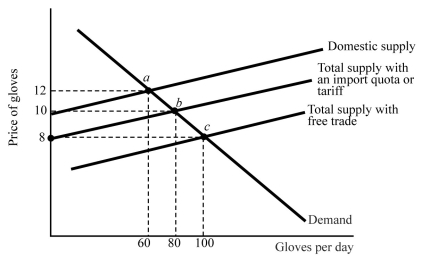 Figure 18.1
Refer to Figure 18.1. With free trade, what is the equilibrium quantity of gloves in Duckland?
A) 100
B) 80
C) 60
D) 40
سؤال
سؤال
سؤال
سؤال
سؤال
سؤال
سؤال
Consider two individuals, Celia and Sondra, who produce bracelets and pendants. Celia's and Sondra's hourly productivity are as follows:
 Who has the absolute advantage or comparative advantage in the production of bracelets or pendants?
Who has the absolute advantage or comparative advantage in the production of bracelets or pendants? سؤال
سؤال
سؤال
سؤال
سؤال

فتح الحزمة
قم بالتسجيل لفتح البطاقات في هذه المجموعة!
Unlock Deck
Unlock Deck
1/210

العب

ملء الشاشة (f)
Deck 18: International Trade and Finance
1
Table 18.1Based on the data in Table 18.1
A) April should specialize in painting kites and trade for snowboards.
B) April should specialize in painting snowboards and trade for kites.
C) Jesse should specialize in both goods.
D) April should specialize in both goods.
April should specialize in painting snowboards and trade for kites.
2
Table 18.1Consider two individuals, Jesse and April, who hand paint kites and snowboards. Table 18.1 shows how much of each good Jesse and April can paint in one hour. Jesse's opportunity cost of painting one kite is painting
A) 1/12 of a snowboard.
B) 1/8 of a snowboard.
C) 1/3 of a snowboard.
D) 3 snowboards.
1/8 of a snowboard.
3
Table 18.3Consider two individuals, Nigel and Mia, who produce hair pins and bandanas. Nigel's and Mia's hourly productivity are shown in Table 18.3. Nigel's opportunity cost of producing one hair pin is
A) 1/3 of a bandana.
B) 2.5 bandanas.
C) 3 bandanas.
D) 10 bandanas.
2.5 bandanas.
4
Table 18.3Consider two individuals, Nigel and Mia, who produce hair pins and bandanas. Nigel's and Mia's hourly productivity are shown in Table 18.3. Nigel's opportunity cost of producing one bandana is
A) 1/4 of a hair pin.
B) 2/5 of a hair pin.
C) 2.5 hair pins.
D) 4 hair pins.
فتح الحزمة
افتح القفل للوصول البطاقات البالغ عددها 210 في هذه المجموعة.
فتح الحزمة
k this deck
5
Table 18.3Consider two individuals, Nigel and Mia, who produce hair pins and bandanas. Nigel's and Mia's hourly productivity are shown in Table 18.3. Mia's opportunity cost of producing one hair pin is
A) 1/3 of a bandana.
B) 2.5 bandanas.
C) 3 bandanas.
D) 10 bandanas.
فتح الحزمة
افتح القفل للوصول البطاقات البالغ عددها 210 في هذه المجموعة.
فتح الحزمة
k this deck
6
Table 18.1Consider two individuals, Jesse and April, who hand paint kites and snowboards. Table 18.1 shows how much of each good Jesse and April can paint in one hour. Jesse's opportunity cost of painting one snowboard is painting
A) 1/8 of a kite.
B) 1.5 kites.
C) 8 kites.
D) 12 kites.
فتح الحزمة
افتح القفل للوصول البطاقات البالغ عددها 210 في هذه المجموعة.
فتح الحزمة
k this deck
7
Table 18.1The ability of one person or nation to produce a good at a lower opportunity cost than another is called a(n)
A) market advantage.
B) comparative advantage.
C) absolute advantage.
D) specialization advantage.
فتح الحزمة
افتح القفل للوصول البطاقات البالغ عددها 210 في هذه المجموعة.
فتح الحزمة
k this deck
8
Table 18.2Consider two individuals, Jesse and April, who hand paint kites and snowboards. Table 18.2 shows how much of each good Jesse and April can paint in one hour. Which of the following is TRUE?
A) Jesse has an absolute advantage in painting kites but not snowboards.
B) Jesse has an absolute advantage in painting snowboards but not kites.
C) Jesse has an absolute advantage in painting both goods.
D) Jesse has an absolute advantage in painting neither good.
فتح الحزمة
افتح القفل للوصول البطاقات البالغ عددها 210 في هذه المجموعة.
فتح الحزمة
k this deck
9
Markets exist
A) so people can buy and sell things.
B) because people are self-sufficient.
C) because each person specializes in the production of many products.
D) as an arrangement where buyers do not interact with sellers.
A) so people can buy and sell things.
B) because people are self-sufficient.
C) because each person specializes in the production of many products.
D) as an arrangement where buyers do not interact with sellers.
فتح الحزمة
افتح القفل للوصول البطاقات البالغ عددها 210 في هذه المجموعة.
فتح الحزمة
k this deck
10
Table 18.1An individual or country that has a comparative advantage in the production of one good
A) must have an absolute advantage in the good's production.
B) must not have an absolute advantage in the good's production.
C) may or may not have an absolute advantage in the good's production.
D) must not have an absolute advantage in the production of the other good.
فتح الحزمة
افتح القفل للوصول البطاقات البالغ عددها 210 في هذه المجموعة.
فتح الحزمة
k this deck
11
Table 18.1Consider two individuals, Jesse and April, who hand paint kites and snowboards. Table 18.1 shows how much of each good Jesse and April can paint in one hour. April's opportunity cost of painting one kite is painting
A) 1/12 of a snowboard.
B) 1/4 of a snowboard.
C) 3 snowboards.
D) 4 snowboards.
فتح الحزمة
افتح القفل للوصول البطاقات البالغ عددها 210 في هذه المجموعة.
فتح الحزمة
k this deck
12
Table 18.1Based on the data in Table 18.1
A) Jesse should specialize in painting kites and trade for snowboards.
B) Jesse should specialize in painting snowboards and trade for kites.
C) April should specialize in both goods.
D) Jesse should specialize in both goods.
فتح الحزمة
افتح القفل للوصول البطاقات البالغ عددها 210 في هذه المجموعة.
فتح الحزمة
k this deck
13
Table 18.2Consider two individuals, Jesse and April, who hand paint kites and snowboards. Table 18.2 shows how much of each good Jesse and April can paint in one hour. Which of the following is TRUE?
A) April has a comparative advantage in painting kites but not snowboards.
B) April has a comparative advantage in painting snowboards but not kites.
C) April has a comparative advantage in painting both goods.
D) April does not have a comparative advantage in painting either good.
فتح الحزمة
افتح القفل للوصول البطاقات البالغ عددها 210 في هذه المجموعة.
فتح الحزمة
k this deck
14
Table 18.2Consider two individuals, Jesse and April, who hand paint kites and snowboards. Table 18.2 shows how much of each good Jesse and April can paint in one hour. Which of the following is TRUE?
A) April has both an absolute and comparative advantage in painting kites.
B) April has both an absolute and comparative advantage in painting snowboards.
C) April has neither an absolute nor comparative advantage in painting kites.
D) April has neither an absolute nor a comparative advantage in painting snowboards.
فتح الحزمة
افتح القفل للوصول البطاقات البالغ عددها 210 في هذه المجموعة.
فتح الحزمة
k this deck
15
Table 18.2Consider two individuals, Jesse and April, who hand paint kites and snowboards. Table 18.2 shows how much of each good Jesse and April can paint in one hour. Which of the following is TRUE?
A) April has an absolute advantage in painting kites but not snowboards.
B) April has an absolute advantage in painting snowboards but not kites.
C) April has an absolute advantage in painting both goods.
D) April does not have an absolute advantage in painting either good.
فتح الحزمة
افتح القفل للوصول البطاقات البالغ عددها 210 في هذه المجموعة.
فتح الحزمة
k this deck
16
Table 18.1Based on the data in Table 18.1, if Jesse and April choose to specialize and trade, then
A) April will specialize in painting kites and trade kites for snowboards.
B) April will specialize in painting snowboards and trade snowboards for kites.
C) Jesse will specialize in painting snowboards and trade snowboards for kites.
D) None of the above; specialization and trade are not beneficial for Jesse and April.
فتح الحزمة
افتح القفل للوصول البطاقات البالغ عددها 210 في هذه المجموعة.
فتح الحزمة
k this deck
17
Table 18.3Consider two individuals, Nigel and Mia, who produce hair pins and bandanas. Nigel's and Mia's hourly productivity are shown in Table 18.3. Mia's opportunity cost of producing one bandana is
A) 1/3 of a hair pin.
B) 2.5 hair pins.
C) 3 hair pins.
D) 9 hair pins.
فتح الحزمة
افتح القفل للوصول البطاقات البالغ عددها 210 في هذه المجموعة.
فتح الحزمة
k this deck
18
To explore the rationale for specialization, economists use the
A) marginal principle.
B) principle of opportunity cost.
C) real-nominal principle.
D) principle of marginal exchange.
A) marginal principle.
B) principle of opportunity cost.
C) real-nominal principle.
D) principle of marginal exchange.
فتح الحزمة
افتح القفل للوصول البطاقات البالغ عددها 210 في هذه المجموعة.
فتح الحزمة
k this deck
19
Table 18.1The ability of one person or nation to produce a good at a lower absolute cost than another is called a(n)
A) market advantage.
B) comparative advantage.
C) absolute advantage.
D) specialization advantage.
فتح الحزمة
افتح القفل للوصول البطاقات البالغ عددها 210 في هذه المجموعة.
فتح الحزمة
k this deck
20
Table 18.1Consider two individuals, Jesse and April, who hand paint kites and snowboards. Table 18.1 shows how much of each good Jesse and April can paint in one hour. April's opportunity cost of painting one snowboard is painting
A) 1.5 kites.
B) 3 kites.
C) 4 kites.
D) 12 kites.
فتح الحزمة
افتح القفل للوصول البطاقات البالغ عددها 210 في هذه المجموعة.
فتح الحزمة
k this deck
21
Table 18.3Consider two individuals, Nigel and Mia, who produce hair pins and bandanas. Nigel's and Mia's hourly productivity are shown in Table 18.3. Which of the following is TRUE?
A) Nigel has a comparative advantage in producing hair pins but not bandanas.
B) Nigel has a comparative advantage in producing bandanas but not hair pins.
C) Nigel has a comparative advantage in producing both goods.
D) Nigel does not have a comparative advantage in producing either good.
فتح الحزمة
افتح القفل للوصول البطاقات البالغ عددها 210 في هذه المجموعة.
فتح الحزمة
k this deck
22
Outsourcing allows a company to take advantage of the ________ of other countries, and in doing so it can produce its products at a lower cost.
A) comparative advantages
B) diminishing returns
C) trade imbalances
D) market failures
A) comparative advantages
B) diminishing returns
C) trade imbalances
D) market failures
فتح الحزمة
افتح القفل للوصول البطاقات البالغ عددها 210 في هذه المجموعة.
فتح الحزمة
k this deck
23
Table 18.3Consider two individuals, Nigel and Mia, who produce hair pins and bandanas. Nigel's and Mia's hourly productivity are shown in Table 18.3. Which of the following is TRUE?
A) Nigel has an absolute advantage in producing hair pins but not bandanas.
B) Nigel has an absolute advantage in producing bandanas but not hair pins.
C) Nigel has an absolute advantage in producing both goods.
D) Nigel does not have an absolute advantage in producing either good.
فتح الحزمة
افتح القفل للوصول البطاقات البالغ عددها 210 في هذه المجموعة.
فتح الحزمة
k this deck
24
The cost savings from outsourcing often lead to ________ for consumers and ________ for the outsourcing company.
A) lower prices; less output
B) lower prices; more output
C) higher prices; less output
D) higher prices; more output
A) lower prices; less output
B) lower prices; more output
C) higher prices; less output
D) higher prices; more output
فتح الحزمة
افتح القفل للوصول البطاقات البالغ عددها 210 في هذه المجموعة.
فتح الحزمة
k this deck
25
When a U.S. company shifts some of its production to Mexico, it is engaging in
A) outsourcing.
B) insourcing.
C) self-sufficiency.
D) involuntary exchange.
A) outsourcing.
B) insourcing.
C) self-sufficiency.
D) involuntary exchange.
فتح الحزمة
افتح القفل للوصول البطاقات البالغ عددها 210 في هذه المجموعة.
فتح الحزمة
k this deck
26
For country A, an import is a good produced in
A) country B and purchased by residents of country B.
B) country B and purchased by residents of country A.
C) country A and purchased by residents of country B.
D) country A and purchased by residents of country A.
A) country B and purchased by residents of country B.
B) country B and purchased by residents of country A.
C) country A and purchased by residents of country B.
D) country A and purchased by residents of country A.
فتح الحزمة
افتح القفل للوصول البطاقات البالغ عددها 210 في هذه المجموعة.
فتح الحزمة
k this deck
27
A rich nation will trade with a poor nation because the
A) rich nation has the absolute advantage in producing all products.
B) poor nation has the absolute advantage in producing all products.
C) poor nation has the comparative advantage in producing a product.
D) rich nation has the comparative advantage in producing all products.
A) rich nation has the absolute advantage in producing all products.
B) poor nation has the absolute advantage in producing all products.
C) poor nation has the comparative advantage in producing a product.
D) rich nation has the comparative advantage in producing all products.
فتح الحزمة
افتح القفل للوصول البطاقات البالغ عددها 210 في هذه المجموعة.
فتح الحزمة
k this deck
28
For country A, an export is a good produced in
A) country B and purchased by residents of country B.
B) country B and purchased by residents of country A.
C) country A and purchased by residents of country B.
D) country A and purchased by residents of country A.
A) country B and purchased by residents of country B.
B) country B and purchased by residents of country A.
C) country A and purchased by residents of country B.
D) country A and purchased by residents of country A.
فتح الحزمة
افتح القفل للوصول البطاقات البالغ عددها 210 في هذه المجموعة.
فتح الحزمة
k this deck
29
An import is a product
A) produced in and purchased by residents of the home country.
B) produced in and sold to the residents of a foreign country.
C) produced in the home country and sold in another country.
D) produced in a foreign country and purchased by the residents of the home country.
A) produced in and purchased by residents of the home country.
B) produced in and sold to the residents of a foreign country.
C) produced in the home country and sold in another country.
D) produced in a foreign country and purchased by the residents of the home country.
فتح الحزمة
افتح القفل للوصول البطاقات البالغ عددها 210 في هذه المجموعة.
فتح الحزمة
k this deck
30
Table 18.3Jimbo has a comparative advantage over Ned in producing a good if
A) Jimbo can produce more of the good than Ned can in a given time period.
B) Jimbo has a lower opportunity cost of producing the good than does Ned.
C) Jimbo has to trade off more than Ned does to produce the good.
D) Jimbo has a higher opportunity cost of producing the good than does Ned.
فتح الحزمة
افتح القفل للوصول البطاقات البالغ عددها 210 في هذه المجموعة.
فتح الحزمة
k this deck
31
Table 18.4Consider two individuals, Artie and Deena, who produce wind chimes and sun dials. Artie's and Deena's weekly productivity are shown in Table 18.4. Which of the following is TRUE?
A) Deena has an absolute advantage in producing both goods, and a comparative advantage in producing wind chimes.
B) Deena has an absolute advantage in producing both goods, and a comparative advantage in producing sun dials.
C) Deena has an absolute and a comparative advantage in producing both goods.
D) Deena has an absolute advantage in producing both goods, but no one has a comparative advantage in producing either good.
فتح الحزمة
افتح القفل للوصول البطاقات البالغ عددها 210 في هذه المجموعة.
فتح الحزمة
k this deck
32
Jobs lost to outsourcing can be partially offset by jobs gained from
A) higher production costs.
B) higher opportunity costs.
C) greater trade imbalances.
D) increased output from another industry.
A) higher production costs.
B) higher opportunity costs.
C) greater trade imbalances.
D) increased output from another industry.
فتح الحزمة
افتح القفل للوصول البطاقات البالغ عددها 210 في هذه المجموعة.
فتح الحزمة
k this deck
33
Table 18.3Consider two individuals, Nigel and Mia, who produce hair pins and bandanas. Nigel's and Mia's hourly productivity are shown in Table 18.3. Which of the following is TRUE?
A) Nigel has both an absolute and comparative advantage in hair pin production.
B) Nigel has both an absolute and comparative advantage in bandana production.
C) Nigel has neither an absolute nor comparative advantage in hair pin production.
D) Nigel has neither an absolute nor a comparative advantage in bandana production.
فتح الحزمة
افتح القفل للوصول البطاقات البالغ عددها 210 في هذه المجموعة.
فتح الحزمة
k this deck
34
When a U.S. company shifts its call-center operations overseas to reduce costs, it is applying the economic concept of
A) thinking at the margin.
B) comparative advantage.
C) diminishing returns.
D) using assumptions to simplify.
A) thinking at the margin.
B) comparative advantage.
C) diminishing returns.
D) using assumptions to simplify.
فتح الحزمة
افتح القفل للوصول البطاقات البالغ عددها 210 في هذه المجموعة.
فتح الحزمة
k this deck
35
Trade results from
A) comparative advantage.
B) absolute advantage.
C) self-sufficiency.
D) diminishing returns.
A) comparative advantage.
B) absolute advantage.
C) self-sufficiency.
D) diminishing returns.
فتح الحزمة
افتح القفل للوصول البطاقات البالغ عددها 210 في هذه المجموعة.
فتح الحزمة
k this deck
36
Recall the Application about productivity in the nation of Latvia in the 1990s to answer the following question(s).
According to this Application, in the 1990s EU countries had ________ in the production of all products compared to Latvia.
A) an absolute advantage and a comparative advantage
B) an absolute advantage but not a comparative advantage
C) a comparative advantage but not an absolute advantage
D) neither an absolute advantage nor a comparative advantage
According to this Application, in the 1990s EU countries had ________ in the production of all products compared to Latvia.
A) an absolute advantage and a comparative advantage
B) an absolute advantage but not a comparative advantage
C) a comparative advantage but not an absolute advantage
D) neither an absolute advantage nor a comparative advantage
فتح الحزمة
افتح القفل للوصول البطاقات البالغ عددها 210 في هذه المجموعة.
فتح الحزمة
k this deck
37
Table 18.3Consider two individuals, Nigel and Mia, who produce hair pins and bandanas. Nigel's and Mia's hourly productivity are shown in Table 18.3. Which of the following is TRUE?
A) Mia has an absolute advantage in producing hair pins but not bandanas.
B) Mia has an absolute advantage in producing bandanas but not hair pins.
C) Mia has an absolute advantage in producing both goods.
D) Mia does not have an absolute advantage in producing either good.
فتح الحزمة
افتح القفل للوصول البطاقات البالغ عددها 210 في هذه المجموعة.
فتح الحزمة
k this deck
38
An export is a product
A) produced in and purchased by residents of the home country.
B) produced in and sold to the residents of a foreign country.
C) produced in the home country and sold in another country.
D) produced in a foreign country and purchased by the residents of the home country.
A) produced in and purchased by residents of the home country.
B) produced in and sold to the residents of a foreign country.
C) produced in the home country and sold in another country.
D) produced in a foreign country and purchased by the residents of the home country.
فتح الحزمة
افتح القفل للوصول البطاقات البالغ عددها 210 في هذه المجموعة.
فتح الحزمة
k this deck
39
A U.S. company is attempting to cut costs by shifting some of its services to Thailand. This process of shifting production of products or services overseas to cut costs often results in
A) greater potential for market failure for those products and services.
B) greater economic uncertainty in the market for those products and services.
C) lower consumer prices on those products or services.
D) lower production quantities of those products or services.
A) greater potential for market failure for those products and services.
B) greater economic uncertainty in the market for those products and services.
C) lower consumer prices on those products or services.
D) lower production quantities of those products or services.
فتح الحزمة
افتح القفل للوصول البطاقات البالغ عددها 210 في هذه المجموعة.
فتح الحزمة
k this deck
40
Table 18.4Consider two individuals, Artie and Deena, who produce wind chimes and sun dials. Artie's and Deena's weekly productivity are shown in Table 18.4. Which of the following is TRUE?
A) Artie has a comparative advantage in producing wind chimes but not sun dials.
B) Artie has a comparative advantage in producing sun dials but not wind chimes.
C) Artie has a comparative advantage in producing both goods.
D) Artie does not have a comparative advantage in producing either good.
فتح الحزمة
افتح القفل للوصول البطاقات البالغ عددها 210 في هذه المجموعة.
فتح الحزمة
k this deck
41
What does it mean for a nation to have an absolute advantage in producing a product?
فتح الحزمة
افتح القفل للوصول البطاقات البالغ عددها 210 في هذه المجموعة.
فتح الحزمة
k this deck
42
A comparative advantage is the ability of one person or nation to produce a good at an opportunity cost that is lower than that of another person or nation.
فتح الحزمة
افتح القفل للوصول البطاقات البالغ عددها 210 في هذه المجموعة.
فتح الحزمة
k this deck
43
If Eddie can produce 40 milk shakes or 20 banana splits in an hour, and Tina can produce 30 milk shakes or 16 banana splits in an hour, then Eddie has a comparative advantage in producing milk shakes.
فتح الحزمة
افتح القفل للوصول البطاقات البالغ عددها 210 في هذه المجموعة.
فتح الحزمة
k this deck
44
Recall the Application about productivity in the nation of Latvia in the 1990s to answer the following question(s).
According to this Application, workers in the EU were more productive than workers in Latvia in the 1990s, yet despite this, EU nations chose to trade with Latvia. Engaging in trade with Latvia allowed ________ to become more productive.
A) workers in the EU but not workers in Latvia
B) workers in Latvia but not workers in the EU
C) neither workers in the EU nor in Latvia
D) workers in both the EU and in Latvia
According to this Application, workers in the EU were more productive than workers in Latvia in the 1990s, yet despite this, EU nations chose to trade with Latvia. Engaging in trade with Latvia allowed ________ to become more productive.
A) workers in the EU but not workers in Latvia
B) workers in Latvia but not workers in the EU
C) neither workers in the EU nor in Latvia
D) workers in both the EU and in Latvia
فتح الحزمة
افتح القفل للوصول البطاقات البالغ عددها 210 في هذه المجموعة.
فتح الحزمة
k this deck
45
If Eddie can produce 40 milk shakes or 20 banana splits in an hour, and Tina can produce 30 milk shakes or 16 banana splits in an hour, then Tina has a comparative advantage in producing banana splits.
فتح الحزمة
افتح القفل للوصول البطاقات البالغ عددها 210 في هذه المجموعة.
فتح الحزمة
k this deck
46
Consider two individuals, Ozzy and Sharon, who produce toy boats and yoyos. Ozzy's and Sharon's hourly productivity are as follows:
Who has the absolute advantage or comparative advantage in the production of yoyos or boats?
Who has the absolute advantage or comparative advantage in the production of yoyos or boats? فتح الحزمة
افتح القفل للوصول البطاقات البالغ عددها 210 في هذه المجموعة.
فتح الحزمة
k this deck
47
If Eddie can produce 40 milk shakes or 20 banana splits in an hour, and Tina can produce 30 milk shakes or 16 banana splits in an hour, then Eddie has a comparative advantage in producing banana splits.
فتح الحزمة
افتح القفل للوصول البطاقات البالغ عددها 210 في هذه المجموعة.
فتح الحزمة
k this deck
48
Exports are products produced in the home country and sold in another country.
فتح الحزمة
افتح القفل للوصول البطاقات البالغ عددها 210 في هذه المجموعة.
فتح الحزمة
k this deck
49
If a person has a comparative advantage in some activity, she must have an absolute advantage in that activity as well.
فتح الحزمة
افتح القفل للوصول البطاقات البالغ عددها 210 في هذه المجموعة.
فتح الحزمة
k this deck
50
Explain what is meant by the economic principle of voluntary exchange.
فتح الحزمة
افتح القفل للوصول البطاقات البالغ عددها 210 في هذه المجموعة.
فتح الحزمة
k this deck
51
What does it mean for a person or nation to have a comparative advantage in producing a product?
فتح الحزمة
افتح القفل للوصول البطاقات البالغ عددها 210 في هذه المجموعة.
فتح الحزمة
k this deck
52
The principles of comparative advantage and specialization only apply to trade between different nations.
فتح الحزمة
افتح القفل للوصول البطاقات البالغ عددها 210 في هذه المجموعة.
فتح الحزمة
k this deck
53
Imports are products produced in the home country and sold in another country.
فتح الحزمة
افتح القفل للوصول البطاقات البالغ عددها 210 في هذه المجموعة.
فتح الحزمة
k this deck
54
Trade is only beneficial if a nation has an absolute advantage in producing all products.
فتح الحزمة
افتح القفل للوصول البطاقات البالغ عددها 210 في هذه المجموعة.
فتح الحزمة
k this deck
55
Recall the Application about productivity in the nation of Latvia in the 1990s to answer the following question(s).
According to this Application, workers in the EU were more productive than workers in Latvia in the 1990s, yet EU nations still purchased products from Latvia. This is because Latvia ________ in the production of the products it sold to EU nations.
A) had an absolute advantage
B) had a comparative advantage
C) used fewer resources
D) had a higher opportunity cost
According to this Application, workers in the EU were more productive than workers in Latvia in the 1990s, yet EU nations still purchased products from Latvia. This is because Latvia ________ in the production of the products it sold to EU nations.
A) had an absolute advantage
B) had a comparative advantage
C) used fewer resources
D) had a higher opportunity cost
فتح الحزمة
افتح القفل للوصول البطاقات البالغ عددها 210 في هذه المجموعة.
فتح الحزمة
k this deck
56
If Libby can produce 20 gallons of beer or 5 gallons of wine per hour, her opportunity cost of one gallon of beer is 4 gallons of wine.
فتح الحزمة
افتح القفل للوصول البطاقات البالغ عددها 210 في هذه المجموعة.
فتح الحزمة
k this deck
57
Trade will be beneficial for a nation with a comparative advantage in producing a certain product.
فتح الحزمة
افتح القفل للوصول البطاقات البالغ عددها 210 في هذه المجموعة.
فتح الحزمة
k this deck
58
If a person has an absolute advantage in some activity, she must have a comparative advantage in that activity as well.
فتح الحزمة
افتح القفل للوصول البطاقات البالغ عددها 210 في هذه المجموعة.
فتح الحزمة
k this deck
59
If Eddie can produce 40 milk shakes or 20 banana splits in an hour, and Tina can produce 30 milk shakes or 16 banana splits in an hour, then Tina has a comparative advantage in producing milk shakes.
فتح الحزمة
افتح القفل للوصول البطاقات البالغ عددها 210 في هذه المجموعة.
فتح الحزمة
k this deck
60
Absolute advantage occurs when one producer has greater productivity compared to another producing the same product.
فتح الحزمة
افتح القفل للوصول البطاقات البالغ عددها 210 في هذه المجموعة.
فتح الحزمة
k this deck
61
Import bans, import quotas, voluntary export restraints, and tariffs on goods all
A) increase equilibrium quantity and prices.
B) decrease equilibrium quantity and prices.
C) increase equilibrium quantities, but decrease prices.
D) decrease equilibrium quantities, but increase prices.
A) increase equilibrium quantity and prices.
B) decrease equilibrium quantity and prices.
C) increase equilibrium quantities, but decrease prices.
D) decrease equilibrium quantities, but increase prices.
فتح الحزمة
افتح القفل للوصول البطاقات البالغ عددها 210 في هذه المجموعة.
فتح الحزمة
k this deck
62
Which of the following situations will arise in the domestic market following the imposition of an import ban?
A) imports increase, domestic production increases, prices increase
B) imports increase, domestic production decreases, prices decrease
C) imports decrease, domestic production increases, prices increase
D) imports decrease, domestic production increases, prices decrease
A) imports increase, domestic production increases, prices increase
B) imports increase, domestic production decreases, prices decrease
C) imports decrease, domestic production increases, prices increase
D) imports decrease, domestic production increases, prices decrease
فتح الحزمة
افتح القفل للوصول البطاقات البالغ عددها 210 في هذه المجموعة.
فتح الحزمة
k this deck
63
An import ban results in
A) a decrease in the supply of the product.
B) an increase in the product's price.
C) a decrease in the quantity of the product bought and sold.
D) all of the above.
A) a decrease in the supply of the product.
B) an increase in the product's price.
C) a decrease in the quantity of the product bought and sold.
D) all of the above.
فتح الحزمة
افتح القفل للوصول البطاقات البالغ عددها 210 في هذه المجموعة.
فتح الحزمة
k this deck
64
Which of the following situations will arise in the domestic market following the imposition of a tariff?
A) imports decrease, domestic production increases, prices increase
B) imports increase, domestic production increases, prices increase
C) imports increase, domestic production decreases, prices decrease
D) imports decrease, domestic production increases, prices decrease
A) imports decrease, domestic production increases, prices increase
B) imports increase, domestic production increases, prices increase
C) imports increase, domestic production decreases, prices decrease
D) imports decrease, domestic production increases, prices decrease
فتح الحزمة
افتح القفل للوصول البطاقات البالغ عددها 210 في هذه المجموعة.
فتح الحزمة
k this deck
65
Define the term "import."
فتح الحزمة
افتح القفل للوصول البطاقات البالغ عددها 210 في هذه المجموعة.
فتح الحزمة
k this deck
66
Define the term "export."
فتح الحزمة
افتح القفل للوصول البطاقات البالغ عددها 210 في هذه المجموعة.
فتح الحزمة
k this deck
67
Exporting nations often agree to voluntary export restraints in an attempt to
A) employ more workers in the importing nation.
B) avoid more restrictive trade policies.
C) increase global welfare.
D) decrease inflation.
A) employ more workers in the importing nation.
B) avoid more restrictive trade policies.
C) increase global welfare.
D) decrease inflation.
فتح الحزمة
افتح القفل للوصول البطاقات البالغ عددها 210 في هذه المجموعة.
فتح الحزمة
k this deck
68
Figure 18.1Refer to Figure 18.1. With free trade, what is the equilibrium quantity of gloves in Duckland?
A) 100
B) 80
C) 60
D) 40
فتح الحزمة
افتح القفل للوصول البطاقات البالغ عددها 210 في هذه المجموعة.
فتح الحزمة
k this deck
69
Which of the following situations will arise in the domestic market following the imposition of an import quota?
A) imports increase, domestic production decreases, prices decrease
B) imports decrease, domestic production increases, prices decrease
C) imports decrease, domestic production decreases, prices increase
D) imports decrease, domestic production increases, prices increase
A) imports increase, domestic production decreases, prices decrease
B) imports decrease, domestic production increases, prices decrease
C) imports decrease, domestic production decreases, prices increase
D) imports decrease, domestic production increases, prices increase
فتح الحزمة
افتح القفل للوصول البطاقات البالغ عددها 210 في هذه المجموعة.
فتح الحزمة
k this deck
70
Import bans, import quotas, voluntary export restraints, and tariffs on goods all
A) increase imports and raise prices for consumers.
B) reduce imports and prices for consumers.
C) reduce imports and raise prices for consumers.
D) increase imports and reduce prices for consumers.
A) increase imports and raise prices for consumers.
B) reduce imports and prices for consumers.
C) reduce imports and raise prices for consumers.
D) increase imports and reduce prices for consumers.
فتح الحزمة
افتح القفل للوصول البطاقات البالغ عددها 210 في هذه المجموعة.
فتح الحزمة
k this deck
71
In An Inquiry into the Nature and Causes of the Wealth of Nations, Adam Smith listed three reasons for productivity to increase with specialization. What are these three reasons?
فتح الحزمة
افتح القفل للوصول البطاقات البالغ عددها 210 في هذه المجموعة.
فتح الحزمة
k this deck
72
Which of the following situations will arise in the domestic market following the removal of an import quota?
A) imports increase, domestic production increases, prices increase
B) imports increase, domestic production decreases, prices decrease
C) imports decrease, domestic production increases, prices decrease
D) imports decrease, domestic production decreases, prices increase
A) imports increase, domestic production increases, prices increase
B) imports increase, domestic production decreases, prices decrease
C) imports decrease, domestic production increases, prices decrease
D) imports decrease, domestic production decreases, prices increase
فتح الحزمة
افتح القفل للوصول البطاقات البالغ عددها 210 في هذه المجموعة.
فتح الحزمة
k this deck
73
Which of the following situations will arise in the domestic market following the imposition of a voluntary export restraint?
A) imports increase, domestic production increases, prices increase
B) imports decrease, domestic production increases, prices increase
C) imports increase, domestic production decreases, prices decrease
D) imports decrease, domestic production increases, prices decrease
A) imports increase, domestic production increases, prices increase
B) imports decrease, domestic production increases, prices increase
C) imports increase, domestic production decreases, prices decrease
D) imports decrease, domestic production increases, prices decrease
فتح الحزمة
افتح القفل للوصول البطاقات البالغ عددها 210 في هذه المجموعة.
فتح الحزمة
k this deck
74
A(n) ________ is a trade policy by which a nation agrees to limit its exports of a good in order to avoid more restrictive trade policies.
A) tariff
B) voluntary export restraint
C) import quota
D) import ban
A) tariff
B) voluntary export restraint
C) import quota
D) import ban
فتح الحزمة
افتح القفل للوصول البطاقات البالغ عددها 210 في هذه المجموعة.
فتح الحزمة
k this deck
75
Consider two individuals, Celia and Sondra, who produce bracelets and pendants. Celia's and Sondra's hourly productivity are as follows:
Who has the absolute advantage or comparative advantage in the production of bracelets or pendants?
Who has the absolute advantage or comparative advantage in the production of bracelets or pendants? فتح الحزمة
افتح القفل للوصول البطاقات البالغ عددها 210 في هذه المجموعة.
فتح الحزمة
k this deck
76
Voluntary export restraints
A) have the same effect as an import ban.
B) are illegal under the international trading rules.
C) violate the spirit of international trade agreements.
D) all of the above.
A) have the same effect as an import ban.
B) are illegal under the international trading rules.
C) violate the spirit of international trade agreements.
D) all of the above.
فتح الحزمة
افتح القفل للوصول البطاقات البالغ عددها 210 في هذه المجموعة.
فتح الحزمة
k this deck
77
An import quota
A) limits the amount of a good that can be imported, thus decreasing prices.
B) limits the amount of a good that can be imported, thus increasing prices.
C) increases the amount of a good imported, thus decreasing prices.
D) increases the amount of a good imported, thus increasing prices.
A) limits the amount of a good that can be imported, thus decreasing prices.
B) limits the amount of a good that can be imported, thus increasing prices.
C) increases the amount of a good imported, thus decreasing prices.
D) increases the amount of a good imported, thus increasing prices.
فتح الحزمة
افتح القفل للوصول البطاقات البالغ عددها 210 في هذه المجموعة.
فتح الحزمة
k this deck
78
Imagine two countries, Zorba and Anduluvia. Zorba is producing everything at a lower resource cost than Anduluvia. If the two countries trade what is the reason?
فتح الحزمة
افتح القفل للوصول البطاقات البالغ عددها 210 في هذه المجموعة.
فتح الحزمة
k this deck
79
A(n) ________ is a tax on an imported good.
A) tariff
B) import quota
C) voluntary export restraint
D) export quota
A) tariff
B) import quota
C) voluntary export restraint
D) export quota
فتح الحزمة
افتح القفل للوصول البطاقات البالغ عددها 210 في هذه المجموعة.
فتح الحزمة
k this deck
80
Which of the following benefits from a quota or VER?
A) consumers
B) domestic producers
C) the government
D) all of the above
A) consumers
B) domestic producers
C) the government
D) all of the above
فتح الحزمة
افتح القفل للوصول البطاقات البالغ عددها 210 في هذه المجموعة.
فتح الحزمة
k this deck
فتح الحزمة
افتح القفل للوصول البطاقات البالغ عددها 210 في هذه المجموعة.






