







 تكلم مع الذكاء الاصطناعي


Deck 10: Competitive Markets
ملء الشاشة (f)

سؤال

سؤال
سؤال
سؤال
Consider a perfectly competitive market with inverse market supply  and inverse market demand
  Suppose the government subsidizes this market with a subsidy of $5 per unit.What is the equilibrium quantity traded after imposition of the subsidy?
A) Q = 10
B) Q = 12.5
C) Q = 9
D) Q = 7.5
and inverse market demand Suppose the government subsidizes this market with a subsidy of $5 per unit.What is the equilibrium quantity traded after imposition of the subsidy?A) Q = 10
B) Q = 12.5
C) Q = 9
D) Q = 7.5
سؤال
Consider a perfectly competitive market with inverse market supply  and inverse market demand
  Suppose the government subsidizes this market with a subsidy of $5 per unit.What are the equilibrium price and quantity traded before the subsidy?
A) P = 30; Q = 10
B) P = 25; Q = 12.5
C) P = 32; Q = 9
D) P = 35; Q = 7.5
and inverse market demand Suppose the government subsidizes this market with a subsidy of $5 per unit.What are the equilibrium price and quantity traded before the subsidy?A) P = 30; Q = 10
B) P = 25; Q = 12.5
C) P = 32; Q = 9
D) P = 35; Q = 7.5
سؤال
سؤال
Consider a perfectly competitive market with market supply  and market demand
  Suppose the government imposes an excise tax of $4 per unit on this market.What is total surplus (consumer surplus plus producer surplus) after the government imposes the tax?
A) 72
B) 98
C) 144
D) 196
and market demand Suppose the government imposes an excise tax of $4 per unit on this market.What is total surplus (consumer surplus plus producer surplus) after the government imposes the tax?A) 72
B) 98
C) 144
D) 196
سؤال
Consider a perfectly competitive market with market supply  and market demand
  What is the equilibrium quantity in this market?
A) 12
B) 14
C) 16
D) 18
and market demand What is the equilibrium quantity in this market?A) 12
B) 14
C) 16
D) 18
سؤال
سؤال
سؤال
Suppose that a market is initially in equilibrium.The initial demand curve is  The initial supply curve is
  Suppose that the government imposes a $3 tax on this market.What is the change in consumer surplus due to the tax?
A) $450.
B) $420.50.
C) $29.50.
D) $0.50.
The initial supply curve is Suppose that the government imposes a $3 tax on this market.What is the change in consumer surplus due to the tax?A) $450.
B) $420.50.
C) $29.50.
D) $0.50.
سؤال
سؤال
سؤال
سؤال
سؤال
Suppose that a market is initially in equilibrium.The initial demand curve is  The initial supply curve is
  Suppose that the government imposes a $3 tax on this market.What are the government receipts from the tax?
A) $90.
B) $87.
C) $45.
D) $43.50.
The initial supply curve is Suppose that the government imposes a $3 tax on this market.What are the government receipts from the tax?A) $90.
B) $87.
C) $45.
D) $43.50.
سؤال
Suppose that a market is initially in equilibrium.The initial demand curve is  The initial supply curve is
  Suppose that the government imposes a $3 tax on this market.How much of this $3 is paid for by producers?
A) $0.
B) $1.
C) $1.50.
D) $2.
The initial supply curve is Suppose that the government imposes a $3 tax on this market.How much of this $3 is paid for by producers?A) $0.
B) $1.
C) $1.50.
D) $2.
سؤال
سؤال
سؤال
سؤال
**Reference: Use the following figure to answer the next four questions (24-27). 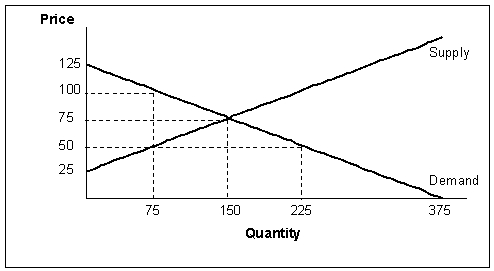
**Suppose the government sets a price ceiling of $50 in this market.What is the minimum level of deadweight loss with the price ceiling?
A) 7,500
B) 3,750
C) 1,875
D) 937.50
**Suppose the government sets a price ceiling of $50 in this market.What is the minimum level of deadweight loss with the price ceiling?
A) 7,500
B) 3,750
C) 1,875
D) 937.50
سؤال
Suppose that the market for corn is initially in equilibrium and is perfectly competitive.The demand curve can be expressed as  ; the supply curve can be expressed as
  Quantity is expressed in millions of bushels.Now suppose that the federal government imposes a price floor of $3 per bushel of corn.What is the dead-weight loss (per million bushels) associated with the price floor when the most efficient producers are active?
A) $9.375
B) $2.25.
C) $1.
D) $0.63.
; the supply curve can be expressed as Quantity is expressed in millions of bushels.Now suppose that the federal government imposes a price floor of $3 per bushel of corn.What is the dead-weight loss (per million bushels) associated with the price floor when the most efficient producers are active?A) $9.375
B) $2.25.
C) $1.
D) $0.63.
سؤال
سؤال
Consider a perfectly competitive market with inverse market supply  and inverse market demand
  Suppose the government subsidizes this market with a subsidy of $5 per unit.What is the deadweight loss resulting from the subsidy?
A) 0, subsidies do not have a deadweight loss
B) 2.5
C) 5
D) 7.5
and inverse market demand Suppose the government subsidizes this market with a subsidy of $5 per unit.What is the deadweight loss resulting from the subsidy?A) 0, subsidies do not have a deadweight loss
B) 2.5
C) 5
D) 7.5
سؤال
Consider a perfectly competitive market with inverse market supply  and inverse market demand
  Suppose the government subsidizes this market with a subsidy of $5 per unit.What is the impact on the government's budget resulting from the subsidy?
A) -45
B) -50
C) -270
D) -300
and inverse market demand Suppose the government subsidizes this market with a subsidy of $5 per unit.What is the impact on the government's budget resulting from the subsidy?A) -45
B) -50
C) -270
D) -300
سؤال
Consider a perfectly competitive market with inverse market supply  and inverse market demand
  Suppose the government subsidizes this market with a subsidy of $5 per unit.What is the increase in consumer surplus resulting from the subsidy?
A) 17
B) 19
C) 21
D) 23
and inverse market demand Suppose the government subsidizes this market with a subsidy of $5 per unit.What is the increase in consumer surplus resulting from the subsidy?A) 17
B) 19
C) 21
D) 23
سؤال
Suppose that the market for corn is initially in equilibrium and is perfectly competitive.The demand curve can be expressed as  ; the supply curve can be expressed as
  Quantity is expressed in millions of bushels.Now suppose that the federal government imposes a price floor of $3 per bushel of corn.What is the dead-weight loss (per million bushels) associated with the price floor when the least efficient producers are active?
A) $9.375
B) $2.25.
C) $1.
D) $0.63.
; the supply curve can be expressed as Quantity is expressed in millions of bushels.Now suppose that the federal government imposes a price floor of $3 per bushel of corn.What is the dead-weight loss (per million bushels) associated with the price floor when the least efficient producers are active?A) $9.375
B) $2.25.
C) $1.
D) $0.63.
سؤال
سؤال
سؤال
Suppose that the market for cigarettes is initially in equilibrium and is perfectly competitive.The demand curve can be expressed as  ; the supply curve can be expressed as
  Quantity is expressed in millions of boxes per month.Now suppose that the federal government imposes a production quota on cigarettes of 30 million boxes per month.What are the new amount traded and the price in this market?
A) Q = 40; P = 20
B) Q = 20; P = 40
C) Q = 30; P = 30
D) Q = 30; P = 15
; the supply curve can be expressed as Quantity is expressed in millions of boxes per month.Now suppose that the federal government imposes a production quota on cigarettes of 30 million boxes per month.What are the new amount traded and the price in this market?A) Q = 40; P = 20
B) Q = 20; P = 40
C) Q = 30; P = 30
D) Q = 30; P = 15
سؤال
سؤال
سؤال
Suppose that the market for corn is initially in equilibrium and is perfectly competitive.The demand curve can be expressed as  ; the supply curve can be expressed as
  Quantity is expressed in millions of bushels.Now suppose that the federal government imposes a price floor of $3 per bushel of corn.Which of the following best describes the market after the price floor is imposed?
A) There will be a shortage of 5 million bushels.
B) There will be a surplus of 5 million bushels.
C) There will be a surplus of 7 million bushels.
D) There will be a surplus of 12 million bushels.
; the supply curve can be expressed as Quantity is expressed in millions of bushels.Now suppose that the federal government imposes a price floor of $3 per bushel of corn.Which of the following best describes the market after the price floor is imposed?A) There will be a shortage of 5 million bushels.
B) There will be a surplus of 5 million bushels.
C) There will be a surplus of 7 million bushels.
D) There will be a surplus of 12 million bushels.
سؤال
سؤال
Suppose that the market for corn is initially in equilibrium and is perfectly competitive.The demand curve can be expressed as  ; the supply curve can be expressed as
  Quantity is expressed in millions of bushels.What is the equilibrium quantity traded and price in this market?
A) Q = 8; P = 2
B) Q = 2; P = 8
C) Q = 7; P = 3
D) Q = 3; P = 7
; the supply curve can be expressed as Quantity is expressed in millions of bushels.What is the equilibrium quantity traded and price in this market?A) Q = 8; P = 2
B) Q = 2; P = 8
C) Q = 7; P = 3
D) Q = 3; P = 7
سؤال
**Reference: Use the following figure to answer the next four questions (24-27).
**Suppose the government sets a price ceiling of $50 in this market.What is the maximum level of consumer surplus with the price ceiling?
A) 16,875
B) 11,250
C) 8,437.50
D) 4,843.75
**Suppose the government sets a price ceiling of $50 in this market.What is the maximum level of consumer surplus with the price ceiling?
A) 16,875
B) 11,250
C) 8,437.50
D) 4,843.75
سؤال
Suppose that the market for cigarettes is initially in equilibrium and is perfectly competitive.The demand curve can be expressed as  ; the supply curve can be expressed as
  Quantity is expressed in millions of boxes per month.Now suppose that the federal government imposes a production quota on cigarettes of 30 million boxes per month.What is the level of excess supply in this market?
A) There is no excess supply. There is an excess demand of Q = 30.
B) There is no excess supply or demand.
C) There is an excess supply of Q = 30.
D) There is an excess supply of Q = 20.
; the supply curve can be expressed as Quantity is expressed in millions of boxes per month.Now suppose that the federal government imposes a production quota on cigarettes of 30 million boxes per month.What is the level of excess supply in this market?A) There is no excess supply. There is an excess demand of Q = 30.
B) There is no excess supply or demand.
C) There is an excess supply of Q = 30.
D) There is an excess supply of Q = 20.
سؤال
**Reference: Use the following figure to answer the next four questions (24-27).
**Determine the level of consumer surplus at the market equilibrium.
A) 16,875
B) 11,250
C) 7,500
D) 3,750
**Determine the level of consumer surplus at the market equilibrium.
A) 16,875
B) 11,250
C) 7,500
D) 3,750
سؤال
**Reference: Use the following figure to answer the next four questions (24-27).
**Determine the level of producer surplus at the market equilibrium.
A) 16,875
B) 11,250
C) 7,500
D) 3,750
**Determine the level of producer surplus at the market equilibrium.
A) 16,875
B) 11,250
C) 7,500
D) 3,750
سؤال
Suppose that the market for cigarettes is initially in equilibrium and is perfectly competitive.The demand curve can be expressed as  ; the supply curve can be expressed as
  Quantity is expressed in millions of boxes per month.What are the amount traded and the price for this market?
A) Q = 40; P = 20
B) Q = 20; P = 40
C) Q = 30; P = 30
D) Q = 30; P = 15
; the supply curve can be expressed as Quantity is expressed in millions of boxes per month.What are the amount traded and the price for this market?A) Q = 40; P = 20
B) Q = 20; P = 40
C) Q = 30; P = 30
D) Q = 30; P = 15
سؤال
Suppose that a market is initially in equilibrium.The initial demand curve is  The initial supply curve is
  Suppose that the government imposes a $3 tax on this market.What is the dead-weight loss due to the tax?
A) $3.
B) $2.
C) $1.50.
D) $1.00.
The initial supply curve is Suppose that the government imposes a $3 tax on this market.What is the dead-weight loss due to the tax?A) $3.
B) $2.
C) $1.50.
D) $1.00.
سؤال
Consider a perfectly competitive market with market supply  and market demand
  What is consumer surplus in this market?
A) 98
B) 128
C) 196
D) 256
and market demand What is consumer surplus in this market?A) 98
B) 128
C) 196
D) 256
سؤال
Suppose that the market for corn is initially in equilibrium and is perfectly competitive.The demand curve can be expressed as  ; the supply curve can be expressed as
  Quantity is expressed in millions of bushels.Now suppose that the federal government imposes a price floor of $3 per bushel of corn.What is the new equilibrium quantity traded in this market?
A) Q = 8;
B) Q = 2;
C) Q = 7
D) Q = 3
; the supply curve can be expressed as Quantity is expressed in millions of bushels.Now suppose that the federal government imposes a price floor of $3 per bushel of corn.What is the new equilibrium quantity traded in this market?A) Q = 8;
B) Q = 2;
C) Q = 7
D) Q = 3
سؤال
سؤال
Consider a perfectly competitive market with market supply  and market demand
  Suppose the government imposes an excise tax of $4 per unit on this market. What is the deadweight loss from this tax?
A) 2
B) 4
C) 6
D) 8
and market demand Suppose the government imposes an excise tax of $4 per unit on this market. What is the deadweight loss from this tax?A) 2
B) 4
C) 6
D) 8
سؤال
Consider a perfectly competitive market with market supply  and market demand
  What is total surplus in this market?
A) 98
B) 128
C) 196
D) 256
and market demand What is total surplus in this market?A) 98
B) 128
C) 196
D) 256
سؤال
Consider a perfectly competitive market with market supply  and market demand
  Suppose the government imposes an excise tax of $4 per unit on this market.What is total surplus (consumer surplus plus producer surplus) before the government imposes the tax?
A) 72
B) 98
C) 144
D) 196
and market demand Suppose the government imposes an excise tax of $4 per unit on this market.What is total surplus (consumer surplus plus producer surplus) before the government imposes the tax?A) 72
B) 98
C) 144
D) 196
سؤال
سؤال
سؤال
سؤال
سؤال
Suppose that a market is initially in equilibrium.The initial demand curve is  The initial supply curve is
  Suppose that the government imposes a $3 tax on this market.What is the change in producer surplus due to the tax?
A) $900.
B) $841.
C) $59.
D) $29.50.
The initial supply curve is Suppose that the government imposes a $3 tax on this market.What is the change in producer surplus due to the tax?A) $900.
B) $841.
C) $59.
D) $29.50.
سؤال
Suppose that the market for cigarettes is initially in equilibrium and is perfectly competitive.The demand curve can be expressed as  ; the supply curve can be expressed as
  Quantity is expressed in millions of boxes per month.Now suppose that the federal government imposes a production quota on cigarettes of 30 million boxes per month.What is the change in consumer surplus (per million boxes) associated with the quota?
A) $450.
B) $350.
C) $300.
D) $50.
; the supply curve can be expressed as Quantity is expressed in millions of boxes per month.Now suppose that the federal government imposes a production quota on cigarettes of 30 million boxes per month.What is the change in consumer surplus (per million boxes) associated with the quota?A) $450.
B) $350.
C) $300.
D) $50.
سؤال
سؤال
Suppose that a market is initially in equilibrium.The initial demand curve is  The initial supply curve is
  Suppose that the government imposes a $3 tax on this market.How much of this $3 tax is paid by consumers?
A) $1.
B) $1.50.
C) $2.
D) $3
The initial supply curve is Suppose that the government imposes a $3 tax on this market.How much of this $3 tax is paid by consumers?A) $1.
B) $1.50.
C) $2.
D) $3
سؤال
Consider a perfectly competitive market with market supply  and market demand
  Suppose the government imposes an excise tax of $4 per unit on this market.What is total surplus (consumer surplus plus producer surplus) after the government imposes the tax?
A) 72
B) 98
C) 144
D) 196
and market demand Suppose the government imposes an excise tax of $4 per unit on this market.What is total surplus (consumer surplus plus producer surplus) after the government imposes the tax?A) 72
B) 98
C) 144
D) 196
سؤال
Suppose that the market for cigarettes is initially in equilibrium and is perfectly competitive.The demand curve can be expressed as  ; the supply curve can be expressed as
  Quantity is expressed in millions of boxes per month.Now suppose that the federal government imposes a production quota on cigarettes of 30 million boxes per month.What is the dead-weight loss (per million boxes) associated with the quota?
A) $275.
B) $75.
C) $50.
D) $25.
; the supply curve can be expressed as Quantity is expressed in millions of boxes per month.Now suppose that the federal government imposes a production quota on cigarettes of 30 million boxes per month.What is the dead-weight loss (per million boxes) associated with the quota?A) $275.
B) $75.
C) $50.
D) $25.
سؤال
Consider a perfectly competitive market with market supply  and market demand
  . Suppose the government imposes an excise tax of $4 per unit on this market. What are the net benefits from this tax?
A) 48
B) 144
C) 192
D) 72
and market demand . Suppose the government imposes an excise tax of $4 per unit on this market. What are the net benefits from this tax?A) 48
B) 144
C) 192
D) 72
سؤال
سؤال
سؤال
سؤال
Suppose that the market for cigarettes is initially in equilibrium and is perfectly competitive.The demand curve can be expressed as  ; the supply curve can be expressed as
  Quantity is expressed in millions of boxes per month.Now suppose that the federal government imposes a production quota on cigarettes of 30 million boxes per month.What is the change in producer surplus (per million boxes) associated with the quota?
A) $275.
B) $75.
C) $50.
D) $25.
; the supply curve can be expressed as Quantity is expressed in millions of boxes per month.Now suppose that the federal government imposes a production quota on cigarettes of 30 million boxes per month.What is the change in producer surplus (per million boxes) associated with the quota?A) $275.
B) $75.
C) $50.
D) $25.
سؤال
سؤال
سؤال
سؤال
سؤال

فتح الحزمة
قم بالتسجيل لفتح البطاقات في هذه المجموعة!
Unlock Deck
Unlock Deck
1/67

العب

ملء الشاشة (f)
Deck 10: Competitive Markets
1
An analysis that determines the equilibrium prices and quantities in more than one market simultaneously is called
A) partial equilibrium analysis
B) general equilibrium analysis
C) externality analysis
D) market equilibrium analysis
A) partial equilibrium analysis
B) general equilibrium analysis
C) externality analysis
D) market equilibrium analysis
B
2
If supply is relatively inelastic when compared with demand in a perfectly competitive market,
A) consumers will share a larger burden of an excise tax than producers.
B) consumers and producers will share the burden of an excise tax equally.
C) producers will share a larger burden of an excise tax than consumers.
D) the incidence of the tax cannot be determined without more information.
A) consumers will share a larger burden of an excise tax than producers.
B) consumers and producers will share the burden of an excise tax equally.
C) producers will share a larger burden of an excise tax than consumers.
D) the incidence of the tax cannot be determined without more information.
C
3
When a perfectly competitive market is in equilibrium,
A) consumer and producer surplus are maximized.
B) price is maximized.
C) quantity is maximized.
D) deadweight loss is positive.
A) consumer and producer surplus are maximized.
B) price is maximized.
C) quantity is maximized.
D) deadweight loss is positive.
A
4
Consider a perfectly competitive market with inverse market supply and inverse market demand Suppose the government subsidizes this market with a subsidy of $5 per unit.What is the equilibrium quantity traded after imposition of the subsidy?
A) Q = 10
B) Q = 12.5
C) Q = 9
D) Q = 7.5
and inverse market demand Suppose the government subsidizes this market with a subsidy of $5 per unit.What is the equilibrium quantity traded after imposition of the subsidy?A) Q = 10
B) Q = 12.5
C) Q = 9
D) Q = 7.5
فتح الحزمة
افتح القفل للوصول البطاقات البالغ عددها 67 في هذه المجموعة.
فتح الحزمة
k this deck
5
Consider a perfectly competitive market with inverse market supply and inverse market demand Suppose the government subsidizes this market with a subsidy of $5 per unit.What are the equilibrium price and quantity traded before the subsidy?
A) P = 30; Q = 10
B) P = 25; Q = 12.5
C) P = 32; Q = 9
D) P = 35; Q = 7.5
and inverse market demand Suppose the government subsidizes this market with a subsidy of $5 per unit.What are the equilibrium price and quantity traded before the subsidy?A) P = 30; Q = 10
B) P = 25; Q = 12.5
C) P = 32; Q = 9
D) P = 35; Q = 7.5
فتح الحزمة
افتح القفل للوصول البطاقات البالغ عددها 67 في هذه المجموعة.
فتح الحزمة
k this deck
6
Identify the truthfulness of the following statements. I.The profit in a perfectly competitive market is the one that maximizes the economic benefits (the sum of consumer and producer surplus).
II)In a way,statement I represents the "invisible hand" of the marketplace that Adam Smith was discussing in his 1776 classic treatise sometimes referred to as "The Wealth of Nations."
A) Both I and II are true.
B) Both I and II are false.
C) I is true; II is false.
D) I is false; II is true.
II)In a way,statement I represents the "invisible hand" of the marketplace that Adam Smith was discussing in his 1776 classic treatise sometimes referred to as "The Wealth of Nations."
A) Both I and II are true.
B) Both I and II are false.
C) I is true; II is false.
D) I is false; II is true.
فتح الحزمة
افتح القفل للوصول البطاقات البالغ عددها 67 في هذه المجموعة.
فتح الحزمة
k this deck
7
Consider a perfectly competitive market with market supply and market demand Suppose the government imposes an excise tax of $4 per unit on this market.What is total surplus (consumer surplus plus producer surplus) after the government imposes the tax?
A) 72
B) 98
C) 144
D) 196
and market demand Suppose the government imposes an excise tax of $4 per unit on this market.What is total surplus (consumer surplus plus producer surplus) after the government imposes the tax?A) 72
B) 98
C) 144
D) 196
فتح الحزمة
افتح القفل للوصول البطاقات البالغ عددها 67 في هذه المجموعة.
فتح الحزمة
k this deck
8
Consider a perfectly competitive market with market supply and market demand What is the equilibrium quantity in this market?
A) 12
B) 14
C) 16
D) 18
and market demand What is the equilibrium quantity in this market?A) 12
B) 14
C) 16
D) 18
فتح الحزمة
افتح القفل للوصول البطاقات البالغ عددها 67 في هذه المجموعة.
فتح الحزمة
k this deck
9
If the government decides to subsidize a good,it will typically do all of the following except:
A) add to consumer surplus.
B) add to producer surplus.
C) have a positive impact on the government's budget.
D) create a deadweight loss.
A) add to consumer surplus.
B) add to producer surplus.
C) have a positive impact on the government's budget.
D) create a deadweight loss.
فتح الحزمة
افتح القفل للوصول البطاقات البالغ عددها 67 في هذه المجموعة.
فتح الحزمة
k this deck
10
In a perfectly competitive market,which of the following will not occur as a result of an excise tax?
A) The market will under-produce relative to the efficient level.
B) Consumer surplus will be higher than with no tax since the tax is imposed on suppliers.
C) Producer surplus will be lower than with no tax.
D) The tax causes a deadweight loss.
A) The market will under-produce relative to the efficient level.
B) Consumer surplus will be higher than with no tax since the tax is imposed on suppliers.
C) Producer surplus will be lower than with no tax.
D) The tax causes a deadweight loss.
فتح الحزمة
افتح القفل للوصول البطاقات البالغ عددها 67 في هذه المجموعة.
فتح الحزمة
k this deck
11
Suppose that a market is initially in equilibrium.The initial demand curve is The initial supply curve is Suppose that the government imposes a $3 tax on this market.What is the change in consumer surplus due to the tax?
A) $450.
B) $420.50.
C) $29.50.
D) $0.50.
The initial supply curve is Suppose that the government imposes a $3 tax on this market.What is the change in consumer surplus due to the tax?A) $450.
B) $420.50.
C) $29.50.
D) $0.50.
فتح الحزمة
افتح القفل للوصول البطاقات البالغ عددها 67 في هذه المجموعة.
فتح الحزمة
k this deck
12
Suppose the government decides to create a price support (floor) on the price of corn,which of the following is a true statement?
A) A binding price support/floor will tend to lower the price of corn for poorer people.
B) If the government does not buy any wheat, there will tend to be an excess supply of wheat in the marketplace, if the price floor is binding.
C) A non-binding price support/floor below the equilibrium price in the market will also lead to a rise in the price of corn.
D) It is likely that the total surplus (consumer surplus plus producer surplus) will rise with a price support program.
A) A binding price support/floor will tend to lower the price of corn for poorer people.
B) If the government does not buy any wheat, there will tend to be an excess supply of wheat in the marketplace, if the price floor is binding.
C) A non-binding price support/floor below the equilibrium price in the market will also lead to a rise in the price of corn.
D) It is likely that the total surplus (consumer surplus plus producer surplus) will rise with a price support program.
فتح الحزمة
افتح القفل للوصول البطاقات البالغ عددها 67 في هذه المجموعة.
فتح الحزمة
k this deck
13
An analysis that determines the equilibrium prices and quantities in one market holding constant prices in all other markets is called
A) partial equilibrium analysis
B) general equilibrium analysis
C) externality analysis
D) market equilibrium analysis
A) partial equilibrium analysis
B) general equilibrium analysis
C) externality analysis
D) market equilibrium analysis
فتح الحزمة
افتح القفل للوصول البطاقات البالغ عددها 67 في هذه المجموعة.
فتح الحزمة
k this deck
14
When a tax is imposed on the producers of a product,which of the following is incorrect?
A) The consumers and producers each bear some part of the burden.
B) If the demand curve is relatively inelastic, the burden borne by consumers increases.
C) If the supply curve is relatively elastic, the burden borne by consumers increases.
D) If the tax is levied on producers, the producers bear the burden of the tax; if the tax is levied on consumers, the consumers bear the burden of the tax.
A) The consumers and producers each bear some part of the burden.
B) If the demand curve is relatively inelastic, the burden borne by consumers increases.
C) If the supply curve is relatively elastic, the burden borne by consumers increases.
D) If the tax is levied on producers, the producers bear the burden of the tax; if the tax is levied on consumers, the consumers bear the burden of the tax.
فتح الحزمة
افتح القفل للوصول البطاقات البالغ عددها 67 في هذه المجموعة.
فتح الحزمة
k this deck
15
In a perfectly competitive market,which of the following will not occur as a result of a subsidy?
A) The market will overproduce relative to the efficient level.
B) Consumer surplus will be higher than with no subsidy.
C) Producer surplus will be higher than with no subsidy.
D) There will be no deadweight loss from the subsidy.
A) The market will overproduce relative to the efficient level.
B) Consumer surplus will be higher than with no subsidy.
C) Producer surplus will be higher than with no subsidy.
D) There will be no deadweight loss from the subsidy.
فتح الحزمة
افتح القفل للوصول البطاقات البالغ عددها 67 في هذه المجموعة.
فتح الحزمة
k this deck
16
Suppose that a market is initially in equilibrium.The initial demand curve is The initial supply curve is Suppose that the government imposes a $3 tax on this market.What are the government receipts from the tax?
A) $90.
B) $87.
C) $45.
D) $43.50.
The initial supply curve is Suppose that the government imposes a $3 tax on this market.What are the government receipts from the tax?A) $90.
B) $87.
C) $45.
D) $43.50.
فتح الحزمة
افتح القفل للوصول البطاقات البالغ عددها 67 في هذه المجموعة.
فتح الحزمة
k this deck
17
Suppose that a market is initially in equilibrium.The initial demand curve is The initial supply curve is Suppose that the government imposes a $3 tax on this market.How much of this $3 is paid for by producers?
A) $0.
B) $1.
C) $1.50.
D) $2.
The initial supply curve is Suppose that the government imposes a $3 tax on this market.How much of this $3 is paid for by producers?A) $0.
B) $1.
C) $1.50.
D) $2.
فتح الحزمة
افتح القفل للوصول البطاقات البالغ عددها 67 في هذه المجموعة.
فتح الحزمة
k this deck
18
It is always the case that
A) the deadweight loss will be lower with a quota system than a tariff system.
B) there will be a deadweight loss from imposing tariffs on imports, even though the government may have a need for the revenue from the tariffs.
C) free trade will lead to a deadweight loss.
D) the deadweight loss will be lower with a tariff system than a quota system.
A) the deadweight loss will be lower with a quota system than a tariff system.
B) there will be a deadweight loss from imposing tariffs on imports, even though the government may have a need for the revenue from the tariffs.
C) free trade will lead to a deadweight loss.
D) the deadweight loss will be lower with a tariff system than a quota system.
فتح الحزمة
افتح القفل للوصول البطاقات البالغ عددها 67 في هذه المجموعة.
فتح الحزمة
k this deck
19
With an acreage limitation program (compared with the initial situation of no program),which of the following statements is true?
A) The impact on the government's budget is zero, consumer surplus increases and producer surplus decreases.
B) The impact on the government's budget is positive, consumer surplus decreases and producer surplus increases.
C) The impact on the government's budget is negative, consumer surplus increases and producer surplus decreases.
D) The impact on the government's budget is negative, consumer surplus decreases, producer surplus increases, and there is a deadweight loss.
A) The impact on the government's budget is zero, consumer surplus increases and producer surplus decreases.
B) The impact on the government's budget is positive, consumer surplus decreases and producer surplus increases.
C) The impact on the government's budget is negative, consumer surplus increases and producer surplus decreases.
D) The impact on the government's budget is negative, consumer surplus decreases, producer surplus increases, and there is a deadweight loss.
فتح الحزمة
افتح القفل للوصول البطاقات البالغ عددها 67 في هذه المجموعة.
فتح الحزمة
k this deck
20
The incidence of a tax depends on
A) whom the tax is levied upon.
B) the relative elasticities of supply and demand.
C) the elasticity of government revenues.
D) the income elasticity of demand for the product.
A) whom the tax is levied upon.
B) the relative elasticities of supply and demand.
C) the elasticity of government revenues.
D) the income elasticity of demand for the product.
فتح الحزمة
افتح القفل للوصول البطاقات البالغ عددها 67 في هذه المجموعة.
فتح الحزمة
k this deck
21
**Reference: Use the following figure to answer the next four questions (24-27).
**Suppose the government sets a price ceiling of $50 in this market.What is the minimum level of deadweight loss with the price ceiling?
A) 7,500
B) 3,750
C) 1,875
D) 937.50
**Suppose the government sets a price ceiling of $50 in this market.What is the minimum level of deadweight loss with the price ceiling?
A) 7,500
B) 3,750
C) 1,875
D) 937.50
فتح الحزمة
افتح القفل للوصول البطاقات البالغ عددها 67 في هذه المجموعة.
فتح الحزمة
k this deck
22
Suppose that the market for corn is initially in equilibrium and is perfectly competitive.The demand curve can be expressed as ; the supply curve can be expressed as Quantity is expressed in millions of bushels.Now suppose that the federal government imposes a price floor of $3 per bushel of corn.What is the dead-weight loss (per million bushels) associated with the price floor when the most efficient producers are active?
A) $9.375
B) $2.25.
C) $1.
D) $0.63.
; the supply curve can be expressed as Quantity is expressed in millions of bushels.Now suppose that the federal government imposes a price floor of $3 per bushel of corn.What is the dead-weight loss (per million bushels) associated with the price floor when the most efficient producers are active?A) $9.375
B) $2.25.
C) $1.
D) $0.63.
فتح الحزمة
افتح القفل للوصول البطاقات البالغ عددها 67 في هذه المجموعة.
فتح الحزمة
k this deck
23
Which of the following statements is false?
A) With a price floor, the market will not clear.
B) With a price floor, consumers will buy less of the good than they would in a free market.
C) With a price floor, producer surplus will always increase.
D) With a price floor there will be excess supply.
A) With a price floor, the market will not clear.
B) With a price floor, consumers will buy less of the good than they would in a free market.
C) With a price floor, producer surplus will always increase.
D) With a price floor there will be excess supply.
فتح الحزمة
افتح القفل للوصول البطاقات البالغ عددها 67 في هذه المجموعة.
فتح الحزمة
k this deck
24
Consider a perfectly competitive market with inverse market supply and inverse market demand Suppose the government subsidizes this market with a subsidy of $5 per unit.What is the deadweight loss resulting from the subsidy?
A) 0, subsidies do not have a deadweight loss
B) 2.5
C) 5
D) 7.5
and inverse market demand Suppose the government subsidizes this market with a subsidy of $5 per unit.What is the deadweight loss resulting from the subsidy?A) 0, subsidies do not have a deadweight loss
B) 2.5
C) 5
D) 7.5
فتح الحزمة
افتح القفل للوصول البطاقات البالغ عددها 67 في هذه المجموعة.
فتح الحزمة
k this deck
25
Consider a perfectly competitive market with inverse market supply and inverse market demand Suppose the government subsidizes this market with a subsidy of $5 per unit.What is the impact on the government's budget resulting from the subsidy?
A) -45
B) -50
C) -270
D) -300
and inverse market demand Suppose the government subsidizes this market with a subsidy of $5 per unit.What is the impact on the government's budget resulting from the subsidy?A) -45
B) -50
C) -270
D) -300
فتح الحزمة
افتح القفل للوصول البطاقات البالغ عددها 67 في هذه المجموعة.
فتح الحزمة
k this deck
26
Consider a perfectly competitive market with inverse market supply and inverse market demand Suppose the government subsidizes this market with a subsidy of $5 per unit.What is the increase in consumer surplus resulting from the subsidy?
A) 17
B) 19
C) 21
D) 23
and inverse market demand Suppose the government subsidizes this market with a subsidy of $5 per unit.What is the increase in consumer surplus resulting from the subsidy?A) 17
B) 19
C) 21
D) 23
فتح الحزمة
افتح القفل للوصول البطاقات البالغ عددها 67 في هذه المجموعة.
فتح الحزمة
k this deck
27
Suppose that the market for corn is initially in equilibrium and is perfectly competitive.The demand curve can be expressed as ; the supply curve can be expressed as Quantity is expressed in millions of bushels.Now suppose that the federal government imposes a price floor of $3 per bushel of corn.What is the dead-weight loss (per million bushels) associated with the price floor when the least efficient producers are active?
A) $9.375
B) $2.25.
C) $1.
D) $0.63.
; the supply curve can be expressed as Quantity is expressed in millions of bushels.Now suppose that the federal government imposes a price floor of $3 per bushel of corn.What is the dead-weight loss (per million bushels) associated with the price floor when the least efficient producers are active?A) $9.375
B) $2.25.
C) $1.
D) $0.63.
فتح الحزمة
افتح القفل للوصول البطاقات البالغ عددها 67 في هذه المجموعة.
فتح الحزمة
k this deck
28
In a perfectly competitive market,a tariff
A) is another term for an excise tax imposed on any good.
B) sets the price of an imported good.
C) is a tax on an imported good.
D) is the same as an import quota.
A) is another term for an excise tax imposed on any good.
B) sets the price of an imported good.
C) is a tax on an imported good.
D) is the same as an import quota.
فتح الحزمة
افتح القفل للوصول البطاقات البالغ عددها 67 في هذه المجموعة.
فتح الحزمة
k this deck
29
In a perfectly competitive market,a production quota
A) sets a limit on the level of imports of a good.
B) has the effect of keeping the market price below the equilibrium level.
C) will create excess supply in the market.
D) creates no deadweight loss.
A) sets a limit on the level of imports of a good.
B) has the effect of keeping the market price below the equilibrium level.
C) will create excess supply in the market.
D) creates no deadweight loss.
فتح الحزمة
افتح القفل للوصول البطاقات البالغ عددها 67 في هذه المجموعة.
فتح الحزمة
k this deck
30
Suppose that the market for cigarettes is initially in equilibrium and is perfectly competitive.The demand curve can be expressed as ; the supply curve can be expressed as Quantity is expressed in millions of boxes per month.Now suppose that the federal government imposes a production quota on cigarettes of 30 million boxes per month.What are the new amount traded and the price in this market?
A) Q = 40; P = 20
B) Q = 20; P = 40
C) Q = 30; P = 30
D) Q = 30; P = 15
; the supply curve can be expressed as Quantity is expressed in millions of boxes per month.Now suppose that the federal government imposes a production quota on cigarettes of 30 million boxes per month.What are the new amount traded and the price in this market?A) Q = 40; P = 20
B) Q = 20; P = 40
C) Q = 30; P = 30
D) Q = 30; P = 15
فتح الحزمة
افتح القفل للوصول البطاقات البالغ عددها 67 في هذه المجموعة.
فتح الحزمة
k this deck
31
Which of the following statements is not generally true of a production quota?
A) The market will not clear due to the excess supply of that good.
B) Consumer surplus increases when compared to the market before the quota.
C) Producer surplus may increase or decrease.
D) Some of the consumer surplus will be transferred to producers.
A) The market will not clear due to the excess supply of that good.
B) Consumer surplus increases when compared to the market before the quota.
C) Producer surplus may increase or decrease.
D) Some of the consumer surplus will be transferred to producers.
فتح الحزمة
افتح القفل للوصول البطاقات البالغ عددها 67 في هذه المجموعة.
فتح الحزمة
k this deck
32
In a perfectly competitive market,an import quota
A) sets a minimum level of production that domestic firms must produce.
B) sets a minimum level of imports for a country.
C) sets a maximum level of production that domestic firms may produce.
D) sets a maximum level of imports into a country.
A) sets a minimum level of production that domestic firms must produce.
B) sets a minimum level of imports for a country.
C) sets a maximum level of production that domestic firms may produce.
D) sets a maximum level of imports into a country.
فتح الحزمة
افتح القفل للوصول البطاقات البالغ عددها 67 في هذه المجموعة.
فتح الحزمة
k this deck
33
Suppose that the market for corn is initially in equilibrium and is perfectly competitive.The demand curve can be expressed as ; the supply curve can be expressed as Quantity is expressed in millions of bushels.Now suppose that the federal government imposes a price floor of $3 per bushel of corn.Which of the following best describes the market after the price floor is imposed?
A) There will be a shortage of 5 million bushels.
B) There will be a surplus of 5 million bushels.
C) There will be a surplus of 7 million bushels.
D) There will be a surplus of 12 million bushels.
; the supply curve can be expressed as Quantity is expressed in millions of bushels.Now suppose that the federal government imposes a price floor of $3 per bushel of corn.Which of the following best describes the market after the price floor is imposed?A) There will be a shortage of 5 million bushels.
B) There will be a surplus of 5 million bushels.
C) There will be a surplus of 7 million bushels.
D) There will be a surplus of 12 million bushels.
فتح الحزمة
افتح القفل للوصول البطاقات البالغ عددها 67 في هذه المجموعة.
فتح الحزمة
k this deck
34
Identify the truthfulness of the following statements. I.In a perfectly competitive market,import quotas and tariffs tend to lead to higher domestic prices and deadweight loss.
II)In a perfectly competitive market,import quotas and tariffs tend to lead to higher domestic prices without the usual deadweight loss that would accompany them.
A) Both I and II are true.
B) Both I and II are false.
C) I is true; II is false.
D) I is false; II is true.
II)In a perfectly competitive market,import quotas and tariffs tend to lead to higher domestic prices without the usual deadweight loss that would accompany them.
A) Both I and II are true.
B) Both I and II are false.
C) I is true; II is false.
D) I is false; II is true.
فتح الحزمة
افتح القفل للوصول البطاقات البالغ عددها 67 في هذه المجموعة.
فتح الحزمة
k this deck
35
Suppose that the market for corn is initially in equilibrium and is perfectly competitive.The demand curve can be expressed as ; the supply curve can be expressed as Quantity is expressed in millions of bushels.What is the equilibrium quantity traded and price in this market?
A) Q = 8; P = 2
B) Q = 2; P = 8
C) Q = 7; P = 3
D) Q = 3; P = 7
; the supply curve can be expressed as Quantity is expressed in millions of bushels.What is the equilibrium quantity traded and price in this market?A) Q = 8; P = 2
B) Q = 2; P = 8
C) Q = 7; P = 3
D) Q = 3; P = 7
فتح الحزمة
افتح القفل للوصول البطاقات البالغ عددها 67 في هذه المجموعة.
فتح الحزمة
k this deck
36
**Reference: Use the following figure to answer the next four questions (24-27).
**Suppose the government sets a price ceiling of $50 in this market.What is the maximum level of consumer surplus with the price ceiling?
A) 16,875
B) 11,250
C) 8,437.50
D) 4,843.75
**Suppose the government sets a price ceiling of $50 in this market.What is the maximum level of consumer surplus with the price ceiling?
A) 16,875
B) 11,250
C) 8,437.50
D) 4,843.75
فتح الحزمة
افتح القفل للوصول البطاقات البالغ عددها 67 في هذه المجموعة.
فتح الحزمة
k this deck
37
Suppose that the market for cigarettes is initially in equilibrium and is perfectly competitive.The demand curve can be expressed as ; the supply curve can be expressed as Quantity is expressed in millions of boxes per month.Now suppose that the federal government imposes a production quota on cigarettes of 30 million boxes per month.What is the level of excess supply in this market?
A) There is no excess supply. There is an excess demand of Q = 30.
B) There is no excess supply or demand.
C) There is an excess supply of Q = 30.
D) There is an excess supply of Q = 20.
; the supply curve can be expressed as Quantity is expressed in millions of boxes per month.Now suppose that the federal government imposes a production quota on cigarettes of 30 million boxes per month.What is the level of excess supply in this market?A) There is no excess supply. There is an excess demand of Q = 30.
B) There is no excess supply or demand.
C) There is an excess supply of Q = 30.
D) There is an excess supply of Q = 20.
فتح الحزمة
افتح القفل للوصول البطاقات البالغ عددها 67 في هذه المجموعة.
فتح الحزمة
k this deck
38
**Reference: Use the following figure to answer the next four questions (24-27).
**Determine the level of consumer surplus at the market equilibrium.
A) 16,875
B) 11,250
C) 7,500
D) 3,750
**Determine the level of consumer surplus at the market equilibrium.
A) 16,875
B) 11,250
C) 7,500
D) 3,750
فتح الحزمة
افتح القفل للوصول البطاقات البالغ عددها 67 في هذه المجموعة.
فتح الحزمة
k this deck
39
**Reference: Use the following figure to answer the next four questions (24-27).
**Determine the level of producer surplus at the market equilibrium.
A) 16,875
B) 11,250
C) 7,500
D) 3,750
**Determine the level of producer surplus at the market equilibrium.
A) 16,875
B) 11,250
C) 7,500
D) 3,750
فتح الحزمة
افتح القفل للوصول البطاقات البالغ عددها 67 في هذه المجموعة.
فتح الحزمة
k this deck
40
Suppose that the market for cigarettes is initially in equilibrium and is perfectly competitive.The demand curve can be expressed as ; the supply curve can be expressed as Quantity is expressed in millions of boxes per month.What are the amount traded and the price for this market?
A) Q = 40; P = 20
B) Q = 20; P = 40
C) Q = 30; P = 30
D) Q = 30; P = 15
; the supply curve can be expressed as Quantity is expressed in millions of boxes per month.What are the amount traded and the price for this market?A) Q = 40; P = 20
B) Q = 20; P = 40
C) Q = 30; P = 30
D) Q = 30; P = 15
فتح الحزمة
افتح القفل للوصول البطاقات البالغ عددها 67 في هذه المجموعة.
فتح الحزمة
k this deck
41
Suppose that a market is initially in equilibrium.The initial demand curve is The initial supply curve is Suppose that the government imposes a $3 tax on this market.What is the dead-weight loss due to the tax?
A) $3.
B) $2.
C) $1.50.
D) $1.00.
The initial supply curve is Suppose that the government imposes a $3 tax on this market.What is the dead-weight loss due to the tax?A) $3.
B) $2.
C) $1.50.
D) $1.00.
فتح الحزمة
افتح القفل للوصول البطاقات البالغ عددها 67 في هذه المجموعة.
فتح الحزمة
k this deck
42
Consider a perfectly competitive market with market supply and market demand What is consumer surplus in this market?
A) 98
B) 128
C) 196
D) 256
and market demand What is consumer surplus in this market?A) 98
B) 128
C) 196
D) 256
فتح الحزمة
افتح القفل للوصول البطاقات البالغ عددها 67 في هذه المجموعة.
فتح الحزمة
k this deck
43
Suppose that the market for corn is initially in equilibrium and is perfectly competitive.The demand curve can be expressed as ; the supply curve can be expressed as Quantity is expressed in millions of bushels.Now suppose that the federal government imposes a price floor of $3 per bushel of corn.What is the new equilibrium quantity traded in this market?
A) Q = 8;
B) Q = 2;
C) Q = 7
D) Q = 3
; the supply curve can be expressed as Quantity is expressed in millions of bushels.Now suppose that the federal government imposes a price floor of $3 per bushel of corn.What is the new equilibrium quantity traded in this market?A) Q = 8;
B) Q = 2;
C) Q = 7
D) Q = 3
فتح الحزمة
افتح القفل للوصول البطاقات البالغ عددها 67 في هذه المجموعة.
فتح الحزمة
k this deck
44
The domestic market for calculators is perfectly competitive and is in equilibrium.Domestic demand is given by Qd = 100 - P and domestic supply is given by Qs = 4P.The world price for calculators is $10.Now,a tariff of $10 is imposed on all imports.How many units of calculators will be imported now?
A) 0
B) 10
C) 30
D) 50
A) 0
B) 10
C) 30
D) 50
فتح الحزمة
افتح القفل للوصول البطاقات البالغ عددها 67 في هذه المجموعة.
فتح الحزمة
k this deck
45
Consider a perfectly competitive market with market supply and market demand Suppose the government imposes an excise tax of $4 per unit on this market. What is the deadweight loss from this tax?
A) 2
B) 4
C) 6
D) 8
and market demand Suppose the government imposes an excise tax of $4 per unit on this market. What is the deadweight loss from this tax?A) 2
B) 4
C) 6
D) 8
فتح الحزمة
افتح القفل للوصول البطاقات البالغ عددها 67 في هذه المجموعة.
فتح الحزمة
k this deck
46
Consider a perfectly competitive market with market supply and market demand What is total surplus in this market?
A) 98
B) 128
C) 196
D) 256
and market demand What is total surplus in this market?A) 98
B) 128
C) 196
D) 256
فتح الحزمة
افتح القفل للوصول البطاقات البالغ عددها 67 في هذه المجموعة.
فتح الحزمة
k this deck
47
Consider a perfectly competitive market with market supply and market demand Suppose the government imposes an excise tax of $4 per unit on this market.What is total surplus (consumer surplus plus producer surplus) before the government imposes the tax?
A) 72
B) 98
C) 144
D) 196
and market demand Suppose the government imposes an excise tax of $4 per unit on this market.What is total surplus (consumer surplus plus producer surplus) before the government imposes the tax?A) 72
B) 98
C) 144
D) 196
فتح الحزمة
افتح القفل للوصول البطاقات البالغ عددها 67 في هذه المجموعة.
فتح الحزمة
k this deck
48
The domestic market for calculators is perfectly competitive and is in equilibrium.Domestic demand is given by Qd = 100 - P and domestic supply is given by Qs = 4P.The world price for calculators is $10.Now,a tariff of $10 is imposed on all imports.How much revenue does this policy generate for the government?
A) 0
B) 10
C) 30
D) 50
A) 0
B) 10
C) 30
D) 50
فتح الحزمة
افتح القفل للوصول البطاقات البالغ عددها 67 في هذه المجموعة.
فتح الحزمة
k this deck
49
If there is an excise tax collected by suppliers of a particular product,when we draw the graph of supply and demand we would normally represent the excise tax by
A) a horizontal shift of the supply curve to the left by the amount of the excise tax.
B) a horizontal shift of the supply curve to the right by the amount of the excise tax.
C) a vertical shift up of the demand curve by the amount of the excise tax.
D) a vertical shift up of the supply curve by the amount of the excise tax.
A) a horizontal shift of the supply curve to the left by the amount of the excise tax.
B) a horizontal shift of the supply curve to the right by the amount of the excise tax.
C) a vertical shift up of the demand curve by the amount of the excise tax.
D) a vertical shift up of the supply curve by the amount of the excise tax.
فتح الحزمة
افتح القفل للوصول البطاقات البالغ عددها 67 في هذه المجموعة.
فتح الحزمة
k this deck
50
Deadweight loss can be explained as
A) An increase in economic benefits resulting due to efficient allocation of resources
B) A reduction in net economic benefits resulting from an inefficient allocation of resources
C) An increase in economic benefits resulting due to inefficient allocation of resources
A) An increase in economic benefits resulting due to efficient allocation of resources
B) A reduction in net economic benefits resulting from an inefficient allocation of resources
C) An increase in economic benefits resulting due to inefficient allocation of resources
فتح الحزمة
افتح القفل للوصول البطاقات البالغ عددها 67 في هذه المجموعة.
فتح الحزمة
k this deck
51
In a perfectly competitive market,which of the following will not occur as a result of a subsidy?
A) The market will under-produce relative to the efficient level.
B) Consumer surplus will be higher than with no subsidy.
C) Producer surplus will be higher with no subsidy.
D) The subsidy causes a deadweight loss.
A) The market will under-produce relative to the efficient level.
B) Consumer surplus will be higher than with no subsidy.
C) Producer surplus will be higher with no subsidy.
D) The subsidy causes a deadweight loss.
فتح الحزمة
افتح القفل للوصول البطاقات البالغ عددها 67 في هذه المجموعة.
فتح الحزمة
k this deck
52
Suppose that a market is initially in equilibrium.The initial demand curve is The initial supply curve is Suppose that the government imposes a $3 tax on this market.What is the change in producer surplus due to the tax?
A) $900.
B) $841.
C) $59.
D) $29.50.
The initial supply curve is Suppose that the government imposes a $3 tax on this market.What is the change in producer surplus due to the tax?A) $900.
B) $841.
C) $59.
D) $29.50.
فتح الحزمة
افتح القفل للوصول البطاقات البالغ عددها 67 في هذه المجموعة.
فتح الحزمة
k this deck
53
Suppose that the market for cigarettes is initially in equilibrium and is perfectly competitive.The demand curve can be expressed as ; the supply curve can be expressed as Quantity is expressed in millions of boxes per month.Now suppose that the federal government imposes a production quota on cigarettes of 30 million boxes per month.What is the change in consumer surplus (per million boxes) associated with the quota?
A) $450.
B) $350.
C) $300.
D) $50.
; the supply curve can be expressed as Quantity is expressed in millions of boxes per month.Now suppose that the federal government imposes a production quota on cigarettes of 30 million boxes per month.What is the change in consumer surplus (per million boxes) associated with the quota?A) $450.
B) $350.
C) $300.
D) $50.
فتح الحزمة
افتح القفل للوصول البطاقات البالغ عددها 67 في هذه المجموعة.
فتح الحزمة
k this deck
54
Identify the truthfulness of the following statements. III.In perfectly competitive markets there are no externalities.That is,actions of decision-makers on each others' well being do not extend beyond those effects transmitted by prices.
IV)Partial equilibrium analysis determines equilibrium in a single market,taking the prices and outputs of other markets as fixed.
A) Both I and II are true.
B) Both I and II are false.
C) I is true; II is false.
D) I is false; II is true.
IV)Partial equilibrium analysis determines equilibrium in a single market,taking the prices and outputs of other markets as fixed.
A) Both I and II are true.
B) Both I and II are false.
C) I is true; II is false.
D) I is false; II is true.
فتح الحزمة
افتح القفل للوصول البطاقات البالغ عددها 67 في هذه المجموعة.
فتح الحزمة
k this deck
55
Suppose that a market is initially in equilibrium.The initial demand curve is The initial supply curve is Suppose that the government imposes a $3 tax on this market.How much of this $3 tax is paid by consumers?
A) $1.
B) $1.50.
C) $2.
D) $3
The initial supply curve is Suppose that the government imposes a $3 tax on this market.How much of this $3 tax is paid by consumers?A) $1.
B) $1.50.
C) $2.
D) $3
فتح الحزمة
افتح القفل للوصول البطاقات البالغ عددها 67 في هذه المجموعة.
فتح الحزمة
k this deck
56
Consider a perfectly competitive market with market supply and market demand Suppose the government imposes an excise tax of $4 per unit on this market.What is total surplus (consumer surplus plus producer surplus) after the government imposes the tax?
A) 72
B) 98
C) 144
D) 196
and market demand Suppose the government imposes an excise tax of $4 per unit on this market.What is total surplus (consumer surplus plus producer surplus) after the government imposes the tax?A) 72
B) 98
C) 144
D) 196
فتح الحزمة
افتح القفل للوصول البطاقات البالغ عددها 67 في هذه المجموعة.
فتح الحزمة
k this deck
57
Suppose that the market for cigarettes is initially in equilibrium and is perfectly competitive.The demand curve can be expressed as ; the supply curve can be expressed as Quantity is expressed in millions of boxes per month.Now suppose that the federal government imposes a production quota on cigarettes of 30 million boxes per month.What is the dead-weight loss (per million boxes) associated with the quota?
A) $275.
B) $75.
C) $50.
D) $25.
; the supply curve can be expressed as Quantity is expressed in millions of boxes per month.Now suppose that the federal government imposes a production quota on cigarettes of 30 million boxes per month.What is the dead-weight loss (per million boxes) associated with the quota?A) $275.
B) $75.
C) $50.
D) $25.
فتح الحزمة
افتح القفل للوصول البطاقات البالغ عددها 67 في هذه المجموعة.
فتح الحزمة
k this deck
58
Consider a perfectly competitive market with market supply and market demand . Suppose the government imposes an excise tax of $4 per unit on this market. What are the net benefits from this tax?
A) 48
B) 144
C) 192
D) 72
and market demand . Suppose the government imposes an excise tax of $4 per unit on this market. What are the net benefits from this tax?A) 48
B) 144
C) 192
D) 72
فتح الحزمة
افتح القفل للوصول البطاقات البالغ عددها 67 في هذه المجموعة.
فتح الحزمة
k this deck
59
In a market with an upward-sloping supply curve and a downward-sloping demand curve,the effects of an excise tax are as follows except:
A) Consumer surplus will be lower than with no tax.
B) Producer surplus will be lower than with no tax.
C) The impact on the government budget will be positive.
D) The tax will generally lead to a deadweight gain.
A) Consumer surplus will be lower than with no tax.
B) Producer surplus will be lower than with no tax.
C) The impact on the government budget will be positive.
D) The tax will generally lead to a deadweight gain.
فتح الحزمة
افتح القفل للوصول البطاقات البالغ عددها 67 في هذه المجموعة.
فتح الحزمة
k this deck
60
The domestic market for calculators is perfectly competitive and is in equilibrium.Domestic demand is given by Qd = 100 - P and domestic supply is given by Qs = 4P.The world price for calculators is $10.How many units of calculators will be imported?
A) 0
B) 10
C) 30
D) 50
A) 0
B) 10
C) 30
D) 50
فتح الحزمة
افتح القفل للوصول البطاقات البالغ عددها 67 في هذه المجموعة.
فتح الحزمة
k this deck
61
Which of the following is not a description of what a tariff can achieve in a perfectly competitive market?
A) A tariff can achieve many of the same goals as an import quota.
B) A tariff can create less domestic deadweight loss than a quota if the tariff revenues are redistributed domestically.
C) A tariff can create greater government revenues than a quota.
D) A tariff creates enough government revenue to completely offset the impact of deadweight loss, thereby increasing total surplus.
A) A tariff can achieve many of the same goals as an import quota.
B) A tariff can create less domestic deadweight loss than a quota if the tariff revenues are redistributed domestically.
C) A tariff can create greater government revenues than a quota.
D) A tariff creates enough government revenue to completely offset the impact of deadweight loss, thereby increasing total surplus.
فتح الحزمة
افتح القفل للوصول البطاقات البالغ عددها 67 في هذه المجموعة.
فتح الحزمة
k this deck
62
Suppose that the market for cigarettes is initially in equilibrium and is perfectly competitive.The demand curve can be expressed as ; the supply curve can be expressed as Quantity is expressed in millions of boxes per month.Now suppose that the federal government imposes a production quota on cigarettes of 30 million boxes per month.What is the change in producer surplus (per million boxes) associated with the quota?
A) $275.
B) $75.
C) $50.
D) $25.
; the supply curve can be expressed as Quantity is expressed in millions of boxes per month.Now suppose that the federal government imposes a production quota on cigarettes of 30 million boxes per month.What is the change in producer surplus (per million boxes) associated with the quota?A) $275.
B) $75.
C) $50.
D) $25.
فتح الحزمة
افتح القفل للوصول البطاقات البالغ عددها 67 في هذه المجموعة.
فتح الحزمة
k this deck
63
Identify the truthfulness of the following statements. I.Government purchase programs in agriculture tend not to be more expensive than acreage limitation programs.
II)Government purchase programs in agriculture tend to be politically more palatable than direct cash transfers,even though they induce more deadweight loss.
A) Both I and II are true.
B) Both I and II are false.
C) I is true; II is false.
D) I is false; II is true.
II)Government purchase programs in agriculture tend to be politically more palatable than direct cash transfers,even though they induce more deadweight loss.
A) Both I and II are true.
B) Both I and II are false.
C) I is true; II is false.
D) I is false; II is true.
فتح الحزمة
افتح القفل للوصول البطاقات البالغ عددها 67 في هذه المجموعة.
فتح الحزمة
k this deck
64
Which of the following statements regarding a price ceiling in a perfectly competitive market is incorrect?
A) There will be no deadweight loss with the price ceiling.
B) The will be excess demand resulting from the price ceiling.
C) The market will under produce relative to the efficient level.
D) Consumer surplus may either increase or decrease with a price ceiling.
A) There will be no deadweight loss with the price ceiling.
B) The will be excess demand resulting from the price ceiling.
C) The market will under produce relative to the efficient level.
D) Consumer surplus may either increase or decrease with a price ceiling.
فتح الحزمة
افتح القفل للوصول البطاقات البالغ عددها 67 في هذه المجموعة.
فتح الحزمة
k this deck
65
Acreage limitations are used by the government because
A) They induce less deadweight loss than cash transfers to farmers.
B) they raise the market price of an agricultural product without the surpluses associated with price supports.
C) the government wishes to lower agricultural prices.
D) they are an effective way to feed poor people.
A) They induce less deadweight loss than cash transfers to farmers.
B) they raise the market price of an agricultural product without the surpluses associated with price supports.
C) the government wishes to lower agricultural prices.
D) they are an effective way to feed poor people.
فتح الحزمة
افتح القفل للوصول البطاقات البالغ عددها 67 في هذه المجموعة.
فتح الحزمة
k this deck
66
Suppose the government decides to create a ceiling on the price of gasoline,which of the following is not likely to be true under the described circumstances?
A) The ceiling will have no effect if the ceiling is above the equilibrium market price.
B) Producer surplus will likely increase if the ceiling is below the equilibrium market price.
C) Producer surplus will be lower with a binding ceiling (below the initial market equilibrium price).
D) The ceiling will lead to shortages if the ceiling is below the initial market price.
A) The ceiling will have no effect if the ceiling is above the equilibrium market price.
B) Producer surplus will likely increase if the ceiling is below the equilibrium market price.
C) Producer surplus will be lower with a binding ceiling (below the initial market equilibrium price).
D) The ceiling will lead to shortages if the ceiling is below the initial market price.
فتح الحزمة
افتح القفل للوصول البطاقات البالغ عددها 67 في هذه المجموعة.
فتح الحزمة
k this deck
67
The domestic market for calculators is perfectly competitive and is in equilibrium.Domestic demand is given by Qd = 100 - P and domestic supply is given by Qs = 4P.The world price for calculators is $10.As an alternative to a tariff of $10 per unit,the government considers an outright trade prohibition on calculators.Which is better for the domestic economy?
A) The trade prohibition is better.
B) The tariff is better.
C) The trade prohibition is better for producers; the tariff is better for consumers.
D) Both policies generate exactly the same surpluses.
A) The trade prohibition is better.
B) The tariff is better.
C) The trade prohibition is better for producers; the tariff is better for consumers.
D) Both policies generate exactly the same surpluses.
فتح الحزمة
افتح القفل للوصول البطاقات البالغ عددها 67 في هذه المجموعة.
فتح الحزمة
k this deck
فتح الحزمة
افتح القفل للوصول البطاقات البالغ عددها 67 في هذه المجموعة.






