







 تكلم مع الذكاء الاصطناعي


Deck 13: The Environment, Health, and Safety
ملء الشاشة (f)

سؤال

سؤال
سؤال
سؤال
سؤال
سؤال
The figure below shows Ava's demand curve for days in the hospital. The marginal cost of an additional day in the hospital is $200. 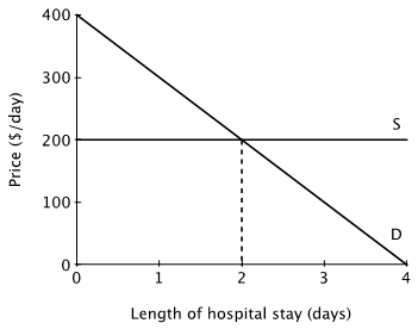 If Ava had first-dollar medical insurance, then she would choose to stay ______ day(s) in the hospital.
A)4
B)1
C)2
D)3
If Ava had first-dollar medical insurance, then she would choose to stay ______ day(s) in the hospital.A)4
B)1
C)2
D)3
سؤال
The figure below shows Ava's demand curve for days in the hospital. The marginal cost of an additional day in the hospital is $200. 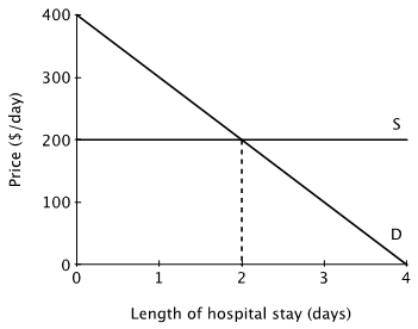 Compared to when Ava has to pay the entire marginal cost of spending a day in the hospital, what is the loss in total economic surplus that would result from Ava having a first-dollar insurance plan?
A)$100
B)$200
C)$300
D)$400
Compared to when Ava has to pay the entire marginal cost of spending a day in the hospital, what is the loss in total economic surplus that would result from Ava having a first-dollar insurance plan?A)$100
B)$200
C)$300
D)$400
سؤال
سؤال
سؤال
سؤال
سؤال
The figure below shows Ava's demand curve for days in the hospital. The marginal cost of an additional day in the hospital is $200. 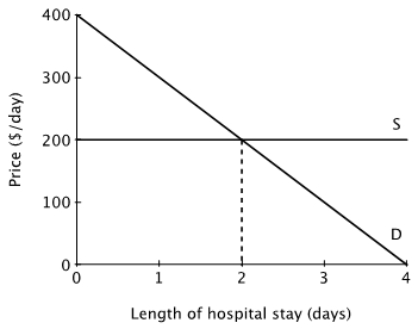 If Ava had to pay the entire marginal cost of spending a day in the hospital, then she would choose to stay ______ day(s).
A)0
B)1
C)2
D)3
If Ava had to pay the entire marginal cost of spending a day in the hospital, then she would choose to stay ______ day(s).A)0
B)1
C)2
D)3
سؤال
سؤال
سؤال
سؤال
Suppose the figure below shows Luke's demand curve for check-ups along with the supply curve for check-ups. 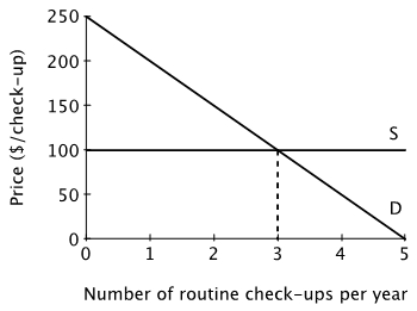 What is the marginal cost of one extra check-up?
A)$50
B)$100
C)$150
D)$200
What is the marginal cost of one extra check-up?A)$50
B)$100
C)$150
D)$200
سؤال
سؤال
سؤال
سؤال
سؤال
سؤال
سؤال
سؤال
سؤال
سؤال
سؤال
سؤال
سؤال
Suppose the figure below shows Annie's demand curve for physical therapy. The marginal cost of each visit to the physical therapist is $150. 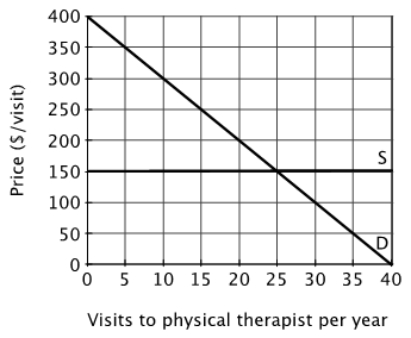 Relative to when Annie has to pay the entire marginal cost of each visit, the loss of total economic surplus due to first-dollar medical insurance would be ______ per year.
A)$150
B)$1,125
C)$2,250
D)$4,500
Relative to when Annie has to pay the entire marginal cost of each visit, the loss of total economic surplus due to first-dollar medical insurance would be ______ per year.A)$150
B)$1,125
C)$2,250
D)$4,500
سؤال
سؤال
Suppose the figure below shows Luke's demand curve for check-ups along with the supply curve for check-ups. 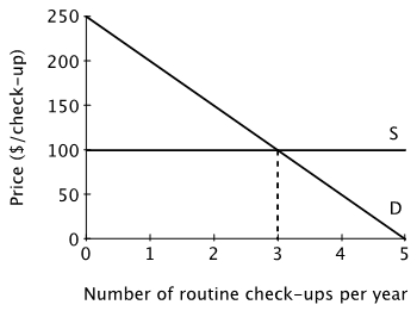 Relative to when Luke has to pay the entire marginal cost of each check-up, the loss of total economic surplus due to first-dollar medical insurance would be ______ per year.
A)$100
B)$200
C)$300
D)$400
Relative to when Luke has to pay the entire marginal cost of each check-up, the loss of total economic surplus due to first-dollar medical insurance would be ______ per year.A)$100
B)$200
C)$300
D)$400
سؤال
Suppose the figure below shows Annie's demand curve for physical therapy. The marginal cost of each visit to the physical therapist is $150. 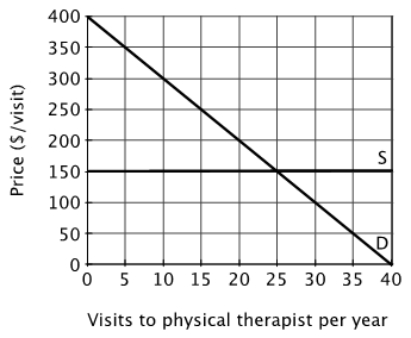 If Annie had first-dollar medical insurance, then she would choose to have _____ visits a year.
A)40
B)25
C)10
D)0
If Annie had first-dollar medical insurance, then she would choose to have _____ visits a year.A)40
B)25
C)10
D)0
سؤال
سؤال
Suppose the figure below shows Luke's demand curve for check-ups along with the supply curve for check-ups. 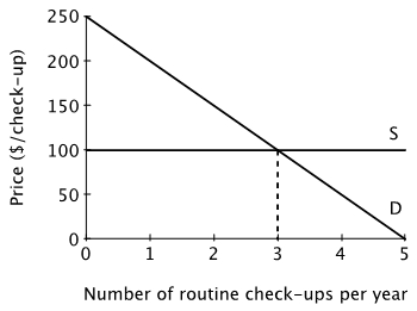 If Luke had to pay the entire marginal cost of each check-up, then he would choose to have ______ check-ups a year.
A)5
B)1
C)2
D)3
If Luke had to pay the entire marginal cost of each check-up, then he would choose to have ______ check-ups a year.A)5
B)1
C)2
D)3
سؤال
سؤال
سؤال
سؤال
سؤال
Suppose the figure below shows Luke's demand curve for check-ups along with the supply curve for check-ups. 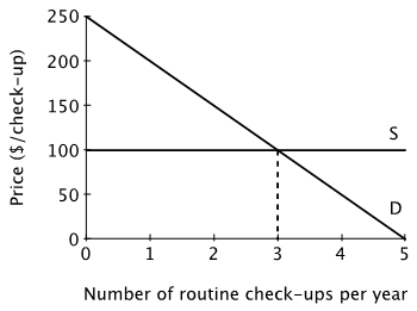 If Luke had first-dollar medical insurance, then he would choose to have _____ check-ups a year.
A)5
B)2
C)3
D)4
If Luke had first-dollar medical insurance, then he would choose to have _____ check-ups a year.A)5
B)2
C)3
D)4
سؤال
Suppose the figure below shows Annie's demand curve for physical therapy. The marginal cost of each visit to the physical therapist is $150. 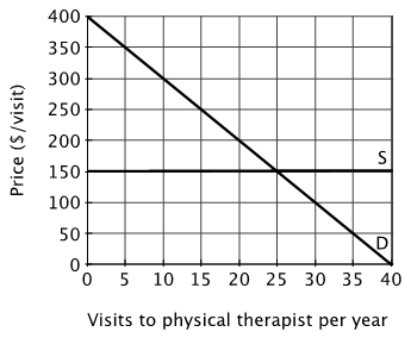 If Annie had to pay the entire marginal cost of each visit to the physical therapist, then she would choose to have ______ visits a year.
A)40
B)25
C)10
D)0
If Annie had to pay the entire marginal cost of each visit to the physical therapist, then she would choose to have ______ visits a year.A)40
B)25
C)10
D)0
سؤال
سؤال
سؤال
سؤال
سؤال
سؤال
سؤال
سؤال
سؤال
سؤال
سؤال
سؤال
سؤال
سؤال
سؤال
سؤال
سؤال
سؤال
سؤال
سؤال
سؤال
سؤال
سؤال
سؤال
سؤال
سؤال
سؤال
سؤال
سؤال
سؤال
سؤال
سؤال
سؤال
سؤال
سؤال
سؤال
سؤال
سؤال
سؤال
سؤال

فتح الحزمة
قم بالتسجيل لفتح البطاقات في هذه المجموعة!
Unlock Deck
Unlock Deck
1/125

العب

ملء الشاشة (f)
Deck 13: The Environment, Health, and Safety
1
The overconsumption of medical care due to first-dollar health insurance coverage is:
A)larger the lower the elasticity of demand for medical care.
B)smaller the higher the elasticity of demand for medical care.
C)larger the higher the elasticity of demand for medical care.
D)small regardless of the elasticity of demand for medical care.
A)larger the lower the elasticity of demand for medical care.
B)smaller the higher the elasticity of demand for medical care.
C)larger the higher the elasticity of demand for medical care.
D)small regardless of the elasticity of demand for medical care.
larger the higher the elasticity of demand for medical care.
2
The growth of medical insurance in general and first-dollar coverage specifically has reduced the marginal cost of treatment to the consumer. Therefore, the current level of medical treatment in the United States is:
A)equal to the efficient level.
B)less than the efficient level.
C)greater than the efficient level.
D)less than or equal to the efficient level.
A)equal to the efficient level.
B)less than the efficient level.
C)greater than the efficient level.
D)less than or equal to the efficient level.
greater than the efficient level.
3
First-dollar insurance coverage means that:
A)most of the insured's expenses are covered.
B)some of the insured's expenses are covered.
C)all of the insured's expenses are covered.
D)the first 10% of the insured's expenses are covered.
A)most of the insured's expenses are covered.
B)some of the insured's expenses are covered.
C)all of the insured's expenses are covered.
D)the first 10% of the insured's expenses are covered.
all of the insured's expenses are covered.
4
According to the text, the allocation of scarce health care resources should be:
A)determined by length of time on a waiting list.
B)based on the willingness to pay of the recipient of the care.
C)based on the degree of suffering of the recipient of the care.
D)determined by weighing marginal costs and marginal benefits.
A)determined by length of time on a waiting list.
B)based on the willingness to pay of the recipient of the care.
C)based on the degree of suffering of the recipient of the care.
D)determined by weighing marginal costs and marginal benefits.
فتح الحزمة
افتح القفل للوصول البطاقات البالغ عددها 125 في هذه المجموعة.
فتح الحزمة
k this deck
5
If the marginal cost of treating an illness is zero, then the optimal amount of treatment to receive is the amount:
A)for which the marginal benefit of treatment is zero.
B)that makes the patient is as healthy as possible.
C)for which the average benefit of treatment is zero.
D)for which the total benefit of treatment is zero.
A)for which the marginal benefit of treatment is zero.
B)that makes the patient is as healthy as possible.
C)for which the average benefit of treatment is zero.
D)for which the total benefit of treatment is zero.
فتح الحزمة
افتح القفل للوصول البطاقات البالغ عددها 125 في هذه المجموعة.
فتح الحزمة
k this deck
6
The figure below shows Ava's demand curve for days in the hospital. The marginal cost of an additional day in the hospital is $200. If Ava had first-dollar medical insurance, then she would choose to stay ______ day(s) in the hospital.
A)4
B)1
C)2
D)3
If Ava had first-dollar medical insurance, then she would choose to stay ______ day(s) in the hospital.A)4
B)1
C)2
D)3
فتح الحزمة
افتح القفل للوصول البطاقات البالغ عددها 125 في هذه المجموعة.
فتح الحزمة
k this deck
7
The figure below shows Ava's demand curve for days in the hospital. The marginal cost of an additional day in the hospital is $200. Compared to when Ava has to pay the entire marginal cost of spending a day in the hospital, what is the loss in total economic surplus that would result from Ava having a first-dollar insurance plan?
A)$100
B)$200
C)$300
D)$400
Compared to when Ava has to pay the entire marginal cost of spending a day in the hospital, what is the loss in total economic surplus that would result from Ava having a first-dollar insurance plan?A)$100
B)$200
C)$300
D)$400
فتح الحزمة
افتح القفل للوصول البطاقات البالغ عددها 125 في هذه المجموعة.
فتح الحزمة
k this deck
8
Under a first-dollar health insurance plan, the patient's marginal cost of treating a covered illness is:
A)positive.
B)zero.
C)negative.
D)a percentage of the total cost.
A)positive.
B)zero.
C)negative.
D)a percentage of the total cost.
فتح الحزمة
افتح القفل للوصول البطاقات البالغ عددها 125 في هذه المجموعة.
فتح الحزمة
k this deck
9
Insurance that pays all expenses generated by the insured activity is known as:
A)total-dollar insurance coverage.
B)last-dollar insurance coverage.
C)cradle-to-grave insurance coverage.
D)first-dollar insurance coverage.
A)total-dollar insurance coverage.
B)last-dollar insurance coverage.
C)cradle-to-grave insurance coverage.
D)first-dollar insurance coverage.
فتح الحزمة
افتح القفل للوصول البطاقات البالغ عددها 125 في هذه المجموعة.
فتح الحزمة
k this deck
10
Relative to when a patient has first-dollar medical insurance, the loss in total economic surplus would be smaller if:
A)medical care providers had to pay the full marginal cost of medical care.
B)medical care providers had to pay more of the marginal cost of medical care.
C)the patient had to pay less of the marginal cost of medical care.
D)the patient had to pay at least some of the marginal cost of medical care.
A)medical care providers had to pay the full marginal cost of medical care.
B)medical care providers had to pay more of the marginal cost of medical care.
C)the patient had to pay less of the marginal cost of medical care.
D)the patient had to pay at least some of the marginal cost of medical care.
فتح الحزمة
افتح القفل للوصول البطاقات البالغ عددها 125 في هذه المجموعة.
فتح الحزمة
k this deck
11
Medical insurance covering routine medical care became common:
A)around 1900.
B)in the 1920's.
C)after World War II.
D)during the 1980's.
A)around 1900.
B)in the 1920's.
C)after World War II.
D)during the 1980's.
فتح الحزمة
افتح القفل للوصول البطاقات البالغ عددها 125 في هذه المجموعة.
فتح الحزمة
k this deck
12
The figure below shows Ava's demand curve for days in the hospital. The marginal cost of an additional day in the hospital is $200. If Ava had to pay the entire marginal cost of spending a day in the hospital, then she would choose to stay ______ day(s).
A)0
B)1
C)2
D)3
If Ava had to pay the entire marginal cost of spending a day in the hospital, then she would choose to stay ______ day(s).A)0
B)1
C)2
D)3
فتح الحزمة
افتح القفل للوصول البطاقات البالغ عددها 125 في هذه المجموعة.
فتح الحزمة
k this deck
13
First-dollar health insurance reduces the:
A)equilibrium amount of medical care received by the insured.
B)marginal benefit of medical care to the insured.
C)marginal cost of medical care to the insured.
D)total cost of providing medical care.
A)equilibrium amount of medical care received by the insured.
B)marginal benefit of medical care to the insured.
C)marginal cost of medical care to the insured.
D)total cost of providing medical care.
فتح الحزمة
افتح القفل للوصول البطاقات البالغ عددها 125 في هذه المجموعة.
فتح الحزمة
k this deck
14
When Dale visits the doctor, Dale does not pay for either the visit or any tests the doctor may order. From this we can infer that Dale must:
A)be a member of an HMO.
B)have a medical insurance policy with a deductible.
C)have first-dollar medical insurance coverage.
D)be underutilizing medical care.
A)be a member of an HMO.
B)have a medical insurance policy with a deductible.
C)have first-dollar medical insurance coverage.
D)be underutilizing medical care.
فتح الحزمة
افتح القفل للوصول البطاقات البالغ عددها 125 في هذه المجموعة.
فتح الحزمة
k this deck
15
According to the textbook, the percentage of gross domestic product devoted to healthcare between the years 1940 and 2013:
A)declined from 4% to less than 2%.
B)increased from 4% to about 6%.
C)increased from 4% to more than 17%.
D)increased from 4% to more than 40%.
A)declined from 4% to less than 2%.
B)increased from 4% to about 6%.
C)increased from 4% to more than 17%.
D)increased from 4% to more than 40%.
فتح الحزمة
افتح القفل للوصول البطاقات البالغ عددها 125 في هذه المجموعة.
فتح الحزمة
k this deck
16
Suppose the figure below shows Luke's demand curve for check-ups along with the supply curve for check-ups. What is the marginal cost of one extra check-up?
A)$50
B)$100
C)$150
D)$200
What is the marginal cost of one extra check-up?A)$50
B)$100
C)$150
D)$200
فتح الحزمة
افتح القفل للوصول البطاقات البالغ عددها 125 في هذه المجموعة.
فتح الحزمة
k this deck
17
Prior to World War II most consumers in the United States:
A)owned medical insurance for catastrophic illness but paid for routine medical care out of their own pockets.
B)paid for catastrophic illness out of their own pockets but owned medical insurance for routine medical care.
C)had no medical insurance of any type.
D)owned medical insurance covering both catastrophic illness and routine medical care.
A)owned medical insurance for catastrophic illness but paid for routine medical care out of their own pockets.
B)paid for catastrophic illness out of their own pockets but owned medical insurance for routine medical care.
C)had no medical insurance of any type.
D)owned medical insurance covering both catastrophic illness and routine medical care.
فتح الحزمة
افتح القفل للوصول البطاقات البالغ عددها 125 في هذه المجموعة.
فتح الحزمة
k this deck
18
In the United States, the emergence of the third-party payment system explains ______ of the increase in health care expenditures from 1940 to the present.
A)all
B)a great deal
C)almost none
D)none
A)all
B)a great deal
C)almost none
D)none
فتح الحزمة
افتح القفل للوصول البطاقات البالغ عددها 125 في هذه المجموعة.
فتح الحزمة
k this deck
19
To the patient, the marginal cost of medical care is zero under:
A)government-sponsored health care coverage.
B)first-dollar health insurance coverage.
C)an HMO.
D)no circumstances.
A)government-sponsored health care coverage.
B)first-dollar health insurance coverage.
C)an HMO.
D)no circumstances.
فتح الحزمة
افتح القفل للوصول البطاقات البالغ عددها 125 في هذه المجموعة.
فتح الحزمة
k this deck
20
In general, the optimal amount of medical care is:
A)as much as one can afford.
B)enough to stay healthy.
C)the quantity at which the total cost of the care equals its total benefit.
D)the quantity at which the marginal cost of the care equals its marginal benefit.
A)as much as one can afford.
B)enough to stay healthy.
C)the quantity at which the total cost of the care equals its total benefit.
D)the quantity at which the marginal cost of the care equals its marginal benefit.
فتح الحزمة
افتح القفل للوصول البطاقات البالغ عددها 125 في هذه المجموعة.
فتح الحزمة
k this deck
21
When Cody went to the physician with a sore elbow, after hearing Cody's symptoms and examining the elbow manually, Cody's physician had two options: (1) prescribe an anti-inflammatory drug and advise Cody to abstain from vigorous physical activity for a period; or (2) advise Cody to undergo a magnetic resonance imaging (MRI) exam, a costly diagnostic procedure. Which of the following physicians is more likely to recommend option 1?
A)A physician who is compensated under a conventional health insurance plan.
B)A physician who is part of an HMO.
C)A physician who is not concerned about the marginal cost of an MRI.
D)All physicians would recommend option 1.
A)A physician who is compensated under a conventional health insurance plan.
B)A physician who is part of an HMO.
C)A physician who is not concerned about the marginal cost of an MRI.
D)All physicians would recommend option 1.
فتح الحزمة
افتح القفل للوصول البطاقات البالغ عددها 125 في هذه المجموعة.
فتح الحزمة
k this deck
22
Compared to patients covered by conventional health insurance plans, patients in HMOs might receive fewer medical services because HMOs:
A)have legal protection from malpractice lawsuits.
B)employ lower quality doctors.
C)receive a fixed annual fee regardless of the amount of medical services provided.
D)save costs by purchasing lower quality medical equipment.
A)have legal protection from malpractice lawsuits.
B)employ lower quality doctors.
C)receive a fixed annual fee regardless of the amount of medical services provided.
D)save costs by purchasing lower quality medical equipment.
فتح الحزمة
افتح القفل للوصول البطاقات البالغ عددها 125 في هذه المجموعة.
فتح الحزمة
k this deck
23
The textbook cites a study comparing a group of consumers with first-dollar coverage to a group with a $1,000 deductible. The study results indicate that those with the deductible spent _____ on health care and had ______ health outcomes.
A)less; the same
B)more; better
C)more; the same
D)less; worse
A)less; the same
B)more; better
C)more; the same
D)less; worse
فتح الحزمة
افتح القفل للوصول البطاقات البالغ عددها 125 في هذه المجموعة.
فتح الحزمة
k this deck
24
The defining characteristic of an HMO is:
A)the emphasis on acute medical treatment.
B)that medical treatment is provided for a fixed annual fee.
C)that patients have the freedom to see nonmember physicians.
D)that medical treatment is provided on a fee-for-service basis.
A)the emphasis on acute medical treatment.
B)that medical treatment is provided for a fixed annual fee.
C)that patients have the freedom to see nonmember physicians.
D)that medical treatment is provided on a fee-for-service basis.
فتح الحزمة
افتح القفل للوصول البطاقات البالغ عددها 125 في هذه المجموعة.
فتح الحزمة
k this deck
25
In contrast to first-dollar insurance coverage, one concern about HMOs is that:
A)the price of medical care will be too low.
B)acute treatment will be overemphasized.
C)patients will receive more medical care than they need.
D)patients will not receive adequate medical care.
A)the price of medical care will be too low.
B)acute treatment will be overemphasized.
C)patients will receive more medical care than they need.
D)patients will not receive adequate medical care.
فتح الحزمة
افتح القفل للوصول البطاقات البالغ عددها 125 في هذه المجموعة.
فتح الحزمة
k this deck
26
According to the textbook, Manning and his colleagues found that people with $1,000-deductible policies spent ______ on health care relative to people with first-dollar coverage.
A)less
B)40 percent more
C)the same amount
D)50 percent more
A)less
B)40 percent more
C)the same amount
D)50 percent more
فتح الحزمة
افتح القفل للوصول البطاقات البالغ عددها 125 في هذه المجموعة.
فتح الحزمة
k this deck
27
If fewer families purchase health insurance because of rising health insurance premiums, then health insurance premiums are likely to rise further due to:
A)first-dollar coverage.
B)commitment problems.
C)moral hazard.
D)adverse selection.
A)first-dollar coverage.
B)commitment problems.
C)moral hazard.
D)adverse selection.
فتح الحزمة
افتح القفل للوصول البطاقات البالغ عددها 125 في هذه المجموعة.
فتح الحزمة
k this deck
28
According to the textbook, the Manning study suggests that a large share of the increase in medical expenditures since World War II has been caused by:
A)advances in medical technology.
B)the increase in high-deductible policies.
C)the annual stipend given to the poor to defray medical expenses.
D)the increase in first-dollar medical insurance.
A)advances in medical technology.
B)the increase in high-deductible policies.
C)the annual stipend given to the poor to defray medical expenses.
D)the increase in first-dollar medical insurance.
فتح الحزمة
افتح القفل للوصول البطاقات البالغ عددها 125 في هذه المجموعة.
فتح الحزمة
k this deck
29
Suppose the figure below shows Annie's demand curve for physical therapy. The marginal cost of each visit to the physical therapist is $150. Relative to when Annie has to pay the entire marginal cost of each visit, the loss of total economic surplus due to first-dollar medical insurance would be ______ per year.
A)$150
B)$1,125
C)$2,250
D)$4,500
Relative to when Annie has to pay the entire marginal cost of each visit, the loss of total economic surplus due to first-dollar medical insurance would be ______ per year.A)$150
B)$1,125
C)$2,250
D)$4,500
فتح الحزمة
افتح القفل للوصول البطاقات البالغ عددها 125 في هذه المجموعة.
فتح الحزمة
k this deck
30
According to the Manning study, people with $1,000-deductible health care coverage had:
A)better health outcomes than those with first-dollar coverage.
B)the same health outcomes as those with first-dollar coverage.
C)worse health outcome than those with first-dollar coverage.
D)worse health outcomes than those with no insurance coverage.
A)better health outcomes than those with first-dollar coverage.
B)the same health outcomes as those with first-dollar coverage.
C)worse health outcome than those with first-dollar coverage.
D)worse health outcomes than those with no insurance coverage.
فتح الحزمة
افتح القفل للوصول البطاقات البالغ عددها 125 في هذه المجموعة.
فتح الحزمة
k this deck
31
Suppose the figure below shows Luke's demand curve for check-ups along with the supply curve for check-ups. Relative to when Luke has to pay the entire marginal cost of each check-up, the loss of total economic surplus due to first-dollar medical insurance would be ______ per year.
A)$100
B)$200
C)$300
D)$400
Relative to when Luke has to pay the entire marginal cost of each check-up, the loss of total economic surplus due to first-dollar medical insurance would be ______ per year.A)$100
B)$200
C)$300
D)$400
فتح الحزمة
افتح القفل للوصول البطاقات البالغ عددها 125 في هذه المجموعة.
فتح الحزمة
k this deck
32
Suppose the figure below shows Annie's demand curve for physical therapy. The marginal cost of each visit to the physical therapist is $150. If Annie had first-dollar medical insurance, then she would choose to have _____ visits a year.
A)40
B)25
C)10
D)0
If Annie had first-dollar medical insurance, then she would choose to have _____ visits a year.A)40
B)25
C)10
D)0
فتح الحزمة
افتح القفل للوصول البطاقات البالغ عددها 125 في هذه المجموعة.
فتح الحزمة
k this deck
33
An economic argument in favor of providing medical care through HMOs is that they:
A)increase provision of care to the sickest patients.
B)reduce incentives for providing unnecessary or excessive care.
C)reduce the cost of seeing a specialist.
D)reduce the probability of patients filing a malpractice claim.
A)increase provision of care to the sickest patients.
B)reduce incentives for providing unnecessary or excessive care.
C)reduce the cost of seeing a specialist.
D)reduce the probability of patients filing a malpractice claim.
فتح الحزمة
افتح القفل للوصول البطاقات البالغ عددها 125 في هذه المجموعة.
فتح الحزمة
k this deck
34
Suppose the figure below shows Luke's demand curve for check-ups along with the supply curve for check-ups. If Luke had to pay the entire marginal cost of each check-up, then he would choose to have ______ check-ups a year.
A)5
B)1
C)2
D)3
If Luke had to pay the entire marginal cost of each check-up, then he would choose to have ______ check-ups a year.A)5
B)1
C)2
D)3
فتح الحزمة
افتح القفل للوصول البطاقات البالغ عددها 125 في هذه المجموعة.
فتح الحزمة
k this deck
35
If fewer families choose to purchase medical insurance because of rising health insurance premiums, then:
A)those who remain insured will tend to spend less on health care.
B)those who remain insured will tend to have higher-than-average rates of illness.
C)the frequency of illness in the general population will fall.
D)those who remain insured will tend to have lower-than-average rates of illness.
A)those who remain insured will tend to spend less on health care.
B)those who remain insured will tend to have higher-than-average rates of illness.
C)the frequency of illness in the general population will fall.
D)those who remain insured will tend to have lower-than-average rates of illness.
فتح الحزمة
افتح القفل للوصول البطاقات البالغ عددها 125 في هذه المجموعة.
فتح الحزمة
k this deck
36
When Cody went to the physician with a sore elbow, after hearing Cody's symptoms and examining the elbow manually, Cody's physician had two options: (1) prescribe an anti-inflammatory drug and advise Cody to abstain from vigorous physical activity for a period; or (2) advise Cody to undergo a magnetic resonance imaging (MRI) exam, a costly diagnostic procedure. Which of the following physicians is more likely to recommend option 2?
A)A physician who is compensated under a conventional health insurance plan.
B)A physician who is part of an HMO.
C)A physician who is concerned about the marginal cost of an MRI.
D)All physicians would recommend option 2.
A)A physician who is compensated under a conventional health insurance plan.
B)A physician who is part of an HMO.
C)A physician who is concerned about the marginal cost of an MRI.
D)All physicians would recommend option 2.
فتح الحزمة
افتح القفل للوصول البطاقات البالغ عددها 125 في هذه المجموعة.
فتح الحزمة
k this deck
37
A group of physicians that provides medical services to members for a fixed annual fee is termed a:
A)health management organization.
B)fee-for-service plan.
C)partnership.
D)health maintenance organization.
A)health management organization.
B)fee-for-service plan.
C)partnership.
D)health maintenance organization.
فتح الحزمة
افتح القفل للوصول البطاقات البالغ عددها 125 في هذه المجموعة.
فتح الحزمة
k this deck
38
All else equal, the amount of waste caused by full health insurance is:
A)larger the lower is the price elasticity of demand for medical services.
B)larger the higher is the price elasticity of demand for medical services.
C)larger the lower is the price elasticity of supply for medical services.
D)smaller the higher is the price of medical services.
A)larger the lower is the price elasticity of demand for medical services.
B)larger the higher is the price elasticity of demand for medical services.
C)larger the lower is the price elasticity of supply for medical services.
D)smaller the higher is the price of medical services.
فتح الحزمة
افتح القفل للوصول البطاقات البالغ عددها 125 في هذه المجموعة.
فتح الحزمة
k this deck
39
Suppose the figure below shows Luke's demand curve for check-ups along with the supply curve for check-ups. If Luke had first-dollar medical insurance, then he would choose to have _____ check-ups a year.
A)5
B)2
C)3
D)4
If Luke had first-dollar medical insurance, then he would choose to have _____ check-ups a year.A)5
B)2
C)3
D)4
فتح الحزمة
افتح القفل للوصول البطاقات البالغ عددها 125 في هذه المجموعة.
فتح الحزمة
k this deck
40
Suppose the figure below shows Annie's demand curve for physical therapy. The marginal cost of each visit to the physical therapist is $150. If Annie had to pay the entire marginal cost of each visit to the physical therapist, then she would choose to have ______ visits a year.
A)40
B)25
C)10
D)0
If Annie had to pay the entire marginal cost of each visit to the physical therapist, then she would choose to have ______ visits a year.A)40
B)25
C)10
D)0
فتح الحزمة
افتح القفل للوصول البطاقات البالغ عددها 125 في هذه المجموعة.
فتح الحزمة
k this deck
41
Two firms, Acme and FirmCo, have access to five production processes, each of which has a different cost and gives off a different amount of pollution. The daily costs of the processes and the corresponding number of tons of smoke emitted are shown in the table below.
Suppose the firms are both currently using process A. If the government requires each firm to reduce pollution by 20%, then the firms will adopt process ______, and a total of ______ tons of smoke will be emitted each day.
A)A; 18
B)B; 16
C)C; 12
D)D; 8
Suppose the firms are both currently using process A. If the government requires each firm to reduce pollution by 20%, then the firms will adopt process ______, and a total of ______ tons of smoke will be emitted each day.
A)A; 18
B)B; 16
C)C; 12
D)D; 8
فتح الحزمة
افتح القفل للوصول البطاقات البالغ عددها 125 في هذه المجموعة.
فتح الحزمة
k this deck
42
Suppose there are three power-generating plants, each of which has access to 5 different production processes. The table below summarizes the cost of each production process and the corresponding number of tons of smoke emitted each.
If pollution is unregulated, then total daily smoke emission will be ______ tons.
A)4
B)12
C)9
D)8
If pollution is unregulated, then total daily smoke emission will be ______ tons.
A)4
B)12
C)9
D)8
فتح الحزمة
افتح القفل للوصول البطاقات البالغ عددها 125 في هذه المجموعة.
فتح الحزمة
k this deck
43
Two companies, Dirty Inc. and Filthy Inc., each of which has access to 5 different production processes, each of which has a different cost and produces a different amount of pollution. The daily costs of the processes and the number of tons of smoke emitted are shown in the table below. If the City Council imposes a tax of $91 per day on each ton of smoke emitted, then what will be the total cost to society of the resulting reduction in pollution?
A)$90
B)$180
C)$270
D)$360
A)$90
B)$180
C)$270
D)$360
فتح الحزمة
افتح القفل للوصول البطاقات البالغ عددها 125 في هذه المجموعة.
فتح الحزمة
k this deck
44
If the marginal cost of pollution abatement differs across firms, then regulations that require all polluters to reduce pollution by a fixed proportion will be:
A)efficient.
B)inefficient
C)ineffective.
D)fair to all polluters.
A)efficient.
B)inefficient
C)ineffective.
D)fair to all polluters.
فتح الحزمة
افتح القفل للوصول البطاقات البالغ عددها 125 في هذه المجموعة.
فتح الحزمة
k this deck
45
Two firms, Acme and FirmCo, have access to five production processes, each of which has a different cost and gives off a different amount of pollution. The daily costs of the processes and the corresponding number of tons of smoke emitted are shown in the table below.
Suppose the firms are both currently using process A. If the government requires each firm to reduce pollution by 20%, then the total cost to society of this policy will be ______ per day.
A)$300
B)$950
C)$1,550
D)$2,350
Suppose the firms are both currently using process A. If the government requires each firm to reduce pollution by 20%, then the total cost to society of this policy will be ______ per day.
A)$300
B)$950
C)$1,550
D)$2,350
فتح الحزمة
افتح القفل للوصول البطاقات البالغ عددها 125 في هذه المجموعة.
فتح الحزمة
k this deck
46
Two firms, Acme and FirmCo, have access to five production processes, each of which has a different cost and gives off a different amount of pollution. The daily costs of the processes and the corresponding number of tons of smoke emitted are shown in the table below.
If pollution is unregulated, the two firms will produce using process ______, and a total of ______ tons of smoke will be emitted each day.
A)C; 12
B)D; 4
C)B; 16
D)A; 20
If pollution is unregulated, the two firms will produce using process ______, and a total of ______ tons of smoke will be emitted each day.
A)C; 12
B)D; 4
C)B; 16
D)A; 20
فتح الحزمة
افتح القفل للوصول البطاقات البالغ عددها 125 في هذه المجموعة.
فتح الحزمة
k this deck
47
Two companies, Dirty Inc. and Filthy Inc., each of which has access to 5 different production processes, each of which has a different cost and produces a different amount of pollution. The daily costs of the processes and the number of tons of smoke emitted are shown in the table below. If pollution is unregulated, then a total of ______ tons of smoke will be emitted each day.
A)1
B)2
C)4
D)8
A)1
B)2
C)4
D)8
فتح الحزمة
افتح القفل للوصول البطاقات البالغ عددها 125 في هذه المجموعة.
فتح الحزمة
k this deck
48
For a fixed percent reduction in pollution emissions to be economically efficient, it would have to be the case that:
A)the marginal cost of pollution control is the same across all firms.
B)enforcement is vigorous.
C)all firms be the same size.
D)large polluters reduce emissions by more than small polluters.
A)the marginal cost of pollution control is the same across all firms.
B)enforcement is vigorous.
C)all firms be the same size.
D)large polluters reduce emissions by more than small polluters.
فتح الحزمة
افتح القفل للوصول البطاقات البالغ عددها 125 في هذه المجموعة.
فتح الحزمة
k this deck
49
Two companies, Dirty Inc. and Filthy Inc., each of which has access to 5 different production processes, each of which has a different cost and produces a different amount of pollution. The daily costs of the processes and the number of tons of smoke emitted are shown in the table below. Suppose pollution is initially unregulated. If the City Council requires each firm to reduce emissions by 50 percent, then the total cost to society of this policy will be ______ per day.
A)$360
B)$380
C)$490
D)$870
A)$360
B)$380
C)$490
D)$870
فتح الحزمة
افتح القفل للوصول البطاقات البالغ عددها 125 في هذه المجموعة.
فتح الحزمة
k this deck
50
The most efficient distribution of pollution abatement is such that the:
A)extent of pollution abatement is the same across all geographic regions.
B)extent of pollution abatement is the same across all polluters.
C)largest reductions in pollution are made by the largest polluters.
D)marginal cost of abatement is the same across all polluters.
A)extent of pollution abatement is the same across all geographic regions.
B)extent of pollution abatement is the same across all polluters.
C)largest reductions in pollution are made by the largest polluters.
D)marginal cost of abatement is the same across all polluters.
فتح الحزمة
افتح القفل للوصول البطاقات البالغ عددها 125 في هذه المجموعة.
فتح الحزمة
k this deck
51
Suppose there are three power-generating plants, each of which has access to 5 different production processes. The table below summarizes the cost of each production process and the corresponding number of tons of smoke emitted each.
Suppose the government decides to impose a tax on each ton of smoke emitted. What would be the lowest tax, in whole dollars, that would reduce emissions to 6 tons per day?
A)$21 per ton
B)$26 per ton
C)$36 per ton
D)$41 per ton
Suppose the government decides to impose a tax on each ton of smoke emitted. What would be the lowest tax, in whole dollars, that would reduce emissions to 6 tons per day?
A)$21 per ton
B)$26 per ton
C)$36 per ton
D)$41 per ton
فتح الحزمة
افتح القفل للوصول البطاقات البالغ عددها 125 في هذه المجموعة.
فتح الحزمة
k this deck
52
Suppose there are three power-generating plants, each of which has access to 5 different production processes. The table below summarizes the cost of each production process and the corresponding number of tons of smoke emitted each.
Suppose the government imposes a tax of $21 on each ton of smoke emitted. To minimize costs, Firm X will emit ______ tons; Firm Y will emit ______ tons, and Firm Z will emit ______ tons.
A)1; 2; 3
B)2; 3; 4
C)3; 4; 4
D)1; 2; 4
Suppose the government imposes a tax of $21 on each ton of smoke emitted. To minimize costs, Firm X will emit ______ tons; Firm Y will emit ______ tons, and Firm Z will emit ______ tons.
A)1; 2; 3
B)2; 3; 4
C)3; 4; 4
D)1; 2; 4
فتح الحزمة
افتح القفل للوصول البطاقات البالغ عددها 125 في هذه المجموعة.
فتح الحزمة
k this deck
53
Suppose there are three power-generating plants, each of which has access to 5 different production processes. The table below summarizes the cost of each production process and the corresponding number of tons of smoke emitted each.
It would cost Firm X ______ to reduce emissions by one ton if it currently emits 3 tons, and ______ to reduce emissions by one ton if it currently emits 2 tons.
A)$14; $25
B)$14; $16
C)$16; $25
D)$30; $55
It would cost Firm X ______ to reduce emissions by one ton if it currently emits 3 tons, and ______ to reduce emissions by one ton if it currently emits 2 tons.
A)$14; $25
B)$14; $16
C)$16; $25
D)$30; $55
فتح الحزمة
افتح القفل للوصول البطاقات البالغ عددها 125 في هذه المجموعة.
فتح الحزمة
k this deck
54
Suppose there are three power-generating plants, each of which has access to 5 different production processes. The table below summarizes the cost of each production process and the corresponding number of tons of smoke emitted each.
For all three firms, the marginal cost of pollution abatement is:
A)increasing
B)decreasing
C)constant
D)decreasing and then increasing
For all three firms, the marginal cost of pollution abatement is:
A)increasing
B)decreasing
C)constant
D)decreasing and then increasing
فتح الحزمة
افتح القفل للوصول البطاقات البالغ عددها 125 في هذه المجموعة.
فتح الحزمة
k this deck
55
Two firms, Acme and FirmCo, have access to five production processes, each of which has a different cost and gives off a different amount of pollution. The daily costs of the processes and the corresponding number of tons of smoke emitted are shown in the table below.
Suppose the firms are both currently using process A. If the government imposes a tax of $110 per ton of smoke emitted, then Acme will use process ______, and FirmCo will use process ______.
A)B; A
B)C; A
C)C; C
D)D; C
Suppose the firms are both currently using process A. If the government imposes a tax of $110 per ton of smoke emitted, then Acme will use process ______, and FirmCo will use process ______.
A)B; A
B)C; A
C)C; C
D)D; C
فتح الحزمة
افتح القفل للوصول البطاقات البالغ عددها 125 في هذه المجموعة.
فتح الحزمة
k this deck
56
Two firms, Acme and FirmCo, have access to five production processes, each of which has a different cost and gives off a different amount of pollution. The daily costs of the processes and the corresponding number of tons of smoke emitted are shown in the table below.
Suppose the firms are both currently using process A. If the government imposes a tax of $110 per ton of smoke emitted, a total of ______ tons of smoke will be emitted each day, and the total cost to society of this policy will be ______ per day.
A)14; $500
B)16; $250
C)18; $50
D)20; $0
Suppose the firms are both currently using process A. If the government imposes a tax of $110 per ton of smoke emitted, a total of ______ tons of smoke will be emitted each day, and the total cost to society of this policy will be ______ per day.
A)14; $500
B)16; $250
C)18; $50
D)20; $0
فتح الحزمة
افتح القفل للوصول البطاقات البالغ عددها 125 في هذه المجموعة.
فتح الحزمة
k this deck
57
Suppose there are three power-generating plants, each of which has access to 5 different production processes. The table below summarizes the cost of each production process and the corresponding number of tons of smoke emitted each.
Suppose the government requires each firm to reduce pollution to 2 tons of smoke per day, so that total daily smoke emission is 6 tons. The total cost to society of this policy will be ______ per day.
A)$59
B)$42
C)$230
D)$135
Suppose the government requires each firm to reduce pollution to 2 tons of smoke per day, so that total daily smoke emission is 6 tons. The total cost to society of this policy will be ______ per day.
A)$59
B)$42
C)$230
D)$135
فتح الحزمة
افتح القفل للوصول البطاقات البالغ عددها 125 في هذه المجموعة.
فتح الحزمة
k this deck
58
If the marginal cost of pollution abatement is smaller for large firms than it is for small firms, then it is efficient for:
A)small firms to reduce pollution by more than large firms.
B)small firms and large firms to reduce pollution by a fixed proportion.
C)small firms and large firms to increase pollution by a fixed proportion.
D)large firms to reduce pollution by more than small firms.
A)small firms to reduce pollution by more than large firms.
B)small firms and large firms to reduce pollution by a fixed proportion.
C)small firms and large firms to increase pollution by a fixed proportion.
D)large firms to reduce pollution by more than small firms.
فتح الحزمة
افتح القفل للوصول البطاقات البالغ عددها 125 في هذه المجموعة.
فتح الحزمة
k this deck
59
Suppose there are three power-generating plants, each of which has access to 5 different production processes. The table below summarizes the cost of each production process and the corresponding number of tons of smoke emitted each.
The least costly way of lowering smoke emissions from 12 tons to 9 tons per day would be for:
A)each firm to reduce emissions by 1 ton, emitting 3 tons each.
B)Firm X to emit 2 tons, Firm Y to emit 3 tons and Firm Z to emit 4 tons.
C)Firm X to emit 4 tons, Firm Y to emit 3 tons and Firm Z to emit 2 tons.
D)Firm X to emit 1 ton, Firm Y to emit 4 tons and Firm Z to emit 4 tons.
The least costly way of lowering smoke emissions from 12 tons to 9 tons per day would be for:
A)each firm to reduce emissions by 1 ton, emitting 3 tons each.
B)Firm X to emit 2 tons, Firm Y to emit 3 tons and Firm Z to emit 4 tons.
C)Firm X to emit 4 tons, Firm Y to emit 3 tons and Firm Z to emit 2 tons.
D)Firm X to emit 1 ton, Firm Y to emit 4 tons and Firm Z to emit 4 tons.
فتح الحزمة
افتح القفل للوصول البطاقات البالغ عددها 125 في هذه المجموعة.
فتح الحزمة
k this deck
60
Two companies, Dirty Inc. and Filthy Inc., each of which has access to 5 different production processes, each of which has a different cost and produces a different amount of pollution. The daily costs of the processes and the number of tons of smoke emitted are shown in the table below. Suppose pollution is initially unregulated. If the City Council imposes a tax of $91 per day on each ton of smoke emitted, then total emissions will fall to ______ tons of smoke per day.
A)1
B)2
C)4
D)8
A)1
B)2
C)4
D)8
فتح الحزمة
افتح القفل للوصول البطاقات البالغ عددها 125 في هذه المجموعة.
فتح الحزمة
k this deck
61
Workplace safety laws are ______ in developed countries because _____.
A)rare; policy makers believe that they undermine the free market system
B)rare; corporate lobbyists convince legislators to vote against them
C)necessary; without them firms that hire workers in competitive labor markets would have no incentive to provide safe workplaces
D)common; many policy makers believe that labor markets are not perfectly competitive and so firms will not provide the optimal level of safety
A)rare; policy makers believe that they undermine the free market system
B)rare; corporate lobbyists convince legislators to vote against them
C)necessary; without them firms that hire workers in competitive labor markets would have no incentive to provide safe workplaces
D)common; many policy makers believe that labor markets are not perfectly competitive and so firms will not provide the optimal level of safety
فتح الحزمة
افتح القفل للوصول البطاقات البالغ عددها 125 في هذه المجموعة.
فتح الحزمة
k this deck
62
Pollution permit policies achieve an ______ outcome because _____.
A)inefficient; wealthier firms can afford to purchase more permits.
B)efficient; firms that have the lowest cost of reducing pollution will be able to pay more for each permit.
C)inefficient; the supply of permits is set by the government, and so is perfectly inelastic.
D)efficient; firms that have the highest cost of reducing pollution will have the greatest incentive to purchase permits.
A)inefficient; wealthier firms can afford to purchase more permits.
B)efficient; firms that have the lowest cost of reducing pollution will be able to pay more for each permit.
C)inefficient; the supply of permits is set by the government, and so is perfectly inelastic.
D)efficient; firms that have the highest cost of reducing pollution will have the greatest incentive to purchase permits.
فتح الحزمة
افتح القفل للوصول البطاقات البالغ عددها 125 في هذه المجموعة.
فتح الحزمة
k this deck
63
In the absence of environmental protection laws, firms pollute because:
A)business owners follow different norms than do environmentalists.
B)controlling emissions costs money, thereby reducing profits.
C)business owners do not believe that pollution is a problem.
D)the cost pollution imposes on society is small relative to the cost of reducing pollution.
A)business owners follow different norms than do environmentalists.
B)controlling emissions costs money, thereby reducing profits.
C)business owners do not believe that pollution is a problem.
D)the cost pollution imposes on society is small relative to the cost of reducing pollution.
فتح الحزمة
افتح القفل للوصول البطاقات البالغ عددها 125 في هذه المجموعة.
فتح الحزمة
k this deck
64
Two firms, Industrio and Capitalista, have access to five production processes, each of which has a different cost and gives off a different amount of pollution. The daily costs of the processes and the corresponding number of tons of smoke emitted are shown in the table below. Both firms currently use process A, and each emits 4 tons of smoke per day. The government is considering two plans to reduce pollution: requiring both firms to reduce pollution by 25 percent or auctioning pollution permits. Each permit would entitle the owner to emit one ton of smoke per day. Without a permit, no smoke can be emitted. Suppose the government decides to auction 6 permits. The government conducts the auction by starting at a price of $1 and asking how many permits each firm wants to buy at that price. If the total is more than 6, it raises the price by $1 and asks again until the total quantity demanded falls to 6. Under this system, each permit will sell for ______ with Industrio buying ______ and Capitalista buying ______.
A)$31; 2; 4
B)$41; 4; 2
C)$51; 4; 2
D)$101; 3; 3
A)$31; 2; 4
B)$41; 4; 2
C)$51; 4; 2
D)$101; 3; 3
فتح الحزمة
افتح القفل للوصول البطاقات البالغ عددها 125 في هذه المجموعة.
فتح الحزمة
k this deck
65
Two firms, Industrio and Capitalista, have access to five production processes, each of which has a different cost and gives off a different amount of pollution. The daily costs of the processes and the corresponding number of tons of smoke emitted are shown in the table below. Both firms currently use process A, and each emits 4 tons of smoke per day. The government is considering two plans to reduce pollution: requiring both firms to reduce pollution by 25 percent or auctioning pollution permits. Each permit would entitle the owner to emit one ton of smoke per day. Without a permit, no smoke can be emitted. Suppose the government decides to sell 6 permits allowing a total of 6 tons of pollution. The government starts the bidding with an opening price of $30. What happens next?
A)A total of five permits will be demanded, forcing the government to lower the price.
B)Industrio will purchase all available permits at $30.
C)Industrio will demand 3 permits and Capitalista will demand 3 permits.
D)A total of seven permits will be demanded, forcing the government to raise the price.
A)A total of five permits will be demanded, forcing the government to lower the price.
B)Industrio will purchase all available permits at $30.
C)Industrio will demand 3 permits and Capitalista will demand 3 permits.
D)A total of seven permits will be demanded, forcing the government to raise the price.
فتح الحزمة
افتح القفل للوصول البطاقات البالغ عددها 125 في هذه المجموعة.
فتح الحزمة
k this deck
66
Two firms, Industrio and Capitalista, have access to five production processes, each of which has a different cost and gives off a different amount of pollution. The daily costs of the processes and the corresponding number of tons of smoke emitted are shown in the table below. Both firms currently use process A, and each emits 4 tons of smoke per day. The government is considering two plans to reduce pollution: requiring both firms to reduce pollution by 25 percent or auctioning pollution permits. Each permit would entitle the owner to emit one ton of smoke per day. Without a permit, no smoke can be emitted. Suppose a permit system has been adopted and each firm has already purchased one permit. Industrio would be willing to pay up to ______ for the right to emit a second ton of smoke, and Capitalista would be willing to pay up to ______ for the right to emit a second ton of smoke.
A)$200; $300
B)$200; $110
C)$100; $40
D)$500; $290
A)$200; $300
B)$200; $110
C)$100; $40
D)$500; $290
فتح الحزمة
افتح القفل للوصول البطاقات البالغ عددها 125 في هذه المجموعة.
فتح الحزمة
k this deck
67
Two firms, Industrio and Capitalista, have access to five production processes, each of which has a different cost and gives off a different amount of pollution. The daily costs of the processes and the corresponding number of tons of smoke emitted are shown in the table below. Both firms currently use process A, and each emits 4 tons of smoke per day. The government is considering two plans to reduce pollution: requiring both firms to reduce pollution by 25 percent or auctioning pollution permits. Each permit would entitle the owner to emit one ton of smoke per day. Without a permit, no smoke can be emitted. If neither firm had any permits, Industrio would be willing to pay up to ______ for the right to emit 1 ton of smoke, and Capitalista would be willing to pay up to ______ for the right to emit 1 ton of smoke.
A)$50; $25
B)$1000, $600
C)$50, $50
D)$300, $200
A)$50; $25
B)$1000, $600
C)$50, $50
D)$300, $200
فتح الحزمة
افتح القفل للوصول البطاقات البالغ عددها 125 في هذه المجموعة.
فتح الحزمة
k this deck
68
Two firms, Industrio and Capitalista, have access to five production processes, each of which has a different cost and gives off a different amount of pollution. The daily costs of the processes and the corresponding number of tons of smoke emitted are shown in the table below. Both firms currently use process A, and each emits 4 tons of smoke per day. The government is considering two plans to reduce pollution: requiring both firms to reduce pollution by 25 percent or auctioning pollution permits. Each permit would entitle the owner to emit one ton of smoke per day. Without a permit, no smoke can be emitted. Given that both firms are currently using process A, if the government decided to auction pollution permits, it would need to sell _____ permits in order to reduce pollution by 25 percent.
A)6
B)4
C)2
D)1
A)6
B)4
C)2
D)1
فتح الحزمة
افتح القفل للوصول البطاقات البالغ عددها 125 في هذه المجموعة.
فتح الحزمة
k this deck
69
Suppose that a government agency is trying to decide between two pollution reduction policy options. Under the permit option, 100 pollution permits would be sold, each allowing emission of one unit of pollution. Firms would be forced to shut down if they produced any units of pollution for which they did not hold a permit. Under the pollution tax option, firms would be taxed $250 for each unit of pollution emitted. The regulated firms all currently pollute and face varying costs of pollution reduction, though all face increasing marginal costs of pollution reduction. The two policies being considered will result in the same amount of pollution reduction
A)never.
B)always.
C)only if the equilibrium price in the pollution permit market is $250.
D)only if the equilibrium price in the pollution permit market is greater than $250.
A)never.
B)always.
C)only if the equilibrium price in the pollution permit market is $250.
D)only if the equilibrium price in the pollution permit market is greater than $250.
فتح الحزمة
افتح القفل للوصول البطاقات البالغ عددها 125 في هذه المجموعة.
فتح الحزمة
k this deck
70
Suppose that a government agency is trying to decide between two pollution reduction policy options. Under the permit option, 100 pollution permits would be sold, each allowing emission of one unit of pollution. Firms would be forced to shut down if they produced any units of pollution for which they did not hold a permit. Under the pollution tax option, firms would be taxed $250 for each unit of pollution emitted. The regulated firms all currently pollute and face varying costs of pollution reduction, though all face increasing marginal costs of pollution reduction. Suppose the regulators chose the permit policy instead of the tax policy. What might explain that decision?
A)Permit auctions raise more revenue than do taxes.
B)The permit policy allows regulators to achieve reduction goals without having detailed knowledge about firms' abatement costs.
C)The permit policy will reduce pollution by more than would the tax policy.
D)Firms prefer the permit policy because it allows them to choose the least-costly reduction technology.
A)Permit auctions raise more revenue than do taxes.
B)The permit policy allows regulators to achieve reduction goals without having detailed knowledge about firms' abatement costs.
C)The permit policy will reduce pollution by more than would the tax policy.
D)Firms prefer the permit policy because it allows them to choose the least-costly reduction technology.
فتح الحزمة
افتح القفل للوصول البطاقات البالغ عددها 125 في هذه المجموعة.
فتح الحزمة
k this deck
71
Suppose that a government agency is trying to decide between two pollution reduction policy options. Under the permit option, 100 pollution permits would be sold, each allowing emission of one unit of pollution. Firms would be forced to shut down if they produced any units of pollution for which they did not hold a permit. Under the pollution tax option, firms would be taxed $250 for each unit of pollution emitted. The regulated firms all currently pollute and face varying costs of pollution reduction, though all face increasing marginal costs of pollution reduction. Suppose the permit policy is adopted. A firm will wish to purchase its first permit if the price of that permit is less than or equal to:
A)the increase in costs associated with reducing its existing emissions by one unit.
B)the lowest cost of eliminating one unit of pollution.
C)the reduction in costs associated with increasing its emissions from zero to one unit.
D)the average cost of eliminating one unit of pollution.
A)the increase in costs associated with reducing its existing emissions by one unit.
B)the lowest cost of eliminating one unit of pollution.
C)the reduction in costs associated with increasing its emissions from zero to one unit.
D)the average cost of eliminating one unit of pollution.
فتح الحزمة
افتح القفل للوصول البطاقات البالغ عددها 125 في هذه المجموعة.
فتح الحزمة
k this deck
72
Two firms, Industrio and Capitalista, have access to five production processes, each of which has a different cost and gives off a different amount of pollution. The daily costs of the processes and the corresponding number of tons of smoke emitted are shown in the table below. Both firms currently use process A, and each emits 4 tons of smoke per day. The government is considering two plans to reduce pollution: requiring both firms to reduce pollution by 25 percent or auctioning pollution permits. Each permit would entitle the owner to emit one ton of smoke per day. Without a permit, no smoke can be emitted. Given that both firms are currently using process A, the cost of requiring the firms to reduce pollution by 25 percent is ______ per day.
A)$75
B)$375
C)$215
D)$790
A)$75
B)$375
C)$215
D)$790
فتح الحزمة
افتح القفل للوصول البطاقات البالغ عددها 125 في هذه المجموعة.
فتح الحزمة
k this deck
73
Compared to taxing pollution, an advantage of auctioning pollution permits is that:
A)the largest reductions in pollution are made by the firms that can do so the most cheaply.
B)auctioning permits raises revenue for the government.
C)it allows the public to directly reduce pollution by purchasing permits.
D)it ensures that all firms reduce pollution by the same amount.
A)the largest reductions in pollution are made by the firms that can do so the most cheaply.
B)auctioning permits raises revenue for the government.
C)it allows the public to directly reduce pollution by purchasing permits.
D)it ensures that all firms reduce pollution by the same amount.
فتح الحزمة
افتح القفل للوصول البطاقات البالغ عددها 125 في هذه المجموعة.
فتح الحزمة
k this deck
74
Suppose that a government agency is trying to decide between two pollution reduction policy options. Under the permit option, 100 pollution permits would be sold, each allowing emission of one unit of pollution. Firms would be forced to shut down if they produced any units of pollution for which they did not hold a permit. Under the pollution tax option, firms would be taxed $250 for each unit of pollution emitted. The regulated firms all currently pollute and face varying costs of pollution reduction, though all face increasing marginal costs of pollution reduction. Because firms face increasing marginal costs to reduce pollution, the demand curve for pollution permits will be:
A)upward sloping.
B)downward sloping.
C)perfectly inelastic.
D)perfectly elastic.
A)upward sloping.
B)downward sloping.
C)perfectly inelastic.
D)perfectly elastic.
فتح الحزمة
افتح القفل للوصول البطاقات البالغ عددها 125 في هذه المجموعة.
فتح الحزمة
k this deck
75
The use of pollution permits by the government to reduce pollution is:
A)theoretically interesting, but untried in the United States.
B)workable in theory but unworkable in practice.
C)common in several parts of the United States.
D)common in the third world.
A)theoretically interesting, but untried in the United States.
B)workable in theory but unworkable in practice.
C)common in several parts of the United States.
D)common in the third world.
فتح الحزمة
افتح القفل للوصول البطاقات البالغ عددها 125 في هذه المجموعة.
فتح الحزمة
k this deck
76
Suppose that a government agency is trying to decide between two pollution reduction policy options. Under the permit option, 100 pollution permits would be sold, each allowing emission of one unit of pollution. Firms would be forced to shut down if they produced any units of pollution for which they did not hold a permit. Under the pollution tax option, firms would be taxed $250 for each unit of pollution emitted. The regulated firms all currently pollute and face varying costs of pollution reduction, though all face increasing marginal costs of pollution reduction. Suppose the tax policy is adopted. A firm will be willing to pay the tax if $250 is less than or equal to:
A)the cost of reducing its existing pollution by one unit.
B)its marginal revenue.
C)its average total cost of production.
D)the average cost of eliminating one unit of pollution.
A)the cost of reducing its existing pollution by one unit.
B)its marginal revenue.
C)its average total cost of production.
D)the average cost of eliminating one unit of pollution.
فتح الحزمة
افتح القفل للوصول البطاقات البالغ عددها 125 في هذه المجموعة.
فتح الحزمة
k this deck
77
The primary advantage to selling pollution permits rather than using a fixed percent reduction for all firms is that:
A)the government can raise additional revenue.
B)pollution reduction is accomplished in the least costly way possible.
C)enforcement costs are eliminated.
D)pollution is driven to zero.
A)the government can raise additional revenue.
B)pollution reduction is accomplished in the least costly way possible.
C)enforcement costs are eliminated.
D)pollution is driven to zero.
فتح الحزمة
افتح القفل للوصول البطاقات البالغ عددها 125 في هذه المجموعة.
فتح الحزمة
k this deck
78
Compared to a fixed percentage reduction regulation, a tax on pollution encourages:
A)firms to reduce pollution by the same percent.
B)firms to use the same technology to reduce pollution.
C)firms that can more cheaply reduce pollution to make larger reductions.
D)big firms to make larger reductions because they can more easily afford it.
A)firms to reduce pollution by the same percent.
B)firms to use the same technology to reduce pollution.
C)firms that can more cheaply reduce pollution to make larger reductions.
D)big firms to make larger reductions because they can more easily afford it.
فتح الحزمة
افتح القفل للوصول البطاقات البالغ عددها 125 في هذه المجموعة.
فتح الحزمة
k this deck
79
Suppose you are an economic researcher, and you have access to detailed information about all of the firms in a given geographic area. You would conclude that the pollution reduction policy in that area is efficient if you observe that:
A)all firms produce approximately the same amount of pollution.
B)the cleanest firms are also the most profitable.
C)the marginal cost of reducing pollution is the same for all firms at current emissions levels.
D)all firms currently use the same pollution reduction technology.
A)all firms produce approximately the same amount of pollution.
B)the cleanest firms are also the most profitable.
C)the marginal cost of reducing pollution is the same for all firms at current emissions levels.
D)all firms currently use the same pollution reduction technology.
فتح الحزمة
افتح القفل للوصول البطاقات البالغ عددها 125 في هذه المجموعة.
فتح الحزمة
k this deck
80
The major difficulty with using a tax on pollution instead of a fixed percentage reduction regulation is:
A)that firms would not pay the tax.
B)that it would cause prices to rise.
C)that it only works in theory.
D)establishing the optimal size of the tax.
A)that firms would not pay the tax.
B)that it would cause prices to rise.
C)that it only works in theory.
D)establishing the optimal size of the tax.
فتح الحزمة
افتح القفل للوصول البطاقات البالغ عددها 125 في هذه المجموعة.
فتح الحزمة
k this deck
فتح الحزمة
افتح القفل للوصول البطاقات البالغ عددها 125 في هذه المجموعة.






