







 تكلم مع الذكاء الاصطناعي


Deck 14: Chemical Equilibrium
ملء الشاشة (f)

سؤال
On analysis, an equilibrium mixture for the reaction 2H2S(g)  2H2(g)+ S2(g)was found to contain 1.0 mol H2S, 4.0 mol H2, and 0.80 mol S2 in a 4.0 L vessel. Calculate the equilibrium constant, Kc, for this reaction.
A)1.6
B)3.2
C)12.8
D)0.64
E)0.8
2H2(g)+ S2(g)was found to contain 1.0 mol H2S, 4.0 mol H2, and 0.80 mol S2 in a 4.0 L vessel. Calculate the equilibrium constant, Kc, for this reaction.A)1.6
B)3.2
C)12.8
D)0.64
E)0.8

سؤال
3.2NO2  2NO + O2 Kp = 5.9 * 10 -5
A)2 < 1 < 3
B)1 < 2 < 3
C)2 < 3 < 1
D)3 < 2 < 1
E)3 < 1 < 2
2NO + O2 Kp = 5.9 * 10 -5A)2 < 1 < 3
B)1 < 2 < 3
C)2 < 3 < 1
D)3 < 2 < 1
E)3 < 1 < 2
سؤال
سؤال
Kp for the reaction of SO2(g)with O2 to produce SO3(g)is 3 * 1024 .Calculate Kc for this equilibrium at 25ºC. (The relevant reaction is 2SO2(g)+ O2(g)  2SO3(g).)
A)3 * 1024
B)5 * 1021
C)2 * 1020
D)5 * 1022
E)7 * 1025
2SO3(g).)A)3 * 1024
B)5 * 1021
C)2 * 1020
D)5 * 1022
E)7 * 1025
سؤال
The equilibrium between carbon dioxide gas and carbonic acid is very important in biology and environmental science. CO2(aq)+ H2O(l) 
H2CO3(aq)
Which one of the following is the correct equilibrium constant expression (Kc)for this reaction?
A)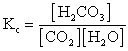
B)Kc =
C)Kc =
D)Kc =
E)Kc =
H2CO3(aq)
Which one of the following is the correct equilibrium constant expression (Kc)for this reaction?
A)
B)Kc =
C)Kc =
D)Kc =
E)Kc =
سؤال
The equilibrium constant for the reaction Ni(s)+ 4CO(g)  Ni(CO)4(g)is 5.0 * 104 at 25ºC. What is the equilibrium constant for the reaction Ni(CO)4(g)
Ni(s)+ 4CO(g)?
A)2.0 * 10-5
B)2.5 * 109
C)5.0 * 104
D)5.0 * 10-4
E)2.0 * 10-3
Ni(CO)4(g)is 5.0 * 104 at 25ºC. What is the equilibrium constant for the reaction Ni(CO)4(g) Ni(s)+ 4CO(g)?
A)2.0 * 10-5
B)2.5 * 109
C)5.0 * 104
D)5.0 * 10-4
E)2.0 * 10-3
سؤال
The equilibrium constant expression for the reaction 2BrF5(g) ![<strong>The equilibrium constant expression for the reaction 2BrF<sub>5</sub>(g) <sub> </sub> Br<sub>2</sub>(g)+ 5F<sub>2</sub>(g)is</strong> A)K<sub>c</sub> = [Br<sub>2</sub>] [F<sub>2</sub>]<sup> </sup>/<sup> </sup>[BrF<sub>5</sub>] B)K<sub>c</sub> = [Br<sub>2</sub>] [F<sub>2</sub>]<sup>5 </sup>/<sup> </sup>[BrF<sub>5</sub>]<sup>2</sup> C)K<sub>c</sub> = [Br<sub>2</sub>] [F<sub>2</sub>]<sup>2 </sup>/<sup> </sup>[BrF<sub>5</sub>]<sup>5</sup> D)K<sub>c</sub> = [BrF<sub>5</sub>]<sup>2 </sup>/<sup> </sup>[Br<sub>2</sub>][F<sub>2</sub>]<sup>5</sup> E)K<sub>c</sub> = 2[BrF<sub>5</sub>]<sup>2 </sup>/<sup> </sup>([Br<sub>2</sub>] * 5[F<sub>2</sub>]<sup>5</sup>) <div style=padding-top: 35px>](https://d2lvgg3v3hfg70.cloudfront.net/TB3245/11ea7cc5_01a1_6f63_a2ab_551de95b7773_TB3245_11.jpg) Br2(g)+ 5F2(g)is
Br2(g)+ 5F2(g)is
A)Kc = [Br2] [F2] / [BrF5]
B)Kc = [Br2] [F2]5 / [BrF5]2
C)Kc = [Br2] [F2]2 / [BrF5]5
D)Kc = [BrF5]2 / [Br2][F2]5
E)Kc = 2[BrF5]2 / ([Br2] * 5[F2]5)
Br2(g)+ 5F2(g)isA)Kc = [Br2] [F2] / [BrF5]
B)Kc = [Br2] [F2]5 / [BrF5]2
C)Kc = [Br2] [F2]2 / [BrF5]5
D)Kc = [BrF5]2 / [Br2][F2]5
E)Kc = 2[BrF5]2 / ([Br2] * 5[F2]5)
سؤال
Phosgene, COCl2, a poisonous gas, decomposes according to the equation COCl2(g)  CO(g)+ Cl2(g). Calculate Kp for this reaction if Kc = 0.083 at 900ºC.
A)0.125
B)8.0
C)6.1
D)0.16
E)0.083
CO(g)+ Cl2(g). Calculate Kp for this reaction if Kc = 0.083 at 900ºC.A)0.125
B)8.0
C)6.1
D)0.16
E)0.083
سؤال
Calculate Kp for the reaction 2NOCl(g)  2NO(g)+ Cl2(g)at 400°C if Kc at 400°C for this reaction is 2.1 * 10-2.
A)2.1 * 10-2
B)1.7 * 10-3
C)0.70
D)1.2
E)3.8 * 10-4
2NO(g)+ Cl2(g)at 400°C if Kc at 400°C for this reaction is 2.1 * 10-2.A)2.1 * 10-2
B)1.7 * 10-3
C)0.70
D)1.2
E)3.8 * 10-4
سؤال
At 250ºC, the equilibrium constant Kp for the reaction PCl5(g)  PCl3(g)+ Cl2(g)is 1.80.Sufficient PCl5 is put into a reaction vessel to give an initial pressure of 2.74 atm at 250ºC.Calculate the pressure of PCl5 after the system has reached equilibrium.
A)1.50 atm
B)1.24 atm
C)4.24 atm
D)0.94 atm
E)1.12 atm
PCl3(g)+ Cl2(g)is 1.80.Sufficient PCl5 is put into a reaction vessel to give an initial pressure of 2.74 atm at 250ºC.Calculate the pressure of PCl5 after the system has reached equilibrium.A)1.50 atm
B)1.24 atm
C)4.24 atm
D)0.94 atm
E)1.12 atm
سؤال
The brown gas NO2 and the colorless gas N2O4 exist in equilibrium, 2NO2  N2O4. In an experiment, 0.625 mole of N2O4 was introduced into a 5.00 L vessel and was allowed to decompose until equilibrium was reached. The concentration of N2O4 at equilibrium was 0.0750 M. Calculate Kc for the reaction.
A)7.5
B)0.125
C)0.0750
D)0.10
E)0.050
N2O4. In an experiment, 0.625 mole of N2O4 was introduced into a 5.00 L vessel and was allowed to decompose until equilibrium was reached. The concentration of N2O4 at equilibrium was 0.0750 M. Calculate Kc for the reaction.A)7.5
B)0.125
C)0.0750
D)0.10
E)0.050
سؤال
The reaction A(g)+ 2B(g)  C(g)was allowed to come to equilibrium. The initial amounts of reactants placed into a 5.00 L vessel were 1.0 mol A and 1.8 mol B. After the reaction reached equilibrium, 1.0 mol of B was found. Calculate Kc for this reaction.
A)0.060
B)5.1
C)17
D)19
E)25
C(g)was allowed to come to equilibrium. The initial amounts of reactants placed into a 5.00 L vessel were 1.0 mol A and 1.8 mol B. After the reaction reached equilibrium, 1.0 mol of B was found. Calculate Kc for this reaction.A)0.060
B)5.1
C)17
D)19
E)25
سؤال
When the following reaction is at equilibrium, which of these relationships is always true? 2NOCl(g) ![<strong>When the following reaction is at equilibrium, which of these relationships is always true? 2NOCl(g) <sub> </sub> 2NO(g)+ Cl<sub>2</sub>(g)</strong> A)[NO] [Cl<sub>2</sub>] = [NOCl] B)[NO]<sup>2</sup> [Cl<sub>2</sub>] = [NOCl]<sup>2</sup> C)[NOCl] = [NO] D)2[NO] = [Cl<sub>2</sub>] E)[NO]<sup>2</sup> [Cl<sub>2</sub>] = K<sub>c</sub>[NOCl]<sup>2</sup> <div style=padding-top: 35px>](https://d2lvgg3v3hfg70.cloudfront.net/TB3245/11ea7cc5_01a2_32bc_a2ab_3d3ca4435fd8_TB3245_00.jpg)
2NO(g)+ Cl2(g)
A)[NO] [Cl2] = [NOCl]
B)[NO]2 [Cl2] = [NOCl]2
C)[NOCl] = [NO]
D)2[NO] = [Cl2]
E)[NO]2 [Cl2] = Kc[NOCl]2
2NO(g)+ Cl2(g)
A)[NO] [Cl2] = [NOCl]
B)[NO]2 [Cl2] = [NOCl]2
C)[NOCl] = [NO]
D)2[NO] = [Cl2]
E)[NO]2 [Cl2] = Kc[NOCl]2
سؤال
If one starts with pure NO2(g)at a pressure of 0.500 atm, the total pressure inside the reaction vessel when 2NO2(g)  2NO(g)+ O2(g)reaches equilibrium is 0.674 atm. Calculate the equilibrium partial pressure of NO2.
A)0.152 atm
B)0.174 atm
C)0.200 atm
D)0.326 atm
E)The total pressure cannot be calculated because Kp is not given
2NO(g)+ O2(g)reaches equilibrium is 0.674 atm. Calculate the equilibrium partial pressure of NO2.A)0.152 atm
B)0.174 atm
C)0.200 atm
D)0.326 atm
E)The total pressure cannot be calculated because Kp is not given
سؤال
Carbon tetrachloride reacts at high temperatures with oxygen to produce two toxic gases, phosgene and chlorine. CCl4(g)+ 1/2O2(g) 
COCl2(g)+ Cl2(g), Kc = 4.4 * 109 at 1,000 K
Calculate Kc for the reaction 2CCl4(g)+ O2(g)
2COCl2(g)+ 2Cl2(g).
A)4.4 * 109
B)8.8 * 109
C)1.9 * 1010
D)1.9 * 1019
E)2.3 * 10-10
COCl2(g)+ Cl2(g), Kc = 4.4 * 109 at 1,000 K
Calculate Kc for the reaction 2CCl4(g)+ O2(g)
2COCl2(g)+ 2Cl2(g).
A)4.4 * 109
B)8.8 * 109
C)1.9 * 1010
D)1.9 * 1019
E)2.3 * 10-10
سؤال
Calculate Kc for the reaction 2HI(g) ![<strong>Calculate K<sub>c</sub> for the reaction 2HI(g)<sub> </sub> <sub> </sub> <sub> </sub> <sub> </sub>H<sub>2</sub>(g)+ I<sub>2</sub>(g)given that the concentrations of each species at equilibrium are as follows: [HI] = 0.85 mol/L, [I<sub>2</sub>] = 0.60 mol/L, [H<sub>2</sub>] = 0.27 mol/L.</strong> A)5.25 B)0.22 C)4.5 D)0.19 E)1.6 * 10<sup>2</sup> <div style=padding-top: 35px>](https://d2lvgg3v3hfg70.cloudfront.net/TB3245/11ea7cc5_01a2_cf01_a2ab_c5b79f1f4387_TB3245_11.jpg)
H2(g)+ I2(g)given that the concentrations of each species at equilibrium are as follows: [HI] = 0.85 mol/L, [I2] = 0.60 mol/L, [H2] = 0.27 mol/L.
A)5.25
B)0.22
C)4.5
D)0.19
E)1.6 * 102
H2(g)+ I2(g)given that the concentrations of each species at equilibrium are as follows: [HI] = 0.85 mol/L, [I2] = 0.60 mol/L, [H2] = 0.27 mol/L.
A)5.25
B)0.22
C)4.5
D)0.19
E)1.6 * 102
سؤال
Consider the two gaseous equilibria:
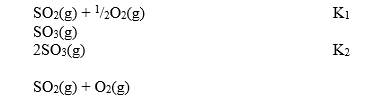
The values of the equilibrium constants K1 and K2 are related by
A)K2 = K12
B)K22 = K1
C)K2 = 1/K
D)K2 = 1/K1
E)none of these.
The values of the equilibrium constants K1 and K2 are related by
A)K2 = K12
B)K22 = K1
C)K2 = 1/K
D)K2 = 1/K1
E)none of these.
سؤال
The following reactions occur at 500 K.Arrange them in order of increasing tendency to proceed to completion (least completion greatest completion).
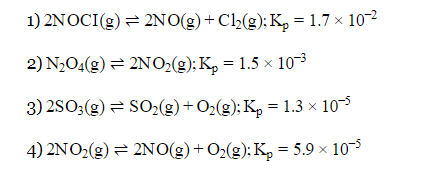
A)2 < 1 < 3 < 4
B)3 < 1 < 4 < 2
C)3 < 4 < 1 < 2
D)4 < 3 < 2 < 1
E)4 < 3 < 1 < 2
A)2 < 1 < 3 < 4
B)3 < 1 < 4 < 2
C)3 < 4 < 1 < 2
D)4 < 3 < 2 < 1
E)4 < 3 < 1 < 2
سؤال
Equilibrium is established for the reaction 2X(s)+ Y(g)  2Z(g)at 500K, Kc = 100.Determine the concentration of Z in equilibrium with 0.2 mol X and 0.50 M Y at 500K.
A)3.2 M
B)3.5 M
C)4.5 M
D)7.1 M
E)None of these.
2Z(g)at 500K, Kc = 100.Determine the concentration of Z in equilibrium with 0.2 mol X and 0.50 M Y at 500K.A)3.2 M
B)3.5 M
C)4.5 M
D)7.1 M
E)None of these.
سؤال
Which is the correct equilibrium constant expression for the following reaction? Fe2O3(s)+ 3H2(g) ![<strong>Which is the correct equilibrium constant expression for the following reaction? Fe<sub>2</sub>O<sub>3</sub>(s)+ 3H<sub>2</sub>(g) <sub> </sub> <sub> </sub>2Fe(s)+ 3H<sub>2</sub>O(g)</strong> A)K<sub>c</sub> = [Fe<sub>2</sub>O<sub>3</sub>] [H<sub>2</sub>]<sup>3 </sup>/<sup> </sup>[Fe]<sup>2</sup>[H<sub>2</sub>O]<sup>3</sup> B)K<sub>c</sub> = [H<sub>2</sub>]<sup> </sup>/<sup> </sup>[H<sub>2</sub>O] C)K<sub>c</sub> = [H<sub>2</sub>O]<sup>3 </sup>/ [H<sub>2</sub>]<sup>3</sup> D)K<sub>c</sub> = [Fe]<sup>2</sup>[H<sub>2</sub>O]<sup>3 </sup>/ [Fe<sub>2</sub>O<sub>3</sub>] [H<sub>2</sub>]<sup>3</sup> E)K<sub>c</sub> = [Fe] [H<sub>2</sub>O] / [Fe<sub>2</sub>O<sub>3</sub>] [H<sub>2</sub>] <div style=padding-top: 35px>](https://d2lvgg3v3hfg70.cloudfront.net/TB3245/11ea7cc5_01a1_4852_a2ab_e994355455f0_TB3245_11.jpg)
2Fe(s)+ 3H2O(g)
A)Kc = [Fe2O3] [H2]3 / [Fe]2[H2O]3
B)Kc = [H2] / [H2O]
C)Kc = [H2O]3 / [H2]3
D)Kc = [Fe]2[H2O]3 / [Fe2O3] [H2]3
E)Kc = [Fe] [H2O] / [Fe2O3] [H2]
2Fe(s)+ 3H2O(g)
A)Kc = [Fe2O3] [H2]3 / [Fe]2[H2O]3
B)Kc = [H2] / [H2O]
C)Kc = [H2O]3 / [H2]3
D)Kc = [Fe]2[H2O]3 / [Fe2O3] [H2]3
E)Kc = [Fe] [H2O] / [Fe2O3] [H2]
سؤال
For the following reaction at equilibrium in a reaction vessel, which one of these changes would cause the Br2 concentration to increase? 2NOBr(g) 
2NO(g)+ Br2(g), Hºrxn= 30 kJ/mol
A)Lower the temperature.
B)Remove some NO.
C)Remove some NOBr.
D)Compress the gas mixture into a smaller volume.
2NO(g)+ Br2(g), Hºrxn= 30 kJ/mol
A)Lower the temperature.
B)Remove some NO.
C)Remove some NOBr.
D)Compress the gas mixture into a smaller volume.
سؤال
For the following reaction at equilibrium, which one of the changes below would cause the equilibrium to shift to the left? 2NOBr(g) 
2NO(g)+ Br2(g), Hºrxn = 30 kJ/mol
A)Increase the container volume.
B)Remove some NO.
C)Remove some Br2 .
D)Add more NOBr.
E)Decrease the temperature.
2NO(g)+ Br2(g), Hºrxn = 30 kJ/mol
A)Increase the container volume.
B)Remove some NO.
C)Remove some Br2 .
D)Add more NOBr.
E)Decrease the temperature.
سؤال
Consider the following equilibria: 2SO3(g)  NEWLINE
2SO2(g)+ O2(g)Kc = 2.3 * 10-7
2NO3(g)
2NO2(g)+ O2(g)Kc = 1.4 * 10-3
Calculate the equilibrium constant for the reaction
SO2(g)+ NO3(g)
SO3(g)+ NO2(g)
A)78
B)1.3 * 10-2
C)1.6 * 10-4
D)3.2 * 10-10
E)6.1 * 103
NEWLINE2SO2(g)+ O2(g)Kc = 2.3 * 10-7
2NO3(g)
2NO2(g)+ O2(g)Kc = 1.4 * 10-3
Calculate the equilibrium constant for the reaction
SO2(g)+ NO3(g)
SO3(g)+ NO2(g)
A)78
B)1.3 * 10-2
C)1.6 * 10-4
D)3.2 * 10-10
E)6.1 * 103
سؤال
For the equilibrium reaction 2SO2(g)+ O2(g)  2SO3(g), Hºrxn = -198 kJ/mol. Which one of these factors would cause the equilibrium constant to increase?
A)Decrease the temperature.
B)Add SO2 gas.
C)Remove O2 gas.
D)Add a catalyst.
E)None of these.
2SO3(g), Hºrxn = -198 kJ/mol. Which one of these factors would cause the equilibrium constant to increase?A)Decrease the temperature.
B)Add SO2 gas.
C)Remove O2 gas.
D)Add a catalyst.
E)None of these.
سؤال
Hydrogen iodide decomposes according to the equation 2HI(g)  H2(g)+ I2(g), for which Kc = 0.0156 at 400ºC. 0.550 mol HI was injected into a 2.00 L reaction vessel at 400ºC.Calculate the concentration of HI at equilibrium.
A)0.138 M
B)0.220 M
C)0.550 M
D)0.275 M
E)0.0275 M
H2(g)+ I2(g), for which Kc = 0.0156 at 400ºC. 0.550 mol HI was injected into a 2.00 L reaction vessel at 400ºC.Calculate the concentration of HI at equilibrium.A)0.138 M
B)0.220 M
C)0.550 M
D)0.275 M
E)0.0275 M
سؤال
At 400ºC, Kc = 64 for the equilibrium H2(g)+ I2(g)  2HI(g). If 3.00 mol H2 and 3.00 mol I2 are introduced into an empty 4.0 L vessel, find the equilibrium concentration of HI at 400ºC.
A)0.15 M
B)1.2 M
C)2.4 M
D)4.8 M
E)5.8 M
2HI(g). If 3.00 mol H2 and 3.00 mol I2 are introduced into an empty 4.0 L vessel, find the equilibrium concentration of HI at 400ºC.A)0.15 M
B)1.2 M
C)2.4 M
D)4.8 M
E)5.8 M
سؤال
For the following reaction at equilibrium, which choice gives a change that will shift the position of equilibrium to favor formation of more products? 2NOBr(g) 
2NO(g)+ Br2(g), Hºrxn = 30 kJ/mol
A)Increase the total pressure by decreasing the volume.
B)Add more NO.
C)Remove Br2.
D)Lower the temperature.
E)Remove NOBr selectively.
2NO(g)+ Br2(g), Hºrxn = 30 kJ/mol
A)Increase the total pressure by decreasing the volume.
B)Add more NO.
C)Remove Br2.
D)Lower the temperature.
E)Remove NOBr selectively.
سؤال
For the reaction SO2(g)+ NO2(g)  SO3(g)+ NO(g), the equilibrium constant is 18.0 at 1,200ºC. If 1.0 mole of SO2 and 2.0 moles of NO2 are placed in a 20.L container, what concentration of SO3 will be present at equilibrium?
A)0.48 mol/L
B)0.11 mol/L
C)0.95 mol/L
D)2.22 mol/L
E)18 mol/L
SO3(g)+ NO(g), the equilibrium constant is 18.0 at 1,200ºC. If 1.0 mole of SO2 and 2.0 moles of NO2 are placed in a 20.L container, what concentration of SO3 will be present at equilibrium?A)0.48 mol/L
B)0.11 mol/L
C)0.95 mol/L
D)2.22 mol/L
E)18 mol/L
سؤال
Consider the reaction N2(g)+ O2(g)  2NO(g), for which Kc = 0.10 at 2,000ºC.Starting with initial concentrations of 0.040 M of N2 and 0.040 M of O2, determine the equilibrium concentration of NO.
A)5.4 * 10-3 M
B)0.0096 M
C)0.011 M
D)0.080 M
E)0.10 M
2NO(g), for which Kc = 0.10 at 2,000ºC.Starting with initial concentrations of 0.040 M of N2 and 0.040 M of O2, determine the equilibrium concentration of NO.A)5.4 * 10-3 M
B)0.0096 M
C)0.011 M
D)0.080 M
E)0.10 M
سؤال
For the following reaction at equilibrium in a reaction vessel, which one of these changes would cause the Br2 concentration to decrease? 2NOBr(g) 
2NO(g)+ Br2(g), Hºrxn= 30 kJ/mol
A)Increase the temperature.
B)Remove some NO.
C)Add more NOBr.
D)Compress the gas mixture into a smaller volume.
2NO(g)+ Br2(g), Hºrxn= 30 kJ/mol
A)Increase the temperature.
B)Remove some NO.
C)Add more NOBr.
D)Compress the gas mixture into a smaller volume.
سؤال
For the nitrogen fixation reaction 3H2(g)+ N2(g)  2NH3(g), Kc = 6.0 * 10-2 at 500°C. If 0.250 M H2 and 0.050 M NH3 are present at equilibrium, what is the equilibrium concentration of N2?
A)0.750 M
B)2.7 M
C)0.250 M
D)0.025 M
E)1.85 M
2NH3(g), Kc = 6.0 * 10-2 at 500°C. If 0.250 M H2 and 0.050 M NH3 are present at equilibrium, what is the equilibrium concentration of N2?A)0.750 M
B)2.7 M
C)0.250 M
D)0.025 M
E)1.85 M
سؤال
Consider the following reactions and their associated equilibrium constants:

For the reaction A + 2B D + E, having equilibrium constant Kc,
A)Kc = K1 + K2
B)Kc = K1/K2
C)Kc = K1 - K2
D)Kc = (K1)(K2)
E)Kc = K2/K1
For the reaction A + 2B
D + E, having equilibrium constant Kc,A)Kc = K1 + K2
B)Kc = K1/K2
C)Kc = K1 - K2
D)Kc = (K1)(K2)
E)Kc = K2/K1
سؤال
For the reaction H2(g)+ I2(g) ![<strong>For the reaction H<sub>2</sub>(g)+ I<sub>2</sub>(g) <sub> </sub> 2HI(g), K<sub>c</sub> = 50.2 at 445ºC.If [H<sub>2</sub>] = [I<sub>2</sub>] = [HI] = 1.75 * 10<sup>-3</sup> M at 445ºC, which one of these statements is true?</strong> A)The system is at equilibrium, thus no concentration changes will occur. B)The concentrations of HI and I<sub>2</sub> will increase as the system approaches equilibrium. C)The concentration of HI will increase as the system approaches equilibrium. D)The concentrations of H<sub>2</sub> and HI will fall as the system moves toward equilibrium. E)The concentrations of H<sub>2</sub> and I<sub>2</sub> will increase as the system approaches equilibrium. <div style=padding-top: 35px>](https://d2lvgg3v3hfg70.cloudfront.net/TB3245/11ea7cc5_01a5_8e37_a2ab_e1ef359a2b9b_TB3245_11.jpg) 2HI(g), Kc = 50.2 at 445ºC.If [H2] = [I2] = [HI] = 1.75 * 10-3 M at 445ºC, which one of these statements is true?
2HI(g), Kc = 50.2 at 445ºC.If [H2] = [I2] = [HI] = 1.75 * 10-3 M at 445ºC, which one of these statements is true?
A)The system is at equilibrium, thus no concentration changes will occur.
B)The concentrations of HI and I2 will increase as the system approaches equilibrium.
C)The concentration of HI will increase as the system approaches equilibrium.
D)The concentrations of H2 and HI will fall as the system moves toward equilibrium.
E)The concentrations of H2 and I2 will increase as the system approaches equilibrium.
2HI(g), Kc = 50.2 at 445ºC.If [H2] = [I2] = [HI] = 1.75 * 10-3 M at 445ºC, which one of these statements is true?A)The system is at equilibrium, thus no concentration changes will occur.
B)The concentrations of HI and I2 will increase as the system approaches equilibrium.
C)The concentration of HI will increase as the system approaches equilibrium.
D)The concentrations of H2 and HI will fall as the system moves toward equilibrium.
E)The concentrations of H2 and I2 will increase as the system approaches equilibrium.
سؤال
At 35ºC, the equilibrium constant for the reaction 2NOCl(g) ![<strong>At 35ºC, the equilibrium constant for the reaction 2NOCl(g) <sub> </sub> 2NO(g)+ Cl<sub>2</sub>(g)is K<sub>c</sub> = 1.6 * 10<sup>-5</sup>. An equilibrium mixture was found to have the following concentrations of Cl<sub>2</sub> and NOCl: [Cl<sub>2</sub>] = 1.2 * 10<sup>-2 </sup>M; [NOCl] = 2.8 * 10<sup>-1 </sup>M. Calculate the concentration of NO(g)at equilibrium.</strong> A)1.0 * 10<sup>-4</sup> M B)1.0 * 10<sup>-2</sup> M C)2.8 * 10<sup>-1</sup> M D)2.4 * 10<sup>-2</sup> M E)1.6 * 10<sup>-3</sup> M <div style=padding-top: 35px>](https://d2lvgg3v3hfg70.cloudfront.net/TB3245/11ea7cc5_01a3_6b47_a2ab_3d73afdc92bd_TB3245_11.jpg) 2NO(g)+ Cl2(g)is Kc = 1.6 * 10-5. An equilibrium mixture was found to have the following concentrations of Cl2 and NOCl: [Cl2] = 1.2 * 10-2 M; [NOCl] = 2.8 * 10-1 M. Calculate the concentration of NO(g)at equilibrium.
2NO(g)+ Cl2(g)is Kc = 1.6 * 10-5. An equilibrium mixture was found to have the following concentrations of Cl2 and NOCl: [Cl2] = 1.2 * 10-2 M; [NOCl] = 2.8 * 10-1 M. Calculate the concentration of NO(g)at equilibrium.
A)1.0 * 10-4 M
B)1.0 * 10-2 M
C)2.8 * 10-1 M
D)2.4 * 10-2 M
E)1.6 * 10-3 M
2NO(g)+ Cl2(g)is Kc = 1.6 * 10-5. An equilibrium mixture was found to have the following concentrations of Cl2 and NOCl: [Cl2] = 1.2 * 10-2 M; [NOCl] = 2.8 * 10-1 M. Calculate the concentration of NO(g)at equilibrium.A)1.0 * 10-4 M
B)1.0 * 10-2 M
C)2.8 * 10-1 M
D)2.4 * 10-2 M
E)1.6 * 10-3 M
سؤال
Hydrogen iodide decomposes according to the equation 2HI(g)  H2(g)+ I2(g), for which Kc = 0.0156 at 400ºC. 0.550 mol HI was injected into a 2.00 L reaction vessel at 400ºC.Calculate the concentration of H2 at equilibrium.
A)0.275 M
B)0.138 M
C)0.0275 M
D)0.0550 M
E)0.220 M
H2(g)+ I2(g), for which Kc = 0.0156 at 400ºC. 0.550 mol HI was injected into a 2.00 L reaction vessel at 400ºC.Calculate the concentration of H2 at equilibrium.A)0.275 M
B)0.138 M
C)0.0275 M
D)0.0550 M
E)0.220 M
سؤال
At 700 K, the reaction 2SO2(g)+ O2(g) ![<strong>At 700 K, the reaction 2SO<sub>2</sub>(g)+ O<sub>2</sub>(g) <sub> </sub> 2SO<sub>3</sub>(g)has the equilibrium constant K<sub>c</sub> = 4.3 * 10<sup>6</sup> , and the following concentrations are present: [SO<sub>2</sub>] = 0.10 M; [SO<sub>3</sub>] = 10.M; [O<sub>2</sub>] = 0.10 M. Is the mixture at equilibrium? If not at equilibrium, in which direction (as the equation is written), left to right or right to left, will the reaction proceed to reach equilibrium?</strong> A)Yes, the mixture is at equilibrium. B)No, left to right C)No, right to left D)There is not enough information to be able to predict the direction. <div style=padding-top: 35px>](https://d2lvgg3v3hfg70.cloudfront.net/TB3245/11ea7cc5_01a5_6725_a2ab_3be7a598f41d_TB3245_11.jpg) 2SO3(g)has the equilibrium constant Kc = 4.3 * 106 , and the following concentrations are present: [SO2] = 0.10 M; [SO3] = 10.M; [O2] = 0.10 M. Is the mixture at equilibrium? If not at equilibrium, in which direction (as the equation is written), left to right or right to left, will the reaction proceed to reach equilibrium?
2SO3(g)has the equilibrium constant Kc = 4.3 * 106 , and the following concentrations are present: [SO2] = 0.10 M; [SO3] = 10.M; [O2] = 0.10 M. Is the mixture at equilibrium? If not at equilibrium, in which direction (as the equation is written), left to right or right to left, will the reaction proceed to reach equilibrium?
A)Yes, the mixture is at equilibrium.
B)No, left to right
C)No, right to left
D)There is not enough information to be able to predict the direction.
2SO3(g)has the equilibrium constant Kc = 4.3 * 106 , and the following concentrations are present: [SO2] = 0.10 M; [SO3] = 10.M; [O2] = 0.10 M. Is the mixture at equilibrium? If not at equilibrium, in which direction (as the equation is written), left to right or right to left, will the reaction proceed to reach equilibrium?A)Yes, the mixture is at equilibrium.
B)No, left to right
C)No, right to left
D)There is not enough information to be able to predict the direction.
سؤال
At 700 K, the reaction 2SO2(g)+ O2(g) ![<strong>At 700 K, the reaction 2SO<sub>2</sub>(g)+ O<sub>2</sub>(g) <sub> </sub> 2SO<sub>3</sub>(g)has the equilibrium constant K<sub>c</sub> = 4.3 * 10<sup>6</sup>, and the following concentrations are present: [SO<sub>2</sub>] = 0.010 M; [SO<sub>3</sub>] = 10.M; [O<sub>2</sub>] = 0.010 M. Is the mixture at equilibrium? If not at equilibrium, in which direction (as the equation is written), left to right or right to left, will the reaction proceed to reach equilibrium?</strong> A)Yes, the mixture is at equilibrium. B)No, left to right C)No, right to left D)There is not enough information to be able to predict the direction. <div style=padding-top: 35px>](https://d2lvgg3v3hfg70.cloudfront.net/TB3245/11ea7cc5_01a5_8e36_a2ab_23153ac3e4c9_TB3245_11.jpg) 2SO3(g)has the equilibrium constant Kc = 4.3 * 106, and the following concentrations are present: [SO2] = 0.010 M; [SO3] = 10.M; [O2] = 0.010 M. Is the mixture at equilibrium? If not at equilibrium, in which direction (as the equation is written), left to right or right to left, will the reaction proceed to reach equilibrium?
2SO3(g)has the equilibrium constant Kc = 4.3 * 106, and the following concentrations are present: [SO2] = 0.010 M; [SO3] = 10.M; [O2] = 0.010 M. Is the mixture at equilibrium? If not at equilibrium, in which direction (as the equation is written), left to right or right to left, will the reaction proceed to reach equilibrium?
A)Yes, the mixture is at equilibrium.
B)No, left to right
C)No, right to left
D)There is not enough information to be able to predict the direction.
2SO3(g)has the equilibrium constant Kc = 4.3 * 106, and the following concentrations are present: [SO2] = 0.010 M; [SO3] = 10.M; [O2] = 0.010 M. Is the mixture at equilibrium? If not at equilibrium, in which direction (as the equation is written), left to right or right to left, will the reaction proceed to reach equilibrium?A)Yes, the mixture is at equilibrium.
B)No, left to right
C)No, right to left
D)There is not enough information to be able to predict the direction.
سؤال
For the reaction PCl3(g)+ Cl2(g) ![<strong>For the reaction PCl<sub>3</sub>(g)+ Cl<sub>2</sub>(g) <sub> </sub> PCl<sub>5</sub>(g)at a particular temperature, K<sub>c</sub> = 24.3.Suppose a system at that temperature is prepared with [PCl<sub>3</sub>] = 0.10 M, [Cl<sub>2</sub>] = 0.15 M, and [PCl<sub>5</sub>] = 0.60 M. Which of these statements is true?</strong> A)The reaction is at equilibrium. B)The reaction will proceed in the direction of forming more PCl<sub>5</sub> until equilibrium is reached. C)The reaction will proceed in the direction of forming more PCl<sub>3</sub> and Cl<sub>2</sub> until equilibrium is reached. D)None of the above statements is true. <div style=padding-top: 35px>](https://d2lvgg3v3hfg70.cloudfront.net/TB3245/11ea7cc5_01a5_8e38_a2ab_addf15eab8da_TB3245_11.jpg) PCl5(g)at a particular temperature, Kc = 24.3.Suppose a system at that temperature is prepared with [PCl3] = 0.10 M, [Cl2] = 0.15 M, and [PCl5] = 0.60 M. Which of these statements is true?
PCl5(g)at a particular temperature, Kc = 24.3.Suppose a system at that temperature is prepared with [PCl3] = 0.10 M, [Cl2] = 0.15 M, and [PCl5] = 0.60 M. Which of these statements is true?
A)The reaction is at equilibrium.
B)The reaction will proceed in the direction of forming more PCl5 until equilibrium is reached.
C)The reaction will proceed in the direction of forming more PCl3 and Cl2 until equilibrium is reached.
D)None of the above statements is true.
PCl5(g)at a particular temperature, Kc = 24.3.Suppose a system at that temperature is prepared with [PCl3] = 0.10 M, [Cl2] = 0.15 M, and [PCl5] = 0.60 M. Which of these statements is true?A)The reaction is at equilibrium.
B)The reaction will proceed in the direction of forming more PCl5 until equilibrium is reached.
C)The reaction will proceed in the direction of forming more PCl3 and Cl2 until equilibrium is reached.
D)None of the above statements is true.
سؤال
Sodium carbonate, Na2CO3(s), can be prepared by heating sodium bicarbonate, NaHCO3(s). 2NaHCO3(s) 
Na2CO3(s)+ CO2(g)+ H2O(g)Kp = 0.23 at 100ºC
If a sample of NaHCO3 is placed in an evacuated flask and allowed to achieve equilibrium at 100ºC, what will the total gas pressure be?
A)0.46 atm
B)0.96 atm
C)0.23 atm
D)0.48 atm
E)0.11 atm
Na2CO3(s)+ CO2(g)+ H2O(g)Kp = 0.23 at 100ºC
If a sample of NaHCO3 is placed in an evacuated flask and allowed to achieve equilibrium at 100ºC, what will the total gas pressure be?
A)0.46 atm
B)0.96 atm
C)0.23 atm
D)0.48 atm
E)0.11 atm
سؤال
At 340 K, Kp = 69 for the reaction H2(g)+ I2(g)  2HI(g). 50.0 g of HI is injected into an evacuated 5.00-L rigid cylinder at 340 K. What is the total pressure inside the cylinder when the system comes to equilibrium?
A)2.60 atm
B)1.76 atm
C)0.424 atm
D)2.18 atm
E)10.9 atm
2HI(g). 50.0 g of HI is injected into an evacuated 5.00-L rigid cylinder at 340 K. What is the total pressure inside the cylinder when the system comes to equilibrium?A)2.60 atm
B)1.76 atm
C)0.424 atm
D)2.18 atm
E)10.9 atm
سؤال
A solution was prepared such that the initial concentrations of Cu2+(aq)and CN-(aq)were 0.0120 M and 0.0400 M, respectively.These ions react according to the following chemical equation
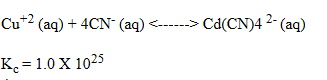
What will be the concentration of CN-(aq)at equilibrium?
What will be the concentration of CN-(aq)at equilibrium?
سؤال
In which of these gas-phase equilibria is the yield of products increased by increasing the total pressure on the reaction mixture?
A)CO(g)+ H2O(g) CO2(g)+ H2(g)
B)2NO(g)+ Cl2(g) 2NOCl(g)
C)2SO3(g) 2SO2(g)+ O2(g)
D)PCl5(g) PCl3(g)+ Cl2(g)
A)CO(g)+ H2O(g)
CO2(g)+ H2(g)B)2NO(g)+ Cl2(g)
2NOCl(g)C)2SO3(g)
2SO2(g)+ O2(g)D)PCl5(g)
PCl3(g)+ Cl2(g) سؤال
For the reaction 2NOCl(g)  2NO(g)+ Cl2(g), Kc = 8.0 at a certain temperature.What concentration of NOCl must be put into an empty 4.00 L reaction vessel in order that the equilibrium concentration of NOCl be 1.00 M?
A)1.26 M
B)2.25 M
C)2.50 M
D)3.52 M
E)11.0 M
2NO(g)+ Cl2(g), Kc = 8.0 at a certain temperature.What concentration of NOCl must be put into an empty 4.00 L reaction vessel in order that the equilibrium concentration of NOCl be 1.00 M?A)1.26 M
B)2.25 M
C)2.50 M
D)3.52 M
E)11.0 M
سؤال
A quantity of liquid methanol, CH3OH, is introduced into a rigid 3.00-L vessel, the vessel is sealed, and the temperature is raised to 500K. At this temperature, the methanol vaporizes and decomposes according to the reaction CH3OH(g) 
CO(g)+ 2 H2(g), Kc= 6.90*10-2.
If the concentration of H2 in the equilibrium mixture is 0.426M, what mass of methanol was initially introduced into the vessel?
A)147 g
B)74.3 g
C)33.9 g
D)49.0 g
E)24.8 g
CO(g)+ 2 H2(g), Kc= 6.90*10-2.
If the concentration of H2 in the equilibrium mixture is 0.426M, what mass of methanol was initially introduced into the vessel?
A)147 g
B)74.3 g
C)33.9 g
D)49.0 g
E)24.8 g
سؤال
If the reaction 2H2S(g)  2H2(g)+ S2(g)is carried out at 1065°C, Kp = 0.0120. Starting from pure H2S introduced into an evacuated vessel at 1065°C, what will the total pressure in the vessel be at equilibrium if the equilibrated mixture contains 0.300 atm of H2(g)?
A)1.06 atm
B)1.36 atm
C)2.39 atm
D)4.20 atm
E)1.51 atm
2H2(g)+ S2(g)is carried out at 1065°C, Kp = 0.0120. Starting from pure H2S introduced into an evacuated vessel at 1065°C, what will the total pressure in the vessel be at equilibrium if the equilibrated mixture contains 0.300 atm of H2(g)?A)1.06 atm
B)1.36 atm
C)2.39 atm
D)4.20 atm
E)1.51 atm
سؤال
The reaction 2SO3(g)  2SO2(g)+ O2(g)is endothermic. If the temperature is increased,
A)more SO3 will be produced.
B)Kc will decrease.
C)no change will occur in Kc .
D)Kc will increase.
E)the pressure will decrease.
2SO2(g)+ O2(g)is endothermic. If the temperature is increased,A)more SO3 will be produced.
B)Kc will decrease.
C)no change will occur in Kc .
D)Kc will increase.
E)the pressure will decrease.
سؤال
Which of these situations will result if some CH4(g)is removed from the reaction CO(g)+ 3H2(g)  CH4(g)+ H2O(g)at equilibrium?
A)H2O will be consumed.
B)More CH4 and H2O will be produced.
C)Kp will decrease.
D)More CO will be produced.
E)No change will occur.
CH4(g)+ H2O(g)at equilibrium?A)H2O will be consumed.
B)More CH4 and H2O will be produced.
C)Kp will decrease.
D)More CO will be produced.
E)No change will occur.
سؤال
For the common allotropes of carbon (graphite and diamond), C(gr)  C(dia)with equilibrium constant K = 0.32. The molar volumes of graphite and diamond are, respectively, 5.30 cm3/mol and 3.42 cm3/mol; Hf of diamond is 1.90 kJ/mol. This data suggests that the formation of diamond is favored at
A)low temperatures and low pressures.
B)high temperatures and low pressures.
C)low temperatures and high pressures.
D)high temperatures and high pressures.
C(dia)with equilibrium constant K = 0.32. The molar volumes of graphite and diamond are, respectively, 5.30 cm3/mol and 3.42 cm3/mol; Hf of diamond is 1.90 kJ/mol. This data suggests that the formation of diamond is favored atA)low temperatures and low pressures.
B)high temperatures and low pressures.
C)low temperatures and high pressures.
D)high temperatures and high pressures.
سؤال
For the reaction at equilibrium 2SO3  2SO2 + O2 ( Hºrxn= 198 kJ/mol), if we increase the reaction temperature, the equilibrium will
A)shift to the right.
B)shift to the left.
C)not shift.
D)The question cannot be answered because the equilibrium constant is not given.
2SO2 + O2 ( Hºrxn= 198 kJ/mol), if we increase the reaction temperature, the equilibrium willA)shift to the right.
B)shift to the left.
C)not shift.
D)The question cannot be answered because the equilibrium constant is not given.
سؤال
Consider this reaction at equilibrium at a total pressure P1: 2SO2(g)+ O2(g) 
2SO3(g)
Suppose the volume of this system is compressed to one-half its initial volume and then equilibrium is reestablished. The new equilibrium total pressure will be
A)twice P1
B)three times P1
C)3.5 P1
D)less than twice P1
E)unchanged
2SO3(g)
Suppose the volume of this system is compressed to one-half its initial volume and then equilibrium is reestablished. The new equilibrium total pressure will be
A)twice P1
B)three times P1
C)3.5 P1
D)less than twice P1
E)unchanged
سؤال
The equilibrium constants for the chemical reaction N2(g)+ O2(g) 
2NO(g)are KP = 1.1 * 10-3 and 3.6 * 10-3 at 2,200 K and 2,500 K, respectively. Which one of these statements is true?
A)The reaction is exothermic, Hº < 0.
B)The partial pressure of NO(g)is less at 2,200 K than at 2,500 K.
C)KP is less than Kc by a factor of (RT).
D)The total pressure at 2,200 K is the same as at 2,500 K.
E)Higher total pressure shifts the equilibrium to the left.
2NO(g)are KP = 1.1 * 10-3 and 3.6 * 10-3 at 2,200 K and 2,500 K, respectively. Which one of these statements is true?
A)The reaction is exothermic, Hº < 0.
B)The partial pressure of NO(g)is less at 2,200 K than at 2,500 K.
C)KP is less than Kc by a factor of (RT).
D)The total pressure at 2,200 K is the same as at 2,500 K.
E)Higher total pressure shifts the equilibrium to the left.
سؤال
Consider the reaction N2(g)+ 3H2(g) 
2NH3(g). If hydrogen gas is added to this system at equilibrium, which direction will the reaction shift?
2NH3(g). If hydrogen gas is added to this system at equilibrium, which direction will the reaction shift?
سؤال
Consider this gas phase equilibrium system: PCl5(g) 
PCl3(g)+ Cl2(g) Hºrxn = +87.8 kJ/mol.
Which of these statements is false?
A)Increasing the system volume shifts the equilibrium to the right.
B)Increasing the temperature shifts the equilibrium to the right.
C)A catalyst speeds up the approach to equilibrium and shifts the position of equilibrium to the right.
D)Decreasing the total pressure of the system shifts the equilibrium to the right.
E)Increasing the temperature causes the equilibrium constant to increase.
PCl3(g)+ Cl2(g) Hºrxn = +87.8 kJ/mol.
Which of these statements is false?
A)Increasing the system volume shifts the equilibrium to the right.
B)Increasing the temperature shifts the equilibrium to the right.
C)A catalyst speeds up the approach to equilibrium and shifts the position of equilibrium to the right.
D)Decreasing the total pressure of the system shifts the equilibrium to the right.
E)Increasing the temperature causes the equilibrium constant to increase.
سؤال
When the reaction 2H2S(g)  2H2(g)+ S2(g)is carried out at 1065°C, Kp = 0.012. Starting with pure H2S at 1065°, what must the initial pressure of H2S be if the equilibrated mixture at this temperature is to contain 0.250 atm of H2(g)?
A)1.06 atm
B)1.86 atm
C)0.94 atm
D)0.90 atm
E)1.52 atm
2H2(g)+ S2(g)is carried out at 1065°C, Kp = 0.012. Starting with pure H2S at 1065°, what must the initial pressure of H2S be if the equilibrated mixture at this temperature is to contain 0.250 atm of H2(g)?A)1.06 atm
B)1.86 atm
C)0.94 atm
D)0.90 atm
E)1.52 atm
سؤال
A solution was prepared such that the initial concentrations of Cu2+(aq)and CN-(aq)were 0.0120 M and 0.0400 M, respectively.These ions react according to the following chemical equation
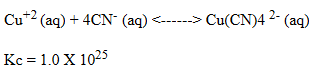
What will be the concentration of Cu2+(aq)at equilibrium?
What will be the concentration of Cu2+(aq)at equilibrium?
سؤال
سؤال
Solid ammonium hydrogen sulfide is introduced into a 2.00-L flask, and the flask is sealed.If this solid decomposes according to the equation NH4HS(s)

NH3(g)+ H2S(g), Kp = 0.108 at 25°C,
What is the minimum mass of ammonium hydrogen sulfide that must be present in the flask initially if equilibrium is to be established at 25°C?
A)0.917 g
B)1.37 g
C)2.74 g
D)0.581 g
E)0.452 g
NH3(g)+ H2S(g), Kp = 0.108 at 25°C,
What is the minimum mass of ammonium hydrogen sulfide that must be present in the flask initially if equilibrium is to be established at 25°C?
A)0.917 g
B)1.37 g
C)2.74 g
D)0.581 g
E)0.452 g
سؤال
When the substances in the equation below are at equilibrium, at pressure P and temperature T, the equilibrium can be shifted to favor the products by CuO(s)+ H2(g) 
H2O(g)+ Cu(s) Hºrxn = -2.0 kJ/mol
A)increasing the pressure by means of a moving piston at constant T.
B)increasing the pressure by adding an inert gas such as nitrogen.
C)decreasing the temperature.
D)allowing some gases to escape at constant P and T.
E)adding a catalyst.
H2O(g)+ Cu(s) Hºrxn = -2.0 kJ/mol
A)increasing the pressure by means of a moving piston at constant T.
B)increasing the pressure by adding an inert gas such as nitrogen.
C)decreasing the temperature.
D)allowing some gases to escape at constant P and T.
E)adding a catalyst.
سؤال
The reaction 2NO(g)  N2(g)+ O2(g)is exothermic, Hºrxn = -180 kJ/mol.Which one of these statements is true?
A)Kp at 1,000 K is less than Kp at 2,000 K.
B)Kp at 1,000 K is larger than Kp at 2,000 K.
C)The Kp's at 1000 K and 2000 K are the same.
D)Kp depends on total pressure as well as temperature.
N2(g)+ O2(g)is exothermic, Hºrxn = -180 kJ/mol.Which one of these statements is true?A)Kp at 1,000 K is less than Kp at 2,000 K.
B)Kp at 1,000 K is larger than Kp at 2,000 K.
C)The Kp's at 1000 K and 2000 K are the same.
D)Kp depends on total pressure as well as temperature.
سؤال
Consider this reaction at equilibrium: 2SO2(g)+ O2(g) 
2SO3(g), Hºrxn = -198 kJ/mol
If the volume of the system is compressed at constant temperature, what change will occur in the position of the equilibrium?
A)A shift to produce more SO2
B)A shift to produce more O2
C)No change
D)A shift to produce more SO3
2SO3(g), Hºrxn = -198 kJ/mol
If the volume of the system is compressed at constant temperature, what change will occur in the position of the equilibrium?
A)A shift to produce more SO2
B)A shift to produce more O2
C)No change
D)A shift to produce more SO3
سؤال
Consider the equilibrium equation C(s)+ H2O(g)+ 2296 J 
CO(g)+ H2(g).What will happen to the concentration of carbon monoxide if the temperature of this system is raised?
CO(g)+ H2(g).What will happen to the concentration of carbon monoxide if the temperature of this system is raised?
سؤال
Consider the chemical reaction 2NH3(g) 
N2(g)+ 3H2(g).The equilibrium is to be established in a 1.0 L container at 1,000 K, where Kc = 4.0 * 10-2. Initially, 1,220 moles of NH3(g)are present.Estimate the equilibrium concentration of N2(g).
N2(g)+ 3H2(g).The equilibrium is to be established in a 1.0 L container at 1,000 K, where Kc = 4.0 * 10-2. Initially, 1,220 moles of NH3(g)are present.Estimate the equilibrium concentration of N2(g).
سؤال
Ethanol and acetic acid react to form ethyl acetate and water according to the following chemical equation:
C2H5OH(l)+ CH3COOH(l)![Ethanol and acetic acid react to form ethyl acetate and water according to the following chemical equation: C<sub>2</sub>H<sub>5</sub>OH(l)+ CH<sub>3</sub>COOH(l) <sub> </sub> CH<sub>3</sub>COOC<sub>2</sub>H<sub>5</sub>(l)+ H<sub>2</sub>O(l) When two moles each of ethanol and acetic acid are combined, equilibrium is reached when two-thirds of a mole of each of the reactants remains.Calculate the equilibrium constant for this reaction assuming total volume does not change during the course of the reaction.(Note: since water is not the solvent, but rather a product of the reaction, [H<sub>2</sub>O] changes during the course of the reaction, so it should be included in the equilibrium constant expression.)<div style=padding-top: 35px>](https://d2lvgg3v3hfg70.cloudfront.net/TB3245/11ea7cc5_01a9_d427_a2ab_43f3a6f44631_TB3245_11.jpg)
CH3COOC2H5(l)+ H2O(l)
When two moles each of ethanol and acetic acid are combined, equilibrium is reached when two-thirds of a mole of each of the reactants remains.Calculate the equilibrium constant for this reaction assuming total volume does not change during the course of the reaction.(Note: since water is not the solvent, but rather a product of the reaction, [H2O] changes during the course of the reaction, so it should be included in the equilibrium constant expression.)
C2H5OH(l)+ CH3COOH(l)
CH3COOC2H5(l)+ H2O(l)
When two moles each of ethanol and acetic acid are combined, equilibrium is reached when two-thirds of a mole of each of the reactants remains.Calculate the equilibrium constant for this reaction assuming total volume does not change during the course of the reaction.(Note: since water is not the solvent, but rather a product of the reaction, [H2O] changes during the course of the reaction, so it should be included in the equilibrium constant expression.)
سؤال
Consider the equilibrium equation C(s)+ H2O(g)+ 2296 J 
CO(g)+ H2(g).What will happen to the mass of carbon if we add gaseous water to the system?
CO(g)+ H2(g).What will happen to the mass of carbon if we add gaseous water to the system?
سؤال
Consider the reaction N2(g)+ 3H2(g) 
2NH3(g). The production of ammonia is an endothermic reaction.Will heating the equilibrium system increase or decrease the amount of ammonia produced?
2NH3(g). The production of ammonia is an endothermic reaction.Will heating the equilibrium system increase or decrease the amount of ammonia produced?
سؤال
The data below refer to the following reaction:
2NO(g)+ Br2(g)
2NOBr(g) Find the concentration of NOBr when the system reaches equilibrium.
2NO(g)+ Br2(g)
2NOBr(g)
Find the concentration of NOBr when the system reaches equilibrium. سؤال
Consider the chemical reaction 2NH3(g) 
N2(g)+ 3H2(g).The equilibrium is to be established in a 1.0 L container at 1,000 K, where Kc = 4.0 * 10-2. Initially, 1,220 moles of NH3(g)are present.Calculate Kp for the reaction.
N2(g)+ 3H2(g).The equilibrium is to be established in a 1.0 L container at 1,000 K, where Kc = 4.0 * 10-2. Initially, 1,220 moles of NH3(g)are present.Calculate Kp for the reaction.
سؤال
Consider the reaction N2(g)+ 3H2(g) 
2NH3(g). If nitrogen is removed from the system at equilibrium, what will happen to the hydrogen (H2)concentration?
2NH3(g). If nitrogen is removed from the system at equilibrium, what will happen to the hydrogen (H2)concentration?
سؤال
سؤال
Consider the chemical reaction 2NH3(g) 
N2(g)+ 3H2(g).The equilibrium is to be established in a 1.0 L container at 1,000 K, where Kc = 4.0 * 10-2. Initially, 1,220 moles of NH3(g)are present.Estimate the equilibrium concentration of H2(g).
N2(g)+ 3H2(g).The equilibrium is to be established in a 1.0 L container at 1,000 K, where Kc = 4.0 * 10-2. Initially, 1,220 moles of NH3(g)are present.Estimate the equilibrium concentration of H2(g).
سؤال
Calcium carbonate decomposes at high temperatures to give calcium oxide and carbon dioxide.
CaCO3(s)
CaO(s)+ CO2(g)
KP for this reaction is 1.16 at 800°C.A 5.00 L vessel containing 10.0 g of CaCO3(s)was evacuated to remove the air, sealed, and then heated to 800°C.Ignoring the volume occupied by the solid, what will be the mass of the solid in the vessel once equilibrium is reached?
CaCO3(s)
CaO(s)+ CO2(g)
KP for this reaction is 1.16 at 800°C.A 5.00 L vessel containing 10.0 g of CaCO3(s)was evacuated to remove the air, sealed, and then heated to 800°C.Ignoring the volume occupied by the solid, what will be the mass of the solid in the vessel once equilibrium is reached?
سؤال
Consider the reaction N2(g)+ 3H2(g) 
2NH3(g). If we use a catalyst, which way will the reaction shift?
2NH3(g). If we use a catalyst, which way will the reaction shift?
سؤال
Consider the equilibrium equation C(s)+ H2O(g)+ 2296 J 
CO(g)+ H2(g).If additional gaseous water is added to this reaction mixture, what will happen to the temperature of the mixture?
CO(g)+ H2(g).If additional gaseous water is added to this reaction mixture, what will happen to the temperature of the mixture?
سؤال
سؤال
The data below refer to the following reaction:
2NO(g)+ Br2(g)
2NOBr(g) Calculate Kc.
2NO(g)+ Br2(g)
2NOBr(g)
Calculate Kc. سؤال
Consider the reaction N2(g)+ 3H2(g) 
2NH3(g). If nitrogen is added to the system at equilibrium, what will happen to the ammonia concentration?
2NH3(g). If nitrogen is added to the system at equilibrium, what will happen to the ammonia concentration?
سؤال
Hydrogen iodide decomposes according to the equation:
2HI(g)
H2(g)+ I2(g), Kc = 0.0156 at 400ºC
A 0.660 mol sample of HI was injected into a 2.00 L reaction vessel held at 400ºC.
Calculate the concentration of H2 equilibrium.
2HI(g)
H2(g)+ I2(g), Kc = 0.0156 at 400ºC
A 0.660 mol sample of HI was injected into a 2.00 L reaction vessel held at 400ºC.
Calculate the concentration of H2 equilibrium.
سؤال
Hydrogen iodide decomposes according to the equation:
2HI(g)
H2(g)+ I2(g), Kc = 0.0156 at 400ºC
A 0.660 mol sample of HI was injected into a 2.00 L reaction vessel held at 400ºC.
Calculate the concentration of HI at equilibrium.
2HI(g)
H2(g)+ I2(g), Kc = 0.0156 at 400ºC
A 0.660 mol sample of HI was injected into a 2.00 L reaction vessel held at 400ºC.
Calculate the concentration of HI at equilibrium.
سؤال
The data below refer to the following reaction:
2NO(g)+ Br2(g)
2NOBr(g) Find the concentration of Br2 when the system reaches equilibrium.
2NO(g)+ Br2(g)
2NOBr(g)
Find the concentration of Br2 when the system reaches equilibrium. سؤال
Consider the equilibrium equation C(s)+ H2O(g)+ 2296 J 
CO(g)+ H2(g).Which way will the reaction shift if the pressure on the system is increased?
CO(g)+ H2(g).Which way will the reaction shift if the pressure on the system is increased?

فتح الحزمة
قم بالتسجيل لفتح البطاقات في هذه المجموعة!
Unlock Deck
Unlock Deck
1/100

العب

ملء الشاشة (f)
Deck 14: Chemical Equilibrium
1
On analysis, an equilibrium mixture for the reaction 2H2S(g) 2H2(g)+ S2(g)was found to contain 1.0 mol H2S, 4.0 mol H2, and 0.80 mol S2 in a 4.0 L vessel. Calculate the equilibrium constant, Kc, for this reaction.
A)1.6
B)3.2
C)12.8
D)0.64
E)0.8
2H2(g)+ S2(g)was found to contain 1.0 mol H2S, 4.0 mol H2, and 0.80 mol S2 in a 4.0 L vessel. Calculate the equilibrium constant, Kc, for this reaction.A)1.6
B)3.2
C)12.8
D)0.64
E)0.8
3.2
2
3.2NO2 2NO + O2 Kp = 5.9 * 10 -5
A)2 < 1 < 3
B)1 < 2 < 3
C)2 < 3 < 1
D)3 < 2 < 1
E)3 < 1 < 2
2NO + O2 Kp = 5.9 * 10 -5A)2 < 1 < 3
B)1 < 2 < 3
C)2 < 3 < 1
D)3 < 2 < 1
E)3 < 1 < 2
2 < 3 < 1
3
Which of these statements is true about chemical equilibria in general?
A)At equilibrium the total concentration of products equals the total concentration of reactants, that is, [products] = [reactants].
B)Equilibrium is the result of the cessation of all chemical change.
C)There is only one set of equilibrium concentrations that equals the Kc value.
D)At equilibrium, the rate constant of the forward reaction is equal to the rate constant for the reverse reaction.
E)At equilibrium, the rate of the forward reaction is equal to as the rate of the reverse reaction.
A)At equilibrium the total concentration of products equals the total concentration of reactants, that is, [products] = [reactants].
B)Equilibrium is the result of the cessation of all chemical change.
C)There is only one set of equilibrium concentrations that equals the Kc value.
D)At equilibrium, the rate constant of the forward reaction is equal to the rate constant for the reverse reaction.
E)At equilibrium, the rate of the forward reaction is equal to as the rate of the reverse reaction.
At equilibrium, the rate of the forward reaction is equal to as the rate of the reverse reaction.
4
Kp for the reaction of SO2(g)with O2 to produce SO3(g)is 3 * 1024 .Calculate Kc for this equilibrium at 25ºC. (The relevant reaction is 2SO2(g)+ O2(g) 2SO3(g).)
A)3 * 1024
B)5 * 1021
C)2 * 1020
D)5 * 1022
E)7 * 1025
2SO3(g).)A)3 * 1024
B)5 * 1021
C)2 * 1020
D)5 * 1022
E)7 * 1025
فتح الحزمة
افتح القفل للوصول البطاقات البالغ عددها 100 في هذه المجموعة.
فتح الحزمة
k this deck
5
The equilibrium between carbon dioxide gas and carbonic acid is very important in biology and environmental science. CO2(aq)+ H2O(l)
H2CO3(aq)
Which one of the following is the correct equilibrium constant expression (Kc)for this reaction?
A)
B)Kc =
C)Kc =
D)Kc =
E)Kc =
H2CO3(aq)
Which one of the following is the correct equilibrium constant expression (Kc)for this reaction?
A)
B)Kc =
C)Kc =
D)Kc =
E)Kc =
فتح الحزمة
افتح القفل للوصول البطاقات البالغ عددها 100 في هذه المجموعة.
فتح الحزمة
k this deck
6
The equilibrium constant for the reaction Ni(s)+ 4CO(g) Ni(CO)4(g)is 5.0 * 104 at 25ºC. What is the equilibrium constant for the reaction Ni(CO)4(g)
Ni(s)+ 4CO(g)?
A)2.0 * 10-5
B)2.5 * 109
C)5.0 * 104
D)5.0 * 10-4
E)2.0 * 10-3
Ni(CO)4(g)is 5.0 * 104 at 25ºC. What is the equilibrium constant for the reaction Ni(CO)4(g) Ni(s)+ 4CO(g)?
A)2.0 * 10-5
B)2.5 * 109
C)5.0 * 104
D)5.0 * 10-4
E)2.0 * 10-3
فتح الحزمة
افتح القفل للوصول البطاقات البالغ عددها 100 في هذه المجموعة.
فتح الحزمة
k this deck
7
The equilibrium constant expression for the reaction 2BrF5(g) Br2(g)+ 5F2(g)is
A)Kc = [Br2] [F2] / [BrF5]
B)Kc = [Br2] [F2]5 / [BrF5]2
C)Kc = [Br2] [F2]2 / [BrF5]5
D)Kc = [BrF5]2 / [Br2][F2]5
E)Kc = 2[BrF5]2 / ([Br2] * 5[F2]5)
Br2(g)+ 5F2(g)isA)Kc = [Br2] [F2] / [BrF5]
B)Kc = [Br2] [F2]5 / [BrF5]2
C)Kc = [Br2] [F2]2 / [BrF5]5
D)Kc = [BrF5]2 / [Br2][F2]5
E)Kc = 2[BrF5]2 / ([Br2] * 5[F2]5)
فتح الحزمة
افتح القفل للوصول البطاقات البالغ عددها 100 في هذه المجموعة.
فتح الحزمة
k this deck
8
Phosgene, COCl2, a poisonous gas, decomposes according to the equation COCl2(g) CO(g)+ Cl2(g). Calculate Kp for this reaction if Kc = 0.083 at 900ºC.
A)0.125
B)8.0
C)6.1
D)0.16
E)0.083
CO(g)+ Cl2(g). Calculate Kp for this reaction if Kc = 0.083 at 900ºC.A)0.125
B)8.0
C)6.1
D)0.16
E)0.083
فتح الحزمة
افتح القفل للوصول البطاقات البالغ عددها 100 في هذه المجموعة.
فتح الحزمة
k this deck
9
Calculate Kp for the reaction 2NOCl(g) 2NO(g)+ Cl2(g)at 400°C if Kc at 400°C for this reaction is 2.1 * 10-2.
A)2.1 * 10-2
B)1.7 * 10-3
C)0.70
D)1.2
E)3.8 * 10-4
2NO(g)+ Cl2(g)at 400°C if Kc at 400°C for this reaction is 2.1 * 10-2.A)2.1 * 10-2
B)1.7 * 10-3
C)0.70
D)1.2
E)3.8 * 10-4
فتح الحزمة
افتح القفل للوصول البطاقات البالغ عددها 100 في هذه المجموعة.
فتح الحزمة
k this deck
10
At 250ºC, the equilibrium constant Kp for the reaction PCl5(g) PCl3(g)+ Cl2(g)is 1.80.Sufficient PCl5 is put into a reaction vessel to give an initial pressure of 2.74 atm at 250ºC.Calculate the pressure of PCl5 after the system has reached equilibrium.
A)1.50 atm
B)1.24 atm
C)4.24 atm
D)0.94 atm
E)1.12 atm
PCl3(g)+ Cl2(g)is 1.80.Sufficient PCl5 is put into a reaction vessel to give an initial pressure of 2.74 atm at 250ºC.Calculate the pressure of PCl5 after the system has reached equilibrium.A)1.50 atm
B)1.24 atm
C)4.24 atm
D)0.94 atm
E)1.12 atm
فتح الحزمة
افتح القفل للوصول البطاقات البالغ عددها 100 في هذه المجموعة.
فتح الحزمة
k this deck
11
The brown gas NO2 and the colorless gas N2O4 exist in equilibrium, 2NO2 N2O4. In an experiment, 0.625 mole of N2O4 was introduced into a 5.00 L vessel and was allowed to decompose until equilibrium was reached. The concentration of N2O4 at equilibrium was 0.0750 M. Calculate Kc for the reaction.
A)7.5
B)0.125
C)0.0750
D)0.10
E)0.050
N2O4. In an experiment, 0.625 mole of N2O4 was introduced into a 5.00 L vessel and was allowed to decompose until equilibrium was reached. The concentration of N2O4 at equilibrium was 0.0750 M. Calculate Kc for the reaction.A)7.5
B)0.125
C)0.0750
D)0.10
E)0.050
فتح الحزمة
افتح القفل للوصول البطاقات البالغ عددها 100 في هذه المجموعة.
فتح الحزمة
k this deck
12
The reaction A(g)+ 2B(g) C(g)was allowed to come to equilibrium. The initial amounts of reactants placed into a 5.00 L vessel were 1.0 mol A and 1.8 mol B. After the reaction reached equilibrium, 1.0 mol of B was found. Calculate Kc for this reaction.
A)0.060
B)5.1
C)17
D)19
E)25
C(g)was allowed to come to equilibrium. The initial amounts of reactants placed into a 5.00 L vessel were 1.0 mol A and 1.8 mol B. After the reaction reached equilibrium, 1.0 mol of B was found. Calculate Kc for this reaction.A)0.060
B)5.1
C)17
D)19
E)25
فتح الحزمة
افتح القفل للوصول البطاقات البالغ عددها 100 في هذه المجموعة.
فتح الحزمة
k this deck
13
When the following reaction is at equilibrium, which of these relationships is always true? 2NOCl(g)
2NO(g)+ Cl2(g)
A)[NO] [Cl2] = [NOCl]
B)[NO]2 [Cl2] = [NOCl]2
C)[NOCl] = [NO]
D)2[NO] = [Cl2]
E)[NO]2 [Cl2] = Kc[NOCl]2
2NO(g)+ Cl2(g)
A)[NO] [Cl2] = [NOCl]
B)[NO]2 [Cl2] = [NOCl]2
C)[NOCl] = [NO]
D)2[NO] = [Cl2]
E)[NO]2 [Cl2] = Kc[NOCl]2
فتح الحزمة
افتح القفل للوصول البطاقات البالغ عددها 100 في هذه المجموعة.
فتح الحزمة
k this deck
14
If one starts with pure NO2(g)at a pressure of 0.500 atm, the total pressure inside the reaction vessel when 2NO2(g) 2NO(g)+ O2(g)reaches equilibrium is 0.674 atm. Calculate the equilibrium partial pressure of NO2.
A)0.152 atm
B)0.174 atm
C)0.200 atm
D)0.326 atm
E)The total pressure cannot be calculated because Kp is not given
2NO(g)+ O2(g)reaches equilibrium is 0.674 atm. Calculate the equilibrium partial pressure of NO2.A)0.152 atm
B)0.174 atm
C)0.200 atm
D)0.326 atm
E)The total pressure cannot be calculated because Kp is not given
فتح الحزمة
افتح القفل للوصول البطاقات البالغ عددها 100 في هذه المجموعة.
فتح الحزمة
k this deck
15
Carbon tetrachloride reacts at high temperatures with oxygen to produce two toxic gases, phosgene and chlorine. CCl4(g)+ 1/2O2(g)
COCl2(g)+ Cl2(g), Kc = 4.4 * 109 at 1,000 K
Calculate Kc for the reaction 2CCl4(g)+ O2(g)
2COCl2(g)+ 2Cl2(g).
A)4.4 * 109
B)8.8 * 109
C)1.9 * 1010
D)1.9 * 1019
E)2.3 * 10-10
COCl2(g)+ Cl2(g), Kc = 4.4 * 109 at 1,000 K
Calculate Kc for the reaction 2CCl4(g)+ O2(g)
2COCl2(g)+ 2Cl2(g).
A)4.4 * 109
B)8.8 * 109
C)1.9 * 1010
D)1.9 * 1019
E)2.3 * 10-10
فتح الحزمة
افتح القفل للوصول البطاقات البالغ عددها 100 في هذه المجموعة.
فتح الحزمة
k this deck
16
Calculate Kc for the reaction 2HI(g)
H2(g)+ I2(g)given that the concentrations of each species at equilibrium are as follows: [HI] = 0.85 mol/L, [I2] = 0.60 mol/L, [H2] = 0.27 mol/L.
A)5.25
B)0.22
C)4.5
D)0.19
E)1.6 * 102
H2(g)+ I2(g)given that the concentrations of each species at equilibrium are as follows: [HI] = 0.85 mol/L, [I2] = 0.60 mol/L, [H2] = 0.27 mol/L.
A)5.25
B)0.22
C)4.5
D)0.19
E)1.6 * 102
فتح الحزمة
افتح القفل للوصول البطاقات البالغ عددها 100 في هذه المجموعة.
فتح الحزمة
k this deck
17
Consider the two gaseous equilibria:
The values of the equilibrium constants K1 and K2 are related by
A)K2 = K12
B)K22 = K1
C)K2 = 1/K
D)K2 = 1/K1
E)none of these.
The values of the equilibrium constants K1 and K2 are related by
A)K2 = K12
B)K22 = K1
C)K2 = 1/K
D)K2 = 1/K1
E)none of these.
فتح الحزمة
افتح القفل للوصول البطاقات البالغ عددها 100 في هذه المجموعة.
فتح الحزمة
k this deck
18
The following reactions occur at 500 K.Arrange them in order of increasing tendency to proceed to completion (least completion greatest completion).
A)2 < 1 < 3 < 4
B)3 < 1 < 4 < 2
C)3 < 4 < 1 < 2
D)4 < 3 < 2 < 1
E)4 < 3 < 1 < 2
A)2 < 1 < 3 < 4
B)3 < 1 < 4 < 2
C)3 < 4 < 1 < 2
D)4 < 3 < 2 < 1
E)4 < 3 < 1 < 2
فتح الحزمة
افتح القفل للوصول البطاقات البالغ عددها 100 في هذه المجموعة.
فتح الحزمة
k this deck
19
Equilibrium is established for the reaction 2X(s)+ Y(g) 2Z(g)at 500K, Kc = 100.Determine the concentration of Z in equilibrium with 0.2 mol X and 0.50 M Y at 500K.
A)3.2 M
B)3.5 M
C)4.5 M
D)7.1 M
E)None of these.
2Z(g)at 500K, Kc = 100.Determine the concentration of Z in equilibrium with 0.2 mol X and 0.50 M Y at 500K.A)3.2 M
B)3.5 M
C)4.5 M
D)7.1 M
E)None of these.
فتح الحزمة
افتح القفل للوصول البطاقات البالغ عددها 100 في هذه المجموعة.
فتح الحزمة
k this deck
20
Which is the correct equilibrium constant expression for the following reaction? Fe2O3(s)+ 3H2(g)
2Fe(s)+ 3H2O(g)
A)Kc = [Fe2O3] [H2]3 / [Fe]2[H2O]3
B)Kc = [H2] / [H2O]
C)Kc = [H2O]3 / [H2]3
D)Kc = [Fe]2[H2O]3 / [Fe2O3] [H2]3
E)Kc = [Fe] [H2O] / [Fe2O3] [H2]
2Fe(s)+ 3H2O(g)
A)Kc = [Fe2O3] [H2]3 / [Fe]2[H2O]3
B)Kc = [H2] / [H2O]
C)Kc = [H2O]3 / [H2]3
D)Kc = [Fe]2[H2O]3 / [Fe2O3] [H2]3
E)Kc = [Fe] [H2O] / [Fe2O3] [H2]
فتح الحزمة
افتح القفل للوصول البطاقات البالغ عددها 100 في هذه المجموعة.
فتح الحزمة
k this deck
21
For the following reaction at equilibrium in a reaction vessel, which one of these changes would cause the Br2 concentration to increase? 2NOBr(g)
2NO(g)+ Br2(g), Hºrxn= 30 kJ/mol
A)Lower the temperature.
B)Remove some NO.
C)Remove some NOBr.
D)Compress the gas mixture into a smaller volume.
2NO(g)+ Br2(g), Hºrxn= 30 kJ/mol
A)Lower the temperature.
B)Remove some NO.
C)Remove some NOBr.
D)Compress the gas mixture into a smaller volume.
فتح الحزمة
افتح القفل للوصول البطاقات البالغ عددها 100 في هذه المجموعة.
فتح الحزمة
k this deck
22
For the following reaction at equilibrium, which one of the changes below would cause the equilibrium to shift to the left? 2NOBr(g)
2NO(g)+ Br2(g), Hºrxn = 30 kJ/mol
A)Increase the container volume.
B)Remove some NO.
C)Remove some Br2 .
D)Add more NOBr.
E)Decrease the temperature.
2NO(g)+ Br2(g), Hºrxn = 30 kJ/mol
A)Increase the container volume.
B)Remove some NO.
C)Remove some Br2 .
D)Add more NOBr.
E)Decrease the temperature.
فتح الحزمة
افتح القفل للوصول البطاقات البالغ عددها 100 في هذه المجموعة.
فتح الحزمة
k this deck
23
Consider the following equilibria: 2SO3(g) NEWLINE
2SO2(g)+ O2(g)Kc = 2.3 * 10-7
2NO3(g)
2NO2(g)+ O2(g)Kc = 1.4 * 10-3
Calculate the equilibrium constant for the reaction
SO2(g)+ NO3(g)
SO3(g)+ NO2(g)
A)78
B)1.3 * 10-2
C)1.6 * 10-4
D)3.2 * 10-10
E)6.1 * 103
NEWLINE2SO2(g)+ O2(g)Kc = 2.3 * 10-7
2NO3(g)
2NO2(g)+ O2(g)Kc = 1.4 * 10-3
Calculate the equilibrium constant for the reaction
SO2(g)+ NO3(g)
SO3(g)+ NO2(g)
A)78
B)1.3 * 10-2
C)1.6 * 10-4
D)3.2 * 10-10
E)6.1 * 103
فتح الحزمة
افتح القفل للوصول البطاقات البالغ عددها 100 في هذه المجموعة.
فتح الحزمة
k this deck
24
For the equilibrium reaction 2SO2(g)+ O2(g) 2SO3(g), Hºrxn = -198 kJ/mol. Which one of these factors would cause the equilibrium constant to increase?
A)Decrease the temperature.
B)Add SO2 gas.
C)Remove O2 gas.
D)Add a catalyst.
E)None of these.
2SO3(g), Hºrxn = -198 kJ/mol. Which one of these factors would cause the equilibrium constant to increase?A)Decrease the temperature.
B)Add SO2 gas.
C)Remove O2 gas.
D)Add a catalyst.
E)None of these.
فتح الحزمة
افتح القفل للوصول البطاقات البالغ عددها 100 في هذه المجموعة.
فتح الحزمة
k this deck
25
Hydrogen iodide decomposes according to the equation 2HI(g) H2(g)+ I2(g), for which Kc = 0.0156 at 400ºC. 0.550 mol HI was injected into a 2.00 L reaction vessel at 400ºC.Calculate the concentration of HI at equilibrium.
A)0.138 M
B)0.220 M
C)0.550 M
D)0.275 M
E)0.0275 M
H2(g)+ I2(g), for which Kc = 0.0156 at 400ºC. 0.550 mol HI was injected into a 2.00 L reaction vessel at 400ºC.Calculate the concentration of HI at equilibrium.A)0.138 M
B)0.220 M
C)0.550 M
D)0.275 M
E)0.0275 M
فتح الحزمة
افتح القفل للوصول البطاقات البالغ عددها 100 في هذه المجموعة.
فتح الحزمة
k this deck
26
At 400ºC, Kc = 64 for the equilibrium H2(g)+ I2(g) 2HI(g). If 3.00 mol H2 and 3.00 mol I2 are introduced into an empty 4.0 L vessel, find the equilibrium concentration of HI at 400ºC.
A)0.15 M
B)1.2 M
C)2.4 M
D)4.8 M
E)5.8 M
2HI(g). If 3.00 mol H2 and 3.00 mol I2 are introduced into an empty 4.0 L vessel, find the equilibrium concentration of HI at 400ºC.A)0.15 M
B)1.2 M
C)2.4 M
D)4.8 M
E)5.8 M
فتح الحزمة
افتح القفل للوصول البطاقات البالغ عددها 100 في هذه المجموعة.
فتح الحزمة
k this deck
27
For the following reaction at equilibrium, which choice gives a change that will shift the position of equilibrium to favor formation of more products? 2NOBr(g)
2NO(g)+ Br2(g), Hºrxn = 30 kJ/mol
A)Increase the total pressure by decreasing the volume.
B)Add more NO.
C)Remove Br2.
D)Lower the temperature.
E)Remove NOBr selectively.
2NO(g)+ Br2(g), Hºrxn = 30 kJ/mol
A)Increase the total pressure by decreasing the volume.
B)Add more NO.
C)Remove Br2.
D)Lower the temperature.
E)Remove NOBr selectively.
فتح الحزمة
افتح القفل للوصول البطاقات البالغ عددها 100 في هذه المجموعة.
فتح الحزمة
k this deck
28
For the reaction SO2(g)+ NO2(g) SO3(g)+ NO(g), the equilibrium constant is 18.0 at 1,200ºC. If 1.0 mole of SO2 and 2.0 moles of NO2 are placed in a 20.L container, what concentration of SO3 will be present at equilibrium?
A)0.48 mol/L
B)0.11 mol/L
C)0.95 mol/L
D)2.22 mol/L
E)18 mol/L
SO3(g)+ NO(g), the equilibrium constant is 18.0 at 1,200ºC. If 1.0 mole of SO2 and 2.0 moles of NO2 are placed in a 20.L container, what concentration of SO3 will be present at equilibrium?A)0.48 mol/L
B)0.11 mol/L
C)0.95 mol/L
D)2.22 mol/L
E)18 mol/L
فتح الحزمة
افتح القفل للوصول البطاقات البالغ عددها 100 في هذه المجموعة.
فتح الحزمة
k this deck
29
Consider the reaction N2(g)+ O2(g) 2NO(g), for which Kc = 0.10 at 2,000ºC.Starting with initial concentrations of 0.040 M of N2 and 0.040 M of O2, determine the equilibrium concentration of NO.
A)5.4 * 10-3 M
B)0.0096 M
C)0.011 M
D)0.080 M
E)0.10 M
2NO(g), for which Kc = 0.10 at 2,000ºC.Starting with initial concentrations of 0.040 M of N2 and 0.040 M of O2, determine the equilibrium concentration of NO.A)5.4 * 10-3 M
B)0.0096 M
C)0.011 M
D)0.080 M
E)0.10 M
فتح الحزمة
افتح القفل للوصول البطاقات البالغ عددها 100 في هذه المجموعة.
فتح الحزمة
k this deck
30
For the following reaction at equilibrium in a reaction vessel, which one of these changes would cause the Br2 concentration to decrease? 2NOBr(g)
2NO(g)+ Br2(g), Hºrxn= 30 kJ/mol
A)Increase the temperature.
B)Remove some NO.
C)Add more NOBr.
D)Compress the gas mixture into a smaller volume.
2NO(g)+ Br2(g), Hºrxn= 30 kJ/mol
A)Increase the temperature.
B)Remove some NO.
C)Add more NOBr.
D)Compress the gas mixture into a smaller volume.
فتح الحزمة
افتح القفل للوصول البطاقات البالغ عددها 100 في هذه المجموعة.
فتح الحزمة
k this deck
31
For the nitrogen fixation reaction 3H2(g)+ N2(g) 2NH3(g), Kc = 6.0 * 10-2 at 500°C. If 0.250 M H2 and 0.050 M NH3 are present at equilibrium, what is the equilibrium concentration of N2?
A)0.750 M
B)2.7 M
C)0.250 M
D)0.025 M
E)1.85 M
2NH3(g), Kc = 6.0 * 10-2 at 500°C. If 0.250 M H2 and 0.050 M NH3 are present at equilibrium, what is the equilibrium concentration of N2?A)0.750 M
B)2.7 M
C)0.250 M
D)0.025 M
E)1.85 M
فتح الحزمة
افتح القفل للوصول البطاقات البالغ عددها 100 في هذه المجموعة.
فتح الحزمة
k this deck
32
Consider the following reactions and their associated equilibrium constants:
For the reaction A + 2BD + E, having equilibrium constant Kc,
A)Kc = K1 + K2
B)Kc = K1/K2
C)Kc = K1 - K2
D)Kc = (K1)(K2)
E)Kc = K2/K1
For the reaction A + 2B
D + E, having equilibrium constant Kc,A)Kc = K1 + K2
B)Kc = K1/K2
C)Kc = K1 - K2
D)Kc = (K1)(K2)
E)Kc = K2/K1
فتح الحزمة
افتح القفل للوصول البطاقات البالغ عددها 100 في هذه المجموعة.
فتح الحزمة
k this deck
33
For the reaction H2(g)+ I2(g) 2HI(g), Kc = 50.2 at 445ºC.If [H2] = [I2] = [HI] = 1.75 * 10-3 M at 445ºC, which one of these statements is true?
A)The system is at equilibrium, thus no concentration changes will occur.
B)The concentrations of HI and I2 will increase as the system approaches equilibrium.
C)The concentration of HI will increase as the system approaches equilibrium.
D)The concentrations of H2 and HI will fall as the system moves toward equilibrium.
E)The concentrations of H2 and I2 will increase as the system approaches equilibrium.
2HI(g), Kc = 50.2 at 445ºC.If [H2] = [I2] = [HI] = 1.75 * 10-3 M at 445ºC, which one of these statements is true?A)The system is at equilibrium, thus no concentration changes will occur.
B)The concentrations of HI and I2 will increase as the system approaches equilibrium.
C)The concentration of HI will increase as the system approaches equilibrium.
D)The concentrations of H2 and HI will fall as the system moves toward equilibrium.
E)The concentrations of H2 and I2 will increase as the system approaches equilibrium.
فتح الحزمة
افتح القفل للوصول البطاقات البالغ عددها 100 في هذه المجموعة.
فتح الحزمة
k this deck
34
At 35ºC, the equilibrium constant for the reaction 2NOCl(g) 2NO(g)+ Cl2(g)is Kc = 1.6 * 10-5. An equilibrium mixture was found to have the following concentrations of Cl2 and NOCl: [Cl2] = 1.2 * 10-2 M; [NOCl] = 2.8 * 10-1 M. Calculate the concentration of NO(g)at equilibrium.
A)1.0 * 10-4 M
B)1.0 * 10-2 M
C)2.8 * 10-1 M
D)2.4 * 10-2 M
E)1.6 * 10-3 M
2NO(g)+ Cl2(g)is Kc = 1.6 * 10-5. An equilibrium mixture was found to have the following concentrations of Cl2 and NOCl: [Cl2] = 1.2 * 10-2 M; [NOCl] = 2.8 * 10-1 M. Calculate the concentration of NO(g)at equilibrium.A)1.0 * 10-4 M
B)1.0 * 10-2 M
C)2.8 * 10-1 M
D)2.4 * 10-2 M
E)1.6 * 10-3 M
فتح الحزمة
افتح القفل للوصول البطاقات البالغ عددها 100 في هذه المجموعة.
فتح الحزمة
k this deck
35
Hydrogen iodide decomposes according to the equation 2HI(g) H2(g)+ I2(g), for which Kc = 0.0156 at 400ºC. 0.550 mol HI was injected into a 2.00 L reaction vessel at 400ºC.Calculate the concentration of H2 at equilibrium.
A)0.275 M
B)0.138 M
C)0.0275 M
D)0.0550 M
E)0.220 M
H2(g)+ I2(g), for which Kc = 0.0156 at 400ºC. 0.550 mol HI was injected into a 2.00 L reaction vessel at 400ºC.Calculate the concentration of H2 at equilibrium.A)0.275 M
B)0.138 M
C)0.0275 M
D)0.0550 M
E)0.220 M
فتح الحزمة
افتح القفل للوصول البطاقات البالغ عددها 100 في هذه المجموعة.
فتح الحزمة
k this deck
36
At 700 K, the reaction 2SO2(g)+ O2(g) 2SO3(g)has the equilibrium constant Kc = 4.3 * 106 , and the following concentrations are present: [SO2] = 0.10 M; [SO3] = 10.M; [O2] = 0.10 M. Is the mixture at equilibrium? If not at equilibrium, in which direction (as the equation is written), left to right or right to left, will the reaction proceed to reach equilibrium?
A)Yes, the mixture is at equilibrium.
B)No, left to right
C)No, right to left
D)There is not enough information to be able to predict the direction.
2SO3(g)has the equilibrium constant Kc = 4.3 * 106 , and the following concentrations are present: [SO2] = 0.10 M; [SO3] = 10.M; [O2] = 0.10 M. Is the mixture at equilibrium? If not at equilibrium, in which direction (as the equation is written), left to right or right to left, will the reaction proceed to reach equilibrium?A)Yes, the mixture is at equilibrium.
B)No, left to right
C)No, right to left
D)There is not enough information to be able to predict the direction.
فتح الحزمة
افتح القفل للوصول البطاقات البالغ عددها 100 في هذه المجموعة.
فتح الحزمة
k this deck
37
At 700 K, the reaction 2SO2(g)+ O2(g) 2SO3(g)has the equilibrium constant Kc = 4.3 * 106, and the following concentrations are present: [SO2] = 0.010 M; [SO3] = 10.M; [O2] = 0.010 M. Is the mixture at equilibrium? If not at equilibrium, in which direction (as the equation is written), left to right or right to left, will the reaction proceed to reach equilibrium?
A)Yes, the mixture is at equilibrium.
B)No, left to right
C)No, right to left
D)There is not enough information to be able to predict the direction.
2SO3(g)has the equilibrium constant Kc = 4.3 * 106, and the following concentrations are present: [SO2] = 0.010 M; [SO3] = 10.M; [O2] = 0.010 M. Is the mixture at equilibrium? If not at equilibrium, in which direction (as the equation is written), left to right or right to left, will the reaction proceed to reach equilibrium?A)Yes, the mixture is at equilibrium.
B)No, left to right
C)No, right to left
D)There is not enough information to be able to predict the direction.
فتح الحزمة
افتح القفل للوصول البطاقات البالغ عددها 100 في هذه المجموعة.
فتح الحزمة
k this deck
38
For the reaction PCl3(g)+ Cl2(g) PCl5(g)at a particular temperature, Kc = 24.3.Suppose a system at that temperature is prepared with [PCl3] = 0.10 M, [Cl2] = 0.15 M, and [PCl5] = 0.60 M. Which of these statements is true?
A)The reaction is at equilibrium.
B)The reaction will proceed in the direction of forming more PCl5 until equilibrium is reached.
C)The reaction will proceed in the direction of forming more PCl3 and Cl2 until equilibrium is reached.
D)None of the above statements is true.
PCl5(g)at a particular temperature, Kc = 24.3.Suppose a system at that temperature is prepared with [PCl3] = 0.10 M, [Cl2] = 0.15 M, and [PCl5] = 0.60 M. Which of these statements is true?A)The reaction is at equilibrium.
B)The reaction will proceed in the direction of forming more PCl5 until equilibrium is reached.
C)The reaction will proceed in the direction of forming more PCl3 and Cl2 until equilibrium is reached.
D)None of the above statements is true.
فتح الحزمة
افتح القفل للوصول البطاقات البالغ عددها 100 في هذه المجموعة.
فتح الحزمة
k this deck
39
Sodium carbonate, Na2CO3(s), can be prepared by heating sodium bicarbonate, NaHCO3(s). 2NaHCO3(s)
Na2CO3(s)+ CO2(g)+ H2O(g)Kp = 0.23 at 100ºC
If a sample of NaHCO3 is placed in an evacuated flask and allowed to achieve equilibrium at 100ºC, what will the total gas pressure be?
A)0.46 atm
B)0.96 atm
C)0.23 atm
D)0.48 atm
E)0.11 atm
Na2CO3(s)+ CO2(g)+ H2O(g)Kp = 0.23 at 100ºC
If a sample of NaHCO3 is placed in an evacuated flask and allowed to achieve equilibrium at 100ºC, what will the total gas pressure be?
A)0.46 atm
B)0.96 atm
C)0.23 atm
D)0.48 atm
E)0.11 atm
فتح الحزمة
افتح القفل للوصول البطاقات البالغ عددها 100 في هذه المجموعة.
فتح الحزمة
k this deck
40
At 340 K, Kp = 69 for the reaction H2(g)+ I2(g) 2HI(g). 50.0 g of HI is injected into an evacuated 5.00-L rigid cylinder at 340 K. What is the total pressure inside the cylinder when the system comes to equilibrium?
A)2.60 atm
B)1.76 atm
C)0.424 atm
D)2.18 atm
E)10.9 atm
2HI(g). 50.0 g of HI is injected into an evacuated 5.00-L rigid cylinder at 340 K. What is the total pressure inside the cylinder when the system comes to equilibrium?A)2.60 atm
B)1.76 atm
C)0.424 atm
D)2.18 atm
E)10.9 atm
فتح الحزمة
افتح القفل للوصول البطاقات البالغ عددها 100 في هذه المجموعة.
فتح الحزمة
k this deck
41
A solution was prepared such that the initial concentrations of Cu2+(aq)and CN-(aq)were 0.0120 M and 0.0400 M, respectively.These ions react according to the following chemical equation
What will be the concentration of CN-(aq)at equilibrium?
What will be the concentration of CN-(aq)at equilibrium?
فتح الحزمة
افتح القفل للوصول البطاقات البالغ عددها 100 في هذه المجموعة.
فتح الحزمة
k this deck
42
In which of these gas-phase equilibria is the yield of products increased by increasing the total pressure on the reaction mixture?
A)CO(g)+ H2O(g) CO2(g)+ H2(g)
B)2NO(g)+ Cl2(g) 2NOCl(g)
C)2SO3(g) 2SO2(g)+ O2(g)
D)PCl5(g) PCl3(g)+ Cl2(g)
A)CO(g)+ H2O(g)
CO2(g)+ H2(g)B)2NO(g)+ Cl2(g)
2NOCl(g)C)2SO3(g)
2SO2(g)+ O2(g)D)PCl5(g)
PCl3(g)+ Cl2(g) فتح الحزمة
افتح القفل للوصول البطاقات البالغ عددها 100 في هذه المجموعة.
فتح الحزمة
k this deck
43
For the reaction 2NOCl(g) 2NO(g)+ Cl2(g), Kc = 8.0 at a certain temperature.What concentration of NOCl must be put into an empty 4.00 L reaction vessel in order that the equilibrium concentration of NOCl be 1.00 M?
A)1.26 M
B)2.25 M
C)2.50 M
D)3.52 M
E)11.0 M
2NO(g)+ Cl2(g), Kc = 8.0 at a certain temperature.What concentration of NOCl must be put into an empty 4.00 L reaction vessel in order that the equilibrium concentration of NOCl be 1.00 M?A)1.26 M
B)2.25 M
C)2.50 M
D)3.52 M
E)11.0 M
فتح الحزمة
افتح القفل للوصول البطاقات البالغ عددها 100 في هذه المجموعة.
فتح الحزمة
k this deck
44
A quantity of liquid methanol, CH3OH, is introduced into a rigid 3.00-L vessel, the vessel is sealed, and the temperature is raised to 500K. At this temperature, the methanol vaporizes and decomposes according to the reaction CH3OH(g)
CO(g)+ 2 H2(g), Kc= 6.90*10-2.
If the concentration of H2 in the equilibrium mixture is 0.426M, what mass of methanol was initially introduced into the vessel?
A)147 g
B)74.3 g
C)33.9 g
D)49.0 g
E)24.8 g
CO(g)+ 2 H2(g), Kc= 6.90*10-2.
If the concentration of H2 in the equilibrium mixture is 0.426M, what mass of methanol was initially introduced into the vessel?
A)147 g
B)74.3 g
C)33.9 g
D)49.0 g
E)24.8 g
فتح الحزمة
افتح القفل للوصول البطاقات البالغ عددها 100 في هذه المجموعة.
فتح الحزمة
k this deck
45
If the reaction 2H2S(g) 2H2(g)+ S2(g)is carried out at 1065°C, Kp = 0.0120. Starting from pure H2S introduced into an evacuated vessel at 1065°C, what will the total pressure in the vessel be at equilibrium if the equilibrated mixture contains 0.300 atm of H2(g)?
A)1.06 atm
B)1.36 atm
C)2.39 atm
D)4.20 atm
E)1.51 atm
2H2(g)+ S2(g)is carried out at 1065°C, Kp = 0.0120. Starting from pure H2S introduced into an evacuated vessel at 1065°C, what will the total pressure in the vessel be at equilibrium if the equilibrated mixture contains 0.300 atm of H2(g)?A)1.06 atm
B)1.36 atm
C)2.39 atm
D)4.20 atm
E)1.51 atm
فتح الحزمة
افتح القفل للوصول البطاقات البالغ عددها 100 في هذه المجموعة.
فتح الحزمة
k this deck
46
The reaction 2SO3(g) 2SO2(g)+ O2(g)is endothermic. If the temperature is increased,
A)more SO3 will be produced.
B)Kc will decrease.
C)no change will occur in Kc .
D)Kc will increase.
E)the pressure will decrease.
2SO2(g)+ O2(g)is endothermic. If the temperature is increased,A)more SO3 will be produced.
B)Kc will decrease.
C)no change will occur in Kc .
D)Kc will increase.
E)the pressure will decrease.
فتح الحزمة
افتح القفل للوصول البطاقات البالغ عددها 100 في هذه المجموعة.
فتح الحزمة
k this deck
47
Which of these situations will result if some CH4(g)is removed from the reaction CO(g)+ 3H2(g) CH4(g)+ H2O(g)at equilibrium?
A)H2O will be consumed.
B)More CH4 and H2O will be produced.
C)Kp will decrease.
D)More CO will be produced.
E)No change will occur.
CH4(g)+ H2O(g)at equilibrium?A)H2O will be consumed.
B)More CH4 and H2O will be produced.
C)Kp will decrease.
D)More CO will be produced.
E)No change will occur.
فتح الحزمة
افتح القفل للوصول البطاقات البالغ عددها 100 في هذه المجموعة.
فتح الحزمة
k this deck
48
For the common allotropes of carbon (graphite and diamond), C(gr) C(dia)with equilibrium constant K = 0.32. The molar volumes of graphite and diamond are, respectively, 5.30 cm3/mol and 3.42 cm3/mol; Hf of diamond is 1.90 kJ/mol. This data suggests that the formation of diamond is favored at
A)low temperatures and low pressures.
B)high temperatures and low pressures.
C)low temperatures and high pressures.
D)high temperatures and high pressures.
C(dia)with equilibrium constant K = 0.32. The molar volumes of graphite and diamond are, respectively, 5.30 cm3/mol and 3.42 cm3/mol; Hf of diamond is 1.90 kJ/mol. This data suggests that the formation of diamond is favored atA)low temperatures and low pressures.
B)high temperatures and low pressures.
C)low temperatures and high pressures.
D)high temperatures and high pressures.
فتح الحزمة
افتح القفل للوصول البطاقات البالغ عددها 100 في هذه المجموعة.
فتح الحزمة
k this deck
49
For the reaction at equilibrium 2SO3 2SO2 + O2 ( Hºrxn= 198 kJ/mol), if we increase the reaction temperature, the equilibrium will
A)shift to the right.
B)shift to the left.
C)not shift.
D)The question cannot be answered because the equilibrium constant is not given.
2SO2 + O2 ( Hºrxn= 198 kJ/mol), if we increase the reaction temperature, the equilibrium willA)shift to the right.
B)shift to the left.
C)not shift.
D)The question cannot be answered because the equilibrium constant is not given.
فتح الحزمة
افتح القفل للوصول البطاقات البالغ عددها 100 في هذه المجموعة.
فتح الحزمة
k this deck
50
Consider this reaction at equilibrium at a total pressure P1: 2SO2(g)+ O2(g)
2SO3(g)
Suppose the volume of this system is compressed to one-half its initial volume and then equilibrium is reestablished. The new equilibrium total pressure will be
A)twice P1
B)three times P1
C)3.5 P1
D)less than twice P1
E)unchanged
2SO3(g)
Suppose the volume of this system is compressed to one-half its initial volume and then equilibrium is reestablished. The new equilibrium total pressure will be
A)twice P1
B)three times P1
C)3.5 P1
D)less than twice P1
E)unchanged
فتح الحزمة
افتح القفل للوصول البطاقات البالغ عددها 100 في هذه المجموعة.
فتح الحزمة
k this deck
51
The equilibrium constants for the chemical reaction N2(g)+ O2(g)
2NO(g)are KP = 1.1 * 10-3 and 3.6 * 10-3 at 2,200 K and 2,500 K, respectively. Which one of these statements is true?
A)The reaction is exothermic, Hº < 0.
B)The partial pressure of NO(g)is less at 2,200 K than at 2,500 K.
C)KP is less than Kc by a factor of (RT).
D)The total pressure at 2,200 K is the same as at 2,500 K.
E)Higher total pressure shifts the equilibrium to the left.
2NO(g)are KP = 1.1 * 10-3 and 3.6 * 10-3 at 2,200 K and 2,500 K, respectively. Which one of these statements is true?
A)The reaction is exothermic, Hº < 0.
B)The partial pressure of NO(g)is less at 2,200 K than at 2,500 K.
C)KP is less than Kc by a factor of (RT).
D)The total pressure at 2,200 K is the same as at 2,500 K.
E)Higher total pressure shifts the equilibrium to the left.
فتح الحزمة
افتح القفل للوصول البطاقات البالغ عددها 100 في هذه المجموعة.
فتح الحزمة
k this deck
52
Consider the reaction N2(g)+ 3H2(g)
2NH3(g). If hydrogen gas is added to this system at equilibrium, which direction will the reaction shift?
2NH3(g). If hydrogen gas is added to this system at equilibrium, which direction will the reaction shift?
فتح الحزمة
افتح القفل للوصول البطاقات البالغ عددها 100 في هذه المجموعة.
فتح الحزمة
k this deck
53
Consider this gas phase equilibrium system: PCl5(g)
PCl3(g)+ Cl2(g) Hºrxn = +87.8 kJ/mol.
Which of these statements is false?
A)Increasing the system volume shifts the equilibrium to the right.
B)Increasing the temperature shifts the equilibrium to the right.
C)A catalyst speeds up the approach to equilibrium and shifts the position of equilibrium to the right.
D)Decreasing the total pressure of the system shifts the equilibrium to the right.
E)Increasing the temperature causes the equilibrium constant to increase.
PCl3(g)+ Cl2(g) Hºrxn = +87.8 kJ/mol.
Which of these statements is false?
A)Increasing the system volume shifts the equilibrium to the right.
B)Increasing the temperature shifts the equilibrium to the right.
C)A catalyst speeds up the approach to equilibrium and shifts the position of equilibrium to the right.
D)Decreasing the total pressure of the system shifts the equilibrium to the right.
E)Increasing the temperature causes the equilibrium constant to increase.
فتح الحزمة
افتح القفل للوصول البطاقات البالغ عددها 100 في هذه المجموعة.
فتح الحزمة
k this deck
54
When the reaction 2H2S(g) 2H2(g)+ S2(g)is carried out at 1065°C, Kp = 0.012. Starting with pure H2S at 1065°, what must the initial pressure of H2S be if the equilibrated mixture at this temperature is to contain 0.250 atm of H2(g)?
A)1.06 atm
B)1.86 atm
C)0.94 atm
D)0.90 atm
E)1.52 atm
2H2(g)+ S2(g)is carried out at 1065°C, Kp = 0.012. Starting with pure H2S at 1065°, what must the initial pressure of H2S be if the equilibrated mixture at this temperature is to contain 0.250 atm of H2(g)?A)1.06 atm
B)1.86 atm
C)0.94 atm
D)0.90 atm
E)1.52 atm
فتح الحزمة
افتح القفل للوصول البطاقات البالغ عددها 100 في هذه المجموعة.
فتح الحزمة
k this deck
55
A solution was prepared such that the initial concentrations of Cu2+(aq)and CN-(aq)were 0.0120 M and 0.0400 M, respectively.These ions react according to the following chemical equation
What will be the concentration of Cu2+(aq)at equilibrium?
What will be the concentration of Cu2+(aq)at equilibrium?
فتح الحزمة
افتح القفل للوصول البطاقات البالغ عددها 100 في هذه المجموعة.
فتح الحزمة
k this deck
56
Describe why addition of a catalyst does not affect the equilibrium constant for a reaction.
فتح الحزمة
افتح القفل للوصول البطاقات البالغ عددها 100 في هذه المجموعة.
فتح الحزمة
k this deck
57
Solid ammonium hydrogen sulfide is introduced into a 2.00-L flask, and the flask is sealed.If this solid decomposes according to the equation NH4HS(s)
NH3(g)+ H2S(g), Kp = 0.108 at 25°C,
What is the minimum mass of ammonium hydrogen sulfide that must be present in the flask initially if equilibrium is to be established at 25°C?
A)0.917 g
B)1.37 g
C)2.74 g
D)0.581 g
E)0.452 g
NH3(g)+ H2S(g), Kp = 0.108 at 25°C,
What is the minimum mass of ammonium hydrogen sulfide that must be present in the flask initially if equilibrium is to be established at 25°C?
A)0.917 g
B)1.37 g
C)2.74 g
D)0.581 g
E)0.452 g
فتح الحزمة
افتح القفل للوصول البطاقات البالغ عددها 100 في هذه المجموعة.
فتح الحزمة
k this deck
58
When the substances in the equation below are at equilibrium, at pressure P and temperature T, the equilibrium can be shifted to favor the products by CuO(s)+ H2(g)
H2O(g)+ Cu(s) Hºrxn = -2.0 kJ/mol
A)increasing the pressure by means of a moving piston at constant T.
B)increasing the pressure by adding an inert gas such as nitrogen.
C)decreasing the temperature.
D)allowing some gases to escape at constant P and T.
E)adding a catalyst.
H2O(g)+ Cu(s) Hºrxn = -2.0 kJ/mol
A)increasing the pressure by means of a moving piston at constant T.
B)increasing the pressure by adding an inert gas such as nitrogen.
C)decreasing the temperature.
D)allowing some gases to escape at constant P and T.
E)adding a catalyst.
فتح الحزمة
افتح القفل للوصول البطاقات البالغ عددها 100 في هذه المجموعة.
فتح الحزمة
k this deck
59
The reaction 2NO(g) N2(g)+ O2(g)is exothermic, Hºrxn = -180 kJ/mol.Which one of these statements is true?
A)Kp at 1,000 K is less than Kp at 2,000 K.
B)Kp at 1,000 K is larger than Kp at 2,000 K.
C)The Kp's at 1000 K and 2000 K are the same.
D)Kp depends on total pressure as well as temperature.
N2(g)+ O2(g)is exothermic, Hºrxn = -180 kJ/mol.Which one of these statements is true?A)Kp at 1,000 K is less than Kp at 2,000 K.
B)Kp at 1,000 K is larger than Kp at 2,000 K.
C)The Kp's at 1000 K and 2000 K are the same.
D)Kp depends on total pressure as well as temperature.
فتح الحزمة
افتح القفل للوصول البطاقات البالغ عددها 100 في هذه المجموعة.
فتح الحزمة
k this deck
60
Consider this reaction at equilibrium: 2SO2(g)+ O2(g)
2SO3(g), Hºrxn = -198 kJ/mol
If the volume of the system is compressed at constant temperature, what change will occur in the position of the equilibrium?
A)A shift to produce more SO2
B)A shift to produce more O2
C)No change
D)A shift to produce more SO3
2SO3(g), Hºrxn = -198 kJ/mol
If the volume of the system is compressed at constant temperature, what change will occur in the position of the equilibrium?
A)A shift to produce more SO2
B)A shift to produce more O2
C)No change
D)A shift to produce more SO3
فتح الحزمة
افتح القفل للوصول البطاقات البالغ عددها 100 في هذه المجموعة.
فتح الحزمة
k this deck
61
Consider the equilibrium equation C(s)+ H2O(g)+ 2296 J
CO(g)+ H2(g).What will happen to the concentration of carbon monoxide if the temperature of this system is raised?
CO(g)+ H2(g).What will happen to the concentration of carbon monoxide if the temperature of this system is raised?
فتح الحزمة
افتح القفل للوصول البطاقات البالغ عددها 100 في هذه المجموعة.
فتح الحزمة
k this deck
62
Consider the chemical reaction 2NH3(g)
N2(g)+ 3H2(g).The equilibrium is to be established in a 1.0 L container at 1,000 K, where Kc = 4.0 * 10-2. Initially, 1,220 moles of NH3(g)are present.Estimate the equilibrium concentration of N2(g).
N2(g)+ 3H2(g).The equilibrium is to be established in a 1.0 L container at 1,000 K, where Kc = 4.0 * 10-2. Initially, 1,220 moles of NH3(g)are present.Estimate the equilibrium concentration of N2(g).
فتح الحزمة
افتح القفل للوصول البطاقات البالغ عددها 100 في هذه المجموعة.
فتح الحزمة
k this deck
63
Ethanol and acetic acid react to form ethyl acetate and water according to the following chemical equation:
C2H5OH(l)+ CH3COOH(l)
CH3COOC2H5(l)+ H2O(l)
When two moles each of ethanol and acetic acid are combined, equilibrium is reached when two-thirds of a mole of each of the reactants remains.Calculate the equilibrium constant for this reaction assuming total volume does not change during the course of the reaction.(Note: since water is not the solvent, but rather a product of the reaction, [H2O] changes during the course of the reaction, so it should be included in the equilibrium constant expression.)
C2H5OH(l)+ CH3COOH(l)
CH3COOC2H5(l)+ H2O(l)
When two moles each of ethanol and acetic acid are combined, equilibrium is reached when two-thirds of a mole of each of the reactants remains.Calculate the equilibrium constant for this reaction assuming total volume does not change during the course of the reaction.(Note: since water is not the solvent, but rather a product of the reaction, [H2O] changes during the course of the reaction, so it should be included in the equilibrium constant expression.)
فتح الحزمة
افتح القفل للوصول البطاقات البالغ عددها 100 في هذه المجموعة.
فتح الحزمة
k this deck
64
Consider the equilibrium equation C(s)+ H2O(g)+ 2296 J
CO(g)+ H2(g).What will happen to the mass of carbon if we add gaseous water to the system?
CO(g)+ H2(g).What will happen to the mass of carbon if we add gaseous water to the system?
فتح الحزمة
افتح القفل للوصول البطاقات البالغ عددها 100 في هذه المجموعة.
فتح الحزمة
k this deck
65
Consider the reaction N2(g)+ 3H2(g)
2NH3(g). The production of ammonia is an endothermic reaction.Will heating the equilibrium system increase or decrease the amount of ammonia produced?
2NH3(g). The production of ammonia is an endothermic reaction.Will heating the equilibrium system increase or decrease the amount of ammonia produced?
فتح الحزمة
افتح القفل للوصول البطاقات البالغ عددها 100 في هذه المجموعة.
فتح الحزمة
k this deck
66
The data below refer to the following reaction:
2NO(g)+ Br2(g)
2NOBr(g) Find the concentration of NOBr when the system reaches equilibrium.
2NO(g)+ Br2(g)
2NOBr(g)
Find the concentration of NOBr when the system reaches equilibrium. فتح الحزمة
افتح القفل للوصول البطاقات البالغ عددها 100 في هذه المجموعة.
فتح الحزمة
k this deck
67
Consider the chemical reaction 2NH3(g)
N2(g)+ 3H2(g).The equilibrium is to be established in a 1.0 L container at 1,000 K, where Kc = 4.0 * 10-2. Initially, 1,220 moles of NH3(g)are present.Calculate Kp for the reaction.
N2(g)+ 3H2(g).The equilibrium is to be established in a 1.0 L container at 1,000 K, where Kc = 4.0 * 10-2. Initially, 1,220 moles of NH3(g)are present.Calculate Kp for the reaction.
فتح الحزمة
افتح القفل للوصول البطاقات البالغ عددها 100 في هذه المجموعة.
فتح الحزمة
k this deck
68
Consider the reaction N2(g)+ 3H2(g)
2NH3(g). If nitrogen is removed from the system at equilibrium, what will happen to the hydrogen (H2)concentration?
2NH3(g). If nitrogen is removed from the system at equilibrium, what will happen to the hydrogen (H2)concentration?
فتح الحزمة
افتح القفل للوصول البطاقات البالغ عددها 100 في هذه المجموعة.
فتح الحزمة
k this deck
69
What conditions are used in the Haber process to enhance the yield of ammonia? Explain why each condition affects the yield in terms of the Le Châtelier principle.
فتح الحزمة
افتح القفل للوصول البطاقات البالغ عددها 100 في هذه المجموعة.
فتح الحزمة
k this deck
70
Consider the chemical reaction 2NH3(g)
N2(g)+ 3H2(g).The equilibrium is to be established in a 1.0 L container at 1,000 K, where Kc = 4.0 * 10-2. Initially, 1,220 moles of NH3(g)are present.Estimate the equilibrium concentration of H2(g).
N2(g)+ 3H2(g).The equilibrium is to be established in a 1.0 L container at 1,000 K, where Kc = 4.0 * 10-2. Initially, 1,220 moles of NH3(g)are present.Estimate the equilibrium concentration of H2(g).
فتح الحزمة
افتح القفل للوصول البطاقات البالغ عددها 100 في هذه المجموعة.
فتح الحزمة
k this deck
71
Calcium carbonate decomposes at high temperatures to give calcium oxide and carbon dioxide.
CaCO3(s)
CaO(s)+ CO2(g)
KP for this reaction is 1.16 at 800°C.A 5.00 L vessel containing 10.0 g of CaCO3(s)was evacuated to remove the air, sealed, and then heated to 800°C.Ignoring the volume occupied by the solid, what will be the mass of the solid in the vessel once equilibrium is reached?
CaCO3(s)
CaO(s)+ CO2(g)
KP for this reaction is 1.16 at 800°C.A 5.00 L vessel containing 10.0 g of CaCO3(s)was evacuated to remove the air, sealed, and then heated to 800°C.Ignoring the volume occupied by the solid, what will be the mass of the solid in the vessel once equilibrium is reached?
فتح الحزمة
افتح القفل للوصول البطاقات البالغ عددها 100 في هذه المجموعة.
فتح الحزمة
k this deck
72
Consider the reaction N2(g)+ 3H2(g)
2NH3(g). If we use a catalyst, which way will the reaction shift?
2NH3(g). If we use a catalyst, which way will the reaction shift?
فتح الحزمة
افتح القفل للوصول البطاقات البالغ عددها 100 في هذه المجموعة.
فتح الحزمة
k this deck
73
Consider the equilibrium equation C(s)+ H2O(g)+ 2296 J
CO(g)+ H2(g).If additional gaseous water is added to this reaction mixture, what will happen to the temperature of the mixture?
CO(g)+ H2(g).If additional gaseous water is added to this reaction mixture, what will happen to the temperature of the mixture?
فتح الحزمة
افتح القفل للوصول البطاقات البالغ عددها 100 في هذه المجموعة.
فتح الحزمة
k this deck
74
The dissociation of solid silver chloride in water to produce silver ions and chloride ions has an equilibrium constant of 1.8 * 10-18.Based on the magnitude of the equilibrium constant, is silver chloride very soluble in water? Why?
فتح الحزمة
افتح القفل للوصول البطاقات البالغ عددها 100 في هذه المجموعة.
فتح الحزمة
k this deck
75
The data below refer to the following reaction:
2NO(g)+ Br2(g)
2NOBr(g) Calculate Kc.
2NO(g)+ Br2(g)
2NOBr(g)
Calculate Kc. فتح الحزمة
افتح القفل للوصول البطاقات البالغ عددها 100 في هذه المجموعة.
فتح الحزمة
k this deck
76
Consider the reaction N2(g)+ 3H2(g)
2NH3(g). If nitrogen is added to the system at equilibrium, what will happen to the ammonia concentration?
2NH3(g). If nitrogen is added to the system at equilibrium, what will happen to the ammonia concentration?
فتح الحزمة
افتح القفل للوصول البطاقات البالغ عددها 100 في هذه المجموعة.
فتح الحزمة
k this deck
77
Hydrogen iodide decomposes according to the equation:
2HI(g)
H2(g)+ I2(g), Kc = 0.0156 at 400ºC
A 0.660 mol sample of HI was injected into a 2.00 L reaction vessel held at 400ºC.
Calculate the concentration of H2 equilibrium.
2HI(g)
H2(g)+ I2(g), Kc = 0.0156 at 400ºC
A 0.660 mol sample of HI was injected into a 2.00 L reaction vessel held at 400ºC.
Calculate the concentration of H2 equilibrium.
فتح الحزمة
افتح القفل للوصول البطاقات البالغ عددها 100 في هذه المجموعة.
فتح الحزمة
k this deck
78
Hydrogen iodide decomposes according to the equation:
2HI(g)
H2(g)+ I2(g), Kc = 0.0156 at 400ºC
A 0.660 mol sample of HI was injected into a 2.00 L reaction vessel held at 400ºC.
Calculate the concentration of HI at equilibrium.
2HI(g)
H2(g)+ I2(g), Kc = 0.0156 at 400ºC
A 0.660 mol sample of HI was injected into a 2.00 L reaction vessel held at 400ºC.
Calculate the concentration of HI at equilibrium.
فتح الحزمة
افتح القفل للوصول البطاقات البالغ عددها 100 في هذه المجموعة.
فتح الحزمة
k this deck
79
The data below refer to the following reaction:
2NO(g)+ Br2(g)
2NOBr(g) Find the concentration of Br2 when the system reaches equilibrium.
2NO(g)+ Br2(g)
2NOBr(g)
Find the concentration of Br2 when the system reaches equilibrium. فتح الحزمة
افتح القفل للوصول البطاقات البالغ عددها 100 في هذه المجموعة.
فتح الحزمة
k this deck
80
Consider the equilibrium equation C(s)+ H2O(g)+ 2296 J
CO(g)+ H2(g).Which way will the reaction shift if the pressure on the system is increased?
CO(g)+ H2(g).Which way will the reaction shift if the pressure on the system is increased?
فتح الحزمة
افتح القفل للوصول البطاقات البالغ عددها 100 في هذه المجموعة.
فتح الحزمة
k this deck
فتح الحزمة
افتح القفل للوصول البطاقات البالغ عددها 100 في هذه المجموعة.






