







 تكلم مع الذكاء الاصطناعي


Deck 24: Electromagnetic Waves
ملء الشاشة (f)

سؤال

سؤال
سؤال
سؤال
سؤال
سؤال
سؤال
سؤال
سؤال
سؤال
سؤال
Note the different types of electromagnetic radiation:  Which list correctly ranks the electromagnetic waves in order of increasing frequency?
A)2, 3, 4, 5, 6, 1
B)2, 5, 4, 1, 6, 3
C)2, 5, 4, 6, 1, 3
D)3, 1, 6, 4, 5, 2
E)3, 6, 1, 4, 5, 2
Which list correctly ranks the electromagnetic waves in order of increasing frequency?A)2, 3, 4, 5, 6, 1
B)2, 5, 4, 1, 6, 3
C)2, 5, 4, 6, 1, 3
D)3, 1, 6, 4, 5, 2
E)3, 6, 1, 4, 5, 2
سؤال
سؤال
سؤال
The electric field E of an electromagnetic wave traveling the positive x direction is illustrated in the figure. This is the wave of the radiation field of an antenna. What are the direction and the phase relative to the electric field of the magnetic field at a point where the electric field is in the negative y direction? Note: The wave is shown in a region of space that is a large distance from its source. 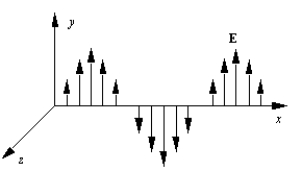
A)+y direction, in phase
B)-z direction, 90° out of phase
C)+z direction, 90° out of phase
D)-z direction, in phase
E)+z direction, in phase
A)+y direction, in phase
B)-z direction, 90° out of phase
C)+z direction, 90° out of phase
D)-z direction, in phase
E)+z direction, in phase
سؤال
سؤال
سؤال
سؤال
سؤال
سؤال
سؤال
سؤال
سؤال
A linearly polarized beam of light is incident upon a group of three polarizing sheets which are arranged so that the transmission axis of each sheet is rotated by 45° with respect to the preceding sheet as shown. What fraction of the incident intensity is transmitted? 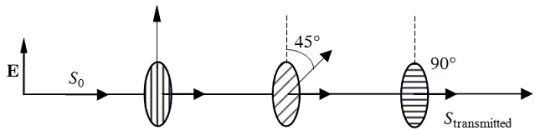
A)1/8
B)1/4
C)3/8
D)1/2
E)3/4
A)1/8
B)1/4
C)3/8
D)1/2
E)3/4
سؤال
سؤال
سؤال
Light emerges from a polarizer that has its transmission axis located along the x axis. The light then passes through two additional sheets of polarizing material. It is desired to orient the two sheets so that, after passing through both of them, the electromagnetic wave has the maximum possible intensity and is polarized 90° with respect to the x axis. How should the transmission axes of the sheets be oriented? Note: the following answers give the angles that the transmission axes make with respect to the x axis. 
A)
B)
C)
D)
E)
A)
B)
C)
D)
E)
سؤال
سؤال
سؤال
سؤال
سؤال
سؤال
سؤال
سؤال
سؤال
سؤال
Unpolarized light of intensity S0 passes through two sheets of polarizing material whose transmission axes make an angle of 60° with each other as shown in the figure. What is the intensity of the transmitted beam, ST? 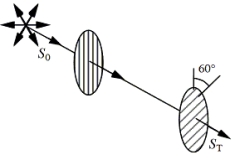
A)S0/4
B)S0/8
C)3S0/4
D)S0/16
E)zero
A)S0/4
B)S0/8
C)3S0/4
D)S0/16
E)zero
سؤال
سؤال
سؤال
سؤال
سؤال
The electromagnetic wave of the radiation field from a wire antenna travels toward the plane of your paper (which is in the -z direction). At time t = 0 s, the wave strikes your paper at normal incidence. The magnetic field vector at point O in the figure points in the -y direction and has a magnitude of 4.0 × 10⁻⁸ T. The frequency of the wave is 1.0 × 10¹⁶ Hz. 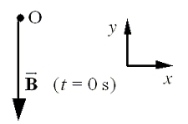
What is the magnitude of the magnetic field at point O at time t = 5.0 × 10⁻¹⁷ s?
A)1.0 × 10⁻⁸ T
B)2.0 × 10⁻⁸ T
C)3.0 × 10⁻⁸ T
D)4.0 × 10⁻⁸ T
E)5.0 × 10⁻⁸ T
What is the magnitude of the magnetic field at point O at time t = 5.0 × 10⁻¹⁷ s?
A)1.0 × 10⁻⁸ T
B)2.0 × 10⁻⁸ T
C)3.0 × 10⁻⁸ T
D)4.0 × 10⁻⁸ T
E)5.0 × 10⁻⁸ T
سؤال
سؤال
The electromagnetic wave of the radiation field from a wire antenna travels toward the plane of your paper (which is in the -z direction). At time t = 0 s, the wave strikes your paper at normal incidence. The magnetic field vector at point O in the figure points in the -y direction and has a magnitude of 4.0 × 10⁻⁸ T. The frequency of the wave is 1.0 × 10¹⁶ Hz.
What is the direction of polarization of this electromagnetic wave?
A)the x direction
B)the y direction
C)the z direction
D)45° with respect to the x direction
E)the wave is not polarized
What is the direction of polarization of this electromagnetic wave?
A)the x direction
B)the y direction
C)the z direction
D)45° with respect to the x direction
E)the wave is not polarized
سؤال
The figure shows the time variation of the magnitude of the electric field of an electromagnetic wave produced by a wire antenna. 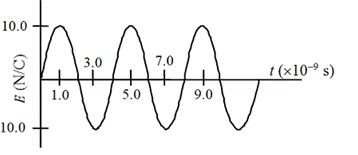
What is the rms value of the magnitude of the magnetic field?
A)1.4 × 10⁻⁸ T
B)2.4 × 10⁻⁸ T
C)3.3 × 10⁻⁸ T
D)4.6 × 10⁻⁸ T
E)5.4 × 10⁻⁸ T
What is the rms value of the magnitude of the magnetic field?
A)1.4 × 10⁻⁸ T
B)2.4 × 10⁻⁸ T
C)3.3 × 10⁻⁸ T
D)4.6 × 10⁻⁸ T
E)5.4 × 10⁻⁸ T
سؤال
The electromagnetic wave of the radiation field from a wire antenna travels toward the plane of your paper (which is in the -z direction). At time t = 0 s, the wave strikes your paper at normal incidence. The magnetic field vector at point O in the figure points in the -y direction and has a magnitude of 4.0 × 10⁻⁸ T. The frequency of the wave is 1.0 × 10¹⁶ Hz.
What is the intensity of the electromagnetic wave at time t = 0 s?
A)0.24 W/m2
B)0.38 W/m2
C)0.48 W/m2
D)0.76 W/m2
E)24 W/m2
What is the intensity of the electromagnetic wave at time t = 0 s?
A)0.24 W/m2
B)0.38 W/m2
C)0.48 W/m2
D)0.76 W/m2
E)24 W/m2
سؤال
A linearly polarized electromagnetic wave is sent through two sheets of polarizing material. The first sheet, A, is oriented so that its transmission axis makes an angle of 30° with respect to the incident electric field of the wave. The second sheet, B, is oriented so that its transmission axis makes an angle of 90° with the incident electric field of the wave. The incident beam has an electric field of peak magnitude E0 and average intensity S0. 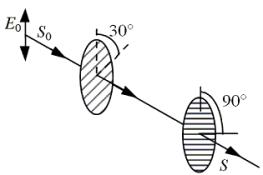
What is the average intensity of the wave after it passes through B?
A)0.19S0
B)0.34S0
C)0.43S0
D)0.50S0
E)zero
What is the average intensity of the wave after it passes through B?
A)0.19S0
B)0.34S0
C)0.43S0
D)0.50S0
E)zero
سؤال
The electromagnetic wave of the radiation field from a wire antenna travels toward the plane of your paper (which is in the -z direction). At time t = 0 s, the wave strikes your paper at normal incidence. The magnetic field vector at point O in the figure points in the -y direction and has a magnitude of 4.0 × 10⁻⁸ T. The frequency of the wave is 1.0 × 10¹⁶ Hz.
What is the magnitude of the associated electric field at time t = 0 s?
A)7.5 × 10⁻³ N/C
B)1.3 N/C
C)7.5 N/C
D)12 N/C
E)7.5 × 10⁴ N/C
What is the magnitude of the associated electric field at time t = 0 s?
A)7.5 × 10⁻³ N/C
B)1.3 N/C
C)7.5 N/C
D)12 N/C
E)7.5 × 10⁴ N/C
سؤال
The electromagnetic wave of the radiation field from a wire antenna travels toward the plane of your paper (which is in the -z direction). At time t = 0 s, the wave strikes your paper at normal incidence. The magnetic field vector at point O in the figure points in the -y direction and has a magnitude of 4.0 × 10⁻⁸ T. The frequency of the wave is 1.0 × 10¹⁶ Hz.
What is the rms value of the electric field? Assume that the figure shows the peak value of .
.
A)7.5 N/C
B)8.5 N/C
C)17 N/C
D)1.1 × 10⁴ N/C
E)8.5 × 10⁻³ N/C
What is the rms value of the electric field? Assume that the figure shows the peak value of
.A)7.5 N/C
B)8.5 N/C
C)17 N/C
D)1.1 × 10⁴ N/C
E)8.5 × 10⁻³ N/C
سؤال
The electromagnetic wave of the radiation field from a wire antenna travels toward the plane of your paper (which is in the -z direction). At time t = 0 s, the wave strikes your paper at normal incidence. The magnetic field vector at point O in the figure points in the -y direction and has a magnitude of 4.0 × 10⁻⁸ T. The frequency of the wave is 1.0 × 10¹⁶ Hz.
What is the direction of the electric field?
A)It points in the negative y direction.
B)It points in the positive y direction.
C)It points in the negative z direction.
D)It points in the negative x direction.
E)It points in the positive x direction.
What is the direction of the electric field?
A)It points in the negative y direction.
B)It points in the positive y direction.
C)It points in the negative z direction.
D)It points in the negative x direction.
E)It points in the positive x direction.
سؤال
The electromagnetic wave of the radiation field from a wire antenna travels toward the plane of your paper (which is in the -z direction). At time t = 0 s, the wave strikes your paper at normal incidence. The magnetic field vector at point O in the figure points in the -y direction and has a magnitude of 4.0 × 10⁻⁸ T. The frequency of the wave is 1.0 × 10¹⁶ Hz.
What is the wavelength of this electromagnetic wave?
A)0.33 nm
B)3.3 nm
C)20 nm
D)30 nm
E)40 nm
What is the wavelength of this electromagnetic wave?
A)0.33 nm
B)3.3 nm
C)20 nm
D)30 nm
E)40 nm
سؤال
The figure shows the time variation of the magnitude of the electric field of an electromagnetic wave produced by a wire antenna.
Determine the wavelength of the wave.
A)0.30 m
B)0.60 m
C)0.79 m
D)1.2 m
E)2.3 m
Determine the wavelength of the wave.
A)0.30 m
B)0.60 m
C)0.79 m
D)1.2 m
E)2.3 m
سؤال
The figure shows the time variation of the magnitude of the electric field of an electromagnetic wave produced by a wire antenna.
Determine the rms value of the electric field magnitude.
A)7.1 N/C
B)12 N/C
C)14 N/C
D)19 N/C
E)28 N/C
Determine the rms value of the electric field magnitude.
A)7.1 N/C
B)12 N/C
C)14 N/C
D)19 N/C
E)28 N/C
سؤال
The figure shows the time variation of the magnitude of the electric field of an electromagnetic wave produced by a wire antenna.
Determine the frequency of the wave.
A)1.0 × 10⁹ Hz
B)1.3 × 10⁸ Hz
C)2.5 × 10⁸ Hz
D)3.8 × 10⁸ Hz
E)5.0 × 10⁸ Hz
Determine the frequency of the wave.
A)1.0 × 10⁹ Hz
B)1.3 × 10⁸ Hz
C)2.5 × 10⁸ Hz
D)3.8 × 10⁸ Hz
E)5.0 × 10⁸ Hz
سؤال
The electromagnetic wave of the radiation field from a wire antenna travels toward the plane of your paper (which is in the -z direction). At time t = 0 s, the wave strikes your paper at normal incidence. The magnetic field vector at point O in the figure points in the -y direction and has a magnitude of 4.0 × 10⁻⁸ T. The frequency of the wave is 1.0 × 10¹⁶ Hz.
What is the direction of electromagnetic energy transport?
A)the positive x direction
B)the negative x direction
C)the positive y direction
D)the negative y direction
E)the negative z direction
What is the direction of electromagnetic energy transport?
A)the positive x direction
B)the negative x direction
C)the positive y direction
D)the negative y direction
E)the negative z direction
سؤال
The figure shows the time variation of the magnitude of the electric field of an electromagnetic wave produced by a wire antenna.
What is the peak value of the magnetic field?
A)1.4 × 10⁻⁸ T
B)2.3 × 10⁻⁸ T
C)3.3 × 10⁻⁸ T
D)4.6 × 10⁻⁸ T
E)5.4 × 10⁻⁸ T
What is the peak value of the magnetic field?
A)1.4 × 10⁻⁸ T
B)2.3 × 10⁻⁸ T
C)3.3 × 10⁻⁸ T
D)4.6 × 10⁻⁸ T
E)5.4 × 10⁻⁸ T
سؤال
The electromagnetic wave of the radiation field from a wire antenna travels toward the plane of your paper (which is in the -z direction). At time t = 0 s, the wave strikes your paper at normal incidence. The magnetic field vector at point O in the figure points in the -y direction and has a magnitude of 4.0 × 10⁻⁸ T. The frequency of the wave is 1.0 × 10¹⁶ Hz.
What is the rms value of the magnetic field? Assume that the figure shows the peak value of .
.
A)1.0 × 10⁻⁸ T
B)1.4 × 10⁻⁸ T
C)2.8 × 10⁻⁸ T
D)4.6 × 10⁻⁸ T
E)5.7 × 10⁻⁸ T
What is the rms value of the magnetic field? Assume that the figure shows the peak value of
.A)1.0 × 10⁻⁸ T
B)1.4 × 10⁻⁸ T
C)2.8 × 10⁻⁸ T
D)4.6 × 10⁻⁸ T
E)5.7 × 10⁻⁸ T
سؤال
A linearly polarized electromagnetic wave is sent through two sheets of polarizing material. The first sheet, A, is oriented so that its transmission axis makes an angle of 30° with respect to the incident electric field of the wave. The second sheet, B, is oriented so that its transmission axis makes an angle of 90° with the incident electric field of the wave. The incident beam has an electric field of peak magnitude E0 and average intensity S0.
What is the average intensity of the wave after it passes through A?
A)0.30S0
B)0.50S0
C)0.60S0
D)0.75S0
E)0.87S0
What is the average intensity of the wave after it passes through A?
A)0.30S0
B)0.50S0
C)0.60S0
D)0.75S0
E)0.87S0
سؤال
A linearly polarized electromagnetic wave is sent through two sheets of polarizing material. The first sheet, A, is oriented so that its transmission axis makes an angle of 30° with respect to the incident electric field of the wave. The second sheet, B, is oriented so that its transmission axis makes an angle of 90° with the incident electric field of the wave. The incident beam has an electric field of peak magnitude E0 and average intensity S0.
What is the peak value of the electric field amplitude after it goes through sheet A?
A)0.30E0
B)0.50E0
C)0.60E0
D)0.75E0
E)0.87E0
What is the peak value of the electric field amplitude after it goes through sheet A?
A)0.30E0
B)0.50E0
C)0.60E0
D)0.75E0
E)0.87E0
سؤال
سؤال
A linearly polarized electromagnetic wave is sent through two sheets of polarizing material. The first sheet, A, is oriented so that its transmission axis makes an angle of 30° with respect to the incident electric field of the wave. The second sheet, B, is oriented so that its transmission axis makes an angle of 90° with the incident electric field of the wave. The incident beam has an electric field of peak magnitude E0 and average intensity S0.
Suppose that A and B are interchanged so that the wave is first incident upon B. What is the average wave intensity after passing through both polarizing sheets?
A)0.19S0
B)0.34S0
C)0.43S0
D)0.50S0
E)zero
Suppose that A and B are interchanged so that the wave is first incident upon B. What is the average wave intensity after passing through both polarizing sheets?
A)0.19S0
B)0.34S0
C)0.43S0
D)0.50S0
E)zero
سؤال
The figure shows the time variation of the magnitude of the electric field of an electromagnetic wave produced by a wire antenna.
What is the magnitude of the electric field at t = 3.34 × 10⁻¹⁰ s?
A)2.0 N/C
B)5.0 N/C
C)7.1 N/C
D)10.0 N/C
E)zero N/C
What is the magnitude of the electric field at t = 3.34 × 10⁻¹⁰ s?
A)2.0 N/C
B)5.0 N/C
C)7.1 N/C
D)10.0 N/C
E)zero N/C
سؤال
The figure shows the time variation of the magnitude of the electric field of an electromagnetic wave produced by a wire antenna.
What is the average intensity of this electromagnetic wave?
A)0.13 W/m2
B)0.26 W/m2
C)0.33 W/m2
D)0.36 W/m2
E)0.54 W/m2
What is the average intensity of this electromagnetic wave?
A)0.13 W/m2
B)0.26 W/m2
C)0.33 W/m2
D)0.36 W/m2
E)0.54 W/m2
سؤال
The figure shows the time variation of the magnitude of the electric field of an electromagnetic wave produced by a wire antenna.
To which region of the electromagnetic spectrum does this wave belong?
A)X-rays
B)gamma rays
C)visible light
D)infrared radiation
E)radio waves
To which region of the electromagnetic spectrum does this wave belong?
A)X-rays
B)gamma rays
C)visible light
D)infrared radiation
E)radio waves
سؤال
The figure shows the time variation of the magnitude of the electric field of an electromagnetic wave produced by a wire antenna.
What is the average total energy density of this electromagnetic wave?
A)6.2 × 10⁻¹¹ J/m3
B)8.6 × 10⁻¹¹ J/m3
C)1.1 × 10⁻¹⁰ J/m3
D)1.8 × 10⁻¹⁰ J/m3
E)4.4 × 10⁻¹⁰ J/m3
What is the average total energy density of this electromagnetic wave?
A)6.2 × 10⁻¹¹ J/m3
B)8.6 × 10⁻¹¹ J/m3
C)1.1 × 10⁻¹⁰ J/m3
D)1.8 × 10⁻¹⁰ J/m3
E)4.4 × 10⁻¹⁰ J/m3
سؤال
The figure shows the time variation of the magnitude of the electric field of an electromagnetic wave produced by a wire antenna.
What is the magnitude of the magnetic field at t = 6.67 × 10⁻¹⁰ s?
A)1.7 × 10⁻⁸ T
B)2.3 × 10⁻⁸ T
C)2.9 × 10⁻⁸ T
D)3.3 × 10⁻⁸ T
E)zero tesla
What is the magnitude of the magnetic field at t = 6.67 × 10⁻¹⁰ s?
A)1.7 × 10⁻⁸ T
B)2.3 × 10⁻⁸ T
C)2.9 × 10⁻⁸ T
D)3.3 × 10⁻⁸ T
E)zero tesla
سؤال
The figure shows the time variation of the magnitude of the electric field of an electromagnetic wave produced by a wire antenna.
What is the magnitude of the magnetic field at t = 6.0 × 10⁻⁹ s?
A)1.7 × 10⁻⁸ T
B)2.3 × 10⁻⁸ T
C)2.8 × 10⁻⁸ T
D)3.3 × 10⁻⁸ T
E)zero tesla
What is the magnitude of the magnetic field at t = 6.0 × 10⁻⁹ s?
A)1.7 × 10⁻⁸ T
B)2.3 × 10⁻⁸ T
C)2.8 × 10⁻⁸ T
D)3.3 × 10⁻⁸ T
E)zero tesla

فتح الحزمة
قم بالتسجيل لفتح البطاقات في هذه المجموعة!
Unlock Deck
Unlock Deck
1/66

العب

ملء الشاشة (f)
Deck 24: Electromagnetic Waves
1
Complete the following sentence: When electrons from a heated filament accelerate through vacuum toward a positive plate,
A)only an electric field will be produced.
B)only a magnetic field will be produced.
C)electromagnetic waves will be produced.
D)longitudinal waves will be produced.
E)neither electric nor magnetic fields will be produced.
A)only an electric field will be produced.
B)only a magnetic field will be produced.
C)electromagnetic waves will be produced.
D)longitudinal waves will be produced.
E)neither electric nor magnetic fields will be produced.
electromagnetic waves will be produced.
2
When a radio telescope observes a region of space between two stars, it detects electromagnetic radiation that has a wavelength of 0.21 m. This radiation was emitted by hydrogen atoms in the gas and dust located in that region. What is the frequency of this radiation?
A)7.1 × 10¹⁰ Hz
B)2.1 × 10¹⁴ Hz
C)3.0 × 10⁸ Hz
D)6.9 × 10¹¹ Hz
E)1.4 × 10⁹ Hz
A)7.1 × 10¹⁰ Hz
B)2.1 × 10¹⁴ Hz
C)3.0 × 10⁸ Hz
D)6.9 × 10¹¹ Hz
E)1.4 × 10⁹ Hz
1.4 × 10⁹ Hz
3
Which one of the following colors of visible light has the highest frequency?
A)yellow
B)red
C)green
D)blue
E)violet
A)yellow
B)red
C)green
D)blue
E)violet
violet
4
Which one of the following will not generate electromagnetic waves or pulses?
A)a steady direct current
B)an accelerating electron
C)a proton in simple harmonic motion
D)an alternating current
E)charged particles traveling in a circular path in a mass spectrometer
A)a steady direct current
B)an accelerating electron
C)a proton in simple harmonic motion
D)an alternating current
E)charged particles traveling in a circular path in a mass spectrometer
فتح الحزمة
افتح القفل للوصول البطاقات البالغ عددها 66 في هذه المجموعة.
فتح الحزمة
k this deck
5
The average distance between the surface of the earth and the surface of the sun is 1.49 × 10¹¹ m. How much time, in minutes, does it take light leaving the surface of the sun to reach the earth?
A)zero minutes
B)2.9 × 10⁻³ min
C)8.3 min
D)74 min
E)500 min
A)zero minutes
B)2.9 × 10⁻³ min
C)8.3 min
D)74 min
E)500 min
فتح الحزمة
افتح القفل للوصول البطاقات البالغ عددها 66 في هذه المجموعة.
فتح الحزمة
k this deck
6
A distant space probe is programmed to emit a radio signal toward Earth at regular time intervals. One such pulse arrives on Earth 6.92 s after it is emitted from the probe. What is the approximate distance from the Earth to the probe?
A)8.76 × 10⁹ m
B)7.40 × 10¹⁰ m
C)6.94 × 10⁹ m
D)2.08 × 10⁹ m
E)3.50 × 10¹⁰ m
A)8.76 × 10⁹ m
B)7.40 × 10¹⁰ m
C)6.94 × 10⁹ m
D)2.08 × 10⁹ m
E)3.50 × 10¹⁰ m
فتح الحزمة
افتح القفل للوصول البطاقات البالغ عددها 66 في هذه المجموعة.
فتح الحزمة
k this deck
7
Which one of the following wavelengths is in the infrared range of the electromagnetic spectrum?
A)100 mm
B)400 nm
C)400 m
D)2 × 10-15 m
E)20 µm
A)100 mm
B)400 nm
C)400 m
D)2 × 10-15 m
E)20 µm
فتح الحزمة
افتح القفل للوصول البطاقات البالغ عددها 66 في هذه المجموعة.
فتح الحزمة
k this deck
8
An FM radio station generates radio waves that have a frequency of 101.3 MHz. The frequency of the waves from a competing station have a frequency of 107.1 MHz. What is the difference in wavelength between the waves emitted from the two stations?
A)0.22 m
B)0.45 m
C)0.84 m
D)2.4 m
E)0.16 m
A)0.22 m
B)0.45 m
C)0.84 m
D)2.4 m
E)0.16 m
فتح الحزمة
افتح القفل للوصول البطاقات البالغ عددها 66 في هذه المجموعة.
فتح الحزمة
k this deck
9
Which one of the following statements concerning electromagnetic waves is false?
A)Electromagnetic waves carry energy.
B)X-rays have longer wavelengths than radio waves.
C)In vacuum, all electromagnetic waves travel at the same speed.
D)Lower frequency electromagnetic waves can be produced by oscillating circuits.
E)They consist of mutually perpendicular electric and magnetic fields that oscillate perpendicular to the direction of propagation.
A)Electromagnetic waves carry energy.
B)X-rays have longer wavelengths than radio waves.
C)In vacuum, all electromagnetic waves travel at the same speed.
D)Lower frequency electromagnetic waves can be produced by oscillating circuits.
E)They consist of mutually perpendicular electric and magnetic fields that oscillate perpendicular to the direction of propagation.
فتح الحزمة
افتح القفل للوصول البطاقات البالغ عددها 66 في هذه المجموعة.
فتح الحزمة
k this deck
10
Which one of the following scientists did not attempt to measure the speed of light?
A)Galileo
B)Maxwell
C)Fizeau
D)Foucault
E)Michelson
A)Galileo
B)Maxwell
C)Fizeau
D)Foucault
E)Michelson
فتح الحزمة
افتح القفل للوصول البطاقات البالغ عددها 66 في هذه المجموعة.
فتح الحزمة
k this deck
11
Note the different types of electromagnetic radiation: Which list correctly ranks the electromagnetic waves in order of increasing frequency?
A)2, 3, 4, 5, 6, 1
B)2, 5, 4, 1, 6, 3
C)2, 5, 4, 6, 1, 3
D)3, 1, 6, 4, 5, 2
E)3, 6, 1, 4, 5, 2
Which list correctly ranks the electromagnetic waves in order of increasing frequency?A)2, 3, 4, 5, 6, 1
B)2, 5, 4, 1, 6, 3
C)2, 5, 4, 6, 1, 3
D)3, 1, 6, 4, 5, 2
E)3, 6, 1, 4, 5, 2
فتح الحزمة
افتح القفل للوصول البطاقات البالغ عددها 66 في هذه المجموعة.
فتح الحزمة
k this deck
12
Complete the following sentence: The various colors of visible light differ in
A)frequency only.
B)wavelength only.
C)their speeds in a vacuum.
D)both frequency and wavelength.
E)both frequency and their speed in a vacuum.
A)frequency only.
B)wavelength only.
C)their speeds in a vacuum.
D)both frequency and wavelength.
E)both frequency and their speed in a vacuum.
فتح الحزمة
افتح القفل للوصول البطاقات البالغ عددها 66 في هذه المجموعة.
فتح الحزمة
k this deck
13
Which one of the following types of wave is fundamentally different than the other four?
A)radio waves
B)sound waves
C)gamma rays
D)ultraviolet radiation
E)visible light
A)radio waves
B)sound waves
C)gamma rays
D)ultraviolet radiation
E)visible light
فتح الحزمة
افتح القفل للوصول البطاقات البالغ عددها 66 في هذه المجموعة.
فتح الحزمة
k this deck
14
The electric field E of an electromagnetic wave traveling the positive x direction is illustrated in the figure. This is the wave of the radiation field of an antenna. What are the direction and the phase relative to the electric field of the magnetic field at a point where the electric field is in the negative y direction? Note: The wave is shown in a region of space that is a large distance from its source.
A)+y direction, in phase
B)-z direction, 90° out of phase
C)+z direction, 90° out of phase
D)-z direction, in phase
E)+z direction, in phase
A)+y direction, in phase
B)-z direction, 90° out of phase
C)+z direction, 90° out of phase
D)-z direction, in phase
E)+z direction, in phase
فتح الحزمة
افتح القفل للوصول البطاقات البالغ عددها 66 في هذه المجموعة.
فتح الحزمة
k this deck
15
A radio wave sent from the surface of the earth reflects from the surface of the moon and returns to the earth. The elapsed time between the generation of the wave and the detection of the reflected wave is 2.6444 s. Determine the distance from the surface of the earth to the surface of the moon. Note: The speed of light is 2.9979 × 10⁸ m/s.
A)3.7688 × 10⁸ m
B)3.8445 × 10⁸ m
C)3.9638 × 10⁸ m
D)4.0551 × 10⁸ m
E)7.9276 × 10⁸ m
A)3.7688 × 10⁸ m
B)3.8445 × 10⁸ m
C)3.9638 × 10⁸ m
D)4.0551 × 10⁸ m
E)7.9276 × 10⁸ m
فتح الحزمة
افتح القفل للوصول البطاقات البالغ عددها 66 في هذه المجموعة.
فتح الحزمة
k this deck
16
Which one of the following statements concerning the wavelength of an electromagnetic wave in a vacuum is true?
A)The wavelength is independent of the speed of the wave for a fixed frequency.
B)The wavelength is inversely proportional to the speed of the wave.
C)The wavelength is the same for all types of electromagnetic waves.
D)The wavelength is directly proportional to the frequency of the wave.
E)The wavelength is inversely proportional to the frequency of the wave.
A)The wavelength is independent of the speed of the wave for a fixed frequency.
B)The wavelength is inversely proportional to the speed of the wave.
C)The wavelength is the same for all types of electromagnetic waves.
D)The wavelength is directly proportional to the frequency of the wave.
E)The wavelength is inversely proportional to the frequency of the wave.
فتح الحزمة
افتح القفل للوصول البطاقات البالغ عددها 66 في هذه المجموعة.
فتح الحزمة
k this deck
17
Which one of the following statements concerning electromagnetic waves is false?
A)Electromagnetic waves are longitudinal waves.
B)Electromagnetic waves transfer energy through space.
C)The existence of electromagnetic waves was predicted by Maxwell.
D)Electromagnetic waves can propagate through a material substance.
E)Electromagnetic waves do not require a physical medium for propagation.
A)Electromagnetic waves are longitudinal waves.
B)Electromagnetic waves transfer energy through space.
C)The existence of electromagnetic waves was predicted by Maxwell.
D)Electromagnetic waves can propagate through a material substance.
E)Electromagnetic waves do not require a physical medium for propagation.
فتح الحزمة
افتح القفل للوصول البطاقات البالغ عددها 66 في هذه المجموعة.
فتح الحزمة
k this deck
18
What is the correct order, beginning with shortest wavelength and extending to the longest wavelength, of the following colors in the visible light spectrum: blue, green, red, violet, and yellow?
A)red, yellow, blue, green, violet
B)violet, blue, yellow, red, green
C)red, yellow, green, blue, violet
D)violet, blue, green, yellow, red
E)red, blue, violet, green, yellow
A)red, yellow, blue, green, violet
B)violet, blue, yellow, red, green
C)red, yellow, green, blue, violet
D)violet, blue, green, yellow, red
E)red, blue, violet, green, yellow
فتح الحزمة
افتح القفل للوصول البطاقات البالغ عددها 66 في هذه المجموعة.
فتح الحزمة
k this deck
19
In 1980, a television station began broadcasting on channel 32 at a frequency of 582 MHz. The circuit contains an inductor with an inductance L = 4.15 × 10⁻⁴ H and a variable-capacitance C. Determine the value of C that allows this television station to be tuned in.
A)2.92 × 10⁻¹² F
B)5.84 × 10⁻¹² F
C)1.80 × 10⁻¹² F
D)3.61 × 10⁻¹¹ F
E)1.10 × 10⁻¹¹ F
A)2.92 × 10⁻¹² F
B)5.84 × 10⁻¹² F
C)1.80 × 10⁻¹² F
D)3.61 × 10⁻¹¹ F
E)1.10 × 10⁻¹¹ F
فتح الحزمة
افتح القفل للوصول البطاقات البالغ عددها 66 في هذه المجموعة.
فتح الحزمة
k this deck
20
A cellular telephone transmits electromagnetic waves at a frequency of 835 MHz. What is the wavelength of these waves?
A)0.0146 m
B)0.359 m
C)0.842 m
D)1.62 m
E)2.47 m
A)0.0146 m
B)0.359 m
C)0.842 m
D)1.62 m
E)2.47 m
فتح الحزمة
افتح القفل للوصول البطاقات البالغ عددها 66 في هذه المجموعة.
فتح الحزمة
k this deck
21
Linearly polarized light is incident of a sheet of polarizing material. The angle between the transmission axis and the incident electric field is 44°. What percentage of the incident intensity is transmitted?
A)38 %
B)43 %
C)52 %
D)72 %
E)84 %
A)38 %
B)43 %
C)52 %
D)72 %
E)84 %
فتح الحزمة
افتح القفل للوصول البطاقات البالغ عددها 66 في هذه المجموعة.
فتح الحزمة
k this deck
22
An incandescent light bulb radiates uniformly in all directions with a total average power of 1.0 × 10² W. What is the maximum value of the magnetic field at a distance of 0.50 m from the bulb?
A)8.4 × 10⁻⁷ T
B)5.2 × 10⁻⁷ T
C)3.1 × 10⁻⁷ T
D)1.6 × 10⁻⁷ T
E)zero tesla
A)8.4 × 10⁻⁷ T
B)5.2 × 10⁻⁷ T
C)3.1 × 10⁻⁷ T
D)1.6 × 10⁻⁷ T
E)zero tesla
فتح الحزمة
افتح القفل للوصول البطاقات البالغ عددها 66 في هذه المجموعة.
فتح الحزمة
k this deck
23
A linearly polarized beam of light is incident upon a group of three polarizing sheets which are arranged so that the transmission axis of each sheet is rotated by 45° with respect to the preceding sheet as shown. What fraction of the incident intensity is transmitted?
A)1/8
B)1/4
C)3/8
D)1/2
E)3/4
A)1/8
B)1/4
C)3/8
D)1/2
E)3/4
فتح الحزمة
افتح القفل للوصول البطاقات البالغ عددها 66 في هذه المجموعة.
فتح الحزمة
k this deck
24
Two polarizing sheets have their transmission axes parallel so that the intensity of unpolarized light transmitted through both of them is a maximum. Through what angle must either sheet be rotated if the transmitted intensity is 25 % of the incident intensity?
A)15°
B)30°
C)45°
D)60°
E)75°
A)15°
B)30°
C)45°
D)60°
E)75°
فتح الحزمة
افتح القفل للوصول البطاقات البالغ عددها 66 في هذه المجموعة.
فتح الحزمة
k this deck
25
The peak value of the electric field component of an electromagnetic wave is E. At a particular instant, the intensity of the wave is of 0.020 W/m2. If the electric field were increased to 5E, what would be the intensity of the wave?
A)0.020 W/m2
B)0.10 W/m2
C)0.25 W/m2
D)0.50 W/m2
E)1.0 W/m2
A)0.020 W/m2
B)0.10 W/m2
C)0.25 W/m2
D)0.50 W/m2
E)1.0 W/m2
فتح الحزمة
افتح القفل للوصول البطاقات البالغ عددها 66 في هذه المجموعة.
فتح الحزمة
k this deck
26
Light emerges from a polarizer that has its transmission axis located along the x axis. The light then passes through two additional sheets of polarizing material. It is desired to orient the two sheets so that, after passing through both of them, the electromagnetic wave has the maximum possible intensity and is polarized 90° with respect to the x axis. How should the transmission axes of the sheets be oriented? Note: the following answers give the angles that the transmission axes make with respect to the x axis.
A)
B)
C)
D)
E)
A)
B)
C)
D)
E)
فتح الحزمة
افتح القفل للوصول البطاقات البالغ عددها 66 في هذه المجموعة.
فتح الحزمة
k this deck
27
The amplitude of the electric field component of an electromagnetic wave is increased from E to 3E. What is the corresponding change in the intensity of the wave?
A)The intensity is unchanged by the increase in E.
B)The intensity increases by a factor of nine.
C)The intensity increases by a factor of three.
D)The intensity decreases by a factor of three.
E)The intensity decreases by a factor of nine.
A)The intensity is unchanged by the increase in E.
B)The intensity increases by a factor of nine.
C)The intensity increases by a factor of three.
D)The intensity decreases by a factor of three.
E)The intensity decreases by a factor of nine.
فتح الحزمة
افتح القفل للوصول البطاقات البالغ عددها 66 في هذه المجموعة.
فتح الحزمة
k this deck
28
The magnitude of the magnetic field component of a plane polarized electromagnetic wave traveling in vacuum is given by By = Bo sin[k z - t]. Which one of the following statements concerning this electromagnetic wave is true?
A)The wavelength is equal to k/ .
B)The wave propagates in the y direction.
C)The wave is polarized in the x direction.
D)The electric field component vibrates in the z direction.
E)The electric field component has a magnitude of E = cBo cos[k z - t].
A)The wavelength is equal to k/ .
B)The wave propagates in the y direction.
C)The wave is polarized in the x direction.
D)The electric field component vibrates in the z direction.
E)The electric field component has a magnitude of E = cBo cos[k z - t].
فتح الحزمة
افتح القفل للوصول البطاقات البالغ عددها 66 في هذه المجموعة.
فتح الحزمة
k this deck
29
An electromagnetic wave has an electric field with peak value 250.0 N/C. What is the average energy delivered to a surface with area 0.75 m2 by this wave in one hour?
A)8.3 × 10⁴ J
B)1.6 × 10⁵ J166 J
C)2.2 × 10⁵ J
D)3700 J
E)9960 J
A)8.3 × 10⁴ J
B)1.6 × 10⁵ J166 J
C)2.2 × 10⁵ J
D)3700 J
E)9960 J
فتح الحزمة
افتح القفل للوصول البطاقات البالغ عددها 66 في هذه المجموعة.
فتح الحزمة
k this deck
30
A laser uniformly illuminates an area with green light that has an average intensity of 550 W/m2. What is the rms value of the electric field of this light?
A)322 N/C
B)405 N/C
C)455 N/C
D)643 N/C
E)891 N/C
A)322 N/C
B)405 N/C
C)455 N/C
D)643 N/C
E)891 N/C
فتح الحزمة
افتح القفل للوصول البطاقات البالغ عددها 66 في هذه المجموعة.
فتح الحزمة
k this deck
31
Electromagnetic waves are radiated uniformly in all directions from a source. The rms electric field of the waves is measured 35 km from the source to have an rms value of 0.012 N/C. Determine the average total power radiated by the source.
A)5.9 × 10³ W
B)9.0 × 10³ W
C)2.4 × 10⁴ W
D)6.3 × 10⁴ W
E)1.6 × 10⁵ W
A)5.9 × 10³ W
B)9.0 × 10³ W
C)2.4 × 10⁴ W
D)6.3 × 10⁴ W
E)1.6 × 10⁵ W
فتح الحزمة
افتح القفل للوصول البطاقات البالغ عددها 66 في هذه المجموعة.
فتح الحزمة
k this deck
32
An astronomer observes electromagnetic waves emitted by oxygen atoms in a distant galaxy that have a frequency of 5.710 × 10¹⁴ Hz. In the laboratory on earth, oxygen atoms emit waves that have a frequency of 5.841 × 10¹⁴ Hz. Determine the relative velocity of the galaxy with respect to the astronomer on the earth. Note: The speed of light is 2.9979 × 10⁸ m/s.
A)6.724 × 10⁶ m/s, away from earth
B)6.724 × 10⁶ m/s, toward earth
C)2.931 × 10⁸ m/s, away from earth
D)4.369 × 10⁴ m/s, toward earth
E)4.369 × 10⁴ m/s, away from earth
A)6.724 × 10⁶ m/s, away from earth
B)6.724 × 10⁶ m/s, toward earth
C)2.931 × 10⁸ m/s, away from earth
D)4.369 × 10⁴ m/s, toward earth
E)4.369 × 10⁴ m/s, away from earth
فتح الحزمة
افتح القفل للوصول البطاقات البالغ عددها 66 في هذه المجموعة.
فتح الحزمة
k this deck
33
Unpolarized light with an average intensity of 845 W/m2 enters a polarizer with a vertical transmission axis. The transmitted light then enters a second polarizer. The light that exits the second polarizer is found to have an average intensity of 225 W/m2. What is the orientation angle of the second polarizer relative to the first one?
A)54.7°
B)22.6°
C)43.1°
D)77.3°
E)zero degrees
A)54.7°
B)22.6°
C)43.1°
D)77.3°
E)zero degrees
فتح الحزمة
افتح القفل للوصول البطاقات البالغ عددها 66 في هذه المجموعة.
فتح الحزمة
k this deck
34
What would the speed of an observer be if a red (4.688 × 10¹⁴ Hz) traffic light appeared green (5.555 × 10¹⁴ Hz) to the observer?
A)4.445 × 10⁸ m/s
B)2.219 × 10⁸ m/s
C)8.438 × 10⁷ m/s
D)5.548 × 10⁷ m/s
E)2.890 × 10⁶ m/s
A)4.445 × 10⁸ m/s
B)2.219 × 10⁸ m/s
C)8.438 × 10⁷ m/s
D)5.548 × 10⁷ m/s
E)2.890 × 10⁶ m/s
فتح الحزمة
افتح القفل للوصول البطاقات البالغ عددها 66 في هذه المجموعة.
فتح الحزمة
k this deck
35
An electromagnetic wave has an electric field with a peak value of 250 N/C. What is the average intensity of the wave?
A)0.66 W/m2
B)0.89 W/m2
C)83 W/m2
D)120 W/m2
E)170 W/m2
A)0.66 W/m2
B)0.89 W/m2
C)83 W/m2
D)120 W/m2
E)170 W/m2
فتح الحزمة
افتح القفل للوصول البطاقات البالغ عددها 66 في هذه المجموعة.
فتح الحزمة
k this deck
36
Unpolarized light of intensity S0 passes through two sheets of polarizing material whose transmission axes make an angle of 60° with each other as shown in the figure. What is the intensity of the transmitted beam, ST?
A)S0/4
B)S0/8
C)3S0/4
D)S0/16
E)zero
A)S0/4
B)S0/8
C)3S0/4
D)S0/16
E)zero
فتح الحزمة
افتح القفل للوصول البطاقات البالغ عددها 66 في هذه المجموعة.
فتح الحزمة
k this deck
37
A local radio station transmits radio waves uniformly in all directions with a total power of 7.50 × 10⁴ W. What is the intensity of these waves when they reach a receiving antenna located 20.0 km from the transmitting antenna?
A)1.49 × 10⁻⁵ W/m2
B)5.96 × 10⁻⁵ W/m2
C)3.73 × 10⁻⁶ W/m2
D)1.17 × 10⁻⁷ W/m2
E)5.60 × 10⁻⁸ W/m2
A)1.49 × 10⁻⁵ W/m2
B)5.96 × 10⁻⁵ W/m2
C)3.73 × 10⁻⁶ W/m2
D)1.17 × 10⁻⁷ W/m2
E)5.60 × 10⁻⁸ W/m2
فتح الحزمة
افتح القفل للوصول البطاقات البالغ عددها 66 في هذه المجموعة.
فتح الحزمة
k this deck
38
The most convincing evidence that electromagnetic waves are transverse waves is that
A)they can be polarized.
B)they carry energy through space.
C)they can travel through a material substance.
D)they do not require a physical medium for propagation.
E)all electromagnetic waves travel with the same speed through vacuum.
A)they can be polarized.
B)they carry energy through space.
C)they can travel through a material substance.
D)they do not require a physical medium for propagation.
E)all electromagnetic waves travel with the same speed through vacuum.
فتح الحزمة
افتح القفل للوصول البطاقات البالغ عددها 66 في هذه المجموعة.
فتح الحزمة
k this deck
39
Which one of the following statements concerning the energy carried by an electromagnetic wave is true?
A)The energy is carried only by the electric field.
B)More energy is carried by the electric field than by the magnetic field.
C)The energy is carried equally by the electric and magnetic fields.
D)More energy is carried by the magnetic field than by the electric field.
E)The energy is carried only by the magnetic field.
A)The energy is carried only by the electric field.
B)More energy is carried by the electric field than by the magnetic field.
C)The energy is carried equally by the electric and magnetic fields.
D)More energy is carried by the magnetic field than by the electric field.
E)The energy is carried only by the magnetic field.
فتح الحزمة
افتح القفل للوصول البطاقات البالغ عددها 66 في هذه المجموعة.
فتح الحزمة
k this deck
40
A minivan moving at 38 m/s passes an unmarked state police car moving at 24 m/s. The electromagnetic waves produced by the radar gun in the police car have a frequency of 8.25 × 10⁹ Hz. What is the magnitude of the difference in frequency between the waves emitted by the gun and those that are reflected back from the speeding minivan?
A)180 Hz
B)390 Hz
C)770 Hz
D)1440 Hz
E)2100 Hz
A)180 Hz
B)390 Hz
C)770 Hz
D)1440 Hz
E)2100 Hz
فتح الحزمة
افتح القفل للوصول البطاقات البالغ عددها 66 في هذه المجموعة.
فتح الحزمة
k this deck
41
The electromagnetic wave of the radiation field from a wire antenna travels toward the plane of your paper (which is in the -z direction). At time t = 0 s, the wave strikes your paper at normal incidence. The magnetic field vector at point O in the figure points in the -y direction and has a magnitude of 4.0 × 10⁻⁸ T. The frequency of the wave is 1.0 × 10¹⁶ Hz.
What is the magnitude of the magnetic field at point O at time t = 5.0 × 10⁻¹⁷ s?
A)1.0 × 10⁻⁸ T
B)2.0 × 10⁻⁸ T
C)3.0 × 10⁻⁸ T
D)4.0 × 10⁻⁸ T
E)5.0 × 10⁻⁸ T
What is the magnitude of the magnetic field at point O at time t = 5.0 × 10⁻¹⁷ s?
A)1.0 × 10⁻⁸ T
B)2.0 × 10⁻⁸ T
C)3.0 × 10⁻⁸ T
D)4.0 × 10⁻⁸ T
E)5.0 × 10⁻⁸ T
فتح الحزمة
افتح القفل للوصول البطاقات البالغ عددها 66 في هذه المجموعة.
فتح الحزمة
k this deck
42
Linearly polarized light is incident upon a polarizing sheet that has a transmission axis is parallel to the incident light. The sheet is rotated about its axis through 360° (one complete revolution). At how many positions, including the initial and final positions, will the transmitted intensity be a maximum?
A)6
B)5
C)4
D)3
E)2
A)6
B)5
C)4
D)3
E)2
فتح الحزمة
افتح القفل للوصول البطاقات البالغ عددها 66 في هذه المجموعة.
فتح الحزمة
k this deck
43
The electromagnetic wave of the radiation field from a wire antenna travels toward the plane of your paper (which is in the -z direction). At time t = 0 s, the wave strikes your paper at normal incidence. The magnetic field vector at point O in the figure points in the -y direction and has a magnitude of 4.0 × 10⁻⁸ T. The frequency of the wave is 1.0 × 10¹⁶ Hz.
What is the direction of polarization of this electromagnetic wave?
A)the x direction
B)the y direction
C)the z direction
D)45° with respect to the x direction
E)the wave is not polarized
What is the direction of polarization of this electromagnetic wave?
A)the x direction
B)the y direction
C)the z direction
D)45° with respect to the x direction
E)the wave is not polarized
فتح الحزمة
افتح القفل للوصول البطاقات البالغ عددها 66 في هذه المجموعة.
فتح الحزمة
k this deck
44
The figure shows the time variation of the magnitude of the electric field of an electromagnetic wave produced by a wire antenna.
What is the rms value of the magnitude of the magnetic field?
A)1.4 × 10⁻⁸ T
B)2.4 × 10⁻⁸ T
C)3.3 × 10⁻⁸ T
D)4.6 × 10⁻⁸ T
E)5.4 × 10⁻⁸ T
What is the rms value of the magnitude of the magnetic field?
A)1.4 × 10⁻⁸ T
B)2.4 × 10⁻⁸ T
C)3.3 × 10⁻⁸ T
D)4.6 × 10⁻⁸ T
E)5.4 × 10⁻⁸ T
فتح الحزمة
افتح القفل للوصول البطاقات البالغ عددها 66 في هذه المجموعة.
فتح الحزمة
k this deck
45
The electromagnetic wave of the radiation field from a wire antenna travels toward the plane of your paper (which is in the -z direction). At time t = 0 s, the wave strikes your paper at normal incidence. The magnetic field vector at point O in the figure points in the -y direction and has a magnitude of 4.0 × 10⁻⁸ T. The frequency of the wave is 1.0 × 10¹⁶ Hz.
What is the intensity of the electromagnetic wave at time t = 0 s?
A)0.24 W/m2
B)0.38 W/m2
C)0.48 W/m2
D)0.76 W/m2
E)24 W/m2
What is the intensity of the electromagnetic wave at time t = 0 s?
A)0.24 W/m2
B)0.38 W/m2
C)0.48 W/m2
D)0.76 W/m2
E)24 W/m2
فتح الحزمة
افتح القفل للوصول البطاقات البالغ عددها 66 في هذه المجموعة.
فتح الحزمة
k this deck
46
A linearly polarized electromagnetic wave is sent through two sheets of polarizing material. The first sheet, A, is oriented so that its transmission axis makes an angle of 30° with respect to the incident electric field of the wave. The second sheet, B, is oriented so that its transmission axis makes an angle of 90° with the incident electric field of the wave. The incident beam has an electric field of peak magnitude E0 and average intensity S0.
What is the average intensity of the wave after it passes through B?
A)0.19S0
B)0.34S0
C)0.43S0
D)0.50S0
E)zero
What is the average intensity of the wave after it passes through B?
A)0.19S0
B)0.34S0
C)0.43S0
D)0.50S0
E)zero
فتح الحزمة
افتح القفل للوصول البطاقات البالغ عددها 66 في هذه المجموعة.
فتح الحزمة
k this deck
47
The electromagnetic wave of the radiation field from a wire antenna travels toward the plane of your paper (which is in the -z direction). At time t = 0 s, the wave strikes your paper at normal incidence. The magnetic field vector at point O in the figure points in the -y direction and has a magnitude of 4.0 × 10⁻⁸ T. The frequency of the wave is 1.0 × 10¹⁶ Hz.
What is the magnitude of the associated electric field at time t = 0 s?
A)7.5 × 10⁻³ N/C
B)1.3 N/C
C)7.5 N/C
D)12 N/C
E)7.5 × 10⁴ N/C
What is the magnitude of the associated electric field at time t = 0 s?
A)7.5 × 10⁻³ N/C
B)1.3 N/C
C)7.5 N/C
D)12 N/C
E)7.5 × 10⁴ N/C
فتح الحزمة
افتح القفل للوصول البطاقات البالغ عددها 66 في هذه المجموعة.
فتح الحزمة
k this deck
48
The electromagnetic wave of the radiation field from a wire antenna travels toward the plane of your paper (which is in the -z direction). At time t = 0 s, the wave strikes your paper at normal incidence. The magnetic field vector at point O in the figure points in the -y direction and has a magnitude of 4.0 × 10⁻⁸ T. The frequency of the wave is 1.0 × 10¹⁶ Hz.
What is the rms value of the electric field? Assume that the figure shows the peak value of .
A)7.5 N/C
B)8.5 N/C
C)17 N/C
D)1.1 × 10⁴ N/C
E)8.5 × 10⁻³ N/C
What is the rms value of the electric field? Assume that the figure shows the peak value of
.A)7.5 N/C
B)8.5 N/C
C)17 N/C
D)1.1 × 10⁴ N/C
E)8.5 × 10⁻³ N/C
فتح الحزمة
افتح القفل للوصول البطاقات البالغ عددها 66 في هذه المجموعة.
فتح الحزمة
k this deck
49
The electromagnetic wave of the radiation field from a wire antenna travels toward the plane of your paper (which is in the -z direction). At time t = 0 s, the wave strikes your paper at normal incidence. The magnetic field vector at point O in the figure points in the -y direction and has a magnitude of 4.0 × 10⁻⁸ T. The frequency of the wave is 1.0 × 10¹⁶ Hz.
What is the direction of the electric field?
A)It points in the negative y direction.
B)It points in the positive y direction.
C)It points in the negative z direction.
D)It points in the negative x direction.
E)It points in the positive x direction.
What is the direction of the electric field?
A)It points in the negative y direction.
B)It points in the positive y direction.
C)It points in the negative z direction.
D)It points in the negative x direction.
E)It points in the positive x direction.
فتح الحزمة
افتح القفل للوصول البطاقات البالغ عددها 66 في هذه المجموعة.
فتح الحزمة
k this deck
50
The electromagnetic wave of the radiation field from a wire antenna travels toward the plane of your paper (which is in the -z direction). At time t = 0 s, the wave strikes your paper at normal incidence. The magnetic field vector at point O in the figure points in the -y direction and has a magnitude of 4.0 × 10⁻⁸ T. The frequency of the wave is 1.0 × 10¹⁶ Hz.
What is the wavelength of this electromagnetic wave?
A)0.33 nm
B)3.3 nm
C)20 nm
D)30 nm
E)40 nm
What is the wavelength of this electromagnetic wave?
A)0.33 nm
B)3.3 nm
C)20 nm
D)30 nm
E)40 nm
فتح الحزمة
افتح القفل للوصول البطاقات البالغ عددها 66 في هذه المجموعة.
فتح الحزمة
k this deck
51
The figure shows the time variation of the magnitude of the electric field of an electromagnetic wave produced by a wire antenna.
Determine the wavelength of the wave.
A)0.30 m
B)0.60 m
C)0.79 m
D)1.2 m
E)2.3 m
Determine the wavelength of the wave.
A)0.30 m
B)0.60 m
C)0.79 m
D)1.2 m
E)2.3 m
فتح الحزمة
افتح القفل للوصول البطاقات البالغ عددها 66 في هذه المجموعة.
فتح الحزمة
k this deck
52
The figure shows the time variation of the magnitude of the electric field of an electromagnetic wave produced by a wire antenna.
Determine the rms value of the electric field magnitude.
A)7.1 N/C
B)12 N/C
C)14 N/C
D)19 N/C
E)28 N/C
Determine the rms value of the electric field magnitude.
A)7.1 N/C
B)12 N/C
C)14 N/C
D)19 N/C
E)28 N/C
فتح الحزمة
افتح القفل للوصول البطاقات البالغ عددها 66 في هذه المجموعة.
فتح الحزمة
k this deck
53
The figure shows the time variation of the magnitude of the electric field of an electromagnetic wave produced by a wire antenna.
Determine the frequency of the wave.
A)1.0 × 10⁹ Hz
B)1.3 × 10⁸ Hz
C)2.5 × 10⁸ Hz
D)3.8 × 10⁸ Hz
E)5.0 × 10⁸ Hz
Determine the frequency of the wave.
A)1.0 × 10⁹ Hz
B)1.3 × 10⁸ Hz
C)2.5 × 10⁸ Hz
D)3.8 × 10⁸ Hz
E)5.0 × 10⁸ Hz
فتح الحزمة
افتح القفل للوصول البطاقات البالغ عددها 66 في هذه المجموعة.
فتح الحزمة
k this deck
54
The electromagnetic wave of the radiation field from a wire antenna travels toward the plane of your paper (which is in the -z direction). At time t = 0 s, the wave strikes your paper at normal incidence. The magnetic field vector at point O in the figure points in the -y direction and has a magnitude of 4.0 × 10⁻⁸ T. The frequency of the wave is 1.0 × 10¹⁶ Hz.
What is the direction of electromagnetic energy transport?
A)the positive x direction
B)the negative x direction
C)the positive y direction
D)the negative y direction
E)the negative z direction
What is the direction of electromagnetic energy transport?
A)the positive x direction
B)the negative x direction
C)the positive y direction
D)the negative y direction
E)the negative z direction
فتح الحزمة
افتح القفل للوصول البطاقات البالغ عددها 66 في هذه المجموعة.
فتح الحزمة
k this deck
55
The figure shows the time variation of the magnitude of the electric field of an electromagnetic wave produced by a wire antenna.
What is the peak value of the magnetic field?
A)1.4 × 10⁻⁸ T
B)2.3 × 10⁻⁸ T
C)3.3 × 10⁻⁸ T
D)4.6 × 10⁻⁸ T
E)5.4 × 10⁻⁸ T
What is the peak value of the magnetic field?
A)1.4 × 10⁻⁸ T
B)2.3 × 10⁻⁸ T
C)3.3 × 10⁻⁸ T
D)4.6 × 10⁻⁸ T
E)5.4 × 10⁻⁸ T
فتح الحزمة
افتح القفل للوصول البطاقات البالغ عددها 66 في هذه المجموعة.
فتح الحزمة
k this deck
56
The electromagnetic wave of the radiation field from a wire antenna travels toward the plane of your paper (which is in the -z direction). At time t = 0 s, the wave strikes your paper at normal incidence. The magnetic field vector at point O in the figure points in the -y direction and has a magnitude of 4.0 × 10⁻⁸ T. The frequency of the wave is 1.0 × 10¹⁶ Hz.
What is the rms value of the magnetic field? Assume that the figure shows the peak value of .
A)1.0 × 10⁻⁸ T
B)1.4 × 10⁻⁸ T
C)2.8 × 10⁻⁸ T
D)4.6 × 10⁻⁸ T
E)5.7 × 10⁻⁸ T
What is the rms value of the magnetic field? Assume that the figure shows the peak value of
.A)1.0 × 10⁻⁸ T
B)1.4 × 10⁻⁸ T
C)2.8 × 10⁻⁸ T
D)4.6 × 10⁻⁸ T
E)5.7 × 10⁻⁸ T
فتح الحزمة
افتح القفل للوصول البطاقات البالغ عددها 66 في هذه المجموعة.
فتح الحزمة
k this deck
57
A linearly polarized electromagnetic wave is sent through two sheets of polarizing material. The first sheet, A, is oriented so that its transmission axis makes an angle of 30° with respect to the incident electric field of the wave. The second sheet, B, is oriented so that its transmission axis makes an angle of 90° with the incident electric field of the wave. The incident beam has an electric field of peak magnitude E0 and average intensity S0.
What is the average intensity of the wave after it passes through A?
A)0.30S0
B)0.50S0
C)0.60S0
D)0.75S0
E)0.87S0
What is the average intensity of the wave after it passes through A?
A)0.30S0
B)0.50S0
C)0.60S0
D)0.75S0
E)0.87S0
فتح الحزمة
افتح القفل للوصول البطاقات البالغ عددها 66 في هذه المجموعة.
فتح الحزمة
k this deck
58
A linearly polarized electromagnetic wave is sent through two sheets of polarizing material. The first sheet, A, is oriented so that its transmission axis makes an angle of 30° with respect to the incident electric field of the wave. The second sheet, B, is oriented so that its transmission axis makes an angle of 90° with the incident electric field of the wave. The incident beam has an electric field of peak magnitude E0 and average intensity S0.
What is the peak value of the electric field amplitude after it goes through sheet A?
A)0.30E0
B)0.50E0
C)0.60E0
D)0.75E0
E)0.87E0
What is the peak value of the electric field amplitude after it goes through sheet A?
A)0.30E0
B)0.50E0
C)0.60E0
D)0.75E0
E)0.87E0
فتح الحزمة
افتح القفل للوصول البطاقات البالغ عددها 66 في هذه المجموعة.
فتح الحزمة
k this deck
59
An FM radio station emits an electromagnetic wave which is received by a circuit containing a 3.33 × 10⁻⁷ H inductor and a variable capacitor set at 7.31 × 10⁻¹² F. What is the frequency of the radio wave?
A)1.02 × 10⁸ Hz
B)8.80 × 10⁷ Hz
C)1.58 × 10⁸ Hz
D)9.40 × 10⁷ Hz
E)9.80 × 10⁷ Hz
A)1.02 × 10⁸ Hz
B)8.80 × 10⁷ Hz
C)1.58 × 10⁸ Hz
D)9.40 × 10⁷ Hz
E)9.80 × 10⁷ Hz
فتح الحزمة
افتح القفل للوصول البطاقات البالغ عددها 66 في هذه المجموعة.
فتح الحزمة
k this deck
60
A linearly polarized electromagnetic wave is sent through two sheets of polarizing material. The first sheet, A, is oriented so that its transmission axis makes an angle of 30° with respect to the incident electric field of the wave. The second sheet, B, is oriented so that its transmission axis makes an angle of 90° with the incident electric field of the wave. The incident beam has an electric field of peak magnitude E0 and average intensity S0.
Suppose that A and B are interchanged so that the wave is first incident upon B. What is the average wave intensity after passing through both polarizing sheets?
A)0.19S0
B)0.34S0
C)0.43S0
D)0.50S0
E)zero
Suppose that A and B are interchanged so that the wave is first incident upon B. What is the average wave intensity after passing through both polarizing sheets?
A)0.19S0
B)0.34S0
C)0.43S0
D)0.50S0
E)zero
فتح الحزمة
افتح القفل للوصول البطاقات البالغ عددها 66 في هذه المجموعة.
فتح الحزمة
k this deck
61
The figure shows the time variation of the magnitude of the electric field of an electromagnetic wave produced by a wire antenna.
What is the magnitude of the electric field at t = 3.34 × 10⁻¹⁰ s?
A)2.0 N/C
B)5.0 N/C
C)7.1 N/C
D)10.0 N/C
E)zero N/C
What is the magnitude of the electric field at t = 3.34 × 10⁻¹⁰ s?
A)2.0 N/C
B)5.0 N/C
C)7.1 N/C
D)10.0 N/C
E)zero N/C
فتح الحزمة
افتح القفل للوصول البطاقات البالغ عددها 66 في هذه المجموعة.
فتح الحزمة
k this deck
62
The figure shows the time variation of the magnitude of the electric field of an electromagnetic wave produced by a wire antenna.
What is the average intensity of this electromagnetic wave?
A)0.13 W/m2
B)0.26 W/m2
C)0.33 W/m2
D)0.36 W/m2
E)0.54 W/m2
What is the average intensity of this electromagnetic wave?
A)0.13 W/m2
B)0.26 W/m2
C)0.33 W/m2
D)0.36 W/m2
E)0.54 W/m2
فتح الحزمة
افتح القفل للوصول البطاقات البالغ عددها 66 في هذه المجموعة.
فتح الحزمة
k this deck
63
The figure shows the time variation of the magnitude of the electric field of an electromagnetic wave produced by a wire antenna.
To which region of the electromagnetic spectrum does this wave belong?
A)X-rays
B)gamma rays
C)visible light
D)infrared radiation
E)radio waves
To which region of the electromagnetic spectrum does this wave belong?
A)X-rays
B)gamma rays
C)visible light
D)infrared radiation
E)radio waves
فتح الحزمة
افتح القفل للوصول البطاقات البالغ عددها 66 في هذه المجموعة.
فتح الحزمة
k this deck
64
The figure shows the time variation of the magnitude of the electric field of an electromagnetic wave produced by a wire antenna.
What is the average total energy density of this electromagnetic wave?
A)6.2 × 10⁻¹¹ J/m3
B)8.6 × 10⁻¹¹ J/m3
C)1.1 × 10⁻¹⁰ J/m3
D)1.8 × 10⁻¹⁰ J/m3
E)4.4 × 10⁻¹⁰ J/m3
What is the average total energy density of this electromagnetic wave?
A)6.2 × 10⁻¹¹ J/m3
B)8.6 × 10⁻¹¹ J/m3
C)1.1 × 10⁻¹⁰ J/m3
D)1.8 × 10⁻¹⁰ J/m3
E)4.4 × 10⁻¹⁰ J/m3
فتح الحزمة
افتح القفل للوصول البطاقات البالغ عددها 66 في هذه المجموعة.
فتح الحزمة
k this deck
65
The figure shows the time variation of the magnitude of the electric field of an electromagnetic wave produced by a wire antenna.
What is the magnitude of the magnetic field at t = 6.67 × 10⁻¹⁰ s?
A)1.7 × 10⁻⁸ T
B)2.3 × 10⁻⁸ T
C)2.9 × 10⁻⁸ T
D)3.3 × 10⁻⁸ T
E)zero tesla
What is the magnitude of the magnetic field at t = 6.67 × 10⁻¹⁰ s?
A)1.7 × 10⁻⁸ T
B)2.3 × 10⁻⁸ T
C)2.9 × 10⁻⁸ T
D)3.3 × 10⁻⁸ T
E)zero tesla
فتح الحزمة
افتح القفل للوصول البطاقات البالغ عددها 66 في هذه المجموعة.
فتح الحزمة
k this deck
66
The figure shows the time variation of the magnitude of the electric field of an electromagnetic wave produced by a wire antenna.
What is the magnitude of the magnetic field at t = 6.0 × 10⁻⁹ s?
A)1.7 × 10⁻⁸ T
B)2.3 × 10⁻⁸ T
C)2.8 × 10⁻⁸ T
D)3.3 × 10⁻⁸ T
E)zero tesla
What is the magnitude of the magnetic field at t = 6.0 × 10⁻⁹ s?
A)1.7 × 10⁻⁸ T
B)2.3 × 10⁻⁸ T
C)2.8 × 10⁻⁸ T
D)3.3 × 10⁻⁸ T
E)zero tesla
فتح الحزمة
افتح القفل للوصول البطاقات البالغ عددها 66 في هذه المجموعة.
فتح الحزمة
k this deck
فتح الحزمة
افتح القفل للوصول البطاقات البالغ عددها 66 في هذه المجموعة.






