







 تكلم مع الذكاء الاصطناعي


Deck 25: Work and Energy in Electrostatics
ملء الشاشة (f)

سؤال

سؤال
سؤال
سؤال
سؤال
Two positive point charges +4.00 μC and +2.00 μC are placed at the opposite corners of a rectangle as shown in the figure.(k = 1/4πε0 = 8.99 × 10⁹ N • m2/C2) 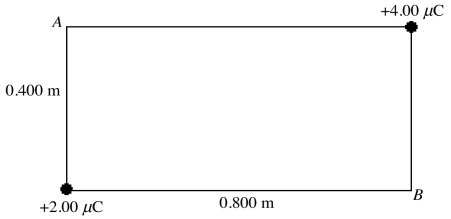
(a)What is the potential at point A (relative to infinity)due to these charges?
(b)What is the potential at point B (relative to infinity)due to these charges?
(a)What is the potential at point A (relative to infinity)due to these charges?
(b)What is the potential at point B (relative to infinity)due to these charges?
سؤال
سؤال
A metallic sphere of radius 5 cm is charged such that the potential of its surface is 100 V (relative to infinity).Which of the following plots correctly shows the potential as a function of distance from the center of the sphere? 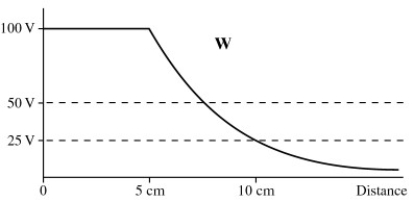
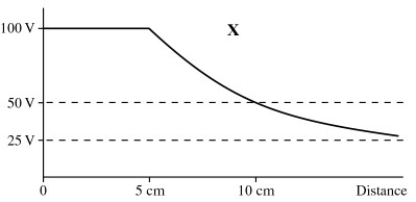
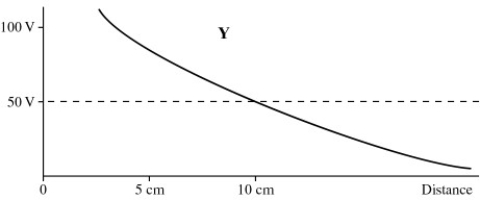
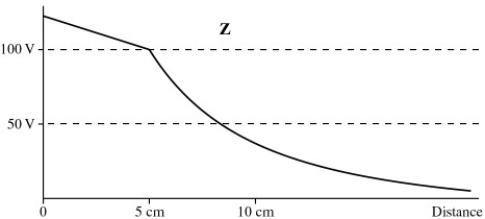
A) plot W
B) plot X
C) plot Y
D) plot Z
A) plot W
B) plot X
C) plot Y
D) plot Z
سؤال
Suppose a region of space has a uniform electric field,directed towards the right,as shown in the figure.Which statement about the electric potential is true? 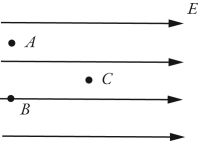
A) The potential at all three locations (A, B,C) is the same because the field is uniform.
B) The potential at points A and B are equal, and the potential at point C is higher than the potential at point A.
C) The potential at points A and B are equal, and the potential at point C is lower than the potential at point A.
D) The potential at point A is the highest, the potential at point B is the second highest, and the potential at point C is the lowest.
A) The potential at all three locations (A, B,C) is the same because the field is uniform.
B) The potential at points A and B are equal, and the potential at point C is higher than the potential at point A.
C) The potential at points A and B are equal, and the potential at point C is lower than the potential at point A.
D) The potential at point A is the highest, the potential at point B is the second highest, and the potential at point C is the lowest.
سؤال
سؤال
سؤال
A conducting sphere of radius R carries an excess positive charge and is very far from any other charges.Which one of the following graphs best illustrates the potential (relative to infinity)produced by this sphere as a function of the distance r from the center of the sphere?
A)
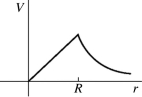
B)
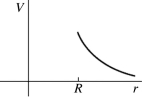
C)
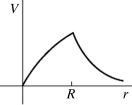
D)
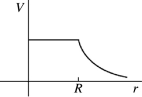
E)
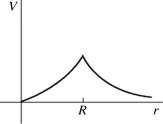
A)
B)
C)
D)
E)
سؤال
The graph in the figure shows the variation of the electric potential V (measured in volts)as a function of the radial direction r (measured in meters).For which range or value of r is the magnitude of the electric field the largest? 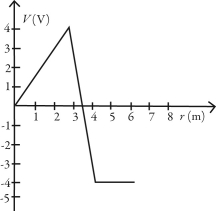
A) from r = 0 m to r = 3 m
B) from r = 3 m to r = 4 m
C) from r = 4 m to r = 6 m
D) at r = 3 m
E) at r = 4 m
A) from r = 0 m to r = 3 m
B) from r = 3 m to r = 4 m
C) from r = 4 m to r = 6 m
D) at r = 3 m
E) at r = 4 m
سؤال
Three point charges of -2.00 μC,+4.00 μC,and +6.00 μC are placed along the x-axis as shown in the figure.What is the electrical potential at point P (relative to infinity)due to these charges?
(k = 1/4πε0 = 8.99 × 10⁹ N • m2/C2)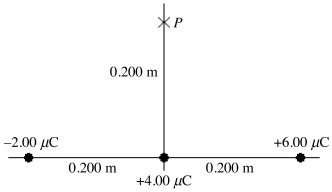
A) -307 kV
B) +307 kV
C) -154 kV
D) +154 kV
E) 0 kV
(k = 1/4πε0 = 8.99 × 10⁹ N • m2/C2)
A) -307 kV
B) +307 kV
C) -154 kV
D) +154 kV
E) 0 kV
سؤال
سؤال
سؤال
سؤال
سؤال
The graph in the figure shows the variation of the electric potential V(x)(in arbitrary units)as a function of the position x (also in arbitrary units).Which of the choices below correctly describes the orientation of the x-component of the electric field along the x-axis? 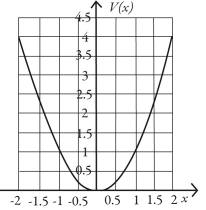
A) Ex is positive from x = -2 to x = 2.
B) Ex is positive from x = -2 to x = 0, and negative from x = 0 to x = 2.
C) Ex is negative from x = -2 to x = 0, and positive from x = 0 to x = 2.
D) Ex is negative from x = -2 to x = 2.
A) Ex is positive from x = -2 to x = 2.
B) Ex is positive from x = -2 to x = 0, and negative from x = 0 to x = 2.
C) Ex is negative from x = -2 to x = 0, and positive from x = 0 to x = 2.
D) Ex is negative from x = -2 to x = 2.
سؤال
سؤال
The potential as a function of position x is shown in the graph in the figure.Which statement about the electric field is true? 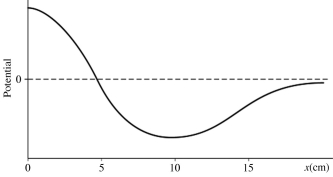
A) The electric field is zero at x = 0, its magnitude is at a maximum at x = 5 cm, and the field is directed to the right there.
B) The electric field is zero at x = 5 cm, its magnitude is at a maximum at x = 0, and the field is directed to the right there.
C) The electric field is zero at x = 0, its magnitude is at a maximum at x = 15 cm, and the field is directed to the left there.
D) The electric field is zero at x = 10 cm, its magnitude is at a maximum at x = 5 cm, and the field is directed to the left there.
A) The electric field is zero at x = 0, its magnitude is at a maximum at x = 5 cm, and the field is directed to the right there.
B) The electric field is zero at x = 5 cm, its magnitude is at a maximum at x = 0, and the field is directed to the right there.
C) The electric field is zero at x = 0, its magnitude is at a maximum at x = 15 cm, and the field is directed to the left there.
D) The electric field is zero at x = 10 cm, its magnitude is at a maximum at x = 5 cm, and the field is directed to the left there.
سؤال
سؤال
سؤال
A tiny object carrying a charge of +3.00 μC and a second tiny charged object are initially very far apart.If it takes  of work to bring them to a final configuration in which the +3.00 μC object i is at
X = 1.00 mm,y = 1.00 mm,and the other charged object is at x = 1.00 mm,y = 3.00 mm,find the magnitude of the charge on the second object.(k = 1/4πε0 = 8.99 × 10⁹ N • m2/C2)
A) 2.15 μC
B) 4.30 μC
C) 10.74 μC
D) 4.30 nC
of work to bring them to a final configuration in which the +3.00 μC object i is atX = 1.00 mm,y = 1.00 mm,and the other charged object is at x = 1.00 mm,y = 3.00 mm,find the magnitude of the charge on the second object.(k = 1/4πε0 = 8.99 × 10⁹ N • m2/C2)
A) 2.15 μC
B) 4.30 μC
C) 10.74 μC
D) 4.30 nC
سؤال
سؤال
سؤال
Four point charges of magnitude 6.00 μC and of varying signs are placed at the corners of a square
2.00 m on each side,as shown in the figure.(k = 1/4πε0 = 8.99 × 10⁹ N • m2/C2)
(a)What is the electric potential (relative to infinity)at the center of this square due to these charges?
(b)What is the magnitude of the electric field due to these charges at the center of the square?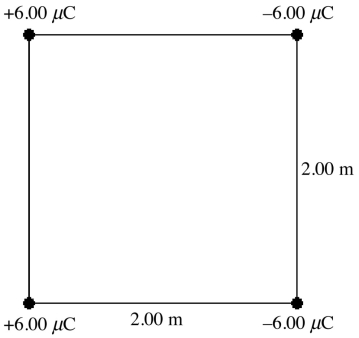
2.00 m on each side,as shown in the figure.(k = 1/4πε0 = 8.99 × 10⁹ N • m2/C2)
(a)What is the electric potential (relative to infinity)at the center of this square due to these charges?
(b)What is the magnitude of the electric field due to these charges at the center of the square?
سؤال
Two +6.0-μC point charges are placed at the corners of the base of an equilateral triangle,as shown in the figure.(k = 1/4πε0 = 8.99 × 10⁹ N • m2/C2)At the vertex,P,of the triangle 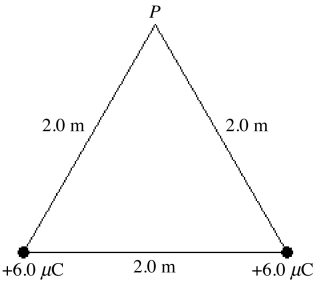
(a)what is the electric potential (relative to infinity)due to these charges?
(b)what is the magnitude of the electric field due to these charges?
(a)what is the electric potential (relative to infinity)due to these charges?
(b)what is the magnitude of the electric field due to these charges?
سؤال
The figure shows two arcs of a circle on which charges +Q and -Q have been spread uniformly.What is the value of the electric potential at the center of the circle? 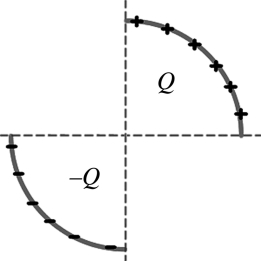
سؤال
سؤال
سؤال
Consider the group of three+2.4 nC point charges shown in the figure.What is the electric potential energy of this system of charges relative to infinity? (k = 1/4πε0 = 8.99 × 10⁹ N • m2/C2) 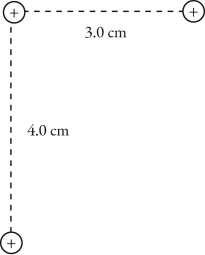
A) 4.1 × 10⁻⁶ J
B) 4.6 × 10⁻⁶ J
C) 4.2 × 10⁻⁶ J
D) 4.4 × 10⁻⁶ J
A) 4.1 × 10⁻⁶ J
B) 4.6 × 10⁻⁶ J
C) 4.2 × 10⁻⁶ J
D) 4.4 × 10⁻⁶ J
سؤال
The figure shows an arrangement of two -4.5 nC charges,each separated by 5.0 mm from a proton.If the two negative charges are held fixed at their locations and the proton is given an initial velocity v as shown in the figure,what is the minimum initial speed v that the proton needs to totally escape from the negative charges? (k = 1/4πε0 = 8.99 × 10⁹ N • m2/C2,e = 1.60 × 10⁻¹⁹ C,mproton = 1.67 × 10⁻²⁷ kg) 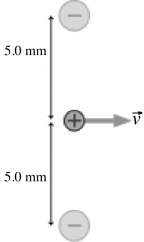
A) 1.8 × 10⁶ m/s
B) 3.5 × 10⁶ m/s
C) 6.8 × 10⁶ m/s
D) 1.4 × 10⁷ m/s
A) 1.8 × 10⁶ m/s
B) 3.5 × 10⁶ m/s
C) 6.8 × 10⁶ m/s
D) 1.4 × 10⁷ m/s
سؤال
سؤال
سؤال
سؤال
A +4.0 μC-point charge and a -4.0-μC point charge are placed as shown in the figure.What is the potential difference,VA - VB,between points A and B? (k = 1/4πε0 = 8.99 × 10⁹ N • m2/C2) 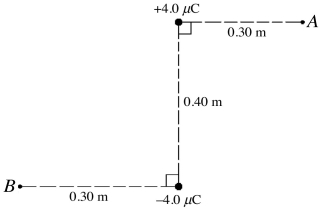
A) 48 V
B) 96 V
C) 0.00 V
D) 96 kV
E) 48 kV
A) 48 V
B) 96 V
C) 0.00 V
D) 96 kV
E) 48 kV
سؤال
سؤال
سؤال
سؤال
سؤال
Two large conducting parallel plates A and B are separated by 2.4 m.A uniform field of 1500 V/m,in the positive x-direction,is produced by charges on the plates.The center plane at x = 0.00 m is an equipotential surface on which V = 0.An electron is projected from x = 0.00 m, with an initial velocity of 1.0 × 10⁷ m/s perpendicular to the plates in the positive x-direction,as shown in the figure.What is the kinetic energy of the electron as it reaches plate A? (e = 1.60 × 10⁻¹⁹ C,mel = 9.11 × 10⁻³¹ kg) 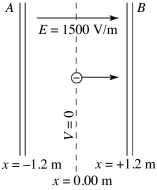
A) +2.4 × 10⁻¹⁶ J
B) +3.3 × 10⁻¹⁶ J
C) -2.4 × 10⁻¹⁶ J
D) -2.9 × 10⁻¹⁶ J
E) -3.3 × 10⁻¹⁶ J
A) +2.4 × 10⁻¹⁶ J
B) +3.3 × 10⁻¹⁶ J
C) -2.4 × 10⁻¹⁶ J
D) -2.9 × 10⁻¹⁶ J
E) -3.3 × 10⁻¹⁶ J
سؤال
سؤال
سؤال
سؤال
سؤال
سؤال
سؤال
سؤال
سؤال
سؤال
سؤال
سؤال

فتح الحزمة
قم بالتسجيل لفتح البطاقات في هذه المجموعة!
Unlock Deck
Unlock Deck
1/53

العب

ملء الشاشة (f)
Deck 25: Work and Energy in Electrostatics
1
A conducting sphere contains positive charge distributed uniformly over its surface.Which statements about the potential due to this sphere are true? All potentials are measured relative to infinity.(There may be more than one correct choice.)
A) The potential is lowest, but not zero, at the center of the sphere.
B) The potential at the center of the sphere is zero.
C) The potential at the center of the sphere is the same as the potential at the surface.
D) The potential at the surface is higher than the potential at the center.
E) The potential at the center is the same as the potential at infinity.
A) The potential is lowest, but not zero, at the center of the sphere.
B) The potential at the center of the sphere is zero.
C) The potential at the center of the sphere is the same as the potential at the surface.
D) The potential at the surface is higher than the potential at the center.
E) The potential at the center is the same as the potential at infinity.
The potential at the center of the sphere is the same as the potential at the surface.
2
Suppose you have two point charges of opposite sign.As you move them farther and farther apart,the potential energy of this system relative to infinity
A) increases.
B) decreases.
C) stays the same.
A) increases.
B) decreases.
C) stays the same.
increases.
3
Suppose you have two negative point charges.As you move them farther and farther apart,the potential energy of this system relative to infinity
A) increases.
B) decreases.
C) stays the same.
A) increases.
B) decreases.
C) stays the same.
decreases.
4
A nonconducting sphere contains positive charge distributed uniformly throughout its volume.Which statements about the potential due to this sphere are true? All potentials are measured relative to infinity.(There may be more than one correct choice.)
A) The potential is highest at the center of the sphere.
B) The potential at the center of the sphere is zero.
C) The potential at the center of the sphere is the same as the potential at the surface.
D) The potential at the surface is higher than the potential at the center.
E) The potential at the center is the same as the potential at infinity.
A) The potential is highest at the center of the sphere.
B) The potential at the center of the sphere is zero.
C) The potential at the center of the sphere is the same as the potential at the surface.
D) The potential at the surface is higher than the potential at the center.
E) The potential at the center is the same as the potential at infinity.
فتح الحزمة
افتح القفل للوصول البطاقات البالغ عددها 53 في هذه المجموعة.
فتح الحزمة
k this deck
5
Two positive point charges +4.00 μC and +2.00 μC are placed at the opposite corners of a rectangle as shown in the figure.(k = 1/4πε0 = 8.99 × 10⁹ N • m2/C2)
(a)What is the potential at point A (relative to infinity)due to these charges?
(b)What is the potential at point B (relative to infinity)due to these charges?
(a)What is the potential at point A (relative to infinity)due to these charges?
(b)What is the potential at point B (relative to infinity)due to these charges?
فتح الحزمة
افتح القفل للوصول البطاقات البالغ عددها 53 في هذه المجموعة.
فتح الحزمة
k this deck
6
Which statements are true for an electron moving in the direction of an electric field? (There may be more than one correct choice.)
A) Its electric potential energy increases as it goes from high to low potential.
B) Its electric potential energy decreases as it goes from high to low potential.
C) Its potential energy increases as its kinetic energy decreases.
D) Its kinetic energy decreases as it moves in the direction of the electric field.
E) Its kinetic energy increases as it moves in the direction of the electric field.
A) Its electric potential energy increases as it goes from high to low potential.
B) Its electric potential energy decreases as it goes from high to low potential.
C) Its potential energy increases as its kinetic energy decreases.
D) Its kinetic energy decreases as it moves in the direction of the electric field.
E) Its kinetic energy increases as it moves in the direction of the electric field.
فتح الحزمة
افتح القفل للوصول البطاقات البالغ عددها 53 في هذه المجموعة.
فتح الحزمة
k this deck
7
A metallic sphere of radius 5 cm is charged such that the potential of its surface is 100 V (relative to infinity).Which of the following plots correctly shows the potential as a function of distance from the center of the sphere?
A) plot W
B) plot X
C) plot Y
D) plot Z
A) plot W
B) plot X
C) plot Y
D) plot Z
فتح الحزمة
افتح القفل للوصول البطاقات البالغ عددها 53 في هذه المجموعة.
فتح الحزمة
k this deck
8
Suppose a region of space has a uniform electric field,directed towards the right,as shown in the figure.Which statement about the electric potential is true?
A) The potential at all three locations (A, B,C) is the same because the field is uniform.
B) The potential at points A and B are equal, and the potential at point C is higher than the potential at point A.
C) The potential at points A and B are equal, and the potential at point C is lower than the potential at point A.
D) The potential at point A is the highest, the potential at point B is the second highest, and the potential at point C is the lowest.
A) The potential at all three locations (A, B,C) is the same because the field is uniform.
B) The potential at points A and B are equal, and the potential at point C is higher than the potential at point A.
C) The potential at points A and B are equal, and the potential at point C is lower than the potential at point A.
D) The potential at point A is the highest, the potential at point B is the second highest, and the potential at point C is the lowest.
فتح الحزمة
افتح القفل للوصول البطاقات البالغ عددها 53 في هذه المجموعة.
فتح الحزمة
k this deck
9
If the electric field is zero everywhere inside a region of space,the potential must also be zero in that region.
فتح الحزمة
افتح القفل للوصول البطاقات البالغ عددها 53 في هذه المجموعة.
فتح الحزمة
k this deck
10
A negative charge,if free,will tend to move
A) from high potential to low potential.
B) from low potential to high potential.
C) toward infinity.
D) away from infinity.
E) in the direction of the electric field.
A) from high potential to low potential.
B) from low potential to high potential.
C) toward infinity.
D) away from infinity.
E) in the direction of the electric field.
فتح الحزمة
افتح القفل للوصول البطاقات البالغ عددها 53 في هذه المجموعة.
فتح الحزمة
k this deck
11
A conducting sphere of radius R carries an excess positive charge and is very far from any other charges.Which one of the following graphs best illustrates the potential (relative to infinity)produced by this sphere as a function of the distance r from the center of the sphere?
A)
B)
C)
D)
E)
A)
B)
C)
D)
E)
فتح الحزمة
افتح القفل للوصول البطاقات البالغ عددها 53 في هذه المجموعة.
فتح الحزمة
k this deck
12
The graph in the figure shows the variation of the electric potential V (measured in volts)as a function of the radial direction r (measured in meters).For which range or value of r is the magnitude of the electric field the largest?
A) from r = 0 m to r = 3 m
B) from r = 3 m to r = 4 m
C) from r = 4 m to r = 6 m
D) at r = 3 m
E) at r = 4 m
A) from r = 0 m to r = 3 m
B) from r = 3 m to r = 4 m
C) from r = 4 m to r = 6 m
D) at r = 3 m
E) at r = 4 m
فتح الحزمة
افتح القفل للوصول البطاقات البالغ عددها 53 في هذه المجموعة.
فتح الحزمة
k this deck
13
Three point charges of -2.00 μC,+4.00 μC,and +6.00 μC are placed along the x-axis as shown in the figure.What is the electrical potential at point P (relative to infinity)due to these charges?
(k = 1/4πε0 = 8.99 × 10⁹ N • m2/C2)
A) -307 kV
B) +307 kV
C) -154 kV
D) +154 kV
E) 0 kV
(k = 1/4πε0 = 8.99 × 10⁹ N • m2/C2)
A) -307 kV
B) +307 kV
C) -154 kV
D) +154 kV
E) 0 kV
فتح الحزمة
افتح القفل للوصول البطاقات البالغ عددها 53 في هذه المجموعة.
فتح الحزمة
k this deck
14
Two equal positive charges are held in place at a fixed distance.If you put a third positive charge midway between these two charges,its electrical potential energy of the system (relative to infinity)is zero because the electrical forces on the third charge due to the two fixed charges just balance each other.
فتح الحزمة
افتح القفل للوصول البطاقات البالغ عددها 53 في هذه المجموعة.
فتح الحزمة
k this deck
15
When the electric field is zero at a point,the potential must also be zero there.
فتح الحزمة
افتح القفل للوصول البطاقات البالغ عددها 53 في هذه المجموعة.
فتح الحزمة
k this deck
16
If the electrical potential in a region is constant,the electric field must be zero everywhere in that region.
فتح الحزمة
افتح القفل للوصول البطاقات البالغ عددها 53 في هذه المجموعة.
فتح الحزمة
k this deck
17
A negative charge is moved from point A to point B along an equipotential surface.Which of the following statements must be true for this case?
A) The negative charge performs work in moving from point A to point B.
B) Work is required to move the negative charge from point A to point B.
C) No work is required to move the negative charge from point A to point B.
D) The work done on the charge depends on the distance between A and B.
E) Work is done in moving the negative charge from point A to point B.
A) The negative charge performs work in moving from point A to point B.
B) Work is required to move the negative charge from point A to point B.
C) No work is required to move the negative charge from point A to point B.
D) The work done on the charge depends on the distance between A and B.
E) Work is done in moving the negative charge from point A to point B.
فتح الحزمة
افتح القفل للوصول البطاقات البالغ عددها 53 في هذه المجموعة.
فتح الحزمة
k this deck
18
The graph in the figure shows the variation of the electric potential V(x)(in arbitrary units)as a function of the position x (also in arbitrary units).Which of the choices below correctly describes the orientation of the x-component of the electric field along the x-axis?
A) Ex is positive from x = -2 to x = 2.
B) Ex is positive from x = -2 to x = 0, and negative from x = 0 to x = 2.
C) Ex is negative from x = -2 to x = 0, and positive from x = 0 to x = 2.
D) Ex is negative from x = -2 to x = 2.
A) Ex is positive from x = -2 to x = 2.
B) Ex is positive from x = -2 to x = 0, and negative from x = 0 to x = 2.
C) Ex is negative from x = -2 to x = 0, and positive from x = 0 to x = 2.
D) Ex is negative from x = -2 to x = 2.
فتح الحزمة
افتح القفل للوصول البطاقات البالغ عددها 53 في هذه المجموعة.
فتح الحزمة
k this deck
19
If the electric potential at a point in space is zero,then the electric field at that point must also be zero.
فتح الحزمة
افتح القفل للوصول البطاقات البالغ عددها 53 في هذه المجموعة.
فتح الحزمة
k this deck
20
The potential as a function of position x is shown in the graph in the figure.Which statement about the electric field is true?
A) The electric field is zero at x = 0, its magnitude is at a maximum at x = 5 cm, and the field is directed to the right there.
B) The electric field is zero at x = 5 cm, its magnitude is at a maximum at x = 0, and the field is directed to the right there.
C) The electric field is zero at x = 0, its magnitude is at a maximum at x = 15 cm, and the field is directed to the left there.
D) The electric field is zero at x = 10 cm, its magnitude is at a maximum at x = 5 cm, and the field is directed to the left there.
A) The electric field is zero at x = 0, its magnitude is at a maximum at x = 5 cm, and the field is directed to the right there.
B) The electric field is zero at x = 5 cm, its magnitude is at a maximum at x = 0, and the field is directed to the right there.
C) The electric field is zero at x = 0, its magnitude is at a maximum at x = 15 cm, and the field is directed to the left there.
D) The electric field is zero at x = 10 cm, its magnitude is at a maximum at x = 5 cm, and the field is directed to the left there.
فتح الحزمة
افتح القفل للوصول البطاقات البالغ عددها 53 في هذه المجموعة.
فتح الحزمة
k this deck
21
Two point charges,Q and -3Q,are located on the x-axis a distance d apart,with -3Q to the right of Q.Find the location of ALL the points on the x-axis (not counting infinity)at which the potential (relative to infinity)due to this pair of charges is equal to zero.
فتح الحزمة
افتح القفل للوصول البطاقات البالغ عددها 53 في هذه المجموعة.
فتح الحزمة
k this deck
22
A half-ring (semicircle)of uniformly distributed charge Q has radius R.What is the electric potential at its center?
فتح الحزمة
افتح القفل للوصول البطاقات البالغ عددها 53 في هذه المجموعة.
فتح الحزمة
k this deck
23
A tiny object carrying a charge of +3.00 μC and a second tiny charged object are initially very far apart.If it takes of work to bring them to a final configuration in which the +3.00 μC object i is at
X = 1.00 mm,y = 1.00 mm,and the other charged object is at x = 1.00 mm,y = 3.00 mm,find the magnitude of the charge on the second object.(k = 1/4πε0 = 8.99 × 10⁹ N • m2/C2)
A) 2.15 μC
B) 4.30 μC
C) 10.74 μC
D) 4.30 nC
of work to bring them to a final configuration in which the +3.00 μC object i is atX = 1.00 mm,y = 1.00 mm,and the other charged object is at x = 1.00 mm,y = 3.00 mm,find the magnitude of the charge on the second object.(k = 1/4πε0 = 8.99 × 10⁹ N • m2/C2)
A) 2.15 μC
B) 4.30 μC
C) 10.74 μC
D) 4.30 nC
فتح الحزمة
افتح القفل للوصول البطاقات البالغ عددها 53 في هذه المجموعة.
فتح الحزمة
k this deck
24
A -7.0-μC point charge has a positively charged object in an elliptical orbit around it.If the mass of the positively charged object is 1.0 kg and the distance varies from 5.0 mm to 20.0 mm between the charges,what is the maximum electric potential difference through which the positive object moves?
(k = 1/4πε0 = 8.99 × 10⁹ N • m2/C2)
A) 9.4 MV
B) 3.2 MV
C) 4.2 MV
D) 16 MV
(k = 1/4πε0 = 8.99 × 10⁹ N • m2/C2)
A) 9.4 MV
B) 3.2 MV
C) 4.2 MV
D) 16 MV
فتح الحزمة
افتح القفل للوصول البطاقات البالغ عددها 53 في هذه المجموعة.
فتح الحزمة
k this deck
25
Two point charges of +2.0 μC and -6.0 μC are located on the x-axis at x = -1.0 cm and x = +2.0 cm respectively.Where should a third charge of +3.0-μC be placed on the +x-axis so that the potential at the origin is equal to zero? (k = 1/4πε0 = 8.99 × 10⁹ N • m2/C2)
A) x = 4.0 cm
B) x = 1.0 cm
C) x = 2.0 cm
D) x = 3.0 cm
E) x = 5.0 cm
A) x = 4.0 cm
B) x = 1.0 cm
C) x = 2.0 cm
D) x = 3.0 cm
E) x = 5.0 cm
فتح الحزمة
افتح القفل للوصول البطاقات البالغ عددها 53 في هذه المجموعة.
فتح الحزمة
k this deck
26
Four point charges of magnitude 6.00 μC and of varying signs are placed at the corners of a square
2.00 m on each side,as shown in the figure.(k = 1/4πε0 = 8.99 × 10⁹ N • m2/C2)
(a)What is the electric potential (relative to infinity)at the center of this square due to these charges?
(b)What is the magnitude of the electric field due to these charges at the center of the square?
2.00 m on each side,as shown in the figure.(k = 1/4πε0 = 8.99 × 10⁹ N • m2/C2)
(a)What is the electric potential (relative to infinity)at the center of this square due to these charges?
(b)What is the magnitude of the electric field due to these charges at the center of the square?
فتح الحزمة
افتح القفل للوصول البطاقات البالغ عددها 53 في هذه المجموعة.
فتح الحزمة
k this deck
27
Two +6.0-μC point charges are placed at the corners of the base of an equilateral triangle,as shown in the figure.(k = 1/4πε0 = 8.99 × 10⁹ N • m2/C2)At the vertex,P,of the triangle
(a)what is the electric potential (relative to infinity)due to these charges?
(b)what is the magnitude of the electric field due to these charges?
(a)what is the electric potential (relative to infinity)due to these charges?
(b)what is the magnitude of the electric field due to these charges?
فتح الحزمة
افتح القفل للوصول البطاقات البالغ عددها 53 في هذه المجموعة.
فتح الحزمة
k this deck
28
The figure shows two arcs of a circle on which charges +Q and -Q have been spread uniformly.What is the value of the electric potential at the center of the circle?
فتح الحزمة
افتح القفل للوصول البطاقات البالغ عددها 53 في هذه المجموعة.
فتح الحزمة
k this deck
29
If an electron is accelerated from rest through a potential difference of 9.9 kV,what is its resulting speed? (e = 1.60 × 10⁻¹⁹ C,k = 1/4πε0 = 8.99 × 10⁹ N • m2/C2, mel = 9.11 × 10⁻³¹ kg)
A) 5.9 × 10⁷ m/s
B) 4.9 × 10⁷ m/s
C) 3.9 × 10⁷ m/s
D) 2.9 × 10⁷ m/s
A) 5.9 × 10⁷ m/s
B) 4.9 × 10⁷ m/s
C) 3.9 × 10⁷ m/s
D) 2.9 × 10⁷ m/s
فتح الحزمة
افتح القفل للوصول البطاقات البالغ عددها 53 في هذه المجموعة.
فتح الحزمة
k this deck
30
An alpha particle is a nucleus of helium.It has twice the charge and four times the mass of the proton.When they were very far away from each other,but headed toward directly each other,a proton and an alpha particle each had an initial speed of 0.0030c,where c is the speed of light.What is their distance of closest approach? Hint: There are two conserved quantities.Make use of both of them.(c = 3.00 × 10⁸ m/s,k = 1/4πε0 = 8.99 × 10⁹ N • m2/C2,e = 1.60 × 10⁻¹⁹ C,mproton = 1.67 × 10⁻²⁷ • kg)
A) 2.1 × 10⁻¹³ m
B) 3.3 × 10⁻¹³ m
C) 2.6 × 10⁻¹³ m
D) 2.9 × 10⁻¹³ m
A) 2.1 × 10⁻¹³ m
B) 3.3 × 10⁻¹³ m
C) 2.6 × 10⁻¹³ m
D) 2.9 × 10⁻¹³ m
فتح الحزمة
افتح القفل للوصول البطاقات البالغ عددها 53 في هذه المجموعة.
فتح الحزمة
k this deck
31
Consider the group of three+2.4 nC point charges shown in the figure.What is the electric potential energy of this system of charges relative to infinity? (k = 1/4πε0 = 8.99 × 10⁹ N • m2/C2)
A) 4.1 × 10⁻⁶ J
B) 4.6 × 10⁻⁶ J
C) 4.2 × 10⁻⁶ J
D) 4.4 × 10⁻⁶ J
A) 4.1 × 10⁻⁶ J
B) 4.6 × 10⁻⁶ J
C) 4.2 × 10⁻⁶ J
D) 4.4 × 10⁻⁶ J
فتح الحزمة
افتح القفل للوصول البطاقات البالغ عددها 53 في هذه المجموعة.
فتح الحزمة
k this deck
32
The figure shows an arrangement of two -4.5 nC charges,each separated by 5.0 mm from a proton.If the two negative charges are held fixed at their locations and the proton is given an initial velocity v as shown in the figure,what is the minimum initial speed v that the proton needs to totally escape from the negative charges? (k = 1/4πε0 = 8.99 × 10⁹ N • m2/C2,e = 1.60 × 10⁻¹⁹ C,mproton = 1.67 × 10⁻²⁷ kg)
A) 1.8 × 10⁶ m/s
B) 3.5 × 10⁶ m/s
C) 6.8 × 10⁶ m/s
D) 1.4 × 10⁷ m/s
A) 1.8 × 10⁶ m/s
B) 3.5 × 10⁶ m/s
C) 6.8 × 10⁶ m/s
D) 1.4 × 10⁷ m/s
فتح الحزمة
افتح القفل للوصول البطاقات البالغ عددها 53 في هذه المجموعة.
فتح الحزمة
k this deck
33
A -3.0-μC point charge and a -9.0-μC point charge are initially extremely far apart.How much work does it take to bring the -3.0-μC charge to x = 3.0 mm,y = 0.00 mm and the -9.0-μC charge to x = -3.0 mm,y = 0.00 mm? (k = 1/4πε0 = 8.99 × 10⁹ N • m2/C2)
A) 40 J
B) 81 J
C) 27 J
D) 6.8 J
A) 40 J
B) 81 J
C) 27 J
D) 6.8 J
فتح الحزمة
افتح القفل للوصول البطاقات البالغ عددها 53 في هذه المجموعة.
فتح الحزمة
k this deck
34
Two equal point charges Q are separated by a distance d.One of the charges is released and moves away from the other due only to the electrical force between them.When the moving charge is a distance 3d from the other charge,what is its kinetic energy?
فتح الحزمة
افتح القفل للوصول البطاقات البالغ عددها 53 في هذه المجموعة.
فتح الحزمة
k this deck
35
A very small object carrying -6.0 μC of charge is attracted to a large,well-anchored,positively charged object.How much kinetic energy does the negatively charged object gain if the potential difference through which it moves is 3.0 mV? (k = 1/4πε0 = 8.99 × 10⁹ N • m2/C2)
A) 18 nJ
B) 0.50 kJ
C) 0.50 J
D) 6.0 μJ
A) 18 nJ
B) 0.50 kJ
C) 0.50 J
D) 6.0 μJ
فتح الحزمة
افتح القفل للوصول البطاقات البالغ عددها 53 في هذه المجموعة.
فتح الحزمة
k this deck
36
A +4.0 μC-point charge and a -4.0-μC point charge are placed as shown in the figure.What is the potential difference,VA - VB,between points A and B? (k = 1/4πε0 = 8.99 × 10⁹ N • m2/C2)
A) 48 V
B) 96 V
C) 0.00 V
D) 96 kV
E) 48 kV
A) 48 V
B) 96 V
C) 0.00 V
D) 96 kV
E) 48 kV
فتح الحزمة
افتح القفل للوصول البطاقات البالغ عددها 53 في هذه المجموعة.
فتح الحزمة
k this deck
37
Four equal +6.00-μC point charges are placed at the corners of a square 2.00 m on each side.
(k = 1/4πε0 = 8.99 × 10⁹ N • m2/C2)
(a)What is the electric potential (relative to infinity)due to these charges at the center of this square?
(b)What is the magnitude of the electric field due to these charges at the center of the square?
(k = 1/4πε0 = 8.99 × 10⁹ N • m2/C2)
(a)What is the electric potential (relative to infinity)due to these charges at the center of this square?
(b)What is the magnitude of the electric field due to these charges at the center of the square?
فتح الحزمة
افتح القفل للوصول البطاقات البالغ عددها 53 في هذه المجموعة.
فتح الحزمة
k this deck
38
A sphere with radius 2.0 mm carries +1.0 μC of charge distributed uniformly throughout its volume.What is the potential difference,VB - VA,between point B,which is 4.0 m from the center of the sphere,and point A,which is 9.0 m from the center of the sphere? (k = 1/4πε0 = 8.99 × 10⁹ N • m2/C2)
A) 1200 V
B) -1200 V
C) 140 V
D) -0.45 V
A) 1200 V
B) -1200 V
C) 140 V
D) -0.45 V
فتح الحزمة
افتح القفل للوصول البطاقات البالغ عددها 53 في هذه المجموعة.
فتح الحزمة
k this deck
39
Two point charges of +1.0 μC and -2.0 μC are located 0.50 m apart.What is the minimum amount of work needed to move the charges apart to double the distance between them?
(k = 1/4πε0 = 8.99 × 10⁹ N • m2/C2)
A) -36 mJ
B) +18 mJ
C) 0 mJ
D) +36 mJ
E) -18 mJ
(k = 1/4πε0 = 8.99 × 10⁹ N • m2/C2)
A) -36 mJ
B) +18 mJ
C) 0 mJ
D) +36 mJ
E) -18 mJ
فتح الحزمة
افتح القفل للوصول البطاقات البالغ عددها 53 في هذه المجموعة.
فتح الحزمة
k this deck
40
An electron is released from rest at a distance of 9.00 cm from a proton.If the proton is held in place,how fast will the electron be moving when it is 3.00 cm from the proton? (mel = 9.11 × 10⁻³¹ kg,
E = 1.60 × 10⁻¹⁹ C,k = 1/4πε0 = 8.99 × 10⁹ N • m2/C2)
A) 75.0 m/s
B) 106 m/s
C) 130 m/s
D) 1.06 × 10³ m/s
E) 4.64 × 10⁵ m/s
E = 1.60 × 10⁻¹⁹ C,k = 1/4πε0 = 8.99 × 10⁹ N • m2/C2)
A) 75.0 m/s
B) 106 m/s
C) 130 m/s
D) 1.06 × 10³ m/s
E) 4.64 × 10⁵ m/s
فتح الحزمة
افتح القفل للوصول البطاقات البالغ عددها 53 في هذه المجموعة.
فتح الحزمة
k this deck
41
Two large conducting parallel plates A and B are separated by 2.4 m.A uniform field of 1500 V/m,in the positive x-direction,is produced by charges on the plates.The center plane at x = 0.00 m is an equipotential surface on which V = 0.An electron is projected from x = 0.00 m, with an initial velocity of 1.0 × 10⁷ m/s perpendicular to the plates in the positive x-direction,as shown in the figure.What is the kinetic energy of the electron as it reaches plate A? (e = 1.60 × 10⁻¹⁹ C,mel = 9.11 × 10⁻³¹ kg)
A) +2.4 × 10⁻¹⁶ J
B) +3.3 × 10⁻¹⁶ J
C) -2.4 × 10⁻¹⁶ J
D) -2.9 × 10⁻¹⁶ J
E) -3.3 × 10⁻¹⁶ J
A) +2.4 × 10⁻¹⁶ J
B) +3.3 × 10⁻¹⁶ J
C) -2.4 × 10⁻¹⁶ J
D) -2.9 × 10⁻¹⁶ J
E) -3.3 × 10⁻¹⁶ J
فتح الحزمة
افتح القفل للوصول البطاقات البالغ عددها 53 في هذه المجموعة.
فتح الحزمة
k this deck
42
If the potential in a region is given by V(x,y,z)= xy - 3z-2,then the y component of the electric field in that region is
A) x + y - 6z-3.
B) -y.
C) -x.
D) x + y.
A) x + y - 6z-3.
B) -y.
C) -x.
D) x + y.
فتح الحزمة
افتح القفل للوصول البطاقات البالغ عددها 53 في هذه المجموعة.
فتح الحزمة
k this deck
43
Two long conducting cylindrical shells are coaxial and have radii of 20 mm and 80 mm.The electric potential of the inner conductor,with respect to the outer conductor,is +600 V.What is the maximum electric field magnitude between the cylinders? (k = 1/4πε0 = 8.99 × 10⁹ N • m2/C2)
A) 10,000 V/m
B) 14,000 V/m
C) 18,000 V/m
D) 22,000 V/m
E) 26,000 V/m
A) 10,000 V/m
B) 14,000 V/m
C) 18,000 V/m
D) 22,000 V/m
E) 26,000 V/m
فتح الحزمة
افتح القفل للوصول البطاقات البالغ عددها 53 في هذه المجموعة.
فتح الحزمة
k this deck
44
Two long conducting cylindrical shells are coaxial and have radii of 20 mm and 80 mm.The electric potential of the inner conductor,with respect to the outer conductor,is +600 V.An electron is released from rest at the surface of the outer conductor.What is the speed of the electron as it reaches the inner conductor? (e = 1.60 × 10⁻¹⁹ C,mel = 9.11 × 10⁻³¹ kg,k = 1/4πε0 = 8.99 × 10⁹ N • m2/C2)
A) 1.1 × 10⁷ m/s
B) 1.3 × 10⁷ m/s
C) 1.5 × 10⁷ m/s
D) 1.7 × 10⁷ m/s
E) 1.9 × 10⁷ m/s
A) 1.1 × 10⁷ m/s
B) 1.3 × 10⁷ m/s
C) 1.5 × 10⁷ m/s
D) 1.7 × 10⁷ m/s
E) 1.9 × 10⁷ m/s
فتح الحزمة
افتح القفل للوصول البطاقات البالغ عددها 53 في هذه المجموعة.
فتح الحزمة
k this deck
45
If the electric potential in a region is given by V(x)= 6/x2,the x component of the electric field in that region is
A) -12x-3.
B) -6x.
C) 12x-3.
D) 12x.
E) 6x.
A) -12x-3.
B) -6x.
C) 12x-3.
D) 12x.
E) 6x.
فتح الحزمة
افتح القفل للوصول البطاقات البالغ عددها 53 في هذه المجموعة.
فتح الحزمة
k this deck
46
In a certain region,the electric potential due to a charge distribution is given by the equation
V(x,y)= 2xy - x2 - y,where x and y are measured in meters and V is in volts.At which point is the electric field equal to zero?
A) x = 0.5 m, y = 1 m
B) x = 1 m, y = 1 m
C) x = 1 m, y = 0.5 m
D) x = 0.5 m, y = 0.5 m
E) x = 0 m, y = 0 m
V(x,y)= 2xy - x2 - y,where x and y are measured in meters and V is in volts.At which point is the electric field equal to zero?
A) x = 0.5 m, y = 1 m
B) x = 1 m, y = 1 m
C) x = 1 m, y = 0.5 m
D) x = 0.5 m, y = 0.5 m
E) x = 0 m, y = 0 m
فتح الحزمة
افتح القفل للوصول البطاقات البالغ عددها 53 في هذه المجموعة.
فتح الحزمة
k this deck
47
A conducting sphere 45 cm in diameter carries an excess of charge,and no other charges are present.You measure the potential of the surface of this sphere and find it to be 14 kV relative to infinity.
(k = 1/4πε0 = 8.99 × 10⁹ N • m2/C2)The excess charge on this sphere is closest to
A) 0.35 nC.
B) 79 nC.
C) 315 nC.
D) 350 nC.
E) 700 nC.
(k = 1/4πε0 = 8.99 × 10⁹ N • m2/C2)The excess charge on this sphere is closest to
A) 0.35 nC.
B) 79 nC.
C) 315 nC.
D) 350 nC.
E) 700 nC.
فتح الحزمة
افتح القفل للوصول البطاقات البالغ عددها 53 في هذه المجموعة.
فتح الحزمة
k this deck
48
A very long nonconducting cylinder of diameter 10.0 cm carries charge distributed uniformly over its surface.Each meter of length carries +5.50 µC of charge.A proton is released from rest just outside the surface.How far will it be from the SURFACE of the cylinder when its speed has reached 2550 km/s?
(k = 1/4πε0 = 8.99 × 10⁹ N • m2/C2,e = 1.60 × 10⁻¹⁹ C,mproton = 1.67 × 10⁻²⁷ kg)
(k = 1/4πε0 = 8.99 × 10⁹ N • m2/C2,e = 1.60 × 10⁻¹⁹ C,mproton = 1.67 × 10⁻²⁷ kg)
فتح الحزمة
افتح القفل للوصول البطاقات البالغ عددها 53 في هذه المجموعة.
فتح الحزمة
k this deck
49
A conducting sphere of radius 20.0 cm carries an excess charge of +15.0 µC,and no other charges are present.(k = 1/4πε0 = 8.99 × 10⁹ N • m2/C2)The potential (relative to infinity)due to this sphere at a point 12.0 cm from its center is closest to
A) zero.
B) 674 kV.
C) 1130 kV.
D) 3380 kV.
E) 9380 kV.
A) zero.
B) 674 kV.
C) 1130 kV.
D) 3380 kV.
E) 9380 kV.
فتح الحزمة
افتح القفل للوصول البطاقات البالغ عددها 53 في هذه المجموعة.
فتح الحزمة
k this deck
50
In a certain region,the electric potential due to a charge distribution is given by the equation
V(x,y,z)= 3x2y2 + yz3 - 2z3x,where x,y,and z are measured in meters and V is in volts.Calculate the magnitude of the electric field vector at the position (x,y,z)= (1.0,1.0,1.0).
A) 4.3 V/m
B) 2.0 V/m
C) -8.1 V/m
D) 8.6 V/m
E) 74 V/m
V(x,y,z)= 3x2y2 + yz3 - 2z3x,where x,y,and z are measured in meters and V is in volts.Calculate the magnitude of the electric field vector at the position (x,y,z)= (1.0,1.0,1.0).
A) 4.3 V/m
B) 2.0 V/m
C) -8.1 V/m
D) 8.6 V/m
E) 74 V/m
فتح الحزمة
افتح القفل للوصول البطاقات البالغ عددها 53 في هذه المجموعة.
فتح الحزمة
k this deck
51
An extremely long thin wire carries a uniform linear charge density of 358 nC/m.Find the potential difference between points 5.0 m and 6.0 m from the wire,provided they are not near either end of the wire.(k = 1/4πε0 = 8.99 × 10⁹ N • m2/C2)
A) 1.2 kV
B) 6.0 kV
C) 0.21 kV
D) 0.215 kV
A) 1.2 kV
B) 6.0 kV
C) 0.21 kV
D) 0.215 kV
فتح الحزمة
افتح القفل للوصول البطاقات البالغ عددها 53 في هذه المجموعة.
فتح الحزمة
k this deck
52
A conducting sphere is charged up such that the potential on its surface is 100 V (relative to infinity).If the sphere's radius were twice as large,but the charge on the sphere were the same,what would be the potential on the surface relative to infinity?
A) 50 V
B) 25 V
C) 100 V
D) 200 V
A) 50 V
B) 25 V
C) 100 V
D) 200 V
فتح الحزمة
افتح القفل للوصول البطاقات البالغ عددها 53 في هذه المجموعة.
فتح الحزمة
k this deck
53
Two parallel conducting plates are separated by 1.0 mm and carry equal but opposite surface charge densities.If the potential difference between them is 2.0 V.what is the magnitude of the surface charge density on each plate? (ε0 = 8.85 × 10⁻¹² C2/N • m2)
A) 18 nC/m2
B) 0.13 mC/m2
C) 35 nC/m2
D) 0.27 mC/m2
A) 18 nC/m2
B) 0.13 mC/m2
C) 35 nC/m2
D) 0.27 mC/m2
فتح الحزمة
افتح القفل للوصول البطاقات البالغ عددها 53 في هذه المجموعة.
فتح الحزمة
k this deck
فتح الحزمة
افتح القفل للوصول البطاقات البالغ عددها 53 في هذه المجموعة.






