







 تكلم مع الذكاء الاصطناعي


Deck 5: Energy
ملء الشاشة (f)

سؤال

سؤال
سؤال
سؤال
In the figure,determine the character of the collision.The masses of the blocks,and the velocities before and after are given.The collision is 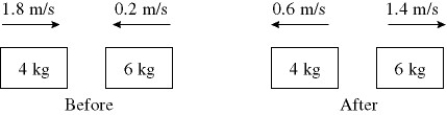
A) perfectly elastic.
B) partially inelastic.
C) completely inelastic.
D) characterized by an increase in kinetic energy.
E) not possible because momentum is not conserved.
A) perfectly elastic.
B) partially inelastic.
C) completely inelastic.
D) characterized by an increase in kinetic energy.
E) not possible because momentum is not conserved.
سؤال
سؤال
Jacques and George meet in the middle of a lake while paddling in their canoes.They come to a complete stop and talk for a while.When they are ready to leave,Jacques pushes George's canoe with a force  to separate the two canoes.What is correct to say about the final momentum and kinetic energy of the system if we can neglect any resistance due to the water?
A) The final momentum is in the direction of but the final kinetic energy is zero.
B) The final momentum is in the direction opposite of but the final kinetic energy is zero.
C) The final momentum is in the direction of and the final kinetic energy is positive.
D) The final momentum is zero and the final kinetic energy is zero.
E) The final momentum is zero but the final kinetic energy is positive.
to separate the two canoes.What is correct to say about the final momentum and kinetic energy of the system if we can neglect any resistance due to the water?A) The final momentum is in the direction of
but the final kinetic energy is zero.B) The final momentum is in the direction opposite of
but the final kinetic energy is zero.C) The final momentum is in the direction of
and the final kinetic energy is positive.D) The final momentum is zero and the final kinetic energy is zero.
E) The final momentum is zero but the final kinetic energy is positive.
سؤال
سؤال
سؤال
سؤال
In the figure,determine the character of the collision.The masses of the blocks,and the velocities before and after are given,and no other unbalanced forces act on these blocks.The collision is 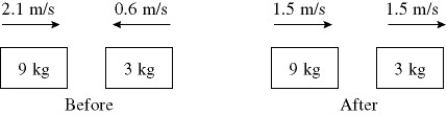
A) perfectly elastic.
B) partially inelastic.
C) completely inelastic.
D) characterized by an increase in kinetic energy.
E) not possible because momentum is not conserved.
A) perfectly elastic.
B) partially inelastic.
C) completely inelastic.
D) characterized by an increase in kinetic energy.
E) not possible because momentum is not conserved.
سؤال
سؤال
سؤال
سؤال
سؤال

فتح الحزمة
قم بالتسجيل لفتح البطاقات في هذه المجموعة!
Unlock Deck
Unlock Deck
1/15

العب

ملء الشاشة (f)
Deck 5: Energy
1
A 2.3-kg object traveling at 6.1 m/s collides head-on with a 3.5-kg object traveling in the opposite direction at 4.8 m/s.If the collision is perfectly elastic,what is the final speed of the 2.3-kg object?
A) 0.48 m/s
B) 7.1 m/s
C) 3.8 m/s
D) 4.3 m/s
E) 6.6 m/s
A) 0.48 m/s
B) 7.1 m/s
C) 3.8 m/s
D) 4.3 m/s
E) 6.6 m/s
7.1 m/s
2
The coefficient of the restitution of an object is defined as the ratio of its outgoing to incoming speed when the object collides with a rigid surface.For an object with a coefficient of 0.78,what fraction of the object's kinetic energy is lost during a single collision?
A) 39%
B) 16%
C) 47%
D) 61%
A) 39%
B) 16%
C) 47%
D) 61%
39%
3
In a perfectly ELASTIC collision between two perfectly rigid objects
A) the momentum of each object is conserved.
B) the kinetic energy of each object is conserved.
C) the momentum of the system is conserved but the kinetic energy of the system is not conserved.
D) both the momentum and the kinetic energy of the system are conserved.
E) the kinetic energy of the system is conserved, but the momentum of the system is not conserved.
A) the momentum of each object is conserved.
B) the kinetic energy of each object is conserved.
C) the momentum of the system is conserved but the kinetic energy of the system is not conserved.
D) both the momentum and the kinetic energy of the system are conserved.
E) the kinetic energy of the system is conserved, but the momentum of the system is not conserved.
both the momentum and the kinetic energy of the system are conserved.
4
In the figure,determine the character of the collision.The masses of the blocks,and the velocities before and after are given.The collision is
A) perfectly elastic.
B) partially inelastic.
C) completely inelastic.
D) characterized by an increase in kinetic energy.
E) not possible because momentum is not conserved.
A) perfectly elastic.
B) partially inelastic.
C) completely inelastic.
D) characterized by an increase in kinetic energy.
E) not possible because momentum is not conserved.
فتح الحزمة
افتح القفل للوصول البطاقات البالغ عددها 15 في هذه المجموعة.
فتح الحزمة
k this deck
5
How much energy is needed to change the speed of a 1600 kg sport utility vehicle from 15.0 m/s to 40.0 m/s?
A) 1.10 MJ
B) 10.0 kJ
C) 20.0 kJ
D) 40.0 kJ
E) 0.960 MJ
A) 1.10 MJ
B) 10.0 kJ
C) 20.0 kJ
D) 40.0 kJ
E) 0.960 MJ
فتح الحزمة
افتح القفل للوصول البطاقات البالغ عددها 15 في هذه المجموعة.
فتح الحزمة
k this deck
6
Jacques and George meet in the middle of a lake while paddling in their canoes.They come to a complete stop and talk for a while.When they are ready to leave,Jacques pushes George's canoe with a force to separate the two canoes.What is correct to say about the final momentum and kinetic energy of the system if we can neglect any resistance due to the water?
A) The final momentum is in the direction of but the final kinetic energy is zero.
B) The final momentum is in the direction opposite of but the final kinetic energy is zero.
C) The final momentum is in the direction of and the final kinetic energy is positive.
D) The final momentum is zero and the final kinetic energy is zero.
E) The final momentum is zero but the final kinetic energy is positive.
to separate the two canoes.What is correct to say about the final momentum and kinetic energy of the system if we can neglect any resistance due to the water?A) The final momentum is in the direction of
but the final kinetic energy is zero.B) The final momentum is in the direction opposite of
but the final kinetic energy is zero.C) The final momentum is in the direction of
and the final kinetic energy is positive.D) The final momentum is zero and the final kinetic energy is zero.
E) The final momentum is zero but the final kinetic energy is positive.
فتح الحزمة
افتح القفل للوصول البطاقات البالغ عددها 15 في هذه المجموعة.
فتح الحزمة
k this deck
7
A 1000.0 kg car is moving at 15 km/h.If a 2000.0 kg truck has 18 times the kinetic energy of the car,how fast is the truck moving?
A) 45 km/h
B) 63 km/h
C) 54 km/h
D) 36 km/h
A) 45 km/h
B) 63 km/h
C) 54 km/h
D) 36 km/h
فتح الحزمة
افتح القفل للوصول البطاقات البالغ عددها 15 في هذه المجموعة.
فتح الحزمة
k this deck
8
On a frictionless horizontal table,two blocks (A of mass 2.00 kg and B of mass 3.00 kg)are pressed together against an ideal massless spring that stores 75.0 J of elastic potential energy.The blocks are not attached to the spring and are free to move free of it once they are released from rest.The maximum speed achieved by each block is closest to:
A) 6.71 m/s (A), 4.47 m/s (B)
B) 4.47 m/s (A), 6.71 m/s (B)
C) 5.48 m/s for both
D) 6.12 m/s (A), 5.00 m/s (B)
E) 5.00 m/s (A), 6.12 m/s (B)
A) 6.71 m/s (A), 4.47 m/s (B)
B) 4.47 m/s (A), 6.71 m/s (B)
C) 5.48 m/s for both
D) 6.12 m/s (A), 5.00 m/s (B)
E) 5.00 m/s (A), 6.12 m/s (B)
فتح الحزمة
افتح القفل للوصول البطاقات البالغ عددها 15 في هذه المجموعة.
فتح الحزمة
k this deck
9
In an INELASTIC collision between two objects
A) the momentum of each object is conserved.
B) the kinetic energy of each object is conserved.
C) the momentum of the system is conserved but the kinetic energy of the system is not conserved.
D) both the momentum and the kinetic energy of the system are conserved.
E) the kinetic energy of the system is conserved, but the momentum of the system is not conserved.
A) the momentum of each object is conserved.
B) the kinetic energy of each object is conserved.
C) the momentum of the system is conserved but the kinetic energy of the system is not conserved.
D) both the momentum and the kinetic energy of the system are conserved.
E) the kinetic energy of the system is conserved, but the momentum of the system is not conserved.
فتح الحزمة
افتح القفل للوصول البطاقات البالغ عددها 15 في هذه المجموعة.
فتح الحزمة
k this deck
10
In the figure,determine the character of the collision.The masses of the blocks,and the velocities before and after are given,and no other unbalanced forces act on these blocks.The collision is
A) perfectly elastic.
B) partially inelastic.
C) completely inelastic.
D) characterized by an increase in kinetic energy.
E) not possible because momentum is not conserved.
A) perfectly elastic.
B) partially inelastic.
C) completely inelastic.
D) characterized by an increase in kinetic energy.
E) not possible because momentum is not conserved.
فتح الحزمة
افتح القفل للوصول البطاقات البالغ عددها 15 في هذه المجموعة.
فتح الحزمة
k this deck
11
A 620-g object traveling at 2.1 m/s collides head-on with a 320-g object traveling in the opposite direction at 3.8 m/s.If the collision is perfectly elastic,what is the change in the kinetic energy of the 620-g object?
A) It loses 0.23 J.
B) It gains 0.69 J.
C) It loses 0.47 J.
D) It loses 1.4 J.
E) It doesn't lose any kinetic energy because the collision is elastic.
A) It loses 0.23 J.
B) It gains 0.69 J.
C) It loses 0.47 J.
D) It loses 1.4 J.
E) It doesn't lose any kinetic energy because the collision is elastic.
فتح الحزمة
افتح القفل للوصول البطاقات البالغ عددها 15 في هذه المجموعة.
فتح الحزمة
k this deck
12
A 1.0-kg block and a 2.0-kg block are pressed together on a horizontal frictionless surface with a compressed very light spring between them.They are not attached to the spring.After they are released and have both moved free of the spring
A) the lighter block will have more kinetic energy than the heavier block.
B) the heavier block will have more kinetic energy than the lighter block.
C) both blocks will both have the same amount of kinetic energy.
D) both blocks will have equal speeds.
E) the magnitude of the momentum of the heavier block will be greater than the magnitude of the momentum of the lighter block.
A) the lighter block will have more kinetic energy than the heavier block.
B) the heavier block will have more kinetic energy than the lighter block.
C) both blocks will both have the same amount of kinetic energy.
D) both blocks will have equal speeds.
E) the magnitude of the momentum of the heavier block will be greater than the magnitude of the momentum of the lighter block.
فتح الحزمة
افتح القفل للوصول البطاقات البالغ عددها 15 في هذه المجموعة.
فتح الحزمة
k this deck
13
A 10.0-kg shell is traveling horizontally to the right at 25.0 m/s relative to the ground when it explodes into two fragments,one of mass 3.00 kg and the other of mass 7.00 kg.The lighter fragment goes directly forward,and the explosion releases 1.50 × 10³ J of mechanical energy to the fragments.Find the magnitude and direction of the velocity of the heavier fragment relative to the ground just after the explosion.Ignore the effect of any ejected gases.
فتح الحزمة
افتح القفل للوصول البطاقات البالغ عددها 15 في هذه المجموعة.
فتح الحزمة
k this deck
14
A car of mass 1689 kg collides head-on with a parked truck of mass 2000 kg. Spring mounted bumpers ensure that the collision is essentially elastic.If the velocity of the truck is 17 km/h (in the same direction as the car's initial velocity)after the collision,what was the initial speed of the car?
A) 19 km/h
B) 38 km/h
C) 29 km/h
D) 10 km/h
A) 19 km/h
B) 38 km/h
C) 29 km/h
D) 10 km/h
فتح الحزمة
افتح القفل للوصول البطاقات البالغ عددها 15 في هذه المجموعة.
فتح الحزمة
k this deck
15
A shell explodes into two fragments,one fragment 25 times heavier than the other.If any gas from the explosion has negligible mass,then
A) the momentum change of the lighter fragment is 25 times as great as the momentum change of the heavier fragment.
B) the momentum change of the heavier fragment is 25 times as great as the momentum change of the lighter fragment.
C) the momentum change of the lighter fragment is exactly the same as the momentum change of the heavier fragment.
D) the kinetic energy change of the heavier fragment is 25 times as great as the kinetic energy change of the lighter fragment.
E) the kinetic energy change of the lighter fragment is 25 times as great as the kinetic energy change of the heavier fragment.
A) the momentum change of the lighter fragment is 25 times as great as the momentum change of the heavier fragment.
B) the momentum change of the heavier fragment is 25 times as great as the momentum change of the lighter fragment.
C) the momentum change of the lighter fragment is exactly the same as the momentum change of the heavier fragment.
D) the kinetic energy change of the heavier fragment is 25 times as great as the kinetic energy change of the lighter fragment.
E) the kinetic energy change of the lighter fragment is 25 times as great as the kinetic energy change of the heavier fragment.
فتح الحزمة
افتح القفل للوصول البطاقات البالغ عددها 15 في هذه المجموعة.
فتح الحزمة
k this deck
فتح الحزمة
افتح القفل للوصول البطاقات البالغ عددها 15 في هذه المجموعة.






