







 تكلم مع الذكاء الاصطناعي


Deck 10: Perfect Competition
ملء الشاشة (f)

سؤال

سؤال
سؤال
سؤال
سؤال
سؤال
سؤال
سؤال
سؤال
سؤال
سؤال
سؤال
سؤال
سؤال
سؤال
سؤال
سؤال
سؤال
سؤال
سؤال
سؤال
The table given below shows the total revenue and total cost of a firm at different levels of output.Table 10.2

What is the equilibrium price for the perfectly competitive firm described in Table 10.2?
A)$2
B)$4
C)$6
D)$8
E)$10
What is the equilibrium price for the perfectly competitive firm described in Table 10.2?
A)$2
B)$4
C)$6
D)$8
E)$10
سؤال
The table given below shows the price of each unit of the product manufactured by a firm and the marginal cost of producing different units of the output.Table: 10.1
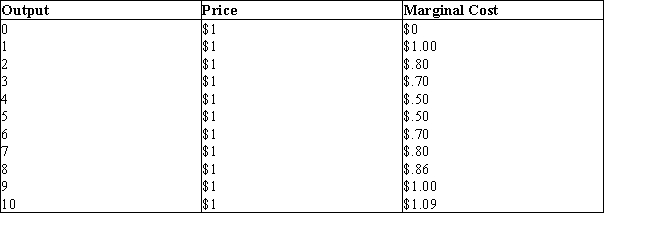
According to the information in Table 10.1, the marginal revenue of the firm:
A)is equal to the marginal cost at each level of output.
B)is equal to price times output.
C)is equal to price times marginal cost.
D)is equal to $1 at all levels of the output.
E)decreases with an increase in output.
According to the information in Table 10.1, the marginal revenue of the firm:
A)is equal to the marginal cost at each level of output.
B)is equal to price times output.
C)is equal to price times marginal cost.
D)is equal to $1 at all levels of the output.
E)decreases with an increase in output.
سؤال
سؤال
The table given below shows the total revenue and total cost of a firm at different levels of output.Table 10.2
Consider the perfectly competitive firm described in Table 10.2. How much profit will the firm make if it is a profit maximizer?
A)$20
B)$45
C)$46
D)$80
E)$50
Consider the perfectly competitive firm described in Table 10.2. How much profit will the firm make if it is a profit maximizer?
A)$20
B)$45
C)$46
D)$80
E)$50
سؤال
The figure given below shows the revenue and cost curves of a perfectly competitive firm.Figure 10.1
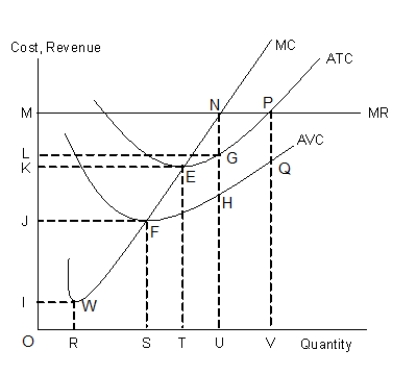
In Figure 10.1, the firm maximizes its profit at _____ units of output.
A)OR
B)OS
C)OT
D)OU
E)OV
In Figure 10.1, the firm maximizes its profit at _____ units of output.
A)OR
B)OS
C)OT
D)OU
E)OV
سؤال
The figure given below shows the revenue and cost curves of a perfectly competitive firm.Figure 10.1
If the price of the output produced by a perfectly competitive firm increases, then:
A)the marginal-cost curve will shift up.
B)the demand curve faced by the firm will shift to the left.
C)marginal cost will fall as output declines.
D)the marginal-revenue curve for the firm will shift up.
E)the marginal-cost curve for the firm will shift down.
If the price of the output produced by a perfectly competitive firm increases, then:
A)the marginal-cost curve will shift up.
B)the demand curve faced by the firm will shift to the left.
C)marginal cost will fall as output declines.
D)the marginal-revenue curve for the firm will shift up.
E)the marginal-cost curve for the firm will shift down.
سؤال
The table given below shows the price of each unit of the product manufactured by a firm and the marginal cost of producing different units of the output.Table: 10.1
A firm's total revenue is $400 for 8 units of output, $600 for 12 units of output, and $1,100 for 22 units of output. Evidently this firm is operating in a(n):
A)perfectly competitive market.
B)monopolistic market.
C)monopsonist market.
D)monopolistically competitive market.
E)oligopolistic market.
A firm's total revenue is $400 for 8 units of output, $600 for 12 units of output, and $1,100 for 22 units of output. Evidently this firm is operating in a(n):
A)perfectly competitive market.
B)monopolistic market.
C)monopsonist market.
D)monopolistically competitive market.
E)oligopolistic market.
سؤال
The figure given below shows the revenue and cost curves of a perfectly competitive firm.Figure 10.1
In Figure 10.1, the firm's profit is equal to the area:
A)OIWR.
B)JKEF
C)OKET
D)LMNG
E)OJFS
In Figure 10.1, the firm's profit is equal to the area:
A)OIWR.
B)JKEF
C)OKET
D)LMNG
E)OJFS
سؤال
The table given below shows the price of each unit of the product manufactured by a firm and the marginal cost of producing different units of the output.Table: 10.1
According to the information in Table 10.1, this firm will maximize profit when total output is equal to _____ units.
A)nine
B)eight
C)seven
D)six
E)five
According to the information in Table 10.1, this firm will maximize profit when total output is equal to _____ units.
A)nine
B)eight
C)seven
D)six
E)five
سؤال
The figure given below shows the revenue and cost curves of a perfectly competitive firm.Figure 10.1
In Figure 10.1, average fixed cost, at the profit-maximizing level of output, is equal to ______.
A)UH
B)UG
C)GH
D)UN
E)HN
In Figure 10.1, average fixed cost, at the profit-maximizing level of output, is equal to ______.
A)UH
B)UG
C)GH
D)UN
E)HN
سؤال
The figure given below shows the revenue and cost curves of a perfectly competitive firm.Figure 10.1
If in the short run, at the profit maximizing level of output, the average revenue curve of a competitive firm lies above the average cost curve then:
A)the firm is incurring losses.
B)the firm is just able to cover its total cost.
C)the firm enjoys above-normal profits.
D)the firm must shut down.
E)the firm is barely able to cover its variable costs.
If in the short run, at the profit maximizing level of output, the average revenue curve of a competitive firm lies above the average cost curve then:
A)the firm is incurring losses.
B)the firm is just able to cover its total cost.
C)the firm enjoys above-normal profits.
D)the firm must shut down.
E)the firm is barely able to cover its variable costs.
سؤال
The table given below shows the total revenue and total cost of a firm at different levels of output.Table 10.2
Consider the perfectly competitive firm described in Table 10.2. How many units of the good should the firm produce to maximize profit?
A)16 units
B)17 units
C)18 units
D)19 units
E)20 units
Consider the perfectly competitive firm described in Table 10.2. How many units of the good should the firm produce to maximize profit?
A)16 units
B)17 units
C)18 units
D)19 units
E)20 units
سؤال
The table given below shows the price of each unit of the product manufactured by a firm and the marginal cost of producing different units of the output.Table: 10.1
In which of the following situations will the profit of a perfectly competitive firm always increase with an increases in its output?
A)When price is greater than marginal revenue
B)When price is less than marginal revenue
C)When price is greater than marginal cost
D)When price is less than marginal cost
E)When price is equal to marginal cost
In which of the following situations will the profit of a perfectly competitive firm always increase with an increases in its output?
A)When price is greater than marginal revenue
B)When price is less than marginal revenue
C)When price is greater than marginal cost
D)When price is less than marginal cost
E)When price is equal to marginal cost
سؤال
The table given below shows the price of each unit of the product manufactured by a firm and the marginal cost of producing different units of the output.Table: 10.1
Refer to Table 10.1. If the market price of the good falls to $0.80 per unit, the firm:
A)should decrease its output to six units, in order to maximize profit.
B)should decrease its output to seven units, in order to maximize profit.
C)should increase its output to ten units, in order to maximize profit.
D)should decrease its output to four units, in order to maximize profit.
E)should keep its output level unchanged, in order to maximize profit.
Refer to Table 10.1. If the market price of the good falls to $0.80 per unit, the firm:
A)should decrease its output to six units, in order to maximize profit.
B)should decrease its output to seven units, in order to maximize profit.
C)should increase its output to ten units, in order to maximize profit.
D)should decrease its output to four units, in order to maximize profit.
E)should keep its output level unchanged, in order to maximize profit.
سؤال
The figure given below shows the revenue and cost curves of a perfectly competitive firm.Figure 10.1
Suppose a perfectly competitive firm's total revenue is equal to $210 and its output is 70 units, when its marginal-cost curve intersects the marginal-revenue curve. What is the marginal revenue earned by the firm?
A)$15
B)$3
C)$30
D)$7
E)$70
Suppose a perfectly competitive firm's total revenue is equal to $210 and its output is 70 units, when its marginal-cost curve intersects the marginal-revenue curve. What is the marginal revenue earned by the firm?
A)$15
B)$3
C)$30
D)$7
E)$70
سؤال
The figure given below shows the revenue and cost curves of a perfectly competitive firm.Figure 10.1
A perfectly competitive firm produces 50 units of output, at equilibrium, in the short run. The total cost borne by the firm is $300 and the average revenue is $2. Therefore, the firm:
A)is just breaking even.
B)is earning positive profits.
C)is facing a positively sloped demand curve.
D)is suffering losses.
E)is experiencing diseconomies of scale.
A perfectly competitive firm produces 50 units of output, at equilibrium, in the short run. The total cost borne by the firm is $300 and the average revenue is $2. Therefore, the firm:
A)is just breaking even.
B)is earning positive profits.
C)is facing a positively sloped demand curve.
D)is suffering losses.
E)is experiencing diseconomies of scale.
سؤال
The table given below shows the total revenue and total cost of a firm at different levels of output.Table 10.2
To maximize profits in the short run, a perfectly competitive firm will produce the output at which:
A)marginal revenue equals demand.
B)price equals marginal revenue.
C)price equals marginal cost.
D)marginal revenue equals average total cost.
E)total revenue equals total cost.
To maximize profits in the short run, a perfectly competitive firm will produce the output at which:
A)marginal revenue equals demand.
B)price equals marginal revenue.
C)price equals marginal cost.
D)marginal revenue equals average total cost.
E)total revenue equals total cost.
سؤال
The table given below shows the price of each unit of the product manufactured by a firm and the marginal cost of producing different units of the output.Table: 10.1
Refer to Table 10.1. The firm depicted in the table is a(n):
A)monopolist.
B)oligopolist.
C)monopolistically competitive firm.
D)perfectly competitive firm.
E)monopsonist.
Refer to Table 10.1. The firm depicted in the table is a(n):
A)monopolist.
B)oligopolist.
C)monopolistically competitive firm.
D)perfectly competitive firm.
E)monopsonist.
سؤال
The figure given below shows the revenue and cost curves of a perfectly competitive firm.Figure 10.1
A perfectly competitive firm incurs a loss in the short run, if at the profit maximizing level of output:
A)the marginal revenue curve lies below the marginal cost curve.
B)the marginal revenue curve lies above the average revenue curve.
C)the average cost curve lies below the average revenue curve.
D)the average revenue curve lies below the average cost curve.
E)the marginal revenue curve lies above the marginal cost curve.
A perfectly competitive firm incurs a loss in the short run, if at the profit maximizing level of output:
A)the marginal revenue curve lies below the marginal cost curve.
B)the marginal revenue curve lies above the average revenue curve.
C)the average cost curve lies below the average revenue curve.
D)the average revenue curve lies below the average cost curve.
E)the marginal revenue curve lies above the marginal cost curve.
سؤال
The table given below shows the total revenue and total cost of a firm at different levels of output.Table 10.2
Given a perfectly competitive market structure, at the profit-maximizing output level, a firm's total fixed cost is $10, total variable cost is $100, marginal revenue is $4, and the quantity demanded is 50. The total profit earned by the firm is:
A)$70.
B)$65.
C)$90.
D)$75.
Given a perfectly competitive market structure, at the profit-maximizing output level, a firm's total fixed cost is $10, total variable cost is $100, marginal revenue is $4, and the quantity demanded is 50. The total profit earned by the firm is:
A)$70.
B)$65.
C)$90.
D)$75.
سؤال
The figure given below shows the revenue and the cost curves of a perfectly competitive firm.Figure 10.3
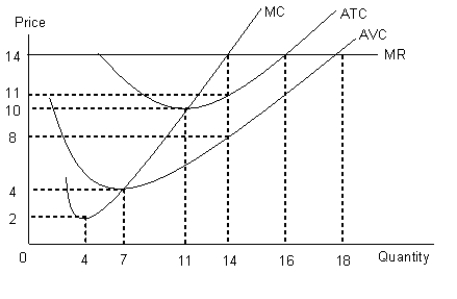
In Figure 10.3, the firm will have to suspend its operations if the price falls below _____.
A)$2
B)$4
C)$10
D)$11
E)$14
In Figure 10.3, the firm will have to suspend its operations if the price falls below _____.
A)$2
B)$4
C)$10
D)$11
E)$14
سؤال
The figure given below shows the revenue and cost curves of a perfectly competitive firm.Figure 10.2
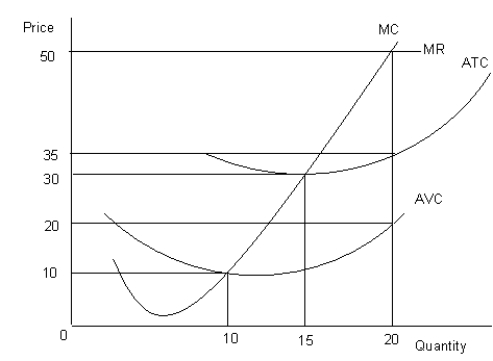 MC: Marginal cost curve
MR: Marginal revenue curve
ATC: Average-total-cost curve
AVC: Average-variable-cost curve
Refer to Figure 10.2. The firm will suspend production if the price falls below:
A)$30.
B)$50.
C)$10.
D)$20.
E)$35.
MC: Marginal cost curveMR: Marginal revenue curve
ATC: Average-total-cost curve
AVC: Average-variable-cost curve
Refer to Figure 10.2. The firm will suspend production if the price falls below:
A)$30.
B)$50.
C)$10.
D)$20.
E)$35.
سؤال
The figure given below shows the revenue and cost curves of a perfectly competitive firm.Figure 10.2
MC: Marginal cost curve
MR: Marginal revenue curve
ATC: Average-total-cost curve
AVC: Average-variable-cost curve
Refer to Figure 10.2. What is the firm's total fixed cost at the profit-maximizing output level?
A)$400
B)$300
C)$600
D)$450
E)$500
MC: Marginal cost curveMR: Marginal revenue curve
ATC: Average-total-cost curve
AVC: Average-variable-cost curve
Refer to Figure 10.2. What is the firm's total fixed cost at the profit-maximizing output level?
A)$400
B)$300
C)$600
D)$450
E)$500
سؤال
The figure given below shows the revenue and cost curves of a perfectly competitive firm.Figure 10.2
MC: Marginal cost curve
MR: Marginal revenue curve
ATC: Average-total-cost curve
AVC: Average-variable-cost curve
Refer to Figure 10.2. If the market price falls to $10, the firm would produce:
A)nothing.
B)15 units.
C)5 units.
D)10 units.
E)20 units.
MC: Marginal cost curveMR: Marginal revenue curve
ATC: Average-total-cost curve
AVC: Average-variable-cost curve
Refer to Figure 10.2. If the market price falls to $10, the firm would produce:
A)nothing.
B)15 units.
C)5 units.
D)10 units.
E)20 units.
سؤال
The figure given below shows the revenue and cost curves of a perfectly competitive firm.Figure 10.2
MC: Marginal cost curve
MR: Marginal revenue curve
ATC: Average-total-cost curve
AVC: Average-variable-cost curve
In the short run, a firm continues to produce only if it can cover the:
A)fixed costs.
B)sunk costs.
C)explicit costs.
D)variable costs.
E)implicit costs.
MC: Marginal cost curveMR: Marginal revenue curve
ATC: Average-total-cost curve
AVC: Average-variable-cost curve
In the short run, a firm continues to produce only if it can cover the:
A)fixed costs.
B)sunk costs.
C)explicit costs.
D)variable costs.
E)implicit costs.
سؤال
The figure given below shows the revenue and cost curves of a perfectly competitive firm.Figure 10.1
A firm whose price is below its average cost:
A)is earning negative economic profit.
B)is earning positive economic profit.
C)is just breaking even.
D)is earning zero economic profit.
E)is earning zero accounting profit.
A firm whose price is below its average cost:
A)is earning negative economic profit.
B)is earning positive economic profit.
C)is just breaking even.
D)is earning zero economic profit.
E)is earning zero accounting profit.
سؤال
The figure given below shows the revenue and the cost curves of a perfectly competitive firm.Figure 10.3
Refer to Figure 10.3 and calculate the firm's total revenue at the profit maximizing level of output.
A)$200
B)$169
C)$196
D)$225
E)$154
Refer to Figure 10.3 and calculate the firm's total revenue at the profit maximizing level of output.
A)$200
B)$169
C)$196
D)$225
E)$154
سؤال
The figure given below shows the revenue and cost curves of a perfectly competitive firm.Figure 10.1
Suppose that in a perfectly competitive market, the market supply of a good increases. As a result, the individual firm's:
A)supply curve would shift outward and the firm would increase output.
B)supply curve would shift inward and the firm would decrease output.
C)average-total-cost curve would shift upward and the firm would increase output.
D)marginal-revenue curve would shift upward and the firm would increase output.
E)marginal-revenue curve would shift downward and the firm would decrease output.
Suppose that in a perfectly competitive market, the market supply of a good increases. As a result, the individual firm's:
A)supply curve would shift outward and the firm would increase output.
B)supply curve would shift inward and the firm would decrease output.
C)average-total-cost curve would shift upward and the firm would increase output.
D)marginal-revenue curve would shift upward and the firm would increase output.
E)marginal-revenue curve would shift downward and the firm would decrease output.
سؤال
The figure given below shows the revenue and the cost curves of a perfectly competitive firm.Figure 10.3
Refer to Figure 10.3 and calculate the total fixed cost borne by the firm at the profit maximizing level of the output.
A)$28
B)$84
C)$70
D)$56
E)$42
Refer to Figure 10.3 and calculate the total fixed cost borne by the firm at the profit maximizing level of the output.
A)$28
B)$84
C)$70
D)$56
E)$42
سؤال
The figure given below shows the revenue and cost curves of a perfectly competitive firm.Figure 10.2
MC: Marginal cost curve
MR: Marginal revenue curve
ATC: Average-total-cost curve
AVC: Average-variable-cost curve
A perfectly competitive firm decides to shut down if:
A)the price falls below the average-total-cost.
B)average revenue falls below the average-variable-cost.
C)the price falls below the marginal cost.
D)the average revenue curve lies below the marginal cost curve.
E)the total revenue is less than total cost.
MC: Marginal cost curveMR: Marginal revenue curve
ATC: Average-total-cost curve
AVC: Average-variable-cost curve
A perfectly competitive firm decides to shut down if:
A)the price falls below the average-total-cost.
B)average revenue falls below the average-variable-cost.
C)the price falls below the marginal cost.
D)the average revenue curve lies below the marginal cost curve.
E)the total revenue is less than total cost.
سؤال
The figure given below shows the revenue and cost curves of a perfectly competitive firm.Figure 10.2
MC: Marginal cost curve
MR: Marginal revenue curve
ATC: Average-total-cost curve
AVC: Average-variable-cost curve
Refer to Figure 10.2. Compute the profit earned by the firm at the profit-maximizing level of output.
A)$300
B)$450
C)$700
D)$500
E)$350
MC: Marginal cost curveMR: Marginal revenue curve
ATC: Average-total-cost curve
AVC: Average-variable-cost curve
Refer to Figure 10.2. Compute the profit earned by the firm at the profit-maximizing level of output.
A)$300
B)$450
C)$700
D)$500
E)$350
سؤال
The figure given below shows the revenue and cost curves of a perfectly competitive firm.Figure 10.2
MC: Marginal cost curve
MR: Marginal revenue curve
ATC: Average-total-cost curve
AVC: Average-variable-cost curve
According to Figure 10.2, the break-even price of the firm is:
A)$30.
B)$50.
C)$20.
D)$10.
E)$35.
MC: Marginal cost curveMR: Marginal revenue curve
ATC: Average-total-cost curve
AVC: Average-variable-cost curve
According to Figure 10.2, the break-even price of the firm is:
A)$30.
B)$50.
C)$20.
D)$10.
E)$35.
سؤال
The figure given below shows the revenue and cost curves of a perfectly competitive firm.Figure 10.2
MC: Marginal cost curve
MR: Marginal revenue curve
ATC: Average-total-cost curve
AVC: Average-variable-cost curve
Refer to Figure 10.2. What is the profit-maximizing price and output level?
A)$35 and 10 units
B)$50 and 15 units
C)$50 and 20 units
D)$20 and 20 units
E)$35 and 20 units
MC: Marginal cost curveMR: Marginal revenue curve
ATC: Average-total-cost curve
AVC: Average-variable-cost curve
Refer to Figure 10.2. What is the profit-maximizing price and output level?
A)$35 and 10 units
B)$50 and 15 units
C)$50 and 20 units
D)$20 and 20 units
E)$35 and 20 units
سؤال
The figure given below shows the revenue and the cost curves of a perfectly competitive firm.Figure 10.3
In Figure 10.3, at equilibrium, the firm enjoys a profit of:
A)$69.
B)$42.
C)$60.
D)$27.
E)$48.
In Figure 10.3, at equilibrium, the firm enjoys a profit of:
A)$69.
B)$42.
C)$60.
D)$27.
E)$48.
سؤال
The figure given below shows the revenue and cost curves of a perfectly competitive firm.Figure 10.1
In the short run, if the marginal cost exceeds the marginal revenue, a perfectly competitive firm should:
A)raise the level of output to maximize profit.
B)keep the level of output constant.
C)raise the level of output to minimize loss.
D)reduce the level of output to minimize loss.
E)shut down.
In the short run, if the marginal cost exceeds the marginal revenue, a perfectly competitive firm should:
A)raise the level of output to maximize profit.
B)keep the level of output constant.
C)raise the level of output to minimize loss.
D)reduce the level of output to minimize loss.
E)shut down.
سؤال
The figure given below shows the revenue and cost curves of a perfectly competitive firm.Figure 10.1
At an output level above the profit-maximizing level, for a perfectly competitive firm, a reduction in output will:
A)reduce total revenue more than total cost.
B)reduce total cost more than total revenue.
C)increase total revenue more than total cost.
D)increase total cost more than total revenue.
E)decrease total revenue and total cost by the same amount.
At an output level above the profit-maximizing level, for a perfectly competitive firm, a reduction in output will:
A)reduce total revenue more than total cost.
B)reduce total cost more than total revenue.
C)increase total revenue more than total cost.
D)increase total cost more than total revenue.
E)decrease total revenue and total cost by the same amount.
سؤال
The figure given below shows the revenue and cost curves of a perfectly competitive firm.Figure 10.2
MC: Marginal cost curve
MR: Marginal revenue curve
ATC: Average-total-cost curve
AVC: Average-variable-cost curve
The minimum point of the _____ curve is called the shutdown price.
A)average-fixed-cost
B)marginal cost
C)average -total-cost
D)total fixed cost
E)average-variable-cost
MC: Marginal cost curveMR: Marginal revenue curve
ATC: Average-total-cost curve
AVC: Average-variable-cost curve
The minimum point of the _____ curve is called the shutdown price.
A)average-fixed-cost
B)marginal cost
C)average -total-cost
D)total fixed cost
E)average-variable-cost
سؤال
The figure given below shows the revenue and cost curves of a perfectly competitive firm.Figure 10.2
MC: Marginal cost curve
MR: Marginal revenue curve
ATC: Average-total-cost curve
AVC: Average-variable-cost curve
Refer to Figure 10.2. If the marginal-revenue curve would have intersected the average-total-cost curve at its lowest point and the firm maximized profit, then total revenue would have been equal to:
A)$500.
B)$550.
C)$600.
D)$450.
E)$400.
MC: Marginal cost curveMR: Marginal revenue curve
ATC: Average-total-cost curve
AVC: Average-variable-cost curve
Refer to Figure 10.2. If the marginal-revenue curve would have intersected the average-total-cost curve at its lowest point and the firm maximized profit, then total revenue would have been equal to:
A)$500.
B)$550.
C)$600.
D)$450.
E)$400.
سؤال
The figure given below shows the revenue and cost curves of a perfectly competitive firm.Figure 10.2
MC: Marginal cost curve
MR: Marginal revenue curve
ATC: Average-total-cost curve
AVC: Average-variable-cost curve
Refer to Figure 10.2. If the marginal-revenue curve would have intersected the average-total-cost curve at the latter's lowest point and the firm maximized profit, then total profit would have been equal to:
A)$30.
B)zero.
C)-$10.
D)$20.
E)-$20.
MC: Marginal cost curveMR: Marginal revenue curve
ATC: Average-total-cost curve
AVC: Average-variable-cost curve
Refer to Figure 10.2. If the marginal-revenue curve would have intersected the average-total-cost curve at the latter's lowest point and the firm maximized profit, then total profit would have been equal to:
A)$30.
B)zero.
C)-$10.
D)$20.
E)-$20.
سؤال
The figure given below shows the revenue and the cost curves of a perfectly competitive firm.Figure 10.3
In Figure 10.3, the profit maximizing output of the firm is _____ units.
A)4
B)16
C)11
D)7
E)14
In Figure 10.3, the profit maximizing output of the firm is _____ units.
A)4
B)16
C)11
D)7
E)14
سؤال
The figure given below shows the revenue and cost curves of a perfectly competitive firm.Figure 10.5
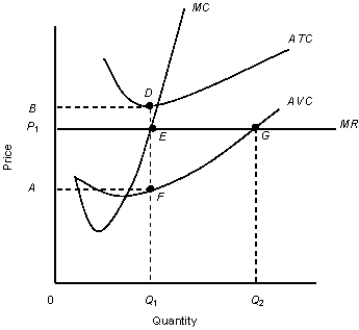 MC: Marginal cost curve
MR: Marginal revenue curve.ATC: Average-total-cost curve
AVC: Average-variable-cost curve
If a profit-maximizing, perfectly competitive firm is producing at a loss in the short run, then it implies that:
A)marginal revenue must be less than marginal cost.
B)price must be less than the average variable cost.
C)price must be less than average total cost but greater than average variable cost.
D)the average revenue curve must lie below the average variable cost curve but above the average fixed cost curve.
E)price must be less than both average variable cost and average fixed cost.
MC: Marginal cost curveMR: Marginal revenue curve.ATC: Average-total-cost curve
AVC: Average-variable-cost curve
If a profit-maximizing, perfectly competitive firm is producing at a loss in the short run, then it implies that:
A)marginal revenue must be less than marginal cost.
B)price must be less than the average variable cost.
C)price must be less than average total cost but greater than average variable cost.
D)the average revenue curve must lie below the average variable cost curve but above the average fixed cost curve.
E)price must be less than both average variable cost and average fixed cost.
سؤال
The figure given below shows the revenue and the cost curves of a perfectly competitive firm.Figure 10.3
Refer to Figure 10.3 and identify the price level at which the firm earns normal profit.
A)$4
B)$8
C)$10
D)$2
E)$14
Refer to Figure 10.3 and identify the price level at which the firm earns normal profit.
A)$4
B)$8
C)$10
D)$2
E)$14
سؤال
The figure given below shows the revenue and cost curves of a perfectly competitive firm.Figure 10.5
MC: Marginal cost curve
MR: Marginal revenue curve.ATC: Average-total-cost curve
AVC: Average-variable-cost curve
When revenue is less than total cost but more than variable cost it implies that:
A)the firm is enjoying positive economic profits.
B)the firm is earning normal profits.
C)the firm can cover its variable cost and a part of its fixed costs.
D)the firm is unable to cover its costs and should shut down.
E)the firm is able to cover both its fixed and variable costs.
MC: Marginal cost curveMR: Marginal revenue curve.ATC: Average-total-cost curve
AVC: Average-variable-cost curve
When revenue is less than total cost but more than variable cost it implies that:
A)the firm is enjoying positive economic profits.
B)the firm is earning normal profits.
C)the firm can cover its variable cost and a part of its fixed costs.
D)the firm is unable to cover its costs and should shut down.
E)the firm is able to cover both its fixed and variable costs.
سؤال
The figure given below shows the revenue and cost curves of a perfectly competitive firm.Figure 10.5
MC: Marginal cost curve
MR: Marginal revenue curve.ATC: Average-total-cost curve
AVC: Average-variable-cost curve
Since the beginning of the millennium, the United States has witnessed closure of many Internet start-up companies. According to the model of perfect competition, these companies must have shut down in the short run because:
A)the price they were charging was too high to attract customers.
B)the price they were charging was too low to provide sufficient revenues.
C)they were not earning enough revenue to cover their total costs.
D)they were not earning enough revenue to cover their total variable costs.
E)they were not earning enough revenue to cover their total fixed costs.
MC: Marginal cost curveMR: Marginal revenue curve.ATC: Average-total-cost curve
AVC: Average-variable-cost curve
Since the beginning of the millennium, the United States has witnessed closure of many Internet start-up companies. According to the model of perfect competition, these companies must have shut down in the short run because:
A)the price they were charging was too high to attract customers.
B)the price they were charging was too low to provide sufficient revenues.
C)they were not earning enough revenue to cover their total costs.
D)they were not earning enough revenue to cover their total variable costs.
E)they were not earning enough revenue to cover their total fixed costs.
سؤال
The figure given below shows the demand and cost curves of a perfectly competitive firm.Figure: 10.4
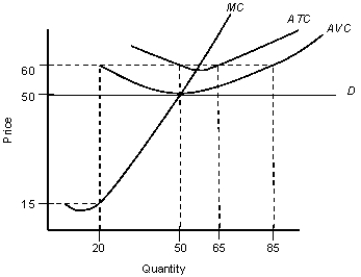 D: Demand curve
MC: Marginal cost curve
ATC: Average-total cost curve
AVC: Average-variable-cost curve
Suppose a firm in a perfectly competitive market is operating at its profit-maximizing level of output. Will the firm suspend operations if it faces a reduction in the price it can charge for its product?
A)No, because it can always raise its prices in the short run.
B)No, because it can always raise its prices in the long run.
C)No, as long as the firm earns sufficient revenue to pay all of the variable costs.
D)Yes, since it never makes sense to operate at a loss, even in the short run.
E)No, because it always makes sense to operate at a loss, even in the long run.
D: Demand curveMC: Marginal cost curve
ATC: Average-total cost curve
AVC: Average-variable-cost curve
Suppose a firm in a perfectly competitive market is operating at its profit-maximizing level of output. Will the firm suspend operations if it faces a reduction in the price it can charge for its product?
A)No, because it can always raise its prices in the short run.
B)No, because it can always raise its prices in the long run.
C)No, as long as the firm earns sufficient revenue to pay all of the variable costs.
D)Yes, since it never makes sense to operate at a loss, even in the short run.
E)No, because it always makes sense to operate at a loss, even in the long run.
سؤال
The figure given below shows the demand and cost curves of a perfectly competitive firm.Figure: 10.4
D: Demand curve
MC: Marginal cost curve
ATC: Average-total cost curve
AVC: Average-variable-cost curve
According to Figure 10.4, the firm's shutdown price is:
A)above $60.
B)$60.
C)$50.
D)between $50 and $60.
E)less than $15.
D: Demand curveMC: Marginal cost curve
ATC: Average-total cost curve
AVC: Average-variable-cost curve
According to Figure 10.4, the firm's shutdown price is:
A)above $60.
B)$60.
C)$50.
D)between $50 and $60.
E)less than $15.
سؤال
The figure given below shows the revenue and cost curves of a perfectly competitive firm.Figure 10.5
MC: Marginal cost curve
MR: Marginal revenue curve.ATC: Average-total-cost curve
AVC: Average-variable-cost curve
A firm should not necessarily shut down if:
A)total revenue is less than total variable cost.
B)firms suffer losses and the price is above variable costs.
C)the demand curve facing the firm lies below its average variable cost curve.
D)price is less than average variable cost.
E)firms suffer losses and the price is below variable costs.
MC: Marginal cost curveMR: Marginal revenue curve.ATC: Average-total-cost curve
AVC: Average-variable-cost curve
A firm should not necessarily shut down if:
A)total revenue is less than total variable cost.
B)firms suffer losses and the price is above variable costs.
C)the demand curve facing the firm lies below its average variable cost curve.
D)price is less than average variable cost.
E)firms suffer losses and the price is below variable costs.
سؤال
The figure given below shows the revenue and cost curves of a perfectly competitive firm.Figure 10.5
MC: Marginal cost curve
MR: Marginal revenue curve.ATC: Average-total-cost curve
AVC: Average-variable-cost curve
For a perfectly competitive firm, in the short run, which of the following statements is true?
A)A price above minimum average variable cost, but below average total cost will produce an economic profit.
B)A price below minimum average variable cost will cause the firm to shut down.
C)Marginal cost is parallel to the axis showing quantity of output.
D)Price is always greater than marginal revenue.
E)Every firm contributes a significant amount to the total market output.
MC: Marginal cost curveMR: Marginal revenue curve.ATC: Average-total-cost curve
AVC: Average-variable-cost curve
For a perfectly competitive firm, in the short run, which of the following statements is true?
A)A price above minimum average variable cost, but below average total cost will produce an economic profit.
B)A price below minimum average variable cost will cause the firm to shut down.
C)Marginal cost is parallel to the axis showing quantity of output.
D)Price is always greater than marginal revenue.
E)Every firm contributes a significant amount to the total market output.
سؤال
The figure given below shows the demand and cost curves of a perfectly competitive firm.Figure: 10.4
D: Demand curve
MC: Marginal cost curve
ATC: Average-total cost curve
AVC: Average-variable-cost curve
Refer to Figure 10.4. The presence of the average-variable-cost curve suggests that the firm is operating:
A)in the short run.
B)in the long run.
C)at a break-even point.
D)in a monopoly.
E)at a zero profit.
D: Demand curveMC: Marginal cost curve
ATC: Average-total cost curve
AVC: Average-variable-cost curve
Refer to Figure 10.4. The presence of the average-variable-cost curve suggests that the firm is operating:
A)in the short run.
B)in the long run.
C)at a break-even point.
D)in a monopoly.
E)at a zero profit.
سؤال
The figure given below shows the demand and cost curves of a perfectly competitive firm.Figure: 10.4
D: Demand curve
MC: Marginal cost curve
ATC: Average-total cost curve
AVC: Average-variable-cost curve
In the short run, certain costs, such as rent on land and equipment, must be paid whether or not any output is produced. These are:
A)the firm's variable costs.
B)the firm's break-even costs.
C)the firm's sunk costs.
D)the firm's marginal costs.
E)the firm's fixed costs.
D: Demand curveMC: Marginal cost curve
ATC: Average-total cost curve
AVC: Average-variable-cost curve
In the short run, certain costs, such as rent on land and equipment, must be paid whether or not any output is produced. These are:
A)the firm's variable costs.
B)the firm's break-even costs.
C)the firm's sunk costs.
D)the firm's marginal costs.
E)the firm's fixed costs.
سؤال
The figure given below shows the revenue and cost curves of a perfectly competitive firm.Figure 10.5
MC: Marginal cost curve
MR: Marginal revenue curve.ATC: Average-total-cost curve
AVC: Average-variable-cost curve
According to Figure 10.5, the firm has:
A)profits equal to the area AP1EF.
B)profits equal to the area P1BDE.
C)losses equal to the area 0AFQ1.
D)losses equal to the area P1BDE.
E)no profit no loss.
MC: Marginal cost curveMR: Marginal revenue curve.ATC: Average-total-cost curve
AVC: Average-variable-cost curve
According to Figure 10.5, the firm has:
A)profits equal to the area AP1EF.
B)profits equal to the area P1BDE.
C)losses equal to the area 0AFQ1.
D)losses equal to the area P1BDE.
E)no profit no loss.
سؤال
The figure given below shows the revenue and cost curves of a perfectly competitive firm.Figure 10.5
MC: Marginal cost curve
MR: Marginal revenue curve.ATC: Average-total-cost curve
AVC: Average-variable-cost curve
In the short run, the firm's break-even point is:
A)the minimum point of the firm's demand curve.
B)the minimum point of the firm's average-total-cost curve.
C)the minimum point of the firm's average-variable-cost curve.
D)the minimum point of the firm's marginal-cost curve.
E)the minimum point on the average-fixed-cost curve.
MC: Marginal cost curveMR: Marginal revenue curve.ATC: Average-total-cost curve
AVC: Average-variable-cost curve
In the short run, the firm's break-even point is:
A)the minimum point of the firm's demand curve.
B)the minimum point of the firm's average-total-cost curve.
C)the minimum point of the firm's average-variable-cost curve.
D)the minimum point of the firm's marginal-cost curve.
E)the minimum point on the average-fixed-cost curve.
سؤال
The figure given below shows the revenue and cost curves of a perfectly competitive firm.Figure 10.5
MC: Marginal cost curve
MR: Marginal revenue curve.ATC: Average-total-cost curve
AVC: Average-variable-cost curve
In the short run, a firm attempting to minimize losses:
A)must leave the industry in order to maximize opportunity costs.
B)will produce as long as marginal cost equals marginal revenue.
C)will produce as long as total revenue exceeds total variable cost.
D)will produce as long as total revenue exceeds total fixed cost.
E)will produce as long as competitors continue to produce.
MC: Marginal cost curveMR: Marginal revenue curve.ATC: Average-total-cost curve
AVC: Average-variable-cost curve
In the short run, a firm attempting to minimize losses:
A)must leave the industry in order to maximize opportunity costs.
B)will produce as long as marginal cost equals marginal revenue.
C)will produce as long as total revenue exceeds total variable cost.
D)will produce as long as total revenue exceeds total fixed cost.
E)will produce as long as competitors continue to produce.
سؤال
The figure given below shows the revenue and cost curves of a perfectly competitive firm.Figure 10.5
MC: Marginal cost curve
MR: Marginal revenue curve.ATC: Average-total-cost curve
AVC: Average-variable-cost curve
The permanent shut down point of a perfectly competitive firm, in the long run, is:
A)the minimum point of the AVC curve.
B)the minimum point of the MC curve.
C)the minimum point of the AR curve.
D)the minimum point of the ATC curve.
E)the minimum point of the AFC curve.
MC: Marginal cost curveMR: Marginal revenue curve.ATC: Average-total-cost curve
AVC: Average-variable-cost curve
The permanent shut down point of a perfectly competitive firm, in the long run, is:
A)the minimum point of the AVC curve.
B)the minimum point of the MC curve.
C)the minimum point of the AR curve.
D)the minimum point of the ATC curve.
E)the minimum point of the AFC curve.
سؤال
The figure given below shows the revenue and cost curves of a perfectly competitive firm.Figure 10.5
MC: Marginal cost curve
MR: Marginal revenue curve.ATC: Average-total-cost curve
AVC: Average-variable-cost curve
In the short-run, a competitive firm is said to break-even if at equilibrium the:
A)price is equal to marginal revenue.
B)price is equal to average revenue.
C)price is equal to average variable cost.
D)price is equal to the average total cost.
E)price is equal to marginal cost.
MC: Marginal cost curveMR: Marginal revenue curve.ATC: Average-total-cost curve
AVC: Average-variable-cost curve
In the short-run, a competitive firm is said to break-even if at equilibrium the:
A)price is equal to marginal revenue.
B)price is equal to average revenue.
C)price is equal to average variable cost.
D)price is equal to the average total cost.
E)price is equal to marginal cost.
سؤال
The figure given below shows the revenue and cost curves of a perfectly competitive firm.Figure 10.5
MC: Marginal cost curve
MR: Marginal revenue curve.ATC: Average-total-cost curve
AVC: Average-variable-cost curve
If a profit-maximizing, perfectly competitive firm is making only a normal profit in the short run, then the firm is in:
A)disequilibrium.
B)equilibrium where MR exceeds minimum ATC.
C)equilibrium where MR equals minimum AVC.
D)equilibrium where P = AFC.
E)equilibrium where P = ATC
MC: Marginal cost curveMR: Marginal revenue curve.ATC: Average-total-cost curve
AVC: Average-variable-cost curve
If a profit-maximizing, perfectly competitive firm is making only a normal profit in the short run, then the firm is in:
A)disequilibrium.
B)equilibrium where MR exceeds minimum ATC.
C)equilibrium where MR equals minimum AVC.
D)equilibrium where P = AFC.
E)equilibrium where P = ATC
سؤال
The figure given below shows the demand and cost curves of a perfectly competitive firm.Figure: 10.4
D: Demand curve
MC: Marginal cost curve
ATC: Average-total cost curve
AVC: Average-variable-cost curve
Some competitive firms are willing to operate at a loss, in the short run, because:
A)their average variable cost is less than the price.
B)their fixed costs are less than their current losses.
C)their average total cost is less than the price.
D)they do not attempt to maximize profits or minimize losses.
E)their revenues are at least able to cover their fixed costs.
D: Demand curveMC: Marginal cost curve
ATC: Average-total cost curve
AVC: Average-variable-cost curve
Some competitive firms are willing to operate at a loss, in the short run, because:
A)their average variable cost is less than the price.
B)their fixed costs are less than their current losses.
C)their average total cost is less than the price.
D)they do not attempt to maximize profits or minimize losses.
E)their revenues are at least able to cover their fixed costs.
سؤال
The figure given below shows the revenue and cost curves of a perfectly competitive firm.Figure 10.5
MC: Marginal cost curve
MR: Marginal revenue curve.ATC: Average-total-cost curve
AVC: Average-variable-cost curve
Assume the price facing the firm in Figure 10.5 is P1.Which of the following statements is true?
A)Total revenue for the firm is area 0BDQ1.
B)The firm should produce Q2.
C)Total cost for the firm is area 0P1EQ1.
D)The firm's total revenue is more than sufficient to cover its variable costs, so it should remain in operation.
E)The firm should shut down because price per unit received is less than average total cost.
MC: Marginal cost curveMR: Marginal revenue curve.ATC: Average-total-cost curve
AVC: Average-variable-cost curve
Assume the price facing the firm in Figure 10.5 is P1.Which of the following statements is true?
A)Total revenue for the firm is area 0BDQ1.
B)The firm should produce Q2.
C)Total cost for the firm is area 0P1EQ1.
D)The firm's total revenue is more than sufficient to cover its variable costs, so it should remain in operation.
E)The firm should shut down because price per unit received is less than average total cost.
سؤال
The figure given below shows the demand and cost curves of a perfectly competitive firm.Figure: 10.4
D: Demand curve
MC: Marginal cost curve
ATC: Average-total cost curve
AVC: Average-variable-cost curve
Refer to Figure 10.4. At the profit-maximizing output level, which of the following is true?
A)The firm is making a profit of $10 per unit.
B)The firm is making a profit of $45 per unit.
C)The firm is losing $35 per unit.
D)The firm is losing $10 per unit.
E)The firm is breaking even.
D: Demand curveMC: Marginal cost curve
ATC: Average-total cost curve
AVC: Average-variable-cost curve
Refer to Figure 10.4. At the profit-maximizing output level, which of the following is true?
A)The firm is making a profit of $10 per unit.
B)The firm is making a profit of $45 per unit.
C)The firm is losing $35 per unit.
D)The firm is losing $10 per unit.
E)The firm is breaking even.
سؤال
The figure given below shows the demand and cost curves of a perfectly competitive firm.Figure: 10.4
D: Demand curve
MC: Marginal cost curve
ATC: Average-total cost curve
AVC: Average-variable-cost curve
Refer to Figure 10.4. The firm faces a total _____ of _____.
A)profit; $500
B)profit; $2,500
C)loss; $2,500
D)loss; $650
E)loss; $500
D: Demand curveMC: Marginal cost curve
ATC: Average-total cost curve
AVC: Average-variable-cost curve
Refer to Figure 10.4. The firm faces a total _____ of _____.
A)profit; $500
B)profit; $2,500
C)loss; $2,500
D)loss; $650
E)loss; $500

فتح الحزمة
قم بالتسجيل لفتح البطاقات في هذه المجموعة!
Unlock Deck
Unlock Deck
1/135

العب

ملء الشاشة (f)
Deck 10: Perfect Competition
1
Scenario 9.2
Consider a publicly held firm (one whose stock shares are traded on the stock exchange) that earned revenue worth $350 million and incurred land, labor, and debt costs worth $320 million. The stockholders who have invested a total of $100 million in this firm could have earned 10 percent return on other comparable investments.
A perfectly competitive producer's demand curve is:
A)a horizontal line.
B)also the market-demand curve.
C)downward sloping but more elastic than the market-demand curve.
D)a vertical line.
E)upward sloping.
Consider a publicly held firm (one whose stock shares are traded on the stock exchange) that earned revenue worth $350 million and incurred land, labor, and debt costs worth $320 million. The stockholders who have invested a total of $100 million in this firm could have earned 10 percent return on other comparable investments.
A perfectly competitive producer's demand curve is:
A)a horizontal line.
B)also the market-demand curve.
C)downward sloping but more elastic than the market-demand curve.
D)a vertical line.
E)upward sloping.
a horizontal line.
2
Scenario 9.2
Consider a publicly held firm (one whose stock shares are traded on the stock exchange) that earned revenue worth $350 million and incurred land, labor, and debt costs worth $320 million. The stockholders who have invested a total of $100 million in this firm could have earned 10 percent return on other comparable investments.
One assumption of the model of perfect competition is that entry into the market is easy. This implies that:
A)there are government licensing requirements for a firm to enter the market.
B)there are no significant economies of scale relative to the size of the market.
C)one firm has gained a patent in the industry.
D)significant economies of scale do exist in the industry.
E)there is no government intervention.
Consider a publicly held firm (one whose stock shares are traded on the stock exchange) that earned revenue worth $350 million and incurred land, labor, and debt costs worth $320 million. The stockholders who have invested a total of $100 million in this firm could have earned 10 percent return on other comparable investments.
One assumption of the model of perfect competition is that entry into the market is easy. This implies that:
A)there are government licensing requirements for a firm to enter the market.
B)there are no significant economies of scale relative to the size of the market.
C)one firm has gained a patent in the industry.
D)significant economies of scale do exist in the industry.
E)there is no government intervention.
there are no significant economies of scale relative to the size of the market.
3
Scenario 9.2
Consider a publicly held firm (one whose stock shares are traded on the stock exchange) that earned revenue worth $350 million and incurred land, labor, and debt costs worth $320 million. The stockholders who have invested a total of $100 million in this firm could have earned 10 percent return on other comparable investments.
At the profit-maximizing output level, an increase in price by a perfectly competitive firm will:
A)cause an increase in profits.
B)reduce total cost more than total revenue.
C)increase total revenue more than total cost.
D)increase total cost more than total revenue.
E)cause the firm to lose all of its sales.
Consider a publicly held firm (one whose stock shares are traded on the stock exchange) that earned revenue worth $350 million and incurred land, labor, and debt costs worth $320 million. The stockholders who have invested a total of $100 million in this firm could have earned 10 percent return on other comparable investments.
At the profit-maximizing output level, an increase in price by a perfectly competitive firm will:
A)cause an increase in profits.
B)reduce total cost more than total revenue.
C)increase total revenue more than total cost.
D)increase total cost more than total revenue.
E)cause the firm to lose all of its sales.
cause the firm to lose all of its sales.
4
Scenario 9.2
Consider a publicly held firm (one whose stock shares are traded on the stock exchange) that earned revenue worth $350 million and incurred land, labor, and debt costs worth $320 million. The stockholders who have invested a total of $100 million in this firm could have earned 10 percent return on other comparable investments.
If a firm in a perfectly competitive market raises its price:
A)it will sell less but earn more revenue.
B)it will sell less but earn the same revenue.
C)it will sell exactly the same amount.
D)it will sell less or more depending on elasticity.
E)it will sell nothing.
Consider a publicly held firm (one whose stock shares are traded on the stock exchange) that earned revenue worth $350 million and incurred land, labor, and debt costs worth $320 million. The stockholders who have invested a total of $100 million in this firm could have earned 10 percent return on other comparable investments.
If a firm in a perfectly competitive market raises its price:
A)it will sell less but earn more revenue.
B)it will sell less but earn the same revenue.
C)it will sell exactly the same amount.
D)it will sell less or more depending on elasticity.
E)it will sell nothing.
فتح الحزمة
افتح القفل للوصول البطاقات البالغ عددها 135 في هذه المجموعة.
فتح الحزمة
k this deck
5
Scenario 9.2
Consider a publicly held firm (one whose stock shares are traded on the stock exchange) that earned revenue worth $350 million and incurred land, labor, and debt costs worth $320 million. The stockholders who have invested a total of $100 million in this firm could have earned 10 percent return on other comparable investments.
Quickie Inc., a perfectly competitive firm, currently maximizes profit by producing 400 units of output. If its marginal cost is equal to $25 and its average total cost is $20, then how much is it earning in economic profit?
A)Economic profit is always equal to zero in perfect competition.
B)$10,000
C)$8,000
D)$2,000
E)$4,000
Consider a publicly held firm (one whose stock shares are traded on the stock exchange) that earned revenue worth $350 million and incurred land, labor, and debt costs worth $320 million. The stockholders who have invested a total of $100 million in this firm could have earned 10 percent return on other comparable investments.
Quickie Inc., a perfectly competitive firm, currently maximizes profit by producing 400 units of output. If its marginal cost is equal to $25 and its average total cost is $20, then how much is it earning in economic profit?
A)Economic profit is always equal to zero in perfect competition.
B)$10,000
C)$8,000
D)$2,000
E)$4,000
فتح الحزمة
افتح القفل للوصول البطاقات البالغ عددها 135 في هذه المجموعة.
فتح الحزمة
k this deck
6
Scenario 9.2
Consider a publicly held firm (one whose stock shares are traded on the stock exchange) that earned revenue worth $350 million and incurred land, labor, and debt costs worth $320 million. The stockholders who have invested a total of $100 million in this firm could have earned 10 percent return on other comparable investments.
Which of the following statements concerning perfect competition is not true?
A)Firms are price takers.
B)The demand curve facing an individual firm is horizontal.
C)A firm's demand curve is identical to its marginal revenue curve.
D)The firms produce differentiated products.
E)If a firm raises its price, it will lose all of its customers.
Consider a publicly held firm (one whose stock shares are traded on the stock exchange) that earned revenue worth $350 million and incurred land, labor, and debt costs worth $320 million. The stockholders who have invested a total of $100 million in this firm could have earned 10 percent return on other comparable investments.
Which of the following statements concerning perfect competition is not true?
A)Firms are price takers.
B)The demand curve facing an individual firm is horizontal.
C)A firm's demand curve is identical to its marginal revenue curve.
D)The firms produce differentiated products.
E)If a firm raises its price, it will lose all of its customers.
فتح الحزمة
افتح القفل للوصول البطاقات البالغ عددها 135 في هذه المجموعة.
فتح الحزمة
k this deck
7
Scenario 9.2
Consider a publicly held firm (one whose stock shares are traded on the stock exchange) that earned revenue worth $350 million and incurred land, labor, and debt costs worth $320 million. The stockholders who have invested a total of $100 million in this firm could have earned 10 percent return on other comparable investments.
Which of the following statements characterizes perfect competition?
A)Producers enjoy complete freedom of entry and exit from the industry.
B)Producers sell differentiated products.
C)Producers are price makers.
D)Consumers are price makers.
E)The firm is not free to choose the quantity that it wishes to produce.
Consider a publicly held firm (one whose stock shares are traded on the stock exchange) that earned revenue worth $350 million and incurred land, labor, and debt costs worth $320 million. The stockholders who have invested a total of $100 million in this firm could have earned 10 percent return on other comparable investments.
Which of the following statements characterizes perfect competition?
A)Producers enjoy complete freedom of entry and exit from the industry.
B)Producers sell differentiated products.
C)Producers are price makers.
D)Consumers are price makers.
E)The firm is not free to choose the quantity that it wishes to produce.
فتح الحزمة
افتح القفل للوصول البطاقات البالغ عددها 135 في هذه المجموعة.
فتح الحزمة
k this deck
8
Scenario 9.2
Consider a publicly held firm (one whose stock shares are traded on the stock exchange) that earned revenue worth $350 million and incurred land, labor, and debt costs worth $320 million. The stockholders who have invested a total of $100 million in this firm could have earned 10 percent return on other comparable investments.
For which of the following types of firm does the average revenue curve coincide with the marginal revenue curve?
A)A monopolist
B)An oligopoly firm
C)A monopolistically competitive firm
D)A perfectly competitive firm
E)A monopsonist
Consider a publicly held firm (one whose stock shares are traded on the stock exchange) that earned revenue worth $350 million and incurred land, labor, and debt costs worth $320 million. The stockholders who have invested a total of $100 million in this firm could have earned 10 percent return on other comparable investments.
For which of the following types of firm does the average revenue curve coincide with the marginal revenue curve?
A)A monopolist
B)An oligopoly firm
C)A monopolistically competitive firm
D)A perfectly competitive firm
E)A monopsonist
فتح الحزمة
افتح القفل للوصول البطاقات البالغ عددها 135 في هذه المجموعة.
فتح الحزمة
k this deck
9
Scenario 9.2
Consider a publicly held firm (one whose stock shares are traded on the stock exchange) that earned revenue worth $350 million and incurred land, labor, and debt costs worth $320 million. The stockholders who have invested a total of $100 million in this firm could have earned 10 percent return on other comparable investments.
Many agricultural products, such as wheat, are produced by thousands of different producers that grow essentially the same product. The market structure that best describes such a model is:
A)perfect competition.
B)monopoly.
C)monopolistic competition.
D)oligopoly.
E)monopsony.
Consider a publicly held firm (one whose stock shares are traded on the stock exchange) that earned revenue worth $350 million and incurred land, labor, and debt costs worth $320 million. The stockholders who have invested a total of $100 million in this firm could have earned 10 percent return on other comparable investments.
Many agricultural products, such as wheat, are produced by thousands of different producers that grow essentially the same product. The market structure that best describes such a model is:
A)perfect competition.
B)monopoly.
C)monopolistic competition.
D)oligopoly.
E)monopsony.
فتح الحزمة
افتح القفل للوصول البطاقات البالغ عددها 135 في هذه المجموعة.
فتح الحزمة
k this deck
10
Scenario 9.2
Consider a publicly held firm (one whose stock shares are traded on the stock exchange) that earned revenue worth $350 million and incurred land, labor, and debt costs worth $320 million. The stockholders who have invested a total of $100 million in this firm could have earned 10 percent return on other comparable investments.
The market-demand curve for a product in a perfectly competitive market:
A)is horizontal.
B)is downward sloping.
C)is vertical.
D)has elasticity equal to 1.
E)is positively sloped.
Consider a publicly held firm (one whose stock shares are traded on the stock exchange) that earned revenue worth $350 million and incurred land, labor, and debt costs worth $320 million. The stockholders who have invested a total of $100 million in this firm could have earned 10 percent return on other comparable investments.
The market-demand curve for a product in a perfectly competitive market:
A)is horizontal.
B)is downward sloping.
C)is vertical.
D)has elasticity equal to 1.
E)is positively sloped.
فتح الحزمة
افتح القفل للوصول البطاقات البالغ عددها 135 في هذه المجموعة.
فتح الحزمة
k this deck
11
Scenario 9.2
Consider a publicly held firm (one whose stock shares are traded on the stock exchange) that earned revenue worth $350 million and incurred land, labor, and debt costs worth $320 million. The stockholders who have invested a total of $100 million in this firm could have earned 10 percent return on other comparable investments.
If an individual firm in a market is a price taker, then:
A)it faces a horizontal demand curve.
B)it is operating in a monopolistically competitive market.
C)it sells its product at the market price that is solely determined by the buyers.
D)it faces a positively sloped marginal revenue curve.
E)it faces significant barriers to exit from the market.
Consider a publicly held firm (one whose stock shares are traded on the stock exchange) that earned revenue worth $350 million and incurred land, labor, and debt costs worth $320 million. The stockholders who have invested a total of $100 million in this firm could have earned 10 percent return on other comparable investments.
If an individual firm in a market is a price taker, then:
A)it faces a horizontal demand curve.
B)it is operating in a monopolistically competitive market.
C)it sells its product at the market price that is solely determined by the buyers.
D)it faces a positively sloped marginal revenue curve.
E)it faces significant barriers to exit from the market.
فتح الحزمة
افتح القفل للوصول البطاقات البالغ عددها 135 في هذه المجموعة.
فتح الحزمة
k this deck
12
Scenario 9.2
Consider a publicly held firm (one whose stock shares are traded on the stock exchange) that earned revenue worth $350 million and incurred land, labor, and debt costs worth $320 million. The stockholders who have invested a total of $100 million in this firm could have earned 10 percent return on other comparable investments.
Suppose Atlas Publishing, a perfectly competitive firm, currently produces 2,000 maps per day at a total cost of $1,600. At its current level of output, Atlas is producing where the marginal revenue curve intersects a rising marginal-cost curve. Which of the following can be concluded about Atlas Publishing?
A)It is maximizing profit.
B)It should produce more to maximize profit.
C)It is incurring losses.
D)It should produce less to maximize profit.
E)It should produce more to break-even.
Consider a publicly held firm (one whose stock shares are traded on the stock exchange) that earned revenue worth $350 million and incurred land, labor, and debt costs worth $320 million. The stockholders who have invested a total of $100 million in this firm could have earned 10 percent return on other comparable investments.
Suppose Atlas Publishing, a perfectly competitive firm, currently produces 2,000 maps per day at a total cost of $1,600. At its current level of output, Atlas is producing where the marginal revenue curve intersects a rising marginal-cost curve. Which of the following can be concluded about Atlas Publishing?
A)It is maximizing profit.
B)It should produce more to maximize profit.
C)It is incurring losses.
D)It should produce less to maximize profit.
E)It should produce more to break-even.
فتح الحزمة
افتح القفل للوصول البطاقات البالغ عددها 135 في هذه المجموعة.
فتح الحزمة
k this deck
13
Scenario 9.2
Consider a publicly held firm (one whose stock shares are traded on the stock exchange) that earned revenue worth $350 million and incurred land, labor, and debt costs worth $320 million. The stockholders who have invested a total of $100 million in this firm could have earned 10 percent return on other comparable investments.
Which of the following is true of the model of perfect competition?
A)There is a high degree of product differentiation.
B)Consumers do not have adequate information concerning the prices and quality of products in the market.
C)There are significant barriers to entry and exit.
D)There are only a few, large firms in the market.
E)An individual firm cannot affect the market price.
Consider a publicly held firm (one whose stock shares are traded on the stock exchange) that earned revenue worth $350 million and incurred land, labor, and debt costs worth $320 million. The stockholders who have invested a total of $100 million in this firm could have earned 10 percent return on other comparable investments.
Which of the following is true of the model of perfect competition?
A)There is a high degree of product differentiation.
B)Consumers do not have adequate information concerning the prices and quality of products in the market.
C)There are significant barriers to entry and exit.
D)There are only a few, large firms in the market.
E)An individual firm cannot affect the market price.
فتح الحزمة
افتح القفل للوصول البطاقات البالغ عددها 135 في هذه المجموعة.
فتح الحزمة
k this deck
14
Scenario 9.2
Consider a publicly held firm (one whose stock shares are traded on the stock exchange) that earned revenue worth $350 million and incurred land, labor, and debt costs worth $320 million. The stockholders who have invested a total of $100 million in this firm could have earned 10 percent return on other comparable investments.
Why is a perfectly competitive firm said to be a price taker?
A)It produces such a good which is not produced by any other firm in the market.
B)It faces a downward sloping market demand curve.
C)The firm's individual production is insignificant relative to the production in the industry.
D)There are no barriers to the entry of new firms in the industry.
E)The firm's marginal-revenue curve is downward sloping.
Consider a publicly held firm (one whose stock shares are traded on the stock exchange) that earned revenue worth $350 million and incurred land, labor, and debt costs worth $320 million. The stockholders who have invested a total of $100 million in this firm could have earned 10 percent return on other comparable investments.
Why is a perfectly competitive firm said to be a price taker?
A)It produces such a good which is not produced by any other firm in the market.
B)It faces a downward sloping market demand curve.
C)The firm's individual production is insignificant relative to the production in the industry.
D)There are no barriers to the entry of new firms in the industry.
E)The firm's marginal-revenue curve is downward sloping.
فتح الحزمة
افتح القفل للوصول البطاقات البالغ عددها 135 في هذه المجموعة.
فتح الحزمة
k this deck
15
Scenario 9.2
Consider a publicly held firm (one whose stock shares are traded on the stock exchange) that earned revenue worth $350 million and incurred land, labor, and debt costs worth $320 million. The stockholders who have invested a total of $100 million in this firm could have earned 10 percent return on other comparable investments.
Perfect competition describes a firm's behavior in a market model where:
A)there are few firms producing identical products.
B)there are few firms producing highly differentiated products.
C)there are many firms producing identical products.
D)there are many firms producing highly differentiated products.
E)there are barriers to entry and exit for the new firms.
Consider a publicly held firm (one whose stock shares are traded on the stock exchange) that earned revenue worth $350 million and incurred land, labor, and debt costs worth $320 million. The stockholders who have invested a total of $100 million in this firm could have earned 10 percent return on other comparable investments.
Perfect competition describes a firm's behavior in a market model where:
A)there are few firms producing identical products.
B)there are few firms producing highly differentiated products.
C)there are many firms producing identical products.
D)there are many firms producing highly differentiated products.
E)there are barriers to entry and exit for the new firms.
فتح الحزمة
افتح القفل للوصول البطاقات البالغ عددها 135 في هذه المجموعة.
فتح الحزمة
k this deck
16
Scenario 9.2
Consider a publicly held firm (one whose stock shares are traded on the stock exchange) that earned revenue worth $350 million and incurred land, labor, and debt costs worth $320 million. The stockholders who have invested a total of $100 million in this firm could have earned 10 percent return on other comparable investments.
The model of perfect competition best applies to markets with:
A)a few firms selling identical products.
B)a few firms selling differentiated products.
C)many firms selling differentiated products.
D)many firms selling identical products.
E)significant barriers to entry and exit.
Consider a publicly held firm (one whose stock shares are traded on the stock exchange) that earned revenue worth $350 million and incurred land, labor, and debt costs worth $320 million. The stockholders who have invested a total of $100 million in this firm could have earned 10 percent return on other comparable investments.
The model of perfect competition best applies to markets with:
A)a few firms selling identical products.
B)a few firms selling differentiated products.
C)many firms selling differentiated products.
D)many firms selling identical products.
E)significant barriers to entry and exit.
فتح الحزمة
افتح القفل للوصول البطاقات البالغ عددها 135 في هذه المجموعة.
فتح الحزمة
k this deck
17
Scenario 9.2
Consider a publicly held firm (one whose stock shares are traded on the stock exchange) that earned revenue worth $350 million and incurred land, labor, and debt costs worth $320 million. The stockholders who have invested a total of $100 million in this firm could have earned 10 percent return on other comparable investments.
A perfectly competitive firm's pricing decision depends on:
A)whether the firm wants to maximize profits or not.
B)whether the firm wants to maximize sales revenue or not.
C)the firm's costs.
D)whether it wants to compete with other firms in the market or not.
E)the market supply and demand.
Consider a publicly held firm (one whose stock shares are traded on the stock exchange) that earned revenue worth $350 million and incurred land, labor, and debt costs worth $320 million. The stockholders who have invested a total of $100 million in this firm could have earned 10 percent return on other comparable investments.
A perfectly competitive firm's pricing decision depends on:
A)whether the firm wants to maximize profits or not.
B)whether the firm wants to maximize sales revenue or not.
C)the firm's costs.
D)whether it wants to compete with other firms in the market or not.
E)the market supply and demand.
فتح الحزمة
افتح القفل للوصول البطاقات البالغ عددها 135 في هذه المجموعة.
فتح الحزمة
k this deck
18
Scenario 9.2
Consider a publicly held firm (one whose stock shares are traded on the stock exchange) that earned revenue worth $350 million and incurred land, labor, and debt costs worth $320 million. The stockholders who have invested a total of $100 million in this firm could have earned 10 percent return on other comparable investments.
At the twenty-fifth anniversary of the Woodstock Festival in 1994, there were many vendors who sold tie-dyed t-shirts. No matter where one went, each vendor was selling these t-shirts for $15 a piece. Which market structure model would best characterize such a situation?
A)Perfect competition
B)Monopolistic competition
C)Monopoly
D)Oligopoly
E)Monopsony
Consider a publicly held firm (one whose stock shares are traded on the stock exchange) that earned revenue worth $350 million and incurred land, labor, and debt costs worth $320 million. The stockholders who have invested a total of $100 million in this firm could have earned 10 percent return on other comparable investments.
At the twenty-fifth anniversary of the Woodstock Festival in 1994, there were many vendors who sold tie-dyed t-shirts. No matter where one went, each vendor was selling these t-shirts for $15 a piece. Which market structure model would best characterize such a situation?
A)Perfect competition
B)Monopolistic competition
C)Monopoly
D)Oligopoly
E)Monopsony
فتح الحزمة
افتح القفل للوصول البطاقات البالغ عددها 135 في هذه المجموعة.
فتح الحزمة
k this deck
19
Scenario 9.2
Consider a publicly held firm (one whose stock shares are traded on the stock exchange) that earned revenue worth $350 million and incurred land, labor, and debt costs worth $320 million. The stockholders who have invested a total of $100 million in this firm could have earned 10 percent return on other comparable investments.
Which of the following faces a horizontal demand curve?
A)A monopolistic firm
B)An oligopolistic firm
C)A perfectly competitive firm
D)A monopolistically competitive firm
E)A monopsonist firm
Consider a publicly held firm (one whose stock shares are traded on the stock exchange) that earned revenue worth $350 million and incurred land, labor, and debt costs worth $320 million. The stockholders who have invested a total of $100 million in this firm could have earned 10 percent return on other comparable investments.
Which of the following faces a horizontal demand curve?
A)A monopolistic firm
B)An oligopolistic firm
C)A perfectly competitive firm
D)A monopolistically competitive firm
E)A monopsonist firm
فتح الحزمة
افتح القفل للوصول البطاقات البالغ عددها 135 في هذه المجموعة.
فتح الحزمة
k this deck
20
Scenario 9.2
Consider a publicly held firm (one whose stock shares are traded on the stock exchange) that earned revenue worth $350 million and incurred land, labor, and debt costs worth $320 million. The stockholders who have invested a total of $100 million in this firm could have earned 10 percent return on other comparable investments.
If the market price of oats is $2.5 per bushel and a farmer decides to sell at $2.8 per bushel, he is likely to sell:
A)more than 5 bushels per day.
B)more than 10 bushels per day.
C)less than 5 bushels per day.
D)10 bushels per day.
E)nothing.
Consider a publicly held firm (one whose stock shares are traded on the stock exchange) that earned revenue worth $350 million and incurred land, labor, and debt costs worth $320 million. The stockholders who have invested a total of $100 million in this firm could have earned 10 percent return on other comparable investments.
If the market price of oats is $2.5 per bushel and a farmer decides to sell at $2.8 per bushel, he is likely to sell:
A)more than 5 bushels per day.
B)more than 10 bushels per day.
C)less than 5 bushels per day.
D)10 bushels per day.
E)nothing.
فتح الحزمة
افتح القفل للوصول البطاقات البالغ عددها 135 في هذه المجموعة.
فتح الحزمة
k this deck
21
The table given below shows the total revenue and total cost of a firm at different levels of output.Table 10.2
What is the equilibrium price for the perfectly competitive firm described in Table 10.2?
A)$2
B)$4
C)$6
D)$8
E)$10
What is the equilibrium price for the perfectly competitive firm described in Table 10.2?
A)$2
B)$4
C)$6
D)$8
E)$10
فتح الحزمة
افتح القفل للوصول البطاقات البالغ عددها 135 في هذه المجموعة.
فتح الحزمة
k this deck
22
The table given below shows the price of each unit of the product manufactured by a firm and the marginal cost of producing different units of the output.Table: 10.1
According to the information in Table 10.1, the marginal revenue of the firm:
A)is equal to the marginal cost at each level of output.
B)is equal to price times output.
C)is equal to price times marginal cost.
D)is equal to $1 at all levels of the output.
E)decreases with an increase in output.
According to the information in Table 10.1, the marginal revenue of the firm:
A)is equal to the marginal cost at each level of output.
B)is equal to price times output.
C)is equal to price times marginal cost.
D)is equal to $1 at all levels of the output.
E)decreases with an increase in output.
فتح الحزمة
افتح القفل للوصول البطاقات البالغ عددها 135 في هذه المجموعة.
فتح الحزمة
k this deck
23
Scenario 9.2
Consider a publicly held firm (one whose stock shares are traded on the stock exchange) that earned revenue worth $350 million and incurred land, labor, and debt costs worth $320 million. The stockholders who have invested a total of $100 million in this firm could have earned 10 percent return on other comparable investments.
A perfectly competitive firm maximizes profit when:
A)its marginal revenue is equal to its marginal cost.
B)its marginal revenue is greater than its marginal cost.
C)its marginal cost is negative.
D)its marginal cost is greater than its marginal revenue.
E)its marginal cost is minimum.
Consider a publicly held firm (one whose stock shares are traded on the stock exchange) that earned revenue worth $350 million and incurred land, labor, and debt costs worth $320 million. The stockholders who have invested a total of $100 million in this firm could have earned 10 percent return on other comparable investments.
A perfectly competitive firm maximizes profit when:
A)its marginal revenue is equal to its marginal cost.
B)its marginal revenue is greater than its marginal cost.
C)its marginal cost is negative.
D)its marginal cost is greater than its marginal revenue.
E)its marginal cost is minimum.
فتح الحزمة
افتح القفل للوصول البطاقات البالغ عددها 135 في هذه المجموعة.
فتح الحزمة
k this deck
24
The table given below shows the total revenue and total cost of a firm at different levels of output.Table 10.2
Consider the perfectly competitive firm described in Table 10.2. How much profit will the firm make if it is a profit maximizer?
A)$20
B)$45
C)$46
D)$80
E)$50
Consider the perfectly competitive firm described in Table 10.2. How much profit will the firm make if it is a profit maximizer?
A)$20
B)$45
C)$46
D)$80
E)$50
فتح الحزمة
افتح القفل للوصول البطاقات البالغ عددها 135 في هذه المجموعة.
فتح الحزمة
k this deck
25
The figure given below shows the revenue and cost curves of a perfectly competitive firm.Figure 10.1
In Figure 10.1, the firm maximizes its profit at _____ units of output.
A)OR
B)OS
C)OT
D)OU
E)OV
In Figure 10.1, the firm maximizes its profit at _____ units of output.
A)OR
B)OS
C)OT
D)OU
E)OV
فتح الحزمة
افتح القفل للوصول البطاقات البالغ عددها 135 في هذه المجموعة.
فتح الحزمة
k this deck
26
The figure given below shows the revenue and cost curves of a perfectly competitive firm.Figure 10.1
If the price of the output produced by a perfectly competitive firm increases, then:
A)the marginal-cost curve will shift up.
B)the demand curve faced by the firm will shift to the left.
C)marginal cost will fall as output declines.
D)the marginal-revenue curve for the firm will shift up.
E)the marginal-cost curve for the firm will shift down.
If the price of the output produced by a perfectly competitive firm increases, then:
A)the marginal-cost curve will shift up.
B)the demand curve faced by the firm will shift to the left.
C)marginal cost will fall as output declines.
D)the marginal-revenue curve for the firm will shift up.
E)the marginal-cost curve for the firm will shift down.
فتح الحزمة
افتح القفل للوصول البطاقات البالغ عددها 135 في هذه المجموعة.
فتح الحزمة
k this deck
27
The table given below shows the price of each unit of the product manufactured by a firm and the marginal cost of producing different units of the output.Table: 10.1
A firm's total revenue is $400 for 8 units of output, $600 for 12 units of output, and $1,100 for 22 units of output. Evidently this firm is operating in a(n):
A)perfectly competitive market.
B)monopolistic market.
C)monopsonist market.
D)monopolistically competitive market.
E)oligopolistic market.
A firm's total revenue is $400 for 8 units of output, $600 for 12 units of output, and $1,100 for 22 units of output. Evidently this firm is operating in a(n):
A)perfectly competitive market.
B)monopolistic market.
C)monopsonist market.
D)monopolistically competitive market.
E)oligopolistic market.
فتح الحزمة
افتح القفل للوصول البطاقات البالغ عددها 135 في هذه المجموعة.
فتح الحزمة
k this deck
28
The figure given below shows the revenue and cost curves of a perfectly competitive firm.Figure 10.1
In Figure 10.1, the firm's profit is equal to the area:
A)OIWR.
B)JKEF
C)OKET
D)LMNG
E)OJFS
In Figure 10.1, the firm's profit is equal to the area:
A)OIWR.
B)JKEF
C)OKET
D)LMNG
E)OJFS
فتح الحزمة
افتح القفل للوصول البطاقات البالغ عددها 135 في هذه المجموعة.
فتح الحزمة
k this deck
29
The table given below shows the price of each unit of the product manufactured by a firm and the marginal cost of producing different units of the output.Table: 10.1
According to the information in Table 10.1, this firm will maximize profit when total output is equal to _____ units.
A)nine
B)eight
C)seven
D)six
E)five
According to the information in Table 10.1, this firm will maximize profit when total output is equal to _____ units.
A)nine
B)eight
C)seven
D)six
E)five
فتح الحزمة
افتح القفل للوصول البطاقات البالغ عددها 135 في هذه المجموعة.
فتح الحزمة
k this deck
30
The figure given below shows the revenue and cost curves of a perfectly competitive firm.Figure 10.1
In Figure 10.1, average fixed cost, at the profit-maximizing level of output, is equal to ______.
A)UH
B)UG
C)GH
D)UN
E)HN
In Figure 10.1, average fixed cost, at the profit-maximizing level of output, is equal to ______.
A)UH
B)UG
C)GH
D)UN
E)HN
فتح الحزمة
افتح القفل للوصول البطاقات البالغ عددها 135 في هذه المجموعة.
فتح الحزمة
k this deck
31
The figure given below shows the revenue and cost curves of a perfectly competitive firm.Figure 10.1
If in the short run, at the profit maximizing level of output, the average revenue curve of a competitive firm lies above the average cost curve then:
A)the firm is incurring losses.
B)the firm is just able to cover its total cost.
C)the firm enjoys above-normal profits.
D)the firm must shut down.
E)the firm is barely able to cover its variable costs.
If in the short run, at the profit maximizing level of output, the average revenue curve of a competitive firm lies above the average cost curve then:
A)the firm is incurring losses.
B)the firm is just able to cover its total cost.
C)the firm enjoys above-normal profits.
D)the firm must shut down.
E)the firm is barely able to cover its variable costs.
فتح الحزمة
افتح القفل للوصول البطاقات البالغ عددها 135 في هذه المجموعة.
فتح الحزمة
k this deck
32
The table given below shows the total revenue and total cost of a firm at different levels of output.Table 10.2
Consider the perfectly competitive firm described in Table 10.2. How many units of the good should the firm produce to maximize profit?
A)16 units
B)17 units
C)18 units
D)19 units
E)20 units
Consider the perfectly competitive firm described in Table 10.2. How many units of the good should the firm produce to maximize profit?
A)16 units
B)17 units
C)18 units
D)19 units
E)20 units
فتح الحزمة
افتح القفل للوصول البطاقات البالغ عددها 135 في هذه المجموعة.
فتح الحزمة
k this deck
33
The table given below shows the price of each unit of the product manufactured by a firm and the marginal cost of producing different units of the output.Table: 10.1
In which of the following situations will the profit of a perfectly competitive firm always increase with an increases in its output?
A)When price is greater than marginal revenue
B)When price is less than marginal revenue
C)When price is greater than marginal cost
D)When price is less than marginal cost
E)When price is equal to marginal cost
In which of the following situations will the profit of a perfectly competitive firm always increase with an increases in its output?
A)When price is greater than marginal revenue
B)When price is less than marginal revenue
C)When price is greater than marginal cost
D)When price is less than marginal cost
E)When price is equal to marginal cost
فتح الحزمة
افتح القفل للوصول البطاقات البالغ عددها 135 في هذه المجموعة.
فتح الحزمة
k this deck
34
The table given below shows the price of each unit of the product manufactured by a firm and the marginal cost of producing different units of the output.Table: 10.1
Refer to Table 10.1. If the market price of the good falls to $0.80 per unit, the firm:
A)should decrease its output to six units, in order to maximize profit.
B)should decrease its output to seven units, in order to maximize profit.
C)should increase its output to ten units, in order to maximize profit.
D)should decrease its output to four units, in order to maximize profit.
E)should keep its output level unchanged, in order to maximize profit.
Refer to Table 10.1. If the market price of the good falls to $0.80 per unit, the firm:
A)should decrease its output to six units, in order to maximize profit.
B)should decrease its output to seven units, in order to maximize profit.
C)should increase its output to ten units, in order to maximize profit.
D)should decrease its output to four units, in order to maximize profit.
E)should keep its output level unchanged, in order to maximize profit.
فتح الحزمة
افتح القفل للوصول البطاقات البالغ عددها 135 في هذه المجموعة.
فتح الحزمة
k this deck
35
The figure given below shows the revenue and cost curves of a perfectly competitive firm.Figure 10.1
Suppose a perfectly competitive firm's total revenue is equal to $210 and its output is 70 units, when its marginal-cost curve intersects the marginal-revenue curve. What is the marginal revenue earned by the firm?
A)$15
B)$3
C)$30
D)$7
E)$70
Suppose a perfectly competitive firm's total revenue is equal to $210 and its output is 70 units, when its marginal-cost curve intersects the marginal-revenue curve. What is the marginal revenue earned by the firm?
A)$15
B)$3
C)$30
D)$7
E)$70
فتح الحزمة
افتح القفل للوصول البطاقات البالغ عددها 135 في هذه المجموعة.
فتح الحزمة
k this deck
36
The figure given below shows the revenue and cost curves of a perfectly competitive firm.Figure 10.1
A perfectly competitive firm produces 50 units of output, at equilibrium, in the short run. The total cost borne by the firm is $300 and the average revenue is $2. Therefore, the firm:
A)is just breaking even.
B)is earning positive profits.
C)is facing a positively sloped demand curve.
D)is suffering losses.
E)is experiencing diseconomies of scale.
A perfectly competitive firm produces 50 units of output, at equilibrium, in the short run. The total cost borne by the firm is $300 and the average revenue is $2. Therefore, the firm:
A)is just breaking even.
B)is earning positive profits.
C)is facing a positively sloped demand curve.
D)is suffering losses.
E)is experiencing diseconomies of scale.
فتح الحزمة
افتح القفل للوصول البطاقات البالغ عددها 135 في هذه المجموعة.
فتح الحزمة
k this deck
37
The table given below shows the total revenue and total cost of a firm at different levels of output.Table 10.2
To maximize profits in the short run, a perfectly competitive firm will produce the output at which:
A)marginal revenue equals demand.
B)price equals marginal revenue.
C)price equals marginal cost.
D)marginal revenue equals average total cost.
E)total revenue equals total cost.
To maximize profits in the short run, a perfectly competitive firm will produce the output at which:
A)marginal revenue equals demand.
B)price equals marginal revenue.
C)price equals marginal cost.
D)marginal revenue equals average total cost.
E)total revenue equals total cost.
فتح الحزمة
افتح القفل للوصول البطاقات البالغ عددها 135 في هذه المجموعة.
فتح الحزمة
k this deck
38
The table given below shows the price of each unit of the product manufactured by a firm and the marginal cost of producing different units of the output.Table: 10.1
Refer to Table 10.1. The firm depicted in the table is a(n):
A)monopolist.
B)oligopolist.
C)monopolistically competitive firm.
D)perfectly competitive firm.
E)monopsonist.
Refer to Table 10.1. The firm depicted in the table is a(n):
A)monopolist.
B)oligopolist.
C)monopolistically competitive firm.
D)perfectly competitive firm.
E)monopsonist.
فتح الحزمة
افتح القفل للوصول البطاقات البالغ عددها 135 في هذه المجموعة.
فتح الحزمة
k this deck
39
The figure given below shows the revenue and cost curves of a perfectly competitive firm.Figure 10.1
A perfectly competitive firm incurs a loss in the short run, if at the profit maximizing level of output:
A)the marginal revenue curve lies below the marginal cost curve.
B)the marginal revenue curve lies above the average revenue curve.
C)the average cost curve lies below the average revenue curve.
D)the average revenue curve lies below the average cost curve.
E)the marginal revenue curve lies above the marginal cost curve.
A perfectly competitive firm incurs a loss in the short run, if at the profit maximizing level of output:
A)the marginal revenue curve lies below the marginal cost curve.
B)the marginal revenue curve lies above the average revenue curve.
C)the average cost curve lies below the average revenue curve.
D)the average revenue curve lies below the average cost curve.
E)the marginal revenue curve lies above the marginal cost curve.
فتح الحزمة
افتح القفل للوصول البطاقات البالغ عددها 135 في هذه المجموعة.
فتح الحزمة
k this deck
40
The table given below shows the total revenue and total cost of a firm at different levels of output.Table 10.2
Given a perfectly competitive market structure, at the profit-maximizing output level, a firm's total fixed cost is $10, total variable cost is $100, marginal revenue is $4, and the quantity demanded is 50. The total profit earned by the firm is:
A)$70.
B)$65.
C)$90.
D)$75.
Given a perfectly competitive market structure, at the profit-maximizing output level, a firm's total fixed cost is $10, total variable cost is $100, marginal revenue is $4, and the quantity demanded is 50. The total profit earned by the firm is:
A)$70.
B)$65.
C)$90.
D)$75.
فتح الحزمة
افتح القفل للوصول البطاقات البالغ عددها 135 في هذه المجموعة.
فتح الحزمة
k this deck
41
The figure given below shows the revenue and the cost curves of a perfectly competitive firm.Figure 10.3
In Figure 10.3, the firm will have to suspend its operations if the price falls below _____.
A)$2
B)$4
C)$10
D)$11
E)$14
In Figure 10.3, the firm will have to suspend its operations if the price falls below _____.
A)$2
B)$4
C)$10
D)$11
E)$14
فتح الحزمة
افتح القفل للوصول البطاقات البالغ عددها 135 في هذه المجموعة.
فتح الحزمة
k this deck
42
The figure given below shows the revenue and cost curves of a perfectly competitive firm.Figure 10.2
MC: Marginal cost curve
MR: Marginal revenue curve
ATC: Average-total-cost curve
AVC: Average-variable-cost curve
Refer to Figure 10.2. The firm will suspend production if the price falls below:
A)$30.
B)$50.
C)$10.
D)$20.
E)$35.
MC: Marginal cost curveMR: Marginal revenue curve
ATC: Average-total-cost curve
AVC: Average-variable-cost curve
Refer to Figure 10.2. The firm will suspend production if the price falls below:
A)$30.
B)$50.
C)$10.
D)$20.
E)$35.
فتح الحزمة
افتح القفل للوصول البطاقات البالغ عددها 135 في هذه المجموعة.
فتح الحزمة
k this deck
43
The figure given below shows the revenue and cost curves of a perfectly competitive firm.Figure 10.2
MC: Marginal cost curve
MR: Marginal revenue curve
ATC: Average-total-cost curve
AVC: Average-variable-cost curve
Refer to Figure 10.2. What is the firm's total fixed cost at the profit-maximizing output level?
A)$400
B)$300
C)$600
D)$450
E)$500
MC: Marginal cost curveMR: Marginal revenue curve
ATC: Average-total-cost curve
AVC: Average-variable-cost curve
Refer to Figure 10.2. What is the firm's total fixed cost at the profit-maximizing output level?
A)$400
B)$300
C)$600
D)$450
E)$500
فتح الحزمة
افتح القفل للوصول البطاقات البالغ عددها 135 في هذه المجموعة.
فتح الحزمة
k this deck
44
The figure given below shows the revenue and cost curves of a perfectly competitive firm.Figure 10.2
MC: Marginal cost curve
MR: Marginal revenue curve
ATC: Average-total-cost curve
AVC: Average-variable-cost curve
Refer to Figure 10.2. If the market price falls to $10, the firm would produce:
A)nothing.
B)15 units.
C)5 units.
D)10 units.
E)20 units.
MC: Marginal cost curveMR: Marginal revenue curve
ATC: Average-total-cost curve
AVC: Average-variable-cost curve
Refer to Figure 10.2. If the market price falls to $10, the firm would produce:
A)nothing.
B)15 units.
C)5 units.
D)10 units.
E)20 units.
فتح الحزمة
افتح القفل للوصول البطاقات البالغ عددها 135 في هذه المجموعة.
فتح الحزمة
k this deck
45
The figure given below shows the revenue and cost curves of a perfectly competitive firm.Figure 10.2
MC: Marginal cost curve
MR: Marginal revenue curve
ATC: Average-total-cost curve
AVC: Average-variable-cost curve
In the short run, a firm continues to produce only if it can cover the:
A)fixed costs.
B)sunk costs.
C)explicit costs.
D)variable costs.
E)implicit costs.
MC: Marginal cost curveMR: Marginal revenue curve
ATC: Average-total-cost curve
AVC: Average-variable-cost curve
In the short run, a firm continues to produce only if it can cover the:
A)fixed costs.
B)sunk costs.
C)explicit costs.
D)variable costs.
E)implicit costs.
فتح الحزمة
افتح القفل للوصول البطاقات البالغ عددها 135 في هذه المجموعة.
فتح الحزمة
k this deck
46
The figure given below shows the revenue and cost curves of a perfectly competitive firm.Figure 10.1
A firm whose price is below its average cost:
A)is earning negative economic profit.
B)is earning positive economic profit.
C)is just breaking even.
D)is earning zero economic profit.
E)is earning zero accounting profit.
A firm whose price is below its average cost:
A)is earning negative economic profit.
B)is earning positive economic profit.
C)is just breaking even.
D)is earning zero economic profit.
E)is earning zero accounting profit.
فتح الحزمة
افتح القفل للوصول البطاقات البالغ عددها 135 في هذه المجموعة.
فتح الحزمة
k this deck
47
The figure given below shows the revenue and the cost curves of a perfectly competitive firm.Figure 10.3
Refer to Figure 10.3 and calculate the firm's total revenue at the profit maximizing level of output.
A)$200
B)$169
C)$196
D)$225
E)$154
Refer to Figure 10.3 and calculate the firm's total revenue at the profit maximizing level of output.
A)$200
B)$169
C)$196
D)$225
E)$154
فتح الحزمة
افتح القفل للوصول البطاقات البالغ عددها 135 في هذه المجموعة.
فتح الحزمة
k this deck
48
The figure given below shows the revenue and cost curves of a perfectly competitive firm.Figure 10.1
Suppose that in a perfectly competitive market, the market supply of a good increases. As a result, the individual firm's:
A)supply curve would shift outward and the firm would increase output.
B)supply curve would shift inward and the firm would decrease output.
C)average-total-cost curve would shift upward and the firm would increase output.
D)marginal-revenue curve would shift upward and the firm would increase output.
E)marginal-revenue curve would shift downward and the firm would decrease output.
Suppose that in a perfectly competitive market, the market supply of a good increases. As a result, the individual firm's:
A)supply curve would shift outward and the firm would increase output.
B)supply curve would shift inward and the firm would decrease output.
C)average-total-cost curve would shift upward and the firm would increase output.
D)marginal-revenue curve would shift upward and the firm would increase output.
E)marginal-revenue curve would shift downward and the firm would decrease output.
فتح الحزمة
افتح القفل للوصول البطاقات البالغ عددها 135 في هذه المجموعة.
فتح الحزمة
k this deck
49
The figure given below shows the revenue and the cost curves of a perfectly competitive firm.Figure 10.3
Refer to Figure 10.3 and calculate the total fixed cost borne by the firm at the profit maximizing level of the output.
A)$28
B)$84
C)$70
D)$56
E)$42
Refer to Figure 10.3 and calculate the total fixed cost borne by the firm at the profit maximizing level of the output.
A)$28
B)$84
C)$70
D)$56
E)$42
فتح الحزمة
افتح القفل للوصول البطاقات البالغ عددها 135 في هذه المجموعة.
فتح الحزمة
k this deck
50
The figure given below shows the revenue and cost curves of a perfectly competitive firm.Figure 10.2
MC: Marginal cost curve
MR: Marginal revenue curve
ATC: Average-total-cost curve
AVC: Average-variable-cost curve
A perfectly competitive firm decides to shut down if:
A)the price falls below the average-total-cost.
B)average revenue falls below the average-variable-cost.
C)the price falls below the marginal cost.
D)the average revenue curve lies below the marginal cost curve.
E)the total revenue is less than total cost.
MC: Marginal cost curveMR: Marginal revenue curve
ATC: Average-total-cost curve
AVC: Average-variable-cost curve
A perfectly competitive firm decides to shut down if:
A)the price falls below the average-total-cost.
B)average revenue falls below the average-variable-cost.
C)the price falls below the marginal cost.
D)the average revenue curve lies below the marginal cost curve.
E)the total revenue is less than total cost.
فتح الحزمة
افتح القفل للوصول البطاقات البالغ عددها 135 في هذه المجموعة.
فتح الحزمة
k this deck
51
The figure given below shows the revenue and cost curves of a perfectly competitive firm.Figure 10.2
MC: Marginal cost curve
MR: Marginal revenue curve
ATC: Average-total-cost curve
AVC: Average-variable-cost curve
Refer to Figure 10.2. Compute the profit earned by the firm at the profit-maximizing level of output.
A)$300
B)$450
C)$700
D)$500
E)$350
MC: Marginal cost curveMR: Marginal revenue curve
ATC: Average-total-cost curve
AVC: Average-variable-cost curve
Refer to Figure 10.2. Compute the profit earned by the firm at the profit-maximizing level of output.
A)$300
B)$450
C)$700
D)$500
E)$350
فتح الحزمة
افتح القفل للوصول البطاقات البالغ عددها 135 في هذه المجموعة.
فتح الحزمة
k this deck
52
The figure given below shows the revenue and cost curves of a perfectly competitive firm.Figure 10.2
MC: Marginal cost curve
MR: Marginal revenue curve
ATC: Average-total-cost curve
AVC: Average-variable-cost curve
According to Figure 10.2, the break-even price of the firm is:
A)$30.
B)$50.
C)$20.
D)$10.
E)$35.
MC: Marginal cost curveMR: Marginal revenue curve
ATC: Average-total-cost curve
AVC: Average-variable-cost curve
According to Figure 10.2, the break-even price of the firm is:
A)$30.
B)$50.
C)$20.
D)$10.
E)$35.
فتح الحزمة
افتح القفل للوصول البطاقات البالغ عددها 135 في هذه المجموعة.
فتح الحزمة
k this deck
53
The figure given below shows the revenue and cost curves of a perfectly competitive firm.Figure 10.2
MC: Marginal cost curve
MR: Marginal revenue curve
ATC: Average-total-cost curve
AVC: Average-variable-cost curve
Refer to Figure 10.2. What is the profit-maximizing price and output level?
A)$35 and 10 units
B)$50 and 15 units
C)$50 and 20 units
D)$20 and 20 units
E)$35 and 20 units
MC: Marginal cost curveMR: Marginal revenue curve
ATC: Average-total-cost curve
AVC: Average-variable-cost curve
Refer to Figure 10.2. What is the profit-maximizing price and output level?
A)$35 and 10 units
B)$50 and 15 units
C)$50 and 20 units
D)$20 and 20 units
E)$35 and 20 units
فتح الحزمة
افتح القفل للوصول البطاقات البالغ عددها 135 في هذه المجموعة.
فتح الحزمة
k this deck
54
The figure given below shows the revenue and the cost curves of a perfectly competitive firm.Figure 10.3
In Figure 10.3, at equilibrium, the firm enjoys a profit of:
A)$69.
B)$42.
C)$60.
D)$27.
E)$48.
In Figure 10.3, at equilibrium, the firm enjoys a profit of:
A)$69.
B)$42.
C)$60.
D)$27.
E)$48.
فتح الحزمة
افتح القفل للوصول البطاقات البالغ عددها 135 في هذه المجموعة.
فتح الحزمة
k this deck
55
The figure given below shows the revenue and cost curves of a perfectly competitive firm.Figure 10.1
In the short run, if the marginal cost exceeds the marginal revenue, a perfectly competitive firm should:
A)raise the level of output to maximize profit.
B)keep the level of output constant.
C)raise the level of output to minimize loss.
D)reduce the level of output to minimize loss.
E)shut down.
In the short run, if the marginal cost exceeds the marginal revenue, a perfectly competitive firm should:
A)raise the level of output to maximize profit.
B)keep the level of output constant.
C)raise the level of output to minimize loss.
D)reduce the level of output to minimize loss.
E)shut down.
فتح الحزمة
افتح القفل للوصول البطاقات البالغ عددها 135 في هذه المجموعة.
فتح الحزمة
k this deck
56
The figure given below shows the revenue and cost curves of a perfectly competitive firm.Figure 10.1
At an output level above the profit-maximizing level, for a perfectly competitive firm, a reduction in output will:
A)reduce total revenue more than total cost.
B)reduce total cost more than total revenue.
C)increase total revenue more than total cost.
D)increase total cost more than total revenue.
E)decrease total revenue and total cost by the same amount.
At an output level above the profit-maximizing level, for a perfectly competitive firm, a reduction in output will:
A)reduce total revenue more than total cost.
B)reduce total cost more than total revenue.
C)increase total revenue more than total cost.
D)increase total cost more than total revenue.
E)decrease total revenue and total cost by the same amount.
فتح الحزمة
افتح القفل للوصول البطاقات البالغ عددها 135 في هذه المجموعة.
فتح الحزمة
k this deck
57
The figure given below shows the revenue and cost curves of a perfectly competitive firm.Figure 10.2
MC: Marginal cost curve
MR: Marginal revenue curve
ATC: Average-total-cost curve
AVC: Average-variable-cost curve
The minimum point of the _____ curve is called the shutdown price.
A)average-fixed-cost
B)marginal cost
C)average -total-cost
D)total fixed cost
E)average-variable-cost
MC: Marginal cost curveMR: Marginal revenue curve
ATC: Average-total-cost curve
AVC: Average-variable-cost curve
The minimum point of the _____ curve is called the shutdown price.
A)average-fixed-cost
B)marginal cost
C)average -total-cost
D)total fixed cost
E)average-variable-cost
فتح الحزمة
افتح القفل للوصول البطاقات البالغ عددها 135 في هذه المجموعة.
فتح الحزمة
k this deck
58
The figure given below shows the revenue and cost curves of a perfectly competitive firm.Figure 10.2
MC: Marginal cost curve
MR: Marginal revenue curve
ATC: Average-total-cost curve
AVC: Average-variable-cost curve
Refer to Figure 10.2. If the marginal-revenue curve would have intersected the average-total-cost curve at its lowest point and the firm maximized profit, then total revenue would have been equal to:
A)$500.
B)$550.
C)$600.
D)$450.
E)$400.
MC: Marginal cost curveMR: Marginal revenue curve
ATC: Average-total-cost curve
AVC: Average-variable-cost curve
Refer to Figure 10.2. If the marginal-revenue curve would have intersected the average-total-cost curve at its lowest point and the firm maximized profit, then total revenue would have been equal to:
A)$500.
B)$550.
C)$600.
D)$450.
E)$400.
فتح الحزمة
افتح القفل للوصول البطاقات البالغ عددها 135 في هذه المجموعة.
فتح الحزمة
k this deck
59
The figure given below shows the revenue and cost curves of a perfectly competitive firm.Figure 10.2
MC: Marginal cost curve
MR: Marginal revenue curve
ATC: Average-total-cost curve
AVC: Average-variable-cost curve
Refer to Figure 10.2. If the marginal-revenue curve would have intersected the average-total-cost curve at the latter's lowest point and the firm maximized profit, then total profit would have been equal to:
A)$30.
B)zero.
C)-$10.
D)$20.
E)-$20.
MC: Marginal cost curveMR: Marginal revenue curve
ATC: Average-total-cost curve
AVC: Average-variable-cost curve
Refer to Figure 10.2. If the marginal-revenue curve would have intersected the average-total-cost curve at the latter's lowest point and the firm maximized profit, then total profit would have been equal to:
A)$30.
B)zero.
C)-$10.
D)$20.
E)-$20.
فتح الحزمة
افتح القفل للوصول البطاقات البالغ عددها 135 في هذه المجموعة.
فتح الحزمة
k this deck
60
The figure given below shows the revenue and the cost curves of a perfectly competitive firm.Figure 10.3
In Figure 10.3, the profit maximizing output of the firm is _____ units.
A)4
B)16
C)11
D)7
E)14
In Figure 10.3, the profit maximizing output of the firm is _____ units.
A)4
B)16
C)11
D)7
E)14
فتح الحزمة
افتح القفل للوصول البطاقات البالغ عددها 135 في هذه المجموعة.
فتح الحزمة
k this deck
61
The figure given below shows the revenue and cost curves of a perfectly competitive firm.Figure 10.5
MC: Marginal cost curve
MR: Marginal revenue curve.ATC: Average-total-cost curve
AVC: Average-variable-cost curve
If a profit-maximizing, perfectly competitive firm is producing at a loss in the short run, then it implies that:
A)marginal revenue must be less than marginal cost.
B)price must be less than the average variable cost.
C)price must be less than average total cost but greater than average variable cost.
D)the average revenue curve must lie below the average variable cost curve but above the average fixed cost curve.
E)price must be less than both average variable cost and average fixed cost.
MC: Marginal cost curveMR: Marginal revenue curve.ATC: Average-total-cost curve
AVC: Average-variable-cost curve
If a profit-maximizing, perfectly competitive firm is producing at a loss in the short run, then it implies that:
A)marginal revenue must be less than marginal cost.
B)price must be less than the average variable cost.
C)price must be less than average total cost but greater than average variable cost.
D)the average revenue curve must lie below the average variable cost curve but above the average fixed cost curve.
E)price must be less than both average variable cost and average fixed cost.
فتح الحزمة
افتح القفل للوصول البطاقات البالغ عددها 135 في هذه المجموعة.
فتح الحزمة
k this deck
62
The figure given below shows the revenue and the cost curves of a perfectly competitive firm.Figure 10.3
Refer to Figure 10.3 and identify the price level at which the firm earns normal profit.
A)$4
B)$8
C)$10
D)$2
E)$14
Refer to Figure 10.3 and identify the price level at which the firm earns normal profit.
A)$4
B)$8
C)$10
D)$2
E)$14
فتح الحزمة
افتح القفل للوصول البطاقات البالغ عددها 135 في هذه المجموعة.
فتح الحزمة
k this deck
63
The figure given below shows the revenue and cost curves of a perfectly competitive firm.Figure 10.5
MC: Marginal cost curve
MR: Marginal revenue curve.ATC: Average-total-cost curve
AVC: Average-variable-cost curve
When revenue is less than total cost but more than variable cost it implies that:
A)the firm is enjoying positive economic profits.
B)the firm is earning normal profits.
C)the firm can cover its variable cost and a part of its fixed costs.
D)the firm is unable to cover its costs and should shut down.
E)the firm is able to cover both its fixed and variable costs.
MC: Marginal cost curveMR: Marginal revenue curve.ATC: Average-total-cost curve
AVC: Average-variable-cost curve
When revenue is less than total cost but more than variable cost it implies that:
A)the firm is enjoying positive economic profits.
B)the firm is earning normal profits.
C)the firm can cover its variable cost and a part of its fixed costs.
D)the firm is unable to cover its costs and should shut down.
E)the firm is able to cover both its fixed and variable costs.
فتح الحزمة
افتح القفل للوصول البطاقات البالغ عددها 135 في هذه المجموعة.
فتح الحزمة
k this deck
64
The figure given below shows the revenue and cost curves of a perfectly competitive firm.Figure 10.5
MC: Marginal cost curve
MR: Marginal revenue curve.ATC: Average-total-cost curve
AVC: Average-variable-cost curve
Since the beginning of the millennium, the United States has witnessed closure of many Internet start-up companies. According to the model of perfect competition, these companies must have shut down in the short run because:
A)the price they were charging was too high to attract customers.
B)the price they were charging was too low to provide sufficient revenues.
C)they were not earning enough revenue to cover their total costs.
D)they were not earning enough revenue to cover their total variable costs.
E)they were not earning enough revenue to cover their total fixed costs.
MC: Marginal cost curveMR: Marginal revenue curve.ATC: Average-total-cost curve
AVC: Average-variable-cost curve
Since the beginning of the millennium, the United States has witnessed closure of many Internet start-up companies. According to the model of perfect competition, these companies must have shut down in the short run because:
A)the price they were charging was too high to attract customers.
B)the price they were charging was too low to provide sufficient revenues.
C)they were not earning enough revenue to cover their total costs.
D)they were not earning enough revenue to cover their total variable costs.
E)they were not earning enough revenue to cover their total fixed costs.
فتح الحزمة
افتح القفل للوصول البطاقات البالغ عددها 135 في هذه المجموعة.
فتح الحزمة
k this deck
65
The figure given below shows the demand and cost curves of a perfectly competitive firm.Figure: 10.4
D: Demand curve
MC: Marginal cost curve
ATC: Average-total cost curve
AVC: Average-variable-cost curve
Suppose a firm in a perfectly competitive market is operating at its profit-maximizing level of output. Will the firm suspend operations if it faces a reduction in the price it can charge for its product?
A)No, because it can always raise its prices in the short run.
B)No, because it can always raise its prices in the long run.
C)No, as long as the firm earns sufficient revenue to pay all of the variable costs.
D)Yes, since it never makes sense to operate at a loss, even in the short run.
E)No, because it always makes sense to operate at a loss, even in the long run.
D: Demand curveMC: Marginal cost curve
ATC: Average-total cost curve
AVC: Average-variable-cost curve
Suppose a firm in a perfectly competitive market is operating at its profit-maximizing level of output. Will the firm suspend operations if it faces a reduction in the price it can charge for its product?
A)No, because it can always raise its prices in the short run.
B)No, because it can always raise its prices in the long run.
C)No, as long as the firm earns sufficient revenue to pay all of the variable costs.
D)Yes, since it never makes sense to operate at a loss, even in the short run.
E)No, because it always makes sense to operate at a loss, even in the long run.
فتح الحزمة
افتح القفل للوصول البطاقات البالغ عددها 135 في هذه المجموعة.
فتح الحزمة
k this deck
66
The figure given below shows the demand and cost curves of a perfectly competitive firm.Figure: 10.4
D: Demand curve
MC: Marginal cost curve
ATC: Average-total cost curve
AVC: Average-variable-cost curve
According to Figure 10.4, the firm's shutdown price is:
A)above $60.
B)$60.
C)$50.
D)between $50 and $60.
E)less than $15.
D: Demand curveMC: Marginal cost curve
ATC: Average-total cost curve
AVC: Average-variable-cost curve
According to Figure 10.4, the firm's shutdown price is:
A)above $60.
B)$60.
C)$50.
D)between $50 and $60.
E)less than $15.
فتح الحزمة
افتح القفل للوصول البطاقات البالغ عددها 135 في هذه المجموعة.
فتح الحزمة
k this deck
67
The figure given below shows the revenue and cost curves of a perfectly competitive firm.Figure 10.5
MC: Marginal cost curve
MR: Marginal revenue curve.ATC: Average-total-cost curve
AVC: Average-variable-cost curve
A firm should not necessarily shut down if:
A)total revenue is less than total variable cost.
B)firms suffer losses and the price is above variable costs.
C)the demand curve facing the firm lies below its average variable cost curve.
D)price is less than average variable cost.
E)firms suffer losses and the price is below variable costs.
MC: Marginal cost curveMR: Marginal revenue curve.ATC: Average-total-cost curve
AVC: Average-variable-cost curve
A firm should not necessarily shut down if:
A)total revenue is less than total variable cost.
B)firms suffer losses and the price is above variable costs.
C)the demand curve facing the firm lies below its average variable cost curve.
D)price is less than average variable cost.
E)firms suffer losses and the price is below variable costs.
فتح الحزمة
افتح القفل للوصول البطاقات البالغ عددها 135 في هذه المجموعة.
فتح الحزمة
k this deck
68
The figure given below shows the revenue and cost curves of a perfectly competitive firm.Figure 10.5
MC: Marginal cost curve
MR: Marginal revenue curve.ATC: Average-total-cost curve
AVC: Average-variable-cost curve
For a perfectly competitive firm, in the short run, which of the following statements is true?
A)A price above minimum average variable cost, but below average total cost will produce an economic profit.
B)A price below minimum average variable cost will cause the firm to shut down.
C)Marginal cost is parallel to the axis showing quantity of output.
D)Price is always greater than marginal revenue.
E)Every firm contributes a significant amount to the total market output.
MC: Marginal cost curveMR: Marginal revenue curve.ATC: Average-total-cost curve
AVC: Average-variable-cost curve
For a perfectly competitive firm, in the short run, which of the following statements is true?
A)A price above minimum average variable cost, but below average total cost will produce an economic profit.
B)A price below minimum average variable cost will cause the firm to shut down.
C)Marginal cost is parallel to the axis showing quantity of output.
D)Price is always greater than marginal revenue.
E)Every firm contributes a significant amount to the total market output.
فتح الحزمة
افتح القفل للوصول البطاقات البالغ عددها 135 في هذه المجموعة.
فتح الحزمة
k this deck
69
The figure given below shows the demand and cost curves of a perfectly competitive firm.Figure: 10.4
D: Demand curve
MC: Marginal cost curve
ATC: Average-total cost curve
AVC: Average-variable-cost curve
Refer to Figure 10.4. The presence of the average-variable-cost curve suggests that the firm is operating:
A)in the short run.
B)in the long run.
C)at a break-even point.
D)in a monopoly.
E)at a zero profit.
D: Demand curveMC: Marginal cost curve
ATC: Average-total cost curve
AVC: Average-variable-cost curve
Refer to Figure 10.4. The presence of the average-variable-cost curve suggests that the firm is operating:
A)in the short run.
B)in the long run.
C)at a break-even point.
D)in a monopoly.
E)at a zero profit.
فتح الحزمة
افتح القفل للوصول البطاقات البالغ عددها 135 في هذه المجموعة.
فتح الحزمة
k this deck
70
The figure given below shows the demand and cost curves of a perfectly competitive firm.Figure: 10.4
D: Demand curve
MC: Marginal cost curve
ATC: Average-total cost curve
AVC: Average-variable-cost curve
In the short run, certain costs, such as rent on land and equipment, must be paid whether or not any output is produced. These are:
A)the firm's variable costs.
B)the firm's break-even costs.
C)the firm's sunk costs.
D)the firm's marginal costs.
E)the firm's fixed costs.
D: Demand curveMC: Marginal cost curve
ATC: Average-total cost curve
AVC: Average-variable-cost curve
In the short run, certain costs, such as rent on land and equipment, must be paid whether or not any output is produced. These are:
A)the firm's variable costs.
B)the firm's break-even costs.
C)the firm's sunk costs.
D)the firm's marginal costs.
E)the firm's fixed costs.
فتح الحزمة
افتح القفل للوصول البطاقات البالغ عددها 135 في هذه المجموعة.
فتح الحزمة
k this deck
71
The figure given below shows the revenue and cost curves of a perfectly competitive firm.Figure 10.5
MC: Marginal cost curve
MR: Marginal revenue curve.ATC: Average-total-cost curve
AVC: Average-variable-cost curve
According to Figure 10.5, the firm has:
A)profits equal to the area AP1EF.
B)profits equal to the area P1BDE.
C)losses equal to the area 0AFQ1.
D)losses equal to the area P1BDE.
E)no profit no loss.
MC: Marginal cost curveMR: Marginal revenue curve.ATC: Average-total-cost curve
AVC: Average-variable-cost curve
According to Figure 10.5, the firm has:
A)profits equal to the area AP1EF.
B)profits equal to the area P1BDE.
C)losses equal to the area 0AFQ1.
D)losses equal to the area P1BDE.
E)no profit no loss.
فتح الحزمة
افتح القفل للوصول البطاقات البالغ عددها 135 في هذه المجموعة.
فتح الحزمة
k this deck
72
The figure given below shows the revenue and cost curves of a perfectly competitive firm.Figure 10.5
MC: Marginal cost curve
MR: Marginal revenue curve.ATC: Average-total-cost curve
AVC: Average-variable-cost curve
In the short run, the firm's break-even point is:
A)the minimum point of the firm's demand curve.
B)the minimum point of the firm's average-total-cost curve.
C)the minimum point of the firm's average-variable-cost curve.
D)the minimum point of the firm's marginal-cost curve.
E)the minimum point on the average-fixed-cost curve.
MC: Marginal cost curveMR: Marginal revenue curve.ATC: Average-total-cost curve
AVC: Average-variable-cost curve
In the short run, the firm's break-even point is:
A)the minimum point of the firm's demand curve.
B)the minimum point of the firm's average-total-cost curve.
C)the minimum point of the firm's average-variable-cost curve.
D)the minimum point of the firm's marginal-cost curve.
E)the minimum point on the average-fixed-cost curve.
فتح الحزمة
افتح القفل للوصول البطاقات البالغ عددها 135 في هذه المجموعة.
فتح الحزمة
k this deck
73
The figure given below shows the revenue and cost curves of a perfectly competitive firm.Figure 10.5
MC: Marginal cost curve
MR: Marginal revenue curve.ATC: Average-total-cost curve
AVC: Average-variable-cost curve
In the short run, a firm attempting to minimize losses:
A)must leave the industry in order to maximize opportunity costs.
B)will produce as long as marginal cost equals marginal revenue.
C)will produce as long as total revenue exceeds total variable cost.
D)will produce as long as total revenue exceeds total fixed cost.
E)will produce as long as competitors continue to produce.
MC: Marginal cost curveMR: Marginal revenue curve.ATC: Average-total-cost curve
AVC: Average-variable-cost curve
In the short run, a firm attempting to minimize losses:
A)must leave the industry in order to maximize opportunity costs.
B)will produce as long as marginal cost equals marginal revenue.
C)will produce as long as total revenue exceeds total variable cost.
D)will produce as long as total revenue exceeds total fixed cost.
E)will produce as long as competitors continue to produce.
فتح الحزمة
افتح القفل للوصول البطاقات البالغ عددها 135 في هذه المجموعة.
فتح الحزمة
k this deck
74
The figure given below shows the revenue and cost curves of a perfectly competitive firm.Figure 10.5
MC: Marginal cost curve
MR: Marginal revenue curve.ATC: Average-total-cost curve
AVC: Average-variable-cost curve
The permanent shut down point of a perfectly competitive firm, in the long run, is:
A)the minimum point of the AVC curve.
B)the minimum point of the MC curve.
C)the minimum point of the AR curve.
D)the minimum point of the ATC curve.
E)the minimum point of the AFC curve.
MC: Marginal cost curveMR: Marginal revenue curve.ATC: Average-total-cost curve
AVC: Average-variable-cost curve
The permanent shut down point of a perfectly competitive firm, in the long run, is:
A)the minimum point of the AVC curve.
B)the minimum point of the MC curve.
C)the minimum point of the AR curve.
D)the minimum point of the ATC curve.
E)the minimum point of the AFC curve.
فتح الحزمة
افتح القفل للوصول البطاقات البالغ عددها 135 في هذه المجموعة.
فتح الحزمة
k this deck
75
The figure given below shows the revenue and cost curves of a perfectly competitive firm.Figure 10.5
MC: Marginal cost curve
MR: Marginal revenue curve.ATC: Average-total-cost curve
AVC: Average-variable-cost curve
In the short-run, a competitive firm is said to break-even if at equilibrium the:
A)price is equal to marginal revenue.
B)price is equal to average revenue.
C)price is equal to average variable cost.
D)price is equal to the average total cost.
E)price is equal to marginal cost.
MC: Marginal cost curveMR: Marginal revenue curve.ATC: Average-total-cost curve
AVC: Average-variable-cost curve
In the short-run, a competitive firm is said to break-even if at equilibrium the:
A)price is equal to marginal revenue.
B)price is equal to average revenue.
C)price is equal to average variable cost.
D)price is equal to the average total cost.
E)price is equal to marginal cost.
فتح الحزمة
افتح القفل للوصول البطاقات البالغ عددها 135 في هذه المجموعة.
فتح الحزمة
k this deck
76
The figure given below shows the revenue and cost curves of a perfectly competitive firm.Figure 10.5
MC: Marginal cost curve
MR: Marginal revenue curve.ATC: Average-total-cost curve
AVC: Average-variable-cost curve
If a profit-maximizing, perfectly competitive firm is making only a normal profit in the short run, then the firm is in:
A)disequilibrium.
B)equilibrium where MR exceeds minimum ATC.
C)equilibrium where MR equals minimum AVC.
D)equilibrium where P = AFC.
E)equilibrium where P = ATC
MC: Marginal cost curveMR: Marginal revenue curve.ATC: Average-total-cost curve
AVC: Average-variable-cost curve
If a profit-maximizing, perfectly competitive firm is making only a normal profit in the short run, then the firm is in:
A)disequilibrium.
B)equilibrium where MR exceeds minimum ATC.
C)equilibrium where MR equals minimum AVC.
D)equilibrium where P = AFC.
E)equilibrium where P = ATC
فتح الحزمة
افتح القفل للوصول البطاقات البالغ عددها 135 في هذه المجموعة.
فتح الحزمة
k this deck
77
The figure given below shows the demand and cost curves of a perfectly competitive firm.Figure: 10.4
D: Demand curve
MC: Marginal cost curve
ATC: Average-total cost curve
AVC: Average-variable-cost curve
Some competitive firms are willing to operate at a loss, in the short run, because:
A)their average variable cost is less than the price.
B)their fixed costs are less than their current losses.
C)their average total cost is less than the price.
D)they do not attempt to maximize profits or minimize losses.
E)their revenues are at least able to cover their fixed costs.
D: Demand curveMC: Marginal cost curve
ATC: Average-total cost curve
AVC: Average-variable-cost curve
Some competitive firms are willing to operate at a loss, in the short run, because:
A)their average variable cost is less than the price.
B)their fixed costs are less than their current losses.
C)their average total cost is less than the price.
D)they do not attempt to maximize profits or minimize losses.
E)their revenues are at least able to cover their fixed costs.
فتح الحزمة
افتح القفل للوصول البطاقات البالغ عددها 135 في هذه المجموعة.
فتح الحزمة
k this deck
78
The figure given below shows the revenue and cost curves of a perfectly competitive firm.Figure 10.5
MC: Marginal cost curve
MR: Marginal revenue curve.ATC: Average-total-cost curve
AVC: Average-variable-cost curve
Assume the price facing the firm in Figure 10.5 is P1.Which of the following statements is true?
A)Total revenue for the firm is area 0BDQ1.
B)The firm should produce Q2.
C)Total cost for the firm is area 0P1EQ1.
D)The firm's total revenue is more than sufficient to cover its variable costs, so it should remain in operation.
E)The firm should shut down because price per unit received is less than average total cost.
MC: Marginal cost curveMR: Marginal revenue curve.ATC: Average-total-cost curve
AVC: Average-variable-cost curve
Assume the price facing the firm in Figure 10.5 is P1.Which of the following statements is true?
A)Total revenue for the firm is area 0BDQ1.
B)The firm should produce Q2.
C)Total cost for the firm is area 0P1EQ1.
D)The firm's total revenue is more than sufficient to cover its variable costs, so it should remain in operation.
E)The firm should shut down because price per unit received is less than average total cost.
فتح الحزمة
افتح القفل للوصول البطاقات البالغ عددها 135 في هذه المجموعة.
فتح الحزمة
k this deck
79
The figure given below shows the demand and cost curves of a perfectly competitive firm.Figure: 10.4
D: Demand curve
MC: Marginal cost curve
ATC: Average-total cost curve
AVC: Average-variable-cost curve
Refer to Figure 10.4. At the profit-maximizing output level, which of the following is true?
A)The firm is making a profit of $10 per unit.
B)The firm is making a profit of $45 per unit.
C)The firm is losing $35 per unit.
D)The firm is losing $10 per unit.
E)The firm is breaking even.
D: Demand curveMC: Marginal cost curve
ATC: Average-total cost curve
AVC: Average-variable-cost curve
Refer to Figure 10.4. At the profit-maximizing output level, which of the following is true?
A)The firm is making a profit of $10 per unit.
B)The firm is making a profit of $45 per unit.
C)The firm is losing $35 per unit.
D)The firm is losing $10 per unit.
E)The firm is breaking even.
فتح الحزمة
افتح القفل للوصول البطاقات البالغ عددها 135 في هذه المجموعة.
فتح الحزمة
k this deck
80
The figure given below shows the demand and cost curves of a perfectly competitive firm.Figure: 10.4
D: Demand curve
MC: Marginal cost curve
ATC: Average-total cost curve
AVC: Average-variable-cost curve
Refer to Figure 10.4. The firm faces a total _____ of _____.
A)profit; $500
B)profit; $2,500
C)loss; $2,500
D)loss; $650
E)loss; $500
D: Demand curveMC: Marginal cost curve
ATC: Average-total cost curve
AVC: Average-variable-cost curve
Refer to Figure 10.4. The firm faces a total _____ of _____.
A)profit; $500
B)profit; $2,500
C)loss; $2,500
D)loss; $650
E)loss; $500
فتح الحزمة
افتح القفل للوصول البطاقات البالغ عددها 135 في هذه المجموعة.
فتح الحزمة
k this deck
فتح الحزمة
افتح القفل للوصول البطاقات البالغ عددها 135 في هذه المجموعة.






