Deck 5: Environmental Health- Eradicating a Parasitic Nightmare: Human Health Is Intricately Linked to the Environment- Consumption and the Environmental Footprint

ملء الشاشة (f)
exit full mode
سؤال
Why is the health of the natural environment one of the biggest influences on human health hazards?
استخدم زر المسافة أو
up arrow
down arrow
لقلب البطاقة.
سؤال
Which of the below choices is not a vector-pathogen pairing?

A) mosquitoes : Plasmodium that causes malaria
B) field mice : bacterium that causes Lyme disease
C) tick : bacterium that causes Lyme disease
D) mosquitoes : virus that causes dengue fever
E) copepods : Guinea worm larvae
سؤال
Unfortunately, many environmental hazards are not modifiable.
سؤال
In a vector-borne disease, the _______ directly causes the disease.

A) vector
B) pathogen
C) human
D) host
E) water
سؤال
What are the variables that a public health epidemiologist has to take into account when devising a plan to mitigate a health threat?

A) economic
B) environmental
C) cultural
D) only A and B
E) A, B, and C
سؤال
Human immunodeficiency virus (HIV), a sexually transmitted disease, is especially prevalent in sub-Saharan Africa. Given what you know about the variables affecting health threats, why do you think passing out free condoms, which would prevent the spread of the virus, may not be an effective strategy?
سؤال
According to the World Health Organization, how many people fall victim to waterborne diseases each year?

A) 100,000
B) 1,000,000
C) 100,000,000
D) 1,000,000,000
E) none of the above
سؤال
Why does urbanization sometimes lead to the increased incidence of waterborne pathogen infections?
سؤال
Public health epidemiologists study the overall health status of ________.

A) a human population
B) a human individual
C) all organisms
D) an ecosystem
E) any organism pathogenic to humans
سؤال
Environmental health is a branch of public health that focuses on health hazards in ___________.?

A) only natural environments
B) only human-built environments
C) both natural and human-built environments
D) contaminated water, air, and soil
E) drinking water
سؤال
Why is it difficult to map cause-and-effect relationships of human hazards and disease?
سؤال
Why do you think such a high proportion of diarrheal diseases can be attributed to environmental factors?
سؤال
Which human activity has not influenced the prevalence and seriousness of health hazards?

A) deforestation
B) urbanization
C) dam building
D) habitat fragmentation
E) All of these options have influenced the prevalence and seriousness of human health hazards.
سؤال
Waterborne and _______ diseases are the main infectious disease threats to human health.

A) airborne
B) chemical hazard
C) vector-borne
D) physical hazard
E) biological hazard
سؤال
How might washing your hands lead to a human health threat?
سؤال
Infectious diseases are a type of ______.

A) physical hazard
B) chemical hazard
C) biological hazard
D) human-caused hazard
E) Infectious diseases are not hazardous.
سؤال
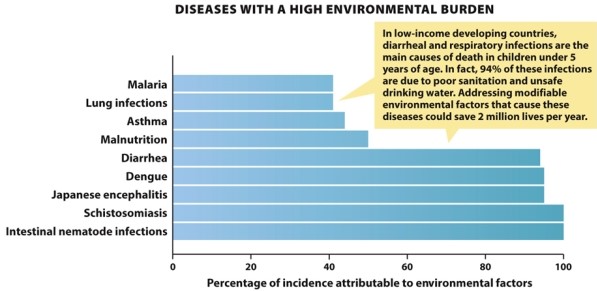
Infographic 5.3.
<strong> Infographic 5.3.   Refer to Infographic 5.3. Which disease is completely due to environmental factors?</strong> A) asthma B) dengue Fever C) malaria D) diarrhea E) intestinal nematode infections <div style=padding-top: 35px>
Refer to Infographic 5.3. Which disease is completely due to environmental factors?

A) asthma
B) dengue Fever
C) malaria
D) diarrhea
E) intestinal nematode infections
سؤال
Which of the organisms listed below causes disease in humans?

A) fungi
B) bacteria
C) viruses
D) worms
E) All of the above.
سؤال
How might poor water quality be a result of all the variable types of a population-that is, cultural and social factors, economic stability or instability, and environmental factors?
سؤال
What is an example of a cultural variable that may influence the plan of action for a particular health threat?

A) water cleanliness
B) habitat fragmentation
C) average income of the population affected
D) religious beliefs
E) All of these options are examples of cultural variables.
سؤال
Emerging infectious diseases are:

A) diseases new to humans.
B) illnesses that are not transmissible between people.
C) diseases that have established themselves in the natural world.
D) all zoonotic.
E) None of these answers are correct.
سؤال
In the chapter, Nabil Aziz Mikhail says that war is the one human behavior that favors Guinea worm disease (GWD) more than bathing in infested water. Why do you think that is?
سؤال
People in less developed nations are more likely to die of:

A) noncommunicable diseases.
B) infectious diseases.
C) lifestyle choices.
D) cancer.
E) a heart attack.
سؤال
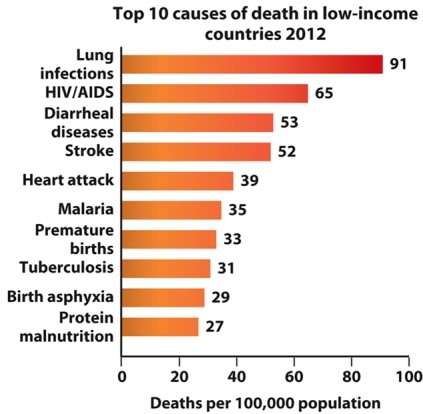
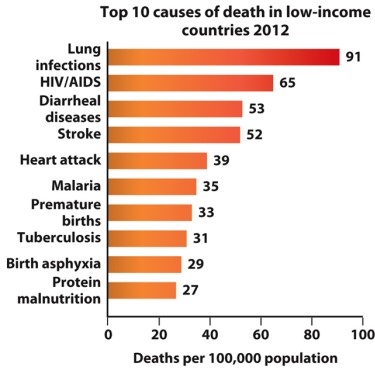
Infographic 5.6 <strong>Infographic 5.6   Of the top 10 causes of death in low-income countries in 2012 (Infographic 5.6), how many are likely caused by infectious disease agents like bacteria, viruses, and parasites?</strong> A) 3 B) 5 C) 7 D) 9 E) They are all caused by infectious disease agents. <div style=padding-top: 35px>
Of the top 10 causes of death in low-income countries in 2012 (Infographic 5.6), how many are likely caused by infectious disease agents like bacteria, viruses, and parasites?

A) 3
B) 5
C) 7
D) 9
E) They are all caused by infectious disease agents.
سؤال
A zoonotic disease is one that:

A) occurs in zoos and other artificial environments.
B) can spread between one infected animal to another, but cannot be spread to humans.
C) can spread between infected animals and humans.
D) is an emerging infectious disease.
E) is caused by environmental changes that are usually caused by humans.
سؤال
In 2006 the death rate from environmentally mediated diseases was how much greater in less developed countries than more developed countries?

A) 5 times
B) 8 times
C) 10 times
D) 12 times
E) 20 times
سؤال
Which pathogen/disease pair is correct?

A) plasmodium/Guinea worm disease
B) dengue virus/malaria
C) Vibrio cholerae/cholera
D) contaminated water/ringworm
E) Tinea corporis/dengue fever
سؤال
Why is Guinea worm disease (GWD) not a zoonotic disease?
سؤال
In Guinea worm disease (GWD), which organism is a vector?

A) humans
B) copepods
C) Guinea worms
D) contaminated water
E) All of the above are vectors.
سؤال
Why do you think 75% of all emerging infectious diseases are zoonotic?
سؤال
Which prevention action is likely to have the greatest effect on reducing the death rate in less developed countries?

A) diet
B) clean water
C) exercise
D) strict industrial pollution regulations
E) regular medical checkups
سؤال
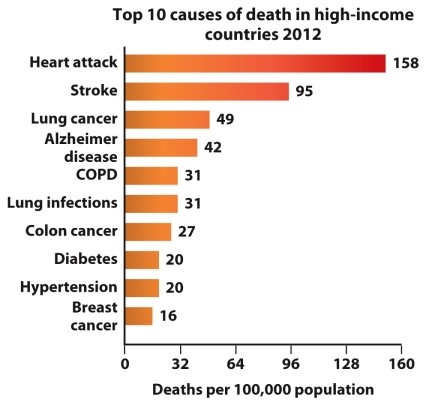
Infographic 5.6.
<strong> Infographic 5.6.   Refer to Infographic 5.6. In order of highest impact to lowest impact, what causes deaths in high-income countries?</strong> A) lung cancer > stroke > breast cancer > diabetes B) diabetes > lung infections > COPD > heart attack C) stroke > colon cancer > hypertension > breast cancer D) heart attack > stroke > COPD > Alzheimer's disease E) colon cancer > diabetes > hypertension > lung infections <div style=padding-top: 35px>
Refer to Infographic 5.6. In order of highest impact to lowest impact, what causes deaths in high-income countries?

A) lung cancer > stroke > breast cancer > diabetes
B) diabetes > lung infections > COPD > heart attack
C) stroke > colon cancer > hypertension > breast cancer
D) heart attack > stroke > COPD > Alzheimer's disease
E) colon cancer > diabetes > hypertension > lung infections
سؤال
Guinea worm disease (GWD) in humans is caused by:

A) direct burrowing of the worm into a person's foot.
B) drinking contaminated water containing adult Guinea worms.
C) drinking contaminated water containing copepods infected with Guinea worm larvae.
D) human-to-human contact (i.e., an infected human can transmit the worms directly to another uninfected human).
E) drinking contaminated water containing copepods.
سؤال
What might be some reasons why diarrheal disease is not one of the top 10 causes of death in high-income countries?
سؤال
Zoonotic diseases are impacted by:

A) bushmeat trade.
B) environmental changes.
C) human encroachment into wild areas.
D) climate change.
E) All of these answers are correct.
سؤال
What is one way to prevent Guinea worm disease (GWD)?

A) Educate the human population about GWD and ways to prevent it.
B) Kill copepods with pesticides.
C) Drink filtered water.
D) Avoid immersing GWD blisters in water.
E) All of the above are ways to prevent GWD.
سؤال
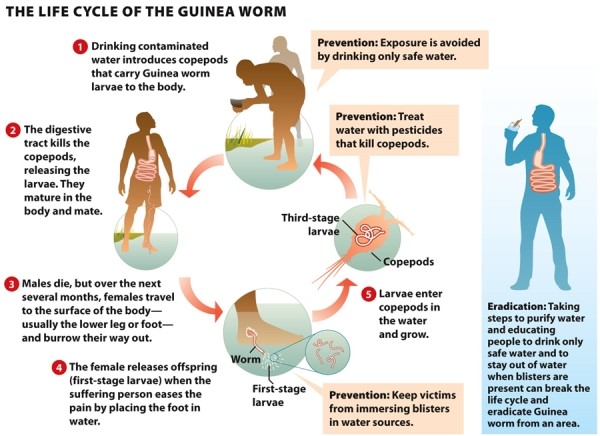
Infographic 5.5.
Infographic 5.5.   Refer to Infographic 5.5. Of the prevention methods mentioned in the graphic, which do you think would have the largest impact on Guinea worm disease (GWD) eradication?<div style=padding-top: 35px>
Refer to Infographic 5.5. Of the prevention methods mentioned in the graphic, which do you think would have the largest impact on Guinea worm disease (GWD) eradication?
سؤال
Why is the eradication of Guinea worm disease (GWD) possible?
سؤال
Guinea worm disease is an example of a zoonotic disease.
سؤال
How might challenges to prevent Guinea worm disease (GWD) in a low-income country be similar to challenges to prevent cardiovascular disease in a high-income country?
سؤال
What do you think has had the greatest impact on eradicating Guinea worm disease?
سؤال
Match between columns
An infectious disease acquired from organisms that transmit a pathogen from one host to another
epidemiologist
An infectious disease acquired from organisms that transmit a pathogen from one host to another
public health
An infectious disease acquired from organisms that transmit a pathogen from one host to another
pathogen
An infectious disease acquired from organisms that transmit a pathogen from one host to another
environmental health
An infectious disease acquired from organisms that transmit a pathogen from one host to another
zoonotic disease
An infectious disease acquired from organisms that transmit a pathogen from one host to another
emerging infectious diseases
An infectious disease acquired from organisms that transmit a pathogen from one host to another
waterborne disease
An infectious disease acquired from organisms that transmit a pathogen from one host to another
vector-borne disease
An infectious disease acquired from organisms that transmit a pathogen from one host to another
noncommunicable diseases (NCD)
An infectious disease acquired from organisms that transmit a pathogen from one host to another
infectious disease
Infectious diseases that are new to humans or that have recently increased significantly in incidence, in some cases by spreading to new ranges
epidemiologist
Infectious diseases that are new to humans or that have recently increased significantly in incidence, in some cases by spreading to new ranges
public health
Infectious diseases that are new to humans or that have recently increased significantly in incidence, in some cases by spreading to new ranges
pathogen
Infectious diseases that are new to humans or that have recently increased significantly in incidence, in some cases by spreading to new ranges
environmental health
Infectious diseases that are new to humans or that have recently increased significantly in incidence, in some cases by spreading to new ranges
zoonotic disease
Infectious diseases that are new to humans or that have recently increased significantly in incidence, in some cases by spreading to new ranges
emerging infectious diseases
Infectious diseases that are new to humans or that have recently increased significantly in incidence, in some cases by spreading to new ranges
waterborne disease
Infectious diseases that are new to humans or that have recently increased significantly in incidence, in some cases by spreading to new ranges
vector-borne disease
Infectious diseases that are new to humans or that have recently increased significantly in incidence, in some cases by spreading to new ranges
noncommunicable diseases (NCD)
Infectious diseases that are new to humans or that have recently increased significantly in incidence, in some cases by spreading to new ranges
infectious disease
A disease that is spread to humans from infected animals (not merely a vector that transmits the pathogen but another host that harbors the pathogen through its life cycle)
epidemiologist
A disease that is spread to humans from infected animals (not merely a vector that transmits the pathogen but another host that harbors the pathogen through its life cycle)
public health
A disease that is spread to humans from infected animals (not merely a vector that transmits the pathogen but another host that harbors the pathogen through its life cycle)
pathogen
A disease that is spread to humans from infected animals (not merely a vector that transmits the pathogen but another host that harbors the pathogen through its life cycle)
environmental health
A disease that is spread to humans from infected animals (not merely a vector that transmits the pathogen but another host that harbors the pathogen through its life cycle)
zoonotic disease
A disease that is spread to humans from infected animals (not merely a vector that transmits the pathogen but another host that harbors the pathogen through its life cycle)
emerging infectious diseases
A disease that is spread to humans from infected animals (not merely a vector that transmits the pathogen but another host that harbors the pathogen through its life cycle)
waterborne disease
A disease that is spread to humans from infected animals (not merely a vector that transmits the pathogen but another host that harbors the pathogen through its life cycle)
vector-borne disease
A disease that is spread to humans from infected animals (not merely a vector that transmits the pathogen but another host that harbors the pathogen through its life cycle)
noncommunicable diseases (NCD)
A disease that is spread to humans from infected animals (not merely a vector that transmits the pathogen but another host that harbors the pathogen through its life cycle)
infectious disease
The science that deals with the health of human populations
epidemiologist
The science that deals with the health of human populations
public health
The science that deals with the health of human populations
pathogen
The science that deals with the health of human populations
environmental health
The science that deals with the health of human populations
zoonotic disease
The science that deals with the health of human populations
emerging infectious diseases
The science that deals with the health of human populations
waterborne disease
The science that deals with the health of human populations
vector-borne disease
The science that deals with the health of human populations
noncommunicable diseases (NCD)
The science that deals with the health of human populations
infectious disease
An illness caused by an invading pathogen such as a bacterium or virus
epidemiologist
An illness caused by an invading pathogen such as a bacterium or virus
public health
An illness caused by an invading pathogen such as a bacterium or virus
pathogen
An illness caused by an invading pathogen such as a bacterium or virus
environmental health
An illness caused by an invading pathogen such as a bacterium or virus
zoonotic disease
An illness caused by an invading pathogen such as a bacterium or virus
emerging infectious diseases
An illness caused by an invading pathogen such as a bacterium or virus
waterborne disease
An illness caused by an invading pathogen such as a bacterium or virus
vector-borne disease
An illness caused by an invading pathogen such as a bacterium or virus
noncommunicable diseases (NCD)
An illness caused by an invading pathogen such as a bacterium or virus
infectious disease
Illnesses that are not transmissible between people; not infectious
epidemiologist
Illnesses that are not transmissible between people; not infectious
public health
Illnesses that are not transmissible between people; not infectious
pathogen
Illnesses that are not transmissible between people; not infectious
environmental health
Illnesses that are not transmissible between people; not infectious
zoonotic disease
Illnesses that are not transmissible between people; not infectious
emerging infectious diseases
Illnesses that are not transmissible between people; not infectious
waterborne disease
Illnesses that are not transmissible between people; not infectious
vector-borne disease
Illnesses that are not transmissible between people; not infectious
noncommunicable diseases (NCD)
Illnesses that are not transmissible between people; not infectious
infectious disease
An infectious disease acquired through contact with contaminated water
epidemiologist
An infectious disease acquired through contact with contaminated water
public health
An infectious disease acquired through contact with contaminated water
pathogen
An infectious disease acquired through contact with contaminated water
environmental health
An infectious disease acquired through contact with contaminated water
zoonotic disease
An infectious disease acquired through contact with contaminated water
emerging infectious diseases
An infectious disease acquired through contact with contaminated water
waterborne disease
An infectious disease acquired through contact with contaminated water
vector-borne disease
An infectious disease acquired through contact with contaminated water
noncommunicable diseases (NCD)
An infectious disease acquired through contact with contaminated water
infectious disease
A scientist who studies the causes and patterns of disease in human populations
epidemiologist
A scientist who studies the causes and patterns of disease in human populations
public health
A scientist who studies the causes and patterns of disease in human populations
pathogen
A scientist who studies the causes and patterns of disease in human populations
environmental health
A scientist who studies the causes and patterns of disease in human populations
zoonotic disease
A scientist who studies the causes and patterns of disease in human populations
emerging infectious diseases
A scientist who studies the causes and patterns of disease in human populations
waterborne disease
A scientist who studies the causes and patterns of disease in human populations
vector-borne disease
A scientist who studies the causes and patterns of disease in human populations
noncommunicable diseases (NCD)
A scientist who studies the causes and patterns of disease in human populations
infectious disease
An infectious agent that causes illness or disease
epidemiologist
An infectious agent that causes illness or disease
public health
An infectious agent that causes illness or disease
pathogen
An infectious agent that causes illness or disease
environmental health
An infectious agent that causes illness or disease
zoonotic disease
An infectious agent that causes illness or disease
emerging infectious diseases
An infectious agent that causes illness or disease
waterborne disease
An infectious agent that causes illness or disease
vector-borne disease
An infectious agent that causes illness or disease
noncommunicable diseases (NCD)
An infectious agent that causes illness or disease
infectious disease
The branch of public health that focuses on factors in the natural world and the human-built environment that impact the health of populations
epidemiologist
The branch of public health that focuses on factors in the natural world and the human-built environment that impact the health of populations
public health
The branch of public health that focuses on factors in the natural world and the human-built environment that impact the health of populations
pathogen
The branch of public health that focuses on factors in the natural world and the human-built environment that impact the health of populations
environmental health
The branch of public health that focuses on factors in the natural world and the human-built environment that impact the health of populations
zoonotic disease
The branch of public health that focuses on factors in the natural world and the human-built environment that impact the health of populations
emerging infectious diseases
The branch of public health that focuses on factors in the natural world and the human-built environment that impact the health of populations
waterborne disease
The branch of public health that focuses on factors in the natural world and the human-built environment that impact the health of populations
vector-borne disease
The branch of public health that focuses on factors in the natural world and the human-built environment that impact the health of populations
noncommunicable diseases (NCD)
The branch of public health that focuses on factors in the natural world and the human-built environment that impact the health of populations
infectious disease
سؤال
Infographic 5.6.
<strong>Infographic 5.6.   Which prevention method would have the greatest impact on reducing the death rate in low-income countries? (Refer to Infographic 5.6.)</strong> A) access to clean water B) vector exposure reduction C) education D) effective public policy E) air pollution reduction <div style=padding-top: 35px>
Which prevention method would have the greatest impact on reducing the death rate in low-income countries? (Refer to Infographic 5.6.)

A) access to clean water
B) vector exposure reduction
C) education
D) effective public policy
E) air pollution reduction
سؤال
How would your actions of taking the entire prescription of an antibiotic potentially help individuals living on the other side of the world?
سؤال
Who must support the prevention of environmentally mediated health problems for the efforts to be successful?

A) the at-risk communities themselves
B) international communities
C) more developed countries
D) A, B, and C must all support the efforts.
E) The efforts need no support.
سؤال
Which prevention method(s) would be most effective in the eradication of Guinea worm disease?

A) reducing air pollution
B) providing access to clean water
C) ceasing all war
D) using solar stoves for cooking
E) planting runoff gardens near bodies of water
سؤال
Why is it important to get affected community buy-in when trying to reduce environmental health hazards (or any kind of hazard, for that matter)?
سؤال
Guinea worm disease is close to total eradication, what is the only other infectious disease to have been eradicated?

A) HIV/AIDS
B) tuberculosis
C) small pox
D) lung cancer
E) No other infectious disease has ever been eradicated.
سؤال
Giving outhouses to communities is always an effective strategy to prevent diarrheal disease.
سؤال
What is an obstacle to the eradication of Guinea worm disease?

A) indifference
B) political issues
C) human stubbornness
D) poverty
E) all of the above
سؤال
In 1986 there were over 3.5 million cases of Guinea worm disease. How many cases were reported in 2013?

A) under 150
B) 500
C) 10,000
D) 50,000
E) over 100,000
فتح الحزمة
قم بالتسجيل لفتح البطاقات في هذه المجموعة!
Unlock Deck
Unlock Deck
1/51
auto play flashcards
العب
simple tutorial
ملء الشاشة (f)
exit full mode
Deck 5: Environmental Health- Eradicating a Parasitic Nightmare: Human Health Is Intricately Linked to the Environment- Consumption and the Environmental Footprint
1
Why is the health of the natural environment one of the biggest influences on human health hazards?
The health of the natural environment has a large influence on the severity and number of human health hazards because we humans have disrupted the Earth's ecosystems to better suit our own needs and wants. This causes the ecosystems to be unbalanced, and as we know from previous chapters, this can cause a lot of problems. In terms of human health, unbalanced ecosystems can select for the overpopulation of a particular pathogen or vector. For example, deforestation increases the breeding grounds for mosquitoes harboring the protozoan that causes malaria or dengue fever virus.
2
Which of the below choices is not a vector-pathogen pairing?

A) mosquitoes : Plasmodium that causes malaria
B) field mice : bacterium that causes Lyme disease
C) tick : bacterium that causes Lyme disease
D) mosquitoes : virus that causes dengue fever
E) copepods : Guinea worm larvae
field mice : bacterium that causes Lyme disease
3
Unfortunately, many environmental hazards are not modifiable.
False
4
In a vector-borne disease, the _______ directly causes the disease.

A) vector
B) pathogen
C) human
D) host
E) water
فتح الحزمة
افتح القفل للوصول البطاقات البالغ عددها 51 في هذه المجموعة.
فتح الحزمة
k this deck
5
What are the variables that a public health epidemiologist has to take into account when devising a plan to mitigate a health threat?

A) economic
B) environmental
C) cultural
D) only A and B
E) A, B, and C
فتح الحزمة
افتح القفل للوصول البطاقات البالغ عددها 51 في هذه المجموعة.
فتح الحزمة
k this deck
6
Human immunodeficiency virus (HIV), a sexually transmitted disease, is especially prevalent in sub-Saharan Africa. Given what you know about the variables affecting health threats, why do you think passing out free condoms, which would prevent the spread of the virus, may not be an effective strategy?
فتح الحزمة
افتح القفل للوصول البطاقات البالغ عددها 51 في هذه المجموعة.
فتح الحزمة
k this deck
7
According to the World Health Organization, how many people fall victim to waterborne diseases each year?

A) 100,000
B) 1,000,000
C) 100,000,000
D) 1,000,000,000
E) none of the above
فتح الحزمة
افتح القفل للوصول البطاقات البالغ عددها 51 في هذه المجموعة.

فتح الحزمة
k this deck
8
Why does urbanization sometimes lead to the increased incidence of waterborne pathogen infections?
فتح الحزمة
افتح القفل للوصول البطاقات البالغ عددها 51 في هذه المجموعة.

فتح الحزمة
k this deck
9
Public health epidemiologists study the overall health status of ________.

A) a human population
B) a human individual
C) all organisms
D) an ecosystem
E) any organism pathogenic to humans
فتح الحزمة
افتح القفل للوصول البطاقات البالغ عددها 51 في هذه المجموعة.
فتح الحزمة
k this deck
10
Environmental health is a branch of public health that focuses on health hazards in ___________.?

A) only natural environments
B) only human-built environments
C) both natural and human-built environments
D) contaminated water, air, and soil
E) drinking water
فتح الحزمة
افتح القفل للوصول البطاقات البالغ عددها 51 في هذه المجموعة.
فتح الحزمة
k this deck
11
Why is it difficult to map cause-and-effect relationships of human hazards and disease?
فتح الحزمة
افتح القفل للوصول البطاقات البالغ عددها 51 في هذه المجموعة.
فتح الحزمة
k this deck
12
Why do you think such a high proportion of diarrheal diseases can be attributed to environmental factors?
فتح الحزمة
افتح القفل للوصول البطاقات البالغ عددها 51 في هذه المجموعة.
فتح الحزمة
k this deck
13
Which human activity has not influenced the prevalence and seriousness of health hazards?

A) deforestation
B) urbanization
C) dam building
D) habitat fragmentation
E) All of these options have influenced the prevalence and seriousness of human health hazards.
فتح الحزمة
افتح القفل للوصول البطاقات البالغ عددها 51 في هذه المجموعة.
فتح الحزمة
k this deck
14
Waterborne and _______ diseases are the main infectious disease threats to human health.

A) airborne
B) chemical hazard
C) vector-borne
D) physical hazard
E) biological hazard
فتح الحزمة
افتح القفل للوصول البطاقات البالغ عددها 51 في هذه المجموعة.
فتح الحزمة
k this deck
15
How might washing your hands lead to a human health threat?
فتح الحزمة
افتح القفل للوصول البطاقات البالغ عددها 51 في هذه المجموعة.
فتح الحزمة
k this deck
16
Infectious diseases are a type of ______.

A) physical hazard
B) chemical hazard
C) biological hazard
D) human-caused hazard
E) Infectious diseases are not hazardous.
فتح الحزمة
افتح القفل للوصول البطاقات البالغ عددها 51 في هذه المجموعة.
فتح الحزمة
k this deck
17
Infographic 5.3.
<strong> Infographic 5.3.   Refer to Infographic 5.3. Which disease is completely due to environmental factors?</strong> A) asthma B) dengue Fever C) malaria D) diarrhea E) intestinal nematode infections
Refer to Infographic 5.3. Which disease is completely due to environmental factors?

A) asthma
B) dengue Fever
C) malaria
D) diarrhea
E) intestinal nematode infections
فتح الحزمة
افتح القفل للوصول البطاقات البالغ عددها 51 في هذه المجموعة.
فتح الحزمة
k this deck
18
Which of the organisms listed below causes disease in humans?

A) fungi
B) bacteria
C) viruses
D) worms
E) All of the above.
فتح الحزمة
افتح القفل للوصول البطاقات البالغ عددها 51 في هذه المجموعة.
فتح الحزمة
k this deck
19
How might poor water quality be a result of all the variable types of a population-that is, cultural and social factors, economic stability or instability, and environmental factors?
فتح الحزمة
افتح القفل للوصول البطاقات البالغ عددها 51 في هذه المجموعة.
فتح الحزمة
k this deck
20
What is an example of a cultural variable that may influence the plan of action for a particular health threat?

A) water cleanliness
B) habitat fragmentation
C) average income of the population affected
D) religious beliefs
E) All of these options are examples of cultural variables.
فتح الحزمة
افتح القفل للوصول البطاقات البالغ عددها 51 في هذه المجموعة.
فتح الحزمة
k this deck
21
Emerging infectious diseases are:

A) diseases new to humans.
B) illnesses that are not transmissible between people.
C) diseases that have established themselves in the natural world.
D) all zoonotic.
E) None of these answers are correct.
فتح الحزمة
افتح القفل للوصول البطاقات البالغ عددها 51 في هذه المجموعة.
فتح الحزمة
k this deck
22
In the chapter, Nabil Aziz Mikhail says that war is the one human behavior that favors Guinea worm disease (GWD) more than bathing in infested water. Why do you think that is?
فتح الحزمة
افتح القفل للوصول البطاقات البالغ عددها 51 في هذه المجموعة.
فتح الحزمة
k this deck
23
People in less developed nations are more likely to die of:

A) noncommunicable diseases.
B) infectious diseases.
C) lifestyle choices.
D) cancer.
E) a heart attack.
فتح الحزمة
افتح القفل للوصول البطاقات البالغ عددها 51 في هذه المجموعة.
فتح الحزمة
k this deck
24
Infographic 5.6 <strong>Infographic 5.6   Of the top 10 causes of death in low-income countries in 2012 (Infographic 5.6), how many are likely caused by infectious disease agents like bacteria, viruses, and parasites?</strong> A) 3 B) 5 C) 7 D) 9 E) They are all caused by infectious disease agents.
Of the top 10 causes of death in low-income countries in 2012 (Infographic 5.6), how many are likely caused by infectious disease agents like bacteria, viruses, and parasites?

A) 3
B) 5
C) 7
D) 9
E) They are all caused by infectious disease agents.
فتح الحزمة
افتح القفل للوصول البطاقات البالغ عددها 51 في هذه المجموعة.
فتح الحزمة
k this deck
25
A zoonotic disease is one that:

A) occurs in zoos and other artificial environments.
B) can spread between one infected animal to another, but cannot be spread to humans.
C) can spread between infected animals and humans.
D) is an emerging infectious disease.
E) is caused by environmental changes that are usually caused by humans.
فتح الحزمة
افتح القفل للوصول البطاقات البالغ عددها 51 في هذه المجموعة.
فتح الحزمة
k this deck
26
In 2006 the death rate from environmentally mediated diseases was how much greater in less developed countries than more developed countries?

A) 5 times
B) 8 times
C) 10 times
D) 12 times
E) 20 times
فتح الحزمة
افتح القفل للوصول البطاقات البالغ عددها 51 في هذه المجموعة.
فتح الحزمة
k this deck
27
Which pathogen/disease pair is correct?

A) plasmodium/Guinea worm disease
B) dengue virus/malaria
C) Vibrio cholerae/cholera
D) contaminated water/ringworm
E) Tinea corporis/dengue fever
فتح الحزمة
افتح القفل للوصول البطاقات البالغ عددها 51 في هذه المجموعة.
فتح الحزمة
k this deck
28
Why is Guinea worm disease (GWD) not a zoonotic disease?
فتح الحزمة
افتح القفل للوصول البطاقات البالغ عددها 51 في هذه المجموعة.
فتح الحزمة
k this deck
29
In Guinea worm disease (GWD), which organism is a vector?

A) humans
B) copepods
C) Guinea worms
D) contaminated water
E) All of the above are vectors.
فتح الحزمة
افتح القفل للوصول البطاقات البالغ عددها 51 في هذه المجموعة.
فتح الحزمة
k this deck
30
Why do you think 75% of all emerging infectious diseases are zoonotic?
فتح الحزمة
افتح القفل للوصول البطاقات البالغ عددها 51 في هذه المجموعة.
فتح الحزمة
k this deck
31
Which prevention action is likely to have the greatest effect on reducing the death rate in less developed countries?

A) diet
B) clean water
C) exercise
D) strict industrial pollution regulations
E) regular medical checkups
فتح الحزمة
افتح القفل للوصول البطاقات البالغ عددها 51 في هذه المجموعة.
فتح الحزمة
k this deck
32
Infographic 5.6.
<strong> Infographic 5.6.   Refer to Infographic 5.6. In order of highest impact to lowest impact, what causes deaths in high-income countries?</strong> A) lung cancer > stroke > breast cancer > diabetes B) diabetes > lung infections > COPD > heart attack C) stroke > colon cancer > hypertension > breast cancer D) heart attack > stroke > COPD > Alzheimer's disease E) colon cancer > diabetes > hypertension > lung infections
Refer to Infographic 5.6. In order of highest impact to lowest impact, what causes deaths in high-income countries?

A) lung cancer > stroke > breast cancer > diabetes
B) diabetes > lung infections > COPD > heart attack
C) stroke > colon cancer > hypertension > breast cancer
D) heart attack > stroke > COPD > Alzheimer's disease
E) colon cancer > diabetes > hypertension > lung infections
فتح الحزمة
افتح القفل للوصول البطاقات البالغ عددها 51 في هذه المجموعة.
فتح الحزمة
k this deck
33
Guinea worm disease (GWD) in humans is caused by:

A) direct burrowing of the worm into a person's foot.
B) drinking contaminated water containing adult Guinea worms.
C) drinking contaminated water containing copepods infected with Guinea worm larvae.
D) human-to-human contact (i.e., an infected human can transmit the worms directly to another uninfected human).
E) drinking contaminated water containing copepods.
فتح الحزمة
افتح القفل للوصول البطاقات البالغ عددها 51 في هذه المجموعة.
فتح الحزمة
k this deck
34
What might be some reasons why diarrheal disease is not one of the top 10 causes of death in high-income countries?
فتح الحزمة
افتح القفل للوصول البطاقات البالغ عددها 51 في هذه المجموعة.
فتح الحزمة
k this deck
35
Zoonotic diseases are impacted by:

A) bushmeat trade.
B) environmental changes.
C) human encroachment into wild areas.
D) climate change.
E) All of these answers are correct.
فتح الحزمة
افتح القفل للوصول البطاقات البالغ عددها 51 في هذه المجموعة.
فتح الحزمة
k this deck
36
What is one way to prevent Guinea worm disease (GWD)?

A) Educate the human population about GWD and ways to prevent it.
B) Kill copepods with pesticides.
C) Drink filtered water.
D) Avoid immersing GWD blisters in water.
E) All of the above are ways to prevent GWD.
فتح الحزمة
افتح القفل للوصول البطاقات البالغ عددها 51 في هذه المجموعة.
فتح الحزمة
k this deck
37
Infographic 5.5.
Infographic 5.5.   Refer to Infographic 5.5. Of the prevention methods mentioned in the graphic, which do you think would have the largest impact on Guinea worm disease (GWD) eradication?
Refer to Infographic 5.5. Of the prevention methods mentioned in the graphic, which do you think would have the largest impact on Guinea worm disease (GWD) eradication?
فتح الحزمة
افتح القفل للوصول البطاقات البالغ عددها 51 في هذه المجموعة.
فتح الحزمة
k this deck
38
Why is the eradication of Guinea worm disease (GWD) possible?
فتح الحزمة
افتح القفل للوصول البطاقات البالغ عددها 51 في هذه المجموعة.
فتح الحزمة
k this deck
39
Guinea worm disease is an example of a zoonotic disease.
فتح الحزمة
افتح القفل للوصول البطاقات البالغ عددها 51 في هذه المجموعة.
فتح الحزمة
k this deck
40
How might challenges to prevent Guinea worm disease (GWD) in a low-income country be similar to challenges to prevent cardiovascular disease in a high-income country?
فتح الحزمة
افتح القفل للوصول البطاقات البالغ عددها 51 في هذه المجموعة.
فتح الحزمة
k this deck
41
What do you think has had the greatest impact on eradicating Guinea worm disease?
فتح الحزمة
افتح القفل للوصول البطاقات البالغ عددها 51 في هذه المجموعة.
فتح الحزمة
k this deck
42
Match between columns
An infectious disease acquired from organisms that transmit a pathogen from one host to another
epidemiologist
An infectious disease acquired from organisms that transmit a pathogen from one host to another
public health
An infectious disease acquired from organisms that transmit a pathogen from one host to another
pathogen
An infectious disease acquired from organisms that transmit a pathogen from one host to another
environmental health
An infectious disease acquired from organisms that transmit a pathogen from one host to another
zoonotic disease
An infectious disease acquired from organisms that transmit a pathogen from one host to another
emerging infectious diseases
An infectious disease acquired from organisms that transmit a pathogen from one host to another
waterborne disease
An infectious disease acquired from organisms that transmit a pathogen from one host to another
vector-borne disease
An infectious disease acquired from organisms that transmit a pathogen from one host to another
noncommunicable diseases (NCD)
An infectious disease acquired from organisms that transmit a pathogen from one host to another
infectious disease
Infectious diseases that are new to humans or that have recently increased significantly in incidence, in some cases by spreading to new ranges
epidemiologist
Infectious diseases that are new to humans or that have recently increased significantly in incidence, in some cases by spreading to new ranges
public health
Infectious diseases that are new to humans or that have recently increased significantly in incidence, in some cases by spreading to new ranges
pathogen
Infectious diseases that are new to humans or that have recently increased significantly in incidence, in some cases by spreading to new ranges
environmental health
Infectious diseases that are new to humans or that have recently increased significantly in incidence, in some cases by spreading to new ranges
zoonotic disease
Infectious diseases that are new to humans or that have recently increased significantly in incidence, in some cases by spreading to new ranges
emerging infectious diseases
Infectious diseases that are new to humans or that have recently increased significantly in incidence, in some cases by spreading to new ranges
waterborne disease
Infectious diseases that are new to humans or that have recently increased significantly in incidence, in some cases by spreading to new ranges
vector-borne disease
Infectious diseases that are new to humans or that have recently increased significantly in incidence, in some cases by spreading to new ranges
noncommunicable diseases (NCD)
Infectious diseases that are new to humans or that have recently increased significantly in incidence, in some cases by spreading to new ranges
infectious disease
A disease that is spread to humans from infected animals (not merely a vector that transmits the pathogen but another host that harbors the pathogen through its life cycle)
epidemiologist
A disease that is spread to humans from infected animals (not merely a vector that transmits the pathogen but another host that harbors the pathogen through its life cycle)
public health
A disease that is spread to humans from infected animals (not merely a vector that transmits the pathogen but another host that harbors the pathogen through its life cycle)
pathogen
A disease that is spread to humans from infected animals (not merely a vector that transmits the pathogen but another host that harbors the pathogen through its life cycle)
environmental health
A disease that is spread to humans from infected animals (not merely a vector that transmits the pathogen but another host that harbors the pathogen through its life cycle)
zoonotic disease
A disease that is spread to humans from infected animals (not merely a vector that transmits the pathogen but another host that harbors the pathogen through its life cycle)
emerging infectious diseases
A disease that is spread to humans from infected animals (not merely a vector that transmits the pathogen but another host that harbors the pathogen through its life cycle)
waterborne disease
A disease that is spread to humans from infected animals (not merely a vector that transmits the pathogen but another host that harbors the pathogen through its life cycle)
vector-borne disease
A disease that is spread to humans from infected animals (not merely a vector that transmits the pathogen but another host that harbors the pathogen through its life cycle)
noncommunicable diseases (NCD)
A disease that is spread to humans from infected animals (not merely a vector that transmits the pathogen but another host that harbors the pathogen through its life cycle)
infectious disease
The science that deals with the health of human populations
epidemiologist
The science that deals with the health of human populations
public health
The science that deals with the health of human populations
pathogen
The science that deals with the health of human populations
environmental health
The science that deals with the health of human populations
zoonotic disease
The science that deals with the health of human populations
emerging infectious diseases
The science that deals with the health of human populations
waterborne disease
The science that deals with the health of human populations
vector-borne disease
The science that deals with the health of human populations
noncommunicable diseases (NCD)
The science that deals with the health of human populations
infectious disease
An illness caused by an invading pathogen such as a bacterium or virus
epidemiologist
An illness caused by an invading pathogen such as a bacterium or virus
public health
An illness caused by an invading pathogen such as a bacterium or virus
pathogen
An illness caused by an invading pathogen such as a bacterium or virus
environmental health
An illness caused by an invading pathogen such as a bacterium or virus
zoonotic disease
An illness caused by an invading pathogen such as a bacterium or virus
emerging infectious diseases
An illness caused by an invading pathogen such as a bacterium or virus
waterborne disease
An illness caused by an invading pathogen such as a bacterium or virus
vector-borne disease
An illness caused by an invading pathogen such as a bacterium or virus
noncommunicable diseases (NCD)
An illness caused by an invading pathogen such as a bacterium or virus
infectious disease
Illnesses that are not transmissible between people; not infectious
epidemiologist
Illnesses that are not transmissible between people; not infectious
public health
Illnesses that are not transmissible between people; not infectious
pathogen
Illnesses that are not transmissible between people; not infectious
environmental health
Illnesses that are not transmissible between people; not infectious
zoonotic disease
Illnesses that are not transmissible between people; not infectious
emerging infectious diseases
Illnesses that are not transmissible between people; not infectious
waterborne disease
Illnesses that are not transmissible between people; not infectious
vector-borne disease
Illnesses that are not transmissible between people; not infectious
noncommunicable diseases (NCD)
Illnesses that are not transmissible between people; not infectious
infectious disease
An infectious disease acquired through contact with contaminated water
epidemiologist
An infectious disease acquired through contact with contaminated water
public health
An infectious disease acquired through contact with contaminated water
pathogen
An infectious disease acquired through contact with contaminated water
environmental health
An infectious disease acquired through contact with contaminated water
zoonotic disease
An infectious disease acquired through contact with contaminated water
emerging infectious diseases
An infectious disease acquired through contact with contaminated water
waterborne disease
An infectious disease acquired through contact with contaminated water
vector-borne disease
An infectious disease acquired through contact with contaminated water
noncommunicable diseases (NCD)
An infectious disease acquired through contact with contaminated water
infectious disease
A scientist who studies the causes and patterns of disease in human populations
epidemiologist
A scientist who studies the causes and patterns of disease in human populations
public health
A scientist who studies the causes and patterns of disease in human populations
pathogen
A scientist who studies the causes and patterns of disease in human populations
environmental health
A scientist who studies the causes and patterns of disease in human populations
zoonotic disease
A scientist who studies the causes and patterns of disease in human populations
emerging infectious diseases
A scientist who studies the causes and patterns of disease in human populations
waterborne disease
A scientist who studies the causes and patterns of disease in human populations
vector-borne disease
A scientist who studies the causes and patterns of disease in human populations
noncommunicable diseases (NCD)
A scientist who studies the causes and patterns of disease in human populations
infectious disease
An infectious agent that causes illness or disease
epidemiologist
An infectious agent that causes illness or disease
public health
An infectious agent that causes illness or disease
pathogen
An infectious agent that causes illness or disease
environmental health
An infectious agent that causes illness or disease
zoonotic disease
An infectious agent that causes illness or disease
emerging infectious diseases
An infectious agent that causes illness or disease
waterborne disease
An infectious agent that causes illness or disease
vector-borne disease
An infectious agent that causes illness or disease
noncommunicable diseases (NCD)
An infectious agent that causes illness or disease
infectious disease
The branch of public health that focuses on factors in the natural world and the human-built environment that impact the health of populations
epidemiologist
The branch of public health that focuses on factors in the natural world and the human-built environment that impact the health of populations
public health
The branch of public health that focuses on factors in the natural world and the human-built environment that impact the health of populations
pathogen
The branch of public health that focuses on factors in the natural world and the human-built environment that impact the health of populations
environmental health
The branch of public health that focuses on factors in the natural world and the human-built environment that impact the health of populations
zoonotic disease
The branch of public health that focuses on factors in the natural world and the human-built environment that impact the health of populations
emerging infectious diseases
The branch of public health that focuses on factors in the natural world and the human-built environment that impact the health of populations
waterborne disease
The branch of public health that focuses on factors in the natural world and the human-built environment that impact the health of populations
vector-borne disease
The branch of public health that focuses on factors in the natural world and the human-built environment that impact the health of populations
noncommunicable diseases (NCD)
The branch of public health that focuses on factors in the natural world and the human-built environment that impact the health of populations
infectious disease
فتح الحزمة
افتح القفل للوصول البطاقات البالغ عددها 51 في هذه المجموعة.
فتح الحزمة
k this deck
43
Infographic 5.6.
<strong>Infographic 5.6.   Which prevention method would have the greatest impact on reducing the death rate in low-income countries? (Refer to Infographic 5.6.)</strong> A) access to clean water B) vector exposure reduction C) education D) effective public policy E) air pollution reduction
Which prevention method would have the greatest impact on reducing the death rate in low-income countries? (Refer to Infographic 5.6.)

A) access to clean water
B) vector exposure reduction
C) education
D) effective public policy
E) air pollution reduction
فتح الحزمة
افتح القفل للوصول البطاقات البالغ عددها 51 في هذه المجموعة.
فتح الحزمة
k this deck
44
How would your actions of taking the entire prescription of an antibiotic potentially help individuals living on the other side of the world?
فتح الحزمة
افتح القفل للوصول البطاقات البالغ عددها 51 في هذه المجموعة.
فتح الحزمة
k this deck
45
Who must support the prevention of environmentally mediated health problems for the efforts to be successful?

A) the at-risk communities themselves
B) international communities
C) more developed countries
D) A, B, and C must all support the efforts.
E) The efforts need no support.
فتح الحزمة
افتح القفل للوصول البطاقات البالغ عددها 51 في هذه المجموعة.
فتح الحزمة
k this deck
46
Which prevention method(s) would be most effective in the eradication of Guinea worm disease?

A) reducing air pollution
B) providing access to clean water
C) ceasing all war
D) using solar stoves for cooking
E) planting runoff gardens near bodies of water
فتح الحزمة
افتح القفل للوصول البطاقات البالغ عددها 51 في هذه المجموعة.
فتح الحزمة
k this deck
47
Why is it important to get affected community buy-in when trying to reduce environmental health hazards (or any kind of hazard, for that matter)?
فتح الحزمة
افتح القفل للوصول البطاقات البالغ عددها 51 في هذه المجموعة.
فتح الحزمة
k this deck
48
Guinea worm disease is close to total eradication, what is the only other infectious disease to have been eradicated?

A) HIV/AIDS
B) tuberculosis
C) small pox
D) lung cancer
E) No other infectious disease has ever been eradicated.
فتح الحزمة
افتح القفل للوصول البطاقات البالغ عددها 51 في هذه المجموعة.
فتح الحزمة
k this deck
49
Giving outhouses to communities is always an effective strategy to prevent diarrheal disease.
فتح الحزمة
افتح القفل للوصول البطاقات البالغ عددها 51 في هذه المجموعة.
فتح الحزمة
k this deck
50
What is an obstacle to the eradication of Guinea worm disease?

A) indifference
B) political issues
C) human stubbornness
D) poverty
E) all of the above
فتح الحزمة
افتح القفل للوصول البطاقات البالغ عددها 51 في هذه المجموعة.
فتح الحزمة
k this deck
51
In 1986 there were over 3.5 million cases of Guinea worm disease. How many cases were reported in 2013?

A) under 150
B) 500
C) 10,000
D) 50,000
E) over 100,000
فتح الحزمة
افتح القفل للوصول البطاقات البالغ عددها 51 في هذه المجموعة.
فتح الحزمة
k this deck
locked card icon
فتح الحزمة
افتح القفل للوصول البطاقات البالغ عددها 51 في هذه المجموعة.