







 تكلم مع الذكاء الاصطناعي


Deck 7: Economic Growth I
ملء الشاشة (f)

سؤال

سؤال
سؤال
سؤال
(Exhibit: Output,Consumption,and Investment)In this graph,when the capital-labour ratio is OA,AB represents: 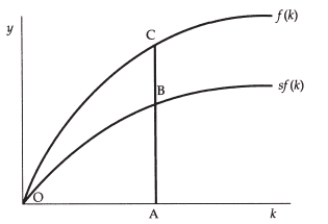
A) investment per worker,and AC represents consumption per worker.
B) consumption per worker,and AC represents investment per worker.
C) investment per worker,and BC represents consumption per worker.
D) consumption per worker,and BC represents investment per worker.
A) investment per worker,and AC represents consumption per worker.
B) consumption per worker,and AC represents investment per worker.
C) investment per worker,and BC represents consumption per worker.
D) consumption per worker,and BC represents investment per worker.
سؤال
سؤال
سؤال
سؤال
سؤال
سؤال
سؤال
سؤال
سؤال
سؤال
سؤال
سؤال
سؤال
سؤال
سؤال
سؤال
سؤال
سؤال
سؤال
سؤال
سؤال
سؤال
سؤال
سؤال
سؤال
سؤال
سؤال
سؤال
(Exhibit: Capital-Labour Ratio and the Steady State)In this graph,capital-labour ratio k2 is not the steady-state capital-labour ratio because: 
A) the saving rate is too high.
B) the investment ratio is too high.
C) gross investment is greater than depreciation.
D) depreciation is greater than gross investment.
A) the saving rate is too high.
B) the investment ratio is too high.
C) gross investment is greater than depreciation.
D) depreciation is greater than gross investment.
سؤال
سؤال
(Exhibit: Steady-State Capital-Labour Ratio)In this graph,the capital-labour ratio that represents the steady-state capital-labour ratio is: 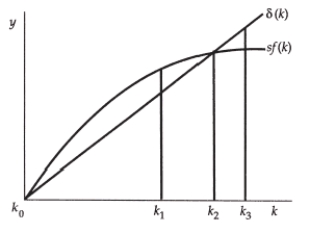
A) k0.
B) k1.
C) k2.
D) k3.
A) k0.
B) k1.
C) k2.
D) k3.
سؤال
سؤال
سؤال
سؤال
سؤال
(Exhibit: The Capital-Labour Ratio)In this graph,starting from capital-labour ratio k1,the capital-labour ratio will: 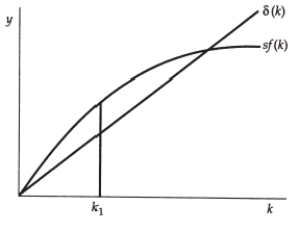
A) decrease.
B) remain constant.
C) increase.
D) first decrease and then remain constant.
A) decrease.
B) remain constant.
C) increase.
D) first decrease and then remain constant.
سؤال
سؤال
سؤال
سؤال
سؤال
سؤال
(Exhibit: Steady-State Consumption II)The Golden Rule level of steady-state investment per worker is: 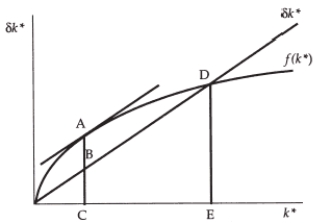
A) AC.
B) AB.
C) BC.
D) DE.
A) AC.
B) AB.
C) BC.
D) DE.
سؤال
سؤال
سؤال
(Exhibit: Steady-State Consumption II)The Golden Rule level of steady-state consumption per worker is: 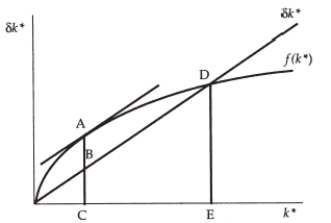
A) AC.
B) AB.
C) BC.
D) DE.
A) AC.
B) AB.
C) BC.
D) DE.
سؤال
سؤال
سؤال
سؤال
(Exhibit: Steady-State Consumption I)The Golden Rule level of the capital-labour ratio is: 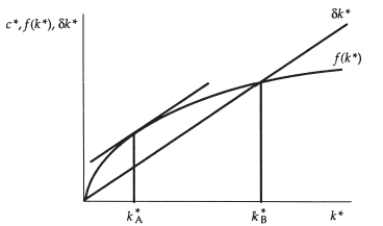
A) k*A .
B) above k*A but below k*B .
C) k*B .
D) above k*B .
A) k*A .
B) above k*A but below k*B .
C) k*B .
D) above k*B .
سؤال
سؤال
سؤال
سؤال
سؤال
سؤال
سؤال
سؤال
سؤال
سؤال
سؤال
سؤال
سؤال
سؤال
سؤال
سؤال
سؤال
سؤال
سؤال
سؤال
سؤال
سؤال
سؤال
سؤال
سؤال
سؤال
سؤال
سؤال

فتح الحزمة
قم بالتسجيل لفتح البطاقات في هذه المجموعة!
Unlock Deck
Unlock Deck
1/114

العب

ملء الشاشة (f)
Deck 7: Economic Growth I
1
Two economies are identical except that the level of capital per worker is higher in Highland than in Lowland.The production functions in both economies exhibit diminishing marginal product of capital.An extra unit of capital per worker increases output per worker:
A) more in Highland.
B) more in Lowland.
C) by the same amount in Highland and Lowland.
D) in Highland,but not in Lowland.
A) more in Highland.
B) more in Lowland.
C) by the same amount in Highland and Lowland.
D) in Highland,but not in Lowland.
more in Lowland.
2
Unlike the long-run classical model in Chapter 3,the Solow growth model:
A) assumes that the factors of production and technology are the sources of the economy's output.
B) describes changes in the economy over time.
C) is static.
D) assumes that the supply of goods determines how much output is produced.
A) assumes that the factors of production and technology are the sources of the economy's output.
B) describes changes in the economy over time.
C) is static.
D) assumes that the supply of goods determines how much output is produced.
describes changes in the economy over time.
3
In the Solow growth model of Chapter 7,investment equals:
A) output.
B) consumption.
C) the marginal product of capital.
D) saving.
A) output.
B) consumption.
C) the marginal product of capital.
D) saving.
saving.
4
(Exhibit: Output,Consumption,and Investment)In this graph,when the capital-labour ratio is OA,AB represents:
A) investment per worker,and AC represents consumption per worker.
B) consumption per worker,and AC represents investment per worker.
C) investment per worker,and BC represents consumption per worker.
D) consumption per worker,and BC represents investment per worker.
A) investment per worker,and AC represents consumption per worker.
B) consumption per worker,and AC represents investment per worker.
C) investment per worker,and BC represents consumption per worker.
D) consumption per worker,and BC represents investment per worker.
فتح الحزمة
افتح القفل للوصول البطاقات البالغ عددها 114 في هذه المجموعة.
فتح الحزمة
k this deck
5
When f(k)is drawn on a graph with increases in k noted along the horizontal axis,the slope of the line denotes:
A) output per worker.
B) output per unit of capital.
C) the marginal product of labour.
D) the marginal product of capital.
A) output per worker.
B) output per unit of capital.
C) the marginal product of labour.
D) the marginal product of capital.
فتح الحزمة
افتح القفل للوصول البطاقات البالغ عددها 114 في هذه المجموعة.
فتح الحزمة
k this deck
6
In the Solow growth model,the assumption of constant returns to scale means that:
A) all economies have the same amount of capital per worker.
B) the steady-state level of output is constant regardless of the number of workers.
C) the saving rate equals the constant rate of depreciation.
D) the number of workers in an economy does not affect the relationship between output per worker and capital per worker.
A) all economies have the same amount of capital per worker.
B) the steady-state level of output is constant regardless of the number of workers.
C) the saving rate equals the constant rate of depreciation.
D) the number of workers in an economy does not affect the relationship between output per worker and capital per worker.
فتح الحزمة
افتح القفل للوصول البطاقات البالغ عددها 114 في هذه المجموعة.
فتح الحزمة
k this deck
7
If the capital stock equals 200 units in year one and the depreciation rate is 5 percent per year,then in year two,assuming no new or replacement investment,the capital stock would equal _____ units.
A) 210
B) 200
C) 195
D) 190
A) 210
B) 200
C) 195
D) 190
فتح الحزمة
افتح القفل للوصول البطاقات البالغ عددها 114 في هذه المجموعة.
فتح الحزمة
k this deck
8
When f(k)is drawn on a graph with increases in k noted along the horizontal axis,the:
A) graph is a straight line.
B) slope of the line eventually gets flatter and flatter.
C) slope of the line eventually becomes negative.
D) slope of the line eventually becomes steeper and steeper.
A) graph is a straight line.
B) slope of the line eventually gets flatter and flatter.
C) slope of the line eventually becomes negative.
D) slope of the line eventually becomes steeper and steeper.
فتح الحزمة
افتح القفل للوصول البطاقات البالغ عددها 114 في هذه المجموعة.
فتح الحزمة
k this deck
9
______ cause(s)the capital stock to rise,while ______ cause(s)the capital stock to fall.
A) Inflation; deflation
B) Interest rates; the discount rate
C) Investment; depreciation
D) International trade; depressions
A) Inflation; deflation
B) Interest rates; the discount rate
C) Investment; depreciation
D) International trade; depressions
فتح الحزمة
افتح القفل للوصول البطاقات البالغ عددها 114 في هذه المجموعة.
فتح الحزمة
k this deck
10
The Solow growth model describes:
A) how output is determined at a point in time.
B) how output is determined with fixed amounts of capital and labour.
C) how saving,population growth,and technological change affect output over time.
D) the static allocation,production,and distribution of the economy's output.
A) how output is determined at a point in time.
B) how output is determined with fixed amounts of capital and labour.
C) how saving,population growth,and technological change affect output over time.
D) the static allocation,production,and distribution of the economy's output.
فتح الحزمة
افتح القفل للوصول البطاقات البالغ عددها 114 في هذه المجموعة.
فتح الحزمة
k this deck
11
In the Solow growth model of Chapter 7,the saving rate determines the allocation of output between:
A) saving and investment.
B) output and capital.
C) consumption and output.
D) investment and consumption.
A) saving and investment.
B) output and capital.
C) consumption and output.
D) investment and consumption.
فتح الحزمة
افتح القفل للوصول البطاقات البالغ عددها 114 في هذه المجموعة.
فتح الحزمة
k this deck
12
In the Solow growth model of Chapter 7,the demand for goods equals investment:
A) minus depreciation.
B) plus saving.
C) plus consumption.
D) plus depreciation.
A) minus depreciation.
B) plus saving.
C) plus consumption.
D) plus depreciation.
فتح الحزمة
افتح القفل للوصول البطاقات البالغ عددها 114 في هذه المجموعة.
فتح الحزمة
k this deck
13
If capital lasts an average of 25 years,the depreciation rate is ______ percent per year.
A) 25
B) 5
C) 4
D) 2.5
A) 25
B) 5
C) 4
D) 2.5
فتح الحزمة
افتح القفل للوصول البطاقات البالغ عددها 114 في هذه المجموعة.
فتح الحزمة
k this deck
14
The change in capital stock per worker ( k)may be expressed as a function of s-the saving ratio,f(k)-output per worker,k-capital per worker,and -the depreciation rate,by the equation:
A) k = sf(k)/ k.
B) k = sf(k)× k.
C) k = sf(k)+ k.
D) k = sf(k)- k.
A) k = sf(k)/ k.
B) k = sf(k)× k.
C) k = sf(k)+ k.
D) k = sf(k)- k.
فتح الحزمة
افتح القفل للوصول البطاقات البالغ عددها 114 في هذه المجموعة.
فتح الحزمة
k this deck
15
In the Solow growth model of Chapter 7,where s is the saving rate,y is output per worker,and i is investment per worker,consumption per worker (c)equals:
A) sy.
B) (1 - s)y.
C) (1 + s)y.
D) (1 - s)y - i.
A) sy.
B) (1 - s)y.
C) (1 + s)y.
D) (1 - s)y - i.
فتح الحزمة
افتح القفل للوصول البطاقات البالغ عددها 114 في هذه المجموعة.
فتح الحزمة
k this deck
16
The consumption function in the Solow model assumes that society saves a:
A) constant proportion of income.
B) smaller proportion of income as it becomes richer.
C) larger proportion of income as it becomes richer.
D) larger proportion of income when the interest rate is higher.
A) constant proportion of income.
B) smaller proportion of income as it becomes richer.
C) larger proportion of income as it becomes richer.
D) larger proportion of income when the interest rate is higher.
فتح الحزمة
افتح القفل للوصول البطاقات البالغ عددها 114 في هذه المجموعة.
فتح الحزمة
k this deck
17
In the Solow growth model of Chapter 7,for any given capital stock,the ______ determines how much output the economy produces and the ______ determines the allocation of output between consumption and investment.
A) saving rate; production function
B) depreciation rate; population growth rate
C) production function; saving rate
D) population growth rate; saving rate
A) saving rate; production function
B) depreciation rate; population growth rate
C) production function; saving rate
D) population growth rate; saving rate
فتح الحزمة
افتح القفل للوصول البطاقات البالغ عددها 114 في هذه المجموعة.
فتح الحزمة
k this deck
18
Investment per worker (i)as a function of the saving ratio (s)and output per worker (f(k))may be expressed as:
A) s + f(k).
B) s - f(k).
C) sf(k).
D) s/f(k).
A) s + f(k).
B) s - f(k).
C) sf(k).
D) s/f(k).
فتح الحزمة
افتح القفل للوصول البطاقات البالغ عددها 114 في هذه المجموعة.
فتح الحزمة
k this deck
19
The production function y = f(k)means:
A) labour is not a factor of production.
B) output per worker is a function of labour productivity.
C) output per worker is a function of capital per worker.
D) the production function exhibits increasing returns to scale.
A) labour is not a factor of production.
B) output per worker is a function of labour productivity.
C) output per worker is a function of capital per worker.
D) the production function exhibits increasing returns to scale.
فتح الحزمة
افتح القفل للوصول البطاقات البالغ عددها 114 في هذه المجموعة.
فتح الحزمة
k this deck
20
In the Solow model,it is assumed that a(n)______ fraction of capital wears out as the capital-labour ratio increases.
A) smaller
B) larger
C) constant
D) increasing
A) smaller
B) larger
C) constant
D) increasing
فتح الحزمة
افتح القفل للوصول البطاقات البالغ عددها 114 في هذه المجموعة.
فتح الحزمة
k this deck
21
In the Solow growth model of an economy with no population growth and no technological progress,the higher the steady capital-per-worker ratio,the higher the steady-state:
A) growth rate of total output.
B) growth rate of capital per worker
C) growth rate of output per worker.
D) level of output per worker.
A) growth rate of total output.
B) growth rate of capital per worker
C) growth rate of output per worker.
D) level of output per worker.
فتح الحزمة
افتح القفل للوصول البطاقات البالغ عددها 114 في هذه المجموعة.
فتح الحزمة
k this deck
22
In the Solow growth model of Chapter 7,the economy ends up with a steady-state level of capital:
A) only if it starts from a level of capital below the steady-state level.
B) only if it starts from a level of capital above the steady-state level.
C) only if it starts from a steady-state level of capital.
D) regardless of the starting level of capital.
A) only if it starts from a level of capital below the steady-state level.
B) only if it starts from a level of capital above the steady-state level.
C) only if it starts from a steady-state level of capital.
D) regardless of the starting level of capital.
فتح الحزمة
افتح القفل للوصول البطاقات البالغ عددها 114 في هذه المجموعة.
فتح الحزمة
k this deck
23
An economy in the steady state will have:
A) investment exceeding depreciation.
B) no depreciation.
C) saving equal to consumption.
D) no change in the capital stock.
A) investment exceeding depreciation.
B) no depreciation.
C) saving equal to consumption.
D) no change in the capital stock.
فتح الحزمة
افتح القفل للوصول البطاقات البالغ عددها 114 في هذه المجموعة.
فتح الحزمة
k this deck
24
A higher saving rate leads to a:
A) higher rate of economic growth in both the short run and the long run.
B) higher rate of economic growth only in the long run.
C) higher rate of economic growth in the short run but a decline in the long run.
D) large capital stock and a high level of output in the long run.
A) higher rate of economic growth in both the short run and the long run.
B) higher rate of economic growth only in the long run.
C) higher rate of economic growth in the short run but a decline in the long run.
D) large capital stock and a high level of output in the long run.
فتح الحزمة
افتح القفل للوصول البطاقات البالغ عددها 114 في هذه المجموعة.
فتح الحزمة
k this deck
25
The Solow model shows that a key determinant of the steady-state ratio of capital to labour is the:
A) level of output.
B) labour force.
C) saving rate.
D) capital elasticity in the production function.
A) level of output.
B) labour force.
C) saving rate.
D) capital elasticity in the production function.
فتح الحزمة
افتح القفل للوصول البطاقات البالغ عددها 114 في هذه المجموعة.
فتح الحزمة
k this deck
26
Examination of recent data for many countries shows that countries with high saving rates generally have high levels of output per person because:
A) high saving rates mean permanently higher growth rates of output.
B) high saving rates lead to high levels of capital per worker.
C) countries with high levels of output per worker can afford to save a lot.
D) countries with large amounts of natural resources have both high output levels and high saving rates.
A) high saving rates mean permanently higher growth rates of output.
B) high saving rates lead to high levels of capital per worker.
C) countries with high levels of output per worker can afford to save a lot.
D) countries with large amounts of natural resources have both high output levels and high saving rates.
فتح الحزمة
افتح القفل للوصول البطاقات البالغ عددها 114 في هذه المجموعة.
فتح الحزمة
k this deck
27
The formula for the steady-state ratio of capital to labour (k*),with no population growth or technological change,is s:
A) divided by the depreciation rate.
B) multiplied by the depreciation rate.
C) divided by the product of f(k*)and the depreciation rate.
D) multiplied by f(k*)divided by the depreciation rate.
A) divided by the depreciation rate.
B) multiplied by the depreciation rate.
C) divided by the product of f(k*)and the depreciation rate.
D) multiplied by f(k*)divided by the depreciation rate.
فتح الحزمة
افتح القفل للوصول البطاقات البالغ عددها 114 في هذه المجموعة.
فتح الحزمة
k this deck
28
If the national saving rate increases,the:
A) economy will grow at a faster rate forever.
B) capital-labour ratio will increase forever.
C) economy will grow at a faster rate until a new,higher,steady-state capital-labour ratio is reached.
D) capital-labour ratio will eventually decline.
A) economy will grow at a faster rate forever.
B) capital-labour ratio will increase forever.
C) economy will grow at a faster rate until a new,higher,steady-state capital-labour ratio is reached.
D) capital-labour ratio will eventually decline.
فتح الحزمة
افتح القفل للوصول البطاقات البالغ عددها 114 في هذه المجموعة.
فتح الحزمة
k this deck
29
In the Solow growth model,with a given production function,depreciation rate,no technological change,and no population growth,a higher saving rate produces a:
A) higher marginal product of capital in the new steady-state.
B) higher steady-state growth rate of output per worker.
C) higher steady-state growth rate of total output.
D) higher steady-state level of output per worker.
A) higher marginal product of capital in the new steady-state.
B) higher steady-state growth rate of output per worker.
C) higher steady-state growth rate of total output.
D) higher steady-state level of output per worker.
فتح الحزمة
افتح القفل للوصول البطاقات البالغ عددها 114 في هذه المجموعة.
فتح الحزمة
k this deck
30
Starting from a steady-state situation,if the saving rate increases,the rate of growth of capital per worker will:
A) increase and continue to increase unabated.
B) increase until the new steady state is reached.
C) decrease until the new steady state is reached.
D) decrease and continue to decrease unabated.
A) increase and continue to increase unabated.
B) increase until the new steady state is reached.
C) decrease until the new steady state is reached.
D) decrease and continue to decrease unabated.
فتح الحزمة
افتح القفل للوصول البطاقات البالغ عددها 114 في هذه المجموعة.
فتح الحزمة
k this deck
31
If a war destroys a large portion of a country's capital stock but the saving rate is unchanged,the Solow model predicts output will grow and that the new steady state will approach:
A) a higher output level than before.
B) the same output level as before.
C) a lower output level than before.
D) the Golden Rule output level.
A) a higher output level than before.
B) the same output level as before.
C) a lower output level than before.
D) the Golden Rule output level.
فتح الحزمة
افتح القفل للوصول البطاقات البالغ عددها 114 في هذه المجموعة.
فتح الحزمة
k this deck
32
(Exhibit: Capital-Labour Ratio and the Steady State)In this graph,capital-labour ratio k2 is not the steady-state capital-labour ratio because:
A) the saving rate is too high.
B) the investment ratio is too high.
C) gross investment is greater than depreciation.
D) depreciation is greater than gross investment.
A) the saving rate is too high.
B) the investment ratio is too high.
C) gross investment is greater than depreciation.
D) depreciation is greater than gross investment.
فتح الحزمة
افتح القفل للوصول البطاقات البالغ عددها 114 في هذه المجموعة.
فتح الحزمة
k this deck
33
In the Solow growth model,if investment is less than depreciation,the capital stock will ______ and output will ______ until the steady state is attained.
A) increase; increase
B) increase; decrease
C) decrease; decrease
D) decrease; increase
A) increase; increase
B) increase; decrease
C) decrease; decrease
D) decrease; increase
فتح الحزمة
افتح القفل للوصول البطاقات البالغ عددها 114 في هذه المجموعة.
فتح الحزمة
k this deck
34
(Exhibit: Steady-State Capital-Labour Ratio)In this graph,the capital-labour ratio that represents the steady-state capital-labour ratio is:
A) k0.
B) k1.
C) k2.
D) k3.
A) k0.
B) k1.
C) k2.
D) k3.
فتح الحزمة
افتح القفل للوصول البطاقات البالغ عددها 114 في هذه المجموعة.
فتح الحزمة
k this deck
35
In the Solow growth model,the steady-state occurs when:
A) capital per worker is constant.
B) the saving rate equals the depreciation rate.
C) output per worker equals consumption per worker.
D) consumption per worker is maximized.
A) capital per worker is constant.
B) the saving rate equals the depreciation rate.
C) output per worker equals consumption per worker.
D) consumption per worker is maximized.
فتح الحزمة
افتح القفل للوصول البطاقات البالغ عددها 114 في هذه المجموعة.
فتح الحزمة
k this deck
36
Assume two economies are identical in every way except that one has a higher saving rate.According to the Solow growth model,in the steady state the country with the higher saving rate will have ______ level of total output and ______ rate of growth of output per worker as/than the country with the lower saving rate.
A) the same; the same
B) the same; a higher
C) a higher; the same
D) a higher; a higher
A) the same; the same
B) the same; a higher
C) a higher; the same
D) a higher; a higher
فتح الحزمة
افتح القفل للوصول البطاقات البالغ عددها 114 في هذه المجموعة.
فتح الحزمة
k this deck
37
In the Solow growth model,if investment exceeds depreciation,the capital stock will ______ and output will ______ until the steady state is attained.
A) increase; increase
B) increase; decrease
C) decrease; decrease
D) decrease; increase
A) increase; increase
B) increase; decrease
C) decrease; decrease
D) decrease; increase
فتح الحزمة
افتح القفل للوصول البطاقات البالغ عددها 114 في هذه المجموعة.
فتح الحزمة
k this deck
38
Among the four countries-the United States,the United Kingdom,Germany,and Japan-the one that experienced the most rapid growth rate of output per person between 1948 and 1972 was:
A) the United States.
B) the United Kingdom.
C) Germany.
D) Japan.
A) the United States.
B) the United Kingdom.
C) Germany.
D) Japan.
فتح الحزمة
افتح القفل للوصول البطاقات البالغ عددها 114 في هذه المجموعة.
فتح الحزمة
k this deck
39
(Exhibit: The Capital-Labour Ratio)In this graph,starting from capital-labour ratio k1,the capital-labour ratio will:
A) decrease.
B) remain constant.
C) increase.
D) first decrease and then remain constant.
A) decrease.
B) remain constant.
C) increase.
D) first decrease and then remain constant.
فتح الحزمة
افتح القفل للوصول البطاقات البالغ عددها 114 في هذه المجموعة.
فتح الحزمة
k this deck
40
In the steady state,the per-capita capital stock does not change because investment equals:
A) output per worker.
B) the marginal product of capital.
C) depreciation.
D) consumption.
A) output per worker.
B) the marginal product of capital.
C) depreciation.
D) consumption.
فتح الحزمة
افتح القفل للوصول البطاقات البالغ عددها 114 في هذه المجموعة.
فتح الحزمة
k this deck
41
The Golden Rule level of capital accumulation is the steady state with the highest level of:
A) output per worker.
B) capital per worker.
C) savings per worker.
D) consumption per worker.
A) output per worker.
B) capital per worker.
C) savings per worker.
D) consumption per worker.
فتح الحزمة
افتح القفل للوصول البطاقات البالغ عددها 114 في هذه المجموعة.
فتح الحزمة
k this deck
42
If an economy is in a steady state with a saving rate below the Golden Rule level,efforts to increase the saving rate result in:
A) both higher per-capita output and higher per-capita depreciation,but the increase in per capita output would be greater.
B) both higher per-capita output and higher per-capita depreciation,but the increase in per capita depreciation would be greater.
C) higher per capita output and lower per-capita depreciation.
D) lower per capita output and higher per-capita depreciation.
A) both higher per-capita output and higher per-capita depreciation,but the increase in per capita output would be greater.
B) both higher per-capita output and higher per-capita depreciation,but the increase in per capita depreciation would be greater.
C) higher per capita output and lower per-capita depreciation.
D) lower per capita output and higher per-capita depreciation.
فتح الحزمة
افتح القفل للوصول البطاقات البالغ عددها 114 في هذه المجموعة.
فتح الحزمة
k this deck
43
The formula for steady-state consumption per worker (c*)as a function of output per worker and investment per worker is:
A) c* = f(k*)- k*.
B) c* = f(k*)+ k*.
C) c* = f(k*)÷ dk*.
D) c* = k* - f(k)*.
A) c* = f(k*)- k*.
B) c* = f(k*)+ k*.
C) c* = f(k*)÷ dk*.
D) c* = k* - f(k)*.
فتح الحزمة
افتح القفل للوصول البطاقات البالغ عددها 114 في هذه المجموعة.
فتح الحزمة
k this deck
44
The Golden Rule level of the steady-state capital stock:
A) will be reached automatically if the saving rate remains constant over a long period.
B) will be reached automatically if each person saves enough to provide for his or her retirement.
C) implies a choice of a particular saving rate.
D) should be avoided by an enlightened government.
A) will be reached automatically if the saving rate remains constant over a long period.
B) will be reached automatically if each person saves enough to provide for his or her retirement.
C) implies a choice of a particular saving rate.
D) should be avoided by an enlightened government.
فتح الحزمة
افتح القفل للوصول البطاقات البالغ عددها 114 في هذه المجموعة.
فتح الحزمة
k this deck
45
(Exhibit: Steady-State Consumption II)The Golden Rule level of steady-state investment per worker is:
A) AC.
B) AB.
C) BC.
D) DE.
A) AC.
B) AB.
C) BC.
D) DE.
فتح الحزمة
افتح القفل للوصول البطاقات البالغ عددها 114 في هذه المجموعة.
فتح الحزمة
k this deck
46
A reduction in the saving rate starting from a steady state with more capital than the Golden Rule causes investment to ______ in the transition to the new steady state.
A) increase
B) decrease
C) first increase,then decrease
D) first decrease,then increase
A) increase
B) decrease
C) first increase,then decrease
D) first decrease,then increase
فتح الحزمة
افتح القفل للوصول البطاقات البالغ عددها 114 في هذه المجموعة.
فتح الحزمة
k this deck
47
If an economy is in a steady state with no population growth or technological change,and the capital stock is below the Golden Rule:
A) a policymaker should definitely take all possible steps to increase the saving rate.
B) if the saving rate is increased,output and consumption per capita will both rise,both in the short and long runs.
C) if the saving rate is increased,output per capita will at first decline and then rise above its initial level,and consumption per capita will rise both in the short and long runs.
D) if the saving rate is increased,output per capita will rise and consumption per capita will first decline and then rise above its initial level.
A) a policymaker should definitely take all possible steps to increase the saving rate.
B) if the saving rate is increased,output and consumption per capita will both rise,both in the short and long runs.
C) if the saving rate is increased,output per capita will at first decline and then rise above its initial level,and consumption per capita will rise both in the short and long runs.
D) if the saving rate is increased,output per capita will rise and consumption per capita will first decline and then rise above its initial level.
فتح الحزمة
افتح القفل للوصول البطاقات البالغ عددها 114 في هذه المجموعة.
فتح الحزمة
k this deck
48
(Exhibit: Steady-State Consumption II)The Golden Rule level of steady-state consumption per worker is:
A) AC.
B) AB.
C) BC.
D) DE.
A) AC.
B) AB.
C) BC.
D) DE.
فتح الحزمة
افتح القفل للوصول البطاقات البالغ عددها 114 في هذه المجموعة.
فتح الحزمة
k this deck
49
Suppose an economy is initially in a steady state with capital per worker exceeding the Golden Rule level.If the saving rate falls to a rate consistent with the Golden Rule,then in the transition to the new steady state consumption per worker will:
A) always exceed the initial level.
B) first fall below then rise above the initial level.
C) first rise above then fall below the initial level.
D) always be lower than the initial level.
A) always exceed the initial level.
B) first fall below then rise above the initial level.
C) first rise above then fall below the initial level.
D) always be lower than the initial level.
فتح الحزمة
افتح القفل للوصول البطاقات البالغ عددها 114 في هذه المجموعة.
فتح الحزمة
k this deck
50
To determine whether an economy is operating at its Golden Rule level of capital stock,a policymaker must determine the steady-state saving rate that produces the:
A) largest MPK.
B) smallest depreciation rate.
C) largest consumption per worker.
D) largest output per worker.
A) largest MPK.
B) smallest depreciation rate.
C) largest consumption per worker.
D) largest output per worker.
فتح الحزمة
افتح القفل للوصول البطاقات البالغ عددها 114 في هذه المجموعة.
فتح الحزمة
k this deck
51
In an economy with no population growth and no technological change,steady-state consumption is at its greatest possible level when the marginal product of:
A) labour equals the marginal product of capital.
B) labour equals the depreciation rate.
C) capital equals the depreciation rate.
D) capital equals zero.
A) labour equals the marginal product of capital.
B) labour equals the depreciation rate.
C) capital equals the depreciation rate.
D) capital equals zero.
فتح الحزمة
افتح القفل للوصول البطاقات البالغ عددها 114 في هذه المجموعة.
فتح الحزمة
k this deck
52
(Exhibit: Steady-State Consumption I)The Golden Rule level of the capital-labour ratio is:
A) k*A .
B) above k*A but below k*B .
C) k*B .
D) above k*B .
A) k*A .
B) above k*A but below k*B .
C) k*B .
D) above k*B .
فتح الحزمة
افتح القفل للوصول البطاقات البالغ عددها 114 في هذه المجموعة.
فتح الحزمة
k this deck
53
When an economy begins above the Golden Rule,reaching the Golden Rule:
A) produces lower consumption at all times in the future.
B) produces higher consumption at all times in the future.
C) requires initially reducing consumption to increase consumption in the future.
D) requires initially increasing consumption to decrease consumption in the future.
A) produces lower consumption at all times in the future.
B) produces higher consumption at all times in the future.
C) requires initially reducing consumption to increase consumption in the future.
D) requires initially increasing consumption to decrease consumption in the future.
فتح الحزمة
افتح القفل للوصول البطاقات البالغ عددها 114 في هذه المجموعة.
فتح الحزمة
k this deck
54
Suppose an economy is initially in a steady state with capital per worker below the Golden Rule level.If the saving rate increases to a rate consistent with the Golden Rule,then in the transition to the new steady state consumption per worker will:
A) always exceed the initial level.
B) first fall below,then rise above the initial level.
C) first rise above,then fall below the initial level.
D) always be lower than the initial level.
A) always exceed the initial level.
B) first fall below,then rise above the initial level.
C) first rise above,then fall below the initial level.
D) always be lower than the initial level.
فتح الحزمة
افتح القفل للوصول البطاقات البالغ عددها 114 في هذه المجموعة.
فتح الحزمة
k this deck
55
If an economy with no population growth or technological change has a steady-state MPK of 0.1,a depreciation rate of 0.1,and a saving rate of 0.2,then the steady-state capital stock:
A) is greater than the Golden Rule level.
B) is less than the Golden Rule level.
C) equals the Golden Rule level.
D) could be either above or below the Golden Rule level.
A) is greater than the Golden Rule level.
B) is less than the Golden Rule level.
C) equals the Golden Rule level.
D) could be either above or below the Golden Rule level.
فتح الحزمة
افتح القفل للوصول البطاقات البالغ عددها 114 في هذه المجموعة.
فتح الحزمة
k this deck
56
In the Solow growth model,increases in capital ______ output and ______ the amount of output used to replace depreciating capital.
A) increase; increase
B) increase; decrease
C) decrease; increase
D) decrease; decrease
A) increase; increase
B) increase; decrease
C) decrease; increase
D) decrease; decrease
فتح الحزمة
افتح القفل للوصول البطاقات البالغ عددها 114 في هذه المجموعة.
فتح الحزمة
k this deck
57
If an economy is in a steady state with no population growth or technological change,and the marginal product of capital is less than the depreciation rate:
A) the economy is following the Golden Rule.
B) steady-state consumption per worker would be higher in a steady state with a lower saving rate.
C) steady-state consumption per worker would be higher in a steady state with a higher saving rate.
D) the depreciation rate should be decreased to achieve the Golden Rule level of consumption per worker.
A) the economy is following the Golden Rule.
B) steady-state consumption per worker would be higher in a steady state with a lower saving rate.
C) steady-state consumption per worker would be higher in a steady state with a higher saving rate.
D) the depreciation rate should be decreased to achieve the Golden Rule level of consumption per worker.
فتح الحزمة
افتح القفل للوصول البطاقات البالغ عددها 114 في هذه المجموعة.
فتح الحزمة
k this deck
58
With a per-worker production function y = k1/2,the steady-state capital stock per worker (k*)as a function of the saving rate (s)is given by:
A) k* = (s/ )2.
B) k* = ( /s)2.
C) k* = s/ .
D) k* = /s.
A) k* = (s/ )2.
B) k* = ( /s)2.
C) k* = s/ .
D) k* = /s.
فتح الحزمة
افتح القفل للوصول البطاقات البالغ عددها 114 في هذه المجموعة.
فتح الحزمة
k this deck
59
If an economy with no population growth or technological change has a steady-state MPK of 0.125,a depreciation rate of 0.1,and a saving rate of 0.225,then the steady-state capital stock:
A) is greater than the Golden Rule level.
B) is less than the Golden Rule level.
C) equals the Golden Rule level.
D) could be either above or below the Golden Rule level.
A) is greater than the Golden Rule level.
B) is less than the Golden Rule level.
C) equals the Golden Rule level.
D) could be either above or below the Golden Rule level.
فتح الحزمة
افتح القفل للوصول البطاقات البالغ عددها 114 في هذه المجموعة.
فتح الحزمة
k this deck
60
If an economy is in a steady state with no population growth or technological change,and the capital stock is above the Golden Rule level and the saving rate falls:
A) output,consumption,investment,and depreciation will all decrease.
B) output and investment will decrease,and consumption and depreciation will increase.
C) output and investment will decrease,and consumption and depreciation will increase and then decrease but finally approach levels above their initial state.
D) output,investment,and depreciation will decrease,and consumption will increase and then decrease but finally approach a level above its initial state.
A) output,consumption,investment,and depreciation will all decrease.
B) output and investment will decrease,and consumption and depreciation will increase.
C) output and investment will decrease,and consumption and depreciation will increase and then decrease but finally approach levels above their initial state.
D) output,investment,and depreciation will decrease,and consumption will increase and then decrease but finally approach a level above its initial state.
فتح الحزمة
افتح القفل للوصول البطاقات البالغ عددها 114 في هذه المجموعة.
فتح الحزمة
k this deck
61
In the Solow growth model of an economy with population growth but no technological change,a higher level of steady-state output per worker can be obtained by all of the following except:
A) increasing the saving rate.
B) decreasing the depreciation rate.
C) increasing the population growth rate.
D) increasing the capital per worker ratio.
A) increasing the saving rate.
B) decreasing the depreciation rate.
C) increasing the population growth rate.
D) increasing the capital per worker ratio.
فتح الحزمة
افتح القفل للوصول البطاقات البالغ عددها 114 في هذه المجموعة.
فتح الحزمة
k this deck
62
With population growth at rate n but no technological change,the Golden Rule steady state may be achieved by equating the marginal product of capital (MPK):
A) net of depreciation to n.
B) to n.
C) net of depreciation to the depreciation rate plus n.
D) to the depreciation rate.
A) net of depreciation to n.
B) to n.
C) net of depreciation to the depreciation rate plus n.
D) to the depreciation rate.
فتح الحزمة
افتح القفل للوصول البطاقات البالغ عددها 114 في هذه المجموعة.
فتح الحزمة
k this deck
63
In the Solow growth model of an economy with population growth but no technological progress,if in the steady state the marginal product of capital equals 0.10,the depreciation rate equals 0.05,and the rate of population growth equals 0.03,then the capital per worker ratio ______ the Golden Rule level.
A) is above
B) is below
C) is equal to
D) moves to
A) is above
B) is below
C) is equal to
D) moves to
فتح الحزمة
افتح القفل للوصول البطاقات البالغ عددها 114 في هذه المجموعة.
فتح الحزمة
k this deck
64
In an economy with population growth at rate n,the change in capital stock per worker is given by the equation:
A) k = sf(k)+ k.
B) k = sf(k)- k.
C) k = sf(k)+ ( + n)k.
D) k = sf(k)- ( + n)k.
A) k = sf(k)+ k.
B) k = sf(k)- k.
C) k = sf(k)+ ( + n)k.
D) k = sf(k)- ( + n)k.
فتح الحزمة
افتح القفل للوصول البطاقات البالغ عددها 114 في هذه المجموعة.
فتح الحزمة
k this deck
65
In the Solow growth model,with a given production function,depreciation rate,saving rate,and no technological change,higher rates of population growth produce:
A) higher steady-state ratios of capital per worker.
B) higher steady-state growth rates of output per worker.
C) higher steady-state growth rates of total output.
D) higher steady-state levels of output per worker.
A) higher steady-state ratios of capital per worker.
B) higher steady-state growth rates of output per worker.
C) higher steady-state growth rates of total output.
D) higher steady-state levels of output per worker.
فتح الحزمة
افتح القفل للوصول البطاقات البالغ عددها 114 في هذه المجموعة.
فتح الحزمة
k this deck
66
In the Solow growth model of an economy with population growth but no technological change,if population grows at rate n,total output grows at rate ______ and output per workers grows at rate ______.
A) n; n
B) n; 0
C) 0; 0
D) 0; n
A) n; n
B) n; 0
C) 0; 0
D) 0; n
فتح الحزمة
افتح القفل للوصول البطاقات البالغ عددها 114 في هذه المجموعة.
فتح الحزمة
k this deck
67
The Solow growth model with population growth but no technological progress can explain:
A) persistent growth in output per worker.
B) persistent growth in total output.
C) persistent growth in consumption per worker.
D) persistent growth in the saving rate.
A) persistent growth in output per worker.
B) persistent growth in total output.
C) persistent growth in consumption per worker.
D) persistent growth in the saving rate.
فتح الحزمة
افتح القفل للوصول البطاقات البالغ عددها 114 في هذه المجموعة.
فتح الحزمة
k this deck
68
In the Solow growth model of an economy with population growth but no technological progress,increases in capital have a positive impact on steady-state consumption per worker by ______,but have a negative impact on steady-state consumption per worker by ______.
A) increasing the capital to worker ratio; reducing saving in the steady state
B) reducing investment required in the steady state; increasing saving in the steady state
C) increasing output; increasing output required to replace depreciating capital
D) decreasing the saving rate; increasing the depreciation rate
A) increasing the capital to worker ratio; reducing saving in the steady state
B) reducing investment required in the steady state; increasing saving in the steady state
C) increasing output; increasing output required to replace depreciating capital
D) decreasing the saving rate; increasing the depreciation rate
فتح الحزمة
افتح القفل للوصول البطاقات البالغ عددها 114 في هذه المجموعة.
فتح الحزمة
k this deck
69
In the Solow growth model,the steady-state level of output per worker would be higher if the ______ increased or the ______ decreased.
A) saving rate; depreciation rate
B) population growth rate; depreciation rate
C) depreciation rate; population growth rate
D) population growth rate; saving rate
A) saving rate; depreciation rate
B) population growth rate; depreciation rate
C) depreciation rate; population growth rate
D) population growth rate; saving rate
فتح الحزمة
افتح القفل للوصول البطاقات البالغ عددها 114 في هذه المجموعة.
فتح الحزمة
k this deck
70
The Solow model with population growth but no technological change cannot explain persistent growth in standards of living because:
A) total output does not grow.
B) depreciation grows faster than output.
C) output,capital,and population all grow at the same rate in the steady state.
D) capital and population grow,but output does not keep up.
A) total output does not grow.
B) depreciation grows faster than output.
C) output,capital,and population all grow at the same rate in the steady state.
D) capital and population grow,but output does not keep up.
فتح الحزمة
افتح القفل للوصول البطاقات البالغ عددها 114 في هذه المجموعة.
فتح الحزمة
k this deck
71
The formula for the steady-state ratio of capital to labour (k*)with population growth at rate n but no technological change,where s is the saving rate,is s:
A) divided by the sum of the depreciation rate plus n.
B) multiplied by the sum of the depreciation rate plus n.
C) divided by the product of f(k*)and the sum of the depreciation rate plus n.
D) multiplied by f(k*)divided by the sum of the depreciation rate plus n.
A) divided by the sum of the depreciation rate plus n.
B) multiplied by the sum of the depreciation rate plus n.
C) divided by the product of f(k*)and the sum of the depreciation rate plus n.
D) multiplied by f(k*)divided by the sum of the depreciation rate plus n.
فتح الحزمة
افتح القفل للوصول البطاقات البالغ عددها 114 في هذه المجموعة.
فتح الحزمة
k this deck
72
In the Solow growth model of an economy with population growth but no technological change,if population grows at rate n,then capital grows at rate ______ and output grows at rate ______.
A) n; n
B) n; 0
C) 0; 0
D) 0; n
A) n; n
B) n; 0
C) 0; 0
D) 0; n
فتح الحزمة
افتح القفل للوصول البطاقات البالغ عددها 114 في هذه المجموعة.
فتح الحزمة
k this deck
73
When an economy begins below the Golden Rule,reaching the Golden Rule:
A) produces lower consumption at all times in the future.
B) produces higher consumption at all times in the future.
C) requires initially reducing consumption to increase consumption in the future.
D) requires initially increasing consumption to decrease consumption in the future.
A) produces lower consumption at all times in the future.
B) produces higher consumption at all times in the future.
C) requires initially reducing consumption to increase consumption in the future.
D) requires initially increasing consumption to decrease consumption in the future.
فتح الحزمة
افتح القفل للوصول البطاقات البالغ عددها 114 في هذه المجموعة.
فتح الحزمة
k this deck
74
In the Solow growth model of an economy with population growth but no technological change,which of the following will generate a higher steady-state growth rate of total output?
A) a higher saving rate
B) a lower depreciation rate
C) a higher population growth rate
D) a higher capital per worker ratio
A) a higher saving rate
B) a lower depreciation rate
C) a higher population growth rate
D) a higher capital per worker ratio
فتح الحزمة
افتح القفل للوصول البطاقات البالغ عددها 114 في هذه المجموعة.
فتح الحزمة
k this deck
75
In the Solow growth model of an economy with population growth but no technological progress,the steady-state amount of investment can be thought of as a break-even amount of investment because the quantity of investment just equals the amount of:
A) output needed to achieve the maximum level of consumption per worker.
B) capital needed to replace depreciated capital and to equip new workers.
C) saving needed to achieve the maximum level of output per worker.
D) output needed to make the capital per worker ratio equal to the marginal product of capital.
A) output needed to achieve the maximum level of consumption per worker.
B) capital needed to replace depreciated capital and to equip new workers.
C) saving needed to achieve the maximum level of output per worker.
D) output needed to make the capital per worker ratio equal to the marginal product of capital.
فتح الحزمة
افتح القفل للوصول البطاقات البالغ عددها 114 في هذه المجموعة.
فتح الحزمة
k this deck
76
In the Solow growth model of an economy with population growth but no technological change,the break-even level of investment must do all of the following except:
A) offset the depreciation of existing capital.
B) provide capital for new workers.
C) equal the marginal productivity of capital (MPK).
D) keep the level of capital per worker constant.
A) offset the depreciation of existing capital.
B) provide capital for new workers.
C) equal the marginal productivity of capital (MPK).
D) keep the level of capital per worker constant.
فتح الحزمة
افتح القفل للوصول البطاقات البالغ عددها 114 في هذه المجموعة.
فتح الحزمة
k this deck
77
An increase in the saving rate starting from a steady state with less capital than the Golden Rule causes investment to ______ in the transition to the new steady state.
A) increase
B) decrease
C) first increase,then decrease
D) first decrease,then increase
A) increase
B) decrease
C) first increase,then decrease
D) first decrease,then increase
فتح الحزمة
افتح القفل للوصول البطاقات البالغ عددها 114 في هذه المجموعة.
فتح الحزمة
k this deck
78
In the Solow growth model,with a given production function,depreciation rate,saving rate,and no technological change,lower rates of population growth produce:
A) lower steady-state ratios of capital per worker.
B) lower steady-state growth rates of output per worker.
C) lower steady-state growth rates of total output.
D) lower steady-state levels of output per worker.
A) lower steady-state ratios of capital per worker.
B) lower steady-state growth rates of output per worker.
C) lower steady-state growth rates of total output.
D) lower steady-state levels of output per worker.
فتح الحزمة
افتح القفل للوصول البطاقات البالغ عددها 114 في هذه المجموعة.
فتح الحزمة
k this deck
79
In the Solow growth model,if two countries are otherwise identical (with the same production function,same saving rate,same depreciation rate,and same rate of population growth)except that Country Large has a population of one billion workers and Country Small has a population of 10 million workers,then the steady-state level of output per worker will be ______ and the steady-state growth rate of output per worker will be ______.
A) the same in both countries; the same in both countries
B) higher in Country Large; higher in Country Large
C) higher in Country Small; higher in Country Small
D) higher in Country Large; higher in Country Small
A) the same in both countries; the same in both countries
B) higher in Country Large; higher in Country Large
C) higher in Country Small; higher in Country Small
D) higher in Country Large; higher in Country Small
فتح الحزمة
افتح القفل للوصول البطاقات البالغ عددها 114 في هذه المجموعة.
فتح الحزمة
k this deck
80
Assume two economies are identical in every way except that one has a higher population growth rate.According to the Solow growth model,in the steady state,the country with the higher population growth rate will have a ______ level of total output and ______ rate of growth of output per worker as/than the country with the lower population growth rate.
A) higher; the same
B) higher; a higher
C) lower; the same
D) lower; a lower
A) higher; the same
B) higher; a higher
C) lower; the same
D) lower; a lower
فتح الحزمة
افتح القفل للوصول البطاقات البالغ عددها 114 في هذه المجموعة.
فتح الحزمة
k this deck
فتح الحزمة
افتح القفل للوصول البطاقات البالغ عددها 114 في هذه المجموعة.






