







 تكلم مع الذكاء الاصطناعي


Deck 25: Diabetes Mellitus and the Metabolic Syndrome
ملء الشاشة (f)

سؤال

سؤال
سؤال
سؤال
سؤال
سؤال
سؤال
سؤال
سؤال
سؤال
سؤال
سؤال
سؤال
سؤال
The nurse is reviewing the medical records of different clients.  Which client does the nurse expect to have metabolic syndrome?
1) Client 1
2) Client 2
3) Client 3
4) Client 4
Which client does the nurse expect to have metabolic syndrome?1) Client 1
2) Client 2
3) Client 3
4) Client 4
سؤال
The nurse is assessing the medical records of different clients with diabetes. 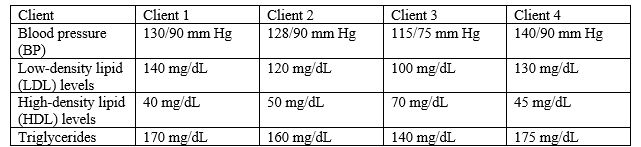 Which client has a reduced risk of cardiovascular disease?
1) Client 1
2) Client 2
3) Client 3
4) Client 4
Which client has a reduced risk of cardiovascular disease?1) Client 1
2) Client 2
3) Client 3
4) Client 4
سؤال
سؤال
سؤال
سؤال
سؤال
سؤال
سؤال
سؤال
سؤال
سؤال

فتح الحزمة
قم بالتسجيل لفتح البطاقات في هذه المجموعة!
Unlock Deck
Unlock Deck
1/25

العب

ملء الشاشة (f)
Deck 25: Diabetes Mellitus and the Metabolic Syndrome
1
Which symptom is associated with hyperosmolar hyperglycemic syndrome?
1) Severe dehydration
2) Stupor
3) Confusion
4) All of the above
1) Severe dehydration
2) Stupor
3) Confusion
4) All of the above
4
2
The nurse observes sweating, dizziness, and disorientation in the client and consults the primary health-care provider while caring for a diabetic client. Which treatment option would be most beneficial to the client?
1) Administering 25 g of glucose intravenously
2) Administering 1 mg of glucagon subcutaneously
3) Administering 50 mL of 50% dextrose intravenously
4) Both A and B
1) Administering 25 g of glucose intravenously
2) Administering 1 mg of glucagon subcutaneously
3) Administering 50 mL of 50% dextrose intravenously
4) Both A and B
3
3
The nurse is assessing the blood glucose levels of a client at regular intervals. The nurse finds 55 mg/dL of blood glucose at 2 am and150 mg/dL at 7 am. Which mechanism does the nurse suspect behind the change in the glucose levels in the client?
1) Somogyi effect
2) Dawn phenomenon
3) Prediabetes
4) None of the above
1) Somogyi effect
2) Dawn phenomenon
3) Prediabetes
4) None of the above
1
4
The nurse is caring for a client with immune mediated type 1 diabetes. What would the nurse expect to be the cause for this condition in the client?
1) The client has hyperinsulinism.
2) The client has destruction of beta cells.
3) The client has insulin resistance.
4) Both A and B
1) The client has hyperinsulinism.
2) The client has destruction of beta cells.
3) The client has insulin resistance.
4) Both A and B
فتح الحزمة
افتح القفل للوصول البطاقات البالغ عددها 25 في هذه المجموعة.
فتح الحزمة
k this deck
5
The laboratory report of a client shows arterial blood pH of 7.6, blood glucose level of 650 mg/dL, and serum bicarbonate level of 17 mEq/L. What does the nurse infer from these laboratory findings?
1) The client has diabetic ketoacidosis.
2) The client has hyperosmolar hyperglycemic syndrome.
3) The client has prediabetes.
4) None of the above
1) The client has diabetic ketoacidosis.
2) The client has hyperosmolar hyperglycemic syndrome.
3) The client has prediabetes.
4) None of the above
فتح الحزمة
افتح القفل للوصول البطاقات البالغ عددها 25 في هذه المجموعة.
فتح الحزمة
k this deck
6
The mother of an adolescent diabetic client tells the nurse, "My daughter is skipping insulin doses frequently because she is concerned about weight gain." Which condition does the nurse document for this client?
1) Insulin purging
2) Autonomic neuropathy
3) Peripheral neuropathy
4) Psychological insulin resistance
1) Insulin purging
2) Autonomic neuropathy
3) Peripheral neuropathy
4) Psychological insulin resistance
فتح الحزمة
افتح القفل للوصول البطاقات البالغ عددها 25 في هذه المجموعة.
فتح الحزمة
k this deck
7
Which is the most common complication expected in clients with type 1diabetes?
1) Diabetic ketoacidosis
2) Hyperosmolar hyperglycemic syndrome
3) Metabolic syndrome
4) None of the above
1) Diabetic ketoacidosis
2) Hyperosmolar hyperglycemic syndrome
3) Metabolic syndrome
4) None of the above
فتح الحزمة
افتح القفل للوصول البطاقات البالغ عددها 25 في هذه المجموعة.
فتح الحزمة
k this deck
8
The nurse observes a diabetic client who has a wound that has not healed for a long time. Which condition does the nurse suspect in the client?
1) Immunosuppression
2) Peripheral neuropathy
3) Transient ischemic attack
4) Accelerated atherosclerosis
1) Immunosuppression
2) Peripheral neuropathy
3) Transient ischemic attack
4) Accelerated atherosclerosis
فتح الحزمة
افتح القفل للوصول البطاقات البالغ عددها 25 في هذه المجموعة.
فتح الحزمة
k this deck
9
After reviewing the medical records of a 35-year-old female client, the nurse concludes that the client has metabolic syndrome. Which findings helped the nurse to reach this conclusion?
1) Triglyceride level of 140 mg/dL, waist circumference of 32 inches, and fasting blood glucose level 80 mg/dL
2) High-density lipoprotein (HDL) cholesterol of 40 mg/dL, blood pressure of 138/90 mm Hg, and fasting blood glucose level of 130 mg/dL
3) Fasting blood glucose of 90 mg/dL, triglyceride level of 120 mg/dL, and waist circumference of 30 inches.
4) Blood pressure of 120/80 mm Hg, waist circumference of 34 inches, and triglyceride level of 130 mg/dL
Exhibit
1) Triglyceride level of 140 mg/dL, waist circumference of 32 inches, and fasting blood glucose level 80 mg/dL
2) High-density lipoprotein (HDL) cholesterol of 40 mg/dL, blood pressure of 138/90 mm Hg, and fasting blood glucose level of 130 mg/dL
3) Fasting blood glucose of 90 mg/dL, triglyceride level of 120 mg/dL, and waist circumference of 30 inches.
4) Blood pressure of 120/80 mm Hg, waist circumference of 34 inches, and triglyceride level of 130 mg/dL
Exhibit
فتح الحزمة
افتح القفل للوصول البطاقات البالغ عددها 25 في هذه المجموعة.
فتح الحزمة
k this deck
10
Which complication is suspected in a client whose blood sugar is less than 30 mg/dL?
1) Bradycardia
2) Anhidrosis
3) Anorexia
4) Seizure
1) Bradycardia
2) Anhidrosis
3) Anorexia
4) Seizure
فتح الحزمة
افتح القفل للوصول البطاقات البالغ عددها 25 في هذه المجموعة.
فتح الحزمة
k this deck
11
Which antidiabetic medication is a sulfonylurea?
1) Glipizide (Glucotrol)
2) Pioglitazone (Actos)
3) Repaglinide (Prandin)
4) Metformin (Glucophage)
1) Glipizide (Glucotrol)
2) Pioglitazone (Actos)
3) Repaglinide (Prandin)
4) Metformin (Glucophage)
فتح الحزمة
افتح القفل للوصول البطاقات البالغ عددها 25 في هذه المجموعة.
فتح الحزمة
k this deck
12
The registered nurse is teaching a group of student nurses about managing hyperosmolar hyperglycemic syndrome (HHS) in clients. Which response of a student nurse indicates effective learning?
1) "Fluids should be administered before administering intravenous (IV) insulin to the client."
2) "IV insulin should be administered until blood glucose is 150 mg/dL."
3) "IV insulin administration should be followed by subcutaneous insulin."
4) "Fluid administration should be followed by IV fluid administration."
1) "Fluids should be administered before administering intravenous (IV) insulin to the client."
2) "IV insulin should be administered until blood glucose is 150 mg/dL."
3) "IV insulin administration should be followed by subcutaneous insulin."
4) "Fluid administration should be followed by IV fluid administration."
فتح الحزمة
افتح القفل للوصول البطاقات البالغ عددها 25 في هذه المجموعة.
فتح الحزمة
k this deck
13
The nurse observes hyperpigmented, velvety macular lesions on the neck during the assessment of a diabetic client. What does the nurse infer from this observation?
1) The client has lipoatrophy.
2) The client has lipohypertrophy.
3) The client has acanthosis nigricans.
4) The client has pigmented pretibial papules.
1) The client has lipoatrophy.
2) The client has lipohypertrophy.
3) The client has acanthosis nigricans.
4) The client has pigmented pretibial papules.
فتح الحزمة
افتح القفل للوصول البطاقات البالغ عددها 25 في هذه المجموعة.
فتح الحزمة
k this deck
14
The nurse is reviewing the medical records of different clients. Which client does the nurse expect to have metabolic syndrome?
1) Client 1
2) Client 2
3) Client 3
4) Client 4
Which client does the nurse expect to have metabolic syndrome?1) Client 1
2) Client 2
3) Client 3
4) Client 4
فتح الحزمة
افتح القفل للوصول البطاقات البالغ عددها 25 في هذه المجموعة.
فتح الحزمة
k this deck
15
The nurse is assessing the medical records of different clients with diabetes. Which client has a reduced risk of cardiovascular disease?
1) Client 1
2) Client 2
3) Client 3
4) Client 4
Which client has a reduced risk of cardiovascular disease?1) Client 1
2) Client 2
3) Client 3
4) Client 4
فتح الحزمة
افتح القفل للوصول البطاقات البالغ عددها 25 في هذه المجموعة.
فتح الحزمة
k this deck
16
Which diagnostic test helps in detecting the natural insulin secretion from the pancreas?
1) Urinalysis
2) C-peptide test
3) Islet cell autoantibodies
4) Both B and C
1) Urinalysis
2) C-peptide test
3) Islet cell autoantibodies
4) Both B and C
فتح الحزمة
افتح القفل للوصول البطاقات البالغ عددها 25 في هذه المجموعة.
فتح الحزمة
k this deck
17
The nurse reviews the laboratory reports of a diabetic client and concludes that the client has diabetic nephropathy. Which finding supports the nurse's conclusion?
1) Ketones in urine
2) Glucose in urine
3) Albumin in urine
4) All of the above
1) Ketones in urine
2) Glucose in urine
3) Albumin in urine
4) All of the above
فتح الحزمة
افتح القفل للوصول البطاقات البالغ عددها 25 في هذه المجموعة.
فتح الحزمة
k this deck
18
The nurse reviews the laboratory reports of a client and concludes that the client has diabetes. Which finding helped the nurse to reach this conclusion?
1) A fasting plasma glucose level of 100 mg/dL
2) A glycated hemoglobin (HbA1c) value of 7
3) A postprandial blood glucose level of 170 mg/dL
4) All of the above
1) A fasting plasma glucose level of 100 mg/dL
2) A glycated hemoglobin (HbA1c) value of 7
3) A postprandial blood glucose level of 170 mg/dL
4) All of the above
فتح الحزمة
افتح القفل للوصول البطاقات البالغ عددها 25 في هذه المجموعة.
فتح الحزمة
k this deck
19
Why does the nurse use the C-peptide test for a type 1 diabetic client?
1) To evaluate residual pancreatic function
2) To monitor the status of pancreatic beta cells
3) To monitor the red blood cell count
4) None of the above
1) To evaluate residual pancreatic function
2) To monitor the status of pancreatic beta cells
3) To monitor the red blood cell count
4) None of the above
فتح الحزمة
افتح القفل للوصول البطاقات البالغ عددها 25 في هذه المجموعة.
فتح الحزمة
k this deck
20
While preparing a client for the oral glucose tolerance test (OGTT), the nurse asks the client to ingest soda which contains 80 g of carbohydrates. After 2 hours, the nurse measures the postprandial blood glucose level and concludes that the client has diabetes. Which blood glucose finding supports the nurse's conclusion?
1) 160 mg/dL
2) 190 mg/dL
3) 250 mg/dL
4) None of the above
1) 160 mg/dL
2) 190 mg/dL
3) 250 mg/dL
4) None of the above
فتح الحزمة
افتح القفل للوصول البطاقات البالغ عددها 25 في هذه المجموعة.
فتح الحزمة
k this deck
21
Which symptoms does the nurse observe in a client with hyperosmolar hyperglycemic syndrome (HHS)?
1) Polyuria
2) Confusion
3) Polydipsia
4) Hypertension
5) Anorexia
1) Polyuria
2) Confusion
3) Polydipsia
4) Hypertension
5) Anorexia
فتح الحزمة
افتح القفل للوصول البطاقات البالغ عددها 25 في هذه المجموعة.
فتح الحزمة
k this deck
22
A client with diabetes is prescribed exenatide (Byetta). What are the immediate effects of the drug that could be observed in the client?
1) Weight loss
2) Delay in gastric emptying
3) Glucose-dependent insulin secretion
4) Improved beta cell mass and function
5) Suppression of postprandial glucagon
1) Weight loss
2) Delay in gastric emptying
3) Glucose-dependent insulin secretion
4) Improved beta cell mass and function
5) Suppression of postprandial glucagon
فتح الحزمة
افتح القفل للوصول البطاقات البالغ عددها 25 في هذه المجموعة.
فتح الحزمة
k this deck
23
The nurse suspects nocturnal hypoglycemia in a diabetic client. Which symptoms can the nurse expect to observe in this client?
1) Sleep disturbance
2) Vivid nightmares
3) Severe dehydration
4) Morning headache
5) All of the above
1) Sleep disturbance
2) Vivid nightmares
3) Severe dehydration
4) Morning headache
5) All of the above
فتح الحزمة
افتح القفل للوصول البطاقات البالغ عددها 25 في هذه المجموعة.
فتح الحزمة
k this deck
24
After reviewing the laboratory reports of a client with diabetes, the nurse finds that the client has diabetic ketoacidosis. Which findings support the nurse's conclusion?
1) Client's arterial blood pH of 6
2) Trace elements of ketones in urine
3) Serum bicarbonate level of 12 mEq/L
4) Blood glucose level of 300 mg/dL
5) None of the above
1) Client's arterial blood pH of 6
2) Trace elements of ketones in urine
3) Serum bicarbonate level of 12 mEq/L
4) Blood glucose level of 300 mg/dL
5) None of the above
فتح الحزمة
افتح القفل للوصول البطاقات البالغ عددها 25 في هذه المجموعة.
فتح الحزمة
k this deck
25
Which symptoms are associated with autonomic neuropathy?
1) Anhidrosis
2) Gastroparesis
3) Microalbuminuria
4) Paresthesias in feet
5) Postural hypotension
1) Anhidrosis
2) Gastroparesis
3) Microalbuminuria
4) Paresthesias in feet
5) Postural hypotension
فتح الحزمة
افتح القفل للوصول البطاقات البالغ عددها 25 في هذه المجموعة.
فتح الحزمة
k this deck
فتح الحزمة
افتح القفل للوصول البطاقات البالغ عددها 25 في هذه المجموعة.






