Deck 8: Neurons: the Matter of the Mind

ملء الشاشة (f)
exit full mode
سؤال
In saltatory conduction, nerve impulses jump from one exposed region of the axon to another. This exposed region is called the ________.

A) motor end plate
B) node of Ranvier
C) Schwann cell gap
D) interneurons
استخدم زر المسافة أو
up arrow
down arrow
لقلب البطاقة.
سؤال
Muscle cells that are not exercised will atrophy, or shrink in size. Lou Gehrig's disease affects nervous tissue but also causes muscle atrophy. What type of nerve cell must be affected to cause this muscle-wasting condition?

A) interneurons
B) sensory neurons
C) neuroglial cells
D) motor neurons
سؤال
Which of the following is a chemical signal that diffuses across the gap between adjacent neurons to convey a message to the next cell?

A) neurotransmitter
B) synapse
C) dendrite
D) action potential
سؤال
Multiple sclerosis is a disease in which the myelin sheath is destroyed. What will happen to nerve conduction speed in affected neurons?

A) It will slow down dramatically.
B) It will speed up dramatically.
C) It will speed up just a little bit.
D) There will be no effect.
سؤال
The specialized membrane proteins that actively transport sodium and potassium ions across the plasma membrane are known as the ________.

A) sodium-chloride pump
B) sodium-manganese pump
C) sodium-potassium pump
D) sodium pump
سؤال
When traveling down the neuron, which of the following parts of the neuron does the action potential pass through before the axon?

A) glial cell
B) dendrite
C) synapse
D) cell body
سؤال
Which one of the following ions outside the neuron would make it very difficult for a depolarization to occur?

A) potassium
B) sodium
C) chloride
D) manganese
سؤال
Which of these diseases involves the destruction of the myelin sheath on certain neurons within the brain and spinal cord?

A) depression
B) Alzheimer's disease
C) Parkinson's disease
D) multiple sclerosis
سؤال
A nerve impulse does not vary in intensity with regard to the strength of the stimulus. What do we call this phenomenon?

A) resting membrane potential
B) refractory period
C) all-or-nothing principle
D) graded response
سؤال
A neuron's membrane that maintains a charge difference across its surface in which the inside is more negative than the outside is called ________.

A) graded potential
B) resting potential
C) action potential
D) summation
سؤال
Infants require many nutrients early in life, including lipids such as fats. A low-fat diet for infants is not recommended because, among other things, it can affect the development of the nervous system. Why does the developing nervous system need lipids?

A) Glial cells need lipids to produce the myelin sheath.
B) Fats are needed for energy because infants are often on a low-carbohydrate diet.
C) Lipids are needed to produce the polypeptide neurotransmitters used by neurons.
D) Fats are required to generate action potentials on nerve cells.
سؤال
Which type of neuron is found only in the brain and spinal cord?

A) sensory neuron
B) interneuron
C) motor neuron
D) glial cell
سؤال
Inhaling or "huffing" is a way to achieve a high, usually by breathing in a fat-soluble substance. Which of the following structures would be most likely attacked first?

A) myelin sheath
B) axon
C) neuron
D) dendrite
سؤال
A new drug interferes with the function of the dendrites of a neuron. What will happen to this neuron?

A) The neuron will continuously send signals.
B) The neuron cannot be stimulated to send a signal along its axon.
C) The neuron will die off.
D) The neuron will sometimes send signals and will sometimes not send signals.
سؤال
Some drugs modulate the activity of ion channels. For example, Novocain somewhat inhibits the opening of sodium channels. What happens to the threshold of a sensory neuron if this drug is used?

A) It will take less stimulation to reach threshold.
B) It will take more stimulation to reach threshold.
C) Threshold will not change.
D) The nerve will not function and will die off.
سؤال
Which of the following parts of the nervous system is closest to a muscle?

A) neuron
B) interneuron
C) motor neuron
D) neuroglial cell
سؤال
Leprosy destroys nerve tissue, so an afflicted person is likely to hurt his or her foot without even knowing it. Which types of neurons are likely to be affected?

A) neuroglial cells
B) motor neurons
C) sensory neurons
D) interneurons
سؤال
Which type of cell found in the nervous system is the most numerous?

A) neuron
B) neuroglial cell
C) sensory cell
D) Schwann cell
سؤال
Sodium and potassium ions cross the neuron's membrane to cause which of the following processes?

A) action potential
B) passive transport
C) refractory period
D) transmission
سؤال
Ouabain is a chemical used on poison arrows in Africa. It works by inhibiting the sodium-potassium pump. What effect does this chemical have on an action potential?

A) It prevents the stimulation of an action potential by removing sodium from the cell.
B) It immediately causes an action potential to be generated.
C) There is no direct effect because the pump is used to maintain ion distributions, not to cause an action potential.
D) It causes the release of a neurotransmitter that causes an action potential.
سؤال
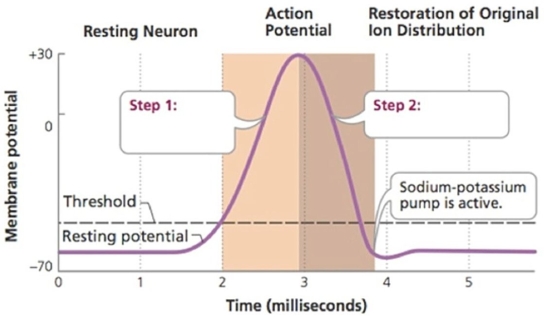
  Look at the accompanying figure. In Step 1 ________ ions enter the neuron, while in Step 2 ________ ions leave the neuron.<div style=padding-top: 35px> Look at the accompanying figure. In Step 1 ________ ions enter the neuron, while in Step 2 ________ ions leave the neuron.
سؤال
During an action potential, the ________ ions rush into the axon.
سؤال
Prescription drugs such as Prozac help maintain higher levels of serotonin in the brain. What effect will this have on an individual?

A) It will act as an antidepressant because a lack of serotonin is considered a cause of depression symptoms.
B) It will act to suppress impulsive behavior because too much serotonin causes children to act out.
C) It will cause a patient to be sleepy because serotonin is essential to a good night's sleep.
D) It will cause tetany due to an overproduction of acetylcholine.
سؤال
The jumping of a nerve impulse from one node of Ranvier to the next is known as ________.
سؤال
The combined effects of inhibitory and excitatory effects on a postsynaptic cell will decide whether that cell generates an action potential. This principle is called ________.

A) threshold
B) internalization
C) summation
D) potentiation
سؤال
Axons and dendrites of individual neurons, arranged in bundles and covered by connective tissue, make up ________.
سؤال
You might have been accidentally exposed to an insecticide while working in a citrus grove. What symptoms of poisoning would you watch for?

A) depression
B) Alzheimer's disease
C) muscle tremors
D) excessive urination
سؤال
Which neurotransmitter may function to regulate emotions and is involved in pathways that control complex movements?

A) dopamine
B) serotonin
C) norepinephrine
D) synapse
سؤال
________ is the name of the cell that wraps around the axon, forming the myelin sheath.
سؤال
________ is a progressive brain disease in which the dopamine-producing neurons in the movement control center of the brain die.
سؤال
A(n) ________, or afferent, neuron conducts information toward the brain and spinal cord.
سؤال
Your classmate does not have much muscle strength. Her doctor says she has an autoimmune disease, but you didn't quite catch the name the physician gave for the illness. Based on what you have learned, what do you think the diagnosis is?

A) Alzheimer's disease
B) schizophrenia
C) senility
D) myasthenia gravis
سؤال
Which neurotransmitter appears to be associated with an energizing "good" feeling and is essential in hunger, thirst, and sex drive?

A) dopamine
B) serotonin
C) norepinephrine
D) synapse
سؤال
Prior to their release, where are the special chemicals called neurotransmitters stored in a neuron?

A) axon
B) synaptic knob
C) dendrites
D) cell body
سؤال
________ is the name given to the motor neurons that carry information away from the brain or spinal cord.
سؤال
The neuron that releases neurotransmitters is known as ________, while the neuron that receives the neurotransmitters is knows as ________.
سؤال
The neuron requires a certain level of depolarization of its membrane in order to generate an action potential. This level of depolarization is known as the ________.
سؤال
________ are numerous short, branching projections from the neuron that create a huge surface for receiving signals from other cells.
سؤال
Immediately after an action potential occurs, the sodium channels close and cannot be reopened. What is this period called?
سؤال
Which of the following is a neurotransmitter that triggers a contraction of a voluntary muscle?

A) synapse
B) action potential
C) sodium
D) acetylcholine
سؤال
Compare and contrast the sensory neurons, motor neurons, and interneurons.
سؤال
If a drug had the side effect of destroying dopamine-producing neurons, what effect would this have on a person?
سؤال
What is the function of the myelin sheath in the nervous system?
سؤال
In the disease myasthenia gravis, the immune system attacks the receptors for the neurotransmitter acetylcholine. A drug is used to inhibit the enzyme acetylcholinesterase, which normally removes the neurotransmitter. This improves the condition of the patient. How does this work?
سؤال
Explain the anatomy of a typical neuron.
سؤال
________ involves an insufficient amount of several neurotransmitters, such as serotonin, dopamine, and norepinephrine, for extended periods of time.
سؤال
The enzyme that removes the neurotransmitter acetylcholine from synapses after it has been released is known as ________.
سؤال
What are some of the dangers associated with the use of organophosphate pesticides that might be of concern for humans? (Organophosphates inhibit acetylcholinesterase.) What are some ethical concerns related to their use?
سؤال
Tay-Sachs disease is a genetic disorder in which fat deposits build up in nerve cells of the brain, leading to a slow loss of function. Because this disease usually strikes children under 1 year of age, the symptoms are not immediately apparent. Think about the symptoms that this condition would cause. List some that you think are possible. What would be the inevitable end result as the disease progresses?
سؤال
Some nerves are myelinated, and others are not. Myelinated nerves send signals faster than unmyelinated neurons. Draw two neurons of equal length, and wrap segments of myelin along one. Be careful to leave spaces for the nodes of Ranvier. Now, measure the exposed axons of each, and total up the distance. Describe why the myelinated neurons send signals faster.
سؤال
Association neurons that are located between the sensory and motor neurons, where they integrate or interpret the sensory signals.
سؤال
Potassium ions are important in the resting membrane potential and the action potential of the nerve and to the contraction of muscle cells. The concentration gradient of potassium ions is critical to both. An excess of potassium outside a neuron or muscle cell would negate the concentration gradient. What would happen if the heart were injected with massive amounts of potassium? Explain your answer.
سؤال
________ is a neurotransmitter released at every neuromuscular junction (the junction of a motor neuron and a skeletal muscle cell), where it triggers contraction of voluntary (skeletal) muscles.
سؤال
The synaptic ________ is the narrow space between two neurons.
سؤال
Match between columns
Synapse in which neurotransmitters decrease the chance of an action potential on the postsynaptic cell.
Inhibitory synapse
Synapse in which neurotransmitters decrease the chance of an action potential on the postsynaptic cell.
Excitatory synapse
Synapse in which neurotransmitters decrease the chance of an action potential on the postsynaptic cell.
Sensory neuron
Synapse in which neurotransmitters decrease the chance of an action potential on the postsynaptic cell.
Synapse
Synapse in which neurotransmitters decrease the chance of an action potential on the postsynaptic cell.
Dendrite
Synapse in which neurotransmitters decrease the chance of an action potential on the postsynaptic cell.
Motor neuron
Synapse in which neurotransmitters decrease the chance of an action potential on the postsynaptic cell.
Ion channels
Synapse in which neurotransmitters decrease the chance of an action potential on the postsynaptic cell.
Synaptic knobs
Synapse in which neurotransmitters decrease the chance of an action potential on the postsynaptic cell.
Axon
Synapse in which neurotransmitters decrease the chance of an action potential on the postsynaptic cell.
Interneurons
Membrane proteins that allow specific charged molecules to pass through from one side of the membrane to the other.
Inhibitory synapse
Membrane proteins that allow specific charged molecules to pass through from one side of the membrane to the other.
Excitatory synapse
Membrane proteins that allow specific charged molecules to pass through from one side of the membrane to the other.
Sensory neuron
Membrane proteins that allow specific charged molecules to pass through from one side of the membrane to the other.
Synapse
Membrane proteins that allow specific charged molecules to pass through from one side of the membrane to the other.
Dendrite
Membrane proteins that allow specific charged molecules to pass through from one side of the membrane to the other.
Motor neuron
Membrane proteins that allow specific charged molecules to pass through from one side of the membrane to the other.
Ion channels
Membrane proteins that allow specific charged molecules to pass through from one side of the membrane to the other.
Synaptic knobs
Membrane proteins that allow specific charged molecules to pass through from one side of the membrane to the other.
Axon
Membrane proteins that allow specific charged molecules to pass through from one side of the membrane to the other.
Interneurons
Association neurons that are located between the sensory and motor neurons, where they integrate or interpret the sensory signals.
Inhibitory synapse
Association neurons that are located between the sensory and motor neurons, where they integrate or interpret the sensory signals.
Excitatory synapse
Association neurons that are located between the sensory and motor neurons, where they integrate or interpret the sensory signals.
Sensory neuron
Association neurons that are located between the sensory and motor neurons, where they integrate or interpret the sensory signals.
Synapse
Association neurons that are located between the sensory and motor neurons, where they integrate or interpret the sensory signals.
Dendrite
Association neurons that are located between the sensory and motor neurons, where they integrate or interpret the sensory signals.
Motor neuron
Association neurons that are located between the sensory and motor neurons, where they integrate or interpret the sensory signals.
Ion channels
Association neurons that are located between the sensory and motor neurons, where they integrate or interpret the sensory signals.
Synaptic knobs
Association neurons that are located between the sensory and motor neurons, where they integrate or interpret the sensory signals.
Axon
Association neurons that are located between the sensory and motor neurons, where they integrate or interpret the sensory signals.
Interneurons
Synapse in which neurotransmitters allow sodium to enter the postsynaptic cell.
Inhibitory synapse
Synapse in which neurotransmitters allow sodium to enter the postsynaptic cell.
Excitatory synapse
Synapse in which neurotransmitters allow sodium to enter the postsynaptic cell.
Sensory neuron
Synapse in which neurotransmitters allow sodium to enter the postsynaptic cell.
Synapse
Synapse in which neurotransmitters allow sodium to enter the postsynaptic cell.
Dendrite
Synapse in which neurotransmitters allow sodium to enter the postsynaptic cell.
Motor neuron
Synapse in which neurotransmitters allow sodium to enter the postsynaptic cell.
Ion channels
Synapse in which neurotransmitters allow sodium to enter the postsynaptic cell.
Synaptic knobs
Synapse in which neurotransmitters allow sodium to enter the postsynaptic cell.
Axon
Synapse in which neurotransmitters allow sodium to enter the postsynaptic cell.
Interneurons
Specific neurons that carry information away from the brain and spinal cord to an effector such as a muscle or a gland.
Inhibitory synapse
Specific neurons that carry information away from the brain and spinal cord to an effector such as a muscle or a gland.
Excitatory synapse
Specific neurons that carry information away from the brain and spinal cord to an effector such as a muscle or a gland.
Sensory neuron
Specific neurons that carry information away from the brain and spinal cord to an effector such as a muscle or a gland.
Synapse
Specific neurons that carry information away from the brain and spinal cord to an effector such as a muscle or a gland.
Dendrite
Specific neurons that carry information away from the brain and spinal cord to an effector such as a muscle or a gland.
Motor neuron
Specific neurons that carry information away from the brain and spinal cord to an effector such as a muscle or a gland.
Ion channels
Specific neurons that carry information away from the brain and spinal cord to an effector such as a muscle or a gland.
Synaptic knobs
Specific neurons that carry information away from the brain and spinal cord to an effector such as a muscle or a gland.
Axon
Specific neurons that carry information away from the brain and spinal cord to an effector such as a muscle or a gland.
Interneurons
Part of the neuron where neurotransmitters are released.
Inhibitory synapse
Part of the neuron where neurotransmitters are released.
Excitatory synapse
Part of the neuron where neurotransmitters are released.
Sensory neuron
Part of the neuron where neurotransmitters are released.
Synapse
Part of the neuron where neurotransmitters are released.
Dendrite
Part of the neuron where neurotransmitters are released.
Motor neuron
Part of the neuron where neurotransmitters are released.
Ion channels
Part of the neuron where neurotransmitters are released.
Synaptic knobs
Part of the neuron where neurotransmitters are released.
Axon
Part of the neuron where neurotransmitters are released.
Interneurons
A specific type of neuron that conducts information toward the brain and spinal cord from a sensory receptor.
Inhibitory synapse
A specific type of neuron that conducts information toward the brain and spinal cord from a sensory receptor.
Excitatory synapse
A specific type of neuron that conducts information toward the brain and spinal cord from a sensory receptor.
Sensory neuron
A specific type of neuron that conducts information toward the brain and spinal cord from a sensory receptor.
Synapse
A specific type of neuron that conducts information toward the brain and spinal cord from a sensory receptor.
Dendrite
A specific type of neuron that conducts information toward the brain and spinal cord from a sensory receptor.
Motor neuron
A specific type of neuron that conducts information toward the brain and spinal cord from a sensory receptor.
Ion channels
A specific type of neuron that conducts information toward the brain and spinal cord from a sensory receptor.
Synaptic knobs
A specific type of neuron that conducts information toward the brain and spinal cord from a sensory receptor.
Axon
A specific type of neuron that conducts information toward the brain and spinal cord from a sensory receptor.
Interneurons
The junction between a neuron and another cell.
Inhibitory synapse
The junction between a neuron and another cell.
Excitatory synapse
The junction between a neuron and another cell.
Sensory neuron
The junction between a neuron and another cell.
Synapse
The junction between a neuron and another cell.
Dendrite
The junction between a neuron and another cell.
Motor neuron
The junction between a neuron and another cell.
Ion channels
The junction between a neuron and another cell.
Synaptic knobs
The junction between a neuron and another cell.
Axon
The junction between a neuron and another cell.
Interneurons
A single, long extension of a neuron's cell body that functions to transmit an incoming message or impulse.
Inhibitory synapse
A single, long extension of a neuron's cell body that functions to transmit an incoming message or impulse.
Excitatory synapse
A single, long extension of a neuron's cell body that functions to transmit an incoming message or impulse.
Sensory neuron
A single, long extension of a neuron's cell body that functions to transmit an incoming message or impulse.
Synapse
A single, long extension of a neuron's cell body that functions to transmit an incoming message or impulse.
Dendrite
A single, long extension of a neuron's cell body that functions to transmit an incoming message or impulse.
Motor neuron
A single, long extension of a neuron's cell body that functions to transmit an incoming message or impulse.
Ion channels
A single, long extension of a neuron's cell body that functions to transmit an incoming message or impulse.
Synaptic knobs
A single, long extension of a neuron's cell body that functions to transmit an incoming message or impulse.
Axon
A single, long extension of a neuron's cell body that functions to transmit an incoming message or impulse.
Interneurons
The short branching projections of a neuron, which provide surface area for sending and receiving signals from other cells.
Inhibitory synapse
The short branching projections of a neuron, which provide surface area for sending and receiving signals from other cells.
Excitatory synapse
The short branching projections of a neuron, which provide surface area for sending and receiving signals from other cells.
Sensory neuron
The short branching projections of a neuron, which provide surface area for sending and receiving signals from other cells.
Synapse
The short branching projections of a neuron, which provide surface area for sending and receiving signals from other cells.
Dendrite
The short branching projections of a neuron, which provide surface area for sending and receiving signals from other cells.
Motor neuron
The short branching projections of a neuron, which provide surface area for sending and receiving signals from other cells.
Ion channels
The short branching projections of a neuron, which provide surface area for sending and receiving signals from other cells.
Synaptic knobs
The short branching projections of a neuron, which provide surface area for sending and receiving signals from other cells.
Axon
The short branching projections of a neuron, which provide surface area for sending and receiving signals from other cells.
Interneurons
فتح الحزمة
قم بالتسجيل لفتح البطاقات في هذه المجموعة!
Unlock Deck
Unlock Deck
1/55
auto play flashcards
العب
simple tutorial
ملء الشاشة (f)
exit full mode
Deck 8: Neurons: the Matter of the Mind
1
In saltatory conduction, nerve impulses jump from one exposed region of the axon to another. This exposed region is called the ________.

A) motor end plate
B) node of Ranvier
C) Schwann cell gap
D) interneurons
B
2
Muscle cells that are not exercised will atrophy, or shrink in size. Lou Gehrig's disease affects nervous tissue but also causes muscle atrophy. What type of nerve cell must be affected to cause this muscle-wasting condition?

A) interneurons
B) sensory neurons
C) neuroglial cells
D) motor neurons
D
3
Which of the following is a chemical signal that diffuses across the gap between adjacent neurons to convey a message to the next cell?

A) neurotransmitter
B) synapse
C) dendrite
D) action potential
A
4
Multiple sclerosis is a disease in which the myelin sheath is destroyed. What will happen to nerve conduction speed in affected neurons?

A) It will slow down dramatically.
B) It will speed up dramatically.
C) It will speed up just a little bit.
D) There will be no effect.
فتح الحزمة
افتح القفل للوصول البطاقات البالغ عددها 55 في هذه المجموعة.
فتح الحزمة
k this deck
5
The specialized membrane proteins that actively transport sodium and potassium ions across the plasma membrane are known as the ________.

A) sodium-chloride pump
B) sodium-manganese pump
C) sodium-potassium pump
D) sodium pump
فتح الحزمة
افتح القفل للوصول البطاقات البالغ عددها 55 في هذه المجموعة.
فتح الحزمة
k this deck
6
When traveling down the neuron, which of the following parts of the neuron does the action potential pass through before the axon?

A) glial cell
B) dendrite
C) synapse
D) cell body
فتح الحزمة
افتح القفل للوصول البطاقات البالغ عددها 55 في هذه المجموعة.
فتح الحزمة
k this deck
7
Which one of the following ions outside the neuron would make it very difficult for a depolarization to occur?

A) potassium
B) sodium
C) chloride
D) manganese
فتح الحزمة
افتح القفل للوصول البطاقات البالغ عددها 55 في هذه المجموعة.

فتح الحزمة
k this deck
8
Which of these diseases involves the destruction of the myelin sheath on certain neurons within the brain and spinal cord?

A) depression
B) Alzheimer's disease
C) Parkinson's disease
D) multiple sclerosis
فتح الحزمة
افتح القفل للوصول البطاقات البالغ عددها 55 في هذه المجموعة.

فتح الحزمة
k this deck
9
A nerve impulse does not vary in intensity with regard to the strength of the stimulus. What do we call this phenomenon?

A) resting membrane potential
B) refractory period
C) all-or-nothing principle
D) graded response
فتح الحزمة
افتح القفل للوصول البطاقات البالغ عددها 55 في هذه المجموعة.
فتح الحزمة
k this deck
10
A neuron's membrane that maintains a charge difference across its surface in which the inside is more negative than the outside is called ________.

A) graded potential
B) resting potential
C) action potential
D) summation
فتح الحزمة
افتح القفل للوصول البطاقات البالغ عددها 55 في هذه المجموعة.
فتح الحزمة
k this deck
11
Infants require many nutrients early in life, including lipids such as fats. A low-fat diet for infants is not recommended because, among other things, it can affect the development of the nervous system. Why does the developing nervous system need lipids?

A) Glial cells need lipids to produce the myelin sheath.
B) Fats are needed for energy because infants are often on a low-carbohydrate diet.
C) Lipids are needed to produce the polypeptide neurotransmitters used by neurons.
D) Fats are required to generate action potentials on nerve cells.
فتح الحزمة
افتح القفل للوصول البطاقات البالغ عددها 55 في هذه المجموعة.
فتح الحزمة
k this deck
12
Which type of neuron is found only in the brain and spinal cord?

A) sensory neuron
B) interneuron
C) motor neuron
D) glial cell
فتح الحزمة
افتح القفل للوصول البطاقات البالغ عددها 55 في هذه المجموعة.
فتح الحزمة
k this deck
13
Inhaling or "huffing" is a way to achieve a high, usually by breathing in a fat-soluble substance. Which of the following structures would be most likely attacked first?

A) myelin sheath
B) axon
C) neuron
D) dendrite
فتح الحزمة
افتح القفل للوصول البطاقات البالغ عددها 55 في هذه المجموعة.
فتح الحزمة
k this deck
14
A new drug interferes with the function of the dendrites of a neuron. What will happen to this neuron?

A) The neuron will continuously send signals.
B) The neuron cannot be stimulated to send a signal along its axon.
C) The neuron will die off.
D) The neuron will sometimes send signals and will sometimes not send signals.
فتح الحزمة
افتح القفل للوصول البطاقات البالغ عددها 55 في هذه المجموعة.
فتح الحزمة
k this deck
15
Some drugs modulate the activity of ion channels. For example, Novocain somewhat inhibits the opening of sodium channels. What happens to the threshold of a sensory neuron if this drug is used?

A) It will take less stimulation to reach threshold.
B) It will take more stimulation to reach threshold.
C) Threshold will not change.
D) The nerve will not function and will die off.
فتح الحزمة
افتح القفل للوصول البطاقات البالغ عددها 55 في هذه المجموعة.
فتح الحزمة
k this deck
16
Which of the following parts of the nervous system is closest to a muscle?

A) neuron
B) interneuron
C) motor neuron
D) neuroglial cell
فتح الحزمة
افتح القفل للوصول البطاقات البالغ عددها 55 في هذه المجموعة.
فتح الحزمة
k this deck
17
Leprosy destroys nerve tissue, so an afflicted person is likely to hurt his or her foot without even knowing it. Which types of neurons are likely to be affected?

A) neuroglial cells
B) motor neurons
C) sensory neurons
D) interneurons
فتح الحزمة
افتح القفل للوصول البطاقات البالغ عددها 55 في هذه المجموعة.
فتح الحزمة
k this deck
18
Which type of cell found in the nervous system is the most numerous?

A) neuron
B) neuroglial cell
C) sensory cell
D) Schwann cell
فتح الحزمة
افتح القفل للوصول البطاقات البالغ عددها 55 في هذه المجموعة.
فتح الحزمة
k this deck
19
Sodium and potassium ions cross the neuron's membrane to cause which of the following processes?

A) action potential
B) passive transport
C) refractory period
D) transmission
فتح الحزمة
افتح القفل للوصول البطاقات البالغ عددها 55 في هذه المجموعة.
فتح الحزمة
k this deck
20
Ouabain is a chemical used on poison arrows in Africa. It works by inhibiting the sodium-potassium pump. What effect does this chemical have on an action potential?

A) It prevents the stimulation of an action potential by removing sodium from the cell.
B) It immediately causes an action potential to be generated.
C) There is no direct effect because the pump is used to maintain ion distributions, not to cause an action potential.
D) It causes the release of a neurotransmitter that causes an action potential.
فتح الحزمة
افتح القفل للوصول البطاقات البالغ عددها 55 في هذه المجموعة.
فتح الحزمة
k this deck
21
  Look at the accompanying figure. In Step 1 ________ ions enter the neuron, while in Step 2 ________ ions leave the neuron. Look at the accompanying figure. In Step 1 ________ ions enter the neuron, while in Step 2 ________ ions leave the neuron.
فتح الحزمة
افتح القفل للوصول البطاقات البالغ عددها 55 في هذه المجموعة.
فتح الحزمة
k this deck
22
During an action potential, the ________ ions rush into the axon.
فتح الحزمة
افتح القفل للوصول البطاقات البالغ عددها 55 في هذه المجموعة.
فتح الحزمة
k this deck
23
Prescription drugs such as Prozac help maintain higher levels of serotonin in the brain. What effect will this have on an individual?

A) It will act as an antidepressant because a lack of serotonin is considered a cause of depression symptoms.
B) It will act to suppress impulsive behavior because too much serotonin causes children to act out.
C) It will cause a patient to be sleepy because serotonin is essential to a good night's sleep.
D) It will cause tetany due to an overproduction of acetylcholine.
فتح الحزمة
افتح القفل للوصول البطاقات البالغ عددها 55 في هذه المجموعة.
فتح الحزمة
k this deck
24
The jumping of a nerve impulse from one node of Ranvier to the next is known as ________.
فتح الحزمة
افتح القفل للوصول البطاقات البالغ عددها 55 في هذه المجموعة.
فتح الحزمة
k this deck
25
The combined effects of inhibitory and excitatory effects on a postsynaptic cell will decide whether that cell generates an action potential. This principle is called ________.

A) threshold
B) internalization
C) summation
D) potentiation
فتح الحزمة
افتح القفل للوصول البطاقات البالغ عددها 55 في هذه المجموعة.
فتح الحزمة
k this deck
26
Axons and dendrites of individual neurons, arranged in bundles and covered by connective tissue, make up ________.
فتح الحزمة
افتح القفل للوصول البطاقات البالغ عددها 55 في هذه المجموعة.
فتح الحزمة
k this deck
27
You might have been accidentally exposed to an insecticide while working in a citrus grove. What symptoms of poisoning would you watch for?

A) depression
B) Alzheimer's disease
C) muscle tremors
D) excessive urination
فتح الحزمة
افتح القفل للوصول البطاقات البالغ عددها 55 في هذه المجموعة.
فتح الحزمة
k this deck
28
Which neurotransmitter may function to regulate emotions and is involved in pathways that control complex movements?

A) dopamine
B) serotonin
C) norepinephrine
D) synapse
فتح الحزمة
افتح القفل للوصول البطاقات البالغ عددها 55 في هذه المجموعة.
فتح الحزمة
k this deck
29
________ is the name of the cell that wraps around the axon, forming the myelin sheath.
فتح الحزمة
افتح القفل للوصول البطاقات البالغ عددها 55 في هذه المجموعة.
فتح الحزمة
k this deck
30
________ is a progressive brain disease in which the dopamine-producing neurons in the movement control center of the brain die.
فتح الحزمة
افتح القفل للوصول البطاقات البالغ عددها 55 في هذه المجموعة.
فتح الحزمة
k this deck
31
A(n) ________, or afferent, neuron conducts information toward the brain and spinal cord.
فتح الحزمة
افتح القفل للوصول البطاقات البالغ عددها 55 في هذه المجموعة.
فتح الحزمة
k this deck
32
Your classmate does not have much muscle strength. Her doctor says she has an autoimmune disease, but you didn't quite catch the name the physician gave for the illness. Based on what you have learned, what do you think the diagnosis is?

A) Alzheimer's disease
B) schizophrenia
C) senility
D) myasthenia gravis
فتح الحزمة
افتح القفل للوصول البطاقات البالغ عددها 55 في هذه المجموعة.
فتح الحزمة
k this deck
33
Which neurotransmitter appears to be associated with an energizing "good" feeling and is essential in hunger, thirst, and sex drive?

A) dopamine
B) serotonin
C) norepinephrine
D) synapse
فتح الحزمة
افتح القفل للوصول البطاقات البالغ عددها 55 في هذه المجموعة.
فتح الحزمة
k this deck
34
Prior to their release, where are the special chemicals called neurotransmitters stored in a neuron?

A) axon
B) synaptic knob
C) dendrites
D) cell body
فتح الحزمة
افتح القفل للوصول البطاقات البالغ عددها 55 في هذه المجموعة.
فتح الحزمة
k this deck
35
________ is the name given to the motor neurons that carry information away from the brain or spinal cord.
فتح الحزمة
افتح القفل للوصول البطاقات البالغ عددها 55 في هذه المجموعة.
فتح الحزمة
k this deck
36
The neuron that releases neurotransmitters is known as ________, while the neuron that receives the neurotransmitters is knows as ________.
فتح الحزمة
افتح القفل للوصول البطاقات البالغ عددها 55 في هذه المجموعة.
فتح الحزمة
k this deck
37
The neuron requires a certain level of depolarization of its membrane in order to generate an action potential. This level of depolarization is known as the ________.
فتح الحزمة
افتح القفل للوصول البطاقات البالغ عددها 55 في هذه المجموعة.
فتح الحزمة
k this deck
38
________ are numerous short, branching projections from the neuron that create a huge surface for receiving signals from other cells.
فتح الحزمة
افتح القفل للوصول البطاقات البالغ عددها 55 في هذه المجموعة.
فتح الحزمة
k this deck
39
Immediately after an action potential occurs, the sodium channels close and cannot be reopened. What is this period called?
فتح الحزمة
افتح القفل للوصول البطاقات البالغ عددها 55 في هذه المجموعة.
فتح الحزمة
k this deck
40
Which of the following is a neurotransmitter that triggers a contraction of a voluntary muscle?

A) synapse
B) action potential
C) sodium
D) acetylcholine
فتح الحزمة
افتح القفل للوصول البطاقات البالغ عددها 55 في هذه المجموعة.
فتح الحزمة
k this deck
41
Compare and contrast the sensory neurons, motor neurons, and interneurons.
فتح الحزمة
افتح القفل للوصول البطاقات البالغ عددها 55 في هذه المجموعة.
فتح الحزمة
k this deck
42
If a drug had the side effect of destroying dopamine-producing neurons, what effect would this have on a person?
فتح الحزمة
افتح القفل للوصول البطاقات البالغ عددها 55 في هذه المجموعة.
فتح الحزمة
k this deck
43
What is the function of the myelin sheath in the nervous system?
فتح الحزمة
افتح القفل للوصول البطاقات البالغ عددها 55 في هذه المجموعة.
فتح الحزمة
k this deck
44
In the disease myasthenia gravis, the immune system attacks the receptors for the neurotransmitter acetylcholine. A drug is used to inhibit the enzyme acetylcholinesterase, which normally removes the neurotransmitter. This improves the condition of the patient. How does this work?
فتح الحزمة
افتح القفل للوصول البطاقات البالغ عددها 55 في هذه المجموعة.
فتح الحزمة
k this deck
45
Explain the anatomy of a typical neuron.
فتح الحزمة
افتح القفل للوصول البطاقات البالغ عددها 55 في هذه المجموعة.
فتح الحزمة
k this deck
46
________ involves an insufficient amount of several neurotransmitters, such as serotonin, dopamine, and norepinephrine, for extended periods of time.
فتح الحزمة
افتح القفل للوصول البطاقات البالغ عددها 55 في هذه المجموعة.
فتح الحزمة
k this deck
47
The enzyme that removes the neurotransmitter acetylcholine from synapses after it has been released is known as ________.
فتح الحزمة
افتح القفل للوصول البطاقات البالغ عددها 55 في هذه المجموعة.
فتح الحزمة
k this deck
48
What are some of the dangers associated with the use of organophosphate pesticides that might be of concern for humans? (Organophosphates inhibit acetylcholinesterase.) What are some ethical concerns related to their use?
فتح الحزمة
افتح القفل للوصول البطاقات البالغ عددها 55 في هذه المجموعة.
فتح الحزمة
k this deck
49
Tay-Sachs disease is a genetic disorder in which fat deposits build up in nerve cells of the brain, leading to a slow loss of function. Because this disease usually strikes children under 1 year of age, the symptoms are not immediately apparent. Think about the symptoms that this condition would cause. List some that you think are possible. What would be the inevitable end result as the disease progresses?
فتح الحزمة
افتح القفل للوصول البطاقات البالغ عددها 55 في هذه المجموعة.
فتح الحزمة
k this deck
50
Some nerves are myelinated, and others are not. Myelinated nerves send signals faster than unmyelinated neurons. Draw two neurons of equal length, and wrap segments of myelin along one. Be careful to leave spaces for the nodes of Ranvier. Now, measure the exposed axons of each, and total up the distance. Describe why the myelinated neurons send signals faster.
فتح الحزمة
افتح القفل للوصول البطاقات البالغ عددها 55 في هذه المجموعة.
فتح الحزمة
k this deck
51
Association neurons that are located between the sensory and motor neurons, where they integrate or interpret the sensory signals.
فتح الحزمة
افتح القفل للوصول البطاقات البالغ عددها 55 في هذه المجموعة.
فتح الحزمة
k this deck
52
Potassium ions are important in the resting membrane potential and the action potential of the nerve and to the contraction of muscle cells. The concentration gradient of potassium ions is critical to both. An excess of potassium outside a neuron or muscle cell would negate the concentration gradient. What would happen if the heart were injected with massive amounts of potassium? Explain your answer.
فتح الحزمة
افتح القفل للوصول البطاقات البالغ عددها 55 في هذه المجموعة.
فتح الحزمة
k this deck
53
________ is a neurotransmitter released at every neuromuscular junction (the junction of a motor neuron and a skeletal muscle cell), where it triggers contraction of voluntary (skeletal) muscles.
فتح الحزمة
افتح القفل للوصول البطاقات البالغ عددها 55 في هذه المجموعة.
فتح الحزمة
k this deck
54
The synaptic ________ is the narrow space between two neurons.
فتح الحزمة
افتح القفل للوصول البطاقات البالغ عددها 55 في هذه المجموعة.
فتح الحزمة
k this deck
55
Match between columns
Synapse in which neurotransmitters decrease the chance of an action potential on the postsynaptic cell.
Inhibitory synapse
Synapse in which neurotransmitters decrease the chance of an action potential on the postsynaptic cell.
Excitatory synapse
Synapse in which neurotransmitters decrease the chance of an action potential on the postsynaptic cell.
Sensory neuron
Synapse in which neurotransmitters decrease the chance of an action potential on the postsynaptic cell.
Synapse
Synapse in which neurotransmitters decrease the chance of an action potential on the postsynaptic cell.
Dendrite
Synapse in which neurotransmitters decrease the chance of an action potential on the postsynaptic cell.
Motor neuron
Synapse in which neurotransmitters decrease the chance of an action potential on the postsynaptic cell.
Ion channels
Synapse in which neurotransmitters decrease the chance of an action potential on the postsynaptic cell.
Synaptic knobs
Synapse in which neurotransmitters decrease the chance of an action potential on the postsynaptic cell.
Axon
Synapse in which neurotransmitters decrease the chance of an action potential on the postsynaptic cell.
Interneurons
Membrane proteins that allow specific charged molecules to pass through from one side of the membrane to the other.
Inhibitory synapse
Membrane proteins that allow specific charged molecules to pass through from one side of the membrane to the other.
Excitatory synapse
Membrane proteins that allow specific charged molecules to pass through from one side of the membrane to the other.
Sensory neuron
Membrane proteins that allow specific charged molecules to pass through from one side of the membrane to the other.
Synapse
Membrane proteins that allow specific charged molecules to pass through from one side of the membrane to the other.
Dendrite
Membrane proteins that allow specific charged molecules to pass through from one side of the membrane to the other.
Motor neuron
Membrane proteins that allow specific charged molecules to pass through from one side of the membrane to the other.
Ion channels
Membrane proteins that allow specific charged molecules to pass through from one side of the membrane to the other.
Synaptic knobs
Membrane proteins that allow specific charged molecules to pass through from one side of the membrane to the other.
Axon
Membrane proteins that allow specific charged molecules to pass through from one side of the membrane to the other.
Interneurons
Association neurons that are located between the sensory and motor neurons, where they integrate or interpret the sensory signals.
Inhibitory synapse
Association neurons that are located between the sensory and motor neurons, where they integrate or interpret the sensory signals.
Excitatory synapse
Association neurons that are located between the sensory and motor neurons, where they integrate or interpret the sensory signals.
Sensory neuron
Association neurons that are located between the sensory and motor neurons, where they integrate or interpret the sensory signals.
Synapse
Association neurons that are located between the sensory and motor neurons, where they integrate or interpret the sensory signals.
Dendrite
Association neurons that are located between the sensory and motor neurons, where they integrate or interpret the sensory signals.
Motor neuron
Association neurons that are located between the sensory and motor neurons, where they integrate or interpret the sensory signals.
Ion channels
Association neurons that are located between the sensory and motor neurons, where they integrate or interpret the sensory signals.
Synaptic knobs
Association neurons that are located between the sensory and motor neurons, where they integrate or interpret the sensory signals.
Axon
Association neurons that are located between the sensory and motor neurons, where they integrate or interpret the sensory signals.
Interneurons
Synapse in which neurotransmitters allow sodium to enter the postsynaptic cell.
Inhibitory synapse
Synapse in which neurotransmitters allow sodium to enter the postsynaptic cell.
Excitatory synapse
Synapse in which neurotransmitters allow sodium to enter the postsynaptic cell.
Sensory neuron
Synapse in which neurotransmitters allow sodium to enter the postsynaptic cell.
Synapse
Synapse in which neurotransmitters allow sodium to enter the postsynaptic cell.
Dendrite
Synapse in which neurotransmitters allow sodium to enter the postsynaptic cell.
Motor neuron
Synapse in which neurotransmitters allow sodium to enter the postsynaptic cell.
Ion channels
Synapse in which neurotransmitters allow sodium to enter the postsynaptic cell.
Synaptic knobs
Synapse in which neurotransmitters allow sodium to enter the postsynaptic cell.
Axon
Synapse in which neurotransmitters allow sodium to enter the postsynaptic cell.
Interneurons
Specific neurons that carry information away from the brain and spinal cord to an effector such as a muscle or a gland.
Inhibitory synapse
Specific neurons that carry information away from the brain and spinal cord to an effector such as a muscle or a gland.
Excitatory synapse
Specific neurons that carry information away from the brain and spinal cord to an effector such as a muscle or a gland.
Sensory neuron
Specific neurons that carry information away from the brain and spinal cord to an effector such as a muscle or a gland.
Synapse
Specific neurons that carry information away from the brain and spinal cord to an effector such as a muscle or a gland.
Dendrite
Specific neurons that carry information away from the brain and spinal cord to an effector such as a muscle or a gland.
Motor neuron
Specific neurons that carry information away from the brain and spinal cord to an effector such as a muscle or a gland.
Ion channels
Specific neurons that carry information away from the brain and spinal cord to an effector such as a muscle or a gland.
Synaptic knobs
Specific neurons that carry information away from the brain and spinal cord to an effector such as a muscle or a gland.
Axon
Specific neurons that carry information away from the brain and spinal cord to an effector such as a muscle or a gland.
Interneurons
Part of the neuron where neurotransmitters are released.
Inhibitory synapse
Part of the neuron where neurotransmitters are released.
Excitatory synapse
Part of the neuron where neurotransmitters are released.
Sensory neuron
Part of the neuron where neurotransmitters are released.
Synapse
Part of the neuron where neurotransmitters are released.
Dendrite
Part of the neuron where neurotransmitters are released.
Motor neuron
Part of the neuron where neurotransmitters are released.
Ion channels
Part of the neuron where neurotransmitters are released.
Synaptic knobs
Part of the neuron where neurotransmitters are released.
Axon
Part of the neuron where neurotransmitters are released.
Interneurons
A specific type of neuron that conducts information toward the brain and spinal cord from a sensory receptor.
Inhibitory synapse
A specific type of neuron that conducts information toward the brain and spinal cord from a sensory receptor.
Excitatory synapse
A specific type of neuron that conducts information toward the brain and spinal cord from a sensory receptor.
Sensory neuron
A specific type of neuron that conducts information toward the brain and spinal cord from a sensory receptor.
Synapse
A specific type of neuron that conducts information toward the brain and spinal cord from a sensory receptor.
Dendrite
A specific type of neuron that conducts information toward the brain and spinal cord from a sensory receptor.
Motor neuron
A specific type of neuron that conducts information toward the brain and spinal cord from a sensory receptor.
Ion channels
A specific type of neuron that conducts information toward the brain and spinal cord from a sensory receptor.
Synaptic knobs
A specific type of neuron that conducts information toward the brain and spinal cord from a sensory receptor.
Axon
A specific type of neuron that conducts information toward the brain and spinal cord from a sensory receptor.
Interneurons
The junction between a neuron and another cell.
Inhibitory synapse
The junction between a neuron and another cell.
Excitatory synapse
The junction between a neuron and another cell.
Sensory neuron
The junction between a neuron and another cell.
Synapse
The junction between a neuron and another cell.
Dendrite
The junction between a neuron and another cell.
Motor neuron
The junction between a neuron and another cell.
Ion channels
The junction between a neuron and another cell.
Synaptic knobs
The junction between a neuron and another cell.
Axon
The junction between a neuron and another cell.
Interneurons
A single, long extension of a neuron's cell body that functions to transmit an incoming message or impulse.
Inhibitory synapse
A single, long extension of a neuron's cell body that functions to transmit an incoming message or impulse.
Excitatory synapse
A single, long extension of a neuron's cell body that functions to transmit an incoming message or impulse.
Sensory neuron
A single, long extension of a neuron's cell body that functions to transmit an incoming message or impulse.
Synapse
A single, long extension of a neuron's cell body that functions to transmit an incoming message or impulse.
Dendrite
A single, long extension of a neuron's cell body that functions to transmit an incoming message or impulse.
Motor neuron
A single, long extension of a neuron's cell body that functions to transmit an incoming message or impulse.
Ion channels
A single, long extension of a neuron's cell body that functions to transmit an incoming message or impulse.
Synaptic knobs
A single, long extension of a neuron's cell body that functions to transmit an incoming message or impulse.
Axon
A single, long extension of a neuron's cell body that functions to transmit an incoming message or impulse.
Interneurons
The short branching projections of a neuron, which provide surface area for sending and receiving signals from other cells.
Inhibitory synapse
The short branching projections of a neuron, which provide surface area for sending and receiving signals from other cells.
Excitatory synapse
The short branching projections of a neuron, which provide surface area for sending and receiving signals from other cells.
Sensory neuron
The short branching projections of a neuron, which provide surface area for sending and receiving signals from other cells.
Synapse
The short branching projections of a neuron, which provide surface area for sending and receiving signals from other cells.
Dendrite
The short branching projections of a neuron, which provide surface area for sending and receiving signals from other cells.
Motor neuron
The short branching projections of a neuron, which provide surface area for sending and receiving signals from other cells.
Ion channels
The short branching projections of a neuron, which provide surface area for sending and receiving signals from other cells.
Synaptic knobs
The short branching projections of a neuron, which provide surface area for sending and receiving signals from other cells.
Axon
The short branching projections of a neuron, which provide surface area for sending and receiving signals from other cells.
Interneurons
فتح الحزمة
افتح القفل للوصول البطاقات البالغ عددها 55 في هذه المجموعة.
فتح الحزمة
k this deck
locked card icon
فتح الحزمة
افتح القفل للوصول البطاقات البالغ عددها 55 في هذه المجموعة.