







 تكلم مع الذكاء الاصطناعي


Deck 13: Taking the Measure of Stars
ملء الشاشة (f)

سؤال

سؤال
سؤال
سؤال
سؤال
سؤال
سؤال
سؤال
سؤال
سؤال
سؤال
سؤال
سؤال
سؤال
سؤال
سؤال
سؤال
سؤال
سؤال
سؤال
سؤال
سؤال
سؤال
سؤال
سؤال
سؤال
سؤال
سؤال
سؤال
سؤال
سؤال
سؤال
سؤال
سؤال
سؤال
سؤال
سؤال
سؤال
سؤال
سؤال
سؤال
سؤال
سؤال
سؤال
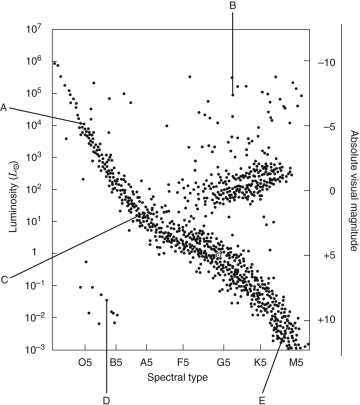 Figure 1
Figure 1 shows an H-R diagram, with five stars labeled A through E. Which star has the largest temperature?
A) A
B) B
C) C
D) D
E) E
سؤال
سؤال
سؤال
سؤال
سؤال
سؤال
سؤال
سؤال
Figure 1Figure 1 shows an H-R diagram, with five stars labeled A through E. Which star has the smallest radius?
A) A
B) B
C) C
D) D
E) E
سؤال
سؤال
سؤال
سؤال
سؤال
سؤال
Figure 1Figure 1 shows an H-R diagram, with five stars labeled A through E. Which star has the largest luminosity?
A) A
B) B
C) C
D) D
E) E
سؤال
سؤال
سؤال
سؤال
سؤال
سؤال
سؤال
سؤال
سؤال
سؤال
سؤال
سؤال
سؤال
سؤال
The picture below shows an H-R diagram, with five stars labeled A through E. Which of the main-sequence stars has the smallest mass? 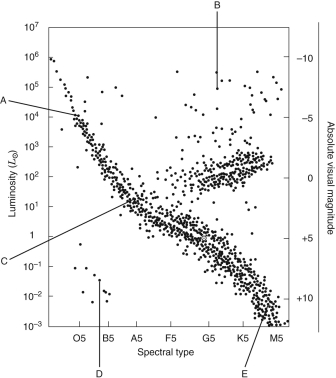
A) A
B) B
C) C
D) D
E) E
A) A
B) B
C) C
D) D
E) E
سؤال
سؤال
سؤال
سؤال
سؤال
The blackbody spectra of a star with a temperature of 6000 K and a star with a temperature of 4000 K are shown below. 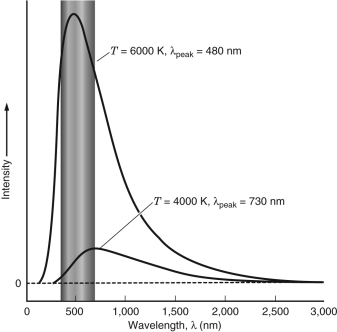 An astronomer uses a telescope to observe each of these two stars in both the blue and red filters. The blue filter is centered at 450 nm, while the red filter is centered at 660 nm. For each of the two stars, state through which filter that star will be the brightest. Explain your answer.
An astronomer uses a telescope to observe each of these two stars in both the blue and red filters. The blue filter is centered at 450 nm, while the red filter is centered at 660 nm. For each of the two stars, state through which filter that star will be the brightest. Explain your answer. سؤال
سؤال
سؤال

فتح الحزمة
قم بالتسجيل لفتح البطاقات في هذه المجموعة!
Unlock Deck
Unlock Deck
1/88

العب

ملء الشاشة (f)
Deck 13: Taking the Measure of Stars
1
Spectra of the least massive main-sequence stars show the largest amount of absorption from molecules like TiO and CN.
True
2
A star's mass is the only characteristic that determines its position in the H-R diagram.
False
3
Parallax is used to measure a star's:
A) distance
B) velocity
C) luminosity
D) mass
E) radius
A) distance
B) velocity
C) luminosity
D) mass
E) radius
distance
4
What advantage do you gain by having two eyes that are separated on your face, rather than being very close together?
A) better collecting area, which allows you to see dimmer objects
B) double vision, which allows you to see multiple objects at once
C) color vision, which allows you to determine temperatures
D) stereoscopic vision, which allows you to determine distances
E) better magnification, which allows you to see smaller objects
A) better collecting area, which allows you to see dimmer objects
B) double vision, which allows you to see multiple objects at once
C) color vision, which allows you to determine temperatures
D) stereoscopic vision, which allows you to determine distances
E) better magnification, which allows you to see smaller objects
فتح الحزمة
افتح القفل للوصول البطاقات البالغ عددها 88 في هذه المجموعة.
فتح الحزمة
k this deck
5
The absolute magnitude of a star is a measure of its luminosity.
فتح الحزمة
افتح القفل للوصول البطاقات البالغ عددها 88 في هذه المجموعة.
فتح الحزمة
k this deck
6
How many arcseconds are there in 1 degree?
A) 60
B) 360
C) 3,600
D) 6,000
E) 36,000
A) 60
B) 360
C) 3,600
D) 6,000
E) 36,000
فتح الحزمة
افتح القفل للوصول البطاقات البالغ عددها 88 في هذه المجموعة.
فتح الحزمة
k this deck
7
To measure the parallax of the most distant stars measurable, we would make two measurements of the star's position on the sky separated by:
A) 6 hours
B) 12 hours
C) 24 hours
D) 6 months
E) 12 months
A) 6 hours
B) 12 hours
C) 24 hours
D) 6 months
E) 12 months
فتح الحزمة
افتح القفل للوصول البطاقات البالغ عددها 88 في هذه المجموعة.
فتح الحزمة
k this deck
8
With today's advanced technology, we can measure the parallax for any star inside the Milky Way.
فتح الحزمة
افتح القفل للوصول البطاقات البالغ عددها 88 في هذه المجموعة.
فتح الحزمة
k this deck
9
If a star's distance is 10 pc, what is its parallax?
A) 0.01 arcsec
B) 0.05 arcsec
C) 0.1 arcsec
D) 0.5 arcsec
E) 1 arcsec
A) 0.01 arcsec
B) 0.05 arcsec
C) 0.1 arcsec
D) 0.5 arcsec
E) 1 arcsec
فتح الحزمة
افتح القفل للوصول البطاقات البالغ عددها 88 في هذه المجموعة.
فتح الحزمة
k this deck
10
Two main-sequence stars have the same temperature. If star A is four times brighter than star B, then:
A) star B is two times farther away than star A
B) star B is four times farther away than star A
C) star B is eight times farther away than star A
D) star B and star A lie at the same distance from us
E) it is impossible to determine their relative distances from the information given
A) star B is two times farther away than star A
B) star B is four times farther away than star A
C) star B is eight times farther away than star A
D) star B and star A lie at the same distance from us
E) it is impossible to determine their relative distances from the information given
فتح الحزمة
افتح القفل للوصول البطاقات البالغ عددها 88 في هذه المجموعة.
فتح الحزمة
k this deck
11
A parsec is a unit of time.
فتح الحزمة
افتح القفل للوصول البطاقات البالغ عددها 88 في هذه المجموعة.
فتح الحزمة
k this deck
12
If a star's measured parallax is 0.2 arcsec, what is its distance?
A) 2 pc
B) 5 pc
C) 20 pc
D) 40 pc
E) 50 pc
A) 2 pc
B) 5 pc
C) 20 pc
D) 40 pc
E) 50 pc
فتح الحزمة
افتح القفل للوصول البطاقات البالغ عددها 88 في هذه المجموعة.
فتح الحزمة
k this deck
13
Binary star systems are extremely useful in studying stars because they allow us to determine stars' masses.
فتح الحزمة
افتح القفل للوصول البطاقات البالغ عددها 88 في هذه المجموعة.
فتح الحزمة
k this deck
14
Stars that have spectral type B are lower in temperature than spectral type M.
فتح الحزمة
افتح القفل للوصول البطاقات البالغ عددها 88 في هذه المجموعة.
فتح الحزمة
k this deck
15
The stars that have the largest radii are classified as supergiants.
فتح الحزمة
افتح القفل للوصول البطاقات البالغ عددها 88 في هذه المجموعة.
فتح الحزمة
k this deck
16
Stars with a larger brightness must be closer to us than fainter stars.
فتح الحزمة
افتح القفل للوصول البطاقات البالغ عددها 88 في هذه المجموعة.
فتح الحزمة
k this deck
17
Stars A and B appear equally bright, but star A is twice as far away from us as star B. Which of the following is true?
A) Star A is twice as luminous as star B.
B) Star A is four times as luminous as star B.
C) Star B is twice as luminous as star A.
D) Star B is four times as luminous as star B.
E) Star A and star B have the same luminosity because they have the same brightness.
A) Star A is twice as luminous as star B.
B) Star A is four times as luminous as star B.
C) Star B is twice as luminous as star A.
D) Star B is four times as luminous as star B.
E) Star A and star B have the same luminosity because they have the same brightness.
فتح الحزمة
افتح القفل للوصول البطاقات البالغ عددها 88 في هذه المجموعة.
فتح الحزمة
k this deck
18
A star's mass determines where it lies on the main sequence of an H-R diagram.
فتح الحزمة
افتح القفل للوصول البطاقات البالغ عددها 88 في هذه المجموعة.
فتح الحزمة
k this deck
19
Stars of spectral class O have the strongest hydrogen absorption lines, whereas stars of spectral class M have the weakest hydrogen absorption lines.
فتح الحزمة
افتح القفل للوصول البطاقات البالغ عددها 88 في هذه المجموعة.
فتح الحزمة
k this deck
20
How is the distance to a star related to its parallax?
A) Distance is directly proportional to parallax.
B) Distance is inversely proportional to parallax.
C) Distance is directly proportional to parallax squared.
D) Distance is inversely proportional to parallax squared.
E) Distance and parallax are not related to each other at all.
A) Distance is directly proportional to parallax.
B) Distance is inversely proportional to parallax.
C) Distance is directly proportional to parallax squared.
D) Distance is inversely proportional to parallax squared.
E) Distance and parallax are not related to each other at all.
فتح الحزمة
افتح القفل للوصول البطاقات البالغ عددها 88 في هذه المجموعة.
فتح الحزمة
k this deck
21
Star A and star B both have the same temperature but different sizes and distances. As a result, star A is more luminous than star B, but star B is brighter than star A. Which of these statements about the absolute and apparent magnitudes of the two stars is correct?
A) Star A has a larger apparent magnitude and a larger absolute magnitude.
B) Star A has a larger apparent magnitude, while star B has a larger absolute magnitude.
C) Star B has a larger apparent magnitude and a larger absolute magnitude.
D) Star B has a larger apparent magnitude, while star A has a larger absolute magnitude.
E) Both stars have the same apparent and absolute magnitudes.
A) Star A has a larger apparent magnitude and a larger absolute magnitude.
B) Star A has a larger apparent magnitude, while star B has a larger absolute magnitude.
C) Star B has a larger apparent magnitude and a larger absolute magnitude.
D) Star B has a larger apparent magnitude, while star A has a larger absolute magnitude.
E) Both stars have the same apparent and absolute magnitudes.
فتح الحزمة
افتح القفل للوصول البطاقات البالغ عددها 88 في هذه المجموعة.
فتح الحزمة
k this deck
22
Star E is the same temperature as star F, but star E is four times as luminous as star F. How do the radii of the stars compare?
A) Star E has twice the radius of star F.
B) Star E has four times the radius of star F.
C) Star F has twice the radius of star E.
D) Star F has four times the radius of star E.
E) They are the same size.
A) Star E has twice the radius of star F.
B) Star E has four times the radius of star F.
C) Star F has twice the radius of star E.
D) Star F has four times the radius of star E.
E) They are the same size.
فتح الحزمة
افتح القفل للوصول البطاقات البالغ عددها 88 في هذه المجموعة.
فتح الحزمة
k this deck
23
Star A is a red star. Star B is a blue star. Which star is hotter?
A) Star A is hotter.
B) Star B is hotter.
C) They are the same temperature.
D) We also need to know the luminosities of the stars to determine their temperatures.
E) Color is not related to temperature at all.
A) Star A is hotter.
B) Star B is hotter.
C) They are the same temperature.
D) We also need to know the luminosities of the stars to determine their temperatures.
E) Color is not related to temperature at all.
فتح الحزمة
افتح القفل للوصول البطاقات البالغ عددها 88 في هذه المجموعة.
فتح الحزمة
k this deck
24
If we know the temperature and luminosity of a star, we can also calculate its:
A) radius
B) mass
C) chemical composition
D) brightness
E) all of the above
A) radius
B) mass
C) chemical composition
D) brightness
E) all of the above
فتح الحزمة
افتح القفل للوصول البطاقات البالغ عددها 88 في هذه المجموعة.
فتح الحزمة
k this deck
25
Two stars with similar temperatures but different sizes will have:
A) similar spectral types but different luminosities
B) similar luminosities but different brightnesses
C) similar brightnesses but different distances
D) similar distances but different masses
E) similar masses but different spectral types
A) similar spectral types but different luminosities
B) similar luminosities but different brightnesses
C) similar brightnesses but different distances
D) similar distances but different masses
E) similar masses but different spectral types
فتح الحزمة
افتح القفل للوصول البطاقات البالغ عددها 88 في هذه المجموعة.
فتح الحزمة
k this deck
26
Stars are made mostly of:
A) helium
B) oxygen
C) hydrogen
D) nitrogen
E) carbon
A) helium
B) oxygen
C) hydrogen
D) nitrogen
E) carbon
فتح الحزمة
افتح القفل للوصول البطاقات البالغ عددها 88 في هذه المجموعة.
فتح الحزمة
k this deck
27
What type of spectrum do most stars produce?
A) an absorption spectrum on top of a blackbody spectrum
B) an emission spectrum on top of a blackbody spectrum
C) an absorption spectrum on top of an emission spectrum
D) a pure emission spectrum
E) a pure blackbody spectrum
A) an absorption spectrum on top of a blackbody spectrum
B) an emission spectrum on top of a blackbody spectrum
C) an absorption spectrum on top of an emission spectrum
D) a pure emission spectrum
E) a pure blackbody spectrum
فتح الحزمة
افتح القفل للوصول البطاقات البالغ عددها 88 في هذه المجموعة.
فتح الحزمة
k this deck
28
A star classified as a K0III star is:
A) a giant that is cooler than the Sun
B) a supergiant that is hotter than the Sun
C) a main-sequence star that is hotter than the Sun
D) a subgiant that is cooler than the Sun
E) a dwarf that is hotter than the Sun
A) a giant that is cooler than the Sun
B) a supergiant that is hotter than the Sun
C) a main-sequence star that is hotter than the Sun
D) a subgiant that is cooler than the Sun
E) a dwarf that is hotter than the Sun
فتح الحزمة
افتح القفل للوصول البطاقات البالغ عددها 88 في هذه المجموعة.
فتح الحزمة
k this deck
29
You observe two stars in a visual binary system using a blue filter that is centered at a wavelength of 550 nm and a red filter that is centered at a wavelength of 650 nm. Star A has a temperature of 10,000 K, while star B has a temperature of 4000 K, and you know that both stars are the same size. Which star will be the brightest in each filter?
A) Star A is the brightest in the blue filter, and star B is the brightest in the red filter.
B) Star B is the brightest in the blue filter, and star A is the brightest in the red filter.
C) Star A is the brightest in both filters.
D) Star B is the brightest in both filters.
E) Both stars have the same brightness in each filter.
A) Star A is the brightest in the blue filter, and star B is the brightest in the red filter.
B) Star B is the brightest in the blue filter, and star A is the brightest in the red filter.
C) Star A is the brightest in both filters.
D) Star B is the brightest in both filters.
E) Both stars have the same brightness in each filter.
فتح الحزمة
افتح القفل للوصول البطاقات البالغ عددها 88 في هذه المجموعة.
فتح الحزمة
k this deck
30
The star named Capella has an apparent magnitude of 0, while the star named Polaris has an apparent magnitude of 2, which means that Capella is _________ than Polaris.
A) 18 times fainter
B) 6 times fainter
C) 2 times fainter
D) 2 times brighter
E) 6 times brighter
A) 18 times fainter
B) 6 times fainter
C) 2 times fainter
D) 2 times brighter
E) 6 times brighter
فتح الحزمة
افتح القفل للوصول البطاقات البالغ عددها 88 في هذه المجموعة.
فتح الحزمة
k this deck
31
The fraction of the Sun's mass that is made of heavy elements is:
A) 0.5 percent
B) 2 percent
C) 10 percent
D) 20 percent
E) 50 percent
A) 0.5 percent
B) 2 percent
C) 10 percent
D) 20 percent
E) 50 percent
فتح الحزمة
افتح القفل للوصول البطاقات البالغ عددها 88 في هذه المجموعة.
فتح الحزمة
k this deck
32
The spectral class of a star is related to its:
A) luminosity
B) brightness
C) radius
D) mass
E) temperature
A) luminosity
B) brightness
C) radius
D) mass
E) temperature
فتح الحزمة
افتح القفل للوصول البطاقات البالغ عددها 88 في هذه المجموعة.
فتح الحزمة
k this deck
33
What spectral class is the Sun?
A) A0
B) B7
C) F5
D) M3
E) G2
A) A0
B) B7
C) F5
D) M3
E) G2
فتح الحزمة
افتح القفل للوصول البطاقات البالغ عددها 88 في هذه المجموعة.
فتح الحزمة
k this deck
34
Star A is a red star. Star B is a blue star. You are able to determine that both stars are the same size. Which star is more luminous?
A) Star A is more luminous.
B) Star B is more luminous.
C) They have the same luminosities.
D) We also need to know the distance of the stars to determine their luminosity.
E) We cannot tell because color is not related to luminosity.
A) Star A is more luminous.
B) Star B is more luminous.
C) They have the same luminosities.
D) We also need to know the distance of the stars to determine their luminosity.
E) We cannot tell because color is not related to luminosity.
فتح الحزمة
افتح القفل للوصول البطاقات البالغ عددها 88 في هذه المجموعة.
فتح الحزمة
k this deck
35
Star C is a red star. Star D is a blue star. Which has a larger radius?
A) Star C has a larger radius.
B) Star D has a larger radius.
C) Stars C and D have the same radius.
D) We also need to know the luminosities of the stars to determine their radii.
E) We cannot determine the radii because color is not related to the radius.
A) Star C has a larger radius.
B) Star D has a larger radius.
C) Stars C and D have the same radius.
D) We also need to know the luminosities of the stars to determine their radii.
E) We cannot determine the radii because color is not related to the radius.
فتح الحزمة
افتح القفل للوصول البطاقات البالغ عددها 88 في هذه المجموعة.
فتح الحزمة
k this deck
36
When astronomers refer to "heavy elements," which elements are they talking about?
A) all elements
B) all elements more massive than hydrogen
C) all elements more massive than helium
D) all elements more massive than carbon
E) all elements more massive than iron
A) all elements
B) all elements more massive than hydrogen
C) all elements more massive than helium
D) all elements more massive than carbon
E) all elements more massive than iron
فتح الحزمة
افتح القفل للوصول البطاقات البالغ عددها 88 في هذه المجموعة.
فتح الحزمة
k this deck
37
What is the difference between brightness and luminosity?
A) These are different names for the same property.
B) Luminosity is how much light we see from a star; brightness is how much light it emits.
C) Brightness is how much light we see from a star; luminosity is how much light it emits.
D) Luminosity measures size; brightness measures temperature.
E) Brightness measure size; luminosity measures temperature.
A) These are different names for the same property.
B) Luminosity is how much light we see from a star; brightness is how much light it emits.
C) Brightness is how much light we see from a star; luminosity is how much light it emits.
D) Luminosity measures size; brightness measures temperature.
E) Brightness measure size; luminosity measures temperature.
فتح الحزمة
افتح القفل للوصول البطاقات البالغ عددها 88 في هذه المجموعة.
فتح الحزمة
k this deck
38
Which sequence correctly lists the spectral classes of stars in order from hottest to coolest?
A) A B F G K M O
B) O A B G F M K
C) A F O B M G K
D) O B A F G K M
E) M K G F A B O
A) A B F G K M O
B) O A B G F M K
C) A F O B M G K
D) O B A F G K M
E) M K G F A B O
فتح الحزمة
افتح القفل للوصول البطاقات البالغ عددها 88 في هذه المجموعة.
فتح الحزمة
k this deck
39
Star A is a red star. Star B is a blue star. You are able to determine that both stars are the same size. Which star is brighter?
A) Star A is brighter.
B) Star B is brighter.
C) They have the same brightness.
D) We also need to know the distance of the stars to determine their brightness.
E) Color is not related to brightness at all.
A) Star A is brighter.
B) Star B is brighter.
C) They have the same brightness.
D) We also need to know the distance of the stars to determine their brightness.
E) Color is not related to brightness at all.
فتح الحزمة
افتح القفل للوصول البطاقات البالغ عددها 88 في هذه المجموعة.
فتح الحزمة
k this deck
40
Why do O- and B-type stars have weaker hydrogen absorption lines than A-type stars?
A) O- and B-type stars are cooler than A-type stars.
B) O- and B-type stars are smaller than A-type stars.
C) A larger fraction of hydrogen atoms in O- and B-type stars is ionized.
D) O- and B-type stars have converted much more of their hydrogen into heavier elements.
E) A-type stars have a higher mass than O- and B-type stars, so they have more hydrogen.
A) O- and B-type stars are cooler than A-type stars.
B) O- and B-type stars are smaller than A-type stars.
C) A larger fraction of hydrogen atoms in O- and B-type stars is ionized.
D) O- and B-type stars have converted much more of their hydrogen into heavier elements.
E) A-type stars have a higher mass than O- and B-type stars, so they have more hydrogen.
فتح الحزمة
افتح القفل للوصول البطاقات البالغ عددها 88 في هذه المجموعة.
فتح الحزمة
k this deck
41
Stars X and Y are 5 AU apart from each other. Star X is four times as massive as star Y. The center of mass of this system is _________ AU away from star X and _________ AU away from star Y.
A) 3; 2
B) 2; 3
C) 2.5; 2.5
D) 1; 4
E) 4; 1
A) 3; 2
B) 2; 3
C) 2.5; 2.5
D) 1; 4
E) 4; 1
فتح الحزمة
افتح القفل للوصول البطاقات البالغ عددها 88 في هذه المجموعة.
فتح الحزمة
k this deck
42
You discover a binary star system in which star A has a velocity of 10 km/s and star B has a velocity of 30 km/s. If you study the system further and find out that the orbital period is 30 days and the orbital separation is a constant 0.3 AU, then what are the masses of stars A and B?
A) Star A is 3M , and Star B is 1M .
B) Star A is 1M , and Star B is 0.3M .
C) Star A is 6M , and Star B is 2M .
D) Star A is 2M , and Star B is 0.5M .
E) Star A is 0.3M , and Star B is 1M
A) Star A is 3M , and Star B is 1M .
B) Star A is 1M , and Star B is 0.3M .
C) Star A is 6M , and Star B is 2M .
D) Star A is 2M , and Star B is 0.5M .
E) Star A is 0.3M , and Star B is 1M
فتح الحزمة
افتح القفل للوصول البطاقات البالغ عددها 88 في هذه المجموعة.
فتح الحزمة
k this deck
43
Astronomers can measure the speed of the stars in a binary system by measuring the _________ of the stars.
A) temperatures
B) luminosities
C) distance
D) colors
E) spectra
A) temperatures
B) luminosities
C) distance
D) colors
E) spectra
فتح الحزمة
افتح القفل للوصول البطاقات البالغ عددها 88 في هذه المجموعة.
فتح الحزمة
k this deck
44
Figure 1Figure 1 shows an H-R diagram, with five stars labeled A through E. Which star has the largest temperature?
A) A
B) B
C) C
D) D
E) E
فتح الحزمة
افتح القفل للوصول البطاقات البالغ عددها 88 في هذه المجموعة.
فتح الحزمة
k this deck
45
Which of the following properties are NOT useful in determining the masses of stars in a typical binary system?
A) The period of the orbits of the two stars is not useful.
B) The average separation between the two stars is not useful.
C) The radii of the two stars is not useful.
D) The velocities of the two stars is not useful.
E) All of the above are useful for determining the masses of stars in a binary.
A) The period of the orbits of the two stars is not useful.
B) The average separation between the two stars is not useful.
C) The radii of the two stars is not useful.
D) The velocities of the two stars is not useful.
E) All of the above are useful for determining the masses of stars in a binary.
فتح الحزمة
افتح القفل للوصول البطاقات البالغ عددها 88 في هذه المجموعة.
فتح الحزمة
k this deck
46
If star A has a temperature that is twice as hot as the Sun but has the same luminosity as the Sun, the diameter of star A must be _________ times the diameter of the Sun.
A) 16
B) 4
C) 2
D) 1/2
E) 1/4
A) 16
B) 4
C) 2
D) 1/2
E) 1/4
فتح الحزمة
افتح القفل للوصول البطاقات البالغ عددها 88 في هذه المجموعة.
فتح الحزمة
k this deck
47
Roughly what percentage of stars in our galaxy are main-sequence stars?
A) 10 percent
B) 25 percent
C) 50 percent
D) 75 percent
E) 90 percent
A) 10 percent
B) 25 percent
C) 50 percent
D) 75 percent
E) 90 percent
فتح الحزمة
افتح القفل للوصول البطاقات البالغ عددها 88 في هذه المجموعة.
فتح الحزمة
k this deck
48
For which type of binary system are astronomers able to resolve each of the two stars individually?
A) eclipsing binary
B) spectroscopic binary
C) visual binary
D) binaries where the two stars have the same mass
E) binaries where the two stars have the same luminosity
A) eclipsing binary
B) spectroscopic binary
C) visual binary
D) binaries where the two stars have the same mass
E) binaries where the two stars have the same luminosity
فتح الحزمة
افتح القفل للوصول البطاقات البالغ عددها 88 في هذه المجموعة.
فتح الحزمة
k this deck
49
Main-sequence stars range in mass from approximately:
A) 0.5 to 10 M
B) 0.08 to 150 M
C) 1 to 100 M
D) 0.1 to 75 M
E) 5 to 50 M
A) 0.5 to 10 M
B) 0.08 to 150 M
C) 1 to 100 M
D) 0.1 to 75 M
E) 5 to 50 M
فتح الحزمة
افتح القفل للوصول البطاقات البالغ عددها 88 في هذه المجموعة.
فتح الحزمة
k this deck
50
Which stars are the most common?
A) Stars with a larger mass and a larger radius than the Sun's are the most common.
B) Stars with a smaller mass and a smaller radius than the Sun's are the most common.
C) Stars with a larger mass and a smaller radius than the Sun's are the most common.
D) Stars with a smaller mass and a larger radius than the Sun's are the most common.
E) All of the above are equally common.
A) Stars with a larger mass and a larger radius than the Sun's are the most common.
B) Stars with a smaller mass and a smaller radius than the Sun's are the most common.
C) Stars with a larger mass and a smaller radius than the Sun's are the most common.
D) Stars with a smaller mass and a larger radius than the Sun's are the most common.
E) All of the above are equally common.
فتح الحزمة
افتح القفل للوصول البطاقات البالغ عددها 88 في هذه المجموعة.
فتح الحزمة
k this deck
51
The Hertzsprung-Russell diagram is a graph of _________ for stars.
A) mass versus brightness
B) size versus mass
C) luminosity versus temperature
D) mass versus spectral type
E) luminosity versus brightness
A) mass versus brightness
B) size versus mass
C) luminosity versus temperature
D) mass versus spectral type
E) luminosity versus brightness
فتح الحزمة
افتح القفل للوصول البطاقات البالغ عددها 88 في هذه المجموعة.
فتح الحزمة
k this deck
52
Figure 1Figure 1 shows an H-R diagram, with five stars labeled A through E. Which star has the smallest radius?
A) A
B) B
C) C
D) D
E) E
فتح الحزمة
افتح القفل للوصول البطاقات البالغ عددها 88 في هذه المجموعة.
فتح الحزمة
k this deck
53
On a typical H-R diagram, where are the stars with the largest radii located?
A) in the upper left corner
B) in the upper right corner
C) in the center
D) in the lower left corner
E) in the lower right corner
A) in the upper left corner
B) in the upper right corner
C) in the center
D) in the lower left corner
E) in the lower right corner
فتح الحزمة
افتح القفل للوصول البطاقات البالغ عددها 88 في هذه المجموعة.
فتح الحزمة
k this deck
54
In a binary star system that contains stars with 2M and 1M , the velocity of the 2M star will be _________ times the velocity of the 1M star.
A) 0.2
B) 0.5
C) 1
D) 2
E) 3
A) 0.2
B) 0.5
C) 1
D) 2
E) 3
فتح الحزمة
افتح القفل للوصول البطاقات البالغ عددها 88 في هذه المجموعة.
فتح الحزمة
k this deck
55
Which of the following properties would not be plotted on the horizontal axis of an H-R diagram?
A) Color would not be plotted.
B) Luminosity would not be plotted.
C) Temperature would not be plotted.
D) Spectral class would not be plotted.
E) All of the above are plotted on the horizontal axis of an H-R diagram.
A) Color would not be plotted.
B) Luminosity would not be plotted.
C) Temperature would not be plotted.
D) Spectral class would not be plotted.
E) All of the above are plotted on the horizontal axis of an H-R diagram.
فتح الحزمة
افتح القفل للوصول البطاقات البالغ عددها 88 في هذه المجموعة.
فتح الحزمة
k this deck
56
Eclipsing binary systems:
A) orbit in the plane of the sky
B) exhibit large radial velocity shifts
C) contain equal mass stars
D) contain stars that pass in front of one another during their orbit
E) contain stars that can be resolved as two separate stars
A) orbit in the plane of the sky
B) exhibit large radial velocity shifts
C) contain equal mass stars
D) contain stars that pass in front of one another during their orbit
E) contain stars that can be resolved as two separate stars
فتح الحزمة
افتح القفل للوصول البطاقات البالغ عددها 88 في هذه المجموعة.
فتح الحزمة
k this deck
57
What type of star is most common in the solar neighborhood?
A) subgiants
B) supergiant
C) white dwarf
D) giant
E) main-sequence
A) subgiants
B) supergiant
C) white dwarf
D) giant
E) main-sequence
فتح الحزمة
افتح القفل للوصول البطاقات البالغ عددها 88 في هذه المجموعة.
فتح الحزمة
k this deck
58
Figure 1Figure 1 shows an H-R diagram, with five stars labeled A through E. Which star has the largest luminosity?
A) A
B) B
C) C
D) D
E) E
فتح الحزمة
افتح القفل للوصول البطاقات البالغ عددها 88 في هذه المجموعة.
فتح الحزمة
k this deck
59
The faster-moving star in a binary is:
A) the less massive star
B) the more massive star
C) the smaller radius star
D) the larger radius star
E) the lower temperature star
A) the less massive star
B) the more massive star
C) the smaller radius star
D) the larger radius star
E) the lower temperature star
فتح الحزمة
افتح القفل للوصول البطاقات البالغ عددها 88 في هذه المجموعة.
فتح الحزمة
k this deck
60
The bright star named Rigel has a luminosity of 66,000 L and a temperature of 11,000 K. What is its radius? Note that the temperature of the Sun is 5,800 K.
A) 5 R
B) 30 R
C) 70 R
D) 135 R
E) 190 R
A) 5 R
B) 30 R
C) 70 R
D) 135 R
E) 190 R
فتح الحزمة
افتح القفل للوصول البطاقات البالغ عددها 88 في هذه المجموعة.
فتح الحزمة
k this deck
61
The brightest stars in the sky also tend to be:
A) the highest mass stars
B) the hottest stars in the sky
C) very near to us
D) very luminous
E) all of the above
A) the highest mass stars
B) the hottest stars in the sky
C) very near to us
D) very luminous
E) all of the above
فتح الحزمة
افتح القفل للوصول البطاقات البالغ عددها 88 في هذه المجموعة.
فتح الحزمة
k this deck
62
What are the two main chemical elements that make up the Sun? How much of the mass of the Sun is composed of elements other than these two?
فتح الحزمة
افتح القفل للوصول البطاقات البالغ عددها 88 في هذه المجموعة.
فتح الحزمة
k this deck
63
Star A is exactly the same color as star B and appears equally bright. Through stellar parallax measurements, we find that star B is twice as far away from us as star A. Determine which star has the largest radius and how much larger it is.
فتح الحزمة
افتح القفل للوصول البطاقات البالغ عددها 88 في هذه المجموعة.
فتح الحزمة
k this deck
64
A star with a stellar parallax of 0.025 arcseconds has a distance of how many parsecs?
فتح الحزمة
افتح القفل للوصول البطاقات البالغ عددها 88 في هذه المجموعة.
فتح الحزمة
k this deck
65
What is the spectral type of stars that have the strongest hydrogen absorption lines? Why do stars that are hotter than these have weaker hydrogen lines?
فتح الحزمة
افتح القفل للوصول البطاقات البالغ عددها 88 في هذه المجموعة.
فتح الحزمة
k this deck
66
Explain how astronomers can use the blue and visual filters to determine the temperatures of stars.
فتح الحزمة
افتح القفل للوصول البطاقات البالغ عددها 88 في هذه المجموعة.
فتح الحزمة
k this deck
67
In which region of an H-R diagram would you find the main-sequence stars with the widest habitable zones?
A) upper left
B) upper right
C) center
D) lower left
E) lower right
A) upper left
B) upper right
C) center
D) lower left
E) lower right
فتح الحزمة
افتح القفل للوصول البطاقات البالغ عددها 88 في هذه المجموعة.
فتح الحزمة
k this deck
68
Rigel is a star with an apparent magnitude of +0.1, and Betelgeuse is a star with an apparent magnitude of +0.4. Which star appears brighter, and what is the ratio of their brightnesses?
فتح الحزمة
افتح القفل للوصول البطاقات البالغ عددها 88 في هذه المجموعة.
فتح الحزمة
k this deck
69
What is the approximate luminosity of a 5 M main-sequence star?
A) 50 L
B) 80 L
C) 150 L
D) 280 L
E) 510 L
A) 50 L
B) 80 L
C) 150 L
D) 280 L
E) 510 L
فتح الحزمة
افتح القفل للوصول البطاقات البالغ عددها 88 في هذه المجموعة.
فتح الحزمة
k this deck
70
The bright star Arcturus has a luminosity of 210 L and a temperature of 4300 K. What is its radius? Note that the Sun has a temperature of 5800 K.
فتح الحزمة
افتح القفل للوصول البطاقات البالغ عددها 88 في هذه المجموعة.
فتح الحزمة
k this deck
71
The one property of a main-sequence star that determines all its other properties is its:
A) luminosity
B) mass
C) temperature
D) spectral type
E) brightness
A) luminosity
B) mass
C) temperature
D) spectral type
E) brightness
فتح الحزمة
افتح القفل للوصول البطاقات البالغ عددها 88 في هذه المجموعة.
فتح الحزمة
k this deck
72
The picture below shows an H-R diagram, with five stars labeled A through E. Which of the main-sequence stars has the smallest mass?
A) A
B) B
C) C
D) D
E) E
A) A
B) B
C) C
D) D
E) E
فتح الحزمة
افتح القفل للوصول البطاقات البالغ عددها 88 في هذه المجموعة.
فتح الحزمة
k this deck
73
The habitable zone for the Sun covers the area that is between _________ from the Sun.
A) 0 to 0.8 AU
B) 0.5 to 10 AU
C) 1.2 to 4.2 AU
D) 0.9 to 1.4 AU
E) 0.2 to 10.2 AU
A) 0 to 0.8 AU
B) 0.5 to 10 AU
C) 1.2 to 4.2 AU
D) 0.9 to 1.4 AU
E) 0.2 to 10.2 AU
فتح الحزمة
افتح القفل للوصول البطاقات البالغ عددها 88 في هذه المجموعة.
فتح الحزمة
k this deck
74
How is the unit of length known as a parsec defined?
فتح الحزمة
افتح القفل للوصول البطاقات البالغ عددها 88 في هذه المجموعة.
فتح الحزمة
k this deck
75
If we measure a star's luminosity and temperature, what other property of the star can we calculate? Explain how.
فتح الحزمة
افتح القفل للوصول البطاقات البالغ عددها 88 في هذه المجموعة.
فتح الحزمة
k this deck
76
If the Hubble space telescope can see stars as faint as magnitude 27, how much fainter are these stars than the faintest ones you can see in a very dark night sky, which have magnitude 6?
فتح الحزمة
افتح القفل للوصول البطاقات البالغ عددها 88 في هذه المجموعة.
فتح الحزمة
k this deck
77
The blackbody spectra of a star with a temperature of 6000 K and a star with a temperature of 4000 K are shown below. An astronomer uses a telescope to observe each of these two stars in both the blue and red filters. The blue filter is centered at 450 nm, while the red filter is centered at 660 nm. For each of the two stars, state through which filter that star will be the brightest. Explain your answer.
An astronomer uses a telescope to observe each of these two stars in both the blue and red filters. The blue filter is centered at 450 nm, while the red filter is centered at 660 nm. For each of the two stars, state through which filter that star will be the brightest. Explain your answer. فتح الحزمة
افتح القفل للوصول البطاقات البالغ عددها 88 في هذه المجموعة.
فتح الحزمة
k this deck
78
If a star's parallax is measured using identical telescopes, one on Earth and the other on Mars, which planet's telescope would measure the biggest parallax? Explain your answer.
فتح الحزمة
افتح القفل للوصول البطاقات البالغ عددها 88 في هذه المجموعة.
فتح الحزمة
k this deck
79
The stars that have the largest radii are classified as:
A) giants
B) ultragiants
C) supergiants
D) megagiants
E) supernovae
A) giants
B) ultragiants
C) supergiants
D) megagiants
E) supernovae
فتح الحزمة
افتح القفل للوصول البطاقات البالغ عددها 88 في هذه المجموعة.
فتح الحزمة
k this deck
80
What is the approximate luminosity of a 0.5 M main-sequence star?
A) 0.09 L
B) 0.01 L
C) 0.2 L
D) 0.5 L
E) 0.7 L
A) 0.09 L
B) 0.01 L
C) 0.2 L
D) 0.5 L
E) 0.7 L
فتح الحزمة
افتح القفل للوصول البطاقات البالغ عددها 88 في هذه المجموعة.
فتح الحزمة
k this deck
فتح الحزمة
افتح القفل للوصول البطاقات البالغ عددها 88 في هذه المجموعة.






