







 تكلم مع الذكاء الاصطناعي


Deck 35: Behavioral Adaptations to the Environment
ملء الشاشة (f)

سؤال

سؤال
سؤال
سؤال
سؤال
سؤال
سؤال
سؤال
سؤال
سؤال
سؤال
سؤال
سؤال
سؤال
سؤال
سؤال
سؤال
سؤال
سؤال
سؤال
سؤال
سؤال
سؤال
سؤال
سؤال
سؤال
سؤال
سؤال
سؤال
سؤال
سؤال
سؤال
سؤال
سؤال
سؤال
سؤال
سؤال
سؤال
سؤال
سؤال
سؤال
After reading the paragraph below, answer the questions that follow.
The herbicide atrazine is a known endocrine disruptor to the development stages of several animal species, including fish, reptiles, and amphibians. Scientists interested in studying long-term effects of exposure to atrazine on mating behaviors compared an all-male population of sexually mature African clawed frogs (Xenopus laevis) exposed to atrazine (Atz) to a sexually mature population of African clawed frogs not exposed to atrazine (Con). Amplexus is defined as the mating position of frogs.
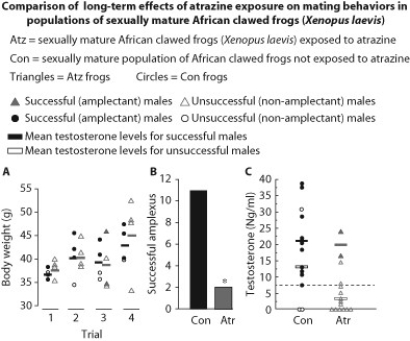
When considered together, Parts A and C demonstrate
A) that all frogs in the experiments were male.
B) a possible explanation for the effect of atrazine.
C) that testosterone levels are lower in nontreated frogs.
D) a lack of relationship between successful mating and testosterone levels.
The herbicide atrazine is a known endocrine disruptor to the development stages of several animal species, including fish, reptiles, and amphibians. Scientists interested in studying long-term effects of exposure to atrazine on mating behaviors compared an all-male population of sexually mature African clawed frogs (Xenopus laevis) exposed to atrazine (Atz) to a sexually mature population of African clawed frogs not exposed to atrazine (Con). Amplexus is defined as the mating position of frogs.
When considered together, Parts A and C demonstrate
A) that all frogs in the experiments were male.
B) a possible explanation for the effect of atrazine.
C) that testosterone levels are lower in nontreated frogs.
D) a lack of relationship between successful mating and testosterone levels.
سؤال
سؤال
After reading the paragraph below, answer the questions that follow.
The herbicide atrazine is a known endocrine disruptor to the development stages of several animal species, including fish, reptiles, and amphibians. Scientists interested in studying long-term effects of exposure to atrazine on mating behaviors compared an all-male population of sexually mature African clawed frogs (Xenopus laevis) exposed to atrazine (Atz) to a sexually mature population of African clawed frogs not exposed to atrazine (Con). Amplexus is defined as the mating position of frogs.
Supposed additional tests conducted on these two groups of frogs indicated that atrazine-treated frogs have lower fertility rates than nontreated frogs, even though both groups have adequate sperm content. What might be concluded about long term-effects of atrazine?
A) Small body weight and decline in fertility in atrazine-exposed males will have a direct negative impact on populations of African clawed frogs.
B) The inability to compete for females and the decline in fertility in atrazine-exposed males will have a direct negative impact on populations of African clawed frogs.
C) Testosterone levels of atrazine-exposed males directly impact female frogs' copulation behaviors.
D) Non-atrazine-treated frogs are more likely to show an increase in body weight and testosterone levels in the presence of sexually mature female frogs.
The herbicide atrazine is a known endocrine disruptor to the development stages of several animal species, including fish, reptiles, and amphibians. Scientists interested in studying long-term effects of exposure to atrazine on mating behaviors compared an all-male population of sexually mature African clawed frogs (Xenopus laevis) exposed to atrazine (Atz) to a sexually mature population of African clawed frogs not exposed to atrazine (Con). Amplexus is defined as the mating position of frogs.
Supposed additional tests conducted on these two groups of frogs indicated that atrazine-treated frogs have lower fertility rates than nontreated frogs, even though both groups have adequate sperm content. What might be concluded about long term-effects of atrazine?
A) Small body weight and decline in fertility in atrazine-exposed males will have a direct negative impact on populations of African clawed frogs.
B) The inability to compete for females and the decline in fertility in atrazine-exposed males will have a direct negative impact on populations of African clawed frogs.
C) Testosterone levels of atrazine-exposed males directly impact female frogs' copulation behaviors.
D) Non-atrazine-treated frogs are more likely to show an increase in body weight and testosterone levels in the presence of sexually mature female frogs.
سؤال
After reading the paragraph below, answer the questions that follow.
The herbicide atrazine is a known endocrine disruptor to the development stages of several animal species, including fish, reptiles, and amphibians. Scientists interested in studying long-term effects of exposure to atrazine on mating behaviors compared an all-male population of sexually mature African clawed frogs (Xenopus laevis) exposed to atrazine (Atz) to a sexually mature population of African clawed frogs not exposed to atrazine (Con). Amplexus is defined as the mating position of frogs.
The role of the nontreated males in this experiment is to
A) increase the sample size.
B) act as controls.
C) show that not all matings are successful.
D) determine number of matings per frog.
The herbicide atrazine is a known endocrine disruptor to the development stages of several animal species, including fish, reptiles, and amphibians. Scientists interested in studying long-term effects of exposure to atrazine on mating behaviors compared an all-male population of sexually mature African clawed frogs (Xenopus laevis) exposed to atrazine (Atz) to a sexually mature population of African clawed frogs not exposed to atrazine (Con). Amplexus is defined as the mating position of frogs.
The role of the nontreated males in this experiment is to
A) increase the sample size.
B) act as controls.
C) show that not all matings are successful.
D) determine number of matings per frog.
سؤال
سؤال
سؤال
سؤال
سؤال
سؤال
Scientists interested in applying the optimal foraging model to wagtail birds' feeding behavior gathered data on the prey (flies) and calories consumed while the prey was being handled (the time the prey is caught until it is consumed) by the wagtails. Which conclusion is supported by this graph? 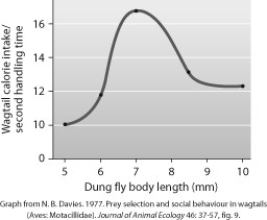
A) Prey size does not affect the number of calories gained per second of handling time by wagtails.
B) Wagtails get more calories per second of handling time with larger flies than with smaller ones.
C) Wagtails get more calories per second of handling time with smaller flies than with larger ones.
D) Wagtails get more calories per second of handling time with 7-mm flies than with either larger or smaller ones.
A) Prey size does not affect the number of calories gained per second of handling time by wagtails.
B) Wagtails get more calories per second of handling time with larger flies than with smaller ones.
C) Wagtails get more calories per second of handling time with smaller flies than with larger ones.
D) Wagtails get more calories per second of handling time with 7-mm flies than with either larger or smaller ones.
سؤال
After reading the paragraph below, answer the questions that follow.
The herbicide atrazine is a known endocrine disruptor to the development stages of several animal species, including fish, reptiles, and amphibians. Scientists interested in studying long-term effects of exposure to atrazine on mating behaviors compared an all-male population of sexually mature African clawed frogs (Xenopus laevis) exposed to atrazine (Atz) to a sexually mature population of African clawed frogs not exposed to atrazine (Con). Amplexus is defined as the mating position of frogs.
Part B indicates that
A) nontreated males were more successful in copulation with females than atrazine-treated males.
B) atrazine-treated males were more successful in copulation with females than nontreated males.
C) there were fewer atrazine-treated males than nontreated males.
D) atrazine-treated males are unable to mate.
The herbicide atrazine is a known endocrine disruptor to the development stages of several animal species, including fish, reptiles, and amphibians. Scientists interested in studying long-term effects of exposure to atrazine on mating behaviors compared an all-male population of sexually mature African clawed frogs (Xenopus laevis) exposed to atrazine (Atz) to a sexually mature population of African clawed frogs not exposed to atrazine (Con). Amplexus is defined as the mating position of frogs.
Part B indicates that
A) nontreated males were more successful in copulation with females than atrazine-treated males.
B) atrazine-treated males were more successful in copulation with females than nontreated males.
C) there were fewer atrazine-treated males than nontreated males.
D) atrazine-treated males are unable to mate.
سؤال
سؤال
What type of behavior is illustrated by the bird in this figure? 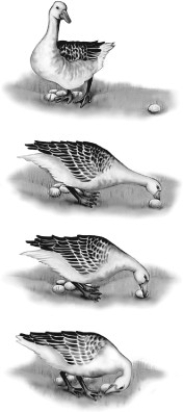
A) territoriality
B) mating behavior
C) fixed action pattern
D) foraging
A) territoriality
B) mating behavior
C) fixed action pattern
D) foraging
سؤال
After reading the paragraph below, answer the questions that follow.
The herbicide atrazine is a known endocrine disruptor to the development stages of several animal species, including fish, reptiles, and amphibians. Scientists interested in studying long-term effects of exposure to atrazine on mating behaviors compared an all-male population of sexually mature African clawed frogs (Xenopus laevis) exposed to atrazine (Atz) to a sexually mature population of African clawed frogs not exposed to atrazine (Con). Amplexus is defined as the mating position of frogs.
Part A demonstrated that
A) greater body weight is associated with high testosterone levels.
B) body weight does not correlate to a higher number of successful matings.
C) frogs gain weight over time.
D) frogs gain more weight in summer than winter.
The herbicide atrazine is a known endocrine disruptor to the development stages of several animal species, including fish, reptiles, and amphibians. Scientists interested in studying long-term effects of exposure to atrazine on mating behaviors compared an all-male population of sexually mature African clawed frogs (Xenopus laevis) exposed to atrazine (Atz) to a sexually mature population of African clawed frogs not exposed to atrazine (Con). Amplexus is defined as the mating position of frogs.
Part A demonstrated that
A) greater body weight is associated with high testosterone levels.
B) body weight does not correlate to a higher number of successful matings.
C) frogs gain weight over time.
D) frogs gain more weight in summer than winter.

فتح الحزمة
قم بالتسجيل لفتح البطاقات في هذه المجموعة!
Unlock Deck
Unlock Deck
1/54

العب

ملء الشاشة (f)
Deck 35: Behavioral Adaptations to the Environment
1
After many hours of observation, Jennifer noticed that a squirrel in her backyard retreated up a certain tree every time it was frightened. At the base of that tree was a wheelbarrow. Jennifer wondered how the squirrel found the same tree each time. That night, she moved the wheelbarrow to the base of another tree. The next day, the squirrel retreated up the new tree. This experiment suggests that the squirrel was using
A) spatial learning.
B) imprinting.
C) habituation.
D) social learning.
A) spatial learning.
B) imprinting.
C) habituation.
D) social learning.
A
2
Cross-fostering experiments with Norway rat pups showed that in their response to stress,
A) environment was the critical factor, not just their genes.
B) genetics was the critical factor, not environment.
C) cross-fostered pups resembled their biological mothers more than their foster mothers.
A) environment was the critical factor, not just their genes.
B) genetics was the critical factor, not environment.
C) cross-fostered pups resembled their biological mothers more than their foster mothers.
A
3
A male turkey that imprinted onto a human at hatching is transferred as an older juvenile to a flock of "normal" turkeys. When this turkey reaches sexual maturity, he will probably try to court
A) male, female, or immature turkeys indiscriminately.
B) immature male turkeys.
C) mature female turkeys.
D) humans.
A) male, female, or immature turkeys indiscriminately.
B) immature male turkeys.
C) mature female turkeys.
D) humans.
D
4
Squirrels seem to be able to figure out how to steal seeds from bird feeders no matter what people do to try to stop them. One day, Jeremy put out a bird feeder with a new design, and sure enough, by the end of the day the squirrels were snacking on the seeds. The squirrels most likely figured out how to get the seeds through
A) trial-and-error learning.
B) the use of alarm calls.
C) imprinting.
D) spatial learning.
A) trial-and-error learning.
B) the use of alarm calls.
C) imprinting.
D) spatial learning.
فتح الحزمة
افتح القفل للوصول البطاقات البالغ عددها 54 في هذه المجموعة.
فتح الحزمة
k this deck
5
The evolutionary explanations for behavior are called the
A) fixed action patterns.
B) sensitive period.
C) proximal causes.
D) ultimate causes.
A) fixed action patterns.
B) sensitive period.
C) proximal causes.
D) ultimate causes.
فتح الحزمة
افتح القفل للوصول البطاقات البالغ عددها 54 في هذه المجموعة.
فتح الحزمة
k this deck
6
In England, at a time when milk was still delivered to doorsteps each morning in foil-capped glass bottles, a songbird called the great tit started pecking through the caps and drinking the cream in the necks of the bottles. This behavior spread through the great tit population in a matter of years. The emergence and spread of this behavior probably depended on
A) trial-and-error learning plus habituation.
B) trial-and-error learning plus social learning.
C) trial-and-error learning plus imprinting.
D) habituation plus social learning.
A) trial-and-error learning plus habituation.
B) trial-and-error learning plus social learning.
C) trial-and-error learning plus imprinting.
D) habituation plus social learning.
فتح الحزمة
افتح القفل للوصول البطاقات البالغ عددها 54 في هذه المجموعة.
فتح الحزمة
k this deck
7
A big difference between social learning and imprinting is that
A) imprinting can only take place among members of the same species.
B) social learning has a primarily genetic basis.
C) social learning is not limited to a sensitive period.
A) imprinting can only take place among members of the same species.
B) social learning has a primarily genetic basis.
C) social learning is not limited to a sensitive period.
فتح الحزمة
افتح القفل للوصول البطاقات البالغ عددها 54 في هذه المجموعة.
فتح الحزمة
k this deck
8
Which behavior is an example of a fixed action pattern?
A) the imprinting of baby goslings on their mother
B) habituation in the cnidarian Hydra
C) the way female digger wasps find their nests
D) the way a greylag goose retrieves an egg that has rolled out of the nest
A) the imprinting of baby goslings on their mother
B) habituation in the cnidarian Hydra
C) the way female digger wasps find their nests
D) the way a greylag goose retrieves an egg that has rolled out of the nest
فتح الحزمة
افتح القفل للوصول البطاقات البالغ عددها 54 في هذه المجموعة.
فتح الحزمة
k this deck
9
Answers to questions about the immediate mechanisms for a behavior are called
A) conclusions.
B) proximate causes.
C) habituation.
D) ultimate causes.
A) conclusions.
B) proximate causes.
C) habituation.
D) ultimate causes.
فتح الحزمة
افتح القفل للوصول البطاقات البالغ عددها 54 في هذه المجموعة.
فتح الحزمة
k this deck
10
In some social insects, there are individuals that do not mate or may not be fertile but help look after other members of their group. Which statement regarding this situation is true?
A) Natural selection cannot act on the genes of nonreproducers since they do not leave offspring.
B) The ultimate cause of this behavior is the need to keep their group safe.
C) By protecting relatives, the nonreproducers increase the probability that their genes will be passed to the next generation.
D) Lack of mating is an agonistic behavior.
A) Natural selection cannot act on the genes of nonreproducers since they do not leave offspring.
B) The ultimate cause of this behavior is the need to keep their group safe.
C) By protecting relatives, the nonreproducers increase the probability that their genes will be passed to the next generation.
D) Lack of mating is an agonistic behavior.
فتح الحزمة
افتح القفل للوصول البطاقات البالغ عددها 54 في هذه المجموعة.
فتح الحزمة
k this deck
11
In a study on human mate choice, researchers found that daughters choose mates who look like their fathers. To determine whether daughters choose mates who are genetically similar to them, the mate choices of adopted daughters were analyzed. Independent judges determined that adopted daughters chose mates with facial similarities to their adoptive father. This influence of parental image on mate choice could be considered a human example of
A) imprinting.
B) habituation.
C) pattern recognition.
D) a dominance hierarchy.
A) imprinting.
B) habituation.
C) pattern recognition.
D) a dominance hierarchy.
فتح الحزمة
افتح القفل للوصول البطاقات البالغ عددها 54 في هذه المجموعة.
فتح الحزمة
k this deck
12
Baby bobcats watched as their mother stalked a rabbit and pounced, catching a meal that was shared by all. The next day, two of the young bobcats were seen stalking a field mouse, which easily escaped from the inexperienced hunters. The young bobcats were learning how to hunt by the process of
A) social learning.
B) imprinting.
C) habituation.
D) associative learning.
A) social learning.
B) imprinting.
C) habituation.
D) associative learning.
فتح الحزمة
افتح القفل للوصول البطاقات البالغ عددها 54 في هذه المجموعة.
فتح الحزمة
k this deck
13
Which statement about behavior is false?
A) In examining proximate behavior in the octopus, scientists might look at behavior in close relatives, like squid, to seek evidence for the kinds of behaviors demonstrated by ancestral molluscs.
B) In examining ultimate behavior in bird territory defense, scientists might look at how the surrounding environment has changed over time.
C) In examining proximate behavior in humans, scientists might examine how reproduction is affected by endocrine disrupters.
D) In examining ultimate behavior in penguins, scientists might examine how melting arctic ice caps change feeding behavior over many generations.
A) In examining proximate behavior in the octopus, scientists might look at behavior in close relatives, like squid, to seek evidence for the kinds of behaviors demonstrated by ancestral molluscs.
B) In examining ultimate behavior in bird territory defense, scientists might look at how the surrounding environment has changed over time.
C) In examining proximate behavior in humans, scientists might examine how reproduction is affected by endocrine disrupters.
D) In examining ultimate behavior in penguins, scientists might examine how melting arctic ice caps change feeding behavior over many generations.
فتح الحزمة
افتح القفل للوصول البطاقات البالغ عددها 54 في هذه المجموعة.
فتح الحزمة
k this deck
14
A student is studying and someone turns on a stereo in the background; this breaks the student's concentration. However, as the stereo continues to play, the student begins to study successfully without broken concentration. The student is demonstrating
A) habituation.
B) imprinting.
C) associative learning.
D) conditioning.
A) habituation.
B) imprinting.
C) associative learning.
D) conditioning.
فتح الحزمة
افتح القفل للوصول البطاقات البالغ عددها 54 في هذه المجموعة.
فتح الحزمة
k this deck
15
You are told that the song of males among a particular songbird species has an innate component but is also largely learned. Nestling males imprint on their father's song and then sing it themselves when they reach sexual maturity. Which observation would lead you to doubt this information?
A) A male chick who is reared in isolation but introduced as an older juvenile into an aviary containing normal males of his species sings his species' song.
B) A male chick who is reared in isolation hears tape recordings of his species' song and grows up to sing normally.
C) A male chick who is reared in isolation hears tape recordings of a different species' song and grows up to sing that species' song.
D) A male chick who is fostered in the nest of a different species grows up to sing the song of its foster species.
A) A male chick who is reared in isolation but introduced as an older juvenile into an aviary containing normal males of his species sings his species' song.
B) A male chick who is reared in isolation hears tape recordings of his species' song and grows up to sing normally.
C) A male chick who is reared in isolation hears tape recordings of a different species' song and grows up to sing that species' song.
D) A male chick who is fostered in the nest of a different species grows up to sing the song of its foster species.
فتح الحزمة
افتح القفل للوصول البطاقات البالغ عددها 54 في هذه المجموعة.
فتح الحزمة
k this deck
16
Many rats were tested for their ability to learn to navigate a maze. The average number of errors, for a total of 14 trials, was 64 per rat. The rats that made the fewest errors were bred to each other, and the offspring were tested in a similar way. This process was repeated for seven generations, at which point the average number of errors for 14 trials was 36. This experiment demonstrates that
A) learned behavior cannot be inherited.
B) maze-learning ability has a genetic basis.
C) maze-learning ability depends mainly on early contact with adept parents.
D) natural selection has a role in the evolution of fixed action patterns but not in the evolution of behavior involving learning.
A) learned behavior cannot be inherited.
B) maze-learning ability has a genetic basis.
C) maze-learning ability depends mainly on early contact with adept parents.
D) natural selection has a role in the evolution of fixed action patterns but not in the evolution of behavior involving learning.
فتح الحزمة
افتح القفل للوصول البطاقات البالغ عددها 54 في هذه المجموعة.
فتح الحزمة
k this deck
17
A grayling butterfly will normally fly toward the sun. This is an example of
A) kinesis.
B) migration.
C) taxis.
A) kinesis.
B) migration.
C) taxis.
فتح الحزمة
افتح القفل للوصول البطاقات البالغ عددها 54 في هذه المجموعة.
فتح الحزمة
k this deck
18
When building a nest, a female Fisher's lovebird cuts long strips of vegetation and carries them to the nest site one at a time in her beak. The female peach-faced lovebird cuts short strips and carries them to the nest tucked under her back feathers. Hybrid female offspring cut intermediate-sized strips and attempt to tuck them under back feathers before carrying them in their beak. What does this demonstrate about behavior?
A) Behavior can be learned from parents.
B) There is a genetic basis to behavior.
C) Environment is important in forming behaviors.
D) Lovebirds can be trained easily.
A) Behavior can be learned from parents.
B) There is a genetic basis to behavior.
C) Environment is important in forming behaviors.
D) Lovebirds can be trained easily.
فتح الحزمة
افتح القفل للوصول البطاقات البالغ عددها 54 في هذه المجموعة.
فتح الحزمة
k this deck
19
When a nipple is placed in a newborn baby's mouth, the infant will immediately begin to suckle. This is an example of
A) imprinted behavior.
B) classical conditioning.
C) innate behavior.
D) imitation.
A) imprinted behavior.
B) classical conditioning.
C) innate behavior.
D) imitation.
فتح الحزمة
افتح القفل للوصول البطاقات البالغ عددها 54 في هذه المجموعة.
فتح الحزمة
k this deck
20
Which statement regarding behavior is true?
A) Innate behaviors are performed the same way in all members of a genus.
B) Fixed action patterns are learned behavior sequences.
C) A learned behavior triggers a fixed action pattern.
D) A fixed action pattern is under strong genetic control.
A) Innate behaviors are performed the same way in all members of a genus.
B) Fixed action patterns are learned behavior sequences.
C) A learned behavior triggers a fixed action pattern.
D) A fixed action pattern is under strong genetic control.
فتح الحزمة
افتح القفل للوصول البطاقات البالغ عددها 54 في هذه المجموعة.
فتح الحزمة
k this deck
21
Which behavior is an example of agonistic behavior?
A) A dog raises its hackles, bares its teeth, and stands tall to appear threatening.
B) A honeybee does a waggle dance to indicate the direction of food.
C) A male ruffed grouse spreads its tail and beats its wings to attract a female.
D) Ants mark their trails by releasing pheromones.
A) A dog raises its hackles, bares its teeth, and stands tall to appear threatening.
B) A honeybee does a waggle dance to indicate the direction of food.
C) A male ruffed grouse spreads its tail and beats its wings to attract a female.
D) Ants mark their trails by releasing pheromones.
فتح الحزمة
افتح القفل للوصول البطاقات البالغ عددها 54 في هذه المجموعة.
فتح الحزمة
k this deck
22
Which statement about chimpanzee behavior is true?
A) Only female chimpanzees are organized in a dominance hierarchy.
B) Alpha males assert their status by making plant stems into tools for food extraction.
C) Social primates do not show reconciliation-type behaviors.
D) Grooming behavior is crucial to maintaining relationships within chimpanzee groups.
A) Only female chimpanzees are organized in a dominance hierarchy.
B) Alpha males assert their status by making plant stems into tools for food extraction.
C) Social primates do not show reconciliation-type behaviors.
D) Grooming behavior is crucial to maintaining relationships within chimpanzee groups.
فتح الحزمة
افتح القفل للوصول البطاقات البالغ عددها 54 في هذه المجموعة.
فتح الحزمة
k this deck
23
Which situation could represent kin selection in action?
A) You help your friend learn linguistics, and your friend helps you learn biology.
B) You help your brother pay for his children's college tuition, even though he may not be able to pay you back.
C) You help your mother pay her property taxes when she gets old.
D) You inexplicably forget to use birth control, and a child results.
A) You help your friend learn linguistics, and your friend helps you learn biology.
B) You help your brother pay for his children's college tuition, even though he may not be able to pay you back.
C) You help your mother pay her property taxes when she gets old.
D) You inexplicably forget to use birth control, and a child results.
فتح الحزمة
افتح القفل للوصول البطاقات البالغ عددها 54 في هذه المجموعة.
فتح الحزمة
k this deck
24
An insectivorous bird has the choice of eating (1) meadow beetles, which are abundant and large but expose the bird to hawk predation, (2) under-a-rock beetles, which are large and fatty but hard to obtain, or (3) under-a-leaf beetles, which are easy to obtain but small. The bird has nestlings to feed. As an optimal forager, it will
A) concentrate on under-a-leaf beetles because they are easy and safe.
B) concentrate on under-a-rock beetles because they are energy-rich.
C) eat one kind of beetle at a time (first under-a-leaf, then meadow, then under-a-rock), switching to a new kind when the old kind becomes scarce.
D) eat all three kinds of beetles, balancing the energy spent and the risks incurred against the energy gained.
A) concentrate on under-a-leaf beetles because they are easy and safe.
B) concentrate on under-a-rock beetles because they are energy-rich.
C) eat one kind of beetle at a time (first under-a-leaf, then meadow, then under-a-rock), switching to a new kind when the old kind becomes scarce.
D) eat all three kinds of beetles, balancing the energy spent and the risks incurred against the energy gained.
فتح الحزمة
افتح القفل للوصول البطاقات البالغ عددها 54 في هذه المجموعة.
فتح الحزمة
k this deck
25
Organisms that are nocturnal are more likely to communicate using
A) sight and sound.
B) sight and smell.
C) smell and sound.
D) touch and taste.
A) sight and sound.
B) sight and smell.
C) smell and sound.
D) touch and taste.
فتح الحزمة
افتح القفل للوصول البطاقات البالغ عددها 54 في هذه المجموعة.
فتح الحزمة
k this deck
26
Which piece of information is communicated by courtship displays?
A) The individuals are of the same species and of the opposite sex.
B) The male represents a threat to other males.
C) The individuals intend to hurt each other.
D) The individuals are of different species.
A) The individuals are of the same species and of the opposite sex.
B) The male represents a threat to other males.
C) The individuals intend to hurt each other.
D) The individuals are of different species.
فتح الحزمة
افتح القفل للوصول البطاقات البالغ عددها 54 في هذه المجموعة.
فتح الحزمة
k this deck
27
Which term broadly describes any kind of interaction between two or more animals?
A) competition
B) dominance hierarchy
C) foraging behavior
D) social behavior
A) competition
B) dominance hierarchy
C) foraging behavior
D) social behavior
فتح الحزمة
افتح القفل للوصول البطاقات البالغ عددها 54 في هذه المجموعة.
فتح الحزمة
k this deck
28
During the spring, male sage grouse gather in an open area and strut about, erecting their feathers in a fanlike display. They also make booming sounds using their inflated air sacs. The function of this dance is to
A) frighten off smaller birds from the territory.
B) select the showiest females and mate.
C) attract the attention of females.
D) imprint the younger male birds.
A) frighten off smaller birds from the territory.
B) select the showiest females and mate.
C) attract the attention of females.
D) imprint the younger male birds.
فتح الحزمة
افتح القفل للوصول البطاقات البالغ عددها 54 في هذه المجموعة.
فتح الحزمة
k this deck
29
The sending of, reception of, and response to signals constitute animal
A) cost-benefit analysis.
B) communication.
C) problem solving.
D) associative learning.
A) cost-benefit analysis.
B) communication.
C) problem solving.
D) associative learning.
فتح الحزمة
افتح القفل للوصول البطاقات البالغ عددها 54 في هذه المجموعة.
فتح الحزمة
k this deck
30
Which situation represents an example of territorial behavior?
A) Digger wasps are able to recognize the pattern of landmarks around their nests.
B) Sow bugs become more active and move around randomly if they find themselves in a dry area.
C) Gannets breed in dense colonies. Each gannet defends the area within the beak's reach of its nest, but gannets feeding at sea are indifferent to each other.
D) Troops of monkey species use well-defined, widely overlapping ranges. Troops avoid encountering each other and are aggressive if they meet.
A) Digger wasps are able to recognize the pattern of landmarks around their nests.
B) Sow bugs become more active and move around randomly if they find themselves in a dry area.
C) Gannets breed in dense colonies. Each gannet defends the area within the beak's reach of its nest, but gannets feeding at sea are indifferent to each other.
D) Troops of monkey species use well-defined, widely overlapping ranges. Troops avoid encountering each other and are aggressive if they meet.
فتح الحزمة
افتح القفل للوصول البطاقات البالغ عددها 54 في هذه المجموعة.
فتح الحزمة
k this deck
31
Pecking order in chickens is an example of
A) dominance hierarchy.
B) altruistic behavior.
C) agonistic behavior.
D) inclusive fitness.
A) dominance hierarchy.
B) altruistic behavior.
C) agonistic behavior.
D) inclusive fitness.
فتح الحزمة
افتح القفل للوصول البطاقات البالغ عددها 54 في هذه المجموعة.
فتح الحزمة
k this deck
32
Agonistic behavior
A) usually causes serious injury to one or both of the combatants.
B) increases the number of individuals who mate.
C) is typically used to determine access to food, mates, or territories.
D) is rare among vertebrates.
A) usually causes serious injury to one or both of the combatants.
B) increases the number of individuals who mate.
C) is typically used to determine access to food, mates, or territories.
D) is rare among vertebrates.
فتح الحزمة
افتح القفل للوصول البطاقات البالغ عددها 54 في هذه المجموعة.
فتح الحزمة
k this deck
33
Based on von Frisch's work on honeybee communication, which type of information is communicated to other workers by a honeybee's "dance"?
A) the direction of the nectar source
B) the distance of the nectar source from the nearest water
C) the color of the flowers producing the nectar
D) the quality of the nectar
A) the direction of the nectar source
B) the distance of the nectar source from the nearest water
C) the color of the flowers producing the nectar
D) the quality of the nectar
فتح الحزمة
افتح القفل للوصول البطاقات البالغ عددها 54 في هذه المجموعة.
فتح الحزمة
k this deck
34
The need for intense parental care of offspring favors mating systems that are
A) polygamous.
B) diurnal.
C) monogamous.
D) promiscuous.
A) polygamous.
B) diurnal.
C) monogamous.
D) promiscuous.
فتح الحزمة
افتح القفل للوصول البطاقات البالغ عددها 54 في هذه المجموعة.
فتح الحزمة
k this deck
35
The certainty of paternity is greatest in organisms that
A) are promiscuous.
B) have extensive parental care.
C) use internal fertilization.
D) mate and lay eggs at the same time.
A) are promiscuous.
B) have extensive parental care.
C) use internal fertilization.
D) mate and lay eggs at the same time.
فتح الحزمة
افتح القفل للوصول البطاقات البالغ عددها 54 في هذه المجموعة.
فتح الحزمة
k this deck
36
From a sociobiological perspective, altruism is a behavior that
A) does not have a genetic basis.
B) can potentially enhance the altruist's fitness.
C) will always be selected against.
D) occurs only in the social insects.
A) does not have a genetic basis.
B) can potentially enhance the altruist's fitness.
C) will always be selected against.
D) occurs only in the social insects.
فتح الحزمة
افتح القفل للوصول البطاقات البالغ عددها 54 في هذه المجموعة.
فتح الحزمة
k this deck
37
Territories are typically used for activities such as
A) feeding, mating, and rearing young.
B) migration and feeding.
C) identification of kin and rearing young.
D) feeding and identification of kin.
A) feeding, mating, and rearing young.
B) migration and feeding.
C) identification of kin and rearing young.
D) feeding and identification of kin.
فتح الحزمة
افتح القفل للوصول البطاقات البالغ عددها 54 في هذه المجموعة.
فتح الحزمة
k this deck
38
Several primates have been taught to communicate with humans using sign language. This supports the view that animals other than humans can learn through the process of
A) social learning.
B) cognition.
C) trial-and-error learning.
D) imprinting.
A) social learning.
B) cognition.
C) trial-and-error learning.
D) imprinting.
فتح الحزمة
افتح القفل للوصول البطاقات البالغ عددها 54 في هذه المجموعة.
فتح الحزمة
k this deck
39
You lose track of your friend in a store and start looking for her. Which strategy represents the use of a search image?
A) You ask a woman if she has seen anyone around this part of the store.
B) You think about what color clothing your friend is wearing and look for that color.
C) You go to the department in the store where your friend most likes to shop.
D) You return to the last place you saw your friend.
A) You ask a woman if she has seen anyone around this part of the store.
B) You think about what color clothing your friend is wearing and look for that color.
C) You go to the department in the store where your friend most likes to shop.
D) You return to the last place you saw your friend.
فتح الحزمة
افتح القفل للوصول البطاقات البالغ عددها 54 في هذه المجموعة.
فتح الحزمة
k this deck
40
Endocrine disruptors affect reproductive behavior by
A) impairing the immune system.
B) enhancing hormone activity.
C) increasing social behavior.
D) reinforcing mating rituals.
A) impairing the immune system.
B) enhancing hormone activity.
C) increasing social behavior.
D) reinforcing mating rituals.
فتح الحزمة
افتح القفل للوصول البطاقات البالغ عددها 54 في هذه المجموعة.
فتح الحزمة
k this deck
41
After reading the paragraph below, answer the questions that follow.
The herbicide atrazine is a known endocrine disruptor to the development stages of several animal species, including fish, reptiles, and amphibians. Scientists interested in studying long-term effects of exposure to atrazine on mating behaviors compared an all-male population of sexually mature African clawed frogs (Xenopus laevis) exposed to atrazine (Atz) to a sexually mature population of African clawed frogs not exposed to atrazine (Con). Amplexus is defined as the mating position of frogs.
When considered together, Parts A and C demonstrate
A) that all frogs in the experiments were male.
B) a possible explanation for the effect of atrazine.
C) that testosterone levels are lower in nontreated frogs.
D) a lack of relationship between successful mating and testosterone levels.
The herbicide atrazine is a known endocrine disruptor to the development stages of several animal species, including fish, reptiles, and amphibians. Scientists interested in studying long-term effects of exposure to atrazine on mating behaviors compared an all-male population of sexually mature African clawed frogs (Xenopus laevis) exposed to atrazine (Atz) to a sexually mature population of African clawed frogs not exposed to atrazine (Con). Amplexus is defined as the mating position of frogs.
When considered together, Parts A and C demonstrate
A) that all frogs in the experiments were male.
B) a possible explanation for the effect of atrazine.
C) that testosterone levels are lower in nontreated frogs.
D) a lack of relationship between successful mating and testosterone levels.
فتح الحزمة
افتح القفل للوصول البطاقات البالغ عددها 54 في هذه المجموعة.
فتح الحزمة
k this deck
42
Human social behavior appears to be
A) exclusively a product of our genes.
B) determined by only the environment.
C) a product of our genes, external influences, and environment.
A) exclusively a product of our genes.
B) determined by only the environment.
C) a product of our genes, external influences, and environment.
فتح الحزمة
افتح القفل للوصول البطاقات البالغ عددها 54 في هذه المجموعة.
فتح الحزمة
k this deck
43
After reading the paragraph below, answer the questions that follow.
The herbicide atrazine is a known endocrine disruptor to the development stages of several animal species, including fish, reptiles, and amphibians. Scientists interested in studying long-term effects of exposure to atrazine on mating behaviors compared an all-male population of sexually mature African clawed frogs (Xenopus laevis) exposed to atrazine (Atz) to a sexually mature population of African clawed frogs not exposed to atrazine (Con). Amplexus is defined as the mating position of frogs.
Supposed additional tests conducted on these two groups of frogs indicated that atrazine-treated frogs have lower fertility rates than nontreated frogs, even though both groups have adequate sperm content. What might be concluded about long term-effects of atrazine?
A) Small body weight and decline in fertility in atrazine-exposed males will have a direct negative impact on populations of African clawed frogs.
B) The inability to compete for females and the decline in fertility in atrazine-exposed males will have a direct negative impact on populations of African clawed frogs.
C) Testosterone levels of atrazine-exposed males directly impact female frogs' copulation behaviors.
D) Non-atrazine-treated frogs are more likely to show an increase in body weight and testosterone levels in the presence of sexually mature female frogs.
The herbicide atrazine is a known endocrine disruptor to the development stages of several animal species, including fish, reptiles, and amphibians. Scientists interested in studying long-term effects of exposure to atrazine on mating behaviors compared an all-male population of sexually mature African clawed frogs (Xenopus laevis) exposed to atrazine (Atz) to a sexually mature population of African clawed frogs not exposed to atrazine (Con). Amplexus is defined as the mating position of frogs.
Supposed additional tests conducted on these two groups of frogs indicated that atrazine-treated frogs have lower fertility rates than nontreated frogs, even though both groups have adequate sperm content. What might be concluded about long term-effects of atrazine?
A) Small body weight and decline in fertility in atrazine-exposed males will have a direct negative impact on populations of African clawed frogs.
B) The inability to compete for females and the decline in fertility in atrazine-exposed males will have a direct negative impact on populations of African clawed frogs.
C) Testosterone levels of atrazine-exposed males directly impact female frogs' copulation behaviors.
D) Non-atrazine-treated frogs are more likely to show an increase in body weight and testosterone levels in the presence of sexually mature female frogs.
فتح الحزمة
افتح القفل للوصول البطاقات البالغ عددها 54 في هذه المجموعة.
فتح الحزمة
k this deck
44
After reading the paragraph below, answer the questions that follow.
The herbicide atrazine is a known endocrine disruptor to the development stages of several animal species, including fish, reptiles, and amphibians. Scientists interested in studying long-term effects of exposure to atrazine on mating behaviors compared an all-male population of sexually mature African clawed frogs (Xenopus laevis) exposed to atrazine (Atz) to a sexually mature population of African clawed frogs not exposed to atrazine (Con). Amplexus is defined as the mating position of frogs.
The role of the nontreated males in this experiment is to
A) increase the sample size.
B) act as controls.
C) show that not all matings are successful.
D) determine number of matings per frog.
The herbicide atrazine is a known endocrine disruptor to the development stages of several animal species, including fish, reptiles, and amphibians. Scientists interested in studying long-term effects of exposure to atrazine on mating behaviors compared an all-male population of sexually mature African clawed frogs (Xenopus laevis) exposed to atrazine (Atz) to a sexually mature population of African clawed frogs not exposed to atrazine (Con). Amplexus is defined as the mating position of frogs.
The role of the nontreated males in this experiment is to
A) increase the sample size.
B) act as controls.
C) show that not all matings are successful.
D) determine number of matings per frog.
فتح الحزمة
افتح القفل للوصول البطاقات البالغ عددها 54 في هذه المجموعة.
فتح الحزمة
k this deck
45
What type of behavior would explain the ability of the salmon to return to their home streams?
A) imprinting
B) associative learning
C) social learning
D) habituation
A) imprinting
B) associative learning
C) social learning
D) habituation
فتح الحزمة
افتح القفل للوصول البطاقات البالغ عددها 54 في هذه المجموعة.
فتح الحزمة
k this deck
46
You unsuccessfully search your room for your math book. Your friend points out that it is on the table in front of you. You overlooked it because it is orange, and you thought it was green. This demonstrates a flaw in your
A) early imprinting.
B) social learning.
C) innate behavior.
D) search image.
A) early imprinting.
B) social learning.
C) innate behavior.
D) search image.
فتح الحزمة
افتح القفل للوصول البطاقات البالغ عددها 54 في هذه المجموعة.
فتح الحزمة
k this deck
47
Scientists were interested in studying differences in the frequency of foraging behaviors demonstrated in two species of flycatchers (birds) in California. They were specifically interested in determining if the overall distribution of foraging behaviors was associated with the stage of the breeding cycle of the two species. Here are some of the data collected:
The number of foraging behaviors observed by stage of the breeding cycle for Hammond's and Western flycatchers in northwestern California
Source: Noon, B. R., and Sakai, H. F. (1990). Variation in the foraging behaviors of two flycatchers: associations with stage of the breeding cycle. Studies in Avian Biology, 13: 237-44.
-Suppose that Hammond's flycatchers tend to forage as individuals while Western flycatchers tend to forage in groups. Which prediction is most reasonably related to foraging costs?
A) Hammond's flycatchers would be more likely to show decreased foraging efficiency.
B) Hammond's flycatchers would be more likely to show increased foraging efficiency.
C) Western flycatchers would be more likely to show decreased foraging efficiency.
D) Western and Hammond's flycatchers would show equivalent foraging efficiency.
The number of foraging behaviors observed by stage of the breeding cycle for Hammond's and Western flycatchers in northwestern California
Source: Noon, B. R., and Sakai, H. F. (1990). Variation in the foraging behaviors of two flycatchers: associations with stage of the breeding cycle. Studies in Avian Biology, 13: 237-44.
-Suppose that Hammond's flycatchers tend to forage as individuals while Western flycatchers tend to forage in groups. Which prediction is most reasonably related to foraging costs?
A) Hammond's flycatchers would be more likely to show decreased foraging efficiency.
B) Hammond's flycatchers would be more likely to show increased foraging efficiency.
C) Western flycatchers would be more likely to show decreased foraging efficiency.
D) Western and Hammond's flycatchers would show equivalent foraging efficiency.
فتح الحزمة
افتح القفل للوصول البطاقات البالغ عددها 54 في هذه المجموعة.
فتح الحزمة
k this deck
48
Scientists were interested in studying differences in the frequency of foraging behaviors demonstrated in two species of flycatchers (birds) in California. They were specifically interested in determining if the overall distribution of foraging behaviors was associated with the stage of the breeding cycle of the two species. Here are some of the data collected:
The number of foraging behaviors observed by stage of the breeding cycle for Hammond's and Western flycatchers in northwestern California
Source: Noon, B. R., and Sakai, H. F. (1990). Variation in the foraging behaviors of two flycatchers: associations with stage of the breeding cycle. Studies in Avian Biology, 13: 237-44.
-Which foraging behavior-species combination showed the greatest range of number of foraging behaviors?
A) Hammond's-glean
B) Hammond's-hover-glean
C) Western-hover-glean
D) Western-flycatch
The number of foraging behaviors observed by stage of the breeding cycle for Hammond's and Western flycatchers in northwestern California
Source: Noon, B. R., and Sakai, H. F. (1990). Variation in the foraging behaviors of two flycatchers: associations with stage of the breeding cycle. Studies in Avian Biology, 13: 237-44.
-Which foraging behavior-species combination showed the greatest range of number of foraging behaviors?
A) Hammond's-glean
B) Hammond's-hover-glean
C) Western-hover-glean
D) Western-flycatch
فتح الحزمة
افتح القفل للوصول البطاقات البالغ عددها 54 في هذه المجموعة.
فتح الحزمة
k this deck
49
Scientists were interested in studying differences in the frequency of foraging behaviors demonstrated in two species of flycatchers (birds) in California. They were specifically interested in determining if the overall distribution of foraging behaviors was associated with the stage of the breeding cycle of the two species. Here are some of the data collected:
The number of foraging behaviors observed by stage of the breeding cycle for Hammond's and Western flycatchers in northwestern California
Source: Noon, B. R., and Sakai, H. F. (1990). Variation in the foraging behaviors of two flycatchers: associations with stage of the breeding cycle. Studies in Avian Biology, 13: 237-44.
-What is true about the conclusion that all foraging behaviors continually increased from the pre-incubation breeding stage to the post-brooding?
A) This occurred for both species of flycatchers.
B) This occurred for Hammond's flycatchers but not for Western flycatchers.
C) This occurred for only the hover-glean foraging behavior in Western flycatchers.
D) This occurred for only the glean foraging behavior of Hammond's flycatchers.
The number of foraging behaviors observed by stage of the breeding cycle for Hammond's and Western flycatchers in northwestern California
Source: Noon, B. R., and Sakai, H. F. (1990). Variation in the foraging behaviors of two flycatchers: associations with stage of the breeding cycle. Studies in Avian Biology, 13: 237-44.
-What is true about the conclusion that all foraging behaviors continually increased from the pre-incubation breeding stage to the post-brooding?
A) This occurred for both species of flycatchers.
B) This occurred for Hammond's flycatchers but not for Western flycatchers.
C) This occurred for only the hover-glean foraging behavior in Western flycatchers.
D) This occurred for only the glean foraging behavior of Hammond's flycatchers.
فتح الحزمة
افتح القفل للوصول البطاقات البالغ عددها 54 في هذه المجموعة.
فتح الحزمة
k this deck
50
Scientists interested in applying the optimal foraging model to wagtail birds' feeding behavior gathered data on the prey (flies) and calories consumed while the prey was being handled (the time the prey is caught until it is consumed) by the wagtails. Which conclusion is supported by this graph?
A) Prey size does not affect the number of calories gained per second of handling time by wagtails.
B) Wagtails get more calories per second of handling time with larger flies than with smaller ones.
C) Wagtails get more calories per second of handling time with smaller flies than with larger ones.
D) Wagtails get more calories per second of handling time with 7-mm flies than with either larger or smaller ones.
A) Prey size does not affect the number of calories gained per second of handling time by wagtails.
B) Wagtails get more calories per second of handling time with larger flies than with smaller ones.
C) Wagtails get more calories per second of handling time with smaller flies than with larger ones.
D) Wagtails get more calories per second of handling time with 7-mm flies than with either larger or smaller ones.
فتح الحزمة
افتح القفل للوصول البطاقات البالغ عددها 54 في هذه المجموعة.
فتح الحزمة
k this deck
51
After reading the paragraph below, answer the questions that follow.
The herbicide atrazine is a known endocrine disruptor to the development stages of several animal species, including fish, reptiles, and amphibians. Scientists interested in studying long-term effects of exposure to atrazine on mating behaviors compared an all-male population of sexually mature African clawed frogs (Xenopus laevis) exposed to atrazine (Atz) to a sexually mature population of African clawed frogs not exposed to atrazine (Con). Amplexus is defined as the mating position of frogs.
Part B indicates that
A) nontreated males were more successful in copulation with females than atrazine-treated males.
B) atrazine-treated males were more successful in copulation with females than nontreated males.
C) there were fewer atrazine-treated males than nontreated males.
D) atrazine-treated males are unable to mate.
The herbicide atrazine is a known endocrine disruptor to the development stages of several animal species, including fish, reptiles, and amphibians. Scientists interested in studying long-term effects of exposure to atrazine on mating behaviors compared an all-male population of sexually mature African clawed frogs (Xenopus laevis) exposed to atrazine (Atz) to a sexually mature population of African clawed frogs not exposed to atrazine (Con). Amplexus is defined as the mating position of frogs.
Part B indicates that
A) nontreated males were more successful in copulation with females than atrazine-treated males.
B) atrazine-treated males were more successful in copulation with females than nontreated males.
C) there were fewer atrazine-treated males than nontreated males.
D) atrazine-treated males are unable to mate.
فتح الحزمة
افتح القفل للوصول البطاقات البالغ عددها 54 في هذه المجموعة.
فتح الحزمة
k this deck
52
After reading the paragraphs below, answer the questions that follow.
A researcher is investigating the ability of salmon to migrate thousands of miles in the ocean yet return to spawn to the exact location where they were hatched. Data from experiments suggest that more than one type of homing mechanism may be involved in this behavior. When salmon arrive at a river mouth from the open sea, they appear to use olfactory cues to find their home streams, but how do they find their way back to the correct hatching spot along the coastline from the open ocean?
Several experiments were carried out to test the hypothesis that geomagnetic factors (the influence of Earth's magnetic field) play a key role in the ability of salmon to find the correct hatching location along the coast. In one such experiment, salmon hatched in Ketchikan, Alaska were subjected to the geomagnetic characteristics of a different location on the Alaska Peninsula, Cold Bay. The fish were then released to determine to which of the two locations they would return to spawn.
If the salmon return to spawn at Cold Bay, the behavior involved is primarily ________, but if they return to Ketchikan, the behavior is primarily ________.
A) proximate; ultimate
B) innate; learned
C) learned; innate
D) fixed; altruistic
A researcher is investigating the ability of salmon to migrate thousands of miles in the ocean yet return to spawn to the exact location where they were hatched. Data from experiments suggest that more than one type of homing mechanism may be involved in this behavior. When salmon arrive at a river mouth from the open sea, they appear to use olfactory cues to find their home streams, but how do they find their way back to the correct hatching spot along the coastline from the open ocean?
Several experiments were carried out to test the hypothesis that geomagnetic factors (the influence of Earth's magnetic field) play a key role in the ability of salmon to find the correct hatching location along the coast. In one such experiment, salmon hatched in Ketchikan, Alaska were subjected to the geomagnetic characteristics of a different location on the Alaska Peninsula, Cold Bay. The fish were then released to determine to which of the two locations they would return to spawn.
If the salmon return to spawn at Cold Bay, the behavior involved is primarily ________, but if they return to Ketchikan, the behavior is primarily ________.
A) proximate; ultimate
B) innate; learned
C) learned; innate
D) fixed; altruistic
فتح الحزمة
افتح القفل للوصول البطاقات البالغ عددها 54 في هذه المجموعة.
فتح الحزمة
k this deck
53
What type of behavior is illustrated by the bird in this figure?
A) territoriality
B) mating behavior
C) fixed action pattern
D) foraging
A) territoriality
B) mating behavior
C) fixed action pattern
D) foraging
فتح الحزمة
افتح القفل للوصول البطاقات البالغ عددها 54 في هذه المجموعة.
فتح الحزمة
k this deck
54
After reading the paragraph below, answer the questions that follow.
The herbicide atrazine is a known endocrine disruptor to the development stages of several animal species, including fish, reptiles, and amphibians. Scientists interested in studying long-term effects of exposure to atrazine on mating behaviors compared an all-male population of sexually mature African clawed frogs (Xenopus laevis) exposed to atrazine (Atz) to a sexually mature population of African clawed frogs not exposed to atrazine (Con). Amplexus is defined as the mating position of frogs.
Part A demonstrated that
A) greater body weight is associated with high testosterone levels.
B) body weight does not correlate to a higher number of successful matings.
C) frogs gain weight over time.
D) frogs gain more weight in summer than winter.
The herbicide atrazine is a known endocrine disruptor to the development stages of several animal species, including fish, reptiles, and amphibians. Scientists interested in studying long-term effects of exposure to atrazine on mating behaviors compared an all-male population of sexually mature African clawed frogs (Xenopus laevis) exposed to atrazine (Atz) to a sexually mature population of African clawed frogs not exposed to atrazine (Con). Amplexus is defined as the mating position of frogs.
Part A demonstrated that
A) greater body weight is associated with high testosterone levels.
B) body weight does not correlate to a higher number of successful matings.
C) frogs gain weight over time.
D) frogs gain more weight in summer than winter.
فتح الحزمة
افتح القفل للوصول البطاقات البالغ عددها 54 في هذه المجموعة.
فتح الحزمة
k this deck
فتح الحزمة
افتح القفل للوصول البطاقات البالغ عددها 54 في هذه المجموعة.






