







 تكلم مع الذكاء الاصطناعي


Deck 20: Phylogeny
ملء الشاشة (f)

سؤال

سؤال
سؤال
سؤال
سؤال
سؤال
سؤال
سؤال
سؤال
سؤال
سؤال
سؤال
سؤال
سؤال
سؤال
سؤال
سؤال
سؤال
سؤال
سؤال
سؤال
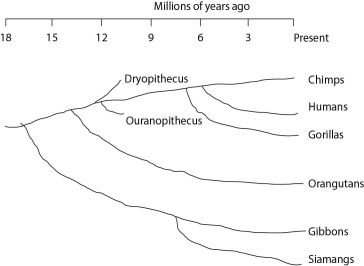 Figure 20.4 Humans, chimpanzees, gorillas, and orangutans are members of a clade called the great apes, which shared a common ancestor about 18 million years ago. Gibbons and siamangs comprise a clade called the lesser apes. Tree-branch lengths indicate elapsed time.
Assuming chimps and gorillas are humans' closest relatives, removing humans from the great ape clade and placing them in a different clade has the effect of making the phylogenetic tree of the great apes
A) polyphyletic.
B) paraphyletic.
C) monophyletic.
D) conform with Linnaeus's view of great ape phylogeny.
سؤال
سؤال
The following questions refer to the phylogenetic tree in Figure 20.3, depicting the origins of life and of the three domains. Horizontal lines indicate instances of gene or genome transfer.
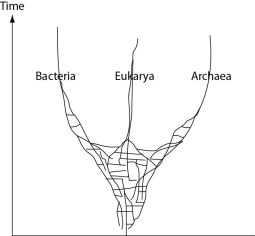 Figure 20.3
A possible phylogenetic tree for the three domains of life.
Which portion of Figure 20.3 may ultimately be better depicted as a "ring"?
A) the bacterial lineage
B) the archaean lineage
C) the eukaryotic lineage
D) the trunk of the tree
E) the part corresponding to the first living cell on Earth
Figure 20.3A possible phylogenetic tree for the three domains of life.
Which portion of Figure 20.3 may ultimately be better depicted as a "ring"?
A) the bacterial lineage
B) the archaean lineage
C) the eukaryotic lineage
D) the trunk of the tree
E) the part corresponding to the first living cell on Earth
سؤال
Figure 20.4 Humans, chimpanzees, gorillas, and orangutans are members of a clade called the great apes, which shared a common ancestor about 18 million years ago. Gibbons and siamangs comprise a clade called the lesser apes. Tree-branch lengths indicate elapsed time.The great apes comprise the family Hominidae, whereas the lesser apes comprise the family Hylobatidae. If the extant organisms on the far right side of Figure 20.4 comprise the next-most exclusive (i.e., specific) taxon, then they comprise different
A) subspecies.
B) species.
C) genuses.
D) genera.
E) orders.
سؤال
سؤال
سؤال
سؤال
سؤال
سؤال
سؤال
The following questions refer to the phylogenetic tree in Figure 20.3, depicting the origins of life and of the three domains. Horizontal lines indicate instances of gene or genome transfer.
Figure 20.3
A possible phylogenetic tree for the three domains of life.
If the early history of life on Earth is accurately depicted by Figure 20.3, then which statement is least in agreement with the hypothesis proposed by this tree?
A) The last universal common ancestor of all extant species is better described as a community of organisms, rather than an individual species.
B) The origin of the three domains appears as a polytomy.
C) Archaean genomes should contain genes that originated in bacteria, and vice versa.
D) Eukaryotes are more closely related to archaeans than to bacteria.
Figure 20.3A possible phylogenetic tree for the three domains of life.
If the early history of life on Earth is accurately depicted by Figure 20.3, then which statement is least in agreement with the hypothesis proposed by this tree?
A) The last universal common ancestor of all extant species is better described as a community of organisms, rather than an individual species.
B) The origin of the three domains appears as a polytomy.
C) Archaean genomes should contain genes that originated in bacteria, and vice versa.
D) Eukaryotes are more closely related to archaeans than to bacteria.
سؤال
Use Figure 20.1 to answer the following questions.
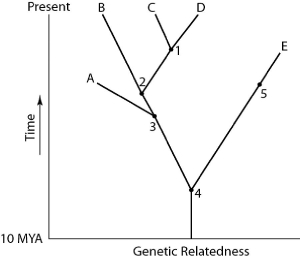 Figure 20.1
Which extinct species should be the best candidate to serve as the outgroup for the clade whose common ancestor occurs at position 2 in Figure 20.1?
A) A
B) B
C) C
D) D
E) E
Figure 20.1Which extinct species should be the best candidate to serve as the outgroup for the clade whose common ancestor occurs at position 2 in Figure 20.1?
A) A
B) B
C) C
D) D
E) E
سؤال
Figure 20.4 Humans, chimpanzees, gorillas, and orangutans are members of a clade called the great apes, which shared a common ancestor about 18 million years ago. Gibbons and siamangs comprise a clade called the lesser apes. Tree-branch lengths indicate elapsed time.Together, the lesser apes and great apes shared a common ancestor most recently with other members of their
A) order.
B) class.
C) subclass.
D) subfamily.
E) family.
سؤال
سؤال
The following questions refer to the phylogenetic tree in Figure 20.3, depicting the origins of life and of the three domains. Horizontal lines indicate instances of gene or genome transfer.
Figure 20.3
A possible phylogenetic tree for the three domains of life.
Which of these processes can be included among those responsible for the horizontal components of Figure 20.3?
A) endosymbiosis
B) mitosis
C) binary fission
D) point mutations
E) S phase of the cell cycle
Figure 20.3A possible phylogenetic tree for the three domains of life.
Which of these processes can be included among those responsible for the horizontal components of Figure 20.3?
A) endosymbiosis
B) mitosis
C) binary fission
D) point mutations
E) S phase of the cell cycle
سؤال
سؤال
Use Figure 20.1 to answer the following questions.
Figure 20.1
If Figure 20.1 is an accurate depiction of relatedness, then which of the following should be correct? 1. The entire tree is based on maximum parsimony.
2) If all species depicted here make up a taxon, this taxon is monophyletic.
3) The last common ancestor of species B and C occurred more recently than the last common ancestor of species D and E.
4) Species A is the direct ancestor of both species B and species C.
5) The species present at position 3 is ancestral to C, D, and E.
A) 1 and 3
B) 3 and 4
C) 2, 3, and 4
D) 1, 2, and 3
Figure 20.1If Figure 20.1 is an accurate depiction of relatedness, then which of the following should be correct? 1. The entire tree is based on maximum parsimony.
2) If all species depicted here make up a taxon, this taxon is monophyletic.
3) The last common ancestor of species B and C occurred more recently than the last common ancestor of species D and E.
4) Species A is the direct ancestor of both species B and species C.
5) The species present at position 3 is ancestral to C, D, and E.
A) 1 and 3
B) 3 and 4
C) 2, 3, and 4
D) 1, 2, and 3
سؤال
سؤال
Traditionally, whales and hippopotamuses have been classified in different orders, the Cetacea and the Artiodactyla, respectively. Recent molecular evidence, however, indicates that the whales' closest living relatives are the hippos. This has caused some zoologists to lump the two orders together into a single clade, the Cetartiodactyla. There is no consensus on whether the Cetartiodactyla should be accorded order status or superorder status. This is because it remains unclear whether the whale lineage diverged from the lineage leading to the hippos before or after the other members of the order Artiodactyla (pigs, camels, etc.) diverged (see Figure 20.2).
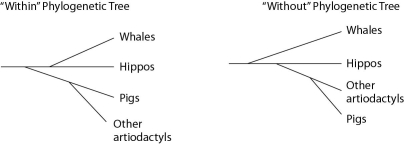 Figure 20.2 contrasts the "Within the artiodactyls" origin of the whale lineage with the "Without the artiodactyls" origin of the whale lineage.
What can be properly inferred from Figure 20.2?
A) In the "Without" tree, pigs are more distantly related to hippos than is depicted in the "Within" tree.
B) In the "Without" tree, pigs are more closely related to hippos than are whales.
C) In the "Within" tree, pigs are more closely related to whales than they are to hippos.
D) The "Without" tree is more consistent with molecular evidence than is the "Within" tree.
E) In the "Within" tree, all artiodactyls, including hippos, are more closely related to each other than any are to the whales.
Figure 20.2 contrasts the "Within the artiodactyls" origin of the whale lineage with the "Without the artiodactyls" origin of the whale lineage.What can be properly inferred from Figure 20.2?
A) In the "Without" tree, pigs are more distantly related to hippos than is depicted in the "Within" tree.
B) In the "Without" tree, pigs are more closely related to hippos than are whales.
C) In the "Within" tree, pigs are more closely related to whales than they are to hippos.
D) The "Without" tree is more consistent with molecular evidence than is the "Within" tree.
E) In the "Within" tree, all artiodactyls, including hippos, are more closely related to each other than any are to the whales.
سؤال
سؤال
The next questions refer to Table 20.1, which compares the % sequence homology of four different parts (two introns and two exons) of a gene that is found in five different eukaryotic species. Each part is numbered to indicate its distance from the promoter (e.g., Intron I is the one closest to the promoter). The data reported for species A were obtained by comparing DNA from one member of species A to the DNA of another member of species A.
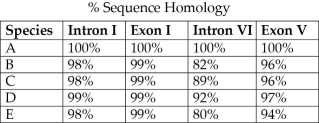 Table 20.1
Which of these four gene parts should allow the construction of the most accurate phylogenetic tree, assuming that this is the only part of the gene that has acted as a reliable molecular clock?
A) Intron I
B) Exon I
C) Intron VI
D) Exon V
Table 20.1Which of these four gene parts should allow the construction of the most accurate phylogenetic tree, assuming that this is the only part of the gene that has acted as a reliable molecular clock?
A) Intron I
B) Exon I
C) Intron VI
D) Exon V
سؤال
The next questions refer to Table 20.1, which compares the % sequence homology of four different parts (two introns and two exons) of a gene that is found in five different eukaryotic species. Each part is numbered to indicate its distance from the promoter (e.g., Intron I is the one closest to the promoter). The data reported for species A were obtained by comparing DNA from one member of species A to the DNA of another member of species A.
Table 20.1
Regarding these sequence homology data, the principle of maximum parsimony would be applicable in
A) distinguishing introns from exons.
B) determining degree of sequence homology.
C) selecting appropriate genes for comparison among species.
D) inferring evolutionary relatedness from the number of sequence differences.
Table 20.1Regarding these sequence homology data, the principle of maximum parsimony would be applicable in
A) distinguishing introns from exons.
B) determining degree of sequence homology.
C) selecting appropriate genes for comparison among species.
D) inferring evolutionary relatedness from the number of sequence differences.
سؤال
The relative lengths of the frog and mouse branches in the phylogenetic tree in the figure given below indicate that 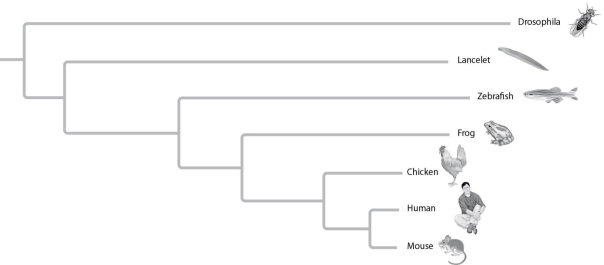
A) frogs evolved before mice.
B) mice evolved before frogs.
C) the genes of frogs and mice have only coincidental homoplasies.
D) the homolog has evolved more slowly in mice.
E) the homolog has evolved more rapidly in mice.
A) frogs evolved before mice.
B) mice evolved before frogs.
C) the genes of frogs and mice have only coincidental homoplasies.
D) the homolog has evolved more slowly in mice.
E) the homolog has evolved more rapidly in mice.
سؤال
Figure 20.4 Humans, chimpanzees, gorillas, and orangutans are members of a clade called the great apes, which shared a common ancestor about 18 million years ago. Gibbons and siamangs comprise a clade called the lesser apes. Tree-branch lengths indicate elapsed time.From Figure 20.4, which other event occurred closest in time to the divergence of gorillas from the lineage that led to humans and chimps?
A) the divergence of chimps and humans
B) the divergence of Dryopithecus and Ouranopithecus
C) the divergence of gibbons and siamangs
D) could be either the divergence of chimps and humans OR of Dryopithecus and Ouranopithecus
E) could be either the divergence of chimps and humans OR of gibbons and siamangs
سؤال
سؤال
سؤال
The next questions refer to Table 20.1, which compares the % sequence homology of four different parts (two introns and two exons) of a gene that is found in five different eukaryotic species. Each part is numbered to indicate its distance from the promoter (e.g., Intron I is the one closest to the promoter). The data reported for species A were obtained by comparing DNA from one member of species A to the DNA of another member of species A.
Table 20.1
Based on the tabular data, and assuming that time advances vertically, which cladogram (a type of phylogenetic tree) is the most likely depiction of the evolutionary relationships among these five species?
A)
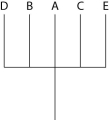
B)
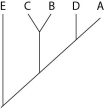
C)
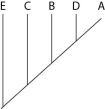
D)
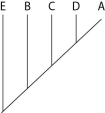
Table 20.1Based on the tabular data, and assuming that time advances vertically, which cladogram (a type of phylogenetic tree) is the most likely depiction of the evolutionary relationships among these five species?
A)
B)
C)
D)
سؤال
سؤال
Based on the tree below, which statement is not correct? 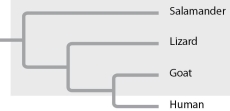
A) The salamander lineage is a basal taxon.
B) Salamanders are a sister group to the group containing lizards, goats, and humans.
C) Salamanders are as closely related to goats as to humans.
D) Lizards are more closely related to salamanders than to humans.
E) The group highlighted by shading is paraphyletic.
A) The salamander lineage is a basal taxon.
B) Salamanders are a sister group to the group containing lizards, goats, and humans.
C) Salamanders are as closely related to goats as to humans.
D) Lizards are more closely related to salamanders than to humans.
E) The group highlighted by shading is paraphyletic.
سؤال
In figure shown below, which similarly inclusive taxon descended from the same common ancestor as Canidae? 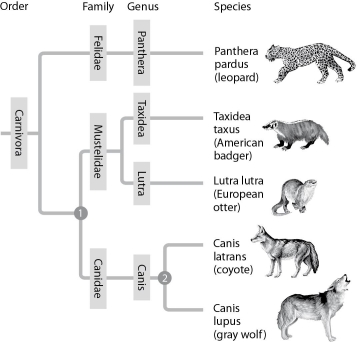
A) Felidae
B) Mustelidae
C) Carnivora
D) Canis
E) Lutra
A) Felidae
B) Mustelidae
C) Carnivora
D) Canis
E) Lutra
سؤال
سؤال
The next questions refer to Table 20.1, which compares the % sequence homology of four different parts (two introns and two exons) of a gene that is found in five different eukaryotic species. Each part is numbered to indicate its distance from the promoter (e.g., Intron I is the one closest to the promoter). The data reported for species A were obtained by comparing DNA from one member of species A to the DNA of another member of species A.
Table 20.1
Which of the following is the best explanation for the high degree of sequence homology observed in Exon I among these five species?
A) It is the most-upstream exon of this gene.
B) Due to alternative gene splicing, this exon is often treated as an intron.
C) It codes for a polypeptide domain that has a crucial function.
D) These five species must actually constitute a single species.
E) This exon is rich in G-C base pairs; thus, it is more stable.
Table 20.1Which of the following is the best explanation for the high degree of sequence homology observed in Exon I among these five species?
A) It is the most-upstream exon of this gene.
B) Due to alternative gene splicing, this exon is often treated as an intron.
C) It codes for a polypeptide domain that has a crucial function.
D) These five species must actually constitute a single species.
E) This exon is rich in G-C base pairs; thus, it is more stable.
سؤال

فتح الحزمة
قم بالتسجيل لفتح البطاقات في هذه المجموعة!
Unlock Deck
Unlock Deck
1/53

العب

ملء الشاشة (f)
Deck 20: Phylogeny
1
The various taxonomic levels (namely, genera, classes, etc.) of the hierarchical classification system differ from each other on the basis of
A) how widely the organisms assigned to each are distributed throughout the environment.
B) their inclusiveness.
C) the relative genome sizes of the organisms assigned to each.
D) morphological characters that are applicable to all organisms.
A) how widely the organisms assigned to each are distributed throughout the environment.
B) their inclusiveness.
C) the relative genome sizes of the organisms assigned to each.
D) morphological characters that are applicable to all organisms.
B
2
Which of the following are the best examples of homologous structures?
A) bones in the bat wing and bones in the human forelimb
B) owl wing and hornet wing
C) bat wing and bird wing
D) eyelessness in the Australian mole and eyelessness in the North American mole
A) bones in the bat wing and bones in the human forelimb
B) owl wing and hornet wing
C) bat wing and bird wing
D) eyelessness in the Australian mole and eyelessness in the North American mole
A
3
When it acts upon a gene, which of the following processes consequently makes that gene an accurate molecular clock?
A) transcription
B) directional natural selection
C) mutation
D) proofreading
E) reverse transcription
A) transcription
B) directional natural selection
C) mutation
D) proofreading
E) reverse transcription
C
4
Some molecular data place the giant panda in the bear family (Ursidae) but place the lesser panda in the raccoon family (Procyonidae). Consequently, the morphological similarities of these two species are probably due to
A) inheritance of acquired characteristics.
B) sexual selection.
C) inheritance of shared derived characters.
D) possession of analogous structures.
E) possession of shared primitive characters.
A) inheritance of acquired characteristics.
B) sexual selection.
C) inheritance of shared derived characters.
D) possession of analogous structures.
E) possession of shared primitive characters.
فتح الحزمة
افتح القفل للوصول البطاقات البالغ عددها 53 في هذه المجموعة.
فتح الحزمة
k this deck
5
A phylogenetic tree constructed using sequence differences in mitochondrial DNA would be most valid for discerning the evolutionary relatedness of
A) archaeans and bacteria.
B) fungi and animals.
C) chimpanzees and humans.
D) sharks and dolphins.
E) mosses and ferns.
A) archaeans and bacteria.
B) fungi and animals.
C) chimpanzees and humans.
D) sharks and dolphins.
E) mosses and ferns.
فتح الحزمة
افتح القفل للوصول البطاقات البالغ عددها 53 في هذه المجموعة.
فتح الحزمة
k this deck
6
The legless condition that is observed in several groups of extant reptiles is the result of
A) their common ancestor having been legless.
B) a shared adaptation to an arboreal (living in trees) lifestyle.
C) several instances of the legless condition arising independently of each other.
D) individual lizards adapting to a fossorial (living in burrows) lifestyle during their lifetimes.
A) their common ancestor having been legless.
B) a shared adaptation to an arboreal (living in trees) lifestyle.
C) several instances of the legless condition arising independently of each other.
D) individual lizards adapting to a fossorial (living in burrows) lifestyle during their lifetimes.
فتح الحزمة
افتح القفل للوصول البطاقات البالغ عددها 53 في هذه المجموعة.
فتح الحزمة
k this deck
7
Cladograms (a type of phylogenetic tree) constructed from evidence from molecular systematics are based on similarities in
A) morphology.
B) the pattern of embryological development.
C) biochemical pathways.
D) habitat and lifestyle choices.
E) mutations to homologous genes.
A) morphology.
B) the pattern of embryological development.
C) biochemical pathways.
D) habitat and lifestyle choices.
E) mutations to homologous genes.
فتح الحزمة
افتح القفل للوصول البطاقات البالغ عددها 53 في هذه المجموعة.
فتح الحزمة
k this deck
8
If organisms A, B, and C belong to the same class but to different orders and if organisms D, E, and F belong to the same order but to different families, which of the following pairs of organisms would be expected to show the greatest degree of structural homology?
A) A and B
B) A and C
C) B and D
D) C and F
E) D and F
A) A and B
B) A and C
C) B and D
D) C and F
E) D and F
فتح الحزمة
افتح القفل للوصول البطاقات البالغ عددها 53 في هذه المجموعة.
فتح الحزمة
k this deck
9
There is some evidence that reptiles called cynodonts may have had whisker-like hairs around their mouths. If true, then what can be properly said of hair?
A) It is a shared derived character of mammals, even if cynodonts continue to be classified as reptiles.
B) It is a shared derived character of the amniote clade, and not of the mammal clade.
C) It is a shared ancestral character of the amniote clade, but only if cynodonts are reclassified as mammals.
D) It is a shared derived character of the mammals, but only if cynodonts are reclassified as mammals.
A) It is a shared derived character of mammals, even if cynodonts continue to be classified as reptiles.
B) It is a shared derived character of the amniote clade, and not of the mammal clade.
C) It is a shared ancestral character of the amniote clade, but only if cynodonts are reclassified as mammals.
D) It is a shared derived character of the mammals, but only if cynodonts are reclassified as mammals.
فتح الحزمة
افتح القفل للوصول البطاقات البالغ عددها 53 في هذه المجموعة.
فتح الحزمة
k this deck
10
The most important feature that permits a gene to act as a molecular clock is
A) having a large number of base pairs.
B) having a larger proportion of exonic DNA than of intronic DNA.
C) having a reliable average rate of mutation.
D) its recent origin by a gene-duplication event.
E) its being acted upon by natural selection.
A) having a large number of base pairs.
B) having a larger proportion of exonic DNA than of intronic DNA.
C) having a reliable average rate of mutation.
D) its recent origin by a gene-duplication event.
E) its being acted upon by natural selection.
فتح الحزمة
افتح القفل للوصول البطاقات البالغ عددها 53 في هذه المجموعة.
فتح الحزمة
k this deck
11
If, someday, an archaean cell is discovered whose rRNA sequence is more similar to that of humans than the sequence of mouse rRNA is to that of humans, the best explanation for this apparent discrepancy would be
A) homology.
B) homoplasy.
C) common ancestry.
D) retro-evolution by humans.
E) coevolution of humans and that archaean.
A) homology.
B) homoplasy.
C) common ancestry.
D) retro-evolution by humans.
E) coevolution of humans and that archaean.
فتح الحزمة
افتح القفل للوصول البطاقات البالغ عددها 53 في هذه المجموعة.
فتح الحزمة
k this deck
12
The importance of computers and of computer software to modern cladistics is most closely linked to advances in
A) light microscopy.
B) radiometric dating.
C) fossil discovery techniques.
D) Linnaean classification.
E) molecular genetics.
A) light microscopy.
B) radiometric dating.
C) fossil discovery techniques.
D) Linnaean classification.
E) molecular genetics.
فتح الحزمة
افتح القفل للوصول البطاقات البالغ عددها 53 في هذه المجموعة.
فتح الحزمة
k this deck
13
A large proportion of archaeans are extremophiles, so called because they inhabit extreme environments with high acidity, salinity, and/or temperature. Such environments are thought to have been much more common on the primitive Earth. Thus, modern extremophiles survive only in places that their ancestors became adapted to long ago. Which of the following is, consequently, a valid statement about modern extremophiles, assuming that their habitats have remained relatively unchanged?
A) Among themselves, they should share relatively few ancestral traits, especially those that enabled ancestral forms to adapt to extreme conditions.
B) On a phylogenetic tree whose branch lengths are proportional to the amount of genetic change, the branches of the extremophiles should be shorter than the non-extremophilic archaeans.
C) They should contain genes that originated in eukaryotes that are the hosts for numerous species of bacteria.
D) They should currently be undergoing a high level of horizontal gene transfer with non-extremophilic archaeans.
A) Among themselves, they should share relatively few ancestral traits, especially those that enabled ancestral forms to adapt to extreme conditions.
B) On a phylogenetic tree whose branch lengths are proportional to the amount of genetic change, the branches of the extremophiles should be shorter than the non-extremophilic archaeans.
C) They should contain genes that originated in eukaryotes that are the hosts for numerous species of bacteria.
D) They should currently be undergoing a high level of horizontal gene transfer with non-extremophilic archaeans.
فتح الحزمة
افتح القفل للوصول البطاقات البالغ عددها 53 في هذه المجموعة.
فتح الحزمة
k this deck
14
The common ancestors of birds and mammals were very early (stem) reptiles, which almost certainly possessed three-chambered hearts (two atria, one ventricle). Birds and mammals, however, are alike in having four-chambered hearts (two atria, two ventricles). The four-chambered hearts of birds and mammals are best described as
A) structural homologies.
B) vestiges.
C) homoplasies.
D) the result of shared ancestry.
E) molecular homologies.
A) structural homologies.
B) vestiges.
C) homoplasies.
D) the result of shared ancestry.
E) molecular homologies.
فتح الحزمة
افتح القفل للوصول البطاقات البالغ عددها 53 في هذه المجموعة.
فتح الحزمة
k this deck
15
The term homoplasy is most applicable to which of the following features?
A) the legless condition found in various lineages of extant lizards
B) the five-digit condition of human hands and bat wings
C) the β hemoglobin genes of mice and of humans
D) the fur that covers Australian moles and North American moles
E) the bones of bat forelimbs and the bones of bird forelimbs
A) the legless condition found in various lineages of extant lizards
B) the five-digit condition of human hands and bat wings
C) the β hemoglobin genes of mice and of humans
D) the fur that covers Australian moles and North American moles
E) the bones of bat forelimbs and the bones of bird forelimbs
فتح الحزمة
افتح القفل للوصول البطاقات البالغ عددها 53 في هذه المجموعة.
فتح الحزمة
k this deck
16
When using a cladistic approach to systematics, which of the following is considered most important for classification?
A) shared primitive characters
B) analogous primitive characters
C) shared derived characters
D) the number of homoplasies
E) overall phenotypic similarity
A) shared primitive characters
B) analogous primitive characters
C) shared derived characters
D) the number of homoplasies
E) overall phenotypic similarity
فتح الحزمة
افتح القفل للوصول البطاقات البالغ عددها 53 في هذه المجموعة.
فتح الحزمة
k this deck
17
The best classification system is that which most closely
A) unites organisms that possess similar morphologies.
B) conforms to traditional, Linnaean taxonomic practices.
C) reflects evolutionary history.
D) reflects the basic separation of prokaryotes from eukaryotes.
A) unites organisms that possess similar morphologies.
B) conforms to traditional, Linnaean taxonomic practices.
C) reflects evolutionary history.
D) reflects the basic separation of prokaryotes from eukaryotes.
فتح الحزمة
افتح القفل للوصول البطاقات البالغ عددها 53 في هذه المجموعة.
فتح الحزمة
k this deck
18
Linnaeus was a "fixist" who believed that species remained fixed in the form in which they had been created. Linnaeus would have been uncomfortable with
A) classifying organisms using the morphospecies concept.
B) the scientific discipline known as taxonomy.
C) phylogenies.
D) nested, ever-more inclusive categories of organisms.
E) a hierarchical classification scheme.
A) classifying organisms using the morphospecies concept.
B) the scientific discipline known as taxonomy.
C) phylogenies.
D) nested, ever-more inclusive categories of organisms.
E) a hierarchical classification scheme.
فتح الحزمة
افتح القفل للوصول البطاقات البالغ عددها 53 في هذه المجموعة.
فتح الحزمة
k this deck
19
Which of the following is true of all horizontally oriented phylogenetic trees, where time advances to the right?
A) Each branch point represents a point in absolute time.
B) Organisms represented at the base of such trees are descendants of those represented at higher levels.
C) The fewer branch points that occur between two taxa, the more divergent their DNA sequences should be.
D) The common ancestor represented by the rightmost branch point existed more recently in time than the common ancestors represented at branch points located to the left.
E) The more branch points there are, the fewer taxa are likely to be represented.
A) Each branch point represents a point in absolute time.
B) Organisms represented at the base of such trees are descendants of those represented at higher levels.
C) The fewer branch points that occur between two taxa, the more divergent their DNA sequences should be.
D) The common ancestor represented by the rightmost branch point existed more recently in time than the common ancestors represented at branch points located to the left.
E) The more branch points there are, the fewer taxa are likely to be represented.
فتح الحزمة
افتح القفل للوصول البطاقات البالغ عددها 53 في هذه المجموعة.
فتح الحزمة
k this deck
20
Neutral theory proposes that
A) molecular clocks are more reliable when the surrounding pH is close to 7.0.
B) most mutations of highly conserved DNA sequences should have no functional effect.
C) DNA is less susceptible to mutation when it codes for amino acid sequences whose side groups (or R groups) have a neutral pH.
D) DNA is less susceptible to mutation when it codes for amino acid sequences whose side groups (or R groups) have a neutral electrical charge.
E) a significant proportion of mutations are not acted upon by natural selection.
A) molecular clocks are more reliable when the surrounding pH is close to 7.0.
B) most mutations of highly conserved DNA sequences should have no functional effect.
C) DNA is less susceptible to mutation when it codes for amino acid sequences whose side groups (or R groups) have a neutral pH.
D) DNA is less susceptible to mutation when it codes for amino acid sequences whose side groups (or R groups) have a neutral electrical charge.
E) a significant proportion of mutations are not acted upon by natural selection.
فتح الحزمة
افتح القفل للوصول البطاقات البالغ عددها 53 في هذه المجموعة.
فتح الحزمة
k this deck
21
Figure 20.4 Humans, chimpanzees, gorillas, and orangutans are members of a clade called the great apes, which shared a common ancestor about 18 million years ago. Gibbons and siamangs comprise a clade called the lesser apes. Tree-branch lengths indicate elapsed time.Assuming chimps and gorillas are humans' closest relatives, removing humans from the great ape clade and placing them in a different clade has the effect of making the phylogenetic tree of the great apes
A) polyphyletic.
B) paraphyletic.
C) monophyletic.
D) conform with Linnaeus's view of great ape phylogeny.
فتح الحزمة
افتح القفل للوصول البطاقات البالغ عددها 53 في هذه المجموعة.
فتح الحزمة
k this deck
22
One morphological feature of modern cetaceans is a vestigial pelvic girdle. If it is determined that cetacean lineage diverged from the artiodactyls' lineage after the divergence of pigs and other artiodactyla, then what should be true of the vestigial pelvic girdle of cetaceans?
A) It should be considered a shared ancestral character of the cetartiodactyls.
B) It should be considered a shared derived character of the cetartiodactyls.
C) It should be considered a shared ancestral character of the cetaceans.
D) It should be considered a shared derived character of the cetaceans.
A) It should be considered a shared ancestral character of the cetartiodactyls.
B) It should be considered a shared derived character of the cetartiodactyls.
C) It should be considered a shared ancestral character of the cetaceans.
D) It should be considered a shared derived character of the cetaceans.
فتح الحزمة
افتح القفل للوصول البطاقات البالغ عددها 53 في هذه المجموعة.
فتح الحزمة
k this deck
23
The following questions refer to the phylogenetic tree in Figure 20.3, depicting the origins of life and of the three domains. Horizontal lines indicate instances of gene or genome transfer.
Figure 20.3
A possible phylogenetic tree for the three domains of life.
Which portion of Figure 20.3 may ultimately be better depicted as a "ring"?
A) the bacterial lineage
B) the archaean lineage
C) the eukaryotic lineage
D) the trunk of the tree
E) the part corresponding to the first living cell on Earth
Figure 20.3A possible phylogenetic tree for the three domains of life.
Which portion of Figure 20.3 may ultimately be better depicted as a "ring"?
A) the bacterial lineage
B) the archaean lineage
C) the eukaryotic lineage
D) the trunk of the tree
E) the part corresponding to the first living cell on Earth
فتح الحزمة
افتح القفل للوصول البطاقات البالغ عددها 53 في هذه المجموعة.
فتح الحزمة
k this deck
24
Figure 20.4 Humans, chimpanzees, gorillas, and orangutans are members of a clade called the great apes, which shared a common ancestor about 18 million years ago. Gibbons and siamangs comprise a clade called the lesser apes. Tree-branch lengths indicate elapsed time.The great apes comprise the family Hominidae, whereas the lesser apes comprise the family Hylobatidae. If the extant organisms on the far right side of Figure 20.4 comprise the next-most exclusive (i.e., specific) taxon, then they comprise different
A) subspecies.
B) species.
C) genuses.
D) genera.
E) orders.
فتح الحزمة
افتح القفل للوصول البطاقات البالغ عددها 53 في هذه المجموعة.
فتح الحزمة
k this deck
25
Which eukaryotic kingdom is polyphyletic, and therefore unacceptable, based on cladistics?
A) Plantae
B) Fungi
C) Animalia
D) Protista
E) Monera
A) Plantae
B) Fungi
C) Animalia
D) Protista
E) Monera
فتح الحزمة
افتح القفل للوصول البطاقات البالغ عددها 53 في هذه المجموعة.
فتح الحزمة
k this deck
26
If it turns out that the whale lineage diverged from the lineage leading to hippos after the divergence of the lineage leading to the pigs and other artiodactyls, and if the whales continue to be classified in the order Cetacea, then what becomes true of the order Artiodactyla?
A) It becomes monophyletic.
B) It becomes paraphyletic.
C) It becomes polyphyletic.
D) It is incorporated into the order Cetacea.
A) It becomes monophyletic.
B) It becomes paraphyletic.
C) It becomes polyphyletic.
D) It is incorporated into the order Cetacea.
فتح الحزمة
افتح القفل للوصول البطاقات البالغ عددها 53 في هذه المجموعة.
فتح الحزمة
k this deck
27
Placing whales and hippos in the same clade means that
A) these organisms are phenotypically more similar to each other than to any others shown on the trees in Figure 20.2.
B) their morphological similarities are probably homoplasies.
C) they had a common ancestor.
D) all three of the responses are correct.
E) two of the responses are correct.
A) these organisms are phenotypically more similar to each other than to any others shown on the trees in Figure 20.2.
B) their morphological similarities are probably homoplasies.
C) they had a common ancestor.
D) all three of the responses are correct.
E) two of the responses are correct.
فتح الحزمة
افتح القفل للوصول البطاقات البالغ عددها 53 في هذه المجموعة.
فتح الحزمة
k this deck
28
It was once thought that cetaceans had evolved from an extinct group of mammals called the mesonychids. If, in the future, it is determined that some organisms currently classified as cetaceans did actually evolve from mesonychids, whereas other cetaceans evolved from artiodactyl stock, then what will be true of the order Cetacea?
A) It will be paraphyletic.
B) It will be polyphyletic.
C) It will need to be modified if classification is to reflect evolutionary history.
D) A and C
E) B and C
A) It will be paraphyletic.
B) It will be polyphyletic.
C) It will need to be modified if classification is to reflect evolutionary history.
D) A and C
E) B and C
فتح الحزمة
افتح القفل للوصول البطاقات البالغ عددها 53 في هذه المجموعة.
فتح الحزمة
k this deck
29
If it turns out that the whale lineage diverged from the lineage leading to hippos after the divergence of the lineage leading to the pigs and other artiodactyls, and if the whales continue to be classified in the order Cetacea, then what becomes true of the taxon Cetartiodactyla?
A) It should be considered as one monophyletic superorder.
B) It should be considered a superorder that consists of two monophyletic orders.
C) It should be established as a paraphyletic order.
D) It should be thrown out or modified by taxonomists if classification is to reflect evolutionary history.
A) It should be considered as one monophyletic superorder.
B) It should be considered a superorder that consists of two monophyletic orders.
C) It should be established as a paraphyletic order.
D) It should be thrown out or modified by taxonomists if classification is to reflect evolutionary history.
فتح الحزمة
افتح القفل للوصول البطاقات البالغ عددها 53 في هذه المجموعة.
فتح الحزمة
k this deck
30
What kind of evidence has recently made it necessary to assign the prokaryotes to either of two different domains, rather than assigning all prokaryotes to the same kingdom?
A) molecular
B) behavioral
C) nutritional
D) anatomical
E) ecological
A) molecular
B) behavioral
C) nutritional
D) anatomical
E) ecological
فتح الحزمة
افتح القفل للوصول البطاقات البالغ عددها 53 في هذه المجموعة.
فتح الحزمة
k this deck
31
The following questions refer to the phylogenetic tree in Figure 20.3, depicting the origins of life and of the three domains. Horizontal lines indicate instances of gene or genome transfer.
Figure 20.3
A possible phylogenetic tree for the three domains of life.
If the early history of life on Earth is accurately depicted by Figure 20.3, then which statement is least in agreement with the hypothesis proposed by this tree?
A) The last universal common ancestor of all extant species is better described as a community of organisms, rather than an individual species.
B) The origin of the three domains appears as a polytomy.
C) Archaean genomes should contain genes that originated in bacteria, and vice versa.
D) Eukaryotes are more closely related to archaeans than to bacteria.
Figure 20.3A possible phylogenetic tree for the three domains of life.
If the early history of life on Earth is accurately depicted by Figure 20.3, then which statement is least in agreement with the hypothesis proposed by this tree?
A) The last universal common ancestor of all extant species is better described as a community of organisms, rather than an individual species.
B) The origin of the three domains appears as a polytomy.
C) Archaean genomes should contain genes that originated in bacteria, and vice versa.
D) Eukaryotes are more closely related to archaeans than to bacteria.
فتح الحزمة
افتح القفل للوصول البطاقات البالغ عددها 53 في هذه المجموعة.
فتح الحزمة
k this deck
32
Use Figure 20.1 to answer the following questions.
Figure 20.1
Which extinct species should be the best candidate to serve as the outgroup for the clade whose common ancestor occurs at position 2 in Figure 20.1?
A) A
B) B
C) C
D) D
E) E
Figure 20.1Which extinct species should be the best candidate to serve as the outgroup for the clade whose common ancestor occurs at position 2 in Figure 20.1?
A) A
B) B
C) C
D) D
E) E
فتح الحزمة
افتح القفل للوصول البطاقات البالغ عددها 53 في هذه المجموعة.
فتح الحزمة
k this deck
33
Figure 20.4 Humans, chimpanzees, gorillas, and orangutans are members of a clade called the great apes, which shared a common ancestor about 18 million years ago. Gibbons and siamangs comprise a clade called the lesser apes. Tree-branch lengths indicate elapsed time.Together, the lesser apes and great apes shared a common ancestor most recently with other members of their
A) order.
B) class.
C) subclass.
D) subfamily.
E) family.
فتح الحزمة
افتح القفل للوصول البطاقات البالغ عددها 53 في هذه المجموعة.
فتح الحزمة
k this deck
34
If cetaceans are determined to have diverged from the lineage leading to the artiodactyls before the divergence of lineages leading to the modern artiodactyls (including hippos), then the cetaceans can be considered 1. a sister order to the order Artiodactyla.
2) an ingroup of the order Artiodactyla.
3) the common ancestor of the order Artiodactyla.
A) 1 only
B) 3 only
C) 1 and 2
D) 1 and 3
E) 2 and 3
2) an ingroup of the order Artiodactyla.
3) the common ancestor of the order Artiodactyla.
A) 1 only
B) 3 only
C) 1 and 2
D) 1 and 3
E) 2 and 3
فتح الحزمة
افتح القفل للوصول البطاقات البالغ عددها 53 في هذه المجموعة.
فتح الحزمة
k this deck
35
The following questions refer to the phylogenetic tree in Figure 20.3, depicting the origins of life and of the three domains. Horizontal lines indicate instances of gene or genome transfer.
Figure 20.3
A possible phylogenetic tree for the three domains of life.
Which of these processes can be included among those responsible for the horizontal components of Figure 20.3?
A) endosymbiosis
B) mitosis
C) binary fission
D) point mutations
E) S phase of the cell cycle
Figure 20.3A possible phylogenetic tree for the three domains of life.
Which of these processes can be included among those responsible for the horizontal components of Figure 20.3?
A) endosymbiosis
B) mitosis
C) binary fission
D) point mutations
E) S phase of the cell cycle
فتح الحزمة
افتح القفل للوصول البطاقات البالغ عددها 53 في هذه المجموعة.
فتح الحزمة
k this deck
36
Which of these would, if it had acted upon a gene, prevent this gene from acting as a reliable molecular clock?
A) neutral mutations
B) genetic drift
C) mutations within introns
D) natural selection
E) most substitution mutations involving an exonic codon's third position
A) neutral mutations
B) genetic drift
C) mutations within introns
D) natural selection
E) most substitution mutations involving an exonic codon's third position
فتح الحزمة
افتح القفل للوصول البطاقات البالغ عددها 53 في هذه المجموعة.
فتح الحزمة
k this deck
37
Use Figure 20.1 to answer the following questions.
Figure 20.1
If Figure 20.1 is an accurate depiction of relatedness, then which of the following should be correct? 1. The entire tree is based on maximum parsimony.
2) If all species depicted here make up a taxon, this taxon is monophyletic.
3) The last common ancestor of species B and C occurred more recently than the last common ancestor of species D and E.
4) Species A is the direct ancestor of both species B and species C.
5) The species present at position 3 is ancestral to C, D, and E.
A) 1 and 3
B) 3 and 4
C) 2, 3, and 4
D) 1, 2, and 3
Figure 20.1If Figure 20.1 is an accurate depiction of relatedness, then which of the following should be correct? 1. The entire tree is based on maximum parsimony.
2) If all species depicted here make up a taxon, this taxon is monophyletic.
3) The last common ancestor of species B and C occurred more recently than the last common ancestor of species D and E.
4) Species A is the direct ancestor of both species B and species C.
5) The species present at position 3 is ancestral to C, D, and E.
A) 1 and 3
B) 3 and 4
C) 2, 3, and 4
D) 1, 2, and 3
فتح الحزمة
افتح القفل للوصول البطاقات البالغ عددها 53 في هذه المجموعة.
فتح الحزمة
k this deck
38
Which kind of DNA should provide the best molecular clock for determining the evolutionary relatedness of several species whose common ancestor became extinct billions of years ago?
A) that coding for ribosomal RNA
B) intronic DNA belonging to a gene whose product performs a crucial function
C) paralogous DNA that has lost its function (i.e., no longer codes for functional gene product)
D) mitochondrial DNA
E) exonic DNA that codes for a noncrucial part of a polypeptide
A) that coding for ribosomal RNA
B) intronic DNA belonging to a gene whose product performs a crucial function
C) paralogous DNA that has lost its function (i.e., no longer codes for functional gene product)
D) mitochondrial DNA
E) exonic DNA that codes for a noncrucial part of a polypeptide
فتح الحزمة
افتح القفل للوصول البطاقات البالغ عددها 53 في هذه المجموعة.
فتح الحزمة
k this deck
39
Traditionally, whales and hippopotamuses have been classified in different orders, the Cetacea and the Artiodactyla, respectively. Recent molecular evidence, however, indicates that the whales' closest living relatives are the hippos. This has caused some zoologists to lump the two orders together into a single clade, the Cetartiodactyla. There is no consensus on whether the Cetartiodactyla should be accorded order status or superorder status. This is because it remains unclear whether the whale lineage diverged from the lineage leading to the hippos before or after the other members of the order Artiodactyla (pigs, camels, etc.) diverged (see Figure 20.2).
Figure 20.2 contrasts the "Within the artiodactyls" origin of the whale lineage with the "Without the artiodactyls" origin of the whale lineage.
What can be properly inferred from Figure 20.2?
A) In the "Without" tree, pigs are more distantly related to hippos than is depicted in the "Within" tree.
B) In the "Without" tree, pigs are more closely related to hippos than are whales.
C) In the "Within" tree, pigs are more closely related to whales than they are to hippos.
D) The "Without" tree is more consistent with molecular evidence than is the "Within" tree.
E) In the "Within" tree, all artiodactyls, including hippos, are more closely related to each other than any are to the whales.
Figure 20.2 contrasts the "Within the artiodactyls" origin of the whale lineage with the "Without the artiodactyls" origin of the whale lineage.What can be properly inferred from Figure 20.2?
A) In the "Without" tree, pigs are more distantly related to hippos than is depicted in the "Within" tree.
B) In the "Without" tree, pigs are more closely related to hippos than are whales.
C) In the "Within" tree, pigs are more closely related to whales than they are to hippos.
D) The "Without" tree is more consistent with molecular evidence than is the "Within" tree.
E) In the "Within" tree, all artiodactyls, including hippos, are more closely related to each other than any are to the whales.
فتح الحزمة
افتح القفل للوصول البطاقات البالغ عددها 53 في هذه المجموعة.
فتح الحزمة
k this deck
40
Which kingdom has been replaced with two domains?
A) Plantae
B) Fungi
C) Animalia
D) Protista
E) Monera
A) Plantae
B) Fungi
C) Animalia
D) Protista
E) Monera
فتح الحزمة
افتح القفل للوصول البطاقات البالغ عددها 53 في هذه المجموعة.
فتح الحزمة
k this deck
41
The next questions refer to Table 20.1, which compares the % sequence homology of four different parts (two introns and two exons) of a gene that is found in five different eukaryotic species. Each part is numbered to indicate its distance from the promoter (e.g., Intron I is the one closest to the promoter). The data reported for species A were obtained by comparing DNA from one member of species A to the DNA of another member of species A.
Table 20.1
Which of these four gene parts should allow the construction of the most accurate phylogenetic tree, assuming that this is the only part of the gene that has acted as a reliable molecular clock?
A) Intron I
B) Exon I
C) Intron VI
D) Exon V
Table 20.1Which of these four gene parts should allow the construction of the most accurate phylogenetic tree, assuming that this is the only part of the gene that has acted as a reliable molecular clock?
A) Intron I
B) Exon I
C) Intron VI
D) Exon V
فتح الحزمة
افتح القفل للوصول البطاقات البالغ عددها 53 في هذه المجموعة.
فتح الحزمة
k this deck
42
The next questions refer to Table 20.1, which compares the % sequence homology of four different parts (two introns and two exons) of a gene that is found in five different eukaryotic species. Each part is numbered to indicate its distance from the promoter (e.g., Intron I is the one closest to the promoter). The data reported for species A were obtained by comparing DNA from one member of species A to the DNA of another member of species A.
Table 20.1
Regarding these sequence homology data, the principle of maximum parsimony would be applicable in
A) distinguishing introns from exons.
B) determining degree of sequence homology.
C) selecting appropriate genes for comparison among species.
D) inferring evolutionary relatedness from the number of sequence differences.
Table 20.1Regarding these sequence homology data, the principle of maximum parsimony would be applicable in
A) distinguishing introns from exons.
B) determining degree of sequence homology.
C) selecting appropriate genes for comparison among species.
D) inferring evolutionary relatedness from the number of sequence differences.
فتح الحزمة
افتح القفل للوصول البطاقات البالغ عددها 53 في هذه المجموعة.
فتح الحزمة
k this deck
43
The relative lengths of the frog and mouse branches in the phylogenetic tree in the figure given below indicate that
A) frogs evolved before mice.
B) mice evolved before frogs.
C) the genes of frogs and mice have only coincidental homoplasies.
D) the homolog has evolved more slowly in mice.
E) the homolog has evolved more rapidly in mice.
A) frogs evolved before mice.
B) mice evolved before frogs.
C) the genes of frogs and mice have only coincidental homoplasies.
D) the homolog has evolved more slowly in mice.
E) the homolog has evolved more rapidly in mice.
فتح الحزمة
افتح القفل للوصول البطاقات البالغ عددها 53 في هذه المجموعة.
فتح الحزمة
k this deck
44
Figure 20.4 Humans, chimpanzees, gorillas, and orangutans are members of a clade called the great apes, which shared a common ancestor about 18 million years ago. Gibbons and siamangs comprise a clade called the lesser apes. Tree-branch lengths indicate elapsed time.From Figure 20.4, which other event occurred closest in time to the divergence of gorillas from the lineage that led to humans and chimps?
A) the divergence of chimps and humans
B) the divergence of Dryopithecus and Ouranopithecus
C) the divergence of gibbons and siamangs
D) could be either the divergence of chimps and humans OR of Dryopithecus and Ouranopithecus
E) could be either the divergence of chimps and humans OR of gibbons and siamangs
فتح الحزمة
افتح القفل للوصول البطاقات البالغ عددها 53 في هذه المجموعة.
فتح الحزمة
k this deck
45
If you were using cladistics to build a phylogenetic tree of cats, which of the following would be the best outgroup?
A) lion
B) domestic cat
C) wolf
D) leopard
E) tiger
A) lion
B) domestic cat
C) wolf
D) leopard
E) tiger
فتح الحزمة
افتح القفل للوصول البطاقات البالغ عددها 53 في هذه المجموعة.
فتح الحزمة
k this deck
46
Traditionally, zoologists have placed birds in their own class, Aves. More recently, molecular evidence has shown that birds are more closely related to reptiles than their anatomy reveals. Genetically, birds are more closely related to crocodiles than crocodiles are to turtles. Thus, bird anatomy has become highly modified as they have adapted to flight, without their genes having undergone nearly as much change.
Taxonomically, what should be done with the birds?
A) The traditional stance is correct. Such dramatic morphological change as undergone by birds merits that the birds be placed in their own order, separate from the reptiles.
B) The birds should be reclassified, and their new taxon should be the subclass Aves. Genetic similarity trumps morphological dissimilarity in cases where morphological traits are uninformative.
C) The rest of the reptiles should be reclassified as a subclass within the class Aves.
D) The classification scheme should remain the same because of historical precedence.
Taxonomically, what should be done with the birds?
A) The traditional stance is correct. Such dramatic morphological change as undergone by birds merits that the birds be placed in their own order, separate from the reptiles.
B) The birds should be reclassified, and their new taxon should be the subclass Aves. Genetic similarity trumps morphological dissimilarity in cases where morphological traits are uninformative.
C) The rest of the reptiles should be reclassified as a subclass within the class Aves.
D) The classification scheme should remain the same because of historical precedence.
فتح الحزمة
افتح القفل للوصول البطاقات البالغ عددها 53 في هذه المجموعة.
فتح الحزمة
k this deck
47
The next questions refer to Table 20.1, which compares the % sequence homology of four different parts (two introns and two exons) of a gene that is found in five different eukaryotic species. Each part is numbered to indicate its distance from the promoter (e.g., Intron I is the one closest to the promoter). The data reported for species A were obtained by comparing DNA from one member of species A to the DNA of another member of species A.
Table 20.1
Based on the tabular data, and assuming that time advances vertically, which cladogram (a type of phylogenetic tree) is the most likely depiction of the evolutionary relationships among these five species?
A)
B)
C)
D)
Table 20.1Based on the tabular data, and assuming that time advances vertically, which cladogram (a type of phylogenetic tree) is the most likely depiction of the evolutionary relationships among these five species?
A)
B)
C)
D)
فتح الحزمة
افتح القفل للوصول البطاقات البالغ عددها 53 في هذه المجموعة.
فتح الحزمة
k this deck
48
Three living species X, Y, and Z share a common ancestor T, as do extinct species U and V. A grouping that consists of species T, X, Y, and Z (but not U or V) makes up
A) a monophyletic taxon.
B) a clade.
C) an ingroup, with species U as the outgroup.
D) a paraphyletic group.
E) a polyphyletic group.
A) a monophyletic taxon.
B) a clade.
C) an ingroup, with species U as the outgroup.
D) a paraphyletic group.
E) a polyphyletic group.
فتح الحزمة
افتح القفل للوصول البطاقات البالغ عددها 53 في هذه المجموعة.
فتح الحزمة
k this deck
49
Based on the tree below, which statement is not correct?
A) The salamander lineage is a basal taxon.
B) Salamanders are a sister group to the group containing lizards, goats, and humans.
C) Salamanders are as closely related to goats as to humans.
D) Lizards are more closely related to salamanders than to humans.
E) The group highlighted by shading is paraphyletic.
A) The salamander lineage is a basal taxon.
B) Salamanders are a sister group to the group containing lizards, goats, and humans.
C) Salamanders are as closely related to goats as to humans.
D) Lizards are more closely related to salamanders than to humans.
E) The group highlighted by shading is paraphyletic.
فتح الحزمة
افتح القفل للوصول البطاقات البالغ عددها 53 في هذه المجموعة.
فتح الحزمة
k this deck
50
In figure shown below, which similarly inclusive taxon descended from the same common ancestor as Canidae?
A) Felidae
B) Mustelidae
C) Carnivora
D) Canis
E) Lutra
A) Felidae
B) Mustelidae
C) Carnivora
D) Canis
E) Lutra
فتح الحزمة
افتح القفل للوصول البطاقات البالغ عددها 53 في هذه المجموعة.
فتح الحزمة
k this deck
51
To apply parsimony to constructing a phylogenetic tree,
A) choose the tree that assumes all evolutionary changes are equally probable.
B) choose the tree in which the branch points are based on as many shared derived characters as possible.
C) base phylogenetic trees only on the fossil record, as this provides the simplest explanation for evolution.
D) choose the tree that represents the fewest evolutionary changes in either DNA sequences or morphology.
E) choose the tree with the fewest branch points.
A) choose the tree that assumes all evolutionary changes are equally probable.
B) choose the tree in which the branch points are based on as many shared derived characters as possible.
C) base phylogenetic trees only on the fossil record, as this provides the simplest explanation for evolution.
D) choose the tree that represents the fewest evolutionary changes in either DNA sequences or morphology.
E) choose the tree with the fewest branch points.
فتح الحزمة
افتح القفل للوصول البطاقات البالغ عددها 53 في هذه المجموعة.
فتح الحزمة
k this deck
52
The next questions refer to Table 20.1, which compares the % sequence homology of four different parts (two introns and two exons) of a gene that is found in five different eukaryotic species. Each part is numbered to indicate its distance from the promoter (e.g., Intron I is the one closest to the promoter). The data reported for species A were obtained by comparing DNA from one member of species A to the DNA of another member of species A.
Table 20.1
Which of the following is the best explanation for the high degree of sequence homology observed in Exon I among these five species?
A) It is the most-upstream exon of this gene.
B) Due to alternative gene splicing, this exon is often treated as an intron.
C) It codes for a polypeptide domain that has a crucial function.
D) These five species must actually constitute a single species.
E) This exon is rich in G-C base pairs; thus, it is more stable.
Table 20.1Which of the following is the best explanation for the high degree of sequence homology observed in Exon I among these five species?
A) It is the most-upstream exon of this gene.
B) Due to alternative gene splicing, this exon is often treated as an intron.
C) It codes for a polypeptide domain that has a crucial function.
D) These five species must actually constitute a single species.
E) This exon is rich in G-C base pairs; thus, it is more stable.
فتح الحزمة
افتح القفل للوصول البطاقات البالغ عددها 53 في هذه المجموعة.
فتح الحزمة
k this deck
53
In a comparison of birds and mammals, the condition of having four limbs is
A) a shared ancestral character.
B) a shared derived character.
C) a character useful for distinguishing birds from mammals.
D) an example of analogy rather than homology.
E) a character useful for sorting bird species.
A) a shared ancestral character.
B) a shared derived character.
C) a character useful for distinguishing birds from mammals.
D) an example of analogy rather than homology.
E) a character useful for sorting bird species.
فتح الحزمة
افتح القفل للوصول البطاقات البالغ عددها 53 في هذه المجموعة.
فتح الحزمة
k this deck
فتح الحزمة
افتح القفل للوصول البطاقات البالغ عددها 53 في هذه المجموعة.






