







 تكلم مع الذكاء الاصطناعي


Deck 27: The Rise of Animal Diversity
ملء الشاشة (f)

سؤال

سؤال
سؤال
سؤال
سؤال
سؤال
سؤال
سؤال
سؤال
سؤال
سؤال
سؤال
سؤال
سؤال
سؤال
سؤال
سؤال
سؤال
سؤال
سؤال
سؤال
سؤال
سؤال
سؤال
سؤال
سؤال
سؤال
سؤال
سؤال
سؤال
سؤال
سؤال
سؤال
سؤال
سؤال
سؤال
سؤال
سؤال
سؤال
سؤال
سؤال
سؤال
سؤال
سؤال
سؤال
سؤال
سؤال
سؤال
سؤال
سؤال
سؤال
سؤال
سؤال
سؤال
سؤال
سؤال
سؤال
سؤال
سؤال
سؤال
سؤال
سؤال
Please use the following information to answer the question(s) below.
Placozoan evolutionary relationships to other animals are currently unclear, and different phylogenies can be created, depending on the characters used to infer relatedness. Placozoans are multicellular invertebrates with a simple structure of only two tissue layers and only four cell types. They have the smallest amount of DNA measured in any animal. In comparison, sponges have no tissues but about 20 cell types. One species of placozoans, Tp (Trichoplax adhaerens), produces a neuropeptide almost identical to one found in cnidarians. The genome of Tp, although the smallest of any known animal, shares many features of complex eumetazoan (even human!) genomes. The next three questions refer to the phylogenetic trees that follow. In the trees, the outgroup is a taxon that is outside the group of interest; members of the group of interest are more closely related to one another than to the outgroup.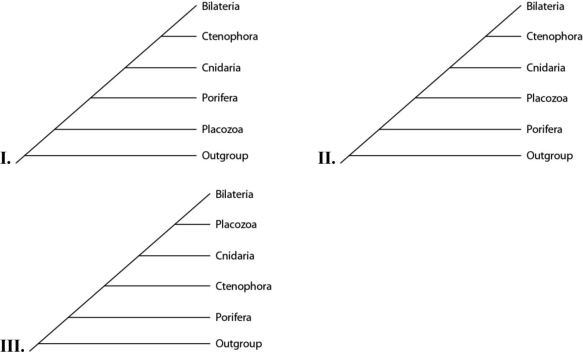
Which tree(s) has (have) been created by emphasizing genomic features of placozoans?
A) I only
B) II only
C) III only
D) I and II
Placozoan evolutionary relationships to other animals are currently unclear, and different phylogenies can be created, depending on the characters used to infer relatedness. Placozoans are multicellular invertebrates with a simple structure of only two tissue layers and only four cell types. They have the smallest amount of DNA measured in any animal. In comparison, sponges have no tissues but about 20 cell types. One species of placozoans, Tp (Trichoplax adhaerens), produces a neuropeptide almost identical to one found in cnidarians. The genome of Tp, although the smallest of any known animal, shares many features of complex eumetazoan (even human!) genomes. The next three questions refer to the phylogenetic trees that follow. In the trees, the outgroup is a taxon that is outside the group of interest; members of the group of interest are more closely related to one another than to the outgroup.
Which tree(s) has (have) been created by emphasizing genomic features of placozoans?
A) I only
B) II only
C) III only
D) I and II
سؤال
Please use the following information to answer the question(s) below.
Placozoan evolutionary relationships to other animals are currently unclear, and different phylogenies can be created, depending on the characters used to infer relatedness. Placozoans are multicellular invertebrates with a simple structure of only two tissue layers and only four cell types. They have the smallest amount of DNA measured in any animal. In comparison, sponges have no tissues but about 20 cell types. One species of placozoans, Tp (Trichoplax adhaerens), produces a neuropeptide almost identical to one found in cnidarians. The genome of Tp, although the smallest of any known animal, shares many features of complex eumetazoan (even human!) genomes. The next three questions refer to the phylogenetic trees that follow. In the trees, the outgroup is a taxon that is outside the group of interest; members of the group of interest are more closely related to one another than to the outgroup.
Which tree(s) has (have) been created by emphasizing the structural simplicity of placozoans?
A) I only
B) II only
C) III only
D) II and III
Placozoan evolutionary relationships to other animals are currently unclear, and different phylogenies can be created, depending on the characters used to infer relatedness. Placozoans are multicellular invertebrates with a simple structure of only two tissue layers and only four cell types. They have the smallest amount of DNA measured in any animal. In comparison, sponges have no tissues but about 20 cell types. One species of placozoans, Tp (Trichoplax adhaerens), produces a neuropeptide almost identical to one found in cnidarians. The genome of Tp, although the smallest of any known animal, shares many features of complex eumetazoan (even human!) genomes. The next three questions refer to the phylogenetic trees that follow. In the trees, the outgroup is a taxon that is outside the group of interest; members of the group of interest are more closely related to one another than to the outgroup.
Which tree(s) has (have) been created by emphasizing the structural simplicity of placozoans?
A) I only
B) II only
C) III only
D) II and III
سؤال
سؤال
سؤال
Please use the following information to answer the question(s) below.
Placozoan evolutionary relationships to other animals are currently unclear, and different phylogenies can be created, depending on the characters used to infer relatedness. Placozoans are multicellular invertebrates with a simple structure of only two tissue layers and only four cell types. They have the smallest amount of DNA measured in any animal. In comparison, sponges have no tissues but about 20 cell types. One species of placozoans, Tp (Trichoplax adhaerens), produces a neuropeptide almost identical to one found in cnidarians. The genome of Tp, although the smallest of any known animal, shares many features of complex eumetazoan (even human!) genomes. The next three questions refer to the phylogenetic trees that follow. In the trees, the outgroup is a taxon that is outside the group of interest; members of the group of interest are more closely related to one another than to the outgroup.
Which tree(s) has (have) been created by emphasizing a protein found in placozoans?
A) I only
B) II only
C) III only
D) I and III
Placozoan evolutionary relationships to other animals are currently unclear, and different phylogenies can be created, depending on the characters used to infer relatedness. Placozoans are multicellular invertebrates with a simple structure of only two tissue layers and only four cell types. They have the smallest amount of DNA measured in any animal. In comparison, sponges have no tissues but about 20 cell types. One species of placozoans, Tp (Trichoplax adhaerens), produces a neuropeptide almost identical to one found in cnidarians. The genome of Tp, although the smallest of any known animal, shares many features of complex eumetazoan (even human!) genomes. The next three questions refer to the phylogenetic trees that follow. In the trees, the outgroup is a taxon that is outside the group of interest; members of the group of interest are more closely related to one another than to the outgroup.
Which tree(s) has (have) been created by emphasizing a protein found in placozoans?
A) I only
B) II only
C) III only
D) I and III
سؤال
Please use the following information to answer the question(s) below. 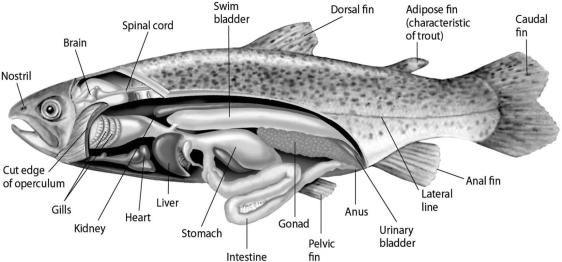 Figure 27.2
Fishes that have swim bladders can regulate their density and thus their buoyancy. There are two types of swim bladder: physostomous and physoclistous. The ancestral version is the physostomous version, in which the swim bladder is connected to the esophagus via a short tube (Figure 27.2). The fish fills this version by swimming to the surface, taking gulps of air, and directing them into the swim bladder. Air is removed from this version by "belching." The physoclistous version is more derived and has lost its connection to the esophagus. Instead, gas enters and leaves the swim bladder via special circulatory mechanisms within the wall of the swim bladder.
The presence of a swim bladder allows the typical ray-finned fish to stop swimming and still
A) effectively circulate its blood.
B) be highly maneuverable.
C) use its swim bladder as a respiratory organ.
D) not sink.
Figure 27.2Fishes that have swim bladders can regulate their density and thus their buoyancy. There are two types of swim bladder: physostomous and physoclistous. The ancestral version is the physostomous version, in which the swim bladder is connected to the esophagus via a short tube (Figure 27.2). The fish fills this version by swimming to the surface, taking gulps of air, and directing them into the swim bladder. Air is removed from this version by "belching." The physoclistous version is more derived and has lost its connection to the esophagus. Instead, gas enters and leaves the swim bladder via special circulatory mechanisms within the wall of the swim bladder.
The presence of a swim bladder allows the typical ray-finned fish to stop swimming and still
A) effectively circulate its blood.
B) be highly maneuverable.
C) use its swim bladder as a respiratory organ.
D) not sink.
سؤال
 Table 27.1. Proposed Number of Hox Genes in Various Extant and Extinct Animals
All things being equal, which of these is the simplest explanation for the change in the number of Hox genes from the last common ancestor of insects and vertebrates to ancestral vertebrates, as shown in Table 27.1?
A) The occurrence of seven independent duplications of individual Hox genes.
B) The occurrence of 14 independent duplications of individual Hox genes
C) The occurrence of two distinct duplications of the entire seven-gene cluster, followed by the loss of one cluster.
D) The occurrence of a single duplication of the entire seven-gene cluster.
سؤال
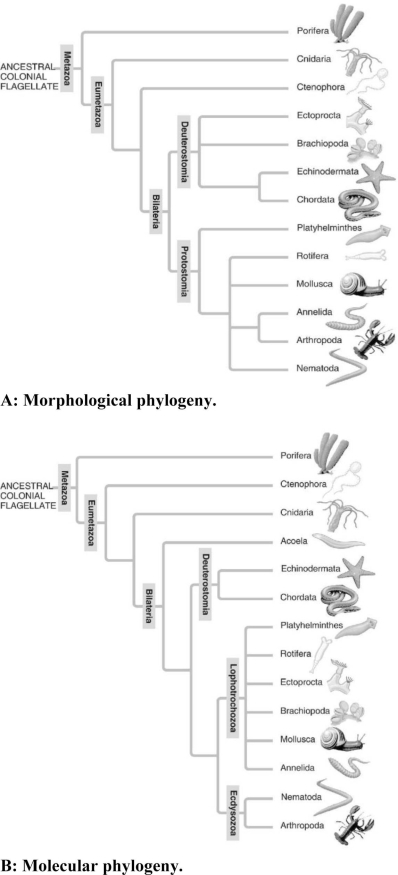
Which of the following is a point of conflict between the phylogenetic analyses presented in these two figures?
A) the relationship of taxa of segmented animals to taxa of nonsegmented animals
B) that sponges are basal animals
C) that chordates are deuterostomes
D) the evolutionary relationship between Nematoda and Arthropoda
سؤال
Table 27.1. Proposed Number of Hox Genes in Various Extant and Extinct AnimalsWhat conclusion is apparent from the data in Table 27.1?
A) Land animals have more Hox genes than do those that live in water.
B) All bilaterian phyla have had the same degree of expansion in their numbers of Hox genes.
C) Acoel flatworms should be expected to contain seven Hox genes.
D) The expansion in number of Hox genes throughout vertebrate evolution cannot be explained merely by three duplications of the ancestral vertebrate Hox cluster.
E) Extant insects all have seven Hox genes.
سؤال
Please use the following information to answer the question(s) below. Figure 27.2
Fishes that have swim bladders can regulate their density and thus their buoyancy. There are two types of swim bladder: physostomous and physoclistous. The ancestral version is the physostomous version, in which the swim bladder is connected to the esophagus via a short tube (Figure 27.2). The fish fills this version by swimming to the surface, taking gulps of air, and directing them into the swim bladder. Air is removed from this version by "belching." The physoclistous version is more derived and has lost its connection to the esophagus. Instead, gas enters and leaves the swim bladder via special circulatory mechanisms within the wall of the swim bladder.
If a physoclistous fish removes gas from its swim bladder, this fish's density cannot actually change until that gas arrives at the
A) mouth.
B) gills.
C) skin.
D) heart.
E) anus.
Figure 27.2Fishes that have swim bladders can regulate their density and thus their buoyancy. There are two types of swim bladder: physostomous and physoclistous. The ancestral version is the physostomous version, in which the swim bladder is connected to the esophagus via a short tube (Figure 27.2). The fish fills this version by swimming to the surface, taking gulps of air, and directing them into the swim bladder. Air is removed from this version by "belching." The physoclistous version is more derived and has lost its connection to the esophagus. Instead, gas enters and leaves the swim bladder via special circulatory mechanisms within the wall of the swim bladder.
If a physoclistous fish removes gas from its swim bladder, this fish's density cannot actually change until that gas arrives at the
A) mouth.
B) gills.
C) skin.
D) heart.
E) anus.
سؤال
سؤال
سؤال
What is true in the molecular phylogeny (B) that is not true in the traditional phylogeny (A)?
A) Deuterostomia is paraphyletic.
B) To maintain Deuterostomia as a clade, some phyla had to be removed from it.
C) Deuterostomia now includes the Acoela.
D) It diverged from the rest of the Bilateria earlier than did the Acoela.
سؤال
In the traditional phylogeny (A), the phylum Platyhelminthes is depicted as a sister taxon to the rest of the protostome phyla and as having diverged earlier from the lineage that led to the rest of the protostomes. In the molecular phylogeny (B), Platyhelminthes is depicted as a lophotrochozoan phylum. What probably led to this change?
A) Platyhelminthes ceased to be recognized as true protostomes.
B) The removal of the acoel flatworms (Acoela) from the Platyhelminthes allowed the remaining flatworms to be clearly tied to the Lophotrochozoa.
C) All Platyhelminthes must have a well-developed lophophore as their feeding apparatus.
D) Platyhelminthes' close genetic ties to the arthropods became clear as their Hox gene sequences were studied.
سؤال
Please use the following information to answer the question(s) below. Figure 27.2
Fishes that have swim bladders can regulate their density and thus their buoyancy. There are two types of swim bladder: physostomous and physoclistous. The ancestral version is the physostomous version, in which the swim bladder is connected to the esophagus via a short tube (Figure 27.2). The fish fills this version by swimming to the surface, taking gulps of air, and directing them into the swim bladder. Air is removed from this version by "belching." The physoclistous version is more derived and has lost its connection to the esophagus. Instead, gas enters and leaves the swim bladder via special circulatory mechanisms within the wall of the swim bladder.
Which graph properly depicts the relationship between the amount of gas in the swim bladder and the density of the fish?
A) A
B) B
C) C
D) D
E) E
Figure 27.2Fishes that have swim bladders can regulate their density and thus their buoyancy. There are two types of swim bladder: physostomous and physoclistous. The ancestral version is the physostomous version, in which the swim bladder is connected to the esophagus via a short tube (Figure 27.2). The fish fills this version by swimming to the surface, taking gulps of air, and directing them into the swim bladder. Air is removed from this version by "belching." The physoclistous version is more derived and has lost its connection to the esophagus. Instead, gas enters and leaves the swim bladder via special circulatory mechanisms within the wall of the swim bladder.
Which graph properly depicts the relationship between the amount of gas in the swim bladder and the density of the fish?
A) A
B) B
C) C
D) D
E) E
سؤال
سؤال
سؤال
Please use the following information to answer the question(s) below. Figure 27.2
Fishes that have swim bladders can regulate their density and thus their buoyancy. There are two types of swim bladder: physostomous and physoclistous. The ancestral version is the physostomous version, in which the swim bladder is connected to the esophagus via a short tube (Figure 27.2). The fish fills this version by swimming to the surface, taking gulps of air, and directing them into the swim bladder. Air is removed from this version by "belching." The physoclistous version is more derived and has lost its connection to the esophagus. Instead, gas enters and leaves the swim bladder via special circulatory mechanisms within the wall of the swim bladder.
How do a physoclistous fish and a physotomous fish compare in terms of the amount of energy each must use to maintain its position (depth) in the water column over the long term?
A) a physoclistous fish uses more energy than a physostomous fish
B) a physostomous fish uses more energy than a physoclistous fish
C) a physoclistous fish and a physostomous fish use the same amount of energy
D) a physoclistous fish initially uses more energy than a physostomous fish but then decreases its energy use to be equal to the physostomous fish
Figure 27.2Fishes that have swim bladders can regulate their density and thus their buoyancy. There are two types of swim bladder: physostomous and physoclistous. The ancestral version is the physostomous version, in which the swim bladder is connected to the esophagus via a short tube (Figure 27.2). The fish fills this version by swimming to the surface, taking gulps of air, and directing them into the swim bladder. Air is removed from this version by "belching." The physoclistous version is more derived and has lost its connection to the esophagus. Instead, gas enters and leaves the swim bladder via special circulatory mechanisms within the wall of the swim bladder.
How do a physoclistous fish and a physotomous fish compare in terms of the amount of energy each must use to maintain its position (depth) in the water column over the long term?
A) a physoclistous fish uses more energy than a physostomous fish
B) a physostomous fish uses more energy than a physoclistous fish
C) a physoclistous fish and a physostomous fish use the same amount of energy
D) a physoclistous fish initially uses more energy than a physostomous fish but then decreases its energy use to be equal to the physostomous fish
سؤال

فتح الحزمة
قم بالتسجيل لفتح البطاقات في هذه المجموعة!
Unlock Deck
Unlock Deck
1/88

العب

ملء الشاشة (f)
Deck 27: The Rise of Animal Diversity
1
The last common ancestor of all animals was probably a(n)
A) chytrid.
B) yeast.
C) algae.
D) fungus.
E) protist.
A) chytrid.
B) yeast.
C) algae.
D) fungus.
E) protist.
E
2
Which statement is most consistent with the hypothesis that the Cambrian explosion was caused by the rise of predator-prey relationships?
A) increased incidence of worm burrows in the fossil record
B) increased incidence of larger animals in the fossil record
C) increased incidence of organic material in the fossil record
D) increased incidence of hard body parts in the fossil record
A) increased incidence of worm burrows in the fossil record
B) increased incidence of larger animals in the fossil record
C) increased incidence of organic material in the fossil record
D) increased incidence of hard body parts in the fossil record
D
3
According to the evidence collected so far, the animal kingdom is
A) monophyletic.
B) paraphyletic.
C) no longer growing in size.
D) growing at an exponential rate.
A) monophyletic.
B) paraphyletic.
C) no longer growing in size.
D) growing at an exponential rate.
A
4
Which of the following functions as both a mouth and an anus in members of the phylum Cnidaria?
A) a noncentralized nerve net
B) a gastrovascular cavity
C) nematocysts
D) an alimentary canal
A) a noncentralized nerve net
B) a gastrovascular cavity
C) nematocysts
D) an alimentary canal
فتح الحزمة
افتح القفل للوصول البطاقات البالغ عددها 88 في هذه المجموعة.
فتح الحزمة
k this deck
5
What is the probable sequence in which the following clades of animals originated, from earliest to most recent?
1) tetrapods
2) vertebrates
3) deuterostomes
4) amniotes
5) bilaterians
A) 5 → 3 → 2 → 4 → 1
B) 5 → 3 → 2 → 1 → 4
C) 5 → 3 → 4 → 2 → 1
D) 3 → 5 → 4 → 2 → 1
E) 3 → 5 → 2 → 1 → 4
1) tetrapods
2) vertebrates
3) deuterostomes
4) amniotes
5) bilaterians
A) 5 → 3 → 2 → 4 → 1
B) 5 → 3 → 2 → 1 → 4
C) 5 → 3 → 4 → 2 → 1
D) 3 → 5 → 4 → 2 → 1
E) 3 → 5 → 2 → 1 → 4
فتح الحزمة
افتح القفل للوصول البطاقات البالغ عددها 88 في هذه المجموعة.
فتح الحزمة
k this deck
6
The most ancient branch point in animal phylogeny is that between having
A) radial and bilateral symmetry.
B) a well-defined head and no head.
C) true tissues and no tissues.
D) a body cavity and no body cavity.
A) radial and bilateral symmetry.
B) a well-defined head and no head.
C) true tissues and no tissues.
D) a body cavity and no body cavity.
فتح الحزمة
افتح القفل للوصول البطاقات البالغ عددها 88 في هذه المجموعة.
فتح الحزمة
k this deck
7
Sponges are most accurately described as
A) marine predators.
B) chemoautotrophs.
C) freshwater scavengers.
D) filter feeders.
E) aquatic predators.
A) marine predators.
B) chemoautotrophs.
C) freshwater scavengers.
D) filter feeders.
E) aquatic predators.
فتح الحزمة
افتح القفل للوصول البطاقات البالغ عددها 88 في هذه المجموعة.
فتح الحزمة
k this deck
8
Evidence of which structure or characteristic would be most surprising to find among fossils of the Ediacaran fauna?
A) true tissues
B) hard body parts
C) bilateral symmetry
D) embryos
A) true tissues
B) hard body parts
C) bilateral symmetry
D) embryos
فتح الحزمة
افتح القفل للوصول البطاقات البالغ عددها 88 في هذه المجموعة.
فتح الحزمة
k this deck
9
Both animals and fungi are heterotrophic. What distinguishes animal heterotrophy from fungal heterotrophy is that only animals derive their nutrition from
A) preying on animals.
B) ingesting it.
C) consuming living, rather than dead, prey.
D) using enzymes to digest their food.
A) preying on animals.
B) ingesting it.
C) consuming living, rather than dead, prey.
D) using enzymes to digest their food.
فتح الحزمة
افتح القفل للوصول البطاقات البالغ عددها 88 في هذه المجموعة.
فتح الحزمة
k this deck
10
In terms of food capture, which sponge cell is most similar to the cnidocyte of a cnidarian?
A) amoebocyte
B) choanocyte
C) epidermal cell
D) gastrovascular cavity cell
A) amoebocyte
B) choanocyte
C) epidermal cell
D) gastrovascular cavity cell
فتح الحزمة
افتح القفل للوصول البطاقات البالغ عددها 88 في هذه المجموعة.
فتح الحزمة
k this deck
11
The last common ancestor of all bilaterians is thought to have had four Hox genes (genes that regulate development of posterior-anterior axes and body segments). Most extant cnidarians have two Hox genes, except Nematostella, which has three Hox genes. On the basis of these observations, some have proposed that the ancestral cnidarians were originally bilateral and, in stages, lost Hox genes from their genomes. If true, this would mean that
A) Radiata should be a true clade.
B) the radial symmetry of extant cnidarians is secondarily derived, rather than being an ancestral trait.
C) Hox genes play little actual role in coding for an animal's "body plan."
D) Cnidaria may someday replace porifera as the basal bilaterians.
E) Cnidarians are the basal metazoans.
A) Radiata should be a true clade.
B) the radial symmetry of extant cnidarians is secondarily derived, rather than being an ancestral trait.
C) Hox genes play little actual role in coding for an animal's "body plan."
D) Cnidaria may someday replace porifera as the basal bilaterians.
E) Cnidarians are the basal metazoans.
فتح الحزمة
افتح القفل للوصول البطاقات البالغ عددها 88 في هذه المجموعة.
فتح الحزمة
k this deck
12
The members of which clade in the phylum Cnidaria occur only as polyps?
A) Hydrozoa
B) Scyphozoa
C) Anthozoa
D) Arthropoda
A) Hydrozoa
B) Scyphozoa
C) Anthozoa
D) Arthropoda
فتح الحزمة
افتح القفل للوصول البطاقات البالغ عددها 88 في هذه المجموعة.
فتح الحزمة
k this deck
13
Whatever its ultimate cause(s), the Cambrian explosion is a prime example of
A) mass extinction.
B) evolutionary stasis.
C) adaptive radiation.
D) a large meteor impact.
A) mass extinction.
B) evolutionary stasis.
C) adaptive radiation.
D) a large meteor impact.
فتح الحزمة
افتح القفل للوصول البطاقات البالغ عددها 88 في هذه المجموعة.
فتح الحزمة
k this deck
14
Which of the following is true of members of the phylum Cnidaria?
A) They are not capable of locomotion because they lack true muscle tissue.
B) They are primarily filter feeders.
C) They coordinate movements through a noncentralized nerve set.
D) They are the simplest organisms with a complete alimentary canal (two openings).
A) They are not capable of locomotion because they lack true muscle tissue.
B) They are primarily filter feeders.
C) They coordinate movements through a noncentralized nerve set.
D) They are the simplest organisms with a complete alimentary canal (two openings).
فتح الحزمة
افتح القفل للوصول البطاقات البالغ عددها 88 في هذه المجموعة.
فتح الحزمة
k this deck
15
If a multicellular animal lacks true tissues, then it can properly be included among the
A) eumetazoans.
B) metazoans.
C) choanoflagellates.
D) lophotrochozoans.
E) bilateria.
A) eumetazoans.
B) metazoans.
C) choanoflagellates.
D) lophotrochozoans.
E) bilateria.
فتح الحزمة
افتح القفل للوصول البطاقات البالغ عددها 88 في هذه المجموعة.
فتح الحزمة
k this deck
16
Which of the following is (are) unique to animals?
A) cells that have mitochondria
B) the structural carbohydrate, chitin
C) nervous conduction and muscular movement
D) heterotrophy
E) flagellated gametes
A) cells that have mitochondria
B) the structural carbohydrate, chitin
C) nervous conduction and muscular movement
D) heterotrophy
E) flagellated gametes
فتح الحزمة
افتح القفل للوصول البطاقات البالغ عددها 88 في هذه المجموعة.
فتح الحزمة
k this deck
17
Some researchers claim that sponge genomes have homeotic genes (genes that regulate development of anatomical structures), but no Hox genes (genes that regulate development of posterior-anterior axes and body segments). If true, this finding would
A) strengthen sponges' evolutionary ties to the Eumetazoa.
B) mean that sponges must no longer be classified as animals.
C) confirm the identity of sponges as basal animals.
D) mean that extinct sponges must have been the last common ancestor of animals and fungi.
E) require sponges to be reclassified as choanoflagellates.
A) strengthen sponges' evolutionary ties to the Eumetazoa.
B) mean that sponges must no longer be classified as animals.
C) confirm the identity of sponges as basal animals.
D) mean that extinct sponges must have been the last common ancestor of animals and fungi.
E) require sponges to be reclassified as choanoflagellates.
فتح الحزمة
افتح القفل للوصول البطاقات البالغ عددها 88 في هذه المجموعة.
فتح الحزمة
k this deck
18
If the current molecular evidence regarding animal origins is well substantiated in the future, then what will be true of any contrary evidence regarding the origin of animals derived from the fossil record?
A) The contrary fossil evidence will be seen as a hoax.
B) The fossil evidence will be understood to have been interpreted incorrectly because it is incomplete.
C) The fossil record will henceforth be ignored.
D) Phylogenies involving even the smallest bit of fossil evidence will need to be discarded.
E) Only phylogenies based solely on fossil evidence will need to be discarded.
A) The contrary fossil evidence will be seen as a hoax.
B) The fossil evidence will be understood to have been interpreted incorrectly because it is incomplete.
C) The fossil record will henceforth be ignored.
D) Phylogenies involving even the smallest bit of fossil evidence will need to be discarded.
E) Only phylogenies based solely on fossil evidence will need to be discarded.
فتح الحزمة
افتح القفل للوصول البطاقات البالغ عددها 88 في هذه المجموعة.
فتح الحزمة
k this deck
19
Which of the following statements concerning animal taxonomy is (are) true?
1) Animals are more closely related to plants than to fungi.
2) All animal clades based on body plan have been found to be incorrect.
3) Kingdom Animalia is monophyletic.
4) Only animals reproduce by sexual means.
5) Animals are thought to have evolved from flagellated protists similar to modern choanoflagellates.
A) 5 only
B) 1 and 3
C) 3 and 5
D) 3, 4, and 5
1) Animals are more closely related to plants than to fungi.
2) All animal clades based on body plan have been found to be incorrect.
3) Kingdom Animalia is monophyletic.
4) Only animals reproduce by sexual means.
5) Animals are thought to have evolved from flagellated protists similar to modern choanoflagellates.
A) 5 only
B) 1 and 3
C) 3 and 5
D) 3, 4, and 5
فتح الحزمة
افتح القفل للوصول البطاقات البالغ عددها 88 في هذه المجموعة.
فتح الحزمة
k this deck
20
Fossil evidence indicates that the following events occurred in what sequence, from earliest to most recent?
1) Protostomes invade terrestrial environments.
2) Cambrian explosion occurs.
3) Deuterostomes invade terrestrial environments.
4) Vertebrates become top predators in the seas.
A) 2 → 4 → 3 → 1
B) 2 → 1 → 4 → 3
C) 2 → 4 → 1 → 3
D) 2 → 3 → 1 → 4
E) 2 → 1 → 3 → 4
1) Protostomes invade terrestrial environments.
2) Cambrian explosion occurs.
3) Deuterostomes invade terrestrial environments.
4) Vertebrates become top predators in the seas.
A) 2 → 4 → 3 → 1
B) 2 → 1 → 4 → 3
C) 2 → 4 → 1 → 3
D) 2 → 3 → 1 → 4
E) 2 → 1 → 3 → 4
فتح الحزمة
افتح القفل للوصول البطاقات البالغ عددها 88 في هذه المجموعة.
فتح الحزمة
k this deck
21
Arrange these taxonomic terms from most inclusive (most general) to least inclusive (most specific).
1) lobe-fins
2) amphibians
3) gnathostomes
4) osteichthyans
5) tetrapods
A) 4, 3, 1, 5, 2
B) 4, 3, 2, 5, 1
C) 4, 2, 3, 5, 1
D) 3, 4, 1, 5, 2
E) 3, 4, 5, 1, 2
1) lobe-fins
2) amphibians
3) gnathostomes
4) osteichthyans
5) tetrapods
A) 4, 3, 1, 5, 2
B) 4, 3, 2, 5, 1
C) 4, 2, 3, 5, 1
D) 3, 4, 1, 5, 2
E) 3, 4, 5, 1, 2
فتح الحزمة
افتح القفل للوصول البطاقات البالغ عددها 88 في هذه المجموعة.
فتح الحزمة
k this deck
22
Why is the amniotic egg considered an important evolutionary breakthrough?
A) It has a shell that increases gas exchange.
B) It allows deposition of eggs in a terrestrial environment.
C) It prolongs embryonic development.
D) It provides insulation to conserve heat.
E) It permits internal fertilization to be replaced by external fertilization.
A) It has a shell that increases gas exchange.
B) It allows deposition of eggs in a terrestrial environment.
C) It prolongs embryonic development.
D) It provides insulation to conserve heat.
E) It permits internal fertilization to be replaced by external fertilization.
فتح الحزمة
افتح القفل للوصول البطاقات البالغ عددها 88 في هذه المجموعة.
فتح الحزمة
k this deck
23
Which of these, if true, would support the claim that the ancestral cnidarians had bilateral symmetry?
1) Cnidarian larvae possess anterior-posterior, left-right, and dorsal-ventral aspects.
2) Cnidarians have fewer Hox genes than bilaterians.
3) All extant cnidarians are diploblastic.
4) All cnidarians are acoelomate.
A) 1 only
B) 1 and 4 only
C) 2 and 3 only
D) 2 and 4 only
E) 3 and 4 only
1) Cnidarian larvae possess anterior-posterior, left-right, and dorsal-ventral aspects.
2) Cnidarians have fewer Hox genes than bilaterians.
3) All extant cnidarians are diploblastic.
4) All cnidarians are acoelomate.
A) 1 only
B) 1 and 4 only
C) 2 and 3 only
D) 2 and 4 only
E) 3 and 4 only
فتح الحزمة
افتح القفل للوصول البطاقات البالغ عددها 88 في هذه المجموعة.
فتح الحزمة
k this deck
24
Which of the following animal groups is entirely aquatic?
A) Mollusca
B) Crustacea
C) Echinodermata
D) Nematoda
E) Platyhelminthes
A) Mollusca
B) Crustacea
C) Echinodermata
D) Nematoda
E) Platyhelminthes
فتح الحزمة
افتح القفل للوصول البطاقات البالغ عددها 88 في هذه المجموعة.
فتح الحزمة
k this deck
25
What should be true of fossils of the earliest tetrapods?
A) They should show evidence of internal fertilization.
B) They should show evidence of having produced shelled eggs.
C) They should indicate limited adaptation to life on land.
D) They should be transitional forms with the fossils of chondrichthyans that lived at the same time.
E) They should feature the earliest indications of the appearance of jaws.
A) They should show evidence of internal fertilization.
B) They should show evidence of having produced shelled eggs.
C) They should indicate limited adaptation to life on land.
D) They should be transitional forms with the fossils of chondrichthyans that lived at the same time.
E) They should feature the earliest indications of the appearance of jaws.
فتح الحزمة
افتح القفل للوصول البطاقات البالغ عددها 88 في هذه المجموعة.
فتح الحزمة
k this deck
26
Jaws first occurred in which extant group of fishes?
A) lampreys
B) chondrichthyans
C) ray-finned fishes
D) lungfishes
E) placoderms
A) lampreys
B) chondrichthyans
C) ray-finned fishes
D) lungfishes
E) placoderms
فتح الحزمة
افتح القفل للوصول البطاقات البالغ عددها 88 في هذه المجموعة.
فتح الحزمة
k this deck
27
Which of these might have been observed in the common ancestor of chondrichthyans and osteichthyans?
A) a mineralized, bony skeleton
B) limbs
C) digits
D) a swim bladder
A) a mineralized, bony skeleton
B) limbs
C) digits
D) a swim bladder
فتح الحزمة
افتح القفل للوصول البطاقات البالغ عددها 88 في هذه المجموعة.
فتح الحزمة
k this deck
28
During chordate evolution, what is the sequence (from earliest to most recent) in which the following structures arose?
1) amniotic egg
2) paired fins
3) jaws
4) four-chambered heart
A) 2, 3, 1, 4
B) 3, 2, 1, 4
C) 4, 1, 3, 2
D) 2, 1, 3, 4
E) 1, 3, 2, 4
1) amniotic egg
2) paired fins
3) jaws
4) four-chambered heart
A) 2, 3, 1, 4
B) 3, 2, 1, 4
C) 4, 1, 3, 2
D) 2, 1, 3, 4
E) 1, 3, 2, 4
فتح الحزمة
افتح القفل للوصول البطاقات البالغ عددها 88 في هذه المجموعة.
فتح الحزمة
k this deck
29
Which of the following are the most abundant and diverse of the extant vertebrates?
A) ray-finned fishes
B) birds
C) amphibians
D) mammals
A) ray-finned fishes
B) birds
C) amphibians
D) mammals
فتح الحزمة
افتح القفل للوصول البطاقات البالغ عددها 88 في هذه المجموعة.
فتح الحزمة
k this deck
30
Chordate pharyngeal slits appear to have functioned first as
A) the digestive system's opening.
B) suspension-feeding devices.
C) components of the jaw.
D) gill slits for respiration.
E) portions of the inner ear.
A) the digestive system's opening.
B) suspension-feeding devices.
C) components of the jaw.
D) gill slits for respiration.
E) portions of the inner ear.
فتح الحزمة
افتح القفل للوصول البطاقات البالغ عددها 88 في هذه المجموعة.
فتح الحزمة
k this deck
31
A new species of aquatic chordate is discovered that closely resembles an ancient form. It has the following characteristics: external armor of bony plates, no paired lateral fins, and a suspension-feeding mode of nutrition. In addition to these, it will probably have which of the following characteristics?
A) legs
B) no jaws
C) an amniotic egg
D) endothermy
A) legs
B) no jaws
C) an amniotic egg
D) endothermy
فتح الحزمة
افتح القفل للوصول البطاقات البالغ عددها 88 في هذه المجموعة.
فتح الحزمة
k this deck
32
Which of the following belong to the lobe-fin clade?
A) chondrichthyans
B) ray-finned fishes
C) lampreys
D) hagfishes
E) tetrapods
A) chondrichthyans
B) ray-finned fishes
C) lampreys
D) hagfishes
E) tetrapods
فتح الحزمة
افتح القفل للوصول البطاقات البالغ عددها 88 في هذه المجموعة.
فتح الحزمة
k this deck
33
Which extant chordates are postulated to be most like the earliest chordates in physical appearance?
A) lancelets
B) adult tunicates
C) amphibians
D) reptiles
E) chondrichthyans
A) lancelets
B) adult tunicates
C) amphibians
D) reptiles
E) chondrichthyans
فتح الحزمة
افتح القفل للوصول البطاقات البالغ عددها 88 في هذه المجموعة.
فتح الحزمة
k this deck
34
Which of these are amniotes?
A) amphibians
B) fishes
C) mammals
D) placental mammals only
E) egg-laying mammals only
A) amphibians
B) fishes
C) mammals
D) placental mammals only
E) egg-laying mammals only
فتح الحزمة
افتح القفل للوصول البطاقات البالغ عددها 88 في هذه المجموعة.
فتح الحزمة
k this deck
35
The feeding mode of the extinct conodonts was
A) herbivory.
B) suspension feeding.
C) predation.
D) filter feeding.
E) absorptive feeding.
A) herbivory.
B) suspension feeding.
C) predation.
D) filter feeding.
E) absorptive feeding.
فتح الحزمة
افتح القفل للوصول البطاقات البالغ عددها 88 في هذه المجموعة.
فتح الحزمة
k this deck
36
Which of the following genetic processes may be most helpful in accounting for the Cambrian explosion?
A) binary fission
B) mitosis
C) meiosis
D) gene duplication
A) binary fission
B) mitosis
C) meiosis
D) gene duplication
فتح الحزمة
افتح القفل للوصول البطاقات البالغ عددها 88 في هذه المجموعة.
فتح الحزمة
k this deck
37
The earliest known mineralized structures in vertebrates are associated with which function?
A) reproduction
B) feeding
C) locomotion
D) defense
E) respiration
A) reproduction
B) feeding
C) locomotion
D) defense
E) respiration
فتح الحزمة
افتح القفل للوصول البطاقات البالغ عددها 88 في هذه المجموعة.
فتح الحزمة
k this deck
38
Which of the following statements would be least acceptable to most zoologists?
A) The extant lancelets are contemporaries, not ancestors, of vertebrates.
B) The first fossils resembling lancelets appeared in the fossil record around 530 million years ago.
C) Recent work in molecular systematics supports the hypothesis that lancelets are the basal clade of chordates.
D) The extant lancelets are the immediate ancestors of the fishes.
E) Lancelets display the same method of swimming as do fishes.
A) The extant lancelets are contemporaries, not ancestors, of vertebrates.
B) The first fossils resembling lancelets appeared in the fossil record around 530 million years ago.
C) Recent work in molecular systematics supports the hypothesis that lancelets are the basal clade of chordates.
D) The extant lancelets are the immediate ancestors of the fishes.
E) Lancelets display the same method of swimming as do fishes.
فتح الحزمة
افتح القفل للوصول البطاقات البالغ عددها 88 في هذه المجموعة.
فتح الحزمة
k this deck
39
What do all craniates have that earlier chordates did not have?
A) brain
B) vertebrae
C) cartilaginous pipe surrounding notochord
D) partial or complete skull
E) bones
A) brain
B) vertebrae
C) cartilaginous pipe surrounding notochord
D) partial or complete skull
E) bones
فتح الحزمة
افتح القفل للوصول البطاقات البالغ عددها 88 في هذه المجموعة.
فتح الحزمة
k this deck
40
Which group's members have had both lungs and gills during their adult lives?
A) sharks, skates, and rays
B) lungfishes
C) lancelets
D) bivalves
A) sharks, skates, and rays
B) lungfishes
C) lancelets
D) bivalves
فتح الحزمة
افتح القفل للوصول البطاقات البالغ عددها 88 في هذه المجموعة.
فتح الحزمة
k this deck
41
Which of the following are the only extant animals that descended directly from dinosaurs?
A) lizards
B) crocodiles
C) snakes
D) birds
E) tuataras
A) lizards
B) crocodiles
C) snakes
D) birds
E) tuataras
فتح الحزمة
افتح القفل للوصول البطاقات البالغ عددها 88 في هذه المجموعة.
فتح الحزمة
k this deck
42
A student catches a ray-finned fish from the ocean and notices that attached to its flank is an equally long, snakelike organism. The attached organism has no external segmentation, no scales, a slimy substance on its surface, a round mouth surrounded by a sucker, a tongue, and two small eyes. The student thinks it might be a marine hagfish or a lamprey. Which feature excludes the organism from possibly being a lamprey?
A) elongated shape
B) lack of scales
C) a slimy substance on its surface
D) round mouth
E) tongue
A) elongated shape
B) lack of scales
C) a slimy substance on its surface
D) round mouth
E) tongue
فتح الحزمة
افتح القفل للوصول البطاقات البالغ عددها 88 في هذه المجموعة.
فتح الحزمة
k this deck
43
As a result of harvesting a higher proportion of older and larger cod and other fish species for food,
A) the number of fish in these populations has increased dramatically.
B) the age and size of fish reaching sexual maturity have decreased.
C) many new species of predators have evolved in these regions.
D) the affected fish species have stopped reproducing.
E) many of the fish in these populations have started to reproduce asexually.
A) the number of fish in these populations has increased dramatically.
B) the age and size of fish reaching sexual maturity have decreased.
C) many new species of predators have evolved in these regions.
D) the affected fish species have stopped reproducing.
E) many of the fish in these populations have started to reproduce asexually.
فتح الحزمة
افتح القفل للوصول البطاقات البالغ عددها 88 في هذه المجموعة.
فتح الحزمة
k this deck
44
A new, sixth global mass-extinction event appears to be occurring on Earth today. The most likely explanation for the dramatic loss of species is
A) climate change.
B) natural fluctuations in global temperatures and precipitation.
C) the evolution of new types of viruses.
D) human activity that alters natural environments.
E) decreases in atmospheric levels of oxygen.
A) climate change.
B) natural fluctuations in global temperatures and precipitation.
C) the evolution of new types of viruses.
D) human activity that alters natural environments.
E) decreases in atmospheric levels of oxygen.
فتح الحزمة
افتح القفل للوصول البطاقات البالغ عددها 88 في هذه المجموعة.
فتح الحزمة
k this deck
45
In which vertebrates is fertilization exclusively internal?
A) chondrichthyans, osteichthyans, and mammals
B) amphibians, mammals, and reptiles
C) chondrichthyans, osteichthyans, and reptiles
D) reptiles and mammals
E) reptiles and amphibians
A) chondrichthyans, osteichthyans, and mammals
B) amphibians, mammals, and reptiles
C) chondrichthyans, osteichthyans, and reptiles
D) reptiles and mammals
E) reptiles and amphibians
فتح الحزمة
افتح القفل للوصول البطاقات البالغ عددها 88 في هذه المجموعة.
فتح الحزمة
k this deck
46
Humans widely use pesticides on plants as a means to control insect and plant pests. However, pesticides are not selective in what they kill, so they often kill beneficial insect and plant species as well. This unintentional consequence favors plant and insect species that are pesticide resistant. This scenario is an example of
A) human impacts on evolution.
B) reciprocal selection.
C) human impacts on antibiotic resistance.
D) mass extinction of plant species.
A) human impacts on evolution.
B) reciprocal selection.
C) human impacts on antibiotic resistance.
D) mass extinction of plant species.
فتح الحزمة
افتح القفل للوصول البطاقات البالغ عددها 88 في هذه المجموعة.
فتح الحزمة
k this deck
47
The decline of cyanobacteria in the early Cambrian oceans was most likely related to
A) the movement of animals onto land.
B) the evolution of land plants.
C) an increase in the number of predatory fish.
D) an increase in organisms with suspension-feeding mouthparts.
E) a decline in the number of marine decomposers.
A) the movement of animals onto land.
B) the evolution of land plants.
C) an increase in the number of predatory fish.
D) an increase in organisms with suspension-feeding mouthparts.
E) a decline in the number of marine decomposers.
فتح الحزمة
افتح القفل للوصول البطاقات البالغ عددها 88 في هذه المجموعة.
فتح الحزمة
k this deck
48
If all of the animals died in a large region of an ocean, we would expect an increase in the
A) number of filter feeders.
B) number of cyanobacteria.
C) number of decomposers.
D) clarity of the ocean waters.
E) temperature of the ocean waters.
A) number of filter feeders.
B) number of cyanobacteria.
C) number of decomposers.
D) clarity of the ocean waters.
E) temperature of the ocean waters.
فتح الحزمة
افتح القفل للوصول البطاقات البالغ عددها 88 في هذه المجموعة.
فتح الحزمة
k this deck
49
One important evolutionary change that occurred with the rise of animals is
A) a change from a microbe-only environment to one of large producers, predators, and prey.
B) the extinction of cyanobacteria.
C) a marine ecosystem dominance of sponges and cnidarians.
D) a confirmed second common ancestor of animals.
A) a change from a microbe-only environment to one of large producers, predators, and prey.
B) the extinction of cyanobacteria.
C) a marine ecosystem dominance of sponges and cnidarians.
D) a confirmed second common ancestor of animals.
فتح الحزمة
افتح القفل للوصول البطاقات البالغ عددها 88 في هذه المجموعة.
فتح الحزمة
k this deck
50
Arthropods invaded land about 100 million years before vertebrates did so. This most clearly implies that
A) arthropods evolved before vertebrates did.
B) extant terrestrial arthropods are better adapted to terrestrial life than are extant terrestrial vertebrates.
C) ancestral arthropods must have been poorly adapted to aquatic life and thus experienced a selective pressure to invade land.
D) vertebrates evolved from arthropods.
E) arthropods have had more time to coevolve with land plants than vertebrates have had.
A) arthropods evolved before vertebrates did.
B) extant terrestrial arthropods are better adapted to terrestrial life than are extant terrestrial vertebrates.
C) ancestral arthropods must have been poorly adapted to aquatic life and thus experienced a selective pressure to invade land.
D) vertebrates evolved from arthropods.
E) arthropods have had more time to coevolve with land plants than vertebrates have had.
فتح الحزمة
افتح القفل للوصول البطاقات البالغ عددها 88 في هذه المجموعة.
فتح الحزمة
k this deck
51
Internal fertilization, leathery amniotic eggs, and skin that resists drying are characteristics of which extant vertebrate group?
A) amphibians
B) non-bird reptiles
C) chondrichthyans
D) mammals
E) birds.
A) amphibians
B) non-bird reptiles
C) chondrichthyans
D) mammals
E) birds.
فتح الحزمة
افتح القفل للوصول البطاقات البالغ عددها 88 في هذه المجموعة.
فتح الحزمة
k this deck
52
Evidence indicates that an ancestral finch species from South America arrived on the Galapágos Islands and formed many new species, adapting to the diverse environments on the islands. With the evolution of these new bird species on the Galapágos Islands, we would expect to find a corresponding
A) increase in the number of bird parasites on the Galapágos Islands.
B) decrease in the number of bird parasites on the Galapágos Islands.
C) increase in the number of bird parasites in South America.
D) decrease in the number of bird parasites in South America.
E) elimination of bird parasites on the Galapágos Islands.
A) increase in the number of bird parasites on the Galapágos Islands.
B) decrease in the number of bird parasites on the Galapágos Islands.
C) increase in the number of bird parasites in South America.
D) decrease in the number of bird parasites in South America.
E) elimination of bird parasites on the Galapágos Islands.
فتح الحزمة
افتح القفل للوصول البطاقات البالغ عددها 88 في هذه المجموعة.
فتح الحزمة
k this deck
53
Which of these characteristics added most to vertebrate success in relatively dry environments?
A) the shelled, amniotic egg
B) the ability to maintain a constant body temperature
C) two pairs of appendages
D) bony scales
E) a four-chambered heart
A) the shelled, amniotic egg
B) the ability to maintain a constant body temperature
C) two pairs of appendages
D) bony scales
E) a four-chambered heart
فتح الحزمة
افتح القفل للوصول البطاقات البالغ عددها 88 في هذه المجموعة.
فتح الحزمة
k this deck
54
If wild dogs take part in cooperative hunting, they will likely have a better outcome than if they hunt alone, especially if they share the prey. The dogs that cooperate are increasing the survival probability of one another. This is an example of
A) parasitism.
B) reciprocal selection.
C) defensive adaptations.
D) adaptive radiation.
A) parasitism.
B) reciprocal selection.
C) defensive adaptations.
D) adaptive radiation.
فتح الحزمة
افتح القفل للوصول البطاقات البالغ عددها 88 في هذه المجموعة.
فتح الحزمة
k this deck
55
Organisms at which of the following trophic levels increased the most because of the movement of animals onto land?
A) herbivores and carnivores
B) decomposers and producers
C) producers
D) decomposers
A) herbivores and carnivores
B) decomposers and producers
C) producers
D) decomposers
فتح الحزمة
افتح القفل للوصول البطاقات البالغ عددها 88 في هذه المجموعة.
فتح الحزمة
k this deck
56
Which of these would a paleontologist be most likely to do in order to determine whether a fossil represents a reptile or a mammal?
A) Look for the presence of milk-producing glands.
B) Look for the mammalian characteristics of a four-chambered heart and a diaphragm.
C) Because mammals are eutherians, look for evidence of a placenta.
D) Use molecular analysis to look for the protein keratin.
E) Examine the teeth to determine how sharp or ground down they are.
A) Look for the presence of milk-producing glands.
B) Look for the mammalian characteristics of a four-chambered heart and a diaphragm.
C) Because mammals are eutherians, look for evidence of a placenta.
D) Use molecular analysis to look for the protein keratin.
E) Examine the teeth to determine how sharp or ground down they are.
فتح الحزمة
افتح القفل للوصول البطاقات البالغ عددها 88 في هذه المجموعة.
فتح الحزمة
k this deck
57
What is a primary, common evolutionary feature of all reptiles, mammals, and birds?
A) teeth
B) endothermic behavior
C) gastrovascular cavity
D) amniotic egg
A) teeth
B) endothermic behavior
C) gastrovascular cavity
D) amniotic egg
فتح الحزمة
افتح القفل للوصول البطاقات البالغ عددها 88 في هذه المجموعة.
فتح الحزمة
k this deck
58
Among the invertebrate phyla, phylum Arthropoda is unique in possessing members that have
A) a cuticle.
B) a ventral nerve cord.
C) open circulation.
D) wings.
E) segmented bodies.
A) a cuticle.
B) a ventral nerve cord.
C) open circulation.
D) wings.
E) segmented bodies.
فتح الحزمة
افتح القفل للوصول البطاقات البالغ عددها 88 في هذه المجموعة.
فتح الحزمة
k this deck
59
Which of the following characteristics distinguishes modern humans from other modern apes?
1) Humans walk upright.
2) Humans walk on two legs.
3) Humans use simple tools.
4) Humans are capable of symbolic thought.
A) 2 and 3 only
B) 1, 2 and 4 only
C) 2, 3, and 4 only
D) 1, 2, 3, and 4 only
1) Humans walk upright.
2) Humans walk on two legs.
3) Humans use simple tools.
4) Humans are capable of symbolic thought.
A) 2 and 3 only
B) 1, 2 and 4 only
C) 2, 3, and 4 only
D) 1, 2, 3, and 4 only
فتح الحزمة
افتح القفل للوصول البطاقات البالغ عددها 88 في هذه المجموعة.
فتح الحزمة
k this deck
60
A trend first observed in the evolution of the earliest tetrapods was
A) the appearance of jaws.
B) the appearance of bony vertebrae.
C) feet with digits.
D) the mineralization of the endoskeleton.
E) the amniotic egg.
A) the appearance of jaws.
B) the appearance of bony vertebrae.
C) feet with digits.
D) the mineralization of the endoskeleton.
E) the amniotic egg.
فتح الحزمة
افتح القفل للوصول البطاقات البالغ عددها 88 في هذه المجموعة.
فتح الحزمة
k this deck
61
Please use the following information to answer the question(s) below.
Trichoplax adhaerens (Tp) is the only living species in the phylum Placozoa. Individuals are about 1 mm wide and only 27 μm high, are irregularly shaped, and consist of a total of about 2,000 cells, which are diploid (2n = 12). There are four types of cells, none of which is a nerve or muscle cell, and none of which has a cell wall. They move using cilia, and any "edge" can lead. Tp feeds on marine microbes, mostly unicellular green algae, by crawling atop the algae and trapping it between its ventral surface and the substrate. Enzymes are then secreted onto the algae, and the resulting nutrients are absorbed. Tp sperm cells have never been observed, nor have embryos past the 64-cell (blastula) stage.
In which of the following ways is Tp similar to a typical animal?
1) Tp is multicellular.
2) Tp lacks muscle and nerve cells.
3) Tp has cilia.
4) Tp lacks cell walls.
5) Tp does not have observable sperm cells.
A) 1 and 2 only
B) 1 and 3 only
C) 1, 3, and 5 only
D) 3, 4, and 5 only
E) 1, 2, 3, 4, and 5
Trichoplax adhaerens (Tp) is the only living species in the phylum Placozoa. Individuals are about 1 mm wide and only 27 μm high, are irregularly shaped, and consist of a total of about 2,000 cells, which are diploid (2n = 12). There are four types of cells, none of which is a nerve or muscle cell, and none of which has a cell wall. They move using cilia, and any "edge" can lead. Tp feeds on marine microbes, mostly unicellular green algae, by crawling atop the algae and trapping it between its ventral surface and the substrate. Enzymes are then secreted onto the algae, and the resulting nutrients are absorbed. Tp sperm cells have never been observed, nor have embryos past the 64-cell (blastula) stage.
In which of the following ways is Tp similar to a typical animal?
1) Tp is multicellular.
2) Tp lacks muscle and nerve cells.
3) Tp has cilia.
4) Tp lacks cell walls.
5) Tp does not have observable sperm cells.
A) 1 and 2 only
B) 1 and 3 only
C) 1, 3, and 5 only
D) 3, 4, and 5 only
E) 1, 2, 3, 4, and 5
فتح الحزمة
افتح القفل للوصول البطاقات البالغ عددها 88 في هذه المجموعة.
فتح الحزمة
k this deck
62
Please use the following information to answer the question(s) below.
Placozoan evolutionary relationships to other animals are currently unclear, and different phylogenies can be created, depending on the characters used to infer relatedness. Placozoans are multicellular invertebrates with a simple structure of only two tissue layers and only four cell types. They have the smallest amount of DNA measured in any animal. In comparison, sponges have no tissues but about 20 cell types. One species of placozoans, Tp (Trichoplax adhaerens), produces a neuropeptide almost identical to one found in cnidarians. The genome of Tp, although the smallest of any known animal, shares many features of complex eumetazoan (even human!) genomes. The next three questions refer to the phylogenetic trees that follow. In the trees, the outgroup is a taxon that is outside the group of interest; members of the group of interest are more closely related to one another than to the outgroup.
Which tree(s) has (have) been created by emphasizing genomic features of placozoans?
A) I only
B) II only
C) III only
D) I and II
Placozoan evolutionary relationships to other animals are currently unclear, and different phylogenies can be created, depending on the characters used to infer relatedness. Placozoans are multicellular invertebrates with a simple structure of only two tissue layers and only four cell types. They have the smallest amount of DNA measured in any animal. In comparison, sponges have no tissues but about 20 cell types. One species of placozoans, Tp (Trichoplax adhaerens), produces a neuropeptide almost identical to one found in cnidarians. The genome of Tp, although the smallest of any known animal, shares many features of complex eumetazoan (even human!) genomes. The next three questions refer to the phylogenetic trees that follow. In the trees, the outgroup is a taxon that is outside the group of interest; members of the group of interest are more closely related to one another than to the outgroup.
Which tree(s) has (have) been created by emphasizing genomic features of placozoans?
A) I only
B) II only
C) III only
D) I and II
فتح الحزمة
افتح القفل للوصول البطاقات البالغ عددها 88 في هذه المجموعة.
فتح الحزمة
k this deck
63
Please use the following information to answer the question(s) below.
Placozoan evolutionary relationships to other animals are currently unclear, and different phylogenies can be created, depending on the characters used to infer relatedness. Placozoans are multicellular invertebrates with a simple structure of only two tissue layers and only four cell types. They have the smallest amount of DNA measured in any animal. In comparison, sponges have no tissues but about 20 cell types. One species of placozoans, Tp (Trichoplax adhaerens), produces a neuropeptide almost identical to one found in cnidarians. The genome of Tp, although the smallest of any known animal, shares many features of complex eumetazoan (even human!) genomes. The next three questions refer to the phylogenetic trees that follow. In the trees, the outgroup is a taxon that is outside the group of interest; members of the group of interest are more closely related to one another than to the outgroup.
Which tree(s) has (have) been created by emphasizing the structural simplicity of placozoans?
A) I only
B) II only
C) III only
D) II and III
Placozoan evolutionary relationships to other animals are currently unclear, and different phylogenies can be created, depending on the characters used to infer relatedness. Placozoans are multicellular invertebrates with a simple structure of only two tissue layers and only four cell types. They have the smallest amount of DNA measured in any animal. In comparison, sponges have no tissues but about 20 cell types. One species of placozoans, Tp (Trichoplax adhaerens), produces a neuropeptide almost identical to one found in cnidarians. The genome of Tp, although the smallest of any known animal, shares many features of complex eumetazoan (even human!) genomes. The next three questions refer to the phylogenetic trees that follow. In the trees, the outgroup is a taxon that is outside the group of interest; members of the group of interest are more closely related to one another than to the outgroup.
Which tree(s) has (have) been created by emphasizing the structural simplicity of placozoans?
A) I only
B) II only
C) III only
D) II and III
فتح الحزمة
افتح القفل للوصول البطاقات البالغ عددها 88 في هذه المجموعة.
فتح الحزمة
k this deck
64
Please use the following information to answer the question(s) below.
An elementary school science teacher decided to liven up the classroom with a saltwater aquarium. Knowing that saltwater aquaria can be quite a hassle, the teacher proceeded stepwise. First, the teacher conditioned the water. Next, the teacher decided to stock the tank with various marine invertebrates, including a sea star, a sponge, a sea urchin, a jellyfish, several hermit crabs, some sand dollars, and an ectoproct. Last, she added some vertebrates - a parrotfish and a clownfish. She arranged for daily feedings of copepods and feeder fish.
One day, Tommy (a student in an undersupervised class of 40 fifth graders) got the urge to pet Nemo (the clownfish), who was swimming among the waving petals of a pretty underwater "flower" that had a big hole in the midst of the petals. Tommy giggled upon finding that these petals felt sticky. A few hours later, Tommy was in the nurse's office with nausea and cramps. Microscopic examination of his fingers would probably have revealed the presence of
A) teeth marks.
B) spines.
C) spicules.
D) nematocysts.
E) a radula.
An elementary school science teacher decided to liven up the classroom with a saltwater aquarium. Knowing that saltwater aquaria can be quite a hassle, the teacher proceeded stepwise. First, the teacher conditioned the water. Next, the teacher decided to stock the tank with various marine invertebrates, including a sea star, a sponge, a sea urchin, a jellyfish, several hermit crabs, some sand dollars, and an ectoproct. Last, she added some vertebrates - a parrotfish and a clownfish. She arranged for daily feedings of copepods and feeder fish.
One day, Tommy (a student in an undersupervised class of 40 fifth graders) got the urge to pet Nemo (the clownfish), who was swimming among the waving petals of a pretty underwater "flower" that had a big hole in the midst of the petals. Tommy giggled upon finding that these petals felt sticky. A few hours later, Tommy was in the nurse's office with nausea and cramps. Microscopic examination of his fingers would probably have revealed the presence of
A) teeth marks.
B) spines.
C) spicules.
D) nematocysts.
E) a radula.
فتح الحزمة
افتح القفل للوصول البطاقات البالغ عددها 88 في هذه المجموعة.
فتح الحزمة
k this deck
65
Please use the following information to answer the question(s) below.
Trichoplax adhaerens (Tp) is the only living species in the phylum Placozoa. Individuals are about 1 mm wide and only 27 μm high, are irregularly shaped, and consist of a total of about 2,000 cells, which are diploid (2n = 12). There are four types of cells, none of which is a nerve or muscle cell, and none of which has a cell wall. They move using cilia, and any "edge" can lead. Tp feeds on marine microbes, mostly unicellular green algae, by crawling atop the algae and trapping it between its ventral surface and the substrate. Enzymes are then secreted onto the algae, and the resulting nutrients are absorbed. Tp sperm cells have never been observed, nor have embryos past the 64-cell (blastula) stage.
Tp's body symmetry seems to be most like that of
A) most sponges.
B) cnidarians.
C) worms.
D) tetrapods.
Trichoplax adhaerens (Tp) is the only living species in the phylum Placozoa. Individuals are about 1 mm wide and only 27 μm high, are irregularly shaped, and consist of a total of about 2,000 cells, which are diploid (2n = 12). There are four types of cells, none of which is a nerve or muscle cell, and none of which has a cell wall. They move using cilia, and any "edge" can lead. Tp feeds on marine microbes, mostly unicellular green algae, by crawling atop the algae and trapping it between its ventral surface and the substrate. Enzymes are then secreted onto the algae, and the resulting nutrients are absorbed. Tp sperm cells have never been observed, nor have embryos past the 64-cell (blastula) stage.
Tp's body symmetry seems to be most like that of
A) most sponges.
B) cnidarians.
C) worms.
D) tetrapods.
فتح الحزمة
افتح القفل للوصول البطاقات البالغ عددها 88 في هذه المجموعة.
فتح الحزمة
k this deck
66
Please use the following information to answer the question(s) below.
Placozoan evolutionary relationships to other animals are currently unclear, and different phylogenies can be created, depending on the characters used to infer relatedness. Placozoans are multicellular invertebrates with a simple structure of only two tissue layers and only four cell types. They have the smallest amount of DNA measured in any animal. In comparison, sponges have no tissues but about 20 cell types. One species of placozoans, Tp (Trichoplax adhaerens), produces a neuropeptide almost identical to one found in cnidarians. The genome of Tp, although the smallest of any known animal, shares many features of complex eumetazoan (even human!) genomes. The next three questions refer to the phylogenetic trees that follow. In the trees, the outgroup is a taxon that is outside the group of interest; members of the group of interest are more closely related to one another than to the outgroup.
Which tree(s) has (have) been created by emphasizing a protein found in placozoans?
A) I only
B) II only
C) III only
D) I and III
Placozoan evolutionary relationships to other animals are currently unclear, and different phylogenies can be created, depending on the characters used to infer relatedness. Placozoans are multicellular invertebrates with a simple structure of only two tissue layers and only four cell types. They have the smallest amount of DNA measured in any animal. In comparison, sponges have no tissues but about 20 cell types. One species of placozoans, Tp (Trichoplax adhaerens), produces a neuropeptide almost identical to one found in cnidarians. The genome of Tp, although the smallest of any known animal, shares many features of complex eumetazoan (even human!) genomes. The next three questions refer to the phylogenetic trees that follow. In the trees, the outgroup is a taxon that is outside the group of interest; members of the group of interest are more closely related to one another than to the outgroup.
Which tree(s) has (have) been created by emphasizing a protein found in placozoans?
A) I only
B) II only
C) III only
D) I and III
فتح الحزمة
افتح القفل للوصول البطاقات البالغ عددها 88 في هذه المجموعة.
فتح الحزمة
k this deck
67
Please use the following information to answer the question(s) below. Figure 27.2
Fishes that have swim bladders can regulate their density and thus their buoyancy. There are two types of swim bladder: physostomous and physoclistous. The ancestral version is the physostomous version, in which the swim bladder is connected to the esophagus via a short tube (Figure 27.2). The fish fills this version by swimming to the surface, taking gulps of air, and directing them into the swim bladder. Air is removed from this version by "belching." The physoclistous version is more derived and has lost its connection to the esophagus. Instead, gas enters and leaves the swim bladder via special circulatory mechanisms within the wall of the swim bladder.
The presence of a swim bladder allows the typical ray-finned fish to stop swimming and still
A) effectively circulate its blood.
B) be highly maneuverable.
C) use its swim bladder as a respiratory organ.
D) not sink.
Figure 27.2Fishes that have swim bladders can regulate their density and thus their buoyancy. There are two types of swim bladder: physostomous and physoclistous. The ancestral version is the physostomous version, in which the swim bladder is connected to the esophagus via a short tube (Figure 27.2). The fish fills this version by swimming to the surface, taking gulps of air, and directing them into the swim bladder. Air is removed from this version by "belching." The physoclistous version is more derived and has lost its connection to the esophagus. Instead, gas enters and leaves the swim bladder via special circulatory mechanisms within the wall of the swim bladder.
The presence of a swim bladder allows the typical ray-finned fish to stop swimming and still
A) effectively circulate its blood.
B) be highly maneuverable.
C) use its swim bladder as a respiratory organ.
D) not sink.
فتح الحزمة
افتح القفل للوصول البطاقات البالغ عددها 88 في هذه المجموعة.
فتح الحزمة
k this deck
68
Table 27.1. Proposed Number of Hox Genes in Various Extant and Extinct AnimalsAll things being equal, which of these is the simplest explanation for the change in the number of Hox genes from the last common ancestor of insects and vertebrates to ancestral vertebrates, as shown in Table 27.1?
A) The occurrence of seven independent duplications of individual Hox genes.
B) The occurrence of 14 independent duplications of individual Hox genes
C) The occurrence of two distinct duplications of the entire seven-gene cluster, followed by the loss of one cluster.
D) The occurrence of a single duplication of the entire seven-gene cluster.
فتح الحزمة
افتح القفل للوصول البطاقات البالغ عددها 88 في هذه المجموعة.
فتح الحزمة
k this deck
69
Which of the following is a point of conflict between the phylogenetic analyses presented in these two figures?
A) the relationship of taxa of segmented animals to taxa of nonsegmented animals
B) that sponges are basal animals
C) that chordates are deuterostomes
D) the evolutionary relationship between Nematoda and Arthropoda
فتح الحزمة
افتح القفل للوصول البطاقات البالغ عددها 88 في هذه المجموعة.
فتح الحزمة
k this deck
70
Table 27.1. Proposed Number of Hox Genes in Various Extant and Extinct AnimalsWhat conclusion is apparent from the data in Table 27.1?
A) Land animals have more Hox genes than do those that live in water.
B) All bilaterian phyla have had the same degree of expansion in their numbers of Hox genes.
C) Acoel flatworms should be expected to contain seven Hox genes.
D) The expansion in number of Hox genes throughout vertebrate evolution cannot be explained merely by three duplications of the ancestral vertebrate Hox cluster.
E) Extant insects all have seven Hox genes.
فتح الحزمة
افتح القفل للوصول البطاقات البالغ عددها 88 في هذه المجموعة.
فتح الحزمة
k this deck
71
Please use the following information to answer the question(s) below. Figure 27.2
Fishes that have swim bladders can regulate their density and thus their buoyancy. There are two types of swim bladder: physostomous and physoclistous. The ancestral version is the physostomous version, in which the swim bladder is connected to the esophagus via a short tube (Figure 27.2). The fish fills this version by swimming to the surface, taking gulps of air, and directing them into the swim bladder. Air is removed from this version by "belching." The physoclistous version is more derived and has lost its connection to the esophagus. Instead, gas enters and leaves the swim bladder via special circulatory mechanisms within the wall of the swim bladder.
If a physoclistous fish removes gas from its swim bladder, this fish's density cannot actually change until that gas arrives at the
A) mouth.
B) gills.
C) skin.
D) heart.
E) anus.
Figure 27.2Fishes that have swim bladders can regulate their density and thus their buoyancy. There are two types of swim bladder: physostomous and physoclistous. The ancestral version is the physostomous version, in which the swim bladder is connected to the esophagus via a short tube (Figure 27.2). The fish fills this version by swimming to the surface, taking gulps of air, and directing them into the swim bladder. Air is removed from this version by "belching." The physoclistous version is more derived and has lost its connection to the esophagus. Instead, gas enters and leaves the swim bladder via special circulatory mechanisms within the wall of the swim bladder.
If a physoclistous fish removes gas from its swim bladder, this fish's density cannot actually change until that gas arrives at the
A) mouth.
B) gills.
C) skin.
D) heart.
E) anus.
فتح الحزمة
افتح القفل للوصول البطاقات البالغ عددها 88 في هذه المجموعة.
فتح الحزمة
k this deck
72
Please use the following information to answer the question(s) below.
An elementary school science teacher decided to liven up the classroom with a saltwater aquarium. Knowing that saltwater aquaria can be quite a hassle, the teacher proceeded stepwise. First, the teacher conditioned the water. Next, the teacher decided to stock the tank with various marine invertebrates, including a sea star, a sponge, a sea urchin, a jellyfish, several hermit crabs, some sand dollars, and an ectoproct. Last, she added some vertebrates - a parrotfish and a clownfish. She arranged for daily feedings of copepods and feeder fish.
Had the teacher wanted to point out organisms that move and feed using the same structural adaptation, the teacher should have chosen the
A) sponge and the jellyfish.
B) hermit crabs and the ecotoprot.
C) sea star, sea urchin, and sand dollars.
D) vertebrates.
An elementary school science teacher decided to liven up the classroom with a saltwater aquarium. Knowing that saltwater aquaria can be quite a hassle, the teacher proceeded stepwise. First, the teacher conditioned the water. Next, the teacher decided to stock the tank with various marine invertebrates, including a sea star, a sponge, a sea urchin, a jellyfish, several hermit crabs, some sand dollars, and an ectoproct. Last, she added some vertebrates - a parrotfish and a clownfish. She arranged for daily feedings of copepods and feeder fish.
Had the teacher wanted to point out organisms that move and feed using the same structural adaptation, the teacher should have chosen the
A) sponge and the jellyfish.
B) hermit crabs and the ecotoprot.
C) sea star, sea urchin, and sand dollars.
D) vertebrates.
فتح الحزمة
افتح القفل للوصول البطاقات البالغ عددها 88 في هذه المجموعة.
فتح الحزمة
k this deck
73
Please use the following information to answer the question(s) below.
The most recently discovered phylum in the animal kingdom (1995) is the phylum Cycliophora. It includes three species of tiny organisms that live in large numbers on the outsides of the mouthparts and appendages of lobsters. When in the feeding stage, a cycliophoran permanently attaches to the lobster via an adhesive disk and collects scraps of food from its host's feeding by capturing the scraps in a current created by a ring of cilia. Its body is sac-like and has a U-shaped intestine that brings the anus close to the mouth. Cycliophorans are eucoelomate (have a body cavity that is a coelom) and do not molt (though their host does).
Basing your inferences on information in the previous paragraph, to which clade(s) should cycliophorans belong?
1) Eumetazoa
2) Deuterostomia
3) Bilateria
4) Ecdysozoa
5) Lophotrochozoa
A) 1 only
B) 1 and 3 only
C) 1, 3, and 5 only
D) 2, 3, and 4 only
E) 2, 3, and 5 only
The most recently discovered phylum in the animal kingdom (1995) is the phylum Cycliophora. It includes three species of tiny organisms that live in large numbers on the outsides of the mouthparts and appendages of lobsters. When in the feeding stage, a cycliophoran permanently attaches to the lobster via an adhesive disk and collects scraps of food from its host's feeding by capturing the scraps in a current created by a ring of cilia. Its body is sac-like and has a U-shaped intestine that brings the anus close to the mouth. Cycliophorans are eucoelomate (have a body cavity that is a coelom) and do not molt (though their host does).
Basing your inferences on information in the previous paragraph, to which clade(s) should cycliophorans belong?
1) Eumetazoa
2) Deuterostomia
3) Bilateria
4) Ecdysozoa
5) Lophotrochozoa
A) 1 only
B) 1 and 3 only
C) 1, 3, and 5 only
D) 2, 3, and 4 only
E) 2, 3, and 5 only
فتح الحزمة
افتح القفل للوصول البطاقات البالغ عددها 88 في هذه المجموعة.
فتح الحزمة
k this deck
74
What is true in the molecular phylogeny (B) that is not true in the traditional phylogeny (A)?
A) Deuterostomia is paraphyletic.
B) To maintain Deuterostomia as a clade, some phyla had to be removed from it.
C) Deuterostomia now includes the Acoela.
D) It diverged from the rest of the Bilateria earlier than did the Acoela.
فتح الحزمة
افتح القفل للوصول البطاقات البالغ عددها 88 في هذه المجموعة.
فتح الحزمة
k this deck
75
In the traditional phylogeny (A), the phylum Platyhelminthes is depicted as a sister taxon to the rest of the protostome phyla and as having diverged earlier from the lineage that led to the rest of the protostomes. In the molecular phylogeny (B), Platyhelminthes is depicted as a lophotrochozoan phylum. What probably led to this change?
A) Platyhelminthes ceased to be recognized as true protostomes.
B) The removal of the acoel flatworms (Acoela) from the Platyhelminthes allowed the remaining flatworms to be clearly tied to the Lophotrochozoa.
C) All Platyhelminthes must have a well-developed lophophore as their feeding apparatus.
D) Platyhelminthes' close genetic ties to the arthropods became clear as their Hox gene sequences were studied.
فتح الحزمة
افتح القفل للوصول البطاقات البالغ عددها 88 في هذه المجموعة.
فتح الحزمة
k this deck
76
Please use the following information to answer the question(s) below. Figure 27.2
Fishes that have swim bladders can regulate their density and thus their buoyancy. There are two types of swim bladder: physostomous and physoclistous. The ancestral version is the physostomous version, in which the swim bladder is connected to the esophagus via a short tube (Figure 27.2). The fish fills this version by swimming to the surface, taking gulps of air, and directing them into the swim bladder. Air is removed from this version by "belching." The physoclistous version is more derived and has lost its connection to the esophagus. Instead, gas enters and leaves the swim bladder via special circulatory mechanisms within the wall of the swim bladder.
Which graph properly depicts the relationship between the amount of gas in the swim bladder and the density of the fish?
A) A
B) B
C) C
D) D
E) E
Figure 27.2Fishes that have swim bladders can regulate their density and thus their buoyancy. There are two types of swim bladder: physostomous and physoclistous. The ancestral version is the physostomous version, in which the swim bladder is connected to the esophagus via a short tube (Figure 27.2). The fish fills this version by swimming to the surface, taking gulps of air, and directing them into the swim bladder. Air is removed from this version by "belching." The physoclistous version is more derived and has lost its connection to the esophagus. Instead, gas enters and leaves the swim bladder via special circulatory mechanisms within the wall of the swim bladder.
Which graph properly depicts the relationship between the amount of gas in the swim bladder and the density of the fish?
A) A
B) B
C) C
D) D
E) E
فتح الحزمة
افتح القفل للوصول البطاقات البالغ عددها 88 في هذه المجموعة.
فتح الحزمة
k this deck
77
Please use the following information to answer the question(s) below.
Trichoplax adhaerens (Tp) is the only living species in the phylum Placozoa. Individuals are about 1 mm wide and only 27 μm high, are irregularly shaped, and consist of a total of about 2,000 cells, which are diploid (2n = 12). There are four types of cells, none of which is a nerve or muscle cell, and none of which has a cell wall. They move using cilia, and any "edge" can lead. Tp feeds on marine microbes, mostly unicellular green algae, by crawling atop the algae and trapping it between its ventral surface and the substrate. Enzymes are then secreted onto the algae, and the resulting nutrients are absorbed. Tp sperm cells have never been observed, nor have embryos past the 64-cell (blastula) stage.
On the basis of the information in the previous paragraph, which of these should be able to be observed in Tp?
A) the act of fertilization
B) the process of gastrulation
C) the presence of eggs
D) A and B only
E) A, B and C
Trichoplax adhaerens (Tp) is the only living species in the phylum Placozoa. Individuals are about 1 mm wide and only 27 μm high, are irregularly shaped, and consist of a total of about 2,000 cells, which are diploid (2n = 12). There are four types of cells, none of which is a nerve or muscle cell, and none of which has a cell wall. They move using cilia, and any "edge" can lead. Tp feeds on marine microbes, mostly unicellular green algae, by crawling atop the algae and trapping it between its ventral surface and the substrate. Enzymes are then secreted onto the algae, and the resulting nutrients are absorbed. Tp sperm cells have never been observed, nor have embryos past the 64-cell (blastula) stage.
On the basis of the information in the previous paragraph, which of these should be able to be observed in Tp?
A) the act of fertilization
B) the process of gastrulation
C) the presence of eggs
D) A and B only
E) A, B and C
فتح الحزمة
افتح القفل للوصول البطاقات البالغ عددها 88 في هذه المجموعة.
فتح الحزمة
k this deck
78
Using similarities in body symmetry and other anatomical features to assign an organism to a clade involves
1) cladistics based on body plan.
2) molecular-based phylogeny.
3) morphology-based phylogeny.
A) 1 only
B) 2 only
C) 3 only
D) 1 and 2 only
E) 1 and 3 only
1) cladistics based on body plan.
2) molecular-based phylogeny.
3) morphology-based phylogeny.
A) 1 only
B) 2 only
C) 3 only
D) 1 and 2 only
E) 1 and 3 only
فتح الحزمة
افتح القفل للوصول البطاقات البالغ عددها 88 في هذه المجموعة.
فتح الحزمة
k this deck
79
Please use the following information to answer the question(s) below. Figure 27.2
Fishes that have swim bladders can regulate their density and thus their buoyancy. There are two types of swim bladder: physostomous and physoclistous. The ancestral version is the physostomous version, in which the swim bladder is connected to the esophagus via a short tube (Figure 27.2). The fish fills this version by swimming to the surface, taking gulps of air, and directing them into the swim bladder. Air is removed from this version by "belching." The physoclistous version is more derived and has lost its connection to the esophagus. Instead, gas enters and leaves the swim bladder via special circulatory mechanisms within the wall of the swim bladder.
How do a physoclistous fish and a physotomous fish compare in terms of the amount of energy each must use to maintain its position (depth) in the water column over the long term?
A) a physoclistous fish uses more energy than a physostomous fish
B) a physostomous fish uses more energy than a physoclistous fish
C) a physoclistous fish and a physostomous fish use the same amount of energy
D) a physoclistous fish initially uses more energy than a physostomous fish but then decreases its energy use to be equal to the physostomous fish
Figure 27.2Fishes that have swim bladders can regulate their density and thus their buoyancy. There are two types of swim bladder: physostomous and physoclistous. The ancestral version is the physostomous version, in which the swim bladder is connected to the esophagus via a short tube (Figure 27.2). The fish fills this version by swimming to the surface, taking gulps of air, and directing them into the swim bladder. Air is removed from this version by "belching." The physoclistous version is more derived and has lost its connection to the esophagus. Instead, gas enters and leaves the swim bladder via special circulatory mechanisms within the wall of the swim bladder.
How do a physoclistous fish and a physotomous fish compare in terms of the amount of energy each must use to maintain its position (depth) in the water column over the long term?
A) a physoclistous fish uses more energy than a physostomous fish
B) a physostomous fish uses more energy than a physoclistous fish
C) a physoclistous fish and a physostomous fish use the same amount of energy
D) a physoclistous fish initially uses more energy than a physostomous fish but then decreases its energy use to be equal to the physostomous fish
فتح الحزمة
افتح القفل للوصول البطاقات البالغ عددها 88 في هذه المجموعة.
فتح الحزمة
k this deck
80
Please use the following information to answer the question(s) below.
The most recently discovered phylum in the animal kingdom (1995) is the phylum Cycliophora. It includes three species of tiny organisms that live in large numbers on the outsides of the mouthparts and appendages of lobsters. When in the feeding stage, a cycliophoran permanently attaches to the lobster via an adhesive disk and collects scraps of food from its host's feeding by capturing the scraps in a current created by a ring of cilia. Its body is sac-like and has a U-shaped intestine that brings the anus close to the mouth. Cycliophorans are eucoelomate (have a body cavity that is a coelom) and do not molt (though their host does).
Which of these features is least useful in assigning the phylum Cycliophora to a clade of animals?
A) having a true coelom as a body cavity
B) having a body symmetry that permits a U-shaped intestine
C) lacking ecdysis (molting)
D) its feeding mechanism
The most recently discovered phylum in the animal kingdom (1995) is the phylum Cycliophora. It includes three species of tiny organisms that live in large numbers on the outsides of the mouthparts and appendages of lobsters. When in the feeding stage, a cycliophoran permanently attaches to the lobster via an adhesive disk and collects scraps of food from its host's feeding by capturing the scraps in a current created by a ring of cilia. Its body is sac-like and has a U-shaped intestine that brings the anus close to the mouth. Cycliophorans are eucoelomate (have a body cavity that is a coelom) and do not molt (though their host does).
Which of these features is least useful in assigning the phylum Cycliophora to a clade of animals?
A) having a true coelom as a body cavity
B) having a body symmetry that permits a U-shaped intestine
C) lacking ecdysis (molting)
D) its feeding mechanism
فتح الحزمة
افتح القفل للوصول البطاقات البالغ عددها 88 في هذه المجموعة.
فتح الحزمة
k this deck
فتح الحزمة
افتح القفل للوصول البطاقات البالغ عددها 88 في هذه المجموعة.






