







 تكلم مع الذكاء الاصطناعي


Deck 5: The Efficiency of Markets and the Costs of Taxation
ملء الشاشة (f)

سؤال

سؤال
سؤال
سؤال
سؤال
سؤال
سؤال
سؤال
سؤال
سؤال
سؤال
سؤال
سؤال
سؤال
سؤال
سؤال
سؤال
سؤال
سؤال
سؤال
سؤال
سؤال
Use the following information to answer the next questions.
The following graph depicts a market where a tax has been imposed. Pe was the equilibrium price before the tax was imposed, and Qe was the equilibrium quantity. After the tax, PC is the price that consumers pay, and PS is the price that producers receive. QT units are sold after the tax is imposed. NOTE: The areas B and C are rectangles that are divided by the supply curve ST. Include both sections of those rectangles when choosing your answers.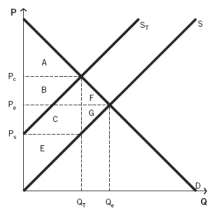
Which areas represent the amount of consumer surplus lost due to the tax?
A) A + F
B) B + C
C) A
D) A + B + F
E) B + F
The following graph depicts a market where a tax has been imposed. Pe was the equilibrium price before the tax was imposed, and Qe was the equilibrium quantity. After the tax, PC is the price that consumers pay, and PS is the price that producers receive. QT units are sold after the tax is imposed. NOTE: The areas B and C are rectangles that are divided by the supply curve ST. Include both sections of those rectangles when choosing your answers.
Which areas represent the amount of consumer surplus lost due to the tax?
A) A + F
B) B + C
C) A
D) A + B + F
E) B + F
سؤال
سؤال
سؤال
سؤال
سؤال
سؤال
Use the following information to answer the next questions.
The following graph depicts a market where a tax has been imposed. Pe was the equilibrium price before the tax was imposed, and Qe was the equilibrium quantity. After the tax, PC is the price that consumers pay, and PS is the price that producers receive. QT units are sold after the tax is imposed. NOTE: The areas B and C are rectangles that are divided by the supply curve ST. Include both sections of those rectangles when choosing your answers.
Which areas represent producer surplus before the tax is imposed?
A) F + G
B) E + C + G
C) A + B + C + E
D) B + C + F + G
E) E
The following graph depicts a market where a tax has been imposed. Pe was the equilibrium price before the tax was imposed, and Qe was the equilibrium quantity. After the tax, PC is the price that consumers pay, and PS is the price that producers receive. QT units are sold after the tax is imposed. NOTE: The areas B and C are rectangles that are divided by the supply curve ST. Include both sections of those rectangles when choosing your answers.
Which areas represent producer surplus before the tax is imposed?
A) F + G
B) E + C + G
C) A + B + C + E
D) B + C + F + G
E) E
سؤال
سؤال
سؤال
سؤال
Use the following information to answer the next questions.
The following graph depicts a market where a tax has been imposed. Pe was the equilibrium price before the tax was imposed, and Qe was the equilibrium quantity. After the tax, PC is the price that consumers pay, and PS is the price that producers receive. QT units are sold after the tax is imposed. NOTE: The areas B and C are rectangles that are divided by the supply curve ST. Include both sections of those rectangles when choosing your answers.
Which areas represent consumer surplus before the tax is imposed?
A) A + B + F
B) A
C) C + G + E
D) B + C
E) F + G
The following graph depicts a market where a tax has been imposed. Pe was the equilibrium price before the tax was imposed, and Qe was the equilibrium quantity. After the tax, PC is the price that consumers pay, and PS is the price that producers receive. QT units are sold after the tax is imposed. NOTE: The areas B and C are rectangles that are divided by the supply curve ST. Include both sections of those rectangles when choosing your answers.
Which areas represent consumer surplus before the tax is imposed?
A) A + B + F
B) A
C) C + G + E
D) B + C
E) F + G
سؤال
سؤال
سؤال
سؤال
سؤال
Use the following information to answer the next questions.
The following graph depicts a market where a tax has been imposed. Pe was the equilibrium price before the tax was imposed, and Qe was the equilibrium quantity. After the tax, PC is the price that consumers pay, and PS is the price that producers receive. QT units are sold after the tax is imposed. NOTE: The areas B and C are rectangles that are divided by the supply curve ST. Include both sections of those rectangles when choosing your answers.
Which areas represent consumer surplus after the tax is imposed?
A) A
B) A + B
C) A + B + F
D) F + G
E) B + C + F
The following graph depicts a market where a tax has been imposed. Pe was the equilibrium price before the tax was imposed, and Qe was the equilibrium quantity. After the tax, PC is the price that consumers pay, and PS is the price that producers receive. QT units are sold after the tax is imposed. NOTE: The areas B and C are rectangles that are divided by the supply curve ST. Include both sections of those rectangles when choosing your answers.
Which areas represent consumer surplus after the tax is imposed?
A) A
B) A + B
C) A + B + F
D) F + G
E) B + C + F
سؤال
سؤال
سؤال
سؤال
سؤال
سؤال
Use the following information to answer the next questions.
The following graph depicts a market where a tax has been imposed. Pe was the equilibrium price before the tax was imposed, and Qe was the equilibrium quantity. After the tax, PC is the price that consumers pay, and PS is the price that producers receive. QT units are sold after the tax is imposed. NOTE: The areas B and C are rectangles that are divided by the supply curve ST. Include both sections of those rectangles when choosing your answers.
Which areas represent producer surplus after the tax is imposed?
A) E + C + G
B) E + C
C) E + G
D) F + G
E) E
The following graph depicts a market where a tax has been imposed. Pe was the equilibrium price before the tax was imposed, and Qe was the equilibrium quantity. After the tax, PC is the price that consumers pay, and PS is the price that producers receive. QT units are sold after the tax is imposed. NOTE: The areas B and C are rectangles that are divided by the supply curve ST. Include both sections of those rectangles when choosing your answers.
Which areas represent producer surplus after the tax is imposed?
A) E + C + G
B) E + C
C) E + G
D) F + G
E) E
سؤال
سؤال
سؤال
سؤال
Use the following information to answer the next questions.
The following graph depicts a market where a tax has been imposed. Pe was the equilibrium price before the tax was imposed, and Qe was the equilibrium quantity. After the tax, PC is the price that consumers pay, and PS is the price that producers receive. QT units are sold after the tax is imposed. NOTE: The areas B and C are rectangles that are divided by the supply curve ST. Include both sections of those rectangles when choosing your answers.
Which areas represent the revenue collected from this tax?
A) A + B + F
B) B + C
C) F + G
D) E
E) A + E
The following graph depicts a market where a tax has been imposed. Pe was the equilibrium price before the tax was imposed, and Qe was the equilibrium quantity. After the tax, PC is the price that consumers pay, and PS is the price that producers receive. QT units are sold after the tax is imposed. NOTE: The areas B and C are rectangles that are divided by the supply curve ST. Include both sections of those rectangles when choosing your answers.
Which areas represent the revenue collected from this tax?
A) A + B + F
B) B + C
C) F + G
D) E
E) A + E
سؤال
Use the following information to answer the next questions.
The following graph depicts a market where a tax has been imposed. Pe was the equilibrium price before the tax was imposed, and Qe was the equilibrium quantity. After the tax, PC is the price that consumers pay, and PS is the price that producers receive. QT units are sold after the tax is imposed. NOTE: The areas B and C are rectangles that are divided by the supply curve ST. Include both sections of those rectangles when choosing your answers.
What areas represent the total tax revenue created as a result of the tax?
A) A + C
B) A + E
C) B + C
D) A + E + F + G
E) A + B + C + D + E + F + G
The following graph depicts a market where a tax has been imposed. Pe was the equilibrium price before the tax was imposed, and Qe was the equilibrium quantity. After the tax, PC is the price that consumers pay, and PS is the price that producers receive. QT units are sold after the tax is imposed. NOTE: The areas B and C are rectangles that are divided by the supply curve ST. Include both sections of those rectangles when choosing your answers.
What areas represent the total tax revenue created as a result of the tax?
A) A + C
B) A + E
C) B + C
D) A + E + F + G
E) A + B + C + D + E + F + G
سؤال
Use the following information to answer the next questions.
The following graph depicts a market where a tax has been imposed. Pe was the equilibrium price before the tax was imposed, and Qe was the equilibrium quantity. After the tax, PC is the price that consumers pay, and PS is the price that producers receive. QT units are sold after the tax is imposed. NOTE: The areas B and C are rectangles that are divided by the supply curve ST. Include both sections of those rectangles when choosing your answers.
Which party is responsible for paying this tax out of pocket?
A) consumers
B) producers
C) both consumers and producers
D) some consumers and some producers, but not all consumers and producers
E) some consumers and no producers
The following graph depicts a market where a tax has been imposed. Pe was the equilibrium price before the tax was imposed, and Qe was the equilibrium quantity. After the tax, PC is the price that consumers pay, and PS is the price that producers receive. QT units are sold after the tax is imposed. NOTE: The areas B and C are rectangles that are divided by the supply curve ST. Include both sections of those rectangles when choosing your answers.
Which party is responsible for paying this tax out of pocket?
A) consumers
B) producers
C) both consumers and producers
D) some consumers and some producers, but not all consumers and producers
E) some consumers and no producers
سؤال
Use the following information to answer the next questions.
The following graph depicts a market where a tax has been imposed. Pe was the equilibrium price before the tax was imposed, and Qe was the equilibrium quantity. After the tax, PC is the price that consumers pay, and PS is the price that producers receive. QT units are sold after the tax is imposed. NOTE: The areas B and C are rectangles that are divided by the supply curve ST. Include both sections of those rectangles when choosing your answers.
What is the total amount of producer and consumer surplus (i.e., social welfare) in this market before the tax is imposed?
A) A + B + C + E + F + G
B) A + C
C) A + B + C + E
D) F + G
E) B + C + F + G
The following graph depicts a market where a tax has been imposed. Pe was the equilibrium price before the tax was imposed, and Qe was the equilibrium quantity. After the tax, PC is the price that consumers pay, and PS is the price that producers receive. QT units are sold after the tax is imposed. NOTE: The areas B and C are rectangles that are divided by the supply curve ST. Include both sections of those rectangles when choosing your answers.
What is the total amount of producer and consumer surplus (i.e., social welfare) in this market before the tax is imposed?
A) A + B + C + E + F + G
B) A + C
C) A + B + C + E
D) F + G
E) B + C + F + G
سؤال
سؤال
سؤال
Use the following information to answer the next questions.
The following graph depicts a market where a tax has been imposed. Pe was the equilibrium price before the tax was imposed, and Qe was the equilibrium quantity. After the tax, PC is the price that consumers pay, and PS is the price that producers receive. QT units are sold after the tax is imposed. NOTE: The areas B and C are rectangles that are divided by the supply curve ST. Include both sections of those rectangles when choosing your answers.
Which areas represent the amount of producer surplus lost due to the tax?
A) G
B) A + B + C + E
C) C
D) C + G
E) B + F
The following graph depicts a market where a tax has been imposed. Pe was the equilibrium price before the tax was imposed, and Qe was the equilibrium quantity. After the tax, PC is the price that consumers pay, and PS is the price that producers receive. QT units are sold after the tax is imposed. NOTE: The areas B and C are rectangles that are divided by the supply curve ST. Include both sections of those rectangles when choosing your answers.
Which areas represent the amount of producer surplus lost due to the tax?
A) G
B) A + B + C + E
C) C
D) C + G
E) B + F
سؤال
Use the following information to answer the next questions.
The following graph depicts a market where a tax has been imposed. Pe was the equilibrium price before the tax was imposed, and Qe was the equilibrium quantity. After the tax, PC is the price that consumers pay, and PS is the price that producers receive. QT units are sold after the tax is imposed. NOTE: The areas B and C are rectangles that are divided by the supply curve ST. Include both sections of those rectangles when choosing your answers.
What is the amount of the tax, as measured along the y axis?
A) PC + PS
B) Pe - PS
C) PC - PS
D) PC - P*
E) Pe + PS
The following graph depicts a market where a tax has been imposed. Pe was the equilibrium price before the tax was imposed, and Qe was the equilibrium quantity. After the tax, PC is the price that consumers pay, and PS is the price that producers receive. QT units are sold after the tax is imposed. NOTE: The areas B and C are rectangles that are divided by the supply curve ST. Include both sections of those rectangles when choosing your answers.
What is the amount of the tax, as measured along the y axis?
A) PC + PS
B) Pe - PS
C) PC - PS
D) PC - P*
E) Pe + PS
سؤال
سؤال
سؤال
Use the following information to answer the next questions.
The following graph depicts a market where a tax has been imposed. Pe was the equilibrium price before the tax was imposed, and Qe was the equilibrium quantity. After the tax, PC is the price that consumers pay, and PS is the price that producers receive. QT units are sold after the tax is imposed. NOTE: The areas B and C are rectangles that are divided by the supply curve ST. Include both sections of those rectangles when choosing your answers.
What areas represent the total cost to society, in terms of lost social welfare, created as a result of the tax?
A) B + C + F + G
B) A + B + F
C) C + E + G
D) A + B + C + E
E) F + G
The following graph depicts a market where a tax has been imposed. Pe was the equilibrium price before the tax was imposed, and Qe was the equilibrium quantity. After the tax, PC is the price that consumers pay, and PS is the price that producers receive. QT units are sold after the tax is imposed. NOTE: The areas B and C are rectangles that are divided by the supply curve ST. Include both sections of those rectangles when choosing your answers.
What areas represent the total cost to society, in terms of lost social welfare, created as a result of the tax?
A) B + C + F + G
B) A + B + F
C) C + E + G
D) A + B + C + E
E) F + G
سؤال
Use the following information to answer the next questions.
The following graph depicts a market where a tax has been imposed. Pe was the equilibrium price before the tax was imposed, and Qe was the equilibrium quantity. After the tax, PC is the price that consumers pay, and PS is the price that producers receive. QT units are sold after the tax is imposed. NOTE: The areas B and C are rectangles that are divided by the supply curve ST. Include both sections of those rectangles when choosing your answers.
What is the total amount of producer and consumer surplus (i.e., social welfare) in this market after the tax is imposed?
A) A + B + C + E + F + G
B) A + E
C) A + B + C + E
D) F + G
E) B + C + F + G
The following graph depicts a market where a tax has been imposed. Pe was the equilibrium price before the tax was imposed, and Qe was the equilibrium quantity. After the tax, PC is the price that consumers pay, and PS is the price that producers receive. QT units are sold after the tax is imposed. NOTE: The areas B and C are rectangles that are divided by the supply curve ST. Include both sections of those rectangles when choosing your answers.
What is the total amount of producer and consumer surplus (i.e., social welfare) in this market after the tax is imposed?
A) A + B + C + E + F + G
B) A + E
C) A + B + C + E
D) F + G
E) B + C + F + G
سؤال
Use the following information to answer the next questions.
The following graph depicts a market where a tax has been imposed. Pe was the equilibrium price before the tax was imposed, and Qe was the equilibrium quantity. After the tax, PC is the price that consumers pay, and PS is the price that producers receive. QT units are sold after the tax is imposed. NOTE: The areas B and C are rectangles that are divided by the supply curve ST. Include both sections of those rectangles when choosing your answers.
What areas represent the total lost consumer and producer surplus (i.e., social welfare) as a result of the tax?
A) A + B + C + E + F + G
B) A + C
C) A + B + C + E
D) F + G
E) B + C + F + G
The following graph depicts a market where a tax has been imposed. Pe was the equilibrium price before the tax was imposed, and Qe was the equilibrium quantity. After the tax, PC is the price that consumers pay, and PS is the price that producers receive. QT units are sold after the tax is imposed. NOTE: The areas B and C are rectangles that are divided by the supply curve ST. Include both sections of those rectangles when choosing your answers.
What areas represent the total lost consumer and producer surplus (i.e., social welfare) as a result of the tax?
A) A + B + C + E + F + G
B) A + C
C) A + B + C + E
D) F + G
E) B + C + F + G
سؤال
Use the following information to answer the next questions.
The following graph depicts a market where a tax has been imposed. Pe was the equilibrium price before the tax was imposed, and Qe was the equilibrium quantity. After the tax, PC is the price that consumers pay, and PS is the price that producers receive. QT units are sold after the tax is imposed. NOTE: The areas B and C are rectangles that are divided by the supply curve ST. Include both sections of those rectangles when choosing your answers.
What areas represent the deadweight loss created as a result of the tax?
A) A + B + C + E + F + G
B) A + C
C) A + B + C + E
D) F + G
E) B + C + F + G
The following graph depicts a market where a tax has been imposed. Pe was the equilibrium price before the tax was imposed, and Qe was the equilibrium quantity. After the tax, PC is the price that consumers pay, and PS is the price that producers receive. QT units are sold after the tax is imposed. NOTE: The areas B and C are rectangles that are divided by the supply curve ST. Include both sections of those rectangles when choosing your answers.
What areas represent the deadweight loss created as a result of the tax?
A) A + B + C + E + F + G
B) A + C
C) A + B + C + E
D) F + G
E) B + C + F + G
سؤال
سؤال
سؤال
سؤال
سؤال
سؤال
سؤال
سؤال
سؤال
سؤال
سؤال
سؤال
سؤال
سؤال
سؤال
سؤال
سؤال
سؤال
سؤال
سؤال

فتح الحزمة
قم بالتسجيل لفتح البطاقات في هذه المجموعة!
Unlock Deck
Unlock Deck
1/152

العب

ملء الشاشة (f)
Deck 5: The Efficiency of Markets and the Costs of Taxation
1
All else held constant, a decrease in the price of a good would necessarily:
A) increase social welfare.
B) decrease producer surplus.
C) decrease consumer surplus.
D) increase demand for the good.
E) increase producer surplus.
A) increase social welfare.
B) decrease producer surplus.
C) decrease consumer surplus.
D) increase demand for the good.
E) increase producer surplus.
decrease producer surplus.
2
Consider the market for socks. The current price of a pair of plain white socks is $5.00. Two consumers, Jeff and Samir, are willing to pay $7.25 and $8.00, respectively, for a pair of plain white socks. Two sock manufacturers are willing to sell plain white socks for as little as $4.00 and $4.15 per pair. What is the total producer surplus in this market?
A) $0.15
B) $8.15
C) $0.85
D) $1.00
E) $1.85
A) $0.15
B) $8.15
C) $0.85
D) $1.00
E) $1.85
$1.85
3
The difference between the willingness to pay for a good and the amount that is paid to get it is also known as:
A) consumer expenditure.
B) surplus spending.
C) consumer benefit.
D) producer profit.
E) consumer surplus.
A) consumer expenditure.
B) surplus spending.
C) consumer benefit.
D) producer profit.
E) consumer surplus.
consumer surplus.
4
Holding all else constant, when the price of a good decreases:
A) producer surplus increases.
B) consumer surplus increases.
C) both consumer surplus and producer surplus increase.
D) consumer surplus decreases.
E) both consumer surplus and producer surplus decrease.
A) producer surplus increases.
B) consumer surplus increases.
C) both consumer surplus and producer surplus increase.
D) consumer surplus decreases.
E) both consumer surplus and producer surplus decrease.
فتح الحزمة
افتح القفل للوصول البطاقات البالغ عددها 152 في هذه المجموعة.
فتح الحزمة
k this deck
5
Bob is willing to pay $65 for a new pair of shoes. Bill is willing to pay $50 for the same shoes. The shoes have a price of $45. What is the total consumer surplus for Bob and Bill?
A) $15
B) $20
C) $5
D) $25
E) $35
A) $15
B) $20
C) $5
D) $25
E) $35
فتح الحزمة
افتح القفل للوصول البطاقات البالغ عددها 152 في هذه المجموعة.
فتح الحزمة
k this deck
6
Muddy's Bakery and Lilly's Sweetshop both sell cupcakes. The market price of one chocolate cupcake is $2.50. Muddy's is willing to sell a cupcake for as little as $1.65; Lilly's is willing to sell a cupcake for as little as $1.75. What is the total producer surplus for the two firms?
A) $0.75
B) $1.60
C) $0.85
D) $2.50
E) $3.40
A) $0.75
B) $1.60
C) $0.85
D) $2.50
E) $3.40
فتح الحزمة
افتح القفل للوصول البطاقات البالغ عددها 152 في هذه المجموعة.
فتح الحزمة
k this deck
7
Producer surplus is the difference between:
A) supply and demand.
B) the price the producer receives and the willingness to sell a good.
C) the willingness to pay for a good and the willingness to sell a good.
D) the willingness to pay for a good and the amount that is paid to get it.
E) the price paid for a good and the amount of the good produced.
A) supply and demand.
B) the price the producer receives and the willingness to sell a good.
C) the willingness to pay for a good and the willingness to sell a good.
D) the willingness to pay for a good and the amount that is paid to get it.
E) the price paid for a good and the amount of the good produced.
فتح الحزمة
افتح القفل للوصول البطاقات البالغ عددها 152 في هذه المجموعة.
فتح الحزمة
k this deck
8
Producer surplus is defined as the:
A) difference between the willingness to pay for a good and the willingness to sell it.
B) difference between the price the seller receives and the willingness to sell it.
C) difference between the willingness to pay for a good and the price paid to get it.
D) quantity of units that consumers want to buy at the market price.
E) total revenue earned from producing and selling some good.
A) difference between the willingness to pay for a good and the willingness to sell it.
B) difference between the price the seller receives and the willingness to sell it.
C) difference between the willingness to pay for a good and the price paid to get it.
D) quantity of units that consumers want to buy at the market price.
E) total revenue earned from producing and selling some good.
فتح الحزمة
افتح القفل للوصول البطاقات البالغ عددها 152 في هذه المجموعة.
فتح الحزمة
k this deck
9
The difference between the willingness to sell a good and the price a producer receives is also known as:
A) producer profit.
B) producer surplus.
C) consumer waste.
D) tax revenue.
E) producer benefit.
A) producer profit.
B) producer surplus.
C) consumer waste.
D) tax revenue.
E) producer benefit.
فتح الحزمة
افتح القفل للوصول البطاقات البالغ عددها 152 في هذه المجموعة.
فتح الحزمة
k this deck
10
Jamal is willing to pay $85 for a new jacket that sells for $70. Eddie is willing to pay $65 for that same jacket. What is the total consumer surplus for Jamal and Eddie?
A) $30
B) $15
C) $20
D) $25
E) $155
A) $30
B) $15
C) $20
D) $25
E) $155
فتح الحزمة
افتح القفل للوصول البطاقات البالغ عددها 152 في هذه المجموعة.
فتح الحزمة
k this deck
11
Holding all else constant, when the price of a good increases:
A) consumer surplus increases.
B) producer surplus decreases.
C) both producer surplus and consumer surplus increase.
D) both consumer surplus and producer surplus decrease.
E) consumer surplus decreases.
A) consumer surplus increases.
B) producer surplus decreases.
C) both producer surplus and consumer surplus increase.
D) both consumer surplus and producer surplus decrease.
E) consumer surplus decreases.
فتح الحزمة
افتح القفل للوصول البطاقات البالغ عددها 152 في هذه المجموعة.
فتح الحزمة
k this deck
12
Consumer surplus is the difference between:
A) supply and demand.
B) the price the producer receives and the willingness to sell a good.
C) the willingness to pay for a good and the willingness to sell a good.
D) the willingness to pay for a good and the amount that is paid to get it.
E) the price paid for a good and the amount of the good produced.
A) supply and demand.
B) the price the producer receives and the willingness to sell a good.
C) the willingness to pay for a good and the willingness to sell a good.
D) the willingness to pay for a good and the amount that is paid to get it.
E) the price paid for a good and the amount of the good produced.
فتح الحزمة
افتح القفل للوصول البطاقات البالغ عددها 152 في هذه المجموعة.
فتح الحزمة
k this deck
13
Consumer surplus is defined as the:
A) difference between the willingness to pay for a good and the willingness to sell it.
B) total revenue earned from producing and selling some good.
C) difference between the willingness to pay for a good and the price paid to get it.
D) quantity of units that consumers want to buy at the market price.
E) difference between the price the seller receives and the willingness to sell it.
A) difference between the willingness to pay for a good and the willingness to sell it.
B) total revenue earned from producing and selling some good.
C) difference between the willingness to pay for a good and the price paid to get it.
D) quantity of units that consumers want to buy at the market price.
E) difference between the price the seller receives and the willingness to sell it.
فتح الحزمة
افتح القفل للوصول البطاقات البالغ عددها 152 في هذه المجموعة.
فتح الحزمة
k this deck
14
All else being held constant, an increase in the price of a good would necessarily:
A) increase social welfare.
B) decrease producer surplus.
C) decrease consumer surplus.
D) increase consumer surplus.
E) increase the supply of the good.
A) increase social welfare.
B) decrease producer surplus.
C) decrease consumer surplus.
D) increase consumer surplus.
E) increase the supply of the good.
فتح الحزمة
افتح القفل للوصول البطاقات البالغ عددها 152 في هذه المجموعة.
فتح الحزمة
k this deck
15
When the price of a good decreases and all else is held constant:
A) producer surplus increases.
B) both consumer surplus and producer surplus decrease.
C) both consumer surplus and producer surplus increase.
D) producer surplus decreases.
E) consumer surplus decreases.
A) producer surplus increases.
B) both consumer surplus and producer surplus decrease.
C) both consumer surplus and producer surplus increase.
D) producer surplus decreases.
E) consumer surplus decreases.
فتح الحزمة
افتح القفل للوصول البطاقات البالغ عددها 152 في هذه المجموعة.
فتح الحزمة
k this deck
16
MJM Products, Inc., designs and sells flannel jackets. The company is willing to sell a men's flannel jacket for as little as $45. Its main competitor is RL Outriggers, which is willing to sell the same men's flannel jacket for as little as $40. The current market price of that type of jacket is $57. What is the total producer surplus for the two firms?
A) $95
B) $12
C) $17
D) $29
E) $5
A) $95
B) $12
C) $17
D) $29
E) $5
فتح الحزمة
افتح القفل للوصول البطاقات البالغ عددها 152 في هذه المجموعة.
فتح الحزمة
k this deck
17
When looking at a graph, the area under the demand curve and above market price is defined as:
A) tax revenue.
B) spending surplus.
C) consumer benefit.
D) producer surplus.
E) consumer surplus.
A) tax revenue.
B) spending surplus.
C) consumer benefit.
D) producer surplus.
E) consumer surplus.
فتح الحزمة
افتح القفل للوصول البطاقات البالغ عددها 152 في هذه المجموعة.
فتح الحزمة
k this deck
18
When looking at a supply and demand graph, you would find consumer surplus:
A) above the demand curve and below the supply curve.
B) below the demand curve and above market price.
C) to the right of equilibrium quantity and above market price.
D) above the demand curve and above the supply curve.
E) below market price and above the supply curve.
A) above the demand curve and below the supply curve.
B) below the demand curve and above market price.
C) to the right of equilibrium quantity and above market price.
D) above the demand curve and above the supply curve.
E) below market price and above the supply curve.
فتح الحزمة
افتح القفل للوصول البطاقات البالغ عددها 152 في هذه المجموعة.
فتح الحزمة
k this deck
19
Consider the market for socks. The current price of a pair of plain white socks is $5.00. Two consumers, Jeff and Samir, are willing to pay $7.25 and $8.00, respectively, for a pair of plain white socks. Two sock manufacturers are willing to sell plain white socks for as little as $4.00 and $4.15 per pair. How much is total consumer surplus in this market?
A) $2.25
B) $3.00
C) $0.75
D) $5.25
E) $15.25
A) $2.25
B) $3.00
C) $0.75
D) $5.25
E) $15.25
فتح الحزمة
افتح القفل للوصول البطاقات البالغ عددها 152 في هذه المجموعة.
فتح الحزمة
k this deck
20
When the price of a good increases and all else is held constant:
A) both consumer surplus and producer surplus decrease.
B) both consumer surplus and producer surplus increase.
C) consumer surplus decreases.
D) producer surplus decreases.
E) producer surplus increases.
A) both consumer surplus and producer surplus decrease.
B) both consumer surplus and producer surplus increase.
C) consumer surplus decreases.
D) producer surplus decreases.
E) producer surplus increases.
فتح الحزمة
افتح القفل للوصول البطاقات البالغ عددها 152 في هذه المجموعة.
فتح الحزمة
k this deck
21
Social welfare (i.e., the sum of producer and consumer surplus) is maximized when:
A) the government taxes most goods and services.
B) very few consumers and producers exist within a market.
C) the market reaches its equilibrium price and quantity.
D) supply and demand are perfectly inelastic.
E) the government imposes price controls.
A) the government taxes most goods and services.
B) very few consumers and producers exist within a market.
C) the market reaches its equilibrium price and quantity.
D) supply and demand are perfectly inelastic.
E) the government imposes price controls.
فتح الحزمة
افتح القفل للوصول البطاقات البالغ عددها 152 في هذه المجموعة.
فتح الحزمة
k this deck
22
Use the following information to answer the next questions.
The following graph depicts a market where a tax has been imposed. Pe was the equilibrium price before the tax was imposed, and Qe was the equilibrium quantity. After the tax, PC is the price that consumers pay, and PS is the price that producers receive. QT units are sold after the tax is imposed. NOTE: The areas B and C are rectangles that are divided by the supply curve ST. Include both sections of those rectangles when choosing your answers.
Which areas represent the amount of consumer surplus lost due to the tax?
A) A + F
B) B + C
C) A
D) A + B + F
E) B + F
The following graph depicts a market where a tax has been imposed. Pe was the equilibrium price before the tax was imposed, and Qe was the equilibrium quantity. After the tax, PC is the price that consumers pay, and PS is the price that producers receive. QT units are sold after the tax is imposed. NOTE: The areas B and C are rectangles that are divided by the supply curve ST. Include both sections of those rectangles when choosing your answers.
Which areas represent the amount of consumer surplus lost due to the tax?
A) A + F
B) B + C
C) A
D) A + B + F
E) B + F
فتح الحزمة
افتح القفل للوصول البطاقات البالغ عددها 152 في هذه المجموعة.
فتح الحزمة
k this deck
23
Questions about the equity of a tax are concerned mostly with:
A) efficiency.
B) tax revenue.
C) fairness.
D) deadweight loss.
E) elasticity.
A) efficiency.
B) tax revenue.
C) fairness.
D) deadweight loss.
E) elasticity.
فتح الحزمة
افتح القفل للوصول البطاقات البالغ عددها 152 في هذه المجموعة.
فتح الحزمة
k this deck
24
Which of the following statements is concerned with equity rather than efficiency?
A) Almost all taxes create some amount of deadweight loss.
B) Excise taxes tend to raise prices for consumers and reduce sales for firms.
C) Tax rates on the wealthy are too low and should be raised.
D) The incidence of a tax does not depend on who actually pays it.
E) Taxes generate revenues that governments spend on services.
A) Almost all taxes create some amount of deadweight loss.
B) Excise taxes tend to raise prices for consumers and reduce sales for firms.
C) Tax rates on the wealthy are too low and should be raised.
D) The incidence of a tax does not depend on who actually pays it.
E) Taxes generate revenues that governments spend on services.
فتح الحزمة
افتح القفل للوصول البطاقات البالغ عددها 152 في هذه المجموعة.
فتح الحزمة
k this deck
25
A market has reached an efficient outcome when:
A) producers are able to produce and sell as much as they like.
B) total surplus is minimized.
C) producer surplus is greater than consumer surplus.
D) consumers are able to purchase as much as they like.
E) total surplus is maximized.
A) producers are able to produce and sell as much as they like.
B) total surplus is minimized.
C) producer surplus is greater than consumer surplus.
D) consumers are able to purchase as much as they like.
E) total surplus is maximized.
فتح الحزمة
افتح القفل للوصول البطاقات البالغ عددها 152 في هذه المجموعة.
فتح الحزمة
k this deck
26
Which of the following statements is concerned with equity rather than efficiency?
A) Imposing a tax on a good reduces the incentive to buy that good.
B) The burden of a sales tax is typically shared by consumers and stores.
C) Deadweight loss is the lost social welfare from a tax.
D) Tax rates on middle-class households are too high and should be reduced.
E) Taxes cause producers and consumers to lose surplus.
A) Imposing a tax on a good reduces the incentive to buy that good.
B) The burden of a sales tax is typically shared by consumers and stores.
C) Deadweight loss is the lost social welfare from a tax.
D) Tax rates on middle-class households are too high and should be reduced.
E) Taxes cause producers and consumers to lose surplus.
فتح الحزمة
افتح القفل للوصول البطاقات البالغ عددها 152 في هذه المجموعة.
فتح الحزمة
k this deck
27
Consider the market for socks. The current price of a pair of plain white socks is $5.00. Two consumers, Jeff and Samir, are willing to pay $7.25 and $8.00, respectively, for a pair of plain white socks. Two sock manufacturers are willing to sell plain white socks for as little as $4.00 and $4.15 per pair. What is the total producer AND consumer surplus (i.e., social welfare) in this market?
A) $7.10
B) $5.25
C) $1.85
D) $23.40
E) $4.50
A) $7.10
B) $5.25
C) $1.85
D) $23.40
E) $4.50
فتح الحزمة
افتح القفل للوصول البطاقات البالغ عددها 152 في هذه المجموعة.
فتح الحزمة
k this deck
28
Use the following information to answer the next questions.
The following graph depicts a market where a tax has been imposed. Pe was the equilibrium price before the tax was imposed, and Qe was the equilibrium quantity. After the tax, PC is the price that consumers pay, and PS is the price that producers receive. QT units are sold after the tax is imposed. NOTE: The areas B and C are rectangles that are divided by the supply curve ST. Include both sections of those rectangles when choosing your answers.
Which areas represent producer surplus before the tax is imposed?
A) F + G
B) E + C + G
C) A + B + C + E
D) B + C + F + G
E) E
The following graph depicts a market where a tax has been imposed. Pe was the equilibrium price before the tax was imposed, and Qe was the equilibrium quantity. After the tax, PC is the price that consumers pay, and PS is the price that producers receive. QT units are sold after the tax is imposed. NOTE: The areas B and C are rectangles that are divided by the supply curve ST. Include both sections of those rectangles when choosing your answers.
Which areas represent producer surplus before the tax is imposed?
A) F + G
B) E + C + G
C) A + B + C + E
D) B + C + F + G
E) E
فتح الحزمة
افتح القفل للوصول البطاقات البالغ عددها 152 في هذه المجموعة.
فتح الحزمة
k this deck
29
When looking at a supply and demand graph, you would find producer surplus:
A) above the demand curve and below the supply curve.
B) below the demand curve and above market price.
C) to the right of equilibrium quantity and above market price.
D) above the demand curve and above the supply curve.
E) below market price and above the supply curve.
A) above the demand curve and below the supply curve.
B) below the demand curve and above market price.
C) to the right of equilibrium quantity and above market price.
D) above the demand curve and above the supply curve.
E) below market price and above the supply curve.
فتح الحزمة
افتح القفل للوصول البطاقات البالغ عددها 152 في هذه المجموعة.
فتح الحزمة
k this deck
30
Consumer surplus plus producer surplus equals:
A) deadweight loss.
B) economic profit.
C) social welfare.
D) tax revenue.
E) market distortions.
A) deadweight loss.
B) economic profit.
C) social welfare.
D) tax revenue.
E) market distortions.
فتح الحزمة
افتح القفل للوصول البطاقات البالغ عددها 152 في هذه المجموعة.
فتح الحزمة
k this deck
31
When looking at a graph, the area above the supply curve and below market price is defined as:
A) consumer surplus.
B) producer surplus.
C) producer benefit.
D) business profit.
E) tax revenue.
A) consumer surplus.
B) producer surplus.
C) producer benefit.
D) business profit.
E) tax revenue.
فتح الحزمة
افتح القفل للوصول البطاقات البالغ عددها 152 في هذه المجموعة.
فتح الحزمة
k this deck
32
Use the following information to answer the next questions.
The following graph depicts a market where a tax has been imposed. Pe was the equilibrium price before the tax was imposed, and Qe was the equilibrium quantity. After the tax, PC is the price that consumers pay, and PS is the price that producers receive. QT units are sold after the tax is imposed. NOTE: The areas B and C are rectangles that are divided by the supply curve ST. Include both sections of those rectangles when choosing your answers.
Which areas represent consumer surplus before the tax is imposed?
A) A + B + F
B) A
C) C + G + E
D) B + C
E) F + G
The following graph depicts a market where a tax has been imposed. Pe was the equilibrium price before the tax was imposed, and Qe was the equilibrium quantity. After the tax, PC is the price that consumers pay, and PS is the price that producers receive. QT units are sold after the tax is imposed. NOTE: The areas B and C are rectangles that are divided by the supply curve ST. Include both sections of those rectangles when choosing your answers.
Which areas represent consumer surplus before the tax is imposed?
A) A + B + F
B) A
C) C + G + E
D) B + C
E) F + G
فتح الحزمة
افتح القفل للوصول البطاقات البالغ عددها 152 في هذه المجموعة.
فتح الحزمة
k this deck
33
The price-quantity combination found where the supply and demand curves intersect is a unique combination that is efficient because:
A) producers can sell as much as they want.
B) total surplus is maximized.
C) tax revenue is sufficient to pay for government services.
D) consumers can buy as much as they want.
E) new products are being introduced.
A) producers can sell as much as they want.
B) total surplus is maximized.
C) tax revenue is sufficient to pay for government services.
D) consumers can buy as much as they want.
E) new products are being introduced.
فتح الحزمة
افتح القفل للوصول البطاقات البالغ عددها 152 في هذه المجموعة.
فتح الحزمة
k this deck
34
Which of the following statements is concerned with efficiency rather than equity?
A) Sales taxes on food are regressive and should be eliminated.
B) Income taxes should be raised on low-income families so that everyone pays.
C) The United States should implement a wealth tax on upper-income households.
D) Excise taxes tend to raise prices for consumers.
E) The overall tax system in the United States should be much more progressive.
A) Sales taxes on food are regressive and should be eliminated.
B) Income taxes should be raised on low-income families so that everyone pays.
C) The United States should implement a wealth tax on upper-income households.
D) Excise taxes tend to raise prices for consumers.
E) The overall tax system in the United States should be much more progressive.
فتح الحزمة
افتح القفل للوصول البطاقات البالغ عددها 152 في هذه المجموعة.
فتح الحزمة
k this deck
35
Which of the following statements is concerned with efficiency rather than equity?
A) It is not fair to tax the income earned by the wealthy at higher rates than the poor.
B) Excise taxes on tobacco products affect low-income families the most and should be reduced.
C) Our income tax system should be more progressive than it is now.
D) Taxes cause distortions in markets and reduce social welfare.
E) The best type of income tax is a flat tax because it treats everyone the same.
A) It is not fair to tax the income earned by the wealthy at higher rates than the poor.
B) Excise taxes on tobacco products affect low-income families the most and should be reduced.
C) Our income tax system should be more progressive than it is now.
D) Taxes cause distortions in markets and reduce social welfare.
E) The best type of income tax is a flat tax because it treats everyone the same.
فتح الحزمة
افتح القفل للوصول البطاقات البالغ عددها 152 في هذه المجموعة.
فتح الحزمة
k this deck
36
Explain what happens to the amount of consumer surplus and producer surplus when the supply of scarves suddenly declines (shifts left).
A) Producer surplus declines and consumer surplus is unchanged.
B) Consumer surplus declines and producer surplus is unchanged.
C) Consumer surplus declines and producer surplus declines.
D) Consumer surplus is unchanged and producer surplus is unchanged.
E) Producer surplus increases and consumer surplus increases.
A) Producer surplus declines and consumer surplus is unchanged.
B) Consumer surplus declines and producer surplus is unchanged.
C) Consumer surplus declines and producer surplus declines.
D) Consumer surplus is unchanged and producer surplus is unchanged.
E) Producer surplus increases and consumer surplus increases.
فتح الحزمة
افتح القفل للوصول البطاقات البالغ عددها 152 في هذه المجموعة.
فتح الحزمة
k this deck
37
Use the following information to answer the next questions.
The following graph depicts a market where a tax has been imposed. Pe was the equilibrium price before the tax was imposed, and Qe was the equilibrium quantity. After the tax, PC is the price that consumers pay, and PS is the price that producers receive. QT units are sold after the tax is imposed. NOTE: The areas B and C are rectangles that are divided by the supply curve ST. Include both sections of those rectangles when choosing your answers.
Which areas represent consumer surplus after the tax is imposed?
A) A
B) A + B
C) A + B + F
D) F + G
E) B + C + F
The following graph depicts a market where a tax has been imposed. Pe was the equilibrium price before the tax was imposed, and Qe was the equilibrium quantity. After the tax, PC is the price that consumers pay, and PS is the price that producers receive. QT units are sold after the tax is imposed. NOTE: The areas B and C are rectangles that are divided by the supply curve ST. Include both sections of those rectangles when choosing your answers.
Which areas represent consumer surplus after the tax is imposed?
A) A
B) A + B
C) A + B + F
D) F + G
E) B + C + F
فتح الحزمة
افتح القفل للوصول البطاقات البالغ عددها 152 في هذه المجموعة.
فتح الحزمة
k this deck
38
Producer surplus is depicted by the area:
A) above market price and below the supply curve.
B) between the supply curve and the demand curve.
C) below market price and above the supply curve.
D) above market price and below the demand curve.
E) above the demand curve and below the supply curve.
A) above market price and below the supply curve.
B) between the supply curve and the demand curve.
C) below market price and above the supply curve.
D) above market price and below the demand curve.
E) above the demand curve and below the supply curve.
فتح الحزمة
افتح القفل للوصول البطاقات البالغ عددها 152 في هذه المجموعة.
فتح الحزمة
k this deck
39
A tax on apples would cause consumers to suffer because:
A) consumer surplus would increase.
B) the price of apples would increase and fewer apples would be purchased.
C) revenues for apple growers would decrease.
D) the government would collect revenue from the tax.
E) producer surplus would decrease.
A) consumer surplus would increase.
B) the price of apples would increase and fewer apples would be purchased.
C) revenues for apple growers would decrease.
D) the government would collect revenue from the tax.
E) producer surplus would decrease.
فتح الحزمة
افتح القفل للوصول البطاقات البالغ عددها 152 في هذه المجموعة.
فتح الحزمة
k this deck
40
Social welfare is measured as the sum of:
A) tax revenue and deadweight loss.
B) deadweight loss and consumer surplus.
C) producer surplus and tax revenue.
D) consumer surplus and tax revenue.
E) consumer surplus and producer surplus.
A) tax revenue and deadweight loss.
B) deadweight loss and consumer surplus.
C) producer surplus and tax revenue.
D) consumer surplus and tax revenue.
E) consumer surplus and producer surplus.
فتح الحزمة
افتح القفل للوصول البطاقات البالغ عددها 152 في هذه المجموعة.
فتح الحزمة
k this deck
41
A tax on apples would cause the price paid by consumers to ________ and the price received by producers to ________.
A) increase; increase
B) increase; decrease
C) decrease; increase, then decrease
D) decrease; decrease
E) increase, then decrease; increase
A) increase; increase
B) increase; decrease
C) decrease; increase, then decrease
D) decrease; decrease
E) increase, then decrease; increase
فتح الحزمة
افتح القفل للوصول البطاقات البالغ عددها 152 في هذه المجموعة.
فتح الحزمة
k this deck
42
A tax on apples would cause apple growers to suffer because:
A) consumer surplus would decrease.
B) the government would collect revenue from the tax.
C) consumers would pay higher prices.
D) producer surplus would increase.
E) revenues and profits from growing apples would decrease.
A) consumer surplus would decrease.
B) the government would collect revenue from the tax.
C) consumers would pay higher prices.
D) producer surplus would increase.
E) revenues and profits from growing apples would decrease.
فتح الحزمة
افتح القفل للوصول البطاقات البالغ عددها 152 في هذه المجموعة.
فتح الحزمة
k this deck
43
Use the following information to answer the next questions.
The following graph depicts a market where a tax has been imposed. Pe was the equilibrium price before the tax was imposed, and Qe was the equilibrium quantity. After the tax, PC is the price that consumers pay, and PS is the price that producers receive. QT units are sold after the tax is imposed. NOTE: The areas B and C are rectangles that are divided by the supply curve ST. Include both sections of those rectangles when choosing your answers.
Which areas represent producer surplus after the tax is imposed?
A) E + C + G
B) E + C
C) E + G
D) F + G
E) E
The following graph depicts a market where a tax has been imposed. Pe was the equilibrium price before the tax was imposed, and Qe was the equilibrium quantity. After the tax, PC is the price that consumers pay, and PS is the price that producers receive. QT units are sold after the tax is imposed. NOTE: The areas B and C are rectangles that are divided by the supply curve ST. Include both sections of those rectangles when choosing your answers.
Which areas represent producer surplus after the tax is imposed?
A) E + C + G
B) E + C
C) E + G
D) F + G
E) E
فتح الحزمة
افتح القفل للوصول البطاقات البالغ عددها 152 في هذه المجموعة.
فتح الحزمة
k this deck
44
After a tax is imposed, the price paid by consumers ________ and the price received by producers ________.
A) increases; increases
B) increases; decreases
C) decreases; increases
D) decreases; decreases
E) is unaffected; is unaffected
A) increases; increases
B) increases; decreases
C) decreases; increases
D) decreases; decreases
E) is unaffected; is unaffected
فتح الحزمة
افتح القفل للوصول البطاقات البالغ عددها 152 في هذه المجموعة.
فتح الحزمة
k this deck
45
When a tax is imposed on some good, what tends to happen to consumer prices and producer prices?
A) Consumer prices decrease and producer prices increase.
B) Consumer prices increase and producer prices decrease.
C) Consumer prices increase and producer prices increase.
D) Consumer prices decrease and producer prices increase
E) Consumer prices and producer prices converge at the same point.
A) Consumer prices decrease and producer prices increase.
B) Consumer prices increase and producer prices decrease.
C) Consumer prices increase and producer prices increase.
D) Consumer prices decrease and producer prices increase
E) Consumer prices and producer prices converge at the same point.
فتح الحزمة
افتح القفل للوصول البطاقات البالغ عددها 152 في هذه المجموعة.
فتح الحزمة
k this deck
46
In most cases, taxes reduce economic efficiency because:
A) they lower prices for consumers and cause firms to suffer.
B) they increase firms' profits at the expense of consumers.
C) taxes are perceived as unfair by some taxpayers.
D) the government often spends tax revenues on programs that some voters don't like.
E) they reduce consumer surplus and producer surplus.
A) they lower prices for consumers and cause firms to suffer.
B) they increase firms' profits at the expense of consumers.
C) taxes are perceived as unfair by some taxpayers.
D) the government often spends tax revenues on programs that some voters don't like.
E) they reduce consumer surplus and producer surplus.
فتح الحزمة
افتح القفل للوصول البطاقات البالغ عددها 152 في هذه المجموعة.
فتح الحزمة
k this deck
47
Use the following information to answer the next questions.
The following graph depicts a market where a tax has been imposed. Pe was the equilibrium price before the tax was imposed, and Qe was the equilibrium quantity. After the tax, PC is the price that consumers pay, and PS is the price that producers receive. QT units are sold after the tax is imposed. NOTE: The areas B and C are rectangles that are divided by the supply curve ST. Include both sections of those rectangles when choosing your answers.
Which areas represent the revenue collected from this tax?
A) A + B + F
B) B + C
C) F + G
D) E
E) A + E
The following graph depicts a market where a tax has been imposed. Pe was the equilibrium price before the tax was imposed, and Qe was the equilibrium quantity. After the tax, PC is the price that consumers pay, and PS is the price that producers receive. QT units are sold after the tax is imposed. NOTE: The areas B and C are rectangles that are divided by the supply curve ST. Include both sections of those rectangles when choosing your answers.
Which areas represent the revenue collected from this tax?
A) A + B + F
B) B + C
C) F + G
D) E
E) A + E
فتح الحزمة
افتح القفل للوصول البطاقات البالغ عددها 152 في هذه المجموعة.
فتح الحزمة
k this deck
48
Use the following information to answer the next questions.
The following graph depicts a market where a tax has been imposed. Pe was the equilibrium price before the tax was imposed, and Qe was the equilibrium quantity. After the tax, PC is the price that consumers pay, and PS is the price that producers receive. QT units are sold after the tax is imposed. NOTE: The areas B and C are rectangles that are divided by the supply curve ST. Include both sections of those rectangles when choosing your answers.
What areas represent the total tax revenue created as a result of the tax?
A) A + C
B) A + E
C) B + C
D) A + E + F + G
E) A + B + C + D + E + F + G
The following graph depicts a market where a tax has been imposed. Pe was the equilibrium price before the tax was imposed, and Qe was the equilibrium quantity. After the tax, PC is the price that consumers pay, and PS is the price that producers receive. QT units are sold after the tax is imposed. NOTE: The areas B and C are rectangles that are divided by the supply curve ST. Include both sections of those rectangles when choosing your answers.
What areas represent the total tax revenue created as a result of the tax?
A) A + C
B) A + E
C) B + C
D) A + E + F + G
E) A + B + C + D + E + F + G
فتح الحزمة
افتح القفل للوصول البطاقات البالغ عددها 152 في هذه المجموعة.
فتح الحزمة
k this deck
49
Use the following information to answer the next questions.
The following graph depicts a market where a tax has been imposed. Pe was the equilibrium price before the tax was imposed, and Qe was the equilibrium quantity. After the tax, PC is the price that consumers pay, and PS is the price that producers receive. QT units are sold after the tax is imposed. NOTE: The areas B and C are rectangles that are divided by the supply curve ST. Include both sections of those rectangles when choosing your answers.
Which party is responsible for paying this tax out of pocket?
A) consumers
B) producers
C) both consumers and producers
D) some consumers and some producers, but not all consumers and producers
E) some consumers and no producers
The following graph depicts a market where a tax has been imposed. Pe was the equilibrium price before the tax was imposed, and Qe was the equilibrium quantity. After the tax, PC is the price that consumers pay, and PS is the price that producers receive. QT units are sold after the tax is imposed. NOTE: The areas B and C are rectangles that are divided by the supply curve ST. Include both sections of those rectangles when choosing your answers.
Which party is responsible for paying this tax out of pocket?
A) consumers
B) producers
C) both consumers and producers
D) some consumers and some producers, but not all consumers and producers
E) some consumers and no producers
فتح الحزمة
افتح القفل للوصول البطاقات البالغ عددها 152 في هذه المجموعة.
فتح الحزمة
k this deck
50
Use the following information to answer the next questions.
The following graph depicts a market where a tax has been imposed. Pe was the equilibrium price before the tax was imposed, and Qe was the equilibrium quantity. After the tax, PC is the price that consumers pay, and PS is the price that producers receive. QT units are sold after the tax is imposed. NOTE: The areas B and C are rectangles that are divided by the supply curve ST. Include both sections of those rectangles when choosing your answers.
What is the total amount of producer and consumer surplus (i.e., social welfare) in this market before the tax is imposed?
A) A + B + C + E + F + G
B) A + C
C) A + B + C + E
D) F + G
E) B + C + F + G
The following graph depicts a market where a tax has been imposed. Pe was the equilibrium price before the tax was imposed, and Qe was the equilibrium quantity. After the tax, PC is the price that consumers pay, and PS is the price that producers receive. QT units are sold after the tax is imposed. NOTE: The areas B and C are rectangles that are divided by the supply curve ST. Include both sections of those rectangles when choosing your answers.
What is the total amount of producer and consumer surplus (i.e., social welfare) in this market before the tax is imposed?
A) A + B + C + E + F + G
B) A + C
C) A + B + C + E
D) F + G
E) B + C + F + G
فتح الحزمة
افتح القفل للوصول البطاقات البالغ عددها 152 في هذه المجموعة.
فتح الحزمة
k this deck
51
The difference between the price consumers pay and the price sellers receive after a tax is imposed is equal to the:
A) loss of social welfare from the tax.
B) dollar amount of the tax.
C) deadweight loss from the tax.
D) revenue from the tax.
E) lost profit from the tax.
A) loss of social welfare from the tax.
B) dollar amount of the tax.
C) deadweight loss from the tax.
D) revenue from the tax.
E) lost profit from the tax.
فتح الحزمة
افتح القفل للوصول البطاقات البالغ عددها 152 في هذه المجموعة.
فتح الحزمة
k this deck
52
Excise taxes are taxes that are:
A) applied to all goods and activities.
B) usually applied to inferior goods.
C) usually applied to income and capital gains.
D) never applied to goods or activities.
E) applied to a particular good or activity.
A) applied to all goods and activities.
B) usually applied to inferior goods.
C) usually applied to income and capital gains.
D) never applied to goods or activities.
E) applied to a particular good or activity.
فتح الحزمة
افتح القفل للوصول البطاقات البالغ عددها 152 في هذه المجموعة.
فتح الحزمة
k this deck
53
Use the following information to answer the next questions.
The following graph depicts a market where a tax has been imposed. Pe was the equilibrium price before the tax was imposed, and Qe was the equilibrium quantity. After the tax, PC is the price that consumers pay, and PS is the price that producers receive. QT units are sold after the tax is imposed. NOTE: The areas B and C are rectangles that are divided by the supply curve ST. Include both sections of those rectangles when choosing your answers.
Which areas represent the amount of producer surplus lost due to the tax?
A) G
B) A + B + C + E
C) C
D) C + G
E) B + F
The following graph depicts a market where a tax has been imposed. Pe was the equilibrium price before the tax was imposed, and Qe was the equilibrium quantity. After the tax, PC is the price that consumers pay, and PS is the price that producers receive. QT units are sold after the tax is imposed. NOTE: The areas B and C are rectangles that are divided by the supply curve ST. Include both sections of those rectangles when choosing your answers.
Which areas represent the amount of producer surplus lost due to the tax?
A) G
B) A + B + C + E
C) C
D) C + G
E) B + F
فتح الحزمة
افتح القفل للوصول البطاقات البالغ عددها 152 في هذه المجموعة.
فتح الحزمة
k this deck
54
Use the following information to answer the next questions.
The following graph depicts a market where a tax has been imposed. Pe was the equilibrium price before the tax was imposed, and Qe was the equilibrium quantity. After the tax, PC is the price that consumers pay, and PS is the price that producers receive. QT units are sold after the tax is imposed. NOTE: The areas B and C are rectangles that are divided by the supply curve ST. Include both sections of those rectangles when choosing your answers.
What is the amount of the tax, as measured along the y axis?
A) PC + PS
B) Pe - PS
C) PC - PS
D) PC - P*
E) Pe + PS
The following graph depicts a market where a tax has been imposed. Pe was the equilibrium price before the tax was imposed, and Qe was the equilibrium quantity. After the tax, PC is the price that consumers pay, and PS is the price that producers receive. QT units are sold after the tax is imposed. NOTE: The areas B and C are rectangles that are divided by the supply curve ST. Include both sections of those rectangles when choosing your answers.
What is the amount of the tax, as measured along the y axis?
A) PC + PS
B) Pe - PS
C) PC - PS
D) PC - P*
E) Pe + PS
فتح الحزمة
افتح القفل للوصول البطاقات البالغ عددها 152 في هذه المجموعة.
فتح الحزمة
k this deck
55
A tax on consumers would cause the ________ curve(s) to shift to the ________.
A) demand; right
B) supply; left
C) supply and demand; left
D) supply and demand; right
E) demand; left
A) demand; right
B) supply; left
C) supply and demand; left
D) supply and demand; right
E) demand; left
فتح الحزمة
افتح القفل للوصول البطاقات البالغ عددها 152 في هذه المجموعة.
فتح الحزمة
k this deck
56
It is said that taxes drive a wedge between prices. This statement is true because taxes cause:
A) both consumer and producer prices to increase.
B) the consumer price to increase but leave producer prices unchanged.
C) both consumer and producer prices to decrease.
D) the consumer price to decrease and the producer price to increase.
E) the consumer price to increase and the producer price to decrease.
A) both consumer and producer prices to increase.
B) the consumer price to increase but leave producer prices unchanged.
C) both consumer and producer prices to decrease.
D) the consumer price to decrease and the producer price to increase.
E) the consumer price to increase and the producer price to decrease.
فتح الحزمة
افتح القفل للوصول البطاقات البالغ عددها 152 في هذه المجموعة.
فتح الحزمة
k this deck
57
Use the following information to answer the next questions.
The following graph depicts a market where a tax has been imposed. Pe was the equilibrium price before the tax was imposed, and Qe was the equilibrium quantity. After the tax, PC is the price that consumers pay, and PS is the price that producers receive. QT units are sold after the tax is imposed. NOTE: The areas B and C are rectangles that are divided by the supply curve ST. Include both sections of those rectangles when choosing your answers.
What areas represent the total cost to society, in terms of lost social welfare, created as a result of the tax?
A) B + C + F + G
B) A + B + F
C) C + E + G
D) A + B + C + E
E) F + G
The following graph depicts a market where a tax has been imposed. Pe was the equilibrium price before the tax was imposed, and Qe was the equilibrium quantity. After the tax, PC is the price that consumers pay, and PS is the price that producers receive. QT units are sold after the tax is imposed. NOTE: The areas B and C are rectangles that are divided by the supply curve ST. Include both sections of those rectangles when choosing your answers.
What areas represent the total cost to society, in terms of lost social welfare, created as a result of the tax?
A) B + C + F + G
B) A + B + F
C) C + E + G
D) A + B + C + E
E) F + G
فتح الحزمة
افتح القفل للوصول البطاقات البالغ عددها 152 في هذه المجموعة.
فتح الحزمة
k this deck
58
Use the following information to answer the next questions.
The following graph depicts a market where a tax has been imposed. Pe was the equilibrium price before the tax was imposed, and Qe was the equilibrium quantity. After the tax, PC is the price that consumers pay, and PS is the price that producers receive. QT units are sold after the tax is imposed. NOTE: The areas B and C are rectangles that are divided by the supply curve ST. Include both sections of those rectangles when choosing your answers.
What is the total amount of producer and consumer surplus (i.e., social welfare) in this market after the tax is imposed?
A) A + B + C + E + F + G
B) A + E
C) A + B + C + E
D) F + G
E) B + C + F + G
The following graph depicts a market where a tax has been imposed. Pe was the equilibrium price before the tax was imposed, and Qe was the equilibrium quantity. After the tax, PC is the price that consumers pay, and PS is the price that producers receive. QT units are sold after the tax is imposed. NOTE: The areas B and C are rectangles that are divided by the supply curve ST. Include both sections of those rectangles when choosing your answers.
What is the total amount of producer and consumer surplus (i.e., social welfare) in this market after the tax is imposed?
A) A + B + C + E + F + G
B) A + E
C) A + B + C + E
D) F + G
E) B + C + F + G
فتح الحزمة
افتح القفل للوصول البطاقات البالغ عددها 152 في هذه المجموعة.
فتح الحزمة
k this deck
59
Use the following information to answer the next questions.
The following graph depicts a market where a tax has been imposed. Pe was the equilibrium price before the tax was imposed, and Qe was the equilibrium quantity. After the tax, PC is the price that consumers pay, and PS is the price that producers receive. QT units are sold after the tax is imposed. NOTE: The areas B and C are rectangles that are divided by the supply curve ST. Include both sections of those rectangles when choosing your answers.
What areas represent the total lost consumer and producer surplus (i.e., social welfare) as a result of the tax?
A) A + B + C + E + F + G
B) A + C
C) A + B + C + E
D) F + G
E) B + C + F + G
The following graph depicts a market where a tax has been imposed. Pe was the equilibrium price before the tax was imposed, and Qe was the equilibrium quantity. After the tax, PC is the price that consumers pay, and PS is the price that producers receive. QT units are sold after the tax is imposed. NOTE: The areas B and C are rectangles that are divided by the supply curve ST. Include both sections of those rectangles when choosing your answers.
What areas represent the total lost consumer and producer surplus (i.e., social welfare) as a result of the tax?
A) A + B + C + E + F + G
B) A + C
C) A + B + C + E
D) F + G
E) B + C + F + G
فتح الحزمة
افتح القفل للوصول البطاقات البالغ عددها 152 في هذه المجموعة.
فتح الحزمة
k this deck
60
Use the following information to answer the next questions.
The following graph depicts a market where a tax has been imposed. Pe was the equilibrium price before the tax was imposed, and Qe was the equilibrium quantity. After the tax, PC is the price that consumers pay, and PS is the price that producers receive. QT units are sold after the tax is imposed. NOTE: The areas B and C are rectangles that are divided by the supply curve ST. Include both sections of those rectangles when choosing your answers.
What areas represent the deadweight loss created as a result of the tax?
A) A + B + C + E + F + G
B) A + C
C) A + B + C + E
D) F + G
E) B + C + F + G
The following graph depicts a market where a tax has been imposed. Pe was the equilibrium price before the tax was imposed, and Qe was the equilibrium quantity. After the tax, PC is the price that consumers pay, and PS is the price that producers receive. QT units are sold after the tax is imposed. NOTE: The areas B and C are rectangles that are divided by the supply curve ST. Include both sections of those rectangles when choosing your answers.
What areas represent the deadweight loss created as a result of the tax?
A) A + B + C + E + F + G
B) A + C
C) A + B + C + E
D) F + G
E) B + C + F + G
فتح الحزمة
افتح القفل للوصول البطاقات البالغ عددها 152 في هذه المجموعة.
فتح الحزمة
k this deck
61
If a tax causes the supply curve to shift, we know that the tax is paid out of pocket by:
A) consumers.
B) producers.
C) the government.
D) both producers and consumers.
E) consumer, producers, and the government.
A) consumers.
B) producers.
C) the government.
D) both producers and consumers.
E) consumer, producers, and the government.
فتح الحزمة
افتح القفل للوصول البطاقات البالغ عددها 152 في هذه المجموعة.
فتح الحزمة
k this deck
62
The per-unit dollar amount of a tax times the quantity sold after the tax is imposed equals:
A) consumer surplus.
B) deadweight loss.
C) the tax revenue.
D) producer surplus.
E) social welfare.
A) consumer surplus.
B) deadweight loss.
C) the tax revenue.
D) producer surplus.
E) social welfare.
فتح الحزمة
افتح القفل للوصول البطاقات البالغ عددها 152 في هذه المجموعة.
فتح الحزمة
k this deck
63
The incidence of a tax is unrelated to:
A) how responsive producers are to the tax.
B) how responsive consumers are to the tax.
C) the elasticity of supply.
D) the elasticity of demand.
E) who pays the tax out of pocket.
A) how responsive producers are to the tax.
B) how responsive consumers are to the tax.
C) the elasticity of supply.
D) the elasticity of demand.
E) who pays the tax out of pocket.
فتح الحزمة
افتح القفل للوصول البطاقات البالغ عددها 152 في هذه المجموعة.
فتح الحزمة
k this deck
64
The revenue generated from a tax equals the:
A) amount of the good sold times the original price of the good.
B) amount of the tax times the quantity sold after the tax is imposed.
C) total social welfare lost as a result of the tax.
D) deadweight loss from the tax.
E) total consumer and producer surplus before the tax.
A) amount of the good sold times the original price of the good.
B) amount of the tax times the quantity sold after the tax is imposed.
C) total social welfare lost as a result of the tax.
D) deadweight loss from the tax.
E) total consumer and producer surplus before the tax.
فتح الحزمة
افتح القفل للوصول البطاقات البالغ عددها 152 في هذه المجموعة.
فتح الحزمة
k this deck
65
In the long run, both supply and demand tend to become more elastic. This suggests that, in the long run, the:
A) deadweight loss from a tax will be less than it is in the short run.
B) deadweight loss will be zero.
C) government will likely reduce tax rates.
D) tax revenue will be lower than it is in the short run.
E) tax revenue will be higher than it is in the short run.
A) deadweight loss from a tax will be less than it is in the short run.
B) deadweight loss will be zero.
C) government will likely reduce tax rates.
D) tax revenue will be lower than it is in the short run.
E) tax revenue will be higher than it is in the short run.
فتح الحزمة
افتح القفل للوصول البطاقات البالغ عددها 152 في هذه المجموعة.
فتح الحزمة
k this deck
66
Taxes will almost always cause consumer prices to increase. How much they increase depends on:
A) how often the government collects the tax.
B) the amount of the tax.
C) who pays the tax out of pocket.
D) who is legally obligated to pay the tax.
E) the elasticities of supply and demand.
A) how often the government collects the tax.
B) the amount of the tax.
C) who pays the tax out of pocket.
D) who is legally obligated to pay the tax.
E) the elasticities of supply and demand.
فتح الحزمة
افتح القفل للوصول البطاقات البالغ عددها 152 في هذه المجموعة.
فتح الحزمة
k this deck
67
A tax on producers would cause the ________ curve(s) to shift to the ________.
A) demand; left
B) supply and demand; left
C) supply; left
D) supply; right
E) supply and demand; right
A) demand; left
B) supply and demand; left
C) supply; left
D) supply; right
E) supply and demand; right
فتح الحزمة
افتح القفل للوصول البطاقات البالغ عددها 152 في هذه المجموعة.
فتح الحزمة
k this deck
68
The incidence of a tax reflects:
A) who pays the tax out of pocket.
B) how much tax revenue the tax generates.
C) who bears the burden of the tax.
D) how the tax revenue from the tax is spent.
E) government efficiency in providing goods and services.
A) who pays the tax out of pocket.
B) how much tax revenue the tax generates.
C) who bears the burden of the tax.
D) how the tax revenue from the tax is spent.
E) government efficiency in providing goods and services.
فتح الحزمة
افتح القفل للوصول البطاقات البالغ عددها 152 في هذه المجموعة.
فتح الحزمة
k this deck
69
When a tax is imposed, consumer surplus and producer surplus are reallocated to:
A) social welfare.
B) tax revenue and deadweight loss.
C) tax revenue.
D) deadweight loss.
E) government spending on public services.
A) social welfare.
B) tax revenue and deadweight loss.
C) tax revenue.
D) deadweight loss.
E) government spending on public services.
فتح الحزمة
افتح القفل للوصول البطاقات البالغ عددها 152 في هذه المجموعة.
فتح الحزمة
k this deck
70
A tax on consumers of a good would shift the ________ curve down and cause the price paid by consumers to ________.
A) supply; increase
B) demand; decrease, then return to its original level
C) supply; decrease
D) demand; increase
E) supply; increase, then return to its original level
A) supply; increase
B) demand; decrease, then return to its original level
C) supply; decrease
D) demand; increase
E) supply; increase, then return to its original level
فتح الحزمة
افتح القفل للوصول البطاقات البالغ عددها 152 في هذه المجموعة.
فتح الحزمة
k this deck
71
Assume that a $0.25/gallon tax on milk causes a loss of $250 million in consumer and producer surplus and creates a deadweight loss of $45 million. From this information, we know that the tax revenue from the tax is:
A) $250 million.
B) $45 million.
C) $205 million.
D) $295 million.
E) $75 million.
A) $250 million.
B) $45 million.
C) $205 million.
D) $295 million.
E) $75 million.
فتح الحزمة
افتح القفل للوصول البطاقات البالغ عددها 152 في هذه المجموعة.
فتح الحزمة
k this deck
72
When a tax is imposed on some good, what usually happens to consumer and producer surplus?
A) They both increase.
B) They both fall to zero.
C) They both decrease.
D) Consumer surplus increases and producer surplus decreases.
E) Consumer surplus decreases and producer surplus increases.
A) They both increase.
B) They both fall to zero.
C) They both decrease.
D) Consumer surplus increases and producer surplus decreases.
E) Consumer surplus decreases and producer surplus increases.
فتح الحزمة
افتح القفل للوصول البطاقات البالغ عددها 152 في هذه المجموعة.
فتح الحزمة
k this deck
73
When a tax is imposed on some good, the lost consumer surplus and producer surplus both typically end up as:
A) additional revenues for firms.
B) lower prices for consumers.
C) more units of output bought and sold.
D) increased social welfare.
E) tax revenue and deadweight loss.
A) additional revenues for firms.
B) lower prices for consumers.
C) more units of output bought and sold.
D) increased social welfare.
E) tax revenue and deadweight loss.
فتح الحزمة
افتح القفل للوصول البطاقات البالغ عددها 152 في هذه المجموعة.
فتح الحزمة
k this deck
74
When a tax is imposed on some good, what happens to the amount of the good bought and sold?
A) It increases.
B) It decreases.
C) It decreases, but only if the tax is imposed on producers.
D) It decreases, but only if the tax is imposed on consumers.
E) It increases, but only if the tax is imposed on consumers.
A) It increases.
B) It decreases.
C) It decreases, but only if the tax is imposed on producers.
D) It decreases, but only if the tax is imposed on consumers.
E) It increases, but only if the tax is imposed on consumers.
فتح الحزمة
افتح القفل للوصول البطاقات البالغ عددها 152 في هذه المجموعة.
فتح الحزمة
k this deck
75
Excise taxes are popular sources of revenue for governments because:
A) they have very high levels of deadweight loss.
B) they are easy to understand.
C) consumers are rarely aware that they are paying them.
D) they are very stable sources of revenue.
E) they require very little paperwork.
A) they have very high levels of deadweight loss.
B) they are easy to understand.
C) consumers are rarely aware that they are paying them.
D) they are very stable sources of revenue.
E) they require very little paperwork.
فتح الحزمة
افتح القفل للوصول البطاقات البالغ عددها 152 في هذه المجموعة.
فتح الحزمة
k this deck
76
A tax that is applied to one specific good or service is a(n):
A) sales tax.
B) general local option sales tax.
C) property tax.
D) excise tax.
E) wealth tax.
A) sales tax.
B) general local option sales tax.
C) property tax.
D) excise tax.
E) wealth tax.
فتح الحزمة
افتح القفل للوصول البطاقات البالغ عددها 152 في هذه المجموعة.
فتح الحزمة
k this deck
77
Taxes almost always cause producer prices to decrease. How much they decrease depends on:
A) the elasticities of supply and demand.
B) the amount of the tax.
C) who is legally obligated to pay the tax.
D) who pays the tax out of pocket.
E) how often the government collects the tax.
A) the elasticities of supply and demand.
B) the amount of the tax.
C) who is legally obligated to pay the tax.
D) who pays the tax out of pocket.
E) how often the government collects the tax.
فتح الحزمة
افتح القفل للوصول البطاقات البالغ عددها 152 في هذه المجموعة.
فتح الحزمة
k this deck
78
A tax on milk would likely cause an increase in the:
A) price consumers pay for milk.
B) price producers receive for milk.
C) amount of milk sold.
D) revenues earned from selling milk.
E) profits earned by selling milk.
A) price consumers pay for milk.
B) price producers receive for milk.
C) amount of milk sold.
D) revenues earned from selling milk.
E) profits earned by selling milk.
فتح الحزمة
افتح القفل للوصول البطاقات البالغ عددها 152 في هذه المجموعة.
فتح الحزمة
k this deck
79
A tax on milk would likely cause a decrease in the:
A) price consumers pay for milk.
B) price of products made from milk.
C) amount of milk sold.
D) revenues from the milk tax.
E) deadweight loss from the milk tax.
A) price consumers pay for milk.
B) price of products made from milk.
C) amount of milk sold.
D) revenues from the milk tax.
E) deadweight loss from the milk tax.
فتح الحزمة
افتح القفل للوصول البطاقات البالغ عددها 152 في هذه المجموعة.
فتح الحزمة
k this deck
80
For any type of tax the government imposes:
A) supply plus demand equals market price.
B) tax revenue plus deadweight loss equals total lost social welfare.
C) tax revenue plus market price equals deadweight loss.
D) deadweight loss plus economic distortion equals tax revenue.
E) total lost social welfare plus tax revenue equals deadweight loss.
A) supply plus demand equals market price.
B) tax revenue plus deadweight loss equals total lost social welfare.
C) tax revenue plus market price equals deadweight loss.
D) deadweight loss plus economic distortion equals tax revenue.
E) total lost social welfare plus tax revenue equals deadweight loss.
فتح الحزمة
افتح القفل للوصول البطاقات البالغ عددها 152 في هذه المجموعة.
فتح الحزمة
k this deck
فتح الحزمة
افتح القفل للوصول البطاقات البالغ عددها 152 في هذه المجموعة.






