







 تكلم مع الذكاء الاصطناعي


Deck 14: The Great Recession, the Great Depression, and Great Macroeconomic Debates
ملء الشاشة (f)

سؤال

سؤال
Use the following graph to answer the next questions. The graph depicts an economy where aggregate demand and long-run aggregate supply (LRAS) have decreased, with no change in short-run aggregate supply (SRAS). 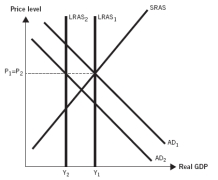
Which of the following would have caused aggregate demand to decrease in the graph, such as occurred during the Great Recession?
A) an increase in expected income
B) a decrease in tax rates
C) a decrease in housing prices and stock prices
D) an increase in consumer sentiment
E) an advance in technology
Which of the following would have caused aggregate demand to decrease in the graph, such as occurred during the Great Recession?
A) an increase in expected income
B) a decrease in tax rates
C) a decrease in housing prices and stock prices
D) an increase in consumer sentiment
E) an advance in technology
سؤال
سؤال
سؤال
سؤال
سؤال
سؤال
Use the following graph to answer the next questions. The graph depicts an economy where aggregate demand and long-run aggregate supply (LRAS) have decreased, with no change in short-run aggregate supply (SRAS).
As a result of aggregate demand and long-run aggregate supply decreasing, we can see that the price level _________ and real gross domestic product (GDP) _________.
A) remained unchanged; decreased
B) increased; decreased
C) decreased; remained unchanged
D) remained unchanged; increased
E) increased; increased
As a result of aggregate demand and long-run aggregate supply decreasing, we can see that the price level _________ and real gross domestic product (GDP) _________.
A) remained unchanged; decreased
B) increased; decreased
C) decreased; remained unchanged
D) remained unchanged; increased
E) increased; increased
سؤال
سؤال
سؤال
سؤال
سؤال
Use the following graph to answer the next questions. The graph depicts an economy where aggregate demand and long-run aggregate supply (LRAS) have decreased, with no change in short-run aggregate supply (SRAS).
The graph accurately summarizes what happened during the Great Recession, because during that time, the price level _________ and real gross domestic product (GDP) _________.
A) decreased; decreased
B) increased; increased
C) remained largely unchanged; decreased
D) decreased; remained unchanged
E) remained unchanged; increased
The graph accurately summarizes what happened during the Great Recession, because during that time, the price level _________ and real gross domestic product (GDP) _________.
A) decreased; decreased
B) increased; increased
C) remained largely unchanged; decreased
D) decreased; remained unchanged
E) remained unchanged; increased
سؤال
سؤال
سؤال
سؤال
سؤال
سؤال
سؤال
سؤال
سؤال
Use the following graph to answer the next questions. The graph depicts an economy where aggregate demand and long-run aggregate supply (LRAS) have decreased, with no change in short-run aggregate supply (SRAS).
In the graph, we see that long-run aggregate supply decreased during the Great Recession. This was due to a decline in housing prices and the subsequent financial crisis. Why did these factors cause long-run aggregate supply to decrease?
A) They caused household wealth and expected income to decline.
B) They caused permanent changes in the market for loanable funds.
C) They caused oil and gas prices to increase, causing inflation.
D) They caused unemployment to remain at normal levels.
E) They caused deflation and an increase in the value of the dollar.
In the graph, we see that long-run aggregate supply decreased during the Great Recession. This was due to a decline in housing prices and the subsequent financial crisis. Why did these factors cause long-run aggregate supply to decrease?
A) They caused household wealth and expected income to decline.
B) They caused permanent changes in the market for loanable funds.
C) They caused oil and gas prices to increase, causing inflation.
D) They caused unemployment to remain at normal levels.
E) They caused deflation and an increase in the value of the dollar.
سؤال
سؤال
سؤال
سؤال
Use the following graph to answer the next questions. The graph depicts an economy where aggregate demand and long-run aggregate supply (LRAS) have decreased, with no change in short-run aggregate supply (SRAS).
During the Great Recession, real gross domestic product (GDP) fell yet the price level was largely unchanged, as depicted in the graph. Because of this, we know that:
A) both aggregate demand and long-run aggregate supply increased during the recession.
B) aggregate demand and long-run aggregate supply both decreased during the recession.
C) aggregate demand decreased and long-run aggregate supply increased during the recession.
D) aggregate demand decreased and short-run aggregate supply increased during the recession.
E) long-run aggregate supply increased and short-run aggregate supply decreased during the recession.
During the Great Recession, real gross domestic product (GDP) fell yet the price level was largely unchanged, as depicted in the graph. Because of this, we know that:
A) both aggregate demand and long-run aggregate supply increased during the recession.
B) aggregate demand and long-run aggregate supply both decreased during the recession.
C) aggregate demand decreased and long-run aggregate supply increased during the recession.
D) aggregate demand decreased and short-run aggregate supply increased during the recession.
E) long-run aggregate supply increased and short-run aggregate supply decreased during the recession.
سؤال
سؤال
سؤال
سؤال
سؤال
سؤال
سؤال
سؤال
سؤال
سؤال
Use the following graph to answer the next questions. The graph depicts an economy where aggregate demand and long-run aggregate supply (LRAS) have decreased, with no change in short-run aggregate supply (SRAS).
During the Great Recession, real gross domestic product (GDP) decreased yet the aggregate price level remained largely unchanged, as depicted in the graph. Unemployment increased to above-normal levels. Which of following best explains why this happened?
A) A significant decline in military spending following the end of a war led to a recession.
B) A sharp recession followed the United States abandoning the gold standard.
C) A decline in housing prices and stock prices, plus a financial crisis, caused a recession.
D) A sudden increase in oil prices caused inflation and a deep recession.
E) A stock market crash, large numbers of bank failures, an increase in tax rates, and a tight money supply caused a recession.
During the Great Recession, real gross domestic product (GDP) decreased yet the aggregate price level remained largely unchanged, as depicted in the graph. Unemployment increased to above-normal levels. Which of following best explains why this happened?
A) A significant decline in military spending following the end of a war led to a recession.
B) A sharp recession followed the United States abandoning the gold standard.
C) A decline in housing prices and stock prices, plus a financial crisis, caused a recession.
D) A sudden increase in oil prices caused inflation and a deep recession.
E) A stock market crash, large numbers of bank failures, an increase in tax rates, and a tight money supply caused a recession.
سؤال
سؤال
سؤال
Use the following graph to answer the next questions. The graph depicts an economy where aggregate demand and long-run aggregate supply (LRAS) have decreased, with no change in short-run aggregate supply (SRAS).
The decline in housing prices contributed to the Great Recession, as depicted in the graph, in that:
A) it caused real gross domestic product (GDP) and the price level to increase.
B) it caused an increase in oil and gas prices, which led to inflation.
C) it caused a decrease in household wealth and created a crisis in the loanable funds market.
D) it caused an increase in household wealth and a crisis in the loanable funds market.
E) it prevented unemployment from rising above historical averages.
The decline in housing prices contributed to the Great Recession, as depicted in the graph, in that:
A) it caused real gross domestic product (GDP) and the price level to increase.
B) it caused an increase in oil and gas prices, which led to inflation.
C) it caused a decrease in household wealth and created a crisis in the loanable funds market.
D) it caused an increase in household wealth and a crisis in the loanable funds market.
E) it prevented unemployment from rising above historical averages.
سؤال
سؤال
سؤال
سؤال
سؤال
سؤال
سؤال
سؤال
سؤال
سؤال
سؤال
سؤال
سؤال
سؤال
سؤال
سؤال
سؤال
سؤال
سؤال
سؤال
سؤال
سؤال
Use the following graph to answer the next questions. This graph depicts an economy where aggregate demand has decreased, with no change in either short-run aggregate supply (SRAS) or long-run aggregate supply (LRAS). 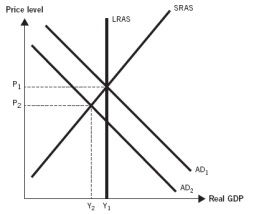
During the Great Depression, the aggregate price level fell by 20% as depicted in the graph, suggesting that:
A) both aggregate demand and long-run aggregate supply decreased during the Great Depression.
B) the primary cause of the Great Depression was a decrease in aggregate demand.
C) aggregate demand decreased and long-run aggregate supply increased during the Great Depression.
D) aggregate demand decreased and short-run aggregate supply increased during the Great Depression.
E) long-run aggregate supply increased whereas short-run aggregate supply decreased during the Great Depression.
During the Great Depression, the aggregate price level fell by 20% as depicted in the graph, suggesting that:
A) both aggregate demand and long-run aggregate supply decreased during the Great Depression.
B) the primary cause of the Great Depression was a decrease in aggregate demand.
C) aggregate demand decreased and long-run aggregate supply increased during the Great Depression.
D) aggregate demand decreased and short-run aggregate supply increased during the Great Depression.
E) long-run aggregate supply increased whereas short-run aggregate supply decreased during the Great Depression.
سؤال
سؤال
سؤال
Use the following graph to answer the next questions. This graph depicts an economy where aggregate demand has decreased, with no change in either short-run aggregate supply (SRAS) or long-run aggregate supply (LRAS).
The graph accurately summarizes what happened during the Great Depression, because during that time, the price level _________ and real gross domestic product (GDP) _________.
A) decreased; decreased
B) increased; decreased
C) remained unchanged; remained unchanged
D) decreased; increased
E) remained unchanged; decreased
The graph accurately summarizes what happened during the Great Depression, because during that time, the price level _________ and real gross domestic product (GDP) _________.
A) decreased; decreased
B) increased; decreased
C) remained unchanged; remained unchanged
D) decreased; increased
E) remained unchanged; decreased
سؤال
سؤال
Use the following graph to answer the next questions. This graph depicts an economy where aggregate demand has decreased, with no change in either short-run aggregate supply (SRAS) or long-run aggregate supply (LRAS).
As a result of aggregate demand decreasing, we can see that the price level ________ and real gross domestic product (GDP) _________.
A) increased; increased
B) decreased; decreased
C) remained unchanged; increased
D) decreased; remained unchanged
E) increased; decreased
As a result of aggregate demand decreasing, we can see that the price level ________ and real gross domestic product (GDP) _________.
A) increased; increased
B) decreased; decreased
C) remained unchanged; increased
D) decreased; remained unchanged
E) increased; decreased
سؤال
Use the following graph to answer the next questions. This graph depicts an economy where aggregate demand has decreased, with no change in either short-run aggregate supply (SRAS) or long-run aggregate supply (LRAS).
Which of the following would have caused aggregate demand to decrease in the graph, such as occurred during the Great Depression?
A) an increase in the money supply
B) a decrease in tax rates
C) a decrease in expected income
D) an increase in consumer sentiment
E) a decrease in savings
Which of the following would have caused aggregate demand to decrease in the graph, such as occurred during the Great Depression?
A) an increase in the money supply
B) a decrease in tax rates
C) a decrease in expected income
D) an increase in consumer sentiment
E) a decrease in savings
سؤال
سؤال
سؤال
Use the following graph to answer the next questions. This graph depicts an economy where aggregate demand has decreased, with no change in either short-run aggregate supply (SRAS) or long-run aggregate supply (LRAS).
During the Great Depression, the aggregate price level and real gross domestic product (GDP) both decreased, as depicted in the graph. Unemployment increased to record levels. Which of following best explains why this happened?
A) A sudden increase in oil prices caused inflation and a deep recession.
B) A stock market crash, large numbers of bank failures, an increase in tax rates, and a tight money supply caused a recession.
C) A rapid decline in housing prices led to problems in the loanable funds market and a recession.
D) A significant decline in military spending following the end of a war led to a recession.
E) A sharp recession followed the United States abandoning the gold standard.
During the Great Depression, the aggregate price level and real gross domestic product (GDP) both decreased, as depicted in the graph. Unemployment increased to record levels. Which of following best explains why this happened?
A) A sudden increase in oil prices caused inflation and a deep recession.
B) A stock market crash, large numbers of bank failures, an increase in tax rates, and a tight money supply caused a recession.
C) A rapid decline in housing prices led to problems in the loanable funds market and a recession.
D) A significant decline in military spending following the end of a war led to a recession.
E) A sharp recession followed the United States abandoning the gold standard.
سؤال
سؤال
سؤال
سؤال
سؤال
Use the following graph to answer the next questions. This graph depicts an economy where aggregate demand has decreased, with no change in either short-run aggregate supply (SRAS) or long-run aggregate supply (LRAS).
In the graph, aggregate demand decreases, causing a decrease in the aggregate price level and real gross domestic product (GDP), just like during the Great Depression. If short-run aggregate supply had decreased by the same margin as aggregate demand, how would the economy have behaved differently?
A) The price level would have increased and real GDP would not have changed.
B) The price level would not have decreased and real GDP would have decreased by more.
C) Both the price level and real GDP would have decreased by much more.
D) The price level would have increased and real GDP would have decreased.
E) Both the price level and real GDP would have increased.
In the graph, aggregate demand decreases, causing a decrease in the aggregate price level and real gross domestic product (GDP), just like during the Great Depression. If short-run aggregate supply had decreased by the same margin as aggregate demand, how would the economy have behaved differently?
A) The price level would have increased and real GDP would not have changed.
B) The price level would not have decreased and real GDP would have decreased by more.
C) Both the price level and real GDP would have decreased by much more.
D) The price level would have increased and real GDP would have decreased.
E) Both the price level and real GDP would have increased.
سؤال
سؤال
سؤال
سؤال
سؤال

فتح الحزمة
قم بالتسجيل لفتح البطاقات في هذه المجموعة!
Unlock Deck
Unlock Deck
1/142

العب

ملء الشاشة (f)
Deck 14: The Great Recession, the Great Depression, and Great Macroeconomic Debates
1
The Great Recession was different from other recessions since World War II in that:
A) the economy did not return to normal for at least one year.
B) most consumers were unaffected by the recession.
C) the overall economy took far longer to recover than the average.
D) the rate of unemployment increased and then decreased at a later time.
E) real gross domestic product (GDP) initially declined and then recovered sometime later.
A) the economy did not return to normal for at least one year.
B) most consumers were unaffected by the recession.
C) the overall economy took far longer to recover than the average.
D) the rate of unemployment increased and then decreased at a later time.
E) real gross domestic product (GDP) initially declined and then recovered sometime later.
the overall economy took far longer to recover than the average.
2
Use the following graph to answer the next questions. The graph depicts an economy where aggregate demand and long-run aggregate supply (LRAS) have decreased, with no change in short-run aggregate supply (SRAS).
Which of the following would have caused aggregate demand to decrease in the graph, such as occurred during the Great Recession?
A) an increase in expected income
B) a decrease in tax rates
C) a decrease in housing prices and stock prices
D) an increase in consumer sentiment
E) an advance in technology
Which of the following would have caused aggregate demand to decrease in the graph, such as occurred during the Great Recession?
A) an increase in expected income
B) a decrease in tax rates
C) a decrease in housing prices and stock prices
D) an increase in consumer sentiment
E) an advance in technology
a decrease in housing prices and stock prices
3
The Great Recession was similar to other recessions since World War II in that:
A) there was extremely high inflation.
B) real gross domestic product (GDP) initially declined and then recovered sometime later.
C) real GDP increased rapidly and then leveled off.
D) the rate of unemployment was unchanged.
E) the trade deficit fell to zero.
A) there was extremely high inflation.
B) real gross domestic product (GDP) initially declined and then recovered sometime later.
C) real GDP increased rapidly and then leveled off.
D) the rate of unemployment was unchanged.
E) the trade deficit fell to zero.
real gross domestic product (GDP) initially declined and then recovered sometime later.
4
The Great Recession was similar to most other recessions since World War II in that:
A) the economy rapidly bounced back and resumed normal growth quickly.
B) the economy never really declined much at all.
C) the economy did not return to normal for at least one year.
D) the economy increased rapidly following the beginning of the recession.
E) the economy essentially collapsed and never recovered.
A) the economy rapidly bounced back and resumed normal growth quickly.
B) the economy never really declined much at all.
C) the economy did not return to normal for at least one year.
D) the economy increased rapidly following the beginning of the recession.
E) the economy essentially collapsed and never recovered.
فتح الحزمة
افتح القفل للوصول البطاقات البالغ عددها 142 في هذه المجموعة.
فتح الحزمة
k this deck
5
The Great Recession lasted from _________ to _________.
A) August 1929; March 1933
B) May 1937; June 1938
C) March 2001; November 2001
D) December 2007; June 2009
E) July 1991; June 1992
A) August 1929; March 1933
B) May 1937; June 1938
C) March 2001; November 2001
D) December 2007; June 2009
E) July 1991; June 1992
فتح الحزمة
افتح القفل للوصول البطاقات البالغ عددها 142 في هذه المجموعة.
فتح الحزمة
k this deck
6
The Great Recession began in:
A) December 2009.
B) June 2009.
C) August 1929.
D) December 2007.
E) January 1930.
A) December 2009.
B) June 2009.
C) August 1929.
D) December 2007.
E) January 1930.
فتح الحزمة
افتح القفل للوصول البطاقات البالغ عددها 142 في هذه المجموعة.
فتح الحزمة
k this deck
7
The Great Recession began in __________ and lasted for __________.
A) June 2011; 12 months
B) August 1929; 44 months
C) December 2007; 18 months
D) May 1937; 14 months
E) March 2001; 8 months
A) June 2011; 12 months
B) August 1929; 44 months
C) December 2007; 18 months
D) May 1937; 14 months
E) March 2001; 8 months
فتح الحزمة
افتح القفل للوصول البطاقات البالغ عددها 142 في هذه المجموعة.
فتح الحزمة
k this deck
8
Use the following graph to answer the next questions. The graph depicts an economy where aggregate demand and long-run aggregate supply (LRAS) have decreased, with no change in short-run aggregate supply (SRAS).
As a result of aggregate demand and long-run aggregate supply decreasing, we can see that the price level _________ and real gross domestic product (GDP) _________.
A) remained unchanged; decreased
B) increased; decreased
C) decreased; remained unchanged
D) remained unchanged; increased
E) increased; increased
As a result of aggregate demand and long-run aggregate supply decreasing, we can see that the price level _________ and real gross domestic product (GDP) _________.
A) remained unchanged; decreased
B) increased; decreased
C) decreased; remained unchanged
D) remained unchanged; increased
E) increased; increased
فتح الحزمة
افتح القفل للوصول البطاقات البالغ عددها 142 في هذه المجموعة.
فتح الحزمة
k this deck
9
During the Great Recession, there was a financial crisis, a stock market crash, and a collapse in housing prices, all of which:
A) contributed to a very long and deep recession.
B) helped the U.S. economy perform better than the economies of other countries.
C) kept unemployment from rising above the historical average.
D) resulted in a very short and mild recession.
E) prevented the United States from experiencing a decline in real gross domestic product (GDP).
A) contributed to a very long and deep recession.
B) helped the U.S. economy perform better than the economies of other countries.
C) kept unemployment from rising above the historical average.
D) resulted in a very short and mild recession.
E) prevented the United States from experiencing a decline in real gross domestic product (GDP).
فتح الحزمة
افتح القفل للوصول البطاقات البالغ عددها 142 في هذه المجموعة.
فتح الحزمة
k this deck
10
The Great Recession lasted longer and was deeper than the average recession, in part, because:
A) oil-producing countries dramatically increased oil prices, causing very high inflation.
B) there was a dramatic cut in military spending in the years leading up to the recession.
C) the Federal Reserve refused to increase the money supply to stimulate aggregate demand.
D) the government raised tax rates in an effort to balance the federal budget.
E) there was a major financial crisis following the collapse of housing prices.
A) oil-producing countries dramatically increased oil prices, causing very high inflation.
B) there was a dramatic cut in military spending in the years leading up to the recession.
C) the Federal Reserve refused to increase the money supply to stimulate aggregate demand.
D) the government raised tax rates in an effort to balance the federal budget.
E) there was a major financial crisis following the collapse of housing prices.
فتح الحزمة
افتح القفل للوصول البطاقات البالغ عددها 142 في هذه المجموعة.
فتح الحزمة
k this deck
11
The Great Recession was different from other recessions since World War II in that:
A) real gross domestic product (GDP) initially declined and then recovered sometime later.
B) the trade deficit was largely unaffected.
C) the rate of unemployment increased and then decreased at a later time.
D) the decline in real GDP was much larger and lasted longer.
E) the economy did not return to normal for at least one year.
A) real gross domestic product (GDP) initially declined and then recovered sometime later.
B) the trade deficit was largely unaffected.
C) the rate of unemployment increased and then decreased at a later time.
D) the decline in real GDP was much larger and lasted longer.
E) the economy did not return to normal for at least one year.
فتح الحزمة
افتح القفل للوصول البطاقات البالغ عددها 142 في هذه المجموعة.
فتح الحزمة
k this deck
12
The Great Recession was similar to other recessions since World War II in that:
A) the rate of unemployment increased and then decreased at a later time.
B) the rate of inflation was extremely high.
C) real gross domestic product (GDP) rapidly increased and then leveled off.
D) the rate of economic growth was unchanged.
E) the rate of unemployment decreased and then increased at a later time.
A) the rate of unemployment increased and then decreased at a later time.
B) the rate of inflation was extremely high.
C) real gross domestic product (GDP) rapidly increased and then leveled off.
D) the rate of economic growth was unchanged.
E) the rate of unemployment decreased and then increased at a later time.
فتح الحزمة
افتح القفل للوصول البطاقات البالغ عددها 142 في هذه المجموعة.
فتح الحزمة
k this deck
13
Use the following graph to answer the next questions. The graph depicts an economy where aggregate demand and long-run aggregate supply (LRAS) have decreased, with no change in short-run aggregate supply (SRAS).
The graph accurately summarizes what happened during the Great Recession, because during that time, the price level _________ and real gross domestic product (GDP) _________.
A) decreased; decreased
B) increased; increased
C) remained largely unchanged; decreased
D) decreased; remained unchanged
E) remained unchanged; increased
The graph accurately summarizes what happened during the Great Recession, because during that time, the price level _________ and real gross domestic product (GDP) _________.
A) decreased; decreased
B) increased; increased
C) remained largely unchanged; decreased
D) decreased; remained unchanged
E) remained unchanged; increased
فتح الحزمة
افتح القفل للوصول البطاقات البالغ عددها 142 في هذه المجموعة.
فتح الحزمة
k this deck
14
During the Great Recession, the unemployment rate climbed as high as _________ and remained around 8% _________ months after the recession began.
A) 15%; 75
B) 25%; 8
C) 10%; 60
D) 20%; 12
E) 35%; 80
A) 15%; 75
B) 25%; 8
C) 10%; 60
D) 20%; 12
E) 35%; 80
فتح الحزمة
افتح القفل للوصول البطاقات البالغ عددها 142 في هذه المجموعة.
فتح الحزمة
k this deck
15
Which of the following best summarizes the main causes of the Great Recession?
A) Oil-producing countries deliberately raised the price of petroleum, leading to inflation and a deep recession.
B) The Federal Reserve raised short-term interest rates very high in an effort to decrease inflation, which also drove the economy into a recession.
C) The end of overseas war efforts led to a deep decrease in federal spending, which reduced employment and caused a recession.
D) The stock market collapsed following the end of a bubble in technology stock prices, which caused a decrease in investment spending and a recession.
E) The collapse of housing prices led to decreased wealth and significant problems in financial markets, as well as a decrease in expected income and a stock market collapse.
A) Oil-producing countries deliberately raised the price of petroleum, leading to inflation and a deep recession.
B) The Federal Reserve raised short-term interest rates very high in an effort to decrease inflation, which also drove the economy into a recession.
C) The end of overseas war efforts led to a deep decrease in federal spending, which reduced employment and caused a recession.
D) The stock market collapsed following the end of a bubble in technology stock prices, which caused a decrease in investment spending and a recession.
E) The collapse of housing prices led to decreased wealth and significant problems in financial markets, as well as a decrease in expected income and a stock market collapse.
فتح الحزمة
افتح القفل للوصول البطاقات البالغ عددها 142 في هذه المجموعة.
فتح الحزمة
k this deck
16
The Great Recession was different from other recessions since World War II in that:
A) the rate of unemployment increased and then decreased at a later time.
B) the increase in unemployment was much greater and lasted longer.
C) real gross domestic product (GDP) initially declined and then recovered sometime later.
D) the economy did not return to normal for at least one year.
E) the rate of inflation did not change at all.
A) the rate of unemployment increased and then decreased at a later time.
B) the increase in unemployment was much greater and lasted longer.
C) real gross domestic product (GDP) initially declined and then recovered sometime later.
D) the economy did not return to normal for at least one year.
E) the rate of inflation did not change at all.
فتح الحزمة
افتح القفل للوصول البطاقات البالغ عددها 142 في هذه المجموعة.
فتح الحزمة
k this deck
17
The Great Recession lasted for:
A) 12 months.
B) 18 months.
C) 32 months.
D) 44 months.
E) 56 months.
A) 12 months.
B) 18 months.
C) 32 months.
D) 44 months.
E) 56 months.
فتح الحزمة
افتح القفل للوصول البطاقات البالغ عددها 142 في هذه المجموعة.
فتح الحزمة
k this deck
18
The Great Recession ended in:
A) June 2009.
B) January 2009.
C) March 1933.
D) June 1938.
E) June 2012.
A) June 2009.
B) January 2009.
C) March 1933.
D) June 1938.
E) June 2012.
فتح الحزمة
افتح القفل للوصول البطاقات البالغ عددها 142 في هذه المجموعة.
فتح الحزمة
k this deck
19
During the Great Recession, a major financial crisis followed the collapse of housing prices, which led to:
A) a decrease in the money supply by the Federal Reserve.
B) the decline in the health of many large financial firms and banks.
C) skyrocketing oil prices.
D) an increase in income tax rates to shrink the federal budget deficit.
E) an increase in expected income.
A) a decrease in the money supply by the Federal Reserve.
B) the decline in the health of many large financial firms and banks.
C) skyrocketing oil prices.
D) an increase in income tax rates to shrink the federal budget deficit.
E) an increase in expected income.
فتح الحزمة
افتح القفل للوصول البطاقات البالغ عددها 142 في هذه المجموعة.
فتح الحزمة
k this deck
20
One similarity between the Great Recession and the Great Depression is that, in both episodes:
A) large numbers of banks failed.
B) there were significant problems in financial markets.
C) the U.S. government raised taxes.
D) the U.S. government allowed the money supply to decrease.
E) the unemployment rate exceeded 20%.
A) large numbers of banks failed.
B) there were significant problems in financial markets.
C) the U.S. government raised taxes.
D) the U.S. government allowed the money supply to decrease.
E) the unemployment rate exceeded 20%.
فتح الحزمة
افتح القفل للوصول البطاقات البالغ عددها 142 في هذه المجموعة.
فتح الحزمة
k this deck
21
When U.S. aggregate demand and long-run aggregate supply decreased during the Great Recession:
A) unemployment decreased.
B) real gross domestic product (GDP) also decreased.
C) real GDP increased.
D) real GDP was unaffected.
E) the price level decreased.
A) unemployment decreased.
B) real gross domestic product (GDP) also decreased.
C) real GDP increased.
D) real GDP was unaffected.
E) the price level decreased.
فتح الحزمة
افتح القفل للوصول البطاقات البالغ عددها 142 في هذه المجموعة.
فتح الحزمة
k this deck
22
Use the following graph to answer the next questions. The graph depicts an economy where aggregate demand and long-run aggregate supply (LRAS) have decreased, with no change in short-run aggregate supply (SRAS).
In the graph, we see that long-run aggregate supply decreased during the Great Recession. This was due to a decline in housing prices and the subsequent financial crisis. Why did these factors cause long-run aggregate supply to decrease?
A) They caused household wealth and expected income to decline.
B) They caused permanent changes in the market for loanable funds.
C) They caused oil and gas prices to increase, causing inflation.
D) They caused unemployment to remain at normal levels.
E) They caused deflation and an increase in the value of the dollar.
In the graph, we see that long-run aggregate supply decreased during the Great Recession. This was due to a decline in housing prices and the subsequent financial crisis. Why did these factors cause long-run aggregate supply to decrease?
A) They caused household wealth and expected income to decline.
B) They caused permanent changes in the market for loanable funds.
C) They caused oil and gas prices to increase, causing inflation.
D) They caused unemployment to remain at normal levels.
E) They caused deflation and an increase in the value of the dollar.
فتح الحزمة
افتح القفل للوصول البطاقات البالغ عددها 142 في هذه المجموعة.
فتح الحزمة
k this deck
23
During the Great Recession, aggregate demand ________ and long-run aggregate supply ________.
A) increased; increased
B) decreased; decreased
C) decreased; remained unchanged
D) remained unchanged; decreased
E) increased; decreased
A) increased; increased
B) decreased; decreased
C) decreased; remained unchanged
D) remained unchanged; decreased
E) increased; decreased
فتح الحزمة
افتح القفل للوصول البطاقات البالغ عددها 142 في هذه المجموعة.
فتح الحزمة
k this deck
24
A decline in U.S. wealth would tend to cause:
A) long-run aggregate supply to increase.
B) aggregate demand to decrease.
C) short-run aggregate supply to increase.
D) long-run aggregate supply to decrease.
E) aggregate demand to increase.
A) long-run aggregate supply to increase.
B) aggregate demand to decrease.
C) short-run aggregate supply to increase.
D) long-run aggregate supply to decrease.
E) aggregate demand to increase.
فتح الحزمة
افتح القفل للوصول البطاقات البالغ عددها 142 في هذه المجموعة.
فتح الحزمة
k this deck
25
During the Great Recession, ___________ caused aggregate demand to decrease.
A) a decrease in stock prices
B) a decrease in business tax rates
C) an increase in immigration to the United States
D) an increase in consumer sentiment
E) a decrease in income taxes
A) a decrease in stock prices
B) a decrease in business tax rates
C) an increase in immigration to the United States
D) an increase in consumer sentiment
E) a decrease in income taxes
فتح الحزمة
افتح القفل للوصول البطاقات البالغ عددها 142 في هذه المجموعة.
فتح الحزمة
k this deck
26
Use the following graph to answer the next questions. The graph depicts an economy where aggregate demand and long-run aggregate supply (LRAS) have decreased, with no change in short-run aggregate supply (SRAS).
During the Great Recession, real gross domestic product (GDP) fell yet the price level was largely unchanged, as depicted in the graph. Because of this, we know that:
A) both aggregate demand and long-run aggregate supply increased during the recession.
B) aggregate demand and long-run aggregate supply both decreased during the recession.
C) aggregate demand decreased and long-run aggregate supply increased during the recession.
D) aggregate demand decreased and short-run aggregate supply increased during the recession.
E) long-run aggregate supply increased and short-run aggregate supply decreased during the recession.
During the Great Recession, real gross domestic product (GDP) fell yet the price level was largely unchanged, as depicted in the graph. Because of this, we know that:
A) both aggregate demand and long-run aggregate supply increased during the recession.
B) aggregate demand and long-run aggregate supply both decreased during the recession.
C) aggregate demand decreased and long-run aggregate supply increased during the recession.
D) aggregate demand decreased and short-run aggregate supply increased during the recession.
E) long-run aggregate supply increased and short-run aggregate supply decreased during the recession.
فتح الحزمة
افتح القفل للوصول البطاقات البالغ عددها 142 في هذه المجموعة.
فتح الحزمة
k this deck
27
During the Great Recession, long-run aggregate supply decreased. This was caused by __________.
A) an advance in technology
B) a decrease in income and business tax rates
C) an increase in immigration to the United States
D) a breakdown in the loanable funds market
E) an increase in the U.S. labor force
A) an advance in technology
B) a decrease in income and business tax rates
C) an increase in immigration to the United States
D) a breakdown in the loanable funds market
E) an increase in the U.S. labor force
فتح الحزمة
افتح القفل للوصول البطاقات البالغ عددها 142 في هذه المجموعة.
فتح الحزمة
k this deck
28
During the Great Recession, the U.S. ________ curve shifted to the ________.
A) aggregate demand; right
B) short-run aggregate supply; right
C) long-run aggregate supply; left
D) long-run aggregate supply; right
E) production possibilities; right
A) aggregate demand; right
B) short-run aggregate supply; right
C) long-run aggregate supply; left
D) long-run aggregate supply; right
E) production possibilities; right
فتح الحزمة
افتح القفل للوصول البطاقات البالغ عددها 142 في هذه المجموعة.
فتح الحزمة
k this deck
29
During the Great Recession, __________ caused long-run aggregate supply to decrease.
A) an increase in international trade
B) an advance in technology
C) financial market turmoil
D) an increase in the U.S. labor force
E) an increase in the money supply
A) an increase in international trade
B) an advance in technology
C) financial market turmoil
D) an increase in the U.S. labor force
E) an increase in the money supply
فتح الحزمة
افتح القفل للوصول البطاقات البالغ عددها 142 في هذه المجموعة.
فتح الحزمة
k this deck
30
During the Great Recession, the U.S. aggregate demand curve shifted to the left, in part, because:
A) the stock market declined in value by one-third.
B) there was a decline in the U.S. population.
C) there was an increase in expected income.
D) the U.S. government restricted trade with other countries.
E) there was an increase in housing prices.
A) the stock market declined in value by one-third.
B) there was a decline in the U.S. population.
C) there was an increase in expected income.
D) the U.S. government restricted trade with other countries.
E) there was an increase in housing prices.
فتح الحزمة
افتح القفل للوصول البطاقات البالغ عددها 142 في هذه المجموعة.
فتح الحزمة
k this deck
31
During the Great Recession, the U.S. aggregate demand curve shifted to the left, in part, because:
A) there was an increase in expected income.
B) the government dramatically increased taxes.
C) there was a decrease in expected income.
D) the Federal Reserve increased interest rates.
E) U.S. housing prices increased.
A) there was an increase in expected income.
B) the government dramatically increased taxes.
C) there was a decrease in expected income.
D) the Federal Reserve increased interest rates.
E) U.S. housing prices increased.
فتح الحزمة
افتح القفل للوصول البطاقات البالغ عددها 142 في هذه المجموعة.
فتح الحزمة
k this deck
32
During the Great Recession, the U.S. ________ curve shifted to the ________.
A) aggregate demand; right
B) short-run aggregate supply; right
C) long-run aggregate supply; right
D) aggregate demand; left
E) production possibilities; right
A) aggregate demand; right
B) short-run aggregate supply; right
C) long-run aggregate supply; right
D) aggregate demand; left
E) production possibilities; right
فتح الحزمة
افتح القفل للوصول البطاقات البالغ عددها 142 في هذه المجموعة.
فتح الحزمة
k this deck
33
A decrease in U.S. housing prices would tend to cause:
A) aggregate demand to decrease.
B) long-run aggregate supply to increase.
C) short-run aggregate supply to decrease.
D) long-run aggregate supply to decrease.
E) aggregate demand to increase.
A) aggregate demand to decrease.
B) long-run aggregate supply to increase.
C) short-run aggregate supply to decrease.
D) long-run aggregate supply to decrease.
E) aggregate demand to increase.
فتح الحزمة
افتح القفل للوصول البطاقات البالغ عددها 142 في هذه المجموعة.
فتح الحزمة
k this deck
34
During the Great Recession, the U.S. long-run aggregate supply curve shifted to the left, in part, because:
A) the government dramatically increased taxes.
B) there was an institutional breakdown in financial markets.
C) there was a decline in the level of technology.
D) there was a decline in the U.S. population.
E) there was a decrease in expected income.
A) the government dramatically increased taxes.
B) there was an institutional breakdown in financial markets.
C) there was a decline in the level of technology.
D) there was a decline in the U.S. population.
E) there was a decrease in expected income.
فتح الحزمة
افتح القفل للوصول البطاقات البالغ عددها 142 في هذه المجموعة.
فتح الحزمة
k this deck
35
During the Great Recession, ___________ caused aggregate demand to decrease.
A) a cut in income tax rates
B) a rapid decline in housing prices
C) an increase in consumer sentiment
D) a decrease in interest rates
E) an increase in international trade
A) a cut in income tax rates
B) a rapid decline in housing prices
C) an increase in consumer sentiment
D) a decrease in interest rates
E) an increase in international trade
فتح الحزمة
افتح القفل للوصول البطاقات البالغ عددها 142 في هذه المجموعة.
فتح الحزمة
k this deck
36
Use the following graph to answer the next questions. The graph depicts an economy where aggregate demand and long-run aggregate supply (LRAS) have decreased, with no change in short-run aggregate supply (SRAS).
During the Great Recession, real gross domestic product (GDP) decreased yet the aggregate price level remained largely unchanged, as depicted in the graph. Unemployment increased to above-normal levels. Which of following best explains why this happened?
A) A significant decline in military spending following the end of a war led to a recession.
B) A sharp recession followed the United States abandoning the gold standard.
C) A decline in housing prices and stock prices, plus a financial crisis, caused a recession.
D) A sudden increase in oil prices caused inflation and a deep recession.
E) A stock market crash, large numbers of bank failures, an increase in tax rates, and a tight money supply caused a recession.
During the Great Recession, real gross domestic product (GDP) decreased yet the aggregate price level remained largely unchanged, as depicted in the graph. Unemployment increased to above-normal levels. Which of following best explains why this happened?
A) A significant decline in military spending following the end of a war led to a recession.
B) A sharp recession followed the United States abandoning the gold standard.
C) A decline in housing prices and stock prices, plus a financial crisis, caused a recession.
D) A sudden increase in oil prices caused inflation and a deep recession.
E) A stock market crash, large numbers of bank failures, an increase in tax rates, and a tight money supply caused a recession.
فتح الحزمة
افتح القفل للوصول البطاقات البالغ عددها 142 في هذه المجموعة.
فتح الحزمة
k this deck
37
An institutional breakdown in U.S. financial markets would tend to cause:
A) aggregate demand to increase.
B) long-run aggregate supply to decrease.
C) short-run aggregate supply to increase.
D) long-run aggregate supply to increase.
E) aggregate demand to decrease.
A) aggregate demand to increase.
B) long-run aggregate supply to decrease.
C) short-run aggregate supply to increase.
D) long-run aggregate supply to increase.
E) aggregate demand to decrease.
فتح الحزمة
افتح القفل للوصول البطاقات البالغ عددها 142 في هذه المجموعة.
فتح الحزمة
k this deck
38
During the Great Recession, the U.S. aggregate demand curve shifted to the left, in part, because:
A) unemployment in the United States decreased.
B) there was excessively high inflation during this time.
C) there was a stock market boom.
D) U.S. housing prices fell.
E) the government dramatically increased taxes.
A) unemployment in the United States decreased.
B) there was excessively high inflation during this time.
C) there was a stock market boom.
D) U.S. housing prices fell.
E) the government dramatically increased taxes.
فتح الحزمة
افتح القفل للوصول البطاقات البالغ عددها 142 في هذه المجموعة.
فتح الحزمة
k this deck
39
Use the following graph to answer the next questions. The graph depicts an economy where aggregate demand and long-run aggregate supply (LRAS) have decreased, with no change in short-run aggregate supply (SRAS).
The decline in housing prices contributed to the Great Recession, as depicted in the graph, in that:
A) it caused real gross domestic product (GDP) and the price level to increase.
B) it caused an increase in oil and gas prices, which led to inflation.
C) it caused a decrease in household wealth and created a crisis in the loanable funds market.
D) it caused an increase in household wealth and a crisis in the loanable funds market.
E) it prevented unemployment from rising above historical averages.
The decline in housing prices contributed to the Great Recession, as depicted in the graph, in that:
A) it caused real gross domestic product (GDP) and the price level to increase.
B) it caused an increase in oil and gas prices, which led to inflation.
C) it caused a decrease in household wealth and created a crisis in the loanable funds market.
D) it caused an increase in household wealth and a crisis in the loanable funds market.
E) it prevented unemployment from rising above historical averages.
فتح الحزمة
افتح القفل للوصول البطاقات البالغ عددها 142 في هذه المجموعة.
فتح الحزمة
k this deck
40
The Great Recession is characterized by a decrease in aggregate demand. __________ would have caused such a decrease.
A) A decrease in consumer sentiment
B) A decrease in income tax rates
C) An increase in international trade
D) An increase in expected income
E) An increase in immigration to the United States
A) A decrease in consumer sentiment
B) A decrease in income tax rates
C) An increase in international trade
D) An increase in expected income
E) An increase in immigration to the United States
فتح الحزمة
افتح القفل للوصول البطاقات البالغ عددها 142 في هذه المجموعة.
فتح الحزمة
k this deck
41
During the Great Recession, U.S. household wealth declined, leading to a decrease in aggregate demand. Which pair of factors contributed to this decline in wealth?
A) an increase in tax rates and a decrease in stock prices
B) a decrease in stock prices and a decrease in housing prices
C) a decrease in housing prices and a decline in the level of technology
D) a financial-market crisis and an increase in gas prices
E) a decrease in housing prices and a decrease in the money supply
A) an increase in tax rates and a decrease in stock prices
B) a decrease in stock prices and a decrease in housing prices
C) a decrease in housing prices and a decline in the level of technology
D) a financial-market crisis and an increase in gas prices
E) a decrease in housing prices and a decrease in the money supply
فتح الحزمة
افتح القفل للوصول البطاقات البالغ عددها 142 في هذه المجموعة.
فتح الحزمة
k this deck
42
When compared to other recessions, the Great Depression:
A) had very high levels of immigration to the United States.
B) had much larger decreases in real gross domestic product (GDP).
C) had very low unemployment.
D) had very stable stock prices.
E) had much higher levels of consumer sentiment.
A) had very high levels of immigration to the United States.
B) had much larger decreases in real gross domestic product (GDP).
C) had very low unemployment.
D) had very stable stock prices.
E) had much higher levels of consumer sentiment.
فتح الحزمة
افتح القفل للوصول البطاقات البالغ عددها 142 في هذه المجموعة.
فتح الحزمة
k this deck
43
When U.S. housing prices declined prior to and during the Great Recession, it caused aggregate demand to decrease because:
A) the government raised interest rates to prevent inflation.
B) household wealth decreased, causing a decline in consumer spending.
C) the U.S. population and labor force declined abruptly.
D) the government refused to allow the money supply to increase.
E) the government raised taxes and decreased spending.
A) the government raised interest rates to prevent inflation.
B) household wealth decreased, causing a decline in consumer spending.
C) the U.S. population and labor force declined abruptly.
D) the government refused to allow the money supply to increase.
E) the government raised taxes and decreased spending.
فتح الحزمة
افتح القفل للوصول البطاقات البالغ عددها 142 في هذه المجموعة.
فتح الحزمة
k this deck
44
In comparison with other recessions, the Great Depression:
A) had much lower rates of unemployment.
B) had much higher levels of consumer sentiment.
C) had much higher international trade.
D) had much larger changes in stock prices.
E) had very small changes in real gross domestic product (GDP).
A) had much lower rates of unemployment.
B) had much higher levels of consumer sentiment.
C) had much higher international trade.
D) had much larger changes in stock prices.
E) had very small changes in real gross domestic product (GDP).
فتح الحزمة
افتح القفل للوصول البطاقات البالغ عددها 142 في هذه المجموعة.
فتح الحزمة
k this deck
45
One similarity between the Great Depression and the Great Recession is that in both cases:
A) stock prices remained largely unaffected.
B) housing prices climbed rapidly.
C) there was very high inflation.
D) unemployment remained very low.
E) there was noticeable stress in financial markets.
A) stock prices remained largely unaffected.
B) housing prices climbed rapidly.
C) there was very high inflation.
D) unemployment remained very low.
E) there was noticeable stress in financial markets.
فتح الحزمة
افتح القفل للوصول البطاقات البالغ عددها 142 في هذه المجموعة.
فتح الحزمة
k this deck
46
When stock prices declined during the Great Recession, it caused aggregate demand to decrease because:
A) households became more optimistic and increased consumer spending.
B) the government raised taxes and decreased spending.
C) firms' net worth decreased, leading to an increase in investment spending.
D) household wealth decreased, leading to a decline in consumer spending.
E) the government refused to allow the money supply to increase.
A) households became more optimistic and increased consumer spending.
B) the government raised taxes and decreased spending.
C) firms' net worth decreased, leading to an increase in investment spending.
D) household wealth decreased, leading to a decline in consumer spending.
E) the government refused to allow the money supply to increase.
فتح الحزمة
افتح القفل للوصول البطاقات البالغ عددها 142 في هذه المجموعة.
فتح الحزمة
k this deck
47
The Great Depression ended in:
A) June 2009.
B) May 1937.
C) August 1929.
D) June 1938.
E) August 2004.
A) June 2009.
B) May 1937.
C) August 1929.
D) June 1938.
E) August 2004.
فتح الحزمة
افتح القفل للوصول البطاقات البالغ عددها 142 في هذه المجموعة.
فتح الحزمة
k this deck
48
The Great Depression actually consisted of two recessions, the first of which began in _________ and ended in _________.
A) May 1937; June 1938
B) August 1929; March 1933
C) March 2001; November 2001
D) December 2007; June 2009
E) February 1971; August 1972
A) May 1937; June 1938
B) August 1929; March 1933
C) March 2001; November 2001
D) December 2007; June 2009
E) February 1971; August 1972
فتح الحزمة
افتح القفل للوصول البطاقات البالغ عددها 142 في هذه المجموعة.
فتح الحزمة
k this deck
49
A stock market crash in is generally viewed as the beginning of the Great Depression.
A) December 2007
B) March 1933
C) June 2009
D) October 1929
E) April 1945
A) December 2007
B) March 1933
C) June 2009
D) October 1929
E) April 1945
فتح الحزمة
افتح القفل للوصول البطاقات البالغ عددها 142 في هذه المجموعة.
فتح الحزمة
k this deck
50
The Great Depression actually consisted of two recessions, the second of which began in _________ and ended in _________.
A) October 1981; January 1984
B) August 1929; March 1933
C) March 2001; November 2001
D) December 2007; June 2009
E) May 1937; June 1938
A) October 1981; January 1984
B) August 1929; March 1933
C) March 2001; November 2001
D) December 2007; June 2009
E) May 1937; June 1938
فتح الحزمة
افتح القفل للوصول البطاقات البالغ عددها 142 في هذه المجموعة.
فتح الحزمة
k this deck
51
Which of the following best summarizes the main causes of the Great Depression?
A) Oil-producing countries deliberately raised the price of petroleum, leading to inflation and a deep recession.
B) The Federal Reserve raised short-term interest rates very high in an effort to decrease inflation, which also drove the economy into a recession.
C) The end of overseas war efforts led to a deep decrease in federal spending, which reduced employment and caused a recession.
D) A stock market crash led to a decrease in expected income and tight monetary policy. Higher tax rates and a banking crisis then drove the economy into a depression.
E) The stock market collapsed following the end of a bubble in technology stock prices, which caused a decrease in investment spending and a recession.
A) Oil-producing countries deliberately raised the price of petroleum, leading to inflation and a deep recession.
B) The Federal Reserve raised short-term interest rates very high in an effort to decrease inflation, which also drove the economy into a recession.
C) The end of overseas war efforts led to a deep decrease in federal spending, which reduced employment and caused a recession.
D) A stock market crash led to a decrease in expected income and tight monetary policy. Higher tax rates and a banking crisis then drove the economy into a depression.
E) The stock market collapsed following the end of a bubble in technology stock prices, which caused a decrease in investment spending and a recession.
فتح الحزمة
افتح القفل للوصول البطاقات البالغ عددها 142 في هذه المجموعة.
فتح الحزمة
k this deck
52
During the Great Recession, consumer sentiment in the United States declined, leading to a decrease in consumer spending. Which of the following factors caused this decrease in consumer sentiment?
A) a decrease in expected income
B) an increase in household wealth
C) a decrease in the money supply
D) an increase in tax rates
E) falling gasoline prices
A) a decrease in expected income
B) an increase in household wealth
C) a decrease in the money supply
D) an increase in tax rates
E) falling gasoline prices
فتح الحزمة
افتح القفل للوصول البطاقات البالغ عددها 142 في هذه المجموعة.
فتح الحزمة
k this deck
53
One of the reasons why the Great Depression was so severe is that:
A) stock prices increased during the Great Depression.
B) the U.S. government increased taxes.
C) the U.S. government allowed the money supply to increase.
D) the unemployment rate decreased.
E) expected income increased.
A) stock prices increased during the Great Depression.
B) the U.S. government increased taxes.
C) the U.S. government allowed the money supply to increase.
D) the unemployment rate decreased.
E) expected income increased.
فتح الحزمة
افتح القفل للوصول البطاقات البالغ عددها 142 في هذه المجموعة.
فتح الحزمة
k this deck
54
When financial markets went into a crisis during the Great Recession, it caused long-run aggregate supply to decrease because:
A) there was a decrease in the level of technology.
B) there were new regulations limiting the amount of loans that could be made.
C) the U.S. population and labor force declined abruptly.
D) all across the country, infrastructure began to fail.
E) profits in the financial industry increased.
A) there was a decrease in the level of technology.
B) there were new regulations limiting the amount of loans that could be made.
C) the U.S. population and labor force declined abruptly.
D) all across the country, infrastructure began to fail.
E) profits in the financial industry increased.
فتح الحزمة
افتح القفل للوصول البطاقات البالغ عددها 142 في هذه المجموعة.
فتح الحزمة
k this deck
55
The back-to-back recessions that began in 1929 and ended in 1938 are collectively known as:
A) the Gilded Age.
B) the Great Downturn.
C) the Roaring Twenties.
D) the Great Depression.
E) the Great Recession.
A) the Gilded Age.
B) the Great Downturn.
C) the Roaring Twenties.
D) the Great Depression.
E) the Great Recession.
فتح الحزمة
افتح القفل للوصول البطاقات البالغ عددها 142 في هذه المجموعة.
فتح الحزمة
k this deck
56
The Great Depression actually consisted of two separate recessions. The "second wave" of the Great Depression began in _________ and lasted for _________.
A) August 1929; 44 months
B) March 2001; 8 months
C) December 2007; 18 months
D) May 1937; 14 months
E) December 1974; 16 months
A) August 1929; 44 months
B) March 2001; 8 months
C) December 2007; 18 months
D) May 1937; 14 months
E) December 1974; 16 months
فتح الحزمة
افتح القفل للوصول البطاقات البالغ عددها 142 في هذه المجموعة.
فتح الحزمة
k this deck
57
The Great Depression actually consisted of two separate recessions. The "first wave" of the Great Depression first began in _________ and initially lasted for _________.
A) May 1937; 14 months
B) August 1929; 44 months
C) August 1945; 12 months
D) July 1991; 18 months
E) August 1972; 7 months
A) May 1937; 14 months
B) August 1929; 44 months
C) August 1945; 12 months
D) July 1991; 18 months
E) August 1972; 7 months
فتح الحزمة
افتح القفل للوصول البطاقات البالغ عددها 142 في هذه المجموعة.
فتح الحزمة
k this deck
58
One difference between the Great Recession and the Great Depression is that:
A) unemployment was far higher during the Great Recession.
B) very few banks failed during the Great Depression, but many failed during the Great Recession.
C) the U.S. government reduced the money supply during the Great Recession but raised it during the Great Depression.
D) the U.S. government reduced taxes during the Great Recession but raised them during the Great Depression.
E) there was significant inflation during the Great Depression and not during the Great Recession.
A) unemployment was far higher during the Great Recession.
B) very few banks failed during the Great Depression, but many failed during the Great Recession.
C) the U.S. government reduced the money supply during the Great Recession but raised it during the Great Depression.
D) the U.S. government reduced taxes during the Great Recession but raised them during the Great Depression.
E) there was significant inflation during the Great Depression and not during the Great Recession.
فتح الحزمة
افتح القفل للوصول البطاقات البالغ عددها 142 في هذه المجموعة.
فتح الحزمة
k this deck
59
The Great Depression had _________ when compared to the average recession.
A) many more bank failures
B) very small decreases in real gross domestic product (GDP)
C) very low tax rates
D) very stable stock prices
E) very high international trade
A) many more bank failures
B) very small decreases in real gross domestic product (GDP)
C) very low tax rates
D) very stable stock prices
E) very high international trade
فتح الحزمة
افتح القفل للوصول البطاقات البالغ عددها 142 في هذه المجموعة.
فتح الحزمة
k this deck
60
One of the reasons why the Great Depression was so severe is that:
A) the U.S. government lowered taxes.
B) stock prices increased during the Great Depression.
C) expected income increased.
D) the U.S. government allowed the money supply to decline.
E) the U.S. government allowed the money supply to increase.
A) the U.S. government lowered taxes.
B) stock prices increased during the Great Depression.
C) expected income increased.
D) the U.S. government allowed the money supply to decline.
E) the U.S. government allowed the money supply to increase.
فتح الحزمة
افتح القفل للوصول البطاقات البالغ عددها 142 في هذه المجموعة.
فتح الحزمة
k this deck
61
Use the following graph to answer the next questions. This graph depicts an economy where aggregate demand has decreased, with no change in either short-run aggregate supply (SRAS) or long-run aggregate supply (LRAS).
During the Great Depression, the aggregate price level fell by 20% as depicted in the graph, suggesting that:
A) both aggregate demand and long-run aggregate supply decreased during the Great Depression.
B) the primary cause of the Great Depression was a decrease in aggregate demand.
C) aggregate demand decreased and long-run aggregate supply increased during the Great Depression.
D) aggregate demand decreased and short-run aggregate supply increased during the Great Depression.
E) long-run aggregate supply increased whereas short-run aggregate supply decreased during the Great Depression.
During the Great Depression, the aggregate price level fell by 20% as depicted in the graph, suggesting that:
A) both aggregate demand and long-run aggregate supply decreased during the Great Depression.
B) the primary cause of the Great Depression was a decrease in aggregate demand.
C) aggregate demand decreased and long-run aggregate supply increased during the Great Depression.
D) aggregate demand decreased and short-run aggregate supply increased during the Great Depression.
E) long-run aggregate supply increased whereas short-run aggregate supply decreased during the Great Depression.
فتح الحزمة
افتح القفل للوصول البطاقات البالغ عددها 142 في هذه المجموعة.
فتح الحزمة
k this deck
62
During the Great Depression, there was a financial crisis and a stock market crash, both of which:
A) prevented the United States from experiencing a decline in real gross domestic product (GDP).
B) helped the U.S. economy perform better than the economies of other countries.
C) kept unemployment from rising above the historical average.
D) resulted in a very short and mild recession.
E) contributed to a very long and deep depression.
A) prevented the United States from experiencing a decline in real gross domestic product (GDP).
B) helped the U.S. economy perform better than the economies of other countries.
C) kept unemployment from rising above the historical average.
D) resulted in a very short and mild recession.
E) contributed to a very long and deep depression.
فتح الحزمة
افتح القفل للوصول البطاقات البالغ عددها 142 في هذه المجموعة.
فتح الحزمة
k this deck
63
During the Great Depression, the U.S. aggregate demand curve shifted to the left, in part, because:
A) the U.S. government increased the money supply.
B) stock prices increased dramatically.
C) the U.S. government increased taxes.
D) there was a gradual decline in the U.S. population.
E) more Americans attended college than in the past.
A) the U.S. government increased the money supply.
B) stock prices increased dramatically.
C) the U.S. government increased taxes.
D) there was a gradual decline in the U.S. population.
E) more Americans attended college than in the past.
فتح الحزمة
افتح القفل للوصول البطاقات البالغ عددها 142 في هذه المجموعة.
فتح الحزمة
k this deck
64
Use the following graph to answer the next questions. This graph depicts an economy where aggregate demand has decreased, with no change in either short-run aggregate supply (SRAS) or long-run aggregate supply (LRAS).
The graph accurately summarizes what happened during the Great Depression, because during that time, the price level _________ and real gross domestic product (GDP) _________.
A) decreased; decreased
B) increased; decreased
C) remained unchanged; remained unchanged
D) decreased; increased
E) remained unchanged; decreased
The graph accurately summarizes what happened during the Great Depression, because during that time, the price level _________ and real gross domestic product (GDP) _________.
A) decreased; decreased
B) increased; decreased
C) remained unchanged; remained unchanged
D) decreased; increased
E) remained unchanged; decreased
فتح الحزمة
افتح القفل للوصول البطاقات البالغ عددها 142 في هذه المجموعة.
فتح الحزمة
k this deck
65
During the Great Depression, the U.S. aggregate demand curve shifted to the left, in part, because:
A) there was a huge discovery of gold in the western United States.
B) the U.S. government decreased the supply of money.
C) there was an advance in technology in manufacturing.
D) there was an increase in trade with other countries.
E) the U.S. government decreased taxes.
A) there was a huge discovery of gold in the western United States.
B) the U.S. government decreased the supply of money.
C) there was an advance in technology in manufacturing.
D) there was an increase in trade with other countries.
E) the U.S. government decreased taxes.
فتح الحزمة
افتح القفل للوصول البطاقات البالغ عددها 142 في هذه المجموعة.
فتح الحزمة
k this deck
66
Use the following graph to answer the next questions. This graph depicts an economy where aggregate demand has decreased, with no change in either short-run aggregate supply (SRAS) or long-run aggregate supply (LRAS).
As a result of aggregate demand decreasing, we can see that the price level ________ and real gross domestic product (GDP) _________.
A) increased; increased
B) decreased; decreased
C) remained unchanged; increased
D) decreased; remained unchanged
E) increased; decreased
As a result of aggregate demand decreasing, we can see that the price level ________ and real gross domestic product (GDP) _________.
A) increased; increased
B) decreased; decreased
C) remained unchanged; increased
D) decreased; remained unchanged
E) increased; decreased
فتح الحزمة
افتح القفل للوصول البطاقات البالغ عددها 142 في هذه المجموعة.
فتح الحزمة
k this deck
67
Use the following graph to answer the next questions. This graph depicts an economy where aggregate demand has decreased, with no change in either short-run aggregate supply (SRAS) or long-run aggregate supply (LRAS).
Which of the following would have caused aggregate demand to decrease in the graph, such as occurred during the Great Depression?
A) an increase in the money supply
B) a decrease in tax rates
C) a decrease in expected income
D) an increase in consumer sentiment
E) a decrease in savings
Which of the following would have caused aggregate demand to decrease in the graph, such as occurred during the Great Depression?
A) an increase in the money supply
B) a decrease in tax rates
C) a decrease in expected income
D) an increase in consumer sentiment
E) a decrease in savings
فتح الحزمة
افتح القفل للوصول البطاقات البالغ عددها 142 في هذه المجموعة.
فتح الحزمة
k this deck
68
When considering the magnitude of the Great Depression in comparison to other recessions, the Great Depression:
A) had far higher levels of international trade.
B) was fairly typical, in terms of its length.
C) was very short.
D) was the most severe recession in U.S. history.
E) only affected a small number of Americans.
A) had far higher levels of international trade.
B) was fairly typical, in terms of its length.
C) was very short.
D) was the most severe recession in U.S. history.
E) only affected a small number of Americans.
فتح الحزمة
افتح القفل للوصول البطاقات البالغ عددها 142 في هذه المجموعة.
فتح الحزمة
k this deck
69
When contrasted with other recessions, the Great Depression:
A) had far higher levels of business investment.
B) was about average in length.
C) lasted far longer.
D) only affected a small percentage of Americans.
E) had much lower unemployment.
A) had far higher levels of business investment.
B) was about average in length.
C) lasted far longer.
D) only affected a small percentage of Americans.
E) had much lower unemployment.
فتح الحزمة
افتح القفل للوصول البطاقات البالغ عددها 142 في هذه المجموعة.
فتح الحزمة
k this deck
70
Use the following graph to answer the next questions. This graph depicts an economy where aggregate demand has decreased, with no change in either short-run aggregate supply (SRAS) or long-run aggregate supply (LRAS).
During the Great Depression, the aggregate price level and real gross domestic product (GDP) both decreased, as depicted in the graph. Unemployment increased to record levels. Which of following best explains why this happened?
A) A sudden increase in oil prices caused inflation and a deep recession.
B) A stock market crash, large numbers of bank failures, an increase in tax rates, and a tight money supply caused a recession.
C) A rapid decline in housing prices led to problems in the loanable funds market and a recession.
D) A significant decline in military spending following the end of a war led to a recession.
E) A sharp recession followed the United States abandoning the gold standard.
During the Great Depression, the aggregate price level and real gross domestic product (GDP) both decreased, as depicted in the graph. Unemployment increased to record levels. Which of following best explains why this happened?
A) A sudden increase in oil prices caused inflation and a deep recession.
B) A stock market crash, large numbers of bank failures, an increase in tax rates, and a tight money supply caused a recession.
C) A rapid decline in housing prices led to problems in the loanable funds market and a recession.
D) A significant decline in military spending following the end of a war led to a recession.
E) A sharp recession followed the United States abandoning the gold standard.
فتح الحزمة
افتح القفل للوصول البطاقات البالغ عددها 142 في هذه المجموعة.
فتح الحزمة
k this deck
71
The Great Depression lasted longer and was deeper than the average recession, in part, because:
A) the government increased the money supply and reduced interest rates.
B) the government reduced tax rates and increased spending.
C) stock prices increased during the Great Depression.
D) there was a stock market crash at the beginning of the depression.
E) the government reduced barriers to trade.
A) the government increased the money supply and reduced interest rates.
B) the government reduced tax rates and increased spending.
C) stock prices increased during the Great Depression.
D) there was a stock market crash at the beginning of the depression.
E) the government reduced barriers to trade.
فتح الحزمة
افتح القفل للوصول البطاقات البالغ عددها 142 في هذه المجموعة.
فتح الحزمة
k this deck
72
During the Great Depression, a major financial crisis followed the collapse of the stock market, which led to:
A) a decrease in tax rates and increase in the money supply.
B) an increase in oil and gas prices.
C) the failure of many banks.
D) an increase in consumer sentiment and spending.
E) a decrease in barriers to international trade.
A) a decrease in tax rates and increase in the money supply.
B) an increase in oil and gas prices.
C) the failure of many banks.
D) an increase in consumer sentiment and spending.
E) a decrease in barriers to international trade.
فتح الحزمة
افتح القفل للوصول البطاقات البالغ عددها 142 في هذه المجموعة.
فتح الحزمة
k this deck
73
During the Great Depression, the U.S. aggregate demand curve shifted to the left, in part, because:
A) a large number of U.S. banks failed.
B) there was an increase in the U.S. population.
C) the U.S. government decreased taxes.
D) there were advances in technology in manufacturing.
E) there was an increase in stock prices.
A) a large number of U.S. banks failed.
B) there was an increase in the U.S. population.
C) the U.S. government decreased taxes.
D) there were advances in technology in manufacturing.
E) there was an increase in stock prices.
فتح الحزمة
افتح القفل للوصول البطاقات البالغ عددها 142 في هذه المجموعة.
فتح الحزمة
k this deck
74
When held up against other economic downturns, the Great Depression:
A) had very high levels of consumer sentiment.
B) had stable stock prices.
C) had high rates of deflation.
D) had very high levels of international trade.
E) had very small changes in real gross domestic product (GDP).
A) had very high levels of consumer sentiment.
B) had stable stock prices.
C) had high rates of deflation.
D) had very high levels of international trade.
E) had very small changes in real gross domestic product (GDP).
فتح الحزمة
افتح القفل للوصول البطاقات البالغ عددها 142 في هذه المجموعة.
فتح الحزمة
k this deck
75
Use the following graph to answer the next questions. This graph depicts an economy where aggregate demand has decreased, with no change in either short-run aggregate supply (SRAS) or long-run aggregate supply (LRAS).
In the graph, aggregate demand decreases, causing a decrease in the aggregate price level and real gross domestic product (GDP), just like during the Great Depression. If short-run aggregate supply had decreased by the same margin as aggregate demand, how would the economy have behaved differently?
A) The price level would have increased and real GDP would not have changed.
B) The price level would not have decreased and real GDP would have decreased by more.
C) Both the price level and real GDP would have decreased by much more.
D) The price level would have increased and real GDP would have decreased.
E) Both the price level and real GDP would have increased.
In the graph, aggregate demand decreases, causing a decrease in the aggregate price level and real gross domestic product (GDP), just like during the Great Depression. If short-run aggregate supply had decreased by the same margin as aggregate demand, how would the economy have behaved differently?
A) The price level would have increased and real GDP would not have changed.
B) The price level would not have decreased and real GDP would have decreased by more.
C) Both the price level and real GDP would have decreased by much more.
D) The price level would have increased and real GDP would have decreased.
E) Both the price level and real GDP would have increased.
فتح الحزمة
افتح القفل للوصول البطاقات البالغ عددها 142 في هذه المجموعة.
فتح الحزمة
k this deck
76
The Great Depression lasted longer and was deeper than the average recession, in part, because:
A) the government raised taxes and did not allow the money supply to increase.
B) the government reduced barriers to trade.
C) the government reduced tax rates and increased spending.
D) consumer sentiment and spending both increased.
E) the unemployment rate remained very low.
A) the government raised taxes and did not allow the money supply to increase.
B) the government reduced barriers to trade.
C) the government reduced tax rates and increased spending.
D) consumer sentiment and spending both increased.
E) the unemployment rate remained very low.
فتح الحزمة
افتح القفل للوصول البطاقات البالغ عددها 142 في هذه المجموعة.
فتح الحزمة
k this deck
77
When the U.S. aggregate demand curve shifted to the left during the Great Depression:
A) the price level increased.
B) the price level decreased.
C) real gross domestic product (GDP) increased.
D) expected income increased.
E) tax rates decreased.
A) the price level increased.
B) the price level decreased.
C) real gross domestic product (GDP) increased.
D) expected income increased.
E) tax rates decreased.
فتح الحزمة
افتح القفل للوصول البطاقات البالغ عددها 142 في هذه المجموعة.
فتح الحزمة
k this deck
78
During the Great Depression, the U.S. aggregate demand curve shifted to the left, in part, because:
A) housing prices increased dramatically.
B) the U.S. government decreased taxes.
C) there was a severe decline in stock prices.
D) the U.S. government increased the supply of money.
E) there was an increase in the U.S. population.
A) housing prices increased dramatically.
B) the U.S. government decreased taxes.
C) there was a severe decline in stock prices.
D) the U.S. government increased the supply of money.
E) there was an increase in the U.S. population.
فتح الحزمة
افتح القفل للوصول البطاقات البالغ عددها 142 في هذه المجموعة.
فتح الحزمة
k this deck
79
When the U.S. aggregate demand curve shifted to the left during the Great Depression:
A) tax rates decreased.
B) real gross domestic product (GDP) increased.
C) the price level increased.
D) the money supply increased.
E) real GDP decreased.
A) tax rates decreased.
B) real gross domestic product (GDP) increased.
C) the price level increased.
D) the money supply increased.
E) real GDP decreased.
فتح الحزمة
افتح القفل للوصول البطاقات البالغ عددها 142 في هذه المجموعة.
فتح الحزمة
k this deck
80
The Great Depression, when compared to other economic downturns in U.S. history:
A) only affected a very few regions of the United States.
B) was about average in terms of severity.
C) barely affected the economy at all.
D) had far higher levels of consumer sentiment.
E) was the longest economic downturn in the twentieth century.
A) only affected a very few regions of the United States.
B) was about average in terms of severity.
C) barely affected the economy at all.
D) had far higher levels of consumer sentiment.
E) was the longest economic downturn in the twentieth century.
فتح الحزمة
افتح القفل للوصول البطاقات البالغ عددها 142 في هذه المجموعة.
فتح الحزمة
k this deck
فتح الحزمة
افتح القفل للوصول البطاقات البالغ عددها 142 في هذه المجموعة.






