







 تكلم مع الذكاء الاصطناعي


Deck 17: The Organic Chemistry of Metabolic Pathways
ملء الشاشة (f)

سؤال
Consider the following reaction. 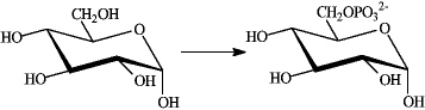 Which of the following describes this reaction?
A) is so strongly exergonic that it does not require a catalyst
B) is an exergonic reaction not coupled to any other reaction
C) is an endergonic reaction that takes place because it is coupled to the exergonic hydrolysis of ATP
D) is an exergonic reaction that is coupled to the endergonic hydrolysis of ATP
Which of the following describes this reaction?A) is so strongly exergonic that it does not require a catalyst
B) is an exergonic reaction not coupled to any other reaction
C) is an endergonic reaction that takes place because it is coupled to the exergonic hydrolysis of ATP
D) is an exergonic reaction that is coupled to the endergonic hydrolysis of ATP

سؤال
سؤال
Which group of small molecules best fit the boxes associated with the reaction shown? 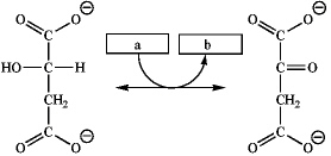 a b
a b
A) ADP + 2 Pi ATP
B) NAD+ NADH
C) NADP+ NADPH
D) FAD FADH2
a bA) ADP + 2 Pi ATP
B) NAD+ NADH
C) NADP+ NADPH
D) FAD FADH2
سؤال
Which group of small molecules best fit the boxes associated with the reaction shown? 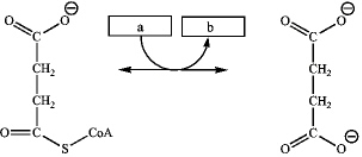 a b
a b
A) GDP GTP
B) NADP+ NADPH
C) ADP + Pi ATP
D) FAD FADH2
a bA) GDP GTP
B) NADP+ NADPH
C) ADP + Pi ATP
D) FAD FADH2
سؤال
Consider the deamination of serine to answer the following questions.

سؤال
سؤال
What product would be obtained from enzymatic transamination of 3-hydroxy-2-ketopropanoic acid? 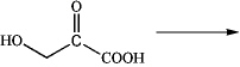
سؤال
سؤال
سؤال
سؤال
Which group of small molecules best fit the boxes associated with the reaction shown? 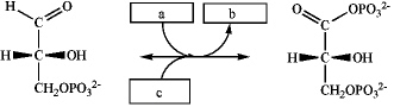 a b c
a b c
A) ATP ADP H2O
B) NADH NAD+ Pi
C) NAD+ NADH H2O
D) NAD+ NADH Pi
a b cA) ATP ADP H2O
B) NADH NAD+ Pi
C) NAD+ NADH H2O
D) NAD+ NADH Pi
سؤال
Which enzyme catalyzes the reaction shown? 
A) an epimerase
B) an isomerase
C) a mutase
D) a dehydrogenase
A) an epimerase
B) an isomerase
C) a mutase
D) a dehydrogenase
سؤال
Consider the structure of amylopectin below to answer the following questions. 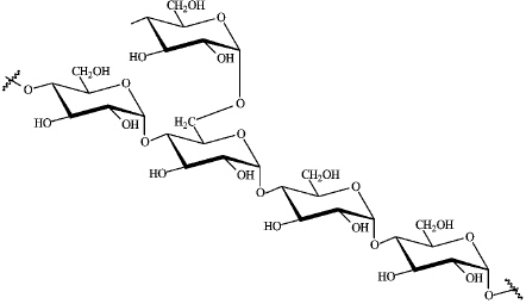

سؤال
Which group of small molecules best fit the boxes associated with the reaction shown? 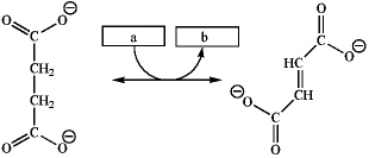 a b
a b
A) ADP + 2 Pi ATP
B) NAD+ NADH
C) ATP ADP + 2 Pi
D) FAD FADH2
a bA) ADP + 2 Pi ATP
B) NAD+ NADH
C) ATP ADP + 2 Pi
D) FAD FADH2
سؤال
Instructions: Consider the reaction below to answer the following question(s). 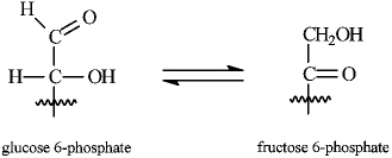 Refer to instructions. This reaction proceeds through a common enol structure. Draw the structure of the glucose/fructose enol.
Refer to instructions. This reaction proceeds through a common enol structure. Draw the structure of the glucose/fructose enol. سؤال
سؤال
Consider the reaction below to answer the following questions. 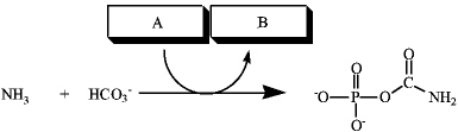
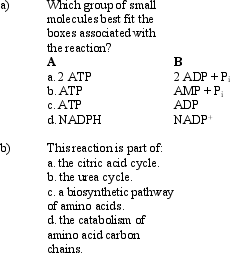
سؤال
سؤال
سؤال
سؤال
سؤال
Draw the product of the following reaction, which is involved in the catabolism of triacylglycerols. 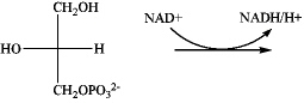
سؤال
Instructions: Consider the reaction below to answer the following question(s). 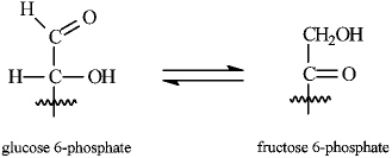 Refer to instructions. Write the mechanism for this isomerization.
Refer to instructions. Write the mechanism for this isomerization. سؤال
سؤال
Instructions: Consider the reaction below to answer the following questions: 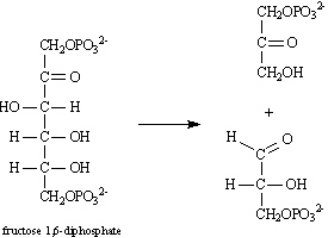 Refer to instructions. This reaction is an example of:
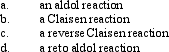
Refer to instructions. This reaction is an example of: سؤال
What is the structure of the a-keto acid formed by transamination of the amino acid isoleucine? 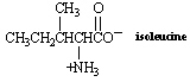
سؤال
سؤال
Instructions: Consider the reaction below to answer the following question(s). 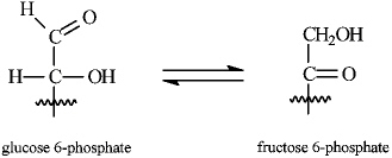 Refer to instructions. The isomerization of glucose 6-phosphate to fructose 6-phosphate is an example of:
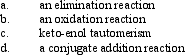
Refer to instructions. The isomerization of glucose 6-phosphate to fructose 6-phosphate is an example of: سؤال
سؤال
سؤال
Draw the structure of the ultimate organic glycolysis product of a-glucose. 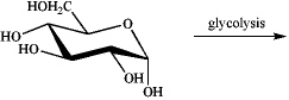
سؤال
Instructions: Consider the reaction below to answer the following questions: 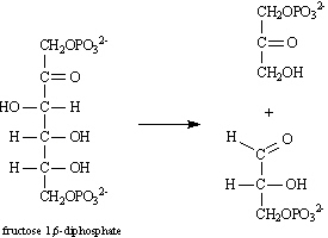 Refer to instructions. Draw arrows on the structure below showing electron flow in this reaction.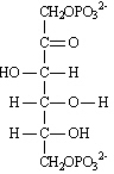
Refer to instructions. Draw arrows on the structure below showing electron flow in this reaction. سؤال
سؤال
Match between columns


فتح الحزمة
قم بالتسجيل لفتح البطاقات في هذه المجموعة!
Unlock Deck
Unlock Deck
1/34

العب

ملء الشاشة (f)
Deck 17: The Organic Chemistry of Metabolic Pathways
1
Consider the following reaction. Which of the following describes this reaction?
A) is so strongly exergonic that it does not require a catalyst
B) is an exergonic reaction not coupled to any other reaction
C) is an endergonic reaction that takes place because it is coupled to the exergonic hydrolysis of ATP
D) is an exergonic reaction that is coupled to the endergonic hydrolysis of ATP
Which of the following describes this reaction?A) is so strongly exergonic that it does not require a catalyst
B) is an exergonic reaction not coupled to any other reaction
C) is an endergonic reaction that takes place because it is coupled to the exergonic hydrolysis of ATP
D) is an exergonic reaction that is coupled to the endergonic hydrolysis of ATP
C
2
What amino acid is the following a-keto acid derived from?
 glutamic acid
3
Which group of small molecules best fit the boxes associated with the reaction shown? a b
A) ADP + 2 Pi ATP
B) NAD+ NADH
C) NADP+ NADPH
D) FAD FADH2
a bA) ADP + 2 Pi ATP
B) NAD+ NADH
C) NADP+ NADPH
D) FAD FADH2
B
4
Which group of small molecules best fit the boxes associated with the reaction shown? a b
A) GDP GTP
B) NADP+ NADPH
C) ADP + Pi ATP
D) FAD FADH2
a bA) GDP GTP
B) NADP+ NADPH
C) ADP + Pi ATP
D) FAD FADH2
فتح الحزمة
افتح القفل للوصول البطاقات البالغ عددها 34 في هذه المجموعة.
فتح الحزمة
k this deck
5
Consider the deamination of serine to answer the following questions.
فتح الحزمة
افتح القفل للوصول البطاقات البالغ عددها 34 في هذه المجموعة.
فتح الحزمة
k this deck
6
The reaction of fructose 1,6-bisphosphate to give glyceraldehyde-3-phosphate and dihydroxyacetone phosphate is an example of
A) a reverse aldol condensation
B) hydrolysis
C) oxidation
D) dehydration
A) a reverse aldol condensation
B) hydrolysis
C) oxidation
D) dehydration
فتح الحزمة
افتح القفل للوصول البطاقات البالغ عددها 34 في هذه المجموعة.
فتح الحزمة
k this deck
7
What product would be obtained from enzymatic transamination of 3-hydroxy-2-ketopropanoic acid?
فتح الحزمة
افتح القفل للوصول البطاقات البالغ عددها 34 في هذه المجموعة.
فتح الحزمة
k this deck
8
A coenzyme frequently encountered in transamination reactions is
A) tetrahydrofolate
B) pyridoxal phosphate
C) thiamine pyrophosphate
D) biotin
A) tetrahydrofolate
B) pyridoxal phosphate
C) thiamine pyrophosphate
D) biotin
فتح الحزمة
افتح القفل للوصول البطاقات البالغ عددها 34 في هذه المجموعة.
فتح الحزمة
k this deck
9
What reaction does glutamate dehydrogenase (GDH) catalyze?
A) The oxidative deamination of glutamate to yield a-ketoglutarate.
B) Phosphorylation of carbamate to yield carbamoyl phosphate.
C) The amidation of the g carboxyl group of glutamate to form glutamine.
D) The deadenylation of glutamine synthetase (GS).
E) The adenylation of glutamine synthetase.
A) The oxidative deamination of glutamate to yield a-ketoglutarate.
B) Phosphorylation of carbamate to yield carbamoyl phosphate.
C) The amidation of the g carboxyl group of glutamate to form glutamine.
D) The deadenylation of glutamine synthetase (GS).
E) The adenylation of glutamine synthetase.
فتح الحزمة
افتح القفل للوصول البطاقات البالغ عددها 34 في هذه المجموعة.
فتح الحزمة
k this deck
10
The key functional group in the PLP-dependent transamination of an a-amino acid is an activated
A) amine
B) imine
C) amide
D) enamine
A) amine
B) imine
C) amide
D) enamine
فتح الحزمة
افتح القفل للوصول البطاقات البالغ عددها 34 في هذه المجموعة.
فتح الحزمة
k this deck
11
Which group of small molecules best fit the boxes associated with the reaction shown? a b c
A) ATP ADP H2O
B) NADH NAD+ Pi
C) NAD+ NADH H2O
D) NAD+ NADH Pi
a b cA) ATP ADP H2O
B) NADH NAD+ Pi
C) NAD+ NADH H2O
D) NAD+ NADH Pi
فتح الحزمة
افتح القفل للوصول البطاقات البالغ عددها 34 في هذه المجموعة.
فتح الحزمة
k this deck
12
Which enzyme catalyzes the reaction shown?
A) an epimerase
B) an isomerase
C) a mutase
D) a dehydrogenase
A) an epimerase
B) an isomerase
C) a mutase
D) a dehydrogenase
فتح الحزمة
افتح القفل للوصول البطاقات البالغ عددها 34 في هذه المجموعة.
فتح الحزمة
k this deck
13
Consider the structure of amylopectin below to answer the following questions.
فتح الحزمة
افتح القفل للوصول البطاقات البالغ عددها 34 في هذه المجموعة.
فتح الحزمة
k this deck
14
Which group of small molecules best fit the boxes associated with the reaction shown? a b
A) ADP + 2 Pi ATP
B) NAD+ NADH
C) ATP ADP + 2 Pi
D) FAD FADH2
a bA) ADP + 2 Pi ATP
B) NAD+ NADH
C) ATP ADP + 2 Pi
D) FAD FADH2
فتح الحزمة
افتح القفل للوصول البطاقات البالغ عددها 34 في هذه المجموعة.
فتح الحزمة
k this deck
15
Instructions: Consider the reaction below to answer the following question(s). Refer to instructions. This reaction proceeds through a common enol structure. Draw the structure of the glucose/fructose enol.
Refer to instructions. This reaction proceeds through a common enol structure. Draw the structure of the glucose/fructose enol. فتح الحزمة
افتح القفل للوصول البطاقات البالغ عددها 34 في هذه المجموعة.
فتح الحزمة
k this deck
16
The formation of amino acids from proteins
A) occurs during anabolism.
B) is endergonic.
C) occurs during digestion.
D) is a cellular process.
E) all of these
A) occurs during anabolism.
B) is endergonic.
C) occurs during digestion.
D) is a cellular process.
E) all of these
فتح الحزمة
افتح القفل للوصول البطاقات البالغ عددها 34 في هذه المجموعة.
فتح الحزمة
k this deck
17
Consider the reaction below to answer the following questions.
فتح الحزمة
افتح القفل للوصول البطاقات البالغ عددها 34 في هذه المجموعة.
فتح الحزمة
k this deck
18
Many biological reactions are endergonic. Explain how it is possible that these reactions occur spontaneously.
فتح الحزمة
افتح القفل للوصول البطاقات البالغ عددها 34 في هذه المجموعة.
فتح الحزمة
k this deck
19
During the complete catabolism of a molecule of glucose, the ultimate fate of the carbon atoms are
A) pyruvate
B) AcetylCoA
C) carbon dioxide
D) fructose-6-phosphate
E) a, b or c
A) pyruvate
B) AcetylCoA
C) carbon dioxide
D) fructose-6-phosphate
E) a, b or c
فتح الحزمة
افتح القفل للوصول البطاقات البالغ عددها 34 في هذه المجموعة.
فتح الحزمة
k this deck
20
When acetyl-CoA reacts with oxaloacetate to form citrate
A) a new carbon-carbon bond is formed
B) an oxidative decarboxylation reaction takes place
C) a dehydration reaction takes place
D) a rearrangement takes place
A) a new carbon-carbon bond is formed
B) an oxidative decarboxylation reaction takes place
C) a dehydration reaction takes place
D) a rearrangement takes place
فتح الحزمة
افتح القفل للوصول البطاقات البالغ عددها 34 في هذه المجموعة.
فتح الحزمة
k this deck
21
Draw and name the major product of the reaction of a-glucose with ATP.
a-glucose-6-phosphate
a-glucose-6-phosphate
فتح الحزمة
افتح القفل للوصول البطاقات البالغ عددها 34 في هذه المجموعة.
فتح الحزمة
k this deck
22
Draw the product of the following reaction, which is involved in the catabolism of triacylglycerols.
فتح الحزمة
افتح القفل للوصول البطاقات البالغ عددها 34 في هذه المجموعة.
فتح الحزمة
k this deck
23
Instructions: Consider the reaction below to answer the following question(s). Refer to instructions. Write the mechanism for this isomerization.
Refer to instructions. Write the mechanism for this isomerization. فتح الحزمة
افتح القفل للوصول البطاقات البالغ عددها 34 في هذه المجموعة.
فتح الحزمة
k this deck
24
How many molecules of acetyl CoA are produced in the catabolism of stearic acid?
فتح الحزمة
افتح القفل للوصول البطاقات البالغ عددها 34 في هذه المجموعة.
فتح الحزمة
k this deck
25
Instructions: Consider the reaction below to answer the following questions: Refer to instructions. This reaction is an example of:
Refer to instructions. This reaction is an example of: فتح الحزمة
افتح القفل للوصول البطاقات البالغ عددها 34 في هذه المجموعة.
فتح الحزمة
k this deck
26
What is the structure of the a-keto acid formed by transamination of the amino acid isoleucine?
فتح الحزمة
افتح القفل للوصول البطاقات البالغ عددها 34 في هذه المجموعة.
فتح الحزمة
k this deck
27
All of the following describe b-oxidation, except:
A) Two-carbon units are eliminated during each cycle.
B) The process employs NAD+ as an oxidant.
C) The process is the primary route to fatty acid degradation.
D) The 2-carbon groups are eliminated from the methyl end of the fatty acid.
E) Fatty acids are attached to coenzyme A during the process.
A) Two-carbon units are eliminated during each cycle.
B) The process employs NAD+ as an oxidant.
C) The process is the primary route to fatty acid degradation.
D) The 2-carbon groups are eliminated from the methyl end of the fatty acid.
E) Fatty acids are attached to coenzyme A during the process.
فتح الحزمة
افتح القفل للوصول البطاقات البالغ عددها 34 في هذه المجموعة.
فتح الحزمة
k this deck
28
Instructions: Consider the reaction below to answer the following question(s). Refer to instructions. The isomerization of glucose 6-phosphate to fructose 6-phosphate is an example of:
Refer to instructions. The isomerization of glucose 6-phosphate to fructose 6-phosphate is an example of: فتح الحزمة
افتح القفل للوصول البطاقات البالغ عددها 34 في هذه المجموعة.
فتح الحزمة
k this deck
29
All of the following are byproducts of b-oxidation, except:
A) Acetyl CoA
B) ADP
C) NADH
D) FADH2
E) All of these are byproducts of b-oxidation.
A) Acetyl CoA
B) ADP
C) NADH
D) FADH2
E) All of these are byproducts of b-oxidation.
فتح الحزمة
افتح القفل للوصول البطاقات البالغ عددها 34 في هذه المجموعة.
فتح الحزمة
k this deck
30
Instructions: Match a term or structure from the list below to each of the following definitions or names.
فتح الحزمة
افتح القفل للوصول البطاقات البالغ عددها 34 في هذه المجموعة.
فتح الحزمة
k this deck
31
Draw the structure of the ultimate organic glycolysis product of a-glucose.
فتح الحزمة
افتح القفل للوصول البطاقات البالغ عددها 34 في هذه المجموعة.
فتح الحزمة
k this deck
32
Instructions: Consider the reaction below to answer the following questions: Refer to instructions. Draw arrows on the structure below showing electron flow in this reaction.
Refer to instructions. Draw arrows on the structure below showing electron flow in this reaction. فتح الحزمة
افتح القفل للوصول البطاقات البالغ عددها 34 في هذه المجموعة.
فتح الحزمة
k this deck
33
The source of oxygen for b-oxidation is:
A) CO2
B) O2
C) Peroxide
D) Water
E) None of these is the source of oxygen for b-oxidation.
A) CO2
B) O2
C) Peroxide
D) Water
E) None of these is the source of oxygen for b-oxidation.
فتح الحزمة
افتح القفل للوصول البطاقات البالغ عددها 34 في هذه المجموعة.
فتح الحزمة
k this deck
35
Match between columns
فتح الحزمة
افتح القفل للوصول البطاقات البالغ عددها 34 في هذه المجموعة.
فتح الحزمة
k this deck
فتح الحزمة
افتح القفل للوصول البطاقات البالغ عددها 34 في هذه المجموعة.






