







 تكلم مع الذكاء الاصطناعي


Deck 15: Chemical Kinetics
ملء الشاشة (f)

سؤال
The following questions refer to the hypothetical reaction A + B products. The kinetics data given can be analyzed to answer the questions. ![<strong>The following questions refer to the hypothetical reaction A + B \rightarrow products. The kinetics data given can be analyzed to answer the questions. -The rate expression for a particular reaction is Rate = k[A][B]<sup>3</sup>. If the initial concentration of B is increased from 0.2 M to 0.6 M, the initial rate will increase by which of the following factors?</strong> A) 6 B) 3 C) 27 D) 4 E) 12 <div style=padding-top: 35px>](https://d2lvgg3v3hfg70.cloudfront.net/TB6420/11eaaf8d_c1e8_56a9_892c_5191392ecc9f_TB6420_00_TB6420_00_TB6420_00.jpg)
-The rate expression for a particular reaction is Rate = k[A][B]3. If the initial concentration of B is increased from 0.2 M to 0.6 M, the initial rate will increase by which of the following factors?
A) 6
B) 3
C) 27
D) 4
E) 12
-The rate expression for a particular reaction is Rate = k[A][B]3. If the initial concentration of B is increased from 0.2 M to 0.6 M, the initial rate will increase by which of the following factors?
A) 6
B) 3
C) 27
D) 4
E) 12

سؤال
A general reaction written as 2A + 2B C + 2D is studied and yields the following data. ![<strong>A general reaction written as 2A + 2B \rightarrow C + 2D is studied and yields the following data. -For the first of the reactions in the table of data, determine - \Delta [B]/ \Delta t.</strong> A) 8.00* 10<sup>-</sup><sup>5</sup> B) 1.60*10<sup>-</sup><sup>4</sup> C) 4.00 *10<sup>-</sup><sup>5</sup> D) 2.00 *10<sup>-</sup><sup>5</sup> E) none of these <div style=padding-top: 35px>](https://d2lvgg3v3hfg70.cloudfront.net/TB6420/11eaaf8d_c1e8_cbda_892c_db802d0aade0_TB6420_00_TB6420_00_TB6420_00_TB6420_00_TB6420_00_TB6420_00.jpg)
-For the first of the reactions in the table of data, determine - [B]/ t.
A) 8.00* 10-5
B) 1.60*10-4
C) 4.00 *10-5
D) 2.00 *10-5
E) none of these
-For the first of the reactions in the table of data, determine - [B]/ t.
A) 8.00* 10-5
B) 1.60*10-4
C) 4.00 *10-5
D) 2.00 *10-5
E) none of these
سؤال
A general reaction written as 2A + 2B C + 2D is studied and yields the following data.
-What is the overall order of the reaction?
A) 0
B) 2
C) 3
D) 4
E) 1
-What is the overall order of the reaction?
A) 0
B) 2
C) 3
D) 4
E) 1
سؤال
The following questions refer to the hypothetical reaction A + B products. The kinetics data given can be analyzed to answer the questions.
-The rate law for the reaction is Rate = k[A]x[B]y. What are the values of x and y?
A) x = 1 y = 0
B) x = 1 y = 1
C) x = 0 y = 1
D) x = 1 y = 2
E) x = 2 y = 1
-The rate law for the reaction is Rate = k[A]x[B]y. What are the values of x and y?
A) x = 1 y = 0
B) x = 1 y = 1
C) x = 0 y = 1
D) x = 1 y = 2
E) x = 2 y = 1
سؤال
سؤال
The following questions refer to the hypothetical reaction A + B products. The kinetics data given can be analyzed to answer the questions.
-What form will the pseudo-rate law have?
A) Rate = kk'[A]x
B) Rate = k'[A]x[B]y
C) Rate = kk'[B]y
D) Rate = k'[B]y
E) Rate = k'[A]x
-What form will the pseudo-rate law have?
A) Rate = kk'[A]x
B) Rate = k'[A]x[B]y
C) Rate = kk'[B]y
D) Rate = k'[B]y
E) Rate = k'[A]x
سؤال
The oxidation of Cr3+ to CrO42- can be accomplished using Ce4+ in a buffered solution. The following data were obtained: 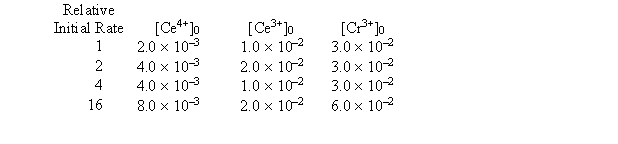
Determine the order in the rate law of the species Ce4+.
A) 1
B) -2
C) 3
D) -1
E) 2
Determine the order in the rate law of the species Ce4+.
A) 1
B) -2
C) 3
D) -1
E) 2
سؤال
A general reaction written as 2A + 2B C + 2D is studied and yields the following data.
-What are the proper units for the rate constant for the reaction?
A) L mol-1 s-1
B) s-1
C) L3 mol-3 s-1
D) mol L-1 s-1
E) L2 mol-2 s-1
-What are the proper units for the rate constant for the reaction?
A) L mol-1 s-1
B) s-1
C) L3 mol-3 s-1
D) mol L-1 s-1
E) L2 mol-2 s-1
سؤال
For the reaction 2N2O5(g) 4NO2(g) + O2(g), the following data were collected. 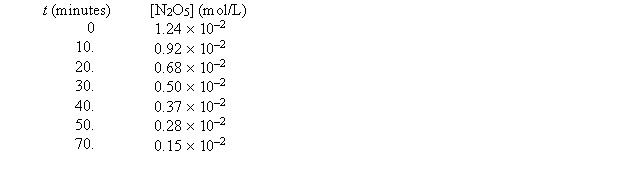 The initial rate of production of NO2 for this reaction is approximately
A) 6.4 *10-4 mol/L • min
B) 3.2*10-4 mol/L • min
C) 1.24* 10-2 mol/L • min
D) 1.6 * 10-4 mol/L • min
E) none of these
The initial rate of production of NO2 for this reaction is approximatelyA) 6.4 *10-4 mol/L • min
B) 3.2*10-4 mol/L • min
C) 1.24* 10-2 mol/L • min
D) 1.6 * 10-4 mol/L • min
E) none of these
سؤال
A general reaction written as 2A + 2B C + 2D is studied and yields the following data.
-What is the order of the reaction with respect to A?
A) 1
B) 0
C) 4
D) 3
E) 2
-What is the order of the reaction with respect to A?
A) 1
B) 0
C) 4
D) 3
E) 2
سؤال
A general reaction written as 2A + 2B C + 2D is studied and yields the following data.
-What is the order of the reaction with respect to B?
A) 3
B) 2
C) 4
D) 1
E) 0
-What is the order of the reaction with respect to B?
A) 3
B) 2
C) 4
D) 1
E) 0
سؤال
The oxidation of Cr3+ to CrO42- can be accomplished using Ce4+ in a buffered solution. The following data were obtained:
Determine the order in the rate law of the species Cr3+.
A) -2
B) 3
C) 1
D) 2
E) -1
Determine the order in the rate law of the species Cr3+.
A) -2
B) 3
C) 1
D) 2
E) -1
سؤال
سؤال
A general reaction written as 2A + 2B C + 2D is studied and yields the following data.
-What is the numerical value of the rate constant?
A) 4.00 * 10-1
B) 4.00* 10-2
C) 4.00 * 10-3
D) 4.00 * 10-4
E) none of these
-What is the numerical value of the rate constant?
A) 4.00 * 10-1
B) 4.00* 10-2
C) 4.00 * 10-3
D) 4.00 * 10-4
E) none of these
سؤال
The oxidation of Cr3+ to CrO42- can be accomplished using Ce4+ in a buffered solution. The following data were obtained:
Determine the order in the rate law of the species Ce3+.
A) -1
B) 2
C) 3
D) -2
E) 1
Determine the order in the rate law of the species Ce3+.
A) -1
B) 2
C) 3
D) -2
E) 1
سؤال
The reaction
H2SeO3(aq) + 6I-(aq) + 4H+(aq) 2I3-(aq) + 3H2O(l) + Se(s)
was studied at 0°C by the method of initial rates:![<strong>The reaction H<sub>2</sub>SeO<sub>3</sub>(aq) + 6I<sup>-</sup>(aq) + 4H<sup>+</sup>(aq) \rightarrow 2I<sub>3</sub><sup>-</sup>(aq) + 3H<sub>2</sub>O(l) + Se(s) was studied at 0°C by the method of initial rates: -What is the rate law?</strong> A) Rate = k[H<sub>2</sub>SeO<sub>3</sub>][H<sup>+</sup>][I<sup>-</sup>]<sup>2</sup> B) Rate = k[H<sub>2</sub>SeO<sub>3</sub>][H<sup>+</sup>]<sup>2</sup>[I<sup>-</sup>]<sup>3</sup> C) Rate = k[H<sub>2</sub>SeO<sub>3</sub>][H<sup>+</sup>][I<sup>-</sup>] D) Rate = k[H<sub>2</sub>SeO<sub>3</sub>][H<sup>+</sup>]<sup>2</sup>[I<sup>-</sup>] E) Rate = k[H<sub>2</sub>SeO<sub>3</sub>]<sup>2</sup>[H<sup>+</sup>][I<sup>-</sup>] <div style=padding-top: 35px>](https://d2lvgg3v3hfg70.cloudfront.net/TB6420/11eaaf8d_c1ea_045c_892c_172f5ee27ea0_TB6420_00_TB6420_00.jpg)
-What is the rate law?
A) Rate = k[H2SeO3][H+][I-]2
B) Rate = k[H2SeO3][H+]2[I-]3
C) Rate = k[H2SeO3][H+][I-]
D) Rate = k[H2SeO3][H+]2[I-]
E) Rate = k[H2SeO3]2[H+][I-]
H2SeO3(aq) + 6I-(aq) + 4H+(aq) 2I3-(aq) + 3H2O(l) + Se(s)
was studied at 0°C by the method of initial rates:
-What is the rate law?
A) Rate = k[H2SeO3][H+][I-]2
B) Rate = k[H2SeO3][H+]2[I-]3
C) Rate = k[H2SeO3][H+][I-]
D) Rate = k[H2SeO3][H+]2[I-]
E) Rate = k[H2SeO3]2[H+][I-]
سؤال
سؤال
سؤال
For the reaction
2A + B products
the following mechanism is proposed:
A + B M
M
A + M products
A catalyst never appears in a rate law.
2A + B products
the following mechanism is proposed:
A + B
MA + M products
A catalyst never appears in a rate law.
سؤال
The following data were obtained for the reaction of NO with O2. Concentrations are in molecules/cm3 and rates are in molecules/cm3 • s. ![<strong>The following data were obtained for the reaction of NO with O<sub>2</sub>. Concentrations are in molecules/cm<sup>3</sup> and rates are in molecules/cm<sup>3</sup> • s. Which of the following is the correct rate law?</strong> A) Rate = k[NO]<sup>2</sup> B) Rate = k[NO]<sup>2</sup>[O<sub>2</sub>]<sup>2</sup> C) Rate = k[NO][O<sub>2</sub>]<sup>2</sup> D) Rate = k[NO][O<sub>2</sub>] E) Rate = k[NO]<sup>2</sup>[O<sub>2</sub>] <div style=padding-top: 35px>](https://d2lvgg3v3hfg70.cloudfront.net/TB6420/11eaaf8d_c1e9_8f2b_892c_893716343e3e_TB6420_00.jpg) Which of the following is the correct rate law?
Which of the following is the correct rate law?
A) Rate = k[NO]2
B) Rate = k[NO]2[O2]2
C) Rate = k[NO][O2]2
D) Rate = k[NO][O2]
E) Rate = k[NO]2[O2]
Which of the following is the correct rate law?A) Rate = k[NO]2
B) Rate = k[NO]2[O2]2
C) Rate = k[NO][O2]2
D) Rate = k[NO][O2]
E) Rate = k[NO]2[O2]
سؤال
سؤال
Initial rate data have been determined at a certain temperature for the gaseous reaction 2NO + 2H2 N2 + 2H2O  What is the numerical value of the rate constant?
A) 1.1
B) 6.9
C) 2.2
D) 0.11
E) 0.35
What is the numerical value of the rate constant?A) 1.1
B) 6.9
C) 2.2
D) 0.11
E) 0.35
سؤال
The following initial rate data were found for the reaction
2MnO4- + 5H2C2O4 + 6H+ 2Mn2+ + 10CO2 + 8H2O![<strong>The following initial rate data were found for the reaction 2MnO<sub>4</sub><sup>-</sup> + 5H<sub>2</sub>C<sub>2</sub>O<sub>4</sub> + 6H<sup>+</sup> \rightarrow 2Mn<sup>2+</sup> + 10CO<sub>2</sub> + 8H<sub>2</sub>O -Which of the following is the correct rate law?</strong> A) Rate = k[MnO<sub>4</sub><sup>-</sup>][H<sub>2</sub>C<sub>2</sub>O<sub>4</sub>][H<sup>+</sup>] B) Rate = k[MnO<sub>4</sub><sup>-</sup>]<sup>2</sup>[H<sub>2</sub>C<sub>2</sub>O<sub>4</sub>][H<sup>+</sup>] C) Rate = k[MnO<sub>4</sub><sup>-</sup>]<sup>2</sup>[H<sub>2</sub>C<sub>2</sub>O<sub>4</sub>] D) Rate = k[MnO<sub>4</sub><sup>-</sup>][H<sub>2</sub>C<sub>2</sub>O<sub>4</sub>]<sup>2</sup> E) Rate = k[MnO<sub>4</sub><sup>-</sup>]<sup>2</sup>[H<sub>2</sub>C<sub>2</sub>O<sub>4</sub>]<sup>5</sup>[H<sup>+</sup>]<sup>6</sup> <div style=padding-top: 35px>](https://d2lvgg3v3hfg70.cloudfront.net/TB6420/11eff460_d311_5218_9103_ad93f3eb4915_TB6420_00.jpg)
-Which of the following is the correct rate law?
A) Rate = k[MnO4-][H2C2O4][H+]
B) Rate = k[MnO4-]2[H2C2O4][H+]
C) Rate = k[MnO4-]2[H2C2O4]
D) Rate = k[MnO4-][H2C2O4]2
E) Rate = k[MnO4-]2[H2C2O4]5[H+]6
2MnO4- + 5H2C2O4 + 6H+ 2Mn2+ + 10CO2 + 8H2O
-Which of the following is the correct rate law?
A) Rate = k[MnO4-][H2C2O4][H+]
B) Rate = k[MnO4-]2[H2C2O4][H+]
C) Rate = k[MnO4-]2[H2C2O4]
D) Rate = k[MnO4-][H2C2O4]2
E) Rate = k[MnO4-]2[H2C2O4]5[H+]6
سؤال
The following initial rate data were found for the reaction
2MnO4- + 5H2C2O4 + 6H+ 2Mn2+ + 10CO2 + 8H2O
-For which order reaction is the half-life of the reaction independent of the initial concentration of the reactant(s)?
A) zero order
B) first order
C) second order
D) all of these
E) none of these
2MnO4- + 5H2C2O4 + 6H+ 2Mn2+ + 10CO2 + 8H2O
-For which order reaction is the half-life of the reaction independent of the initial concentration of the reactant(s)?
A) zero order
B) first order
C) second order
D) all of these
E) none of these
سؤال
Use the following initial rate data for the reaction in aqueous solution to determine the rate law. ![<strong>Use the following initial rate data for the reaction in aqueous solution to determine the rate law. </strong> A) Rate = k[CH<sub>3</sub>COCH<sub>3</sub>][H<sup>+</sup>] B) Rate = k[CH<sub>3</sub>COCH<sub>3</sub>][Br<sub>2</sub>][H<sup>+</sup>] C) Rate = k[Br<sub>2</sub>][H<sup>+</sup>] D) Rate = k[CH<sub>3</sub>COCH<sub>3</sub>][Br<sub>2</sub>][H<sup>+</sup>]<sup>2</sup> E) Rate = k[CH<sub>3</sub>COCH<sub>3</sub>][Br<sub>2</sub>] <div style=padding-top: 35px>](https://d2lvgg3v3hfg70.cloudfront.net/TB6420/11eaaf8d_c1ea_a09d_892c_e7479a955438_TB6420_00.jpg)
A) Rate = k[CH3COCH3][H+]
B) Rate = k[CH3COCH3][Br2][H+]
C) Rate = k[Br2][H+]
D) Rate = k[CH3COCH3][Br2][H+]2
E) Rate = k[CH3COCH3][Br2]
A) Rate = k[CH3COCH3][H+]
B) Rate = k[CH3COCH3][Br2][H+]
C) Rate = k[Br2][H+]
D) Rate = k[CH3COCH3][Br2][H+]2
E) Rate = k[CH3COCH3][Br2]
سؤال
The following initial rate data were found for the reaction
2MnO4- + 5H2C2O4 + 6H+ 2Mn2+ + 10CO2 + 8H2O
-What is the value of the rate constant?
A) 2 * 105 M • s-1
B) 2 * 105 M-2 • s-1
C) 200 M-2 • s-1
D) 2 *10-4 M • s-1
E) 200 M-1 • s-1
2MnO4- + 5H2C2O4 + 6H+ 2Mn2+ + 10CO2 + 8H2O
-What is the value of the rate constant?
A) 2 * 105 M • s-1
B) 2 * 105 M-2 • s-1
C) 200 M-2 • s-1
D) 2 *10-4 M • s-1
E) 200 M-1 • s-1
سؤال
The reaction of (CH3)3CBr with hydroxide ion proceeds with the formation of (CH3)3COH. (CH3)3CBr (aq) + OH- (aq) (CH3)3COH (aq) + Br- (aq)
The following data were obtained at 55°C.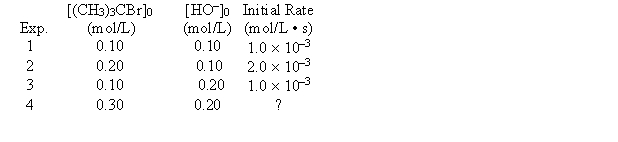 What will the initial rate (in mol/L • s) be in Experiment 4?
A) 18 *10-3
B) 6.0 * 10-3
C) 9.0 * 10-3
D) 3.0* 10-3
E) none of these
The following data were obtained at 55°C.
What will the initial rate (in mol/L • s) be in Experiment 4?A) 18 *10-3
B) 6.0 * 10-3
C) 9.0 * 10-3
D) 3.0* 10-3
E) none of these
سؤال
For the reaction in which A and B react to form C, the following initial rate data were obtained. ![<strong>For the reaction in which A and B react to form C, the following initial rate data were obtained. What is the rate law for the reaction?</strong> A) Rate = k[A]<sup>2</sup>[B]<sup>2</sup> B) Rate = k[A]<sup>2</sup>[B] C) Rate = k[A][B]<sup>2</sup> D) Rate = k[A][B] E) Rate = k[A]<sup>3</sup> <div style=padding-top: 35px>](https://d2lvgg3v3hfg70.cloudfront.net/TB6420/11eaaf8d_c1ec_4e53_892c_09922b7b1856_TB6420_00.jpg) What is the rate law for the reaction?
What is the rate law for the reaction?
A) Rate = k[A]2[B]2
B) Rate = k[A]2[B]
C) Rate = k[A][B]2
D) Rate = k[A][B]
E) Rate = k[A]3
What is the rate law for the reaction?A) Rate = k[A]2[B]2
B) Rate = k[A]2[B]
C) Rate = k[A][B]2
D) Rate = k[A][B]
E) Rate = k[A]3
سؤال
The following questions refer to the hypothetical reaction A + B products. The kinetics data given can be analyzed to answer the questions. 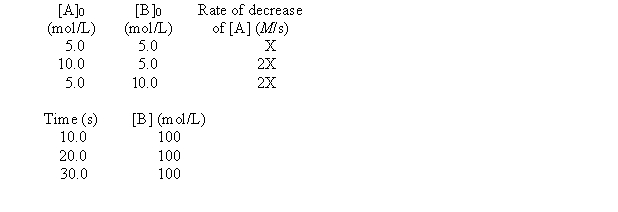 Determine the magnitude of the pseudo-rate constant (k') if the magnitude of X in the rate data is 0.00905.
A) 0.31
B) 1.81 *10-3
C) 4.3 *10-3
D) 0.86
E) 1.2 * 10-2
Determine the magnitude of the pseudo-rate constant (k') if the magnitude of X in the rate data is 0.00905.A) 0.31
B) 1.81 *10-3
C) 4.3 *10-3
D) 0.86
E) 1.2 * 10-2
سؤال
سؤال
For the reaction A + B products, the following data were obtained. ![<strong>For the reaction A + B \rightarrow products, the following data were obtained. What is the experimental rate law?</strong> A) Rate = k[A]<sup>2</sup>[B] B) Rate = k[B] C) Rate = k[A][B] D) Rate = k[A] E) Rate = k[A][B]<sup> 2</sup> <div style=padding-top: 35px>](https://d2lvgg3v3hfg70.cloudfront.net/TB6420/11eaaf8d_c1eb_8b01_892c_9d96b288d9d1_TB6420_00.jpg) What is the experimental rate law?
What is the experimental rate law?
A) Rate = k[A]2[B]
B) Rate = k[B]
C) Rate = k[A][B]
D) Rate = k[A]
E) Rate = k[A][B] 2
What is the experimental rate law?A) Rate = k[A]2[B]
B) Rate = k[B]
C) Rate = k[A][B]
D) Rate = k[A]
E) Rate = k[A][B] 2
سؤال
Tabulated below are initial rate data for the reaction 2Fe(CN)63- + 2I- 2Fe(CN)64- + I2 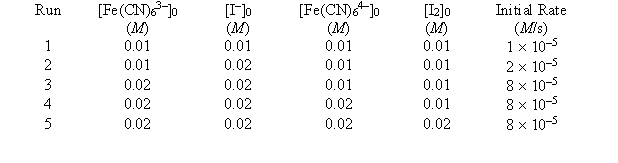 What is the value of k?
A) 103 M-3 s-1
B) 50 M-2 s-1
C) 10 M-2 s-1
D) 107 M-5 s-1
E) none of these
What is the value of k?A) 103 M-3 s-1
B) 50 M-2 s-1
C) 10 M-2 s-1
D) 107 M-5 s-1
E) none of these
سؤال
What is the rate law for the following reaction, given the data below? 2NO + H2 N2O + H2O ![<strong>What is the rate law for the following reaction, given the data below? 2NO + H<sub>2</sub> \rightarrow N<sub>2</sub>O + H<sub>2</sub>O </strong> A) Rate = k[N<sub>2</sub>O][H<sub>2</sub>O] B) Rate = k[NO][H<sub>2</sub>] C) Rate = k[NO]<sup>2</sup>[H<sub>2</sub>] D) Rate = k[NO] E) Rate = k[NO]<sup>2</sup> <div style=padding-top: 35px>](https://d2lvgg3v3hfg70.cloudfront.net/TB6420/11eaaf8d_c1eb_15cf_892c_fbe60dead337_TB6420_00.jpg)
A) Rate = k[N2O][H2O]
B) Rate = k[NO][H2]
C) Rate = k[NO]2[H2]
D) Rate = k[NO]
E) Rate = k[NO]2
A) Rate = k[N2O][H2O]
B) Rate = k[NO][H2]
C) Rate = k[NO]2[H2]
D) Rate = k[NO]
E) Rate = k[NO]2
سؤال
The following initial rate data were found for the reaction
2MnO4- + 5H2C2O4 + 6H+ 2Mn2+ + 10CO2 + 8H2O
-The reaction A B + C is known to be zero order in A with a rate constant of 5.0 *10-2 mol/L • s at 25° C. An experiment was run at 25°C where [A]0 = 1.0 *10-3 M. What is the integrated rate law?
A) [A] = kt
B) [A]0 - [A] = kt
C)![<strong>The following initial rate data were found for the reaction 2MnO<sub>4</sub><sup>-</sup> + 5H<sub>2</sub>C<sub>2</sub>O<sub>4</sub> + 6H<sup>+</sup> \rightarrow 2Mn<sup>2+</sup> + 10CO<sub>2</sub> + 8H<sub>2</sub>O -The reaction A \rightarrow B + C is known to be zero order in A with a rate constant of 5.0 *10<sup>-</sup><sup>2</sup> mol/L • s at 25° C. An experiment was run at 25°C where [A]<sub>0</sub> = 1.0 *10<sup>-</sup><sup>3</sup> M. What is the integrated rate law?</strong> A) [A] = kt B) [A]<sub>0</sub> - [A] = kt C) D) [A] - [A]<sub>0</sub> = kt E) <div style=padding-top: 35px>](https://d2lvgg3v3hfg70.cloudfront.net/TB6420/11eff461_156b_b5b9_9103_031bf8ef21f7_TB6420_00.jpg)
D) [A] - [A]0 = kt
E)![<strong>The following initial rate data were found for the reaction 2MnO<sub>4</sub><sup>-</sup> + 5H<sub>2</sub>C<sub>2</sub>O<sub>4</sub> + 6H<sup>+</sup> \rightarrow 2Mn<sup>2+</sup> + 10CO<sub>2</sub> + 8H<sub>2</sub>O -The reaction A \rightarrow B + C is known to be zero order in A with a rate constant of 5.0 *10<sup>-</sup><sup>2</sup> mol/L • s at 25° C. An experiment was run at 25°C where [A]<sub>0</sub> = 1.0 *10<sup>-</sup><sup>3</sup> M. What is the integrated rate law?</strong> A) [A] = kt B) [A]<sub>0</sub> - [A] = kt C) D) [A] - [A]<sub>0</sub> = kt E) <div style=padding-top: 35px>](https://d2lvgg3v3hfg70.cloudfront.net/TB6420/11eff461_22e1_9a2a_9103_a74d343438db_TB6420_00.jpg)
2MnO4- + 5H2C2O4 + 6H+ 2Mn2+ + 10CO2 + 8H2O
-The reaction A B + C is known to be zero order in A with a rate constant of 5.0 *10-2 mol/L • s at 25° C. An experiment was run at 25°C where [A]0 = 1.0 *10-3 M. What is the integrated rate law?
A) [A] = kt
B) [A]0 - [A] = kt
C)
D) [A] - [A]0 = kt
E)
سؤال
The decomposition of N2O5(g) to NO2(g) and O2(g) obeys first-order kinetics. Assume the form of the rate law is
Rate![<strong>The decomposition of N<sub>2</sub>O<sub>5</sub>(g) to NO<sub>2</sub>(g) and O<sub>2</sub>(g) obeys first-order kinetics. Assume the form of the rate law is Rate where k = 3.4 *10<sup>-</sup><sup>5</sup> s<sup>-</sup><sup>1</sup> at 25°C. -What is the initial rate of reaction at 25°C where [N<sub>2</sub>O<sub>5</sub>]<sub>0</sub> = 5.0 *10<sup>-</sup><sup>2</sup> M?</strong> A) 3.4 * 10<sup>-</sup><sup>5</sup> mol/L • s B) 5.0 * 10<sup>-</sup><sup>2</sup> mol/L • s C) 6.8*10<sup>-</sup><sup>4</sup> mol/L • s D) 1.7* 10<sup>-</sup><sup>6</sup> mol/L • s E) none of these <div style=padding-top: 35px>](https://d2lvgg3v3hfg70.cloudfront.net/TB6420/11eaaf8d_c1ef_82b1_892c_934fc1807a1a_TB6420_11_TB6420_11.jpg) where k = 3.4 *10-5 s-1 at 25°C.
where k = 3.4 *10-5 s-1 at 25°C.
-What is the initial rate of reaction at 25°C where [N2O5]0 = 5.0 *10-2 M?
A) 3.4 * 10-5 mol/L • s
B) 5.0 * 10-2 mol/L • s
C) 6.8*10-4 mol/L • s
D) 1.7* 10-6 mol/L • s
E) none of these
Rate
where k = 3.4 *10-5 s-1 at 25°C.-What is the initial rate of reaction at 25°C where [N2O5]0 = 5.0 *10-2 M?
A) 3.4 * 10-5 mol/L • s
B) 5.0 * 10-2 mol/L • s
C) 6.8*10-4 mol/L • s
D) 1.7* 10-6 mol/L • s
E) none of these
سؤال
Tabulated below are initial rate data for the reaction 2Fe(CN)63- + 2I- 2Fe(CN)64- + I2 ![<strong>Tabulated below are initial rate data for the reaction 2Fe(CN)<sub>6</sub><sup>3</sup><sup>-</sup> + 2I<sup>-</sup> \rightarrow 2Fe(CN)<sub>6</sub><sup>4</sup><sup>-</sup> + I<sub>2</sub> What is the experimental rate law?</strong> A) k[Fe(CN)<sub>6</sub><sup>3</sup><sup>-</sup>][I<sup>-</sup>]<sup>2</sup> B) k[Fe(CN)<sub>6</sub><sup>3</sup><sup>-</sup>][I<sup>-</sup>] [Fe(CN)<sub>6</sub><sup>4</sup><sup>-</sup>] C) k[Fe(CN)<sub>6</sub><sup>3</sup><sup>-</sup>]<sup>2</sup>[I<sup>-</sup>] D) k[Fe(CN)<sub>6</sub><sup>3</sup><sup>-</sup>]<sup>2</sup>[I<sup>-</sup>]<sup>2</sup>[Fe(CN)<sub>6</sub><sup>4</sup><sup>-</sup>]<sup>2</sup>[I<sub>2</sub>] E) k[Fe(CN)<sub>6</sub><sup>3</sup><sup>-</sup>]<sup>2</sup>[I<sup>-</sup>][Fe(CN)<sub>6</sub><sup>4</sup><sup>-</sup>][I<sub>2</sub>] <div style=padding-top: 35px>](https://d2lvgg3v3hfg70.cloudfront.net/TB6420/11eaaf8d_c1ec_7564_892c_6bb38f2001ad_TB6420_00.jpg) What is the experimental rate law?
What is the experimental rate law?
A)![<strong>Tabulated below are initial rate data for the reaction 2Fe(CN)<sub>6</sub><sup>3</sup><sup>-</sup> + 2I<sup>-</sup> \rightarrow 2Fe(CN)<sub>6</sub><sup>4</sup><sup>-</sup> + I<sub>2</sub> What is the experimental rate law?</strong> A) k[Fe(CN)<sub>6</sub><sup>3</sup><sup>-</sup>][I<sup>-</sup>]<sup>2</sup> B) k[Fe(CN)<sub>6</sub><sup>3</sup><sup>-</sup>][I<sup>-</sup>] [Fe(CN)<sub>6</sub><sup>4</sup><sup>-</sup>] C) k[Fe(CN)<sub>6</sub><sup>3</sup><sup>-</sup>]<sup>2</sup>[I<sup>-</sup>] D) k[Fe(CN)<sub>6</sub><sup>3</sup><sup>-</sup>]<sup>2</sup>[I<sup>-</sup>]<sup>2</sup>[Fe(CN)<sub>6</sub><sup>4</sup><sup>-</sup>]<sup>2</sup>[I<sub>2</sub>] E) k[Fe(CN)<sub>6</sub><sup>3</sup><sup>-</sup>]<sup>2</sup>[I<sup>-</sup>][Fe(CN)<sub>6</sub><sup>4</sup><sup>-</sup>][I<sub>2</sub>] <div style=padding-top: 35px>](https://d2lvgg3v3hfg70.cloudfront.net/TB6420/11eaaf8d_c1ec_9c75_892c_3712c843185a_TB6420_11.jpg) k[Fe(CN)63-][I-]2
k[Fe(CN)63-][I-]2
B)![<strong>Tabulated below are initial rate data for the reaction 2Fe(CN)<sub>6</sub><sup>3</sup><sup>-</sup> + 2I<sup>-</sup> \rightarrow 2Fe(CN)<sub>6</sub><sup>4</sup><sup>-</sup> + I<sub>2</sub> What is the experimental rate law?</strong> A) k[Fe(CN)<sub>6</sub><sup>3</sup><sup>-</sup>][I<sup>-</sup>]<sup>2</sup> B) k[Fe(CN)<sub>6</sub><sup>3</sup><sup>-</sup>][I<sup>-</sup>] [Fe(CN)<sub>6</sub><sup>4</sup><sup>-</sup>] C) k[Fe(CN)<sub>6</sub><sup>3</sup><sup>-</sup>]<sup>2</sup>[I<sup>-</sup>] D) k[Fe(CN)<sub>6</sub><sup>3</sup><sup>-</sup>]<sup>2</sup>[I<sup>-</sup>]<sup>2</sup>[Fe(CN)<sub>6</sub><sup>4</sup><sup>-</sup>]<sup>2</sup>[I<sub>2</sub>] E) k[Fe(CN)<sub>6</sub><sup>3</sup><sup>-</sup>]<sup>2</sup>[I<sup>-</sup>][Fe(CN)<sub>6</sub><sup>4</sup><sup>-</sup>][I<sub>2</sub>] <div style=padding-top: 35px>](https://d2lvgg3v3hfg70.cloudfront.net/TB6420/11eaaf8d_c1ec_9c76_892c_a10c947b6120_TB6420_11.jpg) k[Fe(CN)63-][I-] [Fe(CN)64-]
k[Fe(CN)63-][I-] [Fe(CN)64-]
C)![<strong>Tabulated below are initial rate data for the reaction 2Fe(CN)<sub>6</sub><sup>3</sup><sup>-</sup> + 2I<sup>-</sup> \rightarrow 2Fe(CN)<sub>6</sub><sup>4</sup><sup>-</sup> + I<sub>2</sub> What is the experimental rate law?</strong> A) k[Fe(CN)<sub>6</sub><sup>3</sup><sup>-</sup>][I<sup>-</sup>]<sup>2</sup> B) k[Fe(CN)<sub>6</sub><sup>3</sup><sup>-</sup>][I<sup>-</sup>] [Fe(CN)<sub>6</sub><sup>4</sup><sup>-</sup>] C) k[Fe(CN)<sub>6</sub><sup>3</sup><sup>-</sup>]<sup>2</sup>[I<sup>-</sup>] D) k[Fe(CN)<sub>6</sub><sup>3</sup><sup>-</sup>]<sup>2</sup>[I<sup>-</sup>]<sup>2</sup>[Fe(CN)<sub>6</sub><sup>4</sup><sup>-</sup>]<sup>2</sup>[I<sub>2</sub>] E) k[Fe(CN)<sub>6</sub><sup>3</sup><sup>-</sup>]<sup>2</sup>[I<sup>-</sup>][Fe(CN)<sub>6</sub><sup>4</sup><sup>-</sup>][I<sub>2</sub>] <div style=padding-top: 35px>](https://d2lvgg3v3hfg70.cloudfront.net/TB6420/11eaaf8d_c1ec_9c77_892c_9b4473dfd88a_TB6420_11.jpg) k[Fe(CN)63-]2[I-]
k[Fe(CN)63-]2[I-]
D)![<strong>Tabulated below are initial rate data for the reaction 2Fe(CN)<sub>6</sub><sup>3</sup><sup>-</sup> + 2I<sup>-</sup> \rightarrow 2Fe(CN)<sub>6</sub><sup>4</sup><sup>-</sup> + I<sub>2</sub> What is the experimental rate law?</strong> A) k[Fe(CN)<sub>6</sub><sup>3</sup><sup>-</sup>][I<sup>-</sup>]<sup>2</sup> B) k[Fe(CN)<sub>6</sub><sup>3</sup><sup>-</sup>][I<sup>-</sup>] [Fe(CN)<sub>6</sub><sup>4</sup><sup>-</sup>] C) k[Fe(CN)<sub>6</sub><sup>3</sup><sup>-</sup>]<sup>2</sup>[I<sup>-</sup>] D) k[Fe(CN)<sub>6</sub><sup>3</sup><sup>-</sup>]<sup>2</sup>[I<sup>-</sup>]<sup>2</sup>[Fe(CN)<sub>6</sub><sup>4</sup><sup>-</sup>]<sup>2</sup>[I<sub>2</sub>] E) k[Fe(CN)<sub>6</sub><sup>3</sup><sup>-</sup>]<sup>2</sup>[I<sup>-</sup>][Fe(CN)<sub>6</sub><sup>4</sup><sup>-</sup>][I<sub>2</sub>] <div style=padding-top: 35px>](https://d2lvgg3v3hfg70.cloudfront.net/TB6420/11eaaf8d_c1ec_c388_892c_1b7ccab2194b_TB6420_11.jpg) k[Fe(CN)63-]2[I-]2[Fe(CN)64-]2[I2]
k[Fe(CN)63-]2[I-]2[Fe(CN)64-]2[I2]
E)![<strong>Tabulated below are initial rate data for the reaction 2Fe(CN)<sub>6</sub><sup>3</sup><sup>-</sup> + 2I<sup>-</sup> \rightarrow 2Fe(CN)<sub>6</sub><sup>4</sup><sup>-</sup> + I<sub>2</sub> What is the experimental rate law?</strong> A) k[Fe(CN)<sub>6</sub><sup>3</sup><sup>-</sup>][I<sup>-</sup>]<sup>2</sup> B) k[Fe(CN)<sub>6</sub><sup>3</sup><sup>-</sup>][I<sup>-</sup>] [Fe(CN)<sub>6</sub><sup>4</sup><sup>-</sup>] C) k[Fe(CN)<sub>6</sub><sup>3</sup><sup>-</sup>]<sup>2</sup>[I<sup>-</sup>] D) k[Fe(CN)<sub>6</sub><sup>3</sup><sup>-</sup>]<sup>2</sup>[I<sup>-</sup>]<sup>2</sup>[Fe(CN)<sub>6</sub><sup>4</sup><sup>-</sup>]<sup>2</sup>[I<sub>2</sub>] E) k[Fe(CN)<sub>6</sub><sup>3</sup><sup>-</sup>]<sup>2</sup>[I<sup>-</sup>][Fe(CN)<sub>6</sub><sup>4</sup><sup>-</sup>][I<sub>2</sub>] <div style=padding-top: 35px>](https://d2lvgg3v3hfg70.cloudfront.net/TB6420/11eaaf8d_c1ec_c389_892c_c1b805b9bccf_TB6420_11.jpg) k[Fe(CN)63-]2[I-][Fe(CN)64-][I2]
k[Fe(CN)63-]2[I-][Fe(CN)64-][I2]
What is the experimental rate law?A)
k[Fe(CN)63-][I-]2B)
k[Fe(CN)63-][I-] [Fe(CN)64-]C)
k[Fe(CN)63-]2[I-]D)
k[Fe(CN)63-]2[I-]2[Fe(CN)64-]2[I2]E)
k[Fe(CN)63-]2[I-][Fe(CN)64-][I2] سؤال
Two isomers (A andB) of a given compound dimerize as follows: ![<strong>Two isomers (A andB) of a given compound dimerize as follows: Both processes are known to be second order in reactant, and k<sub>1</sub> is known to be 0.25 L/mol • s at 25° C, where In a particular experiment, A and B were placed in separate containers at 25° C, where [A]<sub>0</sub> = 1.0 * 10<sup>-</sup><sup>2</sup> M and [B]<sub>0</sub> = 2.5 *10<sup>-</sup><sup>2</sup> M. It was found that [A] = 3[B] after the reactions progressed for 3.0 min. Calculate the half-life for the reaction involving A.</strong> A) 4.0 * 10<sup>2</sup> s B) 1.8 *10<sup>2</sup> s C) 2.5 * 10<sup>3</sup> D) 1.7 * 10<sup>1</sup> s <div style=padding-top: 35px>](https://d2lvgg3v3hfg70.cloudfront.net/TB6420/11eff455_6f83_ca1e_9103_fd49b31bb481_TB6420_00.jpg)
Both processes are known to be second order in reactant, and k1 is known to be 0.25 L/mol • s at 25° C, where
![<strong>Two isomers (A andB) of a given compound dimerize as follows: Both processes are known to be second order in reactant, and k<sub>1</sub> is known to be 0.25 L/mol • s at 25° C, where In a particular experiment, A and B were placed in separate containers at 25° C, where [A]<sub>0</sub> = 1.0 * 10<sup>-</sup><sup>2</sup> M and [B]<sub>0</sub> = 2.5 *10<sup>-</sup><sup>2</sup> M. It was found that [A] = 3[B] after the reactions progressed for 3.0 min. Calculate the half-life for the reaction involving A.</strong> A) 4.0 * 10<sup>2</sup> s B) 1.8 *10<sup>2</sup> s C) 2.5 * 10<sup>3</sup> D) 1.7 * 10<sup>1</sup> s <div style=padding-top: 35px>](https://d2lvgg3v3hfg70.cloudfront.net/TB6420/11eff455_7d6f_059f_9103_a79f3b3c5a69_TB6420_00.jpg)
In a particular experiment, A and B were placed in separate containers at 25° C, where [A]0 = 1.0 * 10-2 M and [B]0 = 2.5 *10-2 M. It was found that [A] = 3[B] after the reactions progressed for 3.0 min.
Calculate the half-life for the reaction involving A.
A) 4.0 * 102 s
B) 1.8 *102 s
C) 2.5 * 103
D) 1.7 * 101 s
Both processes are known to be second order in reactant, and k1 is known to be 0.25 L/mol • s at 25° C, where
In a particular experiment, A and B were placed in separate containers at 25° C, where [A]0 = 1.0 * 10-2 M and [B]0 = 2.5 *10-2 M. It was found that [A] = 3[B] after the reactions progressed for 3.0 min.
Calculate the half-life for the reaction involving A.
A) 4.0 * 102 s
B) 1.8 *102 s
C) 2.5 * 103
D) 1.7 * 101 s
سؤال
The decomposition of N2O5(g) to NO2(g) and O2(g) obeys first-order kinetics. Assume the form of the rate law is
Rate where k = 3.4 *10-5 s-1 at 25°C.
-What is the half-life for the reaction described?
A) 2.4 * 10-5 s
B) 7.4 *102 s
C) 5.9 * 105 s
D) 2.0 *104 s
E) none of these
Rate
where k = 3.4 *10-5 s-1 at 25°C.-What is the half-life for the reaction described?
A) 2.4 * 10-5 s
B) 7.4 *102 s
C) 5.9 * 105 s
D) 2.0 *104 s
E) none of these
سؤال
The reaction
H2SeO3(aq) + 6I-(aq) + 4H+(aq) 2I3-(aq) + 3H2O(l) + Se(s)
was studied at 0°C by the method of initial rates:
-What is the numerical value of the rate constant?
A) 4.2
B) 2.1 * 102
C) 5.2 * 105
D) 1.9 * 10-6
E) none of these
H2SeO3(aq) + 6I-(aq) + 4H+(aq) 2I3-(aq) + 3H2O(l) + Se(s)
was studied at 0°C by the method of initial rates:
-What is the numerical value of the rate constant?
A) 4.2
B) 2.1 * 102
C) 5.2 * 105
D) 1.9 * 10-6
E) none of these
سؤال
سؤال
سؤال
سؤال
The reaction
2NOBr 2NO + Br2
exhibits the rate law
Rate = k[NOBr]2![<strong>The reaction 2NOBr \rightarrow 2NO + Br<sub>2</sub> exhibits the rate law Rate = k[NOBr]<sup>2</sup> where k = 1.0 *10<sup>-</sup><sup>5</sup> M<sup>-</sup><sup>1</sup> • s<sup>-</sup><sup>1</sup> at 25° C. This reaction is run where the initial concentration of NOBr ([NOBr]<sub>0</sub>) is 1.00 * 10<sup>-</sup><sup>1</sup> M. -What is one half-life for this experiment?</strong> A) 1.0 * 10<sup>6</sup> s B) 6.9 * 10<sup>4</sup> s C) 5.0 * 10<sup>-</sup><sup>1</sup> s D) 1.0 *10<sup>-</sup><sup>5</sup> s E) none of these <div style=padding-top: 35px>](https://d2lvgg3v3hfg70.cloudfront.net/TB6420/11eaaf8d_c1f1_7e83_892c_95fa9a1ba360_TB6420_11_TB6420_11.jpg) where k = 1.0 *10-5 M-1 • s-1 at 25° C. This reaction is run where the initial concentration of NOBr ([NOBr]0) is 1.00 * 10-1 M.
where k = 1.0 *10-5 M-1 • s-1 at 25° C. This reaction is run where the initial concentration of NOBr ([NOBr]0) is 1.00 * 10-1 M.
-What is one half-life for this experiment?
A) 1.0 * 106 s
B) 6.9 * 104 s
C) 5.0 * 10-1 s
D) 1.0 *10-5 s
E) none of these
2NOBr 2NO + Br2
exhibits the rate law
Rate = k[NOBr]2
where k = 1.0 *10-5 M-1 • s-1 at 25° C. This reaction is run where the initial concentration of NOBr ([NOBr]0) is 1.00 * 10-1 M.-What is one half-life for this experiment?
A) 1.0 * 106 s
B) 6.9 * 104 s
C) 5.0 * 10-1 s
D) 1.0 *10-5 s
E) none of these
سؤال
سؤال
The reaction
2NOBr 2NO + Br2
exhibits the rate law
Rate = k[NOBr]2 where k = 1.0 *10-5 M-1 • s-1 at 25° C. This reaction is run where the initial concentration of NOBr ([NOBr]0) is 1.00 * 10-1 M.
-The [NO] after 1.00 h has passed is
A) 9.7 * 10-3 M
B) 9.9*10-3 M
C) 1.0 * 10-3 M
D) 3.5 * 10-4 M
E) none of these
2NOBr 2NO + Br2
exhibits the rate law
Rate = k[NOBr]2
where k = 1.0 *10-5 M-1 • s-1 at 25° C. This reaction is run where the initial concentration of NOBr ([NOBr]0) is 1.00 * 10-1 M.-The [NO] after 1.00 h has passed is
A) 9.7 * 10-3 M
B) 9.9*10-3 M
C) 1.0 * 10-3 M
D) 3.5 * 10-4 M
E) none of these
سؤال
سؤال
For the reaction 2N2O5(g) 4NO2(g) + O2(g), the following data were collected. 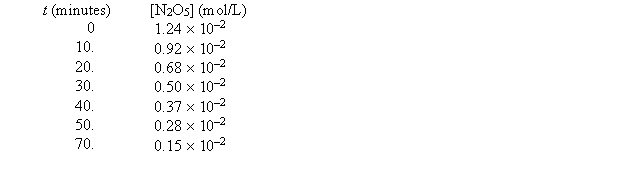
-The concentration of O2 at t = 10. min is
A) 0.32 * 10-2 mol/L
B) 2.0 * 10-4 mol/L
C) 0.64 * 10-2 mol/L
D) 0.16 *10-2 mol/L
E) none of these
-The concentration of O2 at t = 10. min is
A) 0.32 * 10-2 mol/L
B) 2.0 * 10-4 mol/L
C) 0.64 * 10-2 mol/L
D) 0.16 *10-2 mol/L
E) none of these
سؤال
سؤال
سؤال
سؤال
For a reaction aA products, [A]0 = 4.0 M, and the first three successive half-lives are 48, 96, and 192 min.
-The reaction 2NO N2 + O2 has the following rate law:![<strong>For a reaction aA \rightarrow products, [A]<sub>0 </sub>= 4.0 M, and the first three successive half-lives are 48, 96, and 192 min. -The reaction 2NO \rightarrow N<sub>2</sub> + O<sub>2</sub> has the following rate law: After a period of 2.0 * 10<sup>3</sup> s, the concentration of NO falls from an initial value of 2.8 *10<sup>-</sup><sup>3</sup> mol/L to 2.0* 10<sup>-</sup><sup>4</sup> mol/L. What is the rate constant, k?</strong> A) 4.0 *10<sup>-</sup><sup>4</sup> M<sup>-</sup><sup>1</sup>/s B) 7.2 * 10<sup>-</sup><sup>2</sup> M<sup>-</sup><sup>1</sup>/s C) 1.7 *10<sup>-</sup><sup>4</sup> M<sup>-</sup><sup>1</sup>/s D) 4.0 *10<sup>-</sup><sup>7</sup> M<sup>-</sup><sup>1</sup>/s E) 3.6 * 10<sup>-</sup><sup>2</sup> M<sup>-</sup><sup>1</sup>/s <div style=padding-top: 35px>](https://d2lvgg3v3hfg70.cloudfront.net/TB6420/11eaaf8d_c1f2_de15_892c_c393506eb0d6_TB6420_00.jpg) After a period of 2.0 * 103 s, the concentration of NO falls from an initial value of 2.8 *10-3 mol/L to 2.0* 10-4 mol/L. What is the rate constant, k?
After a period of 2.0 * 103 s, the concentration of NO falls from an initial value of 2.8 *10-3 mol/L to 2.0* 10-4 mol/L. What is the rate constant, k?
A) 4.0 *10-4 M-1/s
B) 7.2 * 10-2 M-1/s
C) 1.7 *10-4 M-1/s
D) 4.0 *10-7 M-1/s
E) 3.6 * 10-2 M-1/s
-The reaction 2NO N2 + O2 has the following rate law:
After a period of 2.0 * 103 s, the concentration of NO falls from an initial value of 2.8 *10-3 mol/L to 2.0* 10-4 mol/L. What is the rate constant, k?A) 4.0 *10-4 M-1/s
B) 7.2 * 10-2 M-1/s
C) 1.7 *10-4 M-1/s
D) 4.0 *10-7 M-1/s
E) 3.6 * 10-2 M-1/s
سؤال
سؤال
سؤال
For the reaction 2N2O5(g) 4NO2(g) + O2(g), the following data were collected.
-The concentration N2O5 at 100 min will be approximately
A) 0.10*10-2 mol/L
B) 0.01 *10-2 mol/L
C) 0.06 * 10-2 mol/L
D) 0.03 *10-2 mol/L
E) none of these
-The concentration N2O5 at 100 min will be approximately
A) 0.10*10-2 mol/L
B) 0.01 *10-2 mol/L
C) 0.06 * 10-2 mol/L
D) 0.03 *10-2 mol/L
E) none of these
سؤال
For the reaction 2N2O5(g) 4NO2(g) + O2(g), the following data were collected.
-The order of this reaction in N2O5 is
A) 0
B) 1
C) 2
D) 3
E) none of these
-The order of this reaction in N2O5 is
A) 0
B) 1
C) 2
D) 3
E) none of these
سؤال
سؤال
سؤال
سؤال
The following question refers to the gas-phase decomposition of chloroethane: C2H5Cl products
Experiment shows that the decomposition is first order. The following data show kinetics information for this reaction. What is the rate constant for this decomposition?
A) 0.22/s
B) 0.35/s
C) 0.29/s
D) 0.02/s
E) 0.11/s
Experiment shows that the decomposition is first order. The following data show kinetics information for this reaction.
What is the rate constant for this decomposition?A) 0.22/s
B) 0.35/s
C) 0.29/s
D) 0.02/s
E) 0.11/s
سؤال
For the reaction 2N2O5(g) 4NO2(g) + O2(g), the following data were collected.
-The half-life of this reaction is approximately
A) 18 min
B) 36 min
C) 15 min
D) 23 min
E) 45 min
-The half-life of this reaction is approximately
A) 18 min
B) 36 min
C) 15 min
D) 23 min
E) 45 min
سؤال
Calculate the value of k2 where Rate = ![<strong>Calculate the value of k<sub>2</sub> where Rate = k<sub>2</sub>[B]<sup>2</sup></strong> A) 0.75 L/mol • s B) 2.2 L/mol • s C) 0.21 L/mol • s D) 1.9 L/mol • s E) none of these <div style=padding-top: 35px>](https://d2lvgg3v3hfg70.cloudfront.net/TB6420/11eaaf8d_c1f6_d5c3_892c_7db9d407dc72_TB6420_11.jpg) k2[B]2
k2[B]2
A) 0.75 L/mol • s
B) 2.2 L/mol • s
C) 0.21 L/mol • s
D) 1.9 L/mol • s
E) none of these
k2[B]2A) 0.75 L/mol • s
B) 2.2 L/mol • s
C) 0.21 L/mol • s
D) 1.9 L/mol • s
E) none of these
سؤال
Consider the reaction 3A + B + C D + E
Where the rate law is defined as![<strong>Consider the reaction 3A + B + C \rightarrow D + E Where the rate law is defined as An experiment is carried out where [B]<sub>0</sub> = [C]<sub>0</sub> = 1.00 M and [A]<sub>0</sub> = 2.46 *10<sup>-</sup><sup>4</sup> M. After 2.96 min, [A] = 3.30 *10<sup>-</sup><sup>5</sup> M. What is the value of k?</strong> A) 8.34 *10<sup>7</sup> L<sup>3</sup>/mol<sup>3</sup> • s B) 4.00* 10<sup>-</sup><sup>7</sup> L<sup>3</sup>/mol<sup>3</sup> • s C) 2.13 * 10<sup>-</sup><sup>5</sup> L<sup>3</sup>/mol<sup>3</sup> • s D) 1.48 * 10<sup>2</sup> L<sup>3</sup>/mol<sup>3</sup> • s E) 8.86 *10<sup>3</sup> L<sup>3</sup>/mol<sup>3</sup> • s <div style=padding-top: 35px>](https://d2lvgg3v3hfg70.cloudfront.net/TB6420/11eaaf8d_c1f5_4f1d_892c_bb0e143298d1_TB6420_11.jpg) An experiment is carried out where [B]0 = [C]0 = 1.00 M and [A]0 = 2.46 *10-4 M. After 2.96 min, [A] = 3.30 *10-5 M. What is the value of k?
An experiment is carried out where [B]0 = [C]0 = 1.00 M and [A]0 = 2.46 *10-4 M. After 2.96 min, [A] = 3.30 *10-5 M. What is the value of k?
A) 8.34 *107 L3/mol3 • s
B) 4.00* 10-7 L3/mol3 • s
C) 2.13 * 10-5 L3/mol3 • s
D) 1.48 * 102 L3/mol3 • s
E) 8.86 *103 L3/mol3 • s
Where the rate law is defined as
An experiment is carried out where [B]0 = [C]0 = 1.00 M and [A]0 = 2.46 *10-4 M. After 2.96 min, [A] = 3.30 *10-5 M. What is the value of k?A) 8.34 *107 L3/mol3 • s
B) 4.00* 10-7 L3/mol3 • s
C) 2.13 * 10-5 L3/mol3 • s
D) 1.48 * 102 L3/mol3 • s
E) 8.86 *103 L3/mol3 • s
سؤال
The following questions refer to the gas-phase decomposition of chloroethane:
C2H5Cl products
Experiment shows that the decomposition is first order. The following data show kinetics information for this reaction.
-What would the concentration be after 5.0 s?
A) 0.08 M
B) 0.02 M
C) 0.12 M
D) 0.13 M
E) 0.19 M
C2H5Cl products
Experiment shows that the decomposition is first order. The following data show kinetics information for this reaction.
-What would the concentration be after 5.0 s?
A) 0.08 M
B) 0.02 M
C) 0.12 M
D) 0.13 M
E) 0.19 M
سؤال
Consider the reaction
3A + B + C D + E
where the rate law is defined as![<strong>Consider the reaction 3A + B + C \rightarrow D + E where the rate law is defined as k[A]<sup>2</sup>[B][C] An experiment is carried out where [B]<sub>0</sub> = [C]<sub>0</sub> = 1.00 M and [A]<sub>0</sub> = 1.00 * 10<sup>-</sup><sup>4</sup> M. -What is the concentration of C after 10.0 min?</strong> A) 0.330 M B) 1.10 * 10<sup>-</sup><sup>5</sup> M C) 1.00 M D) 0.100 M E) none of these <div style=padding-top: 35px>](https://d2lvgg3v3hfg70.cloudfront.net/TB6420/11eaaf8d_c1f5_9d3f_892c_5b6711725d52_TB6420_11_TB6420_11.jpg) k[A]2[B][C]
k[A]2[B][C]
An experiment is carried out where [B]0 = [C]0 = 1.00 M and [A]0 = 1.00 * 10-4 M.
-What is the concentration of C after 10.0 min?
A) 0.330 M
B) 1.10 * 10-5 M
C) 1.00 M
D) 0.100 M
E) none of these
3A + B + C D + E
where the rate law is defined as
k[A]2[B][C]An experiment is carried out where [B]0 = [C]0 = 1.00 M and [A]0 = 1.00 * 10-4 M.
-What is the concentration of C after 10.0 min?
A) 0.330 M
B) 1.10 * 10-5 M
C) 1.00 M
D) 0.100 M
E) none of these
سؤال
سؤال
The reaction 2NO2 2NO + O2 obeys the rate law ![<strong>The reaction 2NO<sub>2</sub> \rightarrow 2NO + O<sub>2</sub> obeys the rate law 1.40 * 10<sup>-</sup><sup>2</sup> [NO<sub>2</sub>]<sup>2</sup> at 500° K. If the initial concentration of NO<sub>2</sub> is 1.00 M, how long will it take for the [NO<sub>2</sub>] to decrease to 25.0% of its initial value?</strong> A) 71.4 s B) 214 s C) 49.5 s D) 1.40 *10<sup>-</sup><sup>2</sup> s E) cannot be determined from these data <div style=padding-top: 35px>](https://d2lvgg3v3hfg70.cloudfront.net/TB6420/11eaaf8d_c1f6_fcd4_892c_7bfab7456a7d_TB6420_11.jpg) 1.40 * 10-2 [NO2]2 at 500° K. If the initial concentration of NO2 is 1.00 M, how long will it take for the [NO2] to decrease to 25.0% of its initial value?
1.40 * 10-2 [NO2]2 at 500° K. If the initial concentration of NO2 is 1.00 M, how long will it take for the [NO2] to decrease to 25.0% of its initial value?
A) 71.4 s
B) 214 s
C) 49.5 s
D) 1.40 *10-2 s
E) cannot be determined from these data
1.40 * 10-2 [NO2]2 at 500° K. If the initial concentration of NO2 is 1.00 M, how long will it take for the [NO2] to decrease to 25.0% of its initial value?A) 71.4 s
B) 214 s
C) 49.5 s
D) 1.40 *10-2 s
E) cannot be determined from these data
سؤال
Consider the reaction 3A + B + C D + E
Where the rate law is defined as![<strong>Consider the reaction 3A + B + C \rightarrow D + E Where the rate law is defined as (1.66 * 10<sup>2</sup> L<sup>3</sup>/mol<sup>3</sup> • s)[A]<sup>2</sup>[B][C] An experiment is carried out where [B]<sub>0</sub> = [C]<sub>0</sub> = 1.00 M and [A]<sub>0</sub> = 2.72 * 10<sup>-</sup><sup>4</sup> M. What is the half-life for this experiment?</strong> A) 1.36 * 10<sup>-</sup><sup>5</sup> s B) 4.17 * 10<sup>-</sup><sup>3</sup> s C) 1.66 * 10<sup>2 </sup>s D) 8.19 *10<sup>-</sup><sup>7</sup> s E) 2.21 *10<sup>1 </sup>s <div style=padding-top: 35px>](https://d2lvgg3v3hfg70.cloudfront.net/TB6420/11eaaf8d_c1f5_762e_892c_1fe2098f3a1e_TB6420_11.jpg) (1.66 * 102 L3/mol3 • s)[A]2[B][C]
(1.66 * 102 L3/mol3 • s)[A]2[B][C]
An experiment is carried out where [B]0 = [C]0 = 1.00 M and [A]0 = 2.72 * 10-4 M. What is the half-life for this experiment?
A) 1.36 * 10-5 s
B) 4.17 * 10-3 s
C) 1.66 * 102 s
D) 8.19 *10-7 s
E) 2.21 *101 s
Where the rate law is defined as
(1.66 * 102 L3/mol3 • s)[A]2[B][C]An experiment is carried out where [B]0 = [C]0 = 1.00 M and [A]0 = 2.72 * 10-4 M. What is the half-life for this experiment?
A) 1.36 * 10-5 s
B) 4.17 * 10-3 s
C) 1.66 * 102 s
D) 8.19 *10-7 s
E) 2.21 *101 s
سؤال
Consider the reaction
3A + B + C D + E
where the rate law is defined as k[A]2[B][C]
An experiment is carried out where [B]0 = [C]0 = 1.00 M and [A]0 = 1.00 * 10-4 M.
-What is the concentration of A after 10.0 min?
A) 9.80*10-6 M
B) 2.38*10-6 M
C) 1.27 *10-5 M
D) 1.06 *10-9 M
E) none of these
3A + B + C D + E
where the rate law is defined as
k[A]2[B][C]An experiment is carried out where [B]0 = [C]0 = 1.00 M and [A]0 = 1.00 * 10-4 M.
-What is the concentration of A after 10.0 min?
A) 9.80*10-6 M
B) 2.38*10-6 M
C) 1.27 *10-5 M
D) 1.06 *10-9 M
E) none of these
سؤال
سؤال
The following questions refer to the gas-phase decomposition of chloroethane:
C2H5Cl products
Experiment shows that the decomposition is first order. The following data show kinetics information for this reaction.
-What was the initial concentration of the ethylene chloride?
A) 0.02 M
B) 0.22 M
C) 0.35 M
D) 0.29 M
E) 0.11 M
C2H5Cl products
Experiment shows that the decomposition is first order. The following data show kinetics information for this reaction.
-What was the initial concentration of the ethylene chloride?
A) 0.02 M
B) 0.22 M
C) 0.35 M
D) 0.29 M
E) 0.11 M
سؤال
سؤال
The following data were collected for the decay of HO2 radicals. ![<strong>The following data were collected for the decay of HO<sub>2</sub> radicals. Which of the following statements is true?</strong> A) The half-life of the reaction is 2 ms. B) A plot of 1/[HO<sub>2</sub>] versus time gives a straight line. C) The rate of the reaction increases with time. D) The decay of HO<sub>2</sub> occurs by a first-order process. E) A plot of ln [HO<sub>2</sub>] versus time is linear with a slope of -k. <div style=padding-top: 35px>](https://d2lvgg3v3hfg70.cloudfront.net/TB6420/11eaaf8d_c1f7_23e5_892c_23f61cb6ba31_TB6420_00.jpg) Which of the following statements is true?
Which of the following statements is true?
A) The half-life of the reaction is 2 ms.
B) A plot of 1/[HO2] versus time gives a straight line.
C) The rate of the reaction increases with time.
D) The decay of HO2 occurs by a first-order process.
E) A plot of ln [HO2] versus time is linear with a slope of -k.
Which of the following statements is true?A) The half-life of the reaction is 2 ms.
B) A plot of 1/[HO2] versus time gives a straight line.
C) The rate of the reaction increases with time.
D) The decay of HO2 occurs by a first-order process.
E) A plot of ln [HO2] versus time is linear with a slope of -k.
سؤال
سؤال
Two isomers (A and B) of a given compound dimerize as follows: ![<strong>Two isomers (A and B) of a given compound dimerize as follows: Both processes are known to be second order in reactant, and k<sub>1</sub> is known to be 0.25 L/mol • s at 25° C, where Rate = k<sub>1</sub>[A]<sup>2</sup> In a particular experiment, A and B were placed in separate containers at 25° C, where [A]<sub>0</sub> = 1.0 * 10<sup>-</sup><sup>2</sup> M and [B]<sub>0</sub> = 2.5 * 10<sup>-</sup><sup>2</sup> M. It was found that [A] = 3[B] after the reactions progressed for 3.0 min. -Calculate the concentration of A<sub>2</sub> after 3.0 min.</strong> A) 3.1 * 10<sup>-</sup><sup>3</sup> M B) 6.9 * 10<sup>-</sup><sup>3</sup> M C) 1.6* 10<sup>-</sup><sup>3</sup> M D) 2.8 * 10<sup>-</sup><sup>22</sup> M E) none of these <div style=padding-top: 35px>](https://d2lvgg3v3hfg70.cloudfront.net/TB6420/11eaaf8d_c1f6_6090_892c_a7e5dd135bfb_TB6420_11.jpg)
![<strong>Two isomers (A and B) of a given compound dimerize as follows: Both processes are known to be second order in reactant, and k<sub>1</sub> is known to be 0.25 L/mol • s at 25° C, where Rate = k<sub>1</sub>[A]<sup>2</sup> In a particular experiment, A and B were placed in separate containers at 25° C, where [A]<sub>0</sub> = 1.0 * 10<sup>-</sup><sup>2</sup> M and [B]<sub>0</sub> = 2.5 * 10<sup>-</sup><sup>2</sup> M. It was found that [A] = 3[B] after the reactions progressed for 3.0 min. -Calculate the concentration of A<sub>2</sub> after 3.0 min.</strong> A) 3.1 * 10<sup>-</sup><sup>3</sup> M B) 6.9 * 10<sup>-</sup><sup>3</sup> M C) 1.6* 10<sup>-</sup><sup>3</sup> M D) 2.8 * 10<sup>-</sup><sup>22</sup> M E) none of these <div style=padding-top: 35px>](https://d2lvgg3v3hfg70.cloudfront.net/TB6420/11eaaf8d_c1f6_87a1_892c_b3e7822d56f2_TB6420_11.jpg) Both processes are known to be second order in reactant, and k1 is known to be 0.25 L/mol • s at 25° C, where
Both processes are known to be second order in reactant, and k1 is known to be 0.25 L/mol • s at 25° C, where
Rate =![<strong>Two isomers (A and B) of a given compound dimerize as follows: Both processes are known to be second order in reactant, and k<sub>1</sub> is known to be 0.25 L/mol • s at 25° C, where Rate = k<sub>1</sub>[A]<sup>2</sup> In a particular experiment, A and B were placed in separate containers at 25° C, where [A]<sub>0</sub> = 1.0 * 10<sup>-</sup><sup>2</sup> M and [B]<sub>0</sub> = 2.5 * 10<sup>-</sup><sup>2</sup> M. It was found that [A] = 3[B] after the reactions progressed for 3.0 min. -Calculate the concentration of A<sub>2</sub> after 3.0 min.</strong> A) 3.1 * 10<sup>-</sup><sup>3</sup> M B) 6.9 * 10<sup>-</sup><sup>3</sup> M C) 1.6* 10<sup>-</sup><sup>3</sup> M D) 2.8 * 10<sup>-</sup><sup>22</sup> M E) none of these <div style=padding-top: 35px>](https://d2lvgg3v3hfg70.cloudfront.net/TB6420/11eaaf8d_c1f6_87a2_892c_6391b93a93de_TB6420_11.jpg) k1[A]2
k1[A]2
In a particular experiment, A and B were placed in separate containers at 25° C, where [A]0 = 1.0 * 10-2 M and [B]0 = 2.5 * 10-2 M. It was found that [A] = 3[B] after the reactions progressed for 3.0 min.
-Calculate the concentration of A2 after 3.0 min.
A) 3.1 * 10-3 M
B) 6.9 * 10-3 M
C) 1.6* 10-3 M
D) 2.8 * 10-22 M
E) none of these
Both processes are known to be second order in reactant, and k1 is known to be 0.25 L/mol • s at 25° C, whereRate =
k1[A]2In a particular experiment, A and B were placed in separate containers at 25° C, where [A]0 = 1.0 * 10-2 M and [B]0 = 2.5 * 10-2 M. It was found that [A] = 3[B] after the reactions progressed for 3.0 min.
-Calculate the concentration of A2 after 3.0 min.
A) 3.1 * 10-3 M
B) 6.9 * 10-3 M
C) 1.6* 10-3 M
D) 2.8 * 10-22 M
E) none of these
سؤال
سؤال
At 760 K, acetaldehyde decomposes to carbon monoxide and methane: CH3CHO CH4 + CO
A plot of ln [CH3CHO] versus time is linear. After 530 s, [CH3CHO] decreases to one half of its initial value of 0.10 M. What is the rate law for the reaction?
A)![<strong>At 760 K, acetaldehyde decomposes to carbon monoxide and methane: CH<sub>3</sub>CHO \rightarrow CH<sub>4</sub> + CO A plot of ln [CH<sub>3</sub>CHO] versus time is linear. After 530 s, [CH<sub>3</sub>CHO] decreases to one half of its initial value of 0.10 M. What is the rate law for the reaction?</strong> A) B) C) D) E) <div style=padding-top: 35px>](https://d2lvgg3v3hfg70.cloudfront.net/TB6420/11eaaf8d_c1f4_3da6_892c_214b9842f334_TB6420_11.jpg)
B)![<strong>At 760 K, acetaldehyde decomposes to carbon monoxide and methane: CH<sub>3</sub>CHO \rightarrow CH<sub>4</sub> + CO A plot of ln [CH<sub>3</sub>CHO] versus time is linear. After 530 s, [CH<sub>3</sub>CHO] decreases to one half of its initial value of 0.10 M. What is the rate law for the reaction?</strong> A) B) C) D) E) <div style=padding-top: 35px>](https://d2lvgg3v3hfg70.cloudfront.net/TB6420/11eaaf8d_c1f4_3da7_892c_7b1adfcc5c45_TB6420_11.jpg)
C)![<strong>At 760 K, acetaldehyde decomposes to carbon monoxide and methane: CH<sub>3</sub>CHO \rightarrow CH<sub>4</sub> + CO A plot of ln [CH<sub>3</sub>CHO] versus time is linear. After 530 s, [CH<sub>3</sub>CHO] decreases to one half of its initial value of 0.10 M. What is the rate law for the reaction?</strong> A) B) C) D) E) <div style=padding-top: 35px>](https://d2lvgg3v3hfg70.cloudfront.net/TB6420/11eaaf8d_c1f4_64b8_892c_0154bd27ff57_TB6420_11.jpg)
D)![<strong>At 760 K, acetaldehyde decomposes to carbon monoxide and methane: CH<sub>3</sub>CHO \rightarrow CH<sub>4</sub> + CO A plot of ln [CH<sub>3</sub>CHO] versus time is linear. After 530 s, [CH<sub>3</sub>CHO] decreases to one half of its initial value of 0.10 M. What is the rate law for the reaction?</strong> A) B) C) D) E) <div style=padding-top: 35px>](https://d2lvgg3v3hfg70.cloudfront.net/TB6420/11eaaf8d_c1f4_64b9_892c_4b1d1a1257c2_TB6420_11.jpg)
E)![<strong>At 760 K, acetaldehyde decomposes to carbon monoxide and methane: CH<sub>3</sub>CHO \rightarrow CH<sub>4</sub> + CO A plot of ln [CH<sub>3</sub>CHO] versus time is linear. After 530 s, [CH<sub>3</sub>CHO] decreases to one half of its initial value of 0.10 M. What is the rate law for the reaction?</strong> A) B) C) D) E) <div style=padding-top: 35px>](https://d2lvgg3v3hfg70.cloudfront.net/TB6420/11eaaf8d_c1f4_8bca_892c_abea00f38a97_TB6420_11.jpg)
A plot of ln [CH3CHO] versus time is linear. After 530 s, [CH3CHO] decreases to one half of its initial value of 0.10 M. What is the rate law for the reaction?
A)
B)
C)
D)
E)
سؤال
The reaction 2N2O5(g) O2(g) + 4NO2(g)
Is first order in N2O5. For this reaction at 45° C, the rate constant k = 1.0 * 10-5 s-1, where the rate law is defined as
Rate![<strong>The reaction 2N<sub>2</sub>O<sub>5</sub>(g) \rightarrow O<sub>2</sub>(g) + 4NO<sub>2</sub>(g) Is first order in N<sub>2</sub>O<sub>5</sub>. For this reaction at 45° C, the rate constant k = 1.0 * 10<sup>-</sup><sup>5</sup> s<sup>-</sup><sup>1</sup>, where the rate law is defined as Rate For a particular experiment ([N<sub>2</sub>O<sub>5</sub>]<sub>0</sub> = 1.0 *10<sup>-</sup><sup>3</sup> M), calculate [N<sub>2</sub>O<sub>5</sub>] after 1.0 * 10<sup>5</sup> s.</strong> A) 0 B) 5.0*10<sup>-</sup><sup>4</sup> M C) 3.7 * 10<sup>-</sup><sup>4</sup> M D) 1.0*10<sup>-</sup><sup>3</sup> M E) none of these <div style=padding-top: 35px>](https://d2lvgg3v3hfg70.cloudfront.net/TB6420/11eaaf8d_c1f5_00fc_892c_2d58edb1a197_TB6420_11.jpg) For a particular experiment ([N2O5]0 = 1.0 *10-3 M), calculate [N2O5] after 1.0 * 105 s.
For a particular experiment ([N2O5]0 = 1.0 *10-3 M), calculate [N2O5] after 1.0 * 105 s.
A) 0
B) 5.0*10-4 M
C) 3.7 * 10-4 M
D) 1.0*10-3 M
E) none of these
Is first order in N2O5. For this reaction at 45° C, the rate constant k = 1.0 * 10-5 s-1, where the rate law is defined as
Rate
For a particular experiment ([N2O5]0 = 1.0 *10-3 M), calculate [N2O5] after 1.0 * 105 s.A) 0
B) 5.0*10-4 M
C) 3.7 * 10-4 M
D) 1.0*10-3 M
E) none of these
سؤال
سؤال
سؤال
The following questions refer to the gas-phase decomposition of chloroethane:
C2H5Cl products
Experiment shows that the decomposition is first order. The following data show kinetics information for this reaction.
-What is the time to half-life?
A) 8.9 s
B) 0.7 s
C) 6.3 s
D) 1.3 s
E) 2.2 s
C2H5Cl products
Experiment shows that the decomposition is first order. The following data show kinetics information for this reaction.
-What is the time to half-life?
A) 8.9 s
B) 0.7 s
C) 6.3 s
D) 1.3 s
E) 2.2 s

فتح الحزمة
قم بالتسجيل لفتح البطاقات في هذه المجموعة!
Unlock Deck
Unlock Deck
1/119

العب

ملء الشاشة (f)
Deck 15: Chemical Kinetics
1
The following questions refer to the hypothetical reaction A + B products. The kinetics data given can be analyzed to answer the questions.
-The rate expression for a particular reaction is Rate = k[A][B]3. If the initial concentration of B is increased from 0.2 M to 0.6 M, the initial rate will increase by which of the following factors?
A) 6
B) 3
C) 27
D) 4
E) 12
-The rate expression for a particular reaction is Rate = k[A][B]3. If the initial concentration of B is increased from 0.2 M to 0.6 M, the initial rate will increase by which of the following factors?
A) 6
B) 3
C) 27
D) 4
E) 12
27
2
A general reaction written as 2A + 2B C + 2D is studied and yields the following data.
-For the first of the reactions in the table of data, determine - [B]/ t.
A) 8.00* 10-5
B) 1.60*10-4
C) 4.00 *10-5
D) 2.00 *10-5
E) none of these
-For the first of the reactions in the table of data, determine - [B]/ t.
A) 8.00* 10-5
B) 1.60*10-4
C) 4.00 *10-5
D) 2.00 *10-5
E) none of these
8.00* 10-5
3
A general reaction written as 2A + 2B C + 2D is studied and yields the following data.
-What is the overall order of the reaction?
A) 0
B) 2
C) 3
D) 4
E) 1
-What is the overall order of the reaction?
A) 0
B) 2
C) 3
D) 4
E) 1
1
4
The following questions refer to the hypothetical reaction A + B products. The kinetics data given can be analyzed to answer the questions.
-The rate law for the reaction is Rate = k[A]x[B]y. What are the values of x and y?
A) x = 1 y = 0
B) x = 1 y = 1
C) x = 0 y = 1
D) x = 1 y = 2
E) x = 2 y = 1
-The rate law for the reaction is Rate = k[A]x[B]y. What are the values of x and y?
A) x = 1 y = 0
B) x = 1 y = 1
C) x = 0 y = 1
D) x = 1 y = 2
E) x = 2 y = 1
فتح الحزمة
افتح القفل للوصول البطاقات البالغ عددها 119 في هذه المجموعة.
فتح الحزمة
k this deck
5
The rate constant k is dependent on
A) the concentration of the product.
B) the order of the reaction.
C) the temperature.
D) the concentration of the reactant.
E) none of these
A) the concentration of the product.
B) the order of the reaction.
C) the temperature.
D) the concentration of the reactant.
E) none of these
فتح الحزمة
افتح القفل للوصول البطاقات البالغ عددها 119 في هذه المجموعة.
فتح الحزمة
k this deck
6
The following questions refer to the hypothetical reaction A + B products. The kinetics data given can be analyzed to answer the questions.
-What form will the pseudo-rate law have?
A) Rate = kk'[A]x
B) Rate = k'[A]x[B]y
C) Rate = kk'[B]y
D) Rate = k'[B]y
E) Rate = k'[A]x
-What form will the pseudo-rate law have?
A) Rate = kk'[A]x
B) Rate = k'[A]x[B]y
C) Rate = kk'[B]y
D) Rate = k'[B]y
E) Rate = k'[A]x
فتح الحزمة
افتح القفل للوصول البطاقات البالغ عددها 119 في هذه المجموعة.
فتح الحزمة
k this deck
7
The oxidation of Cr3+ to CrO42- can be accomplished using Ce4+ in a buffered solution. The following data were obtained:
Determine the order in the rate law of the species Ce4+.
A) 1
B) -2
C) 3
D) -1
E) 2
Determine the order in the rate law of the species Ce4+.
A) 1
B) -2
C) 3
D) -1
E) 2
فتح الحزمة
افتح القفل للوصول البطاقات البالغ عددها 119 في هذه المجموعة.
فتح الحزمة
k this deck
8
A general reaction written as 2A + 2B C + 2D is studied and yields the following data.
-What are the proper units for the rate constant for the reaction?
A) L mol-1 s-1
B) s-1
C) L3 mol-3 s-1
D) mol L-1 s-1
E) L2 mol-2 s-1
-What are the proper units for the rate constant for the reaction?
A) L mol-1 s-1
B) s-1
C) L3 mol-3 s-1
D) mol L-1 s-1
E) L2 mol-2 s-1
فتح الحزمة
افتح القفل للوصول البطاقات البالغ عددها 119 في هذه المجموعة.
فتح الحزمة
k this deck
9
For the reaction 2N2O5(g) 4NO2(g) + O2(g), the following data were collected. The initial rate of production of NO2 for this reaction is approximately
A) 6.4 *10-4 mol/L • min
B) 3.2*10-4 mol/L • min
C) 1.24* 10-2 mol/L • min
D) 1.6 * 10-4 mol/L • min
E) none of these
The initial rate of production of NO2 for this reaction is approximatelyA) 6.4 *10-4 mol/L • min
B) 3.2*10-4 mol/L • min
C) 1.24* 10-2 mol/L • min
D) 1.6 * 10-4 mol/L • min
E) none of these
فتح الحزمة
افتح القفل للوصول البطاقات البالغ عددها 119 في هذه المجموعة.
فتح الحزمة
k this deck
10
A general reaction written as 2A + 2B C + 2D is studied and yields the following data.
-What is the order of the reaction with respect to A?
A) 1
B) 0
C) 4
D) 3
E) 2
-What is the order of the reaction with respect to A?
A) 1
B) 0
C) 4
D) 3
E) 2
فتح الحزمة
افتح القفل للوصول البطاقات البالغ عددها 119 في هذه المجموعة.
فتح الحزمة
k this deck
11
A general reaction written as 2A + 2B C + 2D is studied and yields the following data.
-What is the order of the reaction with respect to B?
A) 3
B) 2
C) 4
D) 1
E) 0
-What is the order of the reaction with respect to B?
A) 3
B) 2
C) 4
D) 1
E) 0
فتح الحزمة
افتح القفل للوصول البطاقات البالغ عددها 119 في هذه المجموعة.
فتح الحزمة
k this deck
12
The oxidation of Cr3+ to CrO42- can be accomplished using Ce4+ in a buffered solution. The following data were obtained:
Determine the order in the rate law of the species Cr3+.
A) -2
B) 3
C) 1
D) 2
E) -1
Determine the order in the rate law of the species Cr3+.
A) -2
B) 3
C) 1
D) 2
E) -1
فتح الحزمة
افتح القفل للوصول البطاقات البالغ عددها 119 في هذه المجموعة.
فتح الحزمة
k this deck
13
The balanced equation for the reaction of bromate ion with bromide in acidic solution is BrO+ 5Br- + 6H+ 3Br2 + 3H2O
At a particular instant in time, the value of - [Br-]/ t is 2.0 * 10-3 mol/L • s. What is the value of [Br2]/ t in the same units?
A) 1.2 * 10-3
B) 2.0 * 10-3
C) 6.0 *10-3
D) 3.3*10-5
E) 3.3 * 10-3
At a particular instant in time, the value of - [Br-]/ t is 2.0 * 10-3 mol/L • s. What is the value of [Br2]/ t in the same units?
A) 1.2 * 10-3
B) 2.0 * 10-3
C) 6.0 *10-3
D) 3.3*10-5
E) 3.3 * 10-3
فتح الحزمة
افتح القفل للوصول البطاقات البالغ عددها 119 في هذه المجموعة.
فتح الحزمة
k this deck
14
A general reaction written as 2A + 2B C + 2D is studied and yields the following data.
-What is the numerical value of the rate constant?
A) 4.00 * 10-1
B) 4.00* 10-2
C) 4.00 * 10-3
D) 4.00 * 10-4
E) none of these
-What is the numerical value of the rate constant?
A) 4.00 * 10-1
B) 4.00* 10-2
C) 4.00 * 10-3
D) 4.00 * 10-4
E) none of these
فتح الحزمة
افتح القفل للوصول البطاقات البالغ عددها 119 في هذه المجموعة.
فتح الحزمة
k this deck
15
The oxidation of Cr3+ to CrO42- can be accomplished using Ce4+ in a buffered solution. The following data were obtained:
Determine the order in the rate law of the species Ce3+.
A) -1
B) 2
C) 3
D) -2
E) 1
Determine the order in the rate law of the species Ce3+.
A) -1
B) 2
C) 3
D) -2
E) 1
فتح الحزمة
افتح القفل للوصول البطاقات البالغ عددها 119 في هذه المجموعة.
فتح الحزمة
k this deck
16
The reaction
H2SeO3(aq) + 6I-(aq) + 4H+(aq) 2I3-(aq) + 3H2O(l) + Se(s)
was studied at 0°C by the method of initial rates:
-What is the rate law?
A) Rate = k[H2SeO3][H+][I-]2
B) Rate = k[H2SeO3][H+]2[I-]3
C) Rate = k[H2SeO3][H+][I-]
D) Rate = k[H2SeO3][H+]2[I-]
E) Rate = k[H2SeO3]2[H+][I-]
H2SeO3(aq) + 6I-(aq) + 4H+(aq) 2I3-(aq) + 3H2O(l) + Se(s)
was studied at 0°C by the method of initial rates:
-What is the rate law?
A) Rate = k[H2SeO3][H+][I-]2
B) Rate = k[H2SeO3][H+]2[I-]3
C) Rate = k[H2SeO3][H+][I-]
D) Rate = k[H2SeO3][H+]2[I-]
E) Rate = k[H2SeO3]2[H+][I-]
فتح الحزمة
افتح القفل للوصول البطاقات البالغ عددها 119 في هذه المجموعة.
فتح الحزمة
k this deck
17
The average rate of disappearance of ozone in the reaction 2O3(g) 3O2(g) is found to be 9.6 *10-3 atm over a certain interval of time. What is the rate of appearance of O2 during this interval?
A) 6.4* 10-3 atm/time
B) 2.9 *10-2 atm/time
C) 1.9 * 10-2 atm/time
D) 1.4 *10-2 atm/time
E) 9.6* 10-3 atm/time
A) 6.4* 10-3 atm/time
B) 2.9 *10-2 atm/time
C) 1.9 * 10-2 atm/time
D) 1.4 *10-2 atm/time
E) 9.6* 10-3 atm/time
فتح الحزمة
افتح القفل للوصول البطاقات البالغ عددها 119 في هذه المجموعة.
فتح الحزمة
k this deck
18
A first-order reaction is 54% complete at the end of 12 min. What is the value of the rate constant?
A) 0.065 min-1
B) 0.33 min-1
C) 6.5 * 10-2 min-1
D) 2.8* 10-2 min-1
E) 5.1*10-2 min-1
A) 0.065 min-1
B) 0.33 min-1
C) 6.5 * 10-2 min-1
D) 2.8* 10-2 min-1
E) 5.1*10-2 min-1
فتح الحزمة
افتح القفل للوصول البطاقات البالغ عددها 119 في هذه المجموعة.
فتح الحزمة
k this deck
19
For the reaction
2A + B products
the following mechanism is proposed:
A + B M
A + M products
A catalyst never appears in a rate law.
2A + B products
the following mechanism is proposed:
A + B
MA + M products
A catalyst never appears in a rate law.
فتح الحزمة
افتح القفل للوصول البطاقات البالغ عددها 119 في هذه المجموعة.
فتح الحزمة
k this deck
20
The following data were obtained for the reaction of NO with O2. Concentrations are in molecules/cm3 and rates are in molecules/cm3 • s. Which of the following is the correct rate law?
A) Rate = k[NO]2
B) Rate = k[NO]2[O2]2
C) Rate = k[NO][O2]2
D) Rate = k[NO][O2]
E) Rate = k[NO]2[O2]
Which of the following is the correct rate law?A) Rate = k[NO]2
B) Rate = k[NO]2[O2]2
C) Rate = k[NO][O2]2
D) Rate = k[NO][O2]
E) Rate = k[NO]2[O2]
فتح الحزمة
افتح القفل للوصول البطاقات البالغ عددها 119 في هذه المجموعة.
فتح الحزمة
k this deck
21
For which of the following is the half-life directly dependent on the concentration of the reactant?
A) zero-order reaction
B) second-order reaction
C) first-order reaction
D) two of these
E) all of these
A) zero-order reaction
B) second-order reaction
C) first-order reaction
D) two of these
E) all of these
فتح الحزمة
افتح القفل للوصول البطاقات البالغ عددها 119 في هذه المجموعة.
فتح الحزمة
k this deck
22
Initial rate data have been determined at a certain temperature for the gaseous reaction 2NO + 2H2 N2 + 2H2O What is the numerical value of the rate constant?
A) 1.1
B) 6.9
C) 2.2
D) 0.11
E) 0.35
What is the numerical value of the rate constant?A) 1.1
B) 6.9
C) 2.2
D) 0.11
E) 0.35
فتح الحزمة
افتح القفل للوصول البطاقات البالغ عددها 119 في هذه المجموعة.
فتح الحزمة
k this deck
23
The following initial rate data were found for the reaction
2MnO4- + 5H2C2O4 + 6H+ 2Mn2+ + 10CO2 + 8H2O
-Which of the following is the correct rate law?
A) Rate = k[MnO4-][H2C2O4][H+]
B) Rate = k[MnO4-]2[H2C2O4][H+]
C) Rate = k[MnO4-]2[H2C2O4]
D) Rate = k[MnO4-][H2C2O4]2
E) Rate = k[MnO4-]2[H2C2O4]5[H+]6
2MnO4- + 5H2C2O4 + 6H+ 2Mn2+ + 10CO2 + 8H2O
-Which of the following is the correct rate law?
A) Rate = k[MnO4-][H2C2O4][H+]
B) Rate = k[MnO4-]2[H2C2O4][H+]
C) Rate = k[MnO4-]2[H2C2O4]
D) Rate = k[MnO4-][H2C2O4]2
E) Rate = k[MnO4-]2[H2C2O4]5[H+]6
فتح الحزمة
افتح القفل للوصول البطاقات البالغ عددها 119 في هذه المجموعة.
فتح الحزمة
k this deck
24
The following initial rate data were found for the reaction
2MnO4- + 5H2C2O4 + 6H+ 2Mn2+ + 10CO2 + 8H2O
-For which order reaction is the half-life of the reaction independent of the initial concentration of the reactant(s)?
A) zero order
B) first order
C) second order
D) all of these
E) none of these
2MnO4- + 5H2C2O4 + 6H+ 2Mn2+ + 10CO2 + 8H2O
-For which order reaction is the half-life of the reaction independent of the initial concentration of the reactant(s)?
A) zero order
B) first order
C) second order
D) all of these
E) none of these
فتح الحزمة
افتح القفل للوصول البطاقات البالغ عددها 119 في هذه المجموعة.
فتح الحزمة
k this deck
25
Use the following initial rate data for the reaction in aqueous solution to determine the rate law.
A) Rate = k[CH3COCH3][H+]
B) Rate = k[CH3COCH3][Br2][H+]
C) Rate = k[Br2][H+]
D) Rate = k[CH3COCH3][Br2][H+]2
E) Rate = k[CH3COCH3][Br2]
A) Rate = k[CH3COCH3][H+]
B) Rate = k[CH3COCH3][Br2][H+]
C) Rate = k[Br2][H+]
D) Rate = k[CH3COCH3][Br2][H+]2
E) Rate = k[CH3COCH3][Br2]
فتح الحزمة
افتح القفل للوصول البطاقات البالغ عددها 119 في هذه المجموعة.
فتح الحزمة
k this deck
26
The following initial rate data were found for the reaction
2MnO4- + 5H2C2O4 + 6H+ 2Mn2+ + 10CO2 + 8H2O
-What is the value of the rate constant?
A) 2 * 105 M • s-1
B) 2 * 105 M-2 • s-1
C) 200 M-2 • s-1
D) 2 *10-4 M • s-1
E) 200 M-1 • s-1
2MnO4- + 5H2C2O4 + 6H+ 2Mn2+ + 10CO2 + 8H2O
-What is the value of the rate constant?
A) 2 * 105 M • s-1
B) 2 * 105 M-2 • s-1
C) 200 M-2 • s-1
D) 2 *10-4 M • s-1
E) 200 M-1 • s-1
فتح الحزمة
افتح القفل للوصول البطاقات البالغ عددها 119 في هذه المجموعة.
فتح الحزمة
k this deck
27
The reaction of (CH3)3CBr with hydroxide ion proceeds with the formation of (CH3)3COH. (CH3)3CBr (aq) + OH- (aq) (CH3)3COH (aq) + Br- (aq)
The following data were obtained at 55°C. What will the initial rate (in mol/L • s) be in Experiment 4?
A) 18 *10-3
B) 6.0 * 10-3
C) 9.0 * 10-3
D) 3.0* 10-3
E) none of these
The following data were obtained at 55°C.
What will the initial rate (in mol/L • s) be in Experiment 4?A) 18 *10-3
B) 6.0 * 10-3
C) 9.0 * 10-3
D) 3.0* 10-3
E) none of these
فتح الحزمة
افتح القفل للوصول البطاقات البالغ عددها 119 في هذه المجموعة.
فتح الحزمة
k this deck
28
For the reaction in which A and B react to form C, the following initial rate data were obtained. What is the rate law for the reaction?
A) Rate = k[A]2[B]2
B) Rate = k[A]2[B]
C) Rate = k[A][B]2
D) Rate = k[A][B]
E) Rate = k[A]3
What is the rate law for the reaction?A) Rate = k[A]2[B]2
B) Rate = k[A]2[B]
C) Rate = k[A][B]2
D) Rate = k[A][B]
E) Rate = k[A]3
فتح الحزمة
افتح القفل للوصول البطاقات البالغ عددها 119 في هذه المجموعة.
فتح الحزمة
k this deck
29
The following questions refer to the hypothetical reaction A + B products. The kinetics data given can be analyzed to answer the questions. Determine the magnitude of the pseudo-rate constant (k') if the magnitude of X in the rate data is 0.00905.
A) 0.31
B) 1.81 *10-3
C) 4.3 *10-3
D) 0.86
E) 1.2 * 10-2
Determine the magnitude of the pseudo-rate constant (k') if the magnitude of X in the rate data is 0.00905.A) 0.31
B) 1.81 *10-3
C) 4.3 *10-3
D) 0.86
E) 1.2 * 10-2
فتح الحزمة
افتح القفل للوصول البطاقات البالغ عددها 119 في هذه المجموعة.
فتح الحزمة
k this deck
30
The OH radical disproportionates according to the elementary chemical reaction OH + OH H2O + O. This reaction is second order in OH. The rate constant for the reaction is 2.2 *10-12 cm3/molecule • s at room temperature. If the initial OH concentration is 1.8 *1013 molecules/cm3, what is the first half-life for the reaction?
A) 3.2*1011 s
B) 0.025 s
C) 4.1 * 1024 s
D) 3.7 s
E) 5.1 s
A) 3.2*1011 s
B) 0.025 s
C) 4.1 * 1024 s
D) 3.7 s
E) 5.1 s
فتح الحزمة
افتح القفل للوصول البطاقات البالغ عددها 119 في هذه المجموعة.
فتح الحزمة
k this deck
31
For the reaction A + B products, the following data were obtained. What is the experimental rate law?
A) Rate = k[A]2[B]
B) Rate = k[B]
C) Rate = k[A][B]
D) Rate = k[A]
E) Rate = k[A][B] 2
What is the experimental rate law?A) Rate = k[A]2[B]
B) Rate = k[B]
C) Rate = k[A][B]
D) Rate = k[A]
E) Rate = k[A][B] 2
فتح الحزمة
افتح القفل للوصول البطاقات البالغ عددها 119 في هذه المجموعة.
فتح الحزمة
k this deck
32
Tabulated below are initial rate data for the reaction 2Fe(CN)63- + 2I- 2Fe(CN)64- + I2 What is the value of k?
A) 103 M-3 s-1
B) 50 M-2 s-1
C) 10 M-2 s-1
D) 107 M-5 s-1
E) none of these
What is the value of k?A) 103 M-3 s-1
B) 50 M-2 s-1
C) 10 M-2 s-1
D) 107 M-5 s-1
E) none of these
فتح الحزمة
افتح القفل للوصول البطاقات البالغ عددها 119 في هذه المجموعة.
فتح الحزمة
k this deck
33
What is the rate law for the following reaction, given the data below? 2NO + H2 N2O + H2O
A) Rate = k[N2O][H2O]
B) Rate = k[NO][H2]
C) Rate = k[NO]2[H2]
D) Rate = k[NO]
E) Rate = k[NO]2
A) Rate = k[N2O][H2O]
B) Rate = k[NO][H2]
C) Rate = k[NO]2[H2]
D) Rate = k[NO]
E) Rate = k[NO]2
فتح الحزمة
افتح القفل للوصول البطاقات البالغ عددها 119 في هذه المجموعة.
فتح الحزمة
k this deck
34
The following initial rate data were found for the reaction
2MnO4- + 5H2C2O4 + 6H+ 2Mn2+ + 10CO2 + 8H2O
-The reaction A B + C is known to be zero order in A with a rate constant of 5.0 *10-2 mol/L • s at 25° C. An experiment was run at 25°C where [A]0 = 1.0 *10-3 M. What is the integrated rate law?
A) [A] = kt
B) [A]0 - [A] = kt
C)
D) [A] - [A]0 = kt
E)
2MnO4- + 5H2C2O4 + 6H+ 2Mn2+ + 10CO2 + 8H2O
-The reaction A B + C is known to be zero order in A with a rate constant of 5.0 *10-2 mol/L • s at 25° C. An experiment was run at 25°C where [A]0 = 1.0 *10-3 M. What is the integrated rate law?
A) [A] = kt
B) [A]0 - [A] = kt
C)
D) [A] - [A]0 = kt
E)
فتح الحزمة
افتح القفل للوصول البطاقات البالغ عددها 119 في هذه المجموعة.
فتح الحزمة
k this deck
35
The decomposition of N2O5(g) to NO2(g) and O2(g) obeys first-order kinetics. Assume the form of the rate law is
Rate where k = 3.4 *10-5 s-1 at 25°C.
-What is the initial rate of reaction at 25°C where [N2O5]0 = 5.0 *10-2 M?
A) 3.4 * 10-5 mol/L • s
B) 5.0 * 10-2 mol/L • s
C) 6.8*10-4 mol/L • s
D) 1.7* 10-6 mol/L • s
E) none of these
Rate
where k = 3.4 *10-5 s-1 at 25°C.-What is the initial rate of reaction at 25°C where [N2O5]0 = 5.0 *10-2 M?
A) 3.4 * 10-5 mol/L • s
B) 5.0 * 10-2 mol/L • s
C) 6.8*10-4 mol/L • s
D) 1.7* 10-6 mol/L • s
E) none of these
فتح الحزمة
افتح القفل للوصول البطاقات البالغ عددها 119 في هذه المجموعة.
فتح الحزمة
k this deck
36
Tabulated below are initial rate data for the reaction 2Fe(CN)63- + 2I- 2Fe(CN)64- + I2 What is the experimental rate law?
A) k[Fe(CN)63-][I-]2
B) k[Fe(CN)63-][I-] [Fe(CN)64-]
C) k[Fe(CN)63-]2[I-]
D) k[Fe(CN)63-]2[I-]2[Fe(CN)64-]2[I2]
E) k[Fe(CN)63-]2[I-][Fe(CN)64-][I2]
What is the experimental rate law?A)
k[Fe(CN)63-][I-]2B)
k[Fe(CN)63-][I-] [Fe(CN)64-]C)
k[Fe(CN)63-]2[I-]D)
k[Fe(CN)63-]2[I-]2[Fe(CN)64-]2[I2]E)
k[Fe(CN)63-]2[I-][Fe(CN)64-][I2] فتح الحزمة
افتح القفل للوصول البطاقات البالغ عددها 119 في هذه المجموعة.
فتح الحزمة
k this deck
37
Two isomers (A andB) of a given compound dimerize as follows:
Both processes are known to be second order in reactant, and k1 is known to be 0.25 L/mol • s at 25° C, where
In a particular experiment, A and B were placed in separate containers at 25° C, where [A]0 = 1.0 * 10-2 M and [B]0 = 2.5 *10-2 M. It was found that [A] = 3[B] after the reactions progressed for 3.0 min.
Calculate the half-life for the reaction involving A.
A) 4.0 * 102 s
B) 1.8 *102 s
C) 2.5 * 103
D) 1.7 * 101 s
Both processes are known to be second order in reactant, and k1 is known to be 0.25 L/mol • s at 25° C, where
In a particular experiment, A and B were placed in separate containers at 25° C, where [A]0 = 1.0 * 10-2 M and [B]0 = 2.5 *10-2 M. It was found that [A] = 3[B] after the reactions progressed for 3.0 min.
Calculate the half-life for the reaction involving A.
A) 4.0 * 102 s
B) 1.8 *102 s
C) 2.5 * 103
D) 1.7 * 101 s
فتح الحزمة
افتح القفل للوصول البطاقات البالغ عددها 119 في هذه المجموعة.
فتح الحزمة
k this deck
38
The decomposition of N2O5(g) to NO2(g) and O2(g) obeys first-order kinetics. Assume the form of the rate law is
Rate where k = 3.4 *10-5 s-1 at 25°C.
-What is the half-life for the reaction described?
A) 2.4 * 10-5 s
B) 7.4 *102 s
C) 5.9 * 105 s
D) 2.0 *104 s
E) none of these
Rate
where k = 3.4 *10-5 s-1 at 25°C.-What is the half-life for the reaction described?
A) 2.4 * 10-5 s
B) 7.4 *102 s
C) 5.9 * 105 s
D) 2.0 *104 s
E) none of these
فتح الحزمة
افتح القفل للوصول البطاقات البالغ عددها 119 في هذه المجموعة.
فتح الحزمة
k this deck
39
The reaction
H2SeO3(aq) + 6I-(aq) + 4H+(aq) 2I3-(aq) + 3H2O(l) + Se(s)
was studied at 0°C by the method of initial rates:
-What is the numerical value of the rate constant?
A) 4.2
B) 2.1 * 102
C) 5.2 * 105
D) 1.9 * 10-6
E) none of these
H2SeO3(aq) + 6I-(aq) + 4H+(aq) 2I3-(aq) + 3H2O(l) + Se(s)
was studied at 0°C by the method of initial rates:
-What is the numerical value of the rate constant?
A) 4.2
B) 2.1 * 102
C) 5.2 * 105
D) 1.9 * 10-6
E) none of these
فتح الحزمة
افتح القفل للوصول البطاقات البالغ عددها 119 في هذه المجموعة.
فتح الحزمة
k this deck
40
The reaction A B + C is known to be zero order in A with a rate constant of 3.8 *10-2 mol/L • s at 25° C. An experiment was run at 25°C where [A]0 = 2.2 *10-3 M. What is the rate after 6.8 minutes?
A) 2.2 *10-3 mol/L • s
B) 3.8 * 10-2 mol/L • s
C) 8.4 *10-5 mol/L • s
D) 8.1 *10-4 mol/L • s
E) 1.5 *10-11 mol/L • s
A) 2.2 *10-3 mol/L • s
B) 3.8 * 10-2 mol/L • s
C) 8.4 *10-5 mol/L • s
D) 8.1 *10-4 mol/L • s
E) 1.5 *10-11 mol/L • s
فتح الحزمة
افتح القفل للوصول البطاقات البالغ عددها 119 في هذه المجموعة.
فتح الحزمة
k this deck
41
For the reaction aA products, select the reaction order(s) that best fit(s) the observations.
-The half-life is constant.
A) zero order in A
B) second order in A
C) first order in A
D) all of these
E) none of these
-The half-life is constant.
A) zero order in A
B) second order in A
C) first order in A
D) all of these
E) none of these
فتح الحزمة
افتح القفل للوصول البطاقات البالغ عددها 119 في هذه المجموعة.
فتح الحزمة
k this deck
42
For the reaction aA products, select the reaction order(s) that best fit(s) the observations.
-A plot of [A]2 vs. t gives a straight line.
A) zero order in A
B) second order in A
C) first order in A
D) all of these
E) none of these
-A plot of [A]2 vs. t gives a straight line.
A) zero order in A
B) second order in A
C) first order in A
D) all of these
E) none of these
فتح الحزمة
افتح القفل للوصول البطاقات البالغ عددها 119 في هذه المجموعة.
فتح الحزمة
k this deck
43
The reaction
2NOBr 2NO + Br2
exhibits the rate law
Rate = k[NOBr]2 where k = 1.0 *10-5 M-1 • s-1 at 25° C. This reaction is run where the initial concentration of NOBr ([NOBr]0) is 1.00 * 10-1 M.
-What is one half-life for this experiment?
A) 1.0 * 106 s
B) 6.9 * 104 s
C) 5.0 * 10-1 s
D) 1.0 *10-5 s
E) none of these
2NOBr 2NO + Br2
exhibits the rate law
Rate = k[NOBr]2
where k = 1.0 *10-5 M-1 • s-1 at 25° C. This reaction is run where the initial concentration of NOBr ([NOBr]0) is 1.00 * 10-1 M.-What is one half-life for this experiment?
A) 1.0 * 106 s
B) 6.9 * 104 s
C) 5.0 * 10-1 s
D) 1.0 *10-5 s
E) none of these
فتح الحزمة
افتح القفل للوصول البطاقات البالغ عددها 119 في هذه المجموعة.
فتح الحزمة
k this deck
44
For a reaction aA products, [A]0 = 4.0 M, and the first three successive half-lives are 48, 96, and 192 min.
-Calculate [A] at t = 81 min.
A) 2.6 M
B) 3.0 M
C) 1.3 M
D) 1.5 M
E) none of these
-Calculate [A] at t = 81 min.
A) 2.6 M
B) 3.0 M
C) 1.3 M
D) 1.5 M
E) none of these
فتح الحزمة
افتح القفل للوصول البطاقات البالغ عددها 119 في هذه المجموعة.
فتح الحزمة
k this deck
45
The reaction
2NOBr 2NO + Br2
exhibits the rate law
Rate = k[NOBr]2 where k = 1.0 *10-5 M-1 • s-1 at 25° C. This reaction is run where the initial concentration of NOBr ([NOBr]0) is 1.00 * 10-1 M.
-The [NO] after 1.00 h has passed is
A) 9.7 * 10-3 M
B) 9.9*10-3 M
C) 1.0 * 10-3 M
D) 3.5 * 10-4 M
E) none of these
2NOBr 2NO + Br2
exhibits the rate law
Rate = k[NOBr]2
where k = 1.0 *10-5 M-1 • s-1 at 25° C. This reaction is run where the initial concentration of NOBr ([NOBr]0) is 1.00 * 10-1 M.-The [NO] after 1.00 h has passed is
A) 9.7 * 10-3 M
B) 9.9*10-3 M
C) 1.0 * 10-3 M
D) 3.5 * 10-4 M
E) none of these
فتح الحزمة
افتح القفل للوصول البطاقات البالغ عددها 119 في هذه المجموعة.
فتح الحزمة
k this deck
46
For a reaction aA products, [A]0 = 4.0 M, and the first three successive half-lives are 48, 96, and 192 min.
-Calculate k (without units).
A) 5.2 * 10-3
B) 1.4 * 10-2
C) 2.6*10-3
D) 4.1*10-3
E) none of these
-Calculate k (without units).
A) 5.2 * 10-3
B) 1.4 * 10-2
C) 2.6*10-3
D) 4.1*10-3
E) none of these
فتح الحزمة
افتح القفل للوصول البطاقات البالغ عددها 119 في هذه المجموعة.
فتح الحزمة
k this deck
47
For the reaction 2N2O5(g) 4NO2(g) + O2(g), the following data were collected.
-The concentration of O2 at t = 10. min is
A) 0.32 * 10-2 mol/L
B) 2.0 * 10-4 mol/L
C) 0.64 * 10-2 mol/L
D) 0.16 *10-2 mol/L
E) none of these
-The concentration of O2 at t = 10. min is
A) 0.32 * 10-2 mol/L
B) 2.0 * 10-4 mol/L
C) 0.64 * 10-2 mol/L
D) 0.16 *10-2 mol/L
E) none of these
فتح الحزمة
افتح القفل للوصول البطاقات البالغ عددها 119 في هذه المجموعة.
فتح الحزمة
k this deck
48
For the reaction aA products, select the reaction order(s) that best fit(s) the observations.
-The half-life decreases over time.
A) second order in A
B) first order in A
C) zero order in A
D) all of these
E) none of these
-The half-life decreases over time.
A) second order in A
B) first order in A
C) zero order in A
D) all of these
E) none of these
فتح الحزمة
افتح القفل للوصول البطاقات البالغ عددها 119 في هذه المجموعة.
فتح الحزمة
k this deck
49
For the reaction aA products, select the reaction order(s) that best fit(s) the observations.
-The reaction A B + C is known to be zero order in A with a rate constant of 5.4 * 10-2 mol/L • s at 25° C. An experiment was run at 25°C where [A]0 = 3.0 *10-3 M. What is the half-life for the reaction?
A) 1.3 * 101 s
B) 2.7 * 10-2 s
C) 8.1 *10-2 s
D) 6.2* 104 s
E) 2.8 * 10-2 s
-The reaction A B + C is known to be zero order in A with a rate constant of 5.4 * 10-2 mol/L • s at 25° C. An experiment was run at 25°C where [A]0 = 3.0 *10-3 M. What is the half-life for the reaction?
A) 1.3 * 101 s
B) 2.7 * 10-2 s
C) 8.1 *10-2 s
D) 6.2* 104 s
E) 2.8 * 10-2 s
فتح الحزمة
افتح القفل للوصول البطاقات البالغ عددها 119 في هذه المجموعة.
فتح الحزمة
k this deck
50
For the reaction aA products, select the reaction order(s) that best fit(s) the observations.
-[A] is constant.
A) zero order in A
B) second order in A
C) first order in A
D) all of these
E) none of these
-[A] is constant.
A) zero order in A
B) second order in A
C) first order in A
D) all of these
E) none of these
فتح الحزمة
افتح القفل للوصول البطاقات البالغ عددها 119 في هذه المجموعة.
فتح الحزمة
k this deck
51
For a reaction aA products, [A]0 = 4.0 M, and the first three successive half-lives are 48, 96, and 192 min.
-The reaction 2NO N2 + O2 has the following rate law: After a period of 2.0 * 103 s, the concentration of NO falls from an initial value of 2.8 *10-3 mol/L to 2.0* 10-4 mol/L. What is the rate constant, k?
A) 4.0 *10-4 M-1/s
B) 7.2 * 10-2 M-1/s
C) 1.7 *10-4 M-1/s
D) 4.0 *10-7 M-1/s
E) 3.6 * 10-2 M-1/s
-The reaction 2NO N2 + O2 has the following rate law:
After a period of 2.0 * 103 s, the concentration of NO falls from an initial value of 2.8 *10-3 mol/L to 2.0* 10-4 mol/L. What is the rate constant, k?A) 4.0 *10-4 M-1/s
B) 7.2 * 10-2 M-1/s
C) 1.7 *10-4 M-1/s
D) 4.0 *10-7 M-1/s
E) 3.6 * 10-2 M-1/s
فتح الحزمة
افتح القفل للوصول البطاقات البالغ عددها 119 في هذه المجموعة.
فتح الحزمة
k this deck
52
For the reaction aA products, select the reaction order(s) that best fit(s) the observations.
-A plot of [A] vs. t is a straight line.
A) zero order in A
B) second order in A
C) first order in A
D) all of these
E) none of these
-A plot of [A] vs. t is a straight line.
A) zero order in A
B) second order in A
C) first order in A
D) all of these
E) none of these
فتح الحزمة
افتح القفل للوصول البطاقات البالغ عددها 119 في هذه المجموعة.
فتح الحزمة
k this deck
53
For the reaction aA products, select the reaction order(s) that best fit(s) the observations.
-The rate is constant over time.
A) zero order in A
B) first order in A
C) second order in A
D) all of these
E) none of these
-The rate is constant over time.
A) zero order in A
B) first order in A
C) second order in A
D) all of these
E) none of these
فتح الحزمة
افتح القفل للوصول البطاقات البالغ عددها 119 في هذه المجموعة.
فتح الحزمة
k this deck
54
For the reaction 2N2O5(g) 4NO2(g) + O2(g), the following data were collected.
-The concentration N2O5 at 100 min will be approximately
A) 0.10*10-2 mol/L
B) 0.01 *10-2 mol/L
C) 0.06 * 10-2 mol/L
D) 0.03 *10-2 mol/L
E) none of these
-The concentration N2O5 at 100 min will be approximately
A) 0.10*10-2 mol/L
B) 0.01 *10-2 mol/L
C) 0.06 * 10-2 mol/L
D) 0.03 *10-2 mol/L
E) none of these
فتح الحزمة
افتح القفل للوصول البطاقات البالغ عددها 119 في هذه المجموعة.
فتح الحزمة
k this deck
55
For the reaction 2N2O5(g) 4NO2(g) + O2(g), the following data were collected.
-The order of this reaction in N2O5 is
A) 0
B) 1
C) 2
D) 3
E) none of these
-The order of this reaction in N2O5 is
A) 0
B) 1
C) 2
D) 3
E) none of these
فتح الحزمة
افتح القفل للوصول البطاقات البالغ عددها 119 في هذه المجموعة.
فتح الحزمة
k this deck
56
For the reaction aA products, select the reaction order(s) that best fit(s) the observations.
-For which order reaction is the half-life of the reaction proportional to 1/k (k is the rate constant)?
A) second order
B) zero order
C) first order
D) all of these
E) none of these
-For which order reaction is the half-life of the reaction proportional to 1/k (k is the rate constant)?
A) second order
B) zero order
C) first order
D) all of these
E) none of these
فتح الحزمة
افتح القفل للوصول البطاقات البالغ عددها 119 في هذه المجموعة.
فتح الحزمة
k this deck
57
For the reaction aA products, select the reaction order(s) that best fit(s) the observations.
-A plot of k vs. 1/T gives a straight line.
A) first order in A
B) zero order in A
C) second order in A
D) all of these
E) none of these
-A plot of k vs. 1/T gives a straight line.
A) first order in A
B) zero order in A
C) second order in A
D) all of these
E) none of these
فتح الحزمة
افتح القفل للوصول البطاقات البالغ عددها 119 في هذه المجموعة.
فتح الحزمة
k this deck
58
If the reaction 2HI H2 + I2 is second order, which of the following will yield a linear plot?
A) log [HI] vs. time
B) [HI] vs. time
C) ln [HI] vs. time
D) 1/[HI] vs. time
A) log [HI] vs. time
B) [HI] vs. time
C) ln [HI] vs. time
D) 1/[HI] vs. time
فتح الحزمة
افتح القفل للوصول البطاقات البالغ عددها 119 في هذه المجموعة.
فتح الحزمة
k this deck
59
The following question refers to the gas-phase decomposition of chloroethane: C2H5Cl products
Experiment shows that the decomposition is first order. The following data show kinetics information for this reaction. What is the rate constant for this decomposition?
A) 0.22/s
B) 0.35/s
C) 0.29/s
D) 0.02/s
E) 0.11/s
Experiment shows that the decomposition is first order. The following data show kinetics information for this reaction.
What is the rate constant for this decomposition?A) 0.22/s
B) 0.35/s
C) 0.29/s
D) 0.02/s
E) 0.11/s
فتح الحزمة
افتح القفل للوصول البطاقات البالغ عددها 119 في هذه المجموعة.
فتح الحزمة
k this deck
60
For the reaction 2N2O5(g) 4NO2(g) + O2(g), the following data were collected.
-The half-life of this reaction is approximately
A) 18 min
B) 36 min
C) 15 min
D) 23 min
E) 45 min
-The half-life of this reaction is approximately
A) 18 min
B) 36 min
C) 15 min
D) 23 min
E) 45 min
فتح الحزمة
افتح القفل للوصول البطاقات البالغ عددها 119 في هذه المجموعة.
فتح الحزمة
k this deck
61
Calculate the value of k2 where Rate = k2[B]2
A) 0.75 L/mol • s
B) 2.2 L/mol • s
C) 0.21 L/mol • s
D) 1.9 L/mol • s
E) none of these
k2[B]2A) 0.75 L/mol • s
B) 2.2 L/mol • s
C) 0.21 L/mol • s
D) 1.9 L/mol • s
E) none of these
فتح الحزمة
افتح القفل للوصول البطاقات البالغ عددها 119 في هذه المجموعة.
فتح الحزمة
k this deck
62
Consider the reaction 3A + B + C D + E
Where the rate law is defined as An experiment is carried out where [B]0 = [C]0 = 1.00 M and [A]0 = 2.46 *10-4 M. After 2.96 min, [A] = 3.30 *10-5 M. What is the value of k?
A) 8.34 *107 L3/mol3 • s
B) 4.00* 10-7 L3/mol3 • s
C) 2.13 * 10-5 L3/mol3 • s
D) 1.48 * 102 L3/mol3 • s
E) 8.86 *103 L3/mol3 • s
Where the rate law is defined as
An experiment is carried out where [B]0 = [C]0 = 1.00 M and [A]0 = 2.46 *10-4 M. After 2.96 min, [A] = 3.30 *10-5 M. What is the value of k?A) 8.34 *107 L3/mol3 • s
B) 4.00* 10-7 L3/mol3 • s
C) 2.13 * 10-5 L3/mol3 • s
D) 1.48 * 102 L3/mol3 • s
E) 8.86 *103 L3/mol3 • s
فتح الحزمة
افتح القفل للوصول البطاقات البالغ عددها 119 في هذه المجموعة.
فتح الحزمة
k this deck
63
The following questions refer to the gas-phase decomposition of chloroethane:
C2H5Cl products
Experiment shows that the decomposition is first order. The following data show kinetics information for this reaction.
-What would the concentration be after 5.0 s?
A) 0.08 M
B) 0.02 M
C) 0.12 M
D) 0.13 M
E) 0.19 M
C2H5Cl products
Experiment shows that the decomposition is first order. The following data show kinetics information for this reaction.
-What would the concentration be after 5.0 s?
A) 0.08 M
B) 0.02 M
C) 0.12 M
D) 0.13 M
E) 0.19 M
فتح الحزمة
افتح القفل للوصول البطاقات البالغ عددها 119 في هذه المجموعة.
فتح الحزمة
k this deck
64
Consider the reaction
3A + B + C D + E
where the rate law is defined as k[A]2[B][C]
An experiment is carried out where [B]0 = [C]0 = 1.00 M and [A]0 = 1.00 * 10-4 M.
-What is the concentration of C after 10.0 min?
A) 0.330 M
B) 1.10 * 10-5 M
C) 1.00 M
D) 0.100 M
E) none of these
3A + B + C D + E
where the rate law is defined as
k[A]2[B][C]An experiment is carried out where [B]0 = [C]0 = 1.00 M and [A]0 = 1.00 * 10-4 M.
-What is the concentration of C after 10.0 min?
A) 0.330 M
B) 1.10 * 10-5 M
C) 1.00 M
D) 0.100 M
E) none of these
فتح الحزمة
افتح القفل للوصول البطاقات البالغ عددها 119 في هذه المجموعة.
فتح الحزمة
k this deck
65
In 6 M HCl, the complex ion Ru(NH3)63+ decomposes to a variety of products. The reaction is first order in Ru(NH3)63+ and has a half-life of 14 h at 25°C. Under these conditions, how long will it take for the [Ru(NH3)63+] to decrease to 53.0% of its initial value?
A) 6.6 h
B) 15 h
C) 5.6 h
D) 13 h
E) 7.4 h
A) 6.6 h
B) 15 h
C) 5.6 h
D) 13 h
E) 7.4 h
فتح الحزمة
افتح القفل للوصول البطاقات البالغ عددها 119 في هذه المجموعة.
فتح الحزمة
k this deck
66
The reaction 2NO2 2NO + O2 obeys the rate law 1.40 * 10-2 [NO2]2 at 500° K. If the initial concentration of NO2 is 1.00 M, how long will it take for the [NO2] to decrease to 25.0% of its initial value?
A) 71.4 s
B) 214 s
C) 49.5 s
D) 1.40 *10-2 s
E) cannot be determined from these data
1.40 * 10-2 [NO2]2 at 500° K. If the initial concentration of NO2 is 1.00 M, how long will it take for the [NO2] to decrease to 25.0% of its initial value?A) 71.4 s
B) 214 s
C) 49.5 s
D) 1.40 *10-2 s
E) cannot be determined from these data
فتح الحزمة
افتح القفل للوصول البطاقات البالغ عددها 119 في هذه المجموعة.
فتح الحزمة
k this deck
67
Consider the reaction 3A + B + C D + E
Where the rate law is defined as (1.66 * 102 L3/mol3 • s)[A]2[B][C]
An experiment is carried out where [B]0 = [C]0 = 1.00 M and [A]0 = 2.72 * 10-4 M. What is the half-life for this experiment?
A) 1.36 * 10-5 s
B) 4.17 * 10-3 s
C) 1.66 * 102 s
D) 8.19 *10-7 s
E) 2.21 *101 s
Where the rate law is defined as
(1.66 * 102 L3/mol3 • s)[A]2[B][C]An experiment is carried out where [B]0 = [C]0 = 1.00 M and [A]0 = 2.72 * 10-4 M. What is the half-life for this experiment?
A) 1.36 * 10-5 s
B) 4.17 * 10-3 s
C) 1.66 * 102 s
D) 8.19 *10-7 s
E) 2.21 *101 s
فتح الحزمة
افتح القفل للوصول البطاقات البالغ عددها 119 في هذه المجموعة.
فتح الحزمة
k this deck
68
Consider the reaction
3A + B + C D + E
where the rate law is defined as k[A]2[B][C]
An experiment is carried out where [B]0 = [C]0 = 1.00 M and [A]0 = 1.00 * 10-4 M.
-What is the concentration of A after 10.0 min?
A) 9.80*10-6 M
B) 2.38*10-6 M
C) 1.27 *10-5 M
D) 1.06 *10-9 M
E) none of these
3A + B + C D + E
where the rate law is defined as
k[A]2[B][C]An experiment is carried out where [B]0 = [C]0 = 1.00 M and [A]0 = 1.00 * 10-4 M.
-What is the concentration of A after 10.0 min?
A) 9.80*10-6 M
B) 2.38*10-6 M
C) 1.27 *10-5 M
D) 1.06 *10-9 M
E) none of these
فتح الحزمة
افتح القفل للوصول البطاقات البالغ عددها 119 في هذه المجموعة.
فتح الحزمة
k this deck
69
At a particular temperature, the half-life of a zero-order reaction is 21.0 min. How long will it take for the reactant concentration to be depleted by a factor of 8?
A) 63.0 min
B) 42.0 min
C) 36.8 min
D) 168 min
E) 147 min
A) 63.0 min
B) 42.0 min
C) 36.8 min
D) 168 min
E) 147 min
فتح الحزمة
افتح القفل للوصول البطاقات البالغ عددها 119 في هذه المجموعة.
فتح الحزمة
k this deck
70
The following questions refer to the gas-phase decomposition of chloroethane:
C2H5Cl products
Experiment shows that the decomposition is first order. The following data show kinetics information for this reaction.
-What was the initial concentration of the ethylene chloride?
A) 0.02 M
B) 0.22 M
C) 0.35 M
D) 0.29 M
E) 0.11 M
C2H5Cl products
Experiment shows that the decomposition is first order. The following data show kinetics information for this reaction.
-What was the initial concentration of the ethylene chloride?
A) 0.02 M
B) 0.22 M
C) 0.35 M
D) 0.29 M
E) 0.11 M
فتح الحزمة
افتح القفل للوصول البطاقات البالغ عددها 119 في هذه المجموعة.
فتح الحزمة
k this deck
71
The elementary chemical reaction O + ClO Cl + O2
Is made pseudo-first order in oxygen atoms by using a large excess of ClO radicals. The rate constant for the reaction is 3.5 *10-11 cm3/molecule • s. If the initial concentration of ClO is 1.0 *1011 molecules/cm3, how long will it take for the oxygen atoms to decrease to 10.% of their initial concentration?
A) 3.2 *10-3 s
B) 0.66 s
C) 0.017 s
D) 23 s
E) 2.4 s
Is made pseudo-first order in oxygen atoms by using a large excess of ClO radicals. The rate constant for the reaction is 3.5 *10-11 cm3/molecule • s. If the initial concentration of ClO is 1.0 *1011 molecules/cm3, how long will it take for the oxygen atoms to decrease to 10.% of their initial concentration?
A) 3.2 *10-3 s
B) 0.66 s
C) 0.017 s
D) 23 s
E) 2.4 s
فتح الحزمة
افتح القفل للوصول البطاقات البالغ عددها 119 في هذه المجموعة.
فتح الحزمة
k this deck
72
The following data were collected for the decay of HO2 radicals. Which of the following statements is true?
A) The half-life of the reaction is 2 ms.
B) A plot of 1/[HO2] versus time gives a straight line.
C) The rate of the reaction increases with time.
D) The decay of HO2 occurs by a first-order process.
E) A plot of ln [HO2] versus time is linear with a slope of -k.
Which of the following statements is true?A) The half-life of the reaction is 2 ms.
B) A plot of 1/[HO2] versus time gives a straight line.
C) The rate of the reaction increases with time.
D) The decay of HO2 occurs by a first-order process.
E) A plot of ln [HO2] versus time is linear with a slope of -k.
فتح الحزمة
افتح القفل للوصول البطاقات البالغ عددها 119 في هذه المجموعة.
فتح الحزمة
k this deck
73
The reaction 3NO N2O + NO2
Is found to obey the rate law Rate = k[NO]2. If the first half-life of the reaction is found to be 4.6 s, what is the length of the fourth half-life?
A) 28 s
B) 8.6 s
C) 69 s
D) 18 s
E) 74 s
Is found to obey the rate law Rate = k[NO]2. If the first half-life of the reaction is found to be 4.6 s, what is the length of the fourth half-life?
A) 28 s
B) 8.6 s
C) 69 s
D) 18 s
E) 74 s
فتح الحزمة
افتح القفل للوصول البطاقات البالغ عددها 119 في هذه المجموعة.
فتح الحزمة
k this deck
74
Two isomers (A and B) of a given compound dimerize as follows: Both processes are known to be second order in reactant, and k1 is known to be 0.25 L/mol • s at 25° C, where
Rate = k1[A]2
In a particular experiment, A and B were placed in separate containers at 25° C, where [A]0 = 1.0 * 10-2 M and [B]0 = 2.5 * 10-2 M. It was found that [A] = 3[B] after the reactions progressed for 3.0 min.
-Calculate the concentration of A2 after 3.0 min.
A) 3.1 * 10-3 M
B) 6.9 * 10-3 M
C) 1.6* 10-3 M
D) 2.8 * 10-22 M
E) none of these
Both processes are known to be second order in reactant, and k1 is known to be 0.25 L/mol • s at 25° C, whereRate =
k1[A]2In a particular experiment, A and B were placed in separate containers at 25° C, where [A]0 = 1.0 * 10-2 M and [B]0 = 2.5 * 10-2 M. It was found that [A] = 3[B] after the reactions progressed for 3.0 min.
-Calculate the concentration of A2 after 3.0 min.
A) 3.1 * 10-3 M
B) 6.9 * 10-3 M
C) 1.6* 10-3 M
D) 2.8 * 10-22 M
E) none of these
فتح الحزمة
افتح القفل للوصول البطاقات البالغ عددها 119 في هذه المجموعة.
فتح الحزمة
k this deck
75
At a particular temperature, N2O5 decomposes according to a first-order rate law with a half-life of 3.0 s. If the initial concentration of N2O5 is 1.0 *1016 molecules/cm3, what will be the concentration in molecules/cm3 after 10.0 s?
A) 6.3 * 103
B) 9.9 * 1014
C) 9.4 *102
D) 7.3 * 109
E) 1.8 *1012
A) 6.3 * 103
B) 9.9 * 1014
C) 9.4 *102
D) 7.3 * 109
E) 1.8 *1012
فتح الحزمة
افتح القفل للوصول البطاقات البالغ عددها 119 في هذه المجموعة.
فتح الحزمة
k this deck
76
At 760 K, acetaldehyde decomposes to carbon monoxide and methane: CH3CHO CH4 + CO
A plot of ln [CH3CHO] versus time is linear. After 530 s, [CH3CHO] decreases to one half of its initial value of 0.10 M. What is the rate law for the reaction?
A)
B)
C)
D)
E)
A plot of ln [CH3CHO] versus time is linear. After 530 s, [CH3CHO] decreases to one half of its initial value of 0.10 M. What is the rate law for the reaction?
A)
B)
C)
D)
E)
فتح الحزمة
افتح القفل للوصول البطاقات البالغ عددها 119 في هذه المجموعة.
فتح الحزمة
k this deck
77
The reaction 2N2O5(g) O2(g) + 4NO2(g)
Is first order in N2O5. For this reaction at 45° C, the rate constant k = 1.0 * 10-5 s-1, where the rate law is defined as
Rate For a particular experiment ([N2O5]0 = 1.0 *10-3 M), calculate [N2O5] after 1.0 * 105 s.
A) 0
B) 5.0*10-4 M
C) 3.7 * 10-4 M
D) 1.0*10-3 M
E) none of these
Is first order in N2O5. For this reaction at 45° C, the rate constant k = 1.0 * 10-5 s-1, where the rate law is defined as
Rate
For a particular experiment ([N2O5]0 = 1.0 *10-3 M), calculate [N2O5] after 1.0 * 105 s.A) 0
B) 5.0*10-4 M
C) 3.7 * 10-4 M
D) 1.0*10-3 M
E) none of these
فتح الحزمة
افتح القفل للوصول البطاقات البالغ عددها 119 في هذه المجموعة.
فتح الحزمة
k this deck
78
For a reaction aA products, [A]0 = 4.0 M, and the first three successive half-lives are 48, 96, and 192 min.
-The reaction A B + C is known to be zero order in A with a rate constant of 4.2 *10-2 mol/L • s at 25° C. An experiment was run at 25°C where [A]0 = 1.8 M. What is the concentration of B after 5.4 s?
A) 1.6 M
B) 5.2 * 10-1 M
C) 1.8 M
D) 2.3 *10-1 M
E) 1.0 * 10-1 M
-The reaction A B + C is known to be zero order in A with a rate constant of 4.2 *10-2 mol/L • s at 25° C. An experiment was run at 25°C where [A]0 = 1.8 M. What is the concentration of B after 5.4 s?
A) 1.6 M
B) 5.2 * 10-1 M
C) 1.8 M
D) 2.3 *10-1 M
E) 1.0 * 10-1 M
فتح الحزمة
افتح القفل للوصول البطاقات البالغ عددها 119 في هذه المجموعة.
فتح الحزمة
k this deck
79
Consider the second-order reaction aA products (which has a first half-life of 24 s). If the concentration of A after 15.4 s is 0.40 M, determine the initial concentration of A.
A) 0.66 M
B) 0.30 M
C) 0.61 M
D) 0.15 M
E) 0.20 M
A) 0.66 M
B) 0.30 M
C) 0.61 M
D) 0.15 M
E) 0.20 M
فتح الحزمة
افتح القفل للوصول البطاقات البالغ عددها 119 في هذه المجموعة.
فتح الحزمة
k this deck
80
The following questions refer to the gas-phase decomposition of chloroethane:
C2H5Cl products
Experiment shows that the decomposition is first order. The following data show kinetics information for this reaction.
-What is the time to half-life?
A) 8.9 s
B) 0.7 s
C) 6.3 s
D) 1.3 s
E) 2.2 s
C2H5Cl products
Experiment shows that the decomposition is first order. The following data show kinetics information for this reaction.
-What is the time to half-life?
A) 8.9 s
B) 0.7 s
C) 6.3 s
D) 1.3 s
E) 2.2 s
فتح الحزمة
افتح القفل للوصول البطاقات البالغ عددها 119 في هذه المجموعة.
فتح الحزمة
k this deck
فتح الحزمة
افتح القفل للوصول البطاقات البالغ عددها 119 في هذه المجموعة.






