







 تكلم مع الذكاء الاصطناعي


Deck 13: Gravitation
ملء الشاشة (f)

سؤال

سؤال
سؤال
سؤال
سؤال
سؤال
سؤال
Four particles, each with mass m, are arranged symmetrically about the origin on the x axis. A fifth particle, with mass M, is on the y axis. The direction of the gravitational force on M is: 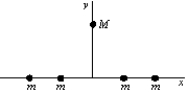
A)
B)
C)
D)
E) none of these directions
A)
B)
C)
D)
E) none of these directions
سؤال
سؤال
سؤال
سؤال
سؤال
سؤال
سؤال
سؤال
سؤال
Three particles, two with mass m and one mass M, might be arranged in any of the four configurations known below. Rank the configurations according to the magnitude of the gravitational force on M, least to greatest. 
A) 1, 2, 3, 4
B) 2, 1, 3, 4
C) 2, 1, 4, 3
D) 2, 3, 4, 2
E) 2, 3, 2, 4
A) 1, 2, 3, 4
B) 2, 1, 3, 4
C) 2, 1, 4, 3
D) 2, 3, 4, 2
E) 2, 3, 2, 4
سؤال
سؤال
سؤال
سؤال
سؤال
سؤال
سؤال
سؤال
The elliptical orbit of a planet around the Sun is shown on the diagram. Which of the following statements is true? 
A) the eccentricity of the orbit is less thatn zero
B) the eccentricity of the orbit is greater than 1
C) the sun might be at point C
D) the sun might be at point D
E) the sun might be at point B
A) the eccentricity of the orbit is less thatn zero
B) the eccentricity of the orbit is greater than 1
C) the sun might be at point C
D) the sun might be at point D
E) the sun might be at point B
سؤال
سؤال
سؤال
A spherical shell has inner radius R1, outer radius R2, and mass M, distributed uniformly throughout the shell. The magnitude of the gravitational force exerted on the shell by a point particle of mass m, located a distance d from the center, outside the inner radius and inside the outer radius, is:
A) 0
B) GMm/d2
C)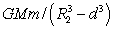
D)
E)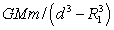
A) 0
B) GMm/d2
C)
D)
E)
سؤال
A planet travels in an elliptical orbit about a star X as shown. The magnitude of the acceleration of the planet is: 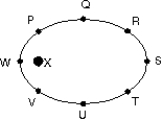
A) greatest at point Q
B) greatest at point S
C) greatest at point U
D) greatest at point W
E) the same at all points
A) greatest at point Q
B) greatest at point S
C) greatest at point U
D) greatest at point W
E) the same at all points
سؤال
سؤال
سؤال
A spherical shell has inner radius R1, outer radius R2, and mass M, distributed uniformly throughout the shell. The magnitude of the gravitational force exerted on the shell by a point mass particle of m a distance d from the center, outside the inner radius, is:
A) 0
B)
C) GMm/d2
D)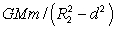
E) GMm/(R1 - d)2
A) 0
B)
C) GMm/d2
D)
E) GMm/(R1 - d)2
سؤال
An object is dropped from an altitude of one Earth radius above Earth's surface. If M is the mass of Earth and R is its radius the speed of the object just before it hits Earth is given by:
A)
B)
C)
D)
E)
A)
B)
C)
D)
E)
سؤال
A particle might be placed  Rank these situations according to the magnitude of the gravitational force on the particle, least to greatest.
A) All tie
B) 1, 2, 3, 4
C) 1 and 2 tie, then 3 and 4 tie
D) 1 and 2 tie, then 3, then 4
E) 1 and 2 tie, then 4, then 3
Rank these situations according to the magnitude of the gravitational force on the particle, least to greatest.A) All tie
B) 1, 2, 3, 4
C) 1 and 2 tie, then 3 and 4 tie
D) 1 and 2 tie, then 3, then 4
E) 1 and 2 tie, then 4, then 3
سؤال
A spherical shell has inner radius R1, outer radius R2, and mass M, distributed uniformly throughout the shell. The magnitude of the gravitational force exerted on the shell by a point mass m a distance d from the center, inside the inner radius, is:
A) 0
B)
C) GMm/d2
D)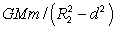
E) GMm/(R1 - d)2
A) 0
B)
C) GMm/d2
D)
E) GMm/(R1 - d)2
سؤال
سؤال
Suppose you have a pendulum clock which keeps correct time on Earth (acceleration due to gravity = 9.8 m/s2). Without changing the clock, you take it to the Moon (acceleration due to gravity = 1.6 m/s2). For every hour interval (on Earth) the Moon clock will record:
A) (9.8/1.6) h
B) 1 h
C)
D) (1.6/9.8) h
E)
A) (9.8/1.6) h
B) 1 h
C)
D) (1.6/9.8) h
E)
سؤال
سؤال
سؤال
Each of the four corners of a square with edge a is occupied by a point mass m. There is a fifth mass, also m, at the center of the square. To remove the mass from the center to a point far away the work that must be done be an external agent is given by:
A) 4Gm2/a
B) -4Gm2/a
C)
D)
E) 4Gm2/a2
A) 4Gm2/a
B) -4Gm2/a
C)
D)
E) 4Gm2/a2
سؤال
سؤال
A planet travels in an elliptical orbit about a star as shown. At what pair of points is the speed of the planet the same? 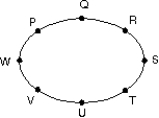
A) W and S
B) P and T
C) P and R
D) Q and U
E) Vand R
A) W and S
B) P and T
C) P and R
D) Q and U
E) Vand R
سؤال
سؤال
A spaceship is returning to Earth with its engine turned off. Consider only the gravitational field of Earth and let M be the mass of Earth, m be the mass of the spaceship, and R be the distance from the center of Earth. In moving from position 1 to position 2 the kinetic energy of the spaceship increases by:
A)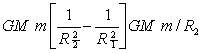
B)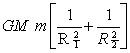
C)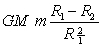
D)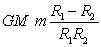
E)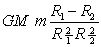
A)
B)
C)
D)
E)
سؤال
سؤال
سؤال
سؤال
سؤال
سؤال
سؤال
سؤال
سؤال
سؤال
سؤال
سؤال
A small satellite is in elliptical orbit around Earth as shown. If L denotes the magnitude of its angular momentum and K denotes kinetic energy: 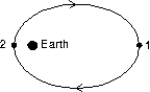
A) L2 > L1 and K2 > K1
B) L2 > L1 and K2 = K1
C) L2 = L1 and K2 = K1
D) L2 < L1 and K2 = K1
E) L2 = L1 and K2 > K1
A) L2 > L1 and K2 > K1
B) L2 > L1 and K2 = K1
C) L2 = L1 and K2 = K1
D) L2 < L1 and K2 = K1
E) L2 = L1 and K2 > K1

فتح الحزمة
قم بالتسجيل لفتح البطاقات في هذه المجموعة!
Unlock Deck
Unlock Deck
1/55

العب

ملء الشاشة (f)
Deck 13: Gravitation
1
An object at the surface of Earth (at a distance R from the center of Earth) weighs 90 N. Its weight at a distance 3R from the center of Earth is:
A) 10 N
B) 30 N
C) 90 N
D) 270 N
E) 810 N
A) 10 N
B) 30 N
C) 90 N
D) 270 N
E) 810 N
10 N
2
An object is raised from the surface of Earth to a height of two Earth radii above Earth. Then:
A) its mass increases and its weight remains constant
B) both its mass and weight remain constant
C) its mass remains constant and its weight decreases
D) both its mass and its weight decrease
E) its mass remains constant and its weight increases
A) its mass increases and its weight remains constant
B) both its mass and weight remain constant
C) its mass remains constant and its weight decreases
D) both its mass and its weight decrease
E) its mass remains constant and its weight increases
its mass remains constant and its weight decreases
3
An astronaut on the Moon simultaneously drops a feather and a hammer. The fact that they land together shows that:
A) no gravity forces act on a body in a vacuum
B) the acceleration due to gravity on the Moon is less than g on the Earth
C) in the absence of air resistance all bodies at a given location fall with the same acceleration
D) the feather has a greater weight on the Moon than on Earth
E) G = 0 on the Moon
A) no gravity forces act on a body in a vacuum
B) the acceleration due to gravity on the Moon is less than g on the Earth
C) in the absence of air resistance all bodies at a given location fall with the same acceleration
D) the feather has a greater weight on the Moon than on Earth
E) G = 0 on the Moon
in the absence of air resistance all bodies at a given location fall with the same acceleration
4
An astronaut in an orbiting space-craft feels "weightless" because she:
A) is beyond the range of gravity
B) is pulled outwards by centrifugal force
C) has no acceleration
D) has the same acceleration as the space-craft
E) is outside Earth's atmosphere
A) is beyond the range of gravity
B) is pulled outwards by centrifugal force
C) has no acceleration
D) has the same acceleration as the space-craft
E) is outside Earth's atmosphere
فتح الحزمة
افتح القفل للوصول البطاقات البالغ عددها 55 في هذه المجموعة.
فتح الحزمة
k this deck
5
In the formula F = Gm1m2/r2, the quantity G:
A) depends on the local value of g
B) is used only when the Earth is one of the two masses
C) is greatest at the surface of the Earth
D) is a universal constant of nature
E) is related to the Sun in the same way that g is related to the Earth
A) depends on the local value of g
B) is used only when the Earth is one of the two masses
C) is greatest at the surface of the Earth
D) is a universal constant of nature
E) is related to the Sun in the same way that g is related to the Earth
فتح الحزمة
افتح القفل للوصول البطاقات البالغ عددها 55 في هذه المجموعة.
فتح الحزمة
k this deck
6
Suitable units for the gravitational constant G are:
A) kg.m/s2
B) m/s2
C) N.s/m
D) kg.m/s
E) m3/(kg.s2)
A) kg.m/s2
B) m/s2
C) N.s/m
D) kg.m/s
E) m3/(kg.s2)
فتح الحزمة
افتح القفل للوصول البطاقات البالغ عددها 55 في هذه المجموعة.
فتح الحزمة
k this deck
7
Four particles, each with mass m, are arranged symmetrically about the origin on the x axis. A fifth particle, with mass M, is on the y axis. The direction of the gravitational force on M is:
A)
B)
C)
D)
E) none of these directions
A)
B)
C)
D)
E) none of these directions
فتح الحزمة
افتح القفل للوصول البطاقات البالغ عددها 55 في هذه المجموعة.
فتح الحزمة
k this deck
8
Let F1 be the magnitude of the gravitational force exerted on the Sun by Earth and F2 be the magnitude of the force exerted on Earth by the Sun. Then:
A) F1 is much greater than F2
B) F1 is slightly greater than F2
C) F1 is equal to F2
D) F1 is slightly less than F2
E) F1 is much less than F2
A) F1 is much greater than F2
B) F1 is slightly greater than F2
C) F1 is equal to F2
D) F1 is slightly less than F2
E) F1 is much less than F2
فتح الحزمة
افتح القفل للوصول البطاقات البالغ عددها 55 في هذه المجموعة.
فتح الحزمة
k this deck
9
If Earth were to rotate only 100 times per year about its axis:
A) airplanes flying west to east would make better time
B) we would fly off Earth's surface
C) our apparent weight would slightly increase
D) Earth's atmosphere would float into outer space
E) our apparent weight would slightly decrease
A) airplanes flying west to east would make better time
B) we would fly off Earth's surface
C) our apparent weight would slightly increase
D) Earth's atmosphere would float into outer space
E) our apparent weight would slightly decrease
فتح الحزمة
افتح القفل للوصول البطاقات البالغ عددها 55 في هذه المجموعة.
فتح الحزمة
k this deck
10
Earth exerts a gravitational force on the Moon, keeping it in its orbit. The reaction to this force, in the sense of Newton's third law, is:
A) the centripetal force on the Moon
B) the nearly circular orbit of the Moon
C) the gravitational force exerted on Earth by the Moon
D) the tides due to the Moon
E) the apple hitting Newton on the head
A) the centripetal force on the Moon
B) the nearly circular orbit of the Moon
C) the gravitational force exerted on Earth by the Moon
D) the tides due to the Moon
E) the apple hitting Newton on the head
فتح الحزمة
افتح القفل للوصول البطاقات البالغ عددها 55 في هذه المجموعة.
فتح الحزمة
k this deck
11
The magnitude of the acceleration of a planet in orbit around the Sun is proportional to:
A) the mass of the planet
B) the mass of the Sun
C) the distance between the planet and the Sun
D) the reciprocal of the distance between the planet and the Sun
E) the product of the mass of the planet and the mass of the Sun
A) the mass of the planet
B) the mass of the Sun
C) the distance between the planet and the Sun
D) the reciprocal of the distance between the planet and the Sun
E) the product of the mass of the planet and the mass of the Sun
فتح الحزمة
افتح القفل للوصول البطاقات البالغ عددها 55 في هذه المجموعة.
فتح الحزمة
k this deck
12
Venus has a mass of about 0.0558 times the mass of Earth and a diameter of about 0.381 times the diameter of Earth. The acceleration of a body falling near the surface of Venus is about:
A) 0.21 m/s2
B) 1.4 m/s2
C) 2.8 m/s2
D) 3.8 m/s2
E) 25 m/s2
A) 0.21 m/s2
B) 1.4 m/s2
C) 2.8 m/s2
D) 3.8 m/s2
E) 25 m/s2
فتح الحزمة
افتح القفل للوصول البطاقات البالغ عددها 55 في هذه المجموعة.
فتح الحزمة
k this deck
13
Let M denote the mass of Earth and let R denote its radius. The ratio g/G at Earth's surface is:
A) R2/M
B) M/R2
C) MR2
D) M/R
E) R/M
A) R2/M
B) M/R2
C) MR2
D) M/R
E) R/M
فتح الحزمة
افتح القفل للوصول البطاقات البالغ عددها 55 في هذه المجموعة.
فتح الحزمة
k this deck
14
The gravitational constant G has the derived units
A) N.m
B) N.m/kg
C) N.kg/m
D) N.m2/kg2
E) N.kg2/m2
A) N.m
B) N.m/kg
C) N.kg/m
D) N.m2/kg2
E) N.kg2/m2
فتح الحزمة
افتح القفل للوصول البطاقات البالغ عددها 55 في هذه المجموعة.
فتح الحزمة
k this deck
15
An artificial satellite of the Earth releases a bomb. Neglecting air resistance, the bomb will:
A) strike Earth under the satellite at the instant of release
B) strike Earth under the satellite at the instant of impact
C) strike Earth ahead of the satellite at the instant of impact
D) strike Earth behind the satellite at the instant of impact
E) never strikes Earth
A) strike Earth under the satellite at the instant of release
B) strike Earth under the satellite at the instant of impact
C) strike Earth ahead of the satellite at the instant of impact
D) strike Earth behind the satellite at the instant of impact
E) never strikes Earth
فتح الحزمة
افتح القفل للوصول البطاقات البالغ عددها 55 في هذه المجموعة.
فتح الحزمة
k this deck
16
Three particles, two with mass m and one mass M, might be arranged in any of the four configurations known below. Rank the configurations according to the magnitude of the gravitational force on M, least to greatest.
A) 1, 2, 3, 4
B) 2, 1, 3, 4
C) 2, 1, 4, 3
D) 2, 3, 4, 2
E) 2, 3, 2, 4
A) 1, 2, 3, 4
B) 2, 1, 3, 4
C) 2, 1, 4, 3
D) 2, 3, 4, 2
E) 2, 3, 2, 4
فتح الحزمة
افتح القفل للوصول البطاقات البالغ عددها 55 في هذه المجموعة.
فتح الحزمة
k this deck
17
The approximate value of g at an altitude above Earth equal to one Earth diameter is:
A) 9.8 m/s2
B) 4.9 m/s2
C) 2.5 m/s2
D) 1.9 m/s2
E) 1.1 m/s2
A) 9.8 m/s2
B) 4.9 m/s2
C) 2.5 m/s2
D) 1.9 m/s2
E) 1.1 m/s2
فتح الحزمة
افتح القفل للوصول البطاقات البالغ عددها 55 في هذه المجموعة.
فتح الحزمة
k this deck
18
The mass of a hypothetical planet is 1/100 that of Earth and its radius is 1/4 that of Earth. If a person weighs 600 N on Earth, what would he weigh on this planet?
A) 24 N
B) 48 N
C) 96 N
D) 192 N
E) 600 N
A) 24 N
B) 48 N
C) 96 N
D) 192 N
E) 600 N
فتح الحزمة
افتح القفل للوصول البطاقات البالغ عددها 55 في هذه المجموعة.
فتح الحزمة
k this deck
19
An astronaut finishes some work on the outside of his satellite, which is in circular orbit around the Earth. He leaves his wrench outside the satellite. The wrench will:
A) fall directly down to the Earth
B) continue in orbit at reduced speed
C) continue in orbit with the satellite
D) fly off tangentially into space
E) spiral down to the Earth
A) fall directly down to the Earth
B) continue in orbit at reduced speed
C) continue in orbit with the satellite
D) fly off tangentially into space
E) spiral down to the Earth
فتح الحزمة
افتح القفل للوصول البطاقات البالغ عددها 55 في هذه المجموعة.
فتح الحزمة
k this deck
20
The mass of an object:
A) is slightly different at different locations on the Earth
B) is a vector
C) is independent of the acceleration due to gravity
D) is the same for all objects of the same size and shape
E) can be measured directly and accurately on a spring scale
A) is slightly different at different locations on the Earth
B) is a vector
C) is independent of the acceleration due to gravity
D) is the same for all objects of the same size and shape
E) can be measured directly and accurately on a spring scale
فتح الحزمة
افتح القفل للوصول البطاقات البالغ عددها 55 في هذه المجموعة.
فتح الحزمة
k this deck
21
Neglecting air resistance, a 1.0-kg projectile has an escape velocity of about 11 km/s at the surface of Earth. The corresponding escape velocity for a 2.0 kg projectile is:
A) 3.5 km/s
B) 5.5 km/s
C) 7.1 km/s
D) 10 km/s
E) 11 km/s
A) 3.5 km/s
B) 5.5 km/s
C) 7.1 km/s
D) 10 km/s
E) 11 km/s
فتح الحزمة
افتح القفل للوصول البطاقات البالغ عددها 55 في هذه المجموعة.
فتح الحزمة
k this deck
22
Two particles, each of mass m, are a distance d apart. To bring a third particle, with mass 2m, from far away to a resting point midway between the two particles the work done by an external agent does work given by:
A) 4Gm2/d
B) -4Gm2/d
C) 8Gm2/d2
D) -8Gm2/d2
E) zero
A) 4Gm2/d
B) -4Gm2/d
C) 8Gm2/d2
D) -8Gm2/d2
E) zero
فتح الحزمة
افتح القفل للوصول البطاقات البالغ عددها 55 في هذه المجموعة.
فتح الحزمة
k this deck
23
Consider the statement: "Earth moves in a stable orbit around the Sun and is therefore in equilibrium". The statement is:
A) false, because no moving body can be in equilibrium
B) true, because the Earth does not fall into or fly away from the sun
C) false, because the Earth is rotating on its axis and no rotating body can be in equilibrium
D) false, because the Earth has a considerable acceleration
E) true, because if it were not in equilibrium then buildings and structures would not be stable
A) false, because no moving body can be in equilibrium
B) true, because the Earth does not fall into or fly away from the sun
C) false, because the Earth is rotating on its axis and no rotating body can be in equilibrium
D) false, because the Earth has a considerable acceleration
E) true, because if it were not in equilibrium then buildings and structures would not be stable
فتح الحزمة
افتح القفل للوصول البطاقات البالغ عددها 55 في هذه المجموعة.
فتح الحزمة
k this deck
24
The elliptical orbit of a planet around the Sun is shown on the diagram. Which of the following statements is true?
A) the eccentricity of the orbit is less thatn zero
B) the eccentricity of the orbit is greater than 1
C) the sun might be at point C
D) the sun might be at point D
E) the sun might be at point B
A) the eccentricity of the orbit is less thatn zero
B) the eccentricity of the orbit is greater than 1
C) the sun might be at point C
D) the sun might be at point D
E) the sun might be at point B
فتح الحزمة
افتح القفل للوصول البطاقات البالغ عددها 55 في هذه المجموعة.
فتح الحزمة
k this deck
25
A projectile is fired straight upward from Earth's surface with a speed that is half the escape speed. If R is the radius of Earth, the highest altitude reached, measured from the surface, is:
A) R/4
B) R/3
C) R/2
D) R
E) 2R
A) R/4
B) R/3
C) R/2
D) R
E) 2R
فتح الحزمة
افتح القفل للوصول البطاقات البالغ عددها 55 في هذه المجموعة.
فتح الحزمة
k this deck
26
The mass density of a certain planet has spherical symmetry but varies in such a way that the mass inside every spherical surface with center at the center of the planet is proportional to the radius of the surface. If r is the distance from the center of the planet to a point mass inside the planet, the gravitational force on the mass is:
A) not dependent on r
B) proportional to r2
C) proportional to r
D) proportional to 1/r
E) proportional to 1/r2
A) not dependent on r
B) proportional to r2
C) proportional to r
D) proportional to 1/r
E) proportional to 1/r2
فتح الحزمة
افتح القفل للوصول البطاقات البالغ عددها 55 في هذه المجموعة.
فتح الحزمة
k this deck
27
A spherical shell has inner radius R1, outer radius R2, and mass M, distributed uniformly throughout the shell. The magnitude of the gravitational force exerted on the shell by a point particle of mass m, located a distance d from the center, outside the inner radius and inside the outer radius, is:
A) 0
B) GMm/d2
C)
D)
E)
A) 0
B) GMm/d2
C)
D)
E)
فتح الحزمة
افتح القفل للوصول البطاقات البالغ عددها 55 في هذه المجموعة.
فتح الحزمة
k this deck
28
A planet travels in an elliptical orbit about a star X as shown. The magnitude of the acceleration of the planet is:
A) greatest at point Q
B) greatest at point S
C) greatest at point U
D) greatest at point W
E) the same at all points
A) greatest at point Q
B) greatest at point S
C) greatest at point U
D) greatest at point W
E) the same at all points
فتح الحزمة
افتح القفل للوصول البطاقات البالغ عددها 55 في هذه المجموعة.
فتح الحزمة
k this deck
29
Of the following where would the weight of an object be the least?
A) 2000 miles above Earth's surface
B) At the north pole
C) At the equator
D) At the center of Earth
E) At the south pole
A) 2000 miles above Earth's surface
B) At the north pole
C) At the equator
D) At the center of Earth
E) At the south pole
فتح الحزمة
افتح القفل للوصول البطاقات البالغ عددها 55 في هذه المجموعة.
فتح الحزمة
k this deck
30
The escape velocity at the surface of Earth is approximately 8 km/s. What is the mass, in units of Earth's mass, of a planet with twice the radius of Earth for which the escape speed is twice that for Earth?
A) 2
B) 4
C) 8
D) 1/2
E) 1/4
A) 2
B) 4
C) 8
D) 1/2
E) 1/4
فتح الحزمة
افتح القفل للوصول البطاقات البالغ عددها 55 في هذه المجموعة.
فتح الحزمة
k this deck
31
A spherical shell has inner radius R1, outer radius R2, and mass M, distributed uniformly throughout the shell. The magnitude of the gravitational force exerted on the shell by a point mass particle of m a distance d from the center, outside the inner radius, is:
A) 0
B)
C) GMm/d2
D)
E) GMm/(R1 - d)2
A) 0
B)
C) GMm/d2
D)
E) GMm/(R1 - d)2
فتح الحزمة
افتح القفل للوصول البطاقات البالغ عددها 55 في هذه المجموعة.
فتح الحزمة
k this deck
32
An object is dropped from an altitude of one Earth radius above Earth's surface. If M is the mass of Earth and R is its radius the speed of the object just before it hits Earth is given by:
A)
B)
C)
D)
E)
A)
B)
C)
D)
E)
فتح الحزمة
افتح القفل للوصول البطاقات البالغ عددها 55 في هذه المجموعة.
فتح الحزمة
k this deck
33
A particle might be placed Rank these situations according to the magnitude of the gravitational force on the particle, least to greatest.
A) All tie
B) 1, 2, 3, 4
C) 1 and 2 tie, then 3 and 4 tie
D) 1 and 2 tie, then 3, then 4
E) 1 and 2 tie, then 4, then 3
Rank these situations according to the magnitude of the gravitational force on the particle, least to greatest.A) All tie
B) 1, 2, 3, 4
C) 1 and 2 tie, then 3 and 4 tie
D) 1 and 2 tie, then 3, then 4
E) 1 and 2 tie, then 4, then 3
فتح الحزمة
افتح القفل للوصول البطاقات البالغ عددها 55 في هذه المجموعة.
فتح الحزمة
k this deck
34
A spherical shell has inner radius R1, outer radius R2, and mass M, distributed uniformly throughout the shell. The magnitude of the gravitational force exerted on the shell by a point mass m a distance d from the center, inside the inner radius, is:
A) 0
B)
C) GMm/d2
D)
E) GMm/(R1 - d)2
A) 0
B)
C) GMm/d2
D)
E) GMm/(R1 - d)2
فتح الحزمة
افتح القفل للوصول البطاقات البالغ عددها 55 في هذه المجموعة.
فتح الحزمة
k this deck
35
Neglecting air resistance, the escape speed from a certain planet for an empty space vehicle is 1.12 *104 m/s. What is the corresponding escape speed for the fully loaded vehicle which has triple the mass of the empty one?
A) 3.73 * 103 m/s
B) 1.12* 104 m/s
C) 3.36 * 104 m/s
D) 9.98 * 104 m/s
E) 1.40 * 1012 m/s
A) 3.73 * 103 m/s
B) 1.12* 104 m/s
C) 3.36 * 104 m/s
D) 9.98 * 104 m/s
E) 1.40 * 1012 m/s
فتح الحزمة
افتح القفل للوصول البطاقات البالغ عددها 55 في هذه المجموعة.
فتح الحزمة
k this deck
36
Suppose you have a pendulum clock which keeps correct time on Earth (acceleration due to gravity = 9.8 m/s2). Without changing the clock, you take it to the Moon (acceleration due to gravity = 1.6 m/s2). For every hour interval (on Earth) the Moon clock will record:
A) (9.8/1.6) h
B) 1 h
C)
D) (1.6/9.8) h
E)
A) (9.8/1.6) h
B) 1 h
C)
D) (1.6/9.8) h
E)
فتح الحزمة
افتح القفل للوصول البطاقات البالغ عددها 55 في هذه المجموعة.
فتح الحزمة
k this deck
37
In planetary motion the line from the star to the planet sweeps out equal areas in equal times. This is a direct consequence of:
A) the conservation of energy
B) the conservation of momentum
C) the conservation of angular momentum
D) the conservation of mass
E) none of the above
A) the conservation of energy
B) the conservation of momentum
C) the conservation of angular momentum
D) the conservation of mass
E) none of the above
فتح الحزمة
افتح القفل للوصول البطاقات البالغ عددها 55 في هذه المجموعة.
فتح الحزمة
k this deck
38
A rocket ship is coasting toward a planet. Its captain wishes to know the value of g at the surface of the planet. This may be inferred by:
A) measuring the apparent weight of one of the crew
B) measuring the apparent weight of an object of known mass in the ship
C) measuring the diameter of the planet
D) measuring the density of the planet
E) observing the ship's acceleration and correcting for the distance from the center of the planet
A) measuring the apparent weight of one of the crew
B) measuring the apparent weight of an object of known mass in the ship
C) measuring the diameter of the planet
D) measuring the density of the planet
E) observing the ship's acceleration and correcting for the distance from the center of the planet
فتح الحزمة
افتح القفل للوصول البطاقات البالغ عددها 55 في هذه المجموعة.
فتح الحزمة
k this deck
39
Each of the four corners of a square with edge a is occupied by a point mass m. There is a fifth mass, also m, at the center of the square. To remove the mass from the center to a point far away the work that must be done be an external agent is given by:
A) 4Gm2/a
B) -4Gm2/a
C)
D)
E) 4Gm2/a2
A) 4Gm2/a
B) -4Gm2/a
C)
D)
E) 4Gm2/a2
فتح الحزمة
افتح القفل للوصول البطاقات البالغ عددها 55 في هذه المجموعة.
فتح الحزمة
k this deck
40
A spring scale, calibrated in newtons, is used to weigh sugar. If it were possible to weigh sugar at the following locations, where will the buyer get the most sugar to a newton?
A) At the north pole
B) At the equator
C) At the center of Earth
D) On the Moon
E) On Jupiter
A) At the north pole
B) At the equator
C) At the center of Earth
D) On the Moon
E) On Jupiter
فتح الحزمة
افتح القفل للوصول البطاقات البالغ عددها 55 في هذه المجموعة.
فتح الحزمة
k this deck
41
A planet travels in an elliptical orbit about a star as shown. At what pair of points is the speed of the planet the same?
A) W and S
B) P and T
C) P and R
D) Q and U
E) Vand R
A) W and S
B) P and T
C) P and R
D) Q and U
E) Vand R
فتح الحزمة
افتح القفل للوصول البطاقات البالغ عددها 55 في هذه المجموعة.
فتح الحزمة
k this deck
42
A planet in another solar system orbits a star with a mass of 4.0 * 1030 kg. At one point in its orbit it is 250 *106 km from the star and is moving at 35 km/s. Take the universal gravitational constant to be 6.67 *10-11 m2/s2 . kg and calculate the semimajor axis of the planet's orbit. The result is:
A) 79 *106 km
B) 160 * 106 km
C) 240 * 106 km
D) 320 * 106 km
E) 590 * 106 km
A) 79 *106 km
B) 160 * 106 km
C) 240 * 106 km
D) 320 * 106 km
E) 590 * 106 km
فتح الحزمة
افتح القفل للوصول البطاقات البالغ عددها 55 في هذه المجموعة.
فتح الحزمة
k this deck
43
A spaceship is returning to Earth with its engine turned off. Consider only the gravitational field of Earth and let M be the mass of Earth, m be the mass of the spaceship, and R be the distance from the center of Earth. In moving from position 1 to position 2 the kinetic energy of the spaceship increases by:
A)
B)
C)
D)
E)
A)
B)
C)
D)
E)
فتح الحزمة
افتح القفل للوصول البطاقات البالغ عددها 55 في هذه المجموعة.
فتح الحزمة
k this deck
44
Two planets are orbiting a star in a distant galaxy. The first has a semimajor axis of 150 *106 km, an eccentricity of 0.20, and a period of 1.0 Earth years. The second has a semimajor axis of 250 * 106 km, an eccentricity of 0.30, and a period of:
A) 0.46 Earth yr
B) 0.57 Earth yr
C) 1.4 Earth yr
D) 1.8 Earth yr
E) 2.2 Earth yr
A) 0.46 Earth yr
B) 0.57 Earth yr
C) 1.4 Earth yr
D) 1.8 Earth yr
E) 2.2 Earth yr
فتح الحزمة
افتح القفل للوصول البطاقات البالغ عددها 55 في هذه المجموعة.
فتح الحزمة
k this deck
45
Planet 1 and planet 2 are both in circular orbits around the same central star. The orbit of planet 2 has a radius that is much larger than the radius of the orbit of planet 1. This means that:
A) the period of planet 1 is greater than the period of planet 2 and the speed of planet 1 is greater than the speed of planet 2
B) the period of planet 1 is greater than the period of planet 2 and the speed of planet 1 is less than the speed of planet 2
C) the period of planet 1 is less than the period of planet 2 and the speed of planet 1 is less than the speed of planet 2
D) the period of planet 1 is less than the period of planet 2 and the speed of planet 1 is greater than the speed of planet 2
E) the planets have the same speed and the same period
A) the period of planet 1 is greater than the period of planet 2 and the speed of planet 1 is greater than the speed of planet 2
B) the period of planet 1 is greater than the period of planet 2 and the speed of planet 1 is less than the speed of planet 2
C) the period of planet 1 is less than the period of planet 2 and the speed of planet 1 is less than the speed of planet 2
D) the period of planet 1 is less than the period of planet 2 and the speed of planet 1 is greater than the speed of planet 2
E) the planets have the same speed and the same period
فتح الحزمة
افتح القفل للوصول البطاقات البالغ عددها 55 في هذه المجموعة.
فتح الحزمة
k this deck
46
A planet is in circular orbit around the Sun. Its distance from the Sun is four times the average distance of Earth from the Sun. The period of this planet, in Earth years, is:
A) 4
B) 8
C) 16
D) 64
E) 2.52
A) 4
B) 8
C) 16
D) 64
E) 2.52
فتح الحزمة
افتح القفل للوصول البطاقات البالغ عددها 55 في هذه المجموعة.
فتح الحزمة
k this deck
47
An artificial Earth satellite is moved from a circular orbit with radius R to a circular orbit with radius 2R. During this move:
A) the gravitational force does positive work, the kinetic energy of the satellite increases, and the potential energy of the Earth-satellite system increases
B) the gravitational force does positive work, the kinetic energy of the satellite increases, and the potential energy of the Earth-satellite system decreases
C) the gravitational force does positive work, the kinetic energy of the satellite decreases, and the potential energy of the Earth-satellite system increases
D) the gravitational force does negative work, the kinetic energy of the satellite system increases, and the potential energy of the Earth-satellite system decreases
E) the gravitational force does negative work, the kinetic energy of the satellite decreases, and the potential energy of the Earth-satellite system increases
A) the gravitational force does positive work, the kinetic energy of the satellite increases, and the potential energy of the Earth-satellite system increases
B) the gravitational force does positive work, the kinetic energy of the satellite increases, and the potential energy of the Earth-satellite system decreases
C) the gravitational force does positive work, the kinetic energy of the satellite decreases, and the potential energy of the Earth-satellite system increases
D) the gravitational force does negative work, the kinetic energy of the satellite system increases, and the potential energy of the Earth-satellite system decreases
E) the gravitational force does negative work, the kinetic energy of the satellite decreases, and the potential energy of the Earth-satellite system increases
فتح الحزمة
افتح القفل للوصول البطاقات البالغ عددها 55 في هذه المجموعة.
فتح الحزمة
k this deck
48
An artificial satellite of Earth nears the end of its life due to air resistance. While still in orbit:
A) it moves faster as the orbit lowers
B) it moves slower as the orbit lowers
C) it slowly spirals away from Earth
D) it moves slower in the same orbit but with a decreasing period
E) it moves faster in the same orbit but with an increasing period
A) it moves faster as the orbit lowers
B) it moves slower as the orbit lowers
C) it slowly spirals away from Earth
D) it moves slower in the same orbit but with a decreasing period
E) it moves faster in the same orbit but with an increasing period
فتح الحزمة
افتح القفل للوصول البطاقات البالغ عددها 55 في هذه المجموعة.
فتح الحزمة
k this deck
49
Given the perihelion distance, aphelion distance, and speed at perihelion of a planet, which of the following CANNOT be calculated?
A) the mass of the star
B) the mass of the planet
C) the speed of the planet at aphelion
D) the period of orbit
E) the semimajor axis of the orbit
A) the mass of the star
B) the mass of the planet
C) the speed of the planet at aphelion
D) the period of orbit
E) the semimajor axis of the orbit
فتح الحزمة
افتح القفل للوصول البطاقات البالغ عددها 55 في هذه المجموعة.
فتح الحزمة
k this deck
50
For a planet in orbit around a star the perihelion distance is rp and its speed at perihelion is vp. The aphelion distance is ra and its speed at aphelion is va. Which of following is true?
A) va = vp
B) va/ ra = vp/rp
C) va ra = vp rp
D) va/ r2a = vp/r2p
E) va r2a = vp/r2p
A) va = vp
B) va/ ra = vp/rp
C) va ra = vp rp
D) va/ r2a = vp/r2p
E) va r2a = vp/r2p
فتح الحزمة
افتح القفل للوصول البطاقات البالغ عددها 55 في هذه المجموعة.
فتح الحزمة
k this deck
51
To measure the mass of a planet with the same radius as Earth, an astronaut drops an object from rest (relative to the planet) from an altitude of one radius above the surface. When the object hits its speed is 4 times what it would be if the same experiment were carried out for Earth. In units of Earth masses, the mass of the planet is:
A) 2
B) 4
C) 8
D) 16
E) 32
A) 2
B) 4
C) 8
D) 16
E) 32
فتح الحزمة
افتح القفل للوصول البطاقات البالغ عددها 55 في هذه المجموعة.
فتح الحزمة
k this deck
52
The orbit of a certain a satellite has a semimajor axis of 1.5 * 107 m and an eccentricity of 0.20. Its perigee (minimum distance) and apogee (maximum distance) are respectively:
A) 1.2 *107 m, 1.8 *107 m
B) 3.0 * 106 m, 1.2*107 m
C) 9.6 *106 m, 1.0*107 m
D) 1.0 * 107 m, 1.2 *107 m
E) 9.6 * 106 m, 1.8 * 107 m
A) 1.2 *107 m, 1.8 *107 m
B) 3.0 * 106 m, 1.2*107 m
C) 9.6 *106 m, 1.0*107 m
D) 1.0 * 107 m, 1.2 *107 m
E) 9.6 * 106 m, 1.8 * 107 m
فتح الحزمة
افتح القفل للوصول البطاقات البالغ عددها 55 في هذه المجموعة.
فتح الحزمة
k this deck
53
Assume that Earth is in circular orbit around the Sun with kinetic energy K and potential energy U, taken to be zero for infinite separation. Then, the relationship between K and U:
A) is K = U
B) is K = -U
C) is K = U/2
D) is K = -U/2
E) depends on the radius of the orbit
A) is K = U
B) is K = -U
C) is K = U/2
D) is K = -U/2
E) depends on the radius of the orbit
فتح الحزمة
افتح القفل للوصول البطاقات البالغ عددها 55 في هذه المجموعة.
فتح الحزمة
k this deck
54
The speed of a comet in an elliptical orbit about the sun:
A) decreases while it is receding from the sun
B) is constant
C) is greatest when farthest from the sun
D) varies sinusoidally with time
E) equals L/(mr), where L is its angular momentum, m is its mass, and r is its distance from the sun
A) decreases while it is receding from the sun
B) is constant
C) is greatest when farthest from the sun
D) varies sinusoidally with time
E) equals L/(mr), where L is its angular momentum, m is its mass, and r is its distance from the sun
فتح الحزمة
افتح القفل للوصول البطاقات البالغ عددها 55 في هذه المجموعة.
فتح الحزمة
k this deck
55
A small satellite is in elliptical orbit around Earth as shown. If L denotes the magnitude of its angular momentum and K denotes kinetic energy:
A) L2 > L1 and K2 > K1
B) L2 > L1 and K2 = K1
C) L2 = L1 and K2 = K1
D) L2 < L1 and K2 = K1
E) L2 = L1 and K2 > K1
A) L2 > L1 and K2 > K1
B) L2 > L1 and K2 = K1
C) L2 = L1 and K2 = K1
D) L2 < L1 and K2 = K1
E) L2 = L1 and K2 > K1
فتح الحزمة
افتح القفل للوصول البطاقات البالغ عددها 55 في هذه المجموعة.
فتح الحزمة
k this deck
فتح الحزمة
افتح القفل للوصول البطاقات البالغ عددها 55 في هذه المجموعة.






