







 تكلم مع الذكاء الاصطناعي


Deck 10: Alkynes
ملء الشاشة (f)

سؤال

سؤال
سؤال
For the molecule below, known as 2-pentyne, which of the following describes the orbital overlap of the C2-C3 sigma bond? 
A) sp-sp
B) sp2-sp2
C) sp3-sp3
D) p-p
E) sp3-sp
A) sp-sp
B) sp2-sp2
C) sp3-sp3
D) p-p
E) sp3-sp
سؤال
Which of the following is a structure for hepta-3,6-dien-1-yne? 
A) I
B) II
C) III
D) IV
E) V
A) I
B) II
C) III
D) IV
E) V
سؤال
سؤال
Which of the following is the structure for 3-sec-butyl-1-heptyne? 
A) I
B) II
C) III
D) IV
E) V
A) I
B) II
C) III
D) IV
E) V
سؤال
What is the IUPAC name for the molecule shown below? 
A) 4-ethyl-2-pentyne
B) 2-ethyl-3-pentyne
C) 3-methyl-4-hexyne
D) 4-methyl-2-hexyne
E) sec-Butylpropyne
A) 4-ethyl-2-pentyne
B) 2-ethyl-3-pentyne
C) 3-methyl-4-hexyne
D) 4-methyl-2-hexyne
E) sec-Butylpropyne
سؤال
What is the IUPAC name for the molecule shown below? 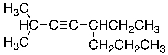
A) 2-methyl-5-propyl-3-heptyne
B) 5-ethyl-2-methyl-3-octyne
C) 1-isopropyl-3-ethyl-1-hexyne
D) 6-methyl-3-propyl-4-heptyne
E) 4-ethyl-7-methyl-5-octyne
A) 2-methyl-5-propyl-3-heptyne
B) 5-ethyl-2-methyl-3-octyne
C) 1-isopropyl-3-ethyl-1-hexyne
D) 6-methyl-3-propyl-4-heptyne
E) 4-ethyl-7-methyl-5-octyne
سؤال
For the molecule below, known as 2,4-hexadiyne, which of the following describes the orbital overlap of the C3-C4 sigma bond? 
A) sp-sp
B) sp2-sp2
C) sp3-sp3
D) p-p
E) sp3-sp
A) sp-sp
B) sp2-sp2
C) sp3-sp3
D) p-p
E) sp3-sp
سؤال
سؤال
Which of the following is the structure for 2-hexyne? 
A) I
B) II
C) III
D) IV
A) I
B) II
C) III
D) IV
سؤال
What is the IUPAC name for the molecule shown below? 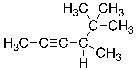
A) 2,2,3-trimethyl-4-hexyne
B) 4-tert-butyl-2-pentyne
C) 4,5,5-trimethyl-2-hexyne
D) 4,5,5,5-tetramethyl-2-pentyne
E) 2,2-dimethyl-3-(1-propynyl)butane
A) 2,2,3-trimethyl-4-hexyne
B) 4-tert-butyl-2-pentyne
C) 4,5,5-trimethyl-2-hexyne
D) 4,5,5,5-tetramethyl-2-pentyne
E) 2,2-dimethyl-3-(1-propynyl)butane
سؤال
What is the IUPAC name for the molecule shown below? 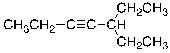
A) 1,1-diethyl-2-pentyne
B) 3-(1-butynyl)pentane
C) 5-ethyl-3-octyne
D) 3-ethyl-4-heptyne
E) 5-ethyl-3-heptyne
A) 1,1-diethyl-2-pentyne
B) 3-(1-butynyl)pentane
C) 5-ethyl-3-octyne
D) 3-ethyl-4-heptyne
E) 5-ethyl-3-heptyne
سؤال
What is the IUPAC name for the molecule shown below? 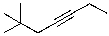
A) 4,4-dimethyl-2-pentyne
B) 2,2-dimethyl-4-heptyne
C) 1-tert-butyl-3-heptyne
D) 6,6-dimethyl-3-heptyne
E) 6,6,6-trimethyl-3-hexyne
A) 4,4-dimethyl-2-pentyne
B) 2,2-dimethyl-4-heptyne
C) 1-tert-butyl-3-heptyne
D) 6,6-dimethyl-3-heptyne
E) 6,6,6-trimethyl-3-hexyne
سؤال
What is the IUPAC name for the molecule shown below? 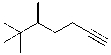
A) 5,6,6-trimethyl-1-heptyne
B) 5-tert-butyl-1-hexyne
C) 2,2,3-trimethyl-6-heptyne
D) 2,2,3-(3-butynyl)butane
E) sec-butyl-tert-butylacetylene
A) 5,6,6-trimethyl-1-heptyne
B) 5-tert-butyl-1-hexyne
C) 2,2,3-trimethyl-6-heptyne
D) 2,2,3-(3-butynyl)butane
E) sec-butyl-tert-butylacetylene
سؤال
What is the IUPAC name for the molecule shown below? 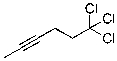
A) 1,1,1-trichloro-4-hexyne
B) 4,4,4-trichloro-1-butyne
C) 1,1,1-trichloro-2-butyne
D) 5,5,5-trichloro-2-pentyne
E) 6,6,6-trichloro-2-hexyne
A) 1,1,1-trichloro-4-hexyne
B) 4,4,4-trichloro-1-butyne
C) 1,1,1-trichloro-2-butyne
D) 5,5,5-trichloro-2-pentyne
E) 6,6,6-trichloro-2-hexyne
سؤال
What is the IUPAC name for the molecule shown below? 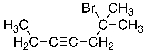
A) 6-bromo-3-octyne
B) 6-bromo-6-methyl-3-heptyne
C) 2-bromo-2-methyl-4-heptyne
D) 6-bromo-6,6-dimethyl-3-hexyne
E) 2-bromo-4-octyne
A) 6-bromo-3-octyne
B) 6-bromo-6-methyl-3-heptyne
C) 2-bromo-2-methyl-4-heptyne
D) 6-bromo-6,6-dimethyl-3-hexyne
E) 2-bromo-4-octyne
سؤال
What is the hybridization of the carbon atoms numbered 1 and 2 respectively in the following structure? 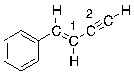
A) sp3, sp2
B) sp2, sp2
C) sp, sp
D) sp2, sp
E) sp, sp2
A) sp3, sp2
B) sp2, sp2
C) sp, sp
D) sp2, sp
E) sp, sp2
سؤال
سؤال
سؤال
سؤال
What is the IUPAC name for the molecule shown below? 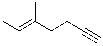
A) (E)-5-methyl-5-hepten-1-yne
B) (Z)-5-methyl-5-hepten-1-yne
C) (E)-3-methyl-2-hepten-6-yne
D) (Z)-3-methyl-2-hepten-6-yne
E) (E)-2-butynyl-2-butene
A) (E)-5-methyl-5-hepten-1-yne
B) (Z)-5-methyl-5-hepten-1-yne
C) (E)-3-methyl-2-hepten-6-yne
D) (Z)-3-methyl-2-hepten-6-yne
E) (E)-2-butynyl-2-butene
سؤال
What is the IUPAC name for the molecule shown below? 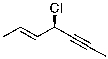
A) (4R,5Z)-4-chlorohept-5-en-2-yne
B) (4S,5E)-4-chlorohept-5-en-2-yne
C) (2E,4S)-4-chlorohept-2-en-5-yne
D) (2E,4R)-4-chlorohept-2-en-5-yne
A) (4R,5Z)-4-chlorohept-5-en-2-yne
B) (4S,5E)-4-chlorohept-5-en-2-yne
C) (2E,4S)-4-chlorohept-2-en-5-yne
D) (2E,4R)-4-chlorohept-2-en-5-yne
سؤال
سؤال
Which of the circled hydrogen atoms is the most acidic? 
A) I
B) II
C) III
D) IV
E) V
A) I
B) II
C) III
D) IV
E) V
سؤال
Which of the following is the structure for (2E,4E)-octa-2,4-dien-6-yne? 
A) I
B) II
C) III
D) IV
E) V
A) I
B) II
C) III
D) IV
E) V
سؤال
سؤال
سؤال
What is the IUPAC name for the molecule shown below? 
A) 3-bromo-4-acetylenylheptane
B) 3-(1-bromopropyl)-1-hexyne
C) 3-bromo-4-propyl-5-hexyne
D) 4-bromo-3-propyl-1-hexyne
E) 4-ethynyl-5-bromo-heptane
A) 3-bromo-4-acetylenylheptane
B) 3-(1-bromopropyl)-1-hexyne
C) 3-bromo-4-propyl-5-hexyne
D) 4-bromo-3-propyl-1-hexyne
E) 4-ethynyl-5-bromo-heptane
سؤال
سؤال
Which of the following is the acceptable structure for (R)-5-bromohept-2-yne? 
A) I
B) II
C) III
D) IV
E) V
A) I
B) II
C) III
D) IV
E) V
سؤال
Rank the following carbanions in order of increasing base strength. 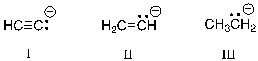
A) I < II < III
B) II < III < I
C) III < II < I
D) III < I < II
E) II < I < III
A) I < II < III
B) II < III < I
C) III < II < I
D) III < I < II
E) II < I < III
سؤال
Rank the following bases in order of decreasing basicity. 
A) III > I > V > II > IV
B) III > V > IV > I> II
C) V > I > III > II > IV
D) III > IV > II > V > I
E) IV > II > I > III > V
A) III > I > V > II > IV
B) III > V > IV > I> II
C) V > I > III > II > IV
D) III > IV > II > V > I
E) IV > II > I > III > V
سؤال
Which structure shown below represents (Z)-3,5-dichloro-3-hexen-1-yne? 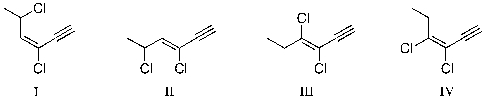
A) I
B) II
C) III
D) IV
E) I and II are both correct
A) I
B) II
C) III
D) IV
E) I and II are both correct
سؤال
What is the IUPAC name for the molecule shown below? 
A) (E)-4-isopropyloct-3-en-5-yne
B) (Z)-4-isopropyloct-3-en-5-yne
C) (E)-5-isopropyloct-5-en-3-yne
D) (Z)-5-isopropyloct-5-en-3-yne
E) (E)-4-(2-methylethyl)oct-3-en-5-yne
A) (E)-4-isopropyloct-3-en-5-yne
B) (Z)-4-isopropyloct-3-en-5-yne
C) (E)-5-isopropyloct-5-en-3-yne
D) (Z)-5-isopropyloct-5-en-3-yne
E) (E)-4-(2-methylethyl)oct-3-en-5-yne
سؤال
سؤال
سؤال
سؤال
سؤال
Rank the following acids in order of decreasing acidity. 
A) V > I > IV > II > III
B) III > IV > II > I > V
C) V > I > III > II > IV
D) I > IV > V > II > III
E) IV > I > V > II > III
A) V > I > IV > II > III
B) III > IV > II > I > V
C) V > I > III > II > IV
D) I > IV > V > II > III
E) IV > I > V > II > III
سؤال
For the reaction shown, select the expected major organic product. 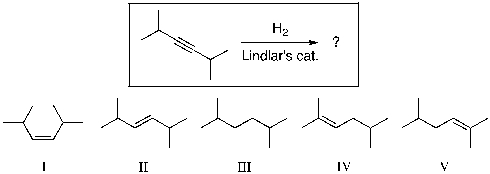
A) I
B) II
C) III
D) IV
E) V
A) I
B) II
C) III
D) IV
E) V
سؤال
For the transformation shown below, select the expected major product. 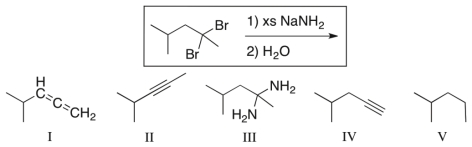
A) I
B) II
C) III
D) IV
E) V
A) I
B) II
C) III
D) IV
E) V
سؤال
سؤال
سؤال
For the reaction sequence below, select the expected major product. 
A) 3-methylhexane
B) 1-bromo-3-methylhexene
C) 2-bromo-3-methylhexene
D) 3-methyl-1-hexyne
E) 3-methyl-2-hexyne
A) 3-methylhexane
B) 1-bromo-3-methylhexene
C) 2-bromo-3-methylhexene
D) 3-methyl-1-hexyne
E) 3-methyl-2-hexyne
سؤال
سؤال
For the reaction shown, select the expected major organic product. 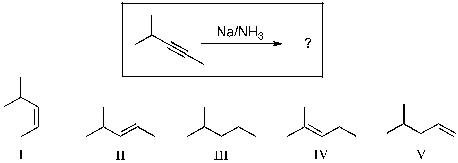
A) I
B) II
C) III
D) IV
E) V
A) I
B) II
C) III
D) IV
E) V
سؤال
Select the reagent(s) expected to accomplish the transformation shown below. 
A) H2, Pd
B) H2, Lindlar's catalyst
C) Na, NH3(l)
D) A or B
E) B or C
A) H2, Pd
B) H2, Lindlar's catalyst
C) Na, NH3(l)
D) A or B
E) B or C
سؤال
Which of the circled hydrogen atoms is the least acidic? 
A) I
B) II
C) III
D) IV
E) V
A) I
B) II
C) III
D) IV
E) V
سؤال
سؤال
سؤال
Which of the bases below would result in the most complete deprotonation of the alkyne, shown in the reaction below? 
A) NaOCH2CH3 (sodium ethoxide)
B) t-BuONa (sodium tert-butoxide)
C) NaH (sodium hydride)
D) NaHCO3 (sodium bicarbonate)
E) NaOH (sodium hydroxide)
A) NaOCH2CH3 (sodium ethoxide)
B) t-BuONa (sodium tert-butoxide)
C) NaH (sodium hydride)
D) NaHCO3 (sodium bicarbonate)
E) NaOH (sodium hydroxide)
سؤال
سؤال
سؤال
سؤال
سؤال
Select the reagent(s) expected to accomplish the transformation shown below. 
A) H2, Ni
B) H2, Ni2B
C) Na, NH3(l)
D) A or B
E) B or C
A) H2, Ni
B) H2, Ni2B
C) Na, NH3(l)
D) A or B
E) B or C
سؤال
For the reaction shown, select the expected major organic product. 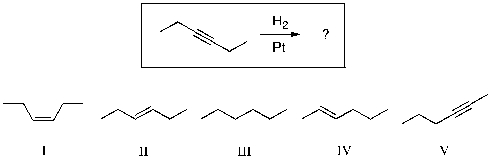
A) I
B) II
C) III
D) IV
E) V
A) I
B) II
C) III
D) IV
E) V
سؤال
سؤال
سؤال
For the reaction shown below, what is the IUPAC name of the expected product? 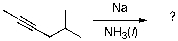
A) 2-methylhexane
B) (Z)-2-methyl-4-hexene
C) (E)-2-methyl-4-hexene
D) (Z)-5-methyl-2-hexene
E) (E)-5-methyl-2-hexene
A) 2-methylhexane
B) (Z)-2-methyl-4-hexene
C) (E)-2-methyl-4-hexene
D) (Z)-5-methyl-2-hexene
E) (E)-5-methyl-2-hexene
سؤال
Which of the compounds shown below would be the most likely product expected from the reaction scheme shown? 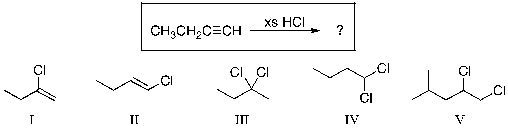
A) I
B) II
C) III
D) IV
E) V
A) I
B) II
C) III
D) IV
E) V
سؤال
For the reaction shown, select the expected major organic product. 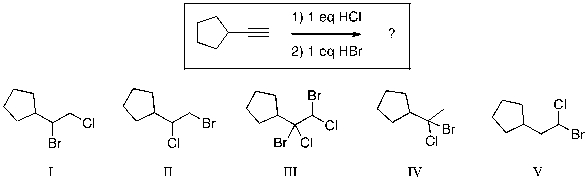
A) I
B) II
C) III
D) IV
E) V
A) I
B) II
C) III
D) IV
E) V
سؤال
سؤال
For the reaction below, select the structure of the expected major organic product. 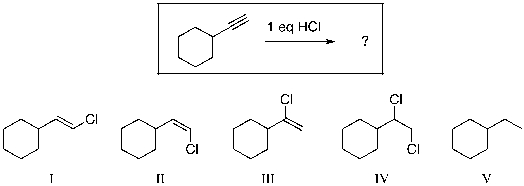
A) I
B) II
C) III
D) IV
E) V
A) I
B) II
C) III
D) IV
E) V
سؤال
سؤال
سؤال
For the reaction shown below, the resulting stereochemistry of the expected product is best described as: 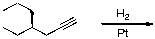
A) only (S)
B) only (R)
C) racemic
D) meso
E) achiral
A) only (S)
B) only (R)
C) racemic
D) meso
E) achiral
سؤال
سؤال
سؤال
سؤال
For the reaction shown below, the resulting stereochemistry of the expected product is best described as: 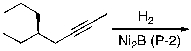
A) (R,E)
B) (S,E)
C) (R,Z)
D) (S,Z)
E) only (S)
A) (R,E)
B) (S,E)
C) (R,Z)
D) (S,Z)
E) only (S)
سؤال
سؤال
What is the major expected product(s) of the reaction shown below? 
A) 2,2-Dichloropentane
B) 3,3-Dichloropentane
C) 2,3-Dichloropentane
D) A and B
E) B and C
A) 2,2-Dichloropentane
B) 3,3-Dichloropentane
C) 2,3-Dichloropentane
D) A and B
E) B and C
سؤال
سؤال
In a dissolving metal reduction of an alkyne, a postulated intermediate is the trans alkenyl radical, shown below. In which orbital type would the unpaired electron be located? 
A) sp
B) sp2
C) sp3
D) p
E) s
A) sp
B) sp2
C) sp3
D) p
E) s
سؤال
سؤال
Select the reagent(s) expected to accomplish the transformation shown below. 
A) H2, Ni
B) H2, Ni2B
C) H2, Lindlar's catalyst
D) A and B
E) B and C
A) H2, Ni
B) H2, Ni2B
C) H2, Lindlar's catalyst
D) A and B
E) B and C
سؤال
سؤال

فتح الحزمة
قم بالتسجيل لفتح البطاقات في هذه المجموعة!
Unlock Deck
Unlock Deck
1/166

العب

ملء الشاشة (f)
Deck 10: Alkynes
1
Provide the IUPAC name for BrCH2CH2C≡CCH2CH3.
A) 1-bromo-3-hexyne
B) 6-bromo-3-hexyne
C) 1-bromo-2-hexyne
D) 6-bromo-4-hexyne
E) 1-bromo-4-hexyne
A) 1-bromo-3-hexyne
B) 6-bromo-3-hexyne
C) 1-bromo-2-hexyne
D) 6-bromo-4-hexyne
E) 1-bromo-4-hexyne
1-bromo-3-hexyne
2
Which of the following statements is true about propyne, H-C≡C-CH3?
A) It contains a total of three sigma bonds.
B) It contains a total of three pi bonds.
C) The H-C≡C bond angle is about 109.5°.
D) The C≡C-C bond angle is 180°.
E) All carbon-carbon bonds are of equal length.
A) It contains a total of three sigma bonds.
B) It contains a total of three pi bonds.
C) The H-C≡C bond angle is about 109.5°.
D) The C≡C-C bond angle is 180°.
E) All carbon-carbon bonds are of equal length.
The C≡C-C bond angle is 180°.
3
For the molecule below, known as 2-pentyne, which of the following describes the orbital overlap of the C2-C3 sigma bond?
A) sp-sp
B) sp2-sp2
C) sp3-sp3
D) p-p
E) sp3-sp
A) sp-sp
B) sp2-sp2
C) sp3-sp3
D) p-p
E) sp3-sp
sp-sp
4
Which of the following is a structure for hepta-3,6-dien-1-yne?
A) I
B) II
C) III
D) IV
E) V
A) I
B) II
C) III
D) IV
E) V
فتح الحزمة
افتح القفل للوصول البطاقات البالغ عددها 166 في هذه المجموعة.
فتح الحزمة
k this deck
5
Provide the IUPAC name for HC≡CCH2CH2CH3.
A) pentyne
B) 1-pentyne
C) butyne
D) 1-butyne
E) 2-butyne
A) pentyne
B) 1-pentyne
C) butyne
D) 1-butyne
E) 2-butyne
فتح الحزمة
افتح القفل للوصول البطاقات البالغ عددها 166 في هذه المجموعة.
فتح الحزمة
k this deck
6
Which of the following is the structure for 3-sec-butyl-1-heptyne?
A) I
B) II
C) III
D) IV
E) V
A) I
B) II
C) III
D) IV
E) V
فتح الحزمة
افتح القفل للوصول البطاقات البالغ عددها 166 في هذه المجموعة.
فتح الحزمة
k this deck
7
What is the IUPAC name for the molecule shown below?
A) 4-ethyl-2-pentyne
B) 2-ethyl-3-pentyne
C) 3-methyl-4-hexyne
D) 4-methyl-2-hexyne
E) sec-Butylpropyne
A) 4-ethyl-2-pentyne
B) 2-ethyl-3-pentyne
C) 3-methyl-4-hexyne
D) 4-methyl-2-hexyne
E) sec-Butylpropyne
فتح الحزمة
افتح القفل للوصول البطاقات البالغ عددها 166 في هذه المجموعة.
فتح الحزمة
k this deck
8
What is the IUPAC name for the molecule shown below?
A) 2-methyl-5-propyl-3-heptyne
B) 5-ethyl-2-methyl-3-octyne
C) 1-isopropyl-3-ethyl-1-hexyne
D) 6-methyl-3-propyl-4-heptyne
E) 4-ethyl-7-methyl-5-octyne
A) 2-methyl-5-propyl-3-heptyne
B) 5-ethyl-2-methyl-3-octyne
C) 1-isopropyl-3-ethyl-1-hexyne
D) 6-methyl-3-propyl-4-heptyne
E) 4-ethyl-7-methyl-5-octyne
فتح الحزمة
افتح القفل للوصول البطاقات البالغ عددها 166 في هذه المجموعة.
فتح الحزمة
k this deck
9
For the molecule below, known as 2,4-hexadiyne, which of the following describes the orbital overlap of the C3-C4 sigma bond?
A) sp-sp
B) sp2-sp2
C) sp3-sp3
D) p-p
E) sp3-sp
A) sp-sp
B) sp2-sp2
C) sp3-sp3
D) p-p
E) sp3-sp
فتح الحزمة
افتح القفل للوصول البطاقات البالغ عددها 166 في هذه المجموعة.
فتح الحزمة
k this deck
10
Which of the following statements best describes the general reactivity of alkynes?
A) An alkyne reacts as a nucleophile and is therefore electron rich.
B) An alkyne reacts as a nucleophile and is therefore electron poor.
C) Alkynes fail to undergo electrophilic addition reactions, unlike alkenes.
D) An alkyne reacts as an electrophile and is therefore electron rich.
E) An alkyne reacts as an electrophile and is therefore electron poor.
A) An alkyne reacts as a nucleophile and is therefore electron rich.
B) An alkyne reacts as a nucleophile and is therefore electron poor.
C) Alkynes fail to undergo electrophilic addition reactions, unlike alkenes.
D) An alkyne reacts as an electrophile and is therefore electron rich.
E) An alkyne reacts as an electrophile and is therefore electron poor.
فتح الحزمة
افتح القفل للوصول البطاقات البالغ عددها 166 في هذه المجموعة.
فتح الحزمة
k this deck
11
Which of the following is the structure for 2-hexyne?
A) I
B) II
C) III
D) IV
A) I
B) II
C) III
D) IV
فتح الحزمة
افتح القفل للوصول البطاقات البالغ عددها 166 في هذه المجموعة.
فتح الحزمة
k this deck
12
What is the IUPAC name for the molecule shown below?
A) 2,2,3-trimethyl-4-hexyne
B) 4-tert-butyl-2-pentyne
C) 4,5,5-trimethyl-2-hexyne
D) 4,5,5,5-tetramethyl-2-pentyne
E) 2,2-dimethyl-3-(1-propynyl)butane
A) 2,2,3-trimethyl-4-hexyne
B) 4-tert-butyl-2-pentyne
C) 4,5,5-trimethyl-2-hexyne
D) 4,5,5,5-tetramethyl-2-pentyne
E) 2,2-dimethyl-3-(1-propynyl)butane
فتح الحزمة
افتح القفل للوصول البطاقات البالغ عددها 166 في هذه المجموعة.
فتح الحزمة
k this deck
13
What is the IUPAC name for the molecule shown below?
A) 1,1-diethyl-2-pentyne
B) 3-(1-butynyl)pentane
C) 5-ethyl-3-octyne
D) 3-ethyl-4-heptyne
E) 5-ethyl-3-heptyne
A) 1,1-diethyl-2-pentyne
B) 3-(1-butynyl)pentane
C) 5-ethyl-3-octyne
D) 3-ethyl-4-heptyne
E) 5-ethyl-3-heptyne
فتح الحزمة
افتح القفل للوصول البطاقات البالغ عددها 166 في هذه المجموعة.
فتح الحزمة
k this deck
14
What is the IUPAC name for the molecule shown below?
A) 4,4-dimethyl-2-pentyne
B) 2,2-dimethyl-4-heptyne
C) 1-tert-butyl-3-heptyne
D) 6,6-dimethyl-3-heptyne
E) 6,6,6-trimethyl-3-hexyne
A) 4,4-dimethyl-2-pentyne
B) 2,2-dimethyl-4-heptyne
C) 1-tert-butyl-3-heptyne
D) 6,6-dimethyl-3-heptyne
E) 6,6,6-trimethyl-3-hexyne
فتح الحزمة
افتح القفل للوصول البطاقات البالغ عددها 166 في هذه المجموعة.
فتح الحزمة
k this deck
15
What is the IUPAC name for the molecule shown below?
A) 5,6,6-trimethyl-1-heptyne
B) 5-tert-butyl-1-hexyne
C) 2,2,3-trimethyl-6-heptyne
D) 2,2,3-(3-butynyl)butane
E) sec-butyl-tert-butylacetylene
A) 5,6,6-trimethyl-1-heptyne
B) 5-tert-butyl-1-hexyne
C) 2,2,3-trimethyl-6-heptyne
D) 2,2,3-(3-butynyl)butane
E) sec-butyl-tert-butylacetylene
فتح الحزمة
افتح القفل للوصول البطاقات البالغ عددها 166 في هذه المجموعة.
فتح الحزمة
k this deck
16
What is the IUPAC name for the molecule shown below?
A) 1,1,1-trichloro-4-hexyne
B) 4,4,4-trichloro-1-butyne
C) 1,1,1-trichloro-2-butyne
D) 5,5,5-trichloro-2-pentyne
E) 6,6,6-trichloro-2-hexyne
A) 1,1,1-trichloro-4-hexyne
B) 4,4,4-trichloro-1-butyne
C) 1,1,1-trichloro-2-butyne
D) 5,5,5-trichloro-2-pentyne
E) 6,6,6-trichloro-2-hexyne
فتح الحزمة
افتح القفل للوصول البطاقات البالغ عددها 166 في هذه المجموعة.
فتح الحزمة
k this deck
17
What is the IUPAC name for the molecule shown below?
A) 6-bromo-3-octyne
B) 6-bromo-6-methyl-3-heptyne
C) 2-bromo-2-methyl-4-heptyne
D) 6-bromo-6,6-dimethyl-3-hexyne
E) 2-bromo-4-octyne
A) 6-bromo-3-octyne
B) 6-bromo-6-methyl-3-heptyne
C) 2-bromo-2-methyl-4-heptyne
D) 6-bromo-6,6-dimethyl-3-hexyne
E) 2-bromo-4-octyne
فتح الحزمة
افتح القفل للوصول البطاقات البالغ عددها 166 في هذه المجموعة.
فتح الحزمة
k this deck
18
What is the hybridization of the carbon atoms numbered 1 and 2 respectively in the following structure?
A) sp3, sp2
B) sp2, sp2
C) sp, sp
D) sp2, sp
E) sp, sp2
A) sp3, sp2
B) sp2, sp2
C) sp, sp
D) sp2, sp
E) sp, sp2
فتح الحزمة
افتح القفل للوصول البطاقات البالغ عددها 166 في هذه المجموعة.
فتح الحزمة
k this deck
19
The C≡C bond of an alkyne is composed of which bond types?
A) three anti-bonds
B) three σ bonds
C) two σ bonds and one π bond
D) one σ bond and two π bonds
E) three π bonds
A) three anti-bonds
B) three σ bonds
C) two σ bonds and one π bond
D) one σ bond and two π bonds
E) three π bonds
فتح الحزمة
افتح القفل للوصول البطاقات البالغ عددها 166 في هذه المجموعة.
فتح الحزمة
k this deck
20
The sigma bond of an alkyne is formed from the overlap of which orbitals?
A) sp3-sp3
B) p-p
C) sp2-sp2
D) s-s
E) sp-sp
A) sp3-sp3
B) p-p
C) sp2-sp2
D) s-s
E) sp-sp
فتح الحزمة
افتح القفل للوصول البطاقات البالغ عددها 166 في هذه المجموعة.
فتح الحزمة
k this deck
21
Provide the IUPAC name for Cl3CCH2CH2CH2C≡CH.
A) 6,6,6-trichloro-1-hexyne
B) 1,1,1-trichloro-5-hexyne
C) 5,5,5-trichloro-1-pentyne
D) 1-heptyne
E) trichlorobutylacetylene
A) 6,6,6-trichloro-1-hexyne
B) 1,1,1-trichloro-5-hexyne
C) 5,5,5-trichloro-1-pentyne
D) 1-heptyne
E) trichlorobutylacetylene
فتح الحزمة
افتح القفل للوصول البطاقات البالغ عددها 166 في هذه المجموعة.
فتح الحزمة
k this deck
22
What is the IUPAC name for the molecule shown below?
A) (E)-5-methyl-5-hepten-1-yne
B) (Z)-5-methyl-5-hepten-1-yne
C) (E)-3-methyl-2-hepten-6-yne
D) (Z)-3-methyl-2-hepten-6-yne
E) (E)-2-butynyl-2-butene
A) (E)-5-methyl-5-hepten-1-yne
B) (Z)-5-methyl-5-hepten-1-yne
C) (E)-3-methyl-2-hepten-6-yne
D) (Z)-3-methyl-2-hepten-6-yne
E) (E)-2-butynyl-2-butene
فتح الحزمة
افتح القفل للوصول البطاقات البالغ عددها 166 في هذه المجموعة.
فتح الحزمة
k this deck
23
What is the IUPAC name for the molecule shown below?
A) (4R,5Z)-4-chlorohept-5-en-2-yne
B) (4S,5E)-4-chlorohept-5-en-2-yne
C) (2E,4S)-4-chlorohept-2-en-5-yne
D) (2E,4R)-4-chlorohept-2-en-5-yne
A) (4R,5Z)-4-chlorohept-5-en-2-yne
B) (4S,5E)-4-chlorohept-5-en-2-yne
C) (2E,4S)-4-chlorohept-2-en-5-yne
D) (2E,4R)-4-chlorohept-2-en-5-yne
فتح الحزمة
افتح القفل للوصول البطاقات البالغ عددها 166 في هذه المجموعة.
فتح الحزمة
k this deck
24
What is the IUPAC name for diisobutylacetylene?
A) diisopropylbutyne
B) 2,7-dimethyl-4-octyne
C) 3,6-dimethyl-4-octyne
D) 2,5-diethyl-3-hexyne
E) 2,2,5,5-tetramethyl-3-hexyne
A) diisopropylbutyne
B) 2,7-dimethyl-4-octyne
C) 3,6-dimethyl-4-octyne
D) 2,5-diethyl-3-hexyne
E) 2,2,5,5-tetramethyl-3-hexyne
فتح الحزمة
افتح القفل للوصول البطاقات البالغ عددها 166 في هذه المجموعة.
فتح الحزمة
k this deck
25
Which of the circled hydrogen atoms is the most acidic?
A) I
B) II
C) III
D) IV
E) V
A) I
B) II
C) III
D) IV
E) V
فتح الحزمة
افتح القفل للوصول البطاقات البالغ عددها 166 في هذه المجموعة.
فتح الحزمة
k this deck
26
Which of the following is the structure for (2E,4E)-octa-2,4-dien-6-yne?
A) I
B) II
C) III
D) IV
E) V
A) I
B) II
C) III
D) IV
E) V
فتح الحزمة
افتح القفل للوصول البطاقات البالغ عددها 166 في هذه المجموعة.
فتح الحزمة
k this deck
27
Which of the following is the structure for 2,5,5?trimethylhept?3?yne?
A) CH3CH2CH(CH3)C≡CCH2CH(CH3)2
B) CH3CH2C(CH3)2C≡CCH(CH3)2
C) (CH3CH2)2C(CH3)C≡CCH2CH3
D) CH3CH2C(CH3)2C≡CC(CH3)3
E) CH3CH2CH2CH(CH3)C≡CC(CH3)3
A) CH3CH2CH(CH3)C≡CCH2CH(CH3)2
B) CH3CH2C(CH3)2C≡CCH(CH3)2
C) (CH3CH2)2C(CH3)C≡CCH2CH3
D) CH3CH2C(CH3)2C≡CC(CH3)3
E) CH3CH2CH2CH(CH3)C≡CC(CH3)3
فتح الحزمة
افتح القفل للوصول البطاقات البالغ عددها 166 في هذه المجموعة.
فتح الحزمة
k this deck
28
Which of the following is a structure for octa-3,6-dien-1-yne?
A) HC≡CCH=CHCH=CHCH2CH3
B) CH3CH=CHCH2C≡CC≡CH
C) CH3CH=CHCH2CH=CHC≡CH
D) CH3C≡CCH=CHCH=CHCH3
E) H2C=CHC≡CCH2CH=CHCH3
A) HC≡CCH=CHCH=CHCH2CH3
B) CH3CH=CHCH2C≡CC≡CH
C) CH3CH=CHCH2CH=CHC≡CH
D) CH3C≡CCH=CHCH=CHCH3
E) H2C=CHC≡CCH2CH=CHCH3
فتح الحزمة
افتح القفل للوصول البطاقات البالغ عددها 166 في هذه المجموعة.
فتح الحزمة
k this deck
29
What is the IUPAC name for the molecule shown below?
A) 3-bromo-4-acetylenylheptane
B) 3-(1-bromopropyl)-1-hexyne
C) 3-bromo-4-propyl-5-hexyne
D) 4-bromo-3-propyl-1-hexyne
E) 4-ethynyl-5-bromo-heptane
A) 3-bromo-4-acetylenylheptane
B) 3-(1-bromopropyl)-1-hexyne
C) 3-bromo-4-propyl-5-hexyne
D) 4-bromo-3-propyl-1-hexyne
E) 4-ethynyl-5-bromo-heptane
فتح الحزمة
افتح القفل للوصول البطاقات البالغ عددها 166 في هذه المجموعة.
فتح الحزمة
k this deck
30
Provide the IUPAC name for (CH3)2CHC≡CCH2C(CH3)3.
A) 1,1,5,5,5-pentamethyl-2-pentyne
B) 1,1,1,5,5-pentamethyl-3-pentyne
C) 2,2,6-trimethyl-4-heptyne
D) 2,6,6-trimethyl-3-heptyne
E) tert-butylisopropylacetylene
A) 1,1,5,5,5-pentamethyl-2-pentyne
B) 1,1,1,5,5-pentamethyl-3-pentyne
C) 2,2,6-trimethyl-4-heptyne
D) 2,6,6-trimethyl-3-heptyne
E) tert-butylisopropylacetylene
فتح الحزمة
افتح القفل للوصول البطاقات البالغ عددها 166 في هذه المجموعة.
فتح الحزمة
k this deck
31
Which of the following is the acceptable structure for (R)-5-bromohept-2-yne?
A) I
B) II
C) III
D) IV
E) V
A) I
B) II
C) III
D) IV
E) V
فتح الحزمة
افتح القفل للوصول البطاقات البالغ عددها 166 في هذه المجموعة.
فتح الحزمة
k this deck
32
Rank the following carbanions in order of increasing base strength.
A) I < II < III
B) II < III < I
C) III < II < I
D) III < I < II
E) II < I < III
A) I < II < III
B) II < III < I
C) III < II < I
D) III < I < II
E) II < I < III
فتح الحزمة
افتح القفل للوصول البطاقات البالغ عددها 166 في هذه المجموعة.
فتح الحزمة
k this deck
33
Rank the following bases in order of decreasing basicity.
A) III > I > V > II > IV
B) III > V > IV > I> II
C) V > I > III > II > IV
D) III > IV > II > V > I
E) IV > II > I > III > V
A) III > I > V > II > IV
B) III > V > IV > I> II
C) V > I > III > II > IV
D) III > IV > II > V > I
E) IV > II > I > III > V
فتح الحزمة
افتح القفل للوصول البطاقات البالغ عددها 166 في هذه المجموعة.
فتح الحزمة
k this deck
34
Which structure shown below represents (Z)-3,5-dichloro-3-hexen-1-yne?
A) I
B) II
C) III
D) IV
E) I and II are both correct
A) I
B) II
C) III
D) IV
E) I and II are both correct
فتح الحزمة
افتح القفل للوصول البطاقات البالغ عددها 166 في هذه المجموعة.
فتح الحزمة
k this deck
35
What is the IUPAC name for the molecule shown below?
A) (E)-4-isopropyloct-3-en-5-yne
B) (Z)-4-isopropyloct-3-en-5-yne
C) (E)-5-isopropyloct-5-en-3-yne
D) (Z)-5-isopropyloct-5-en-3-yne
E) (E)-4-(2-methylethyl)oct-3-en-5-yne
A) (E)-4-isopropyloct-3-en-5-yne
B) (Z)-4-isopropyloct-3-en-5-yne
C) (E)-5-isopropyloct-5-en-3-yne
D) (Z)-5-isopropyloct-5-en-3-yne
E) (E)-4-(2-methylethyl)oct-3-en-5-yne
فتح الحزمة
افتح القفل للوصول البطاقات البالغ عددها 166 في هذه المجموعة.
فتح الحزمة
k this deck
36
Provide the IUPAC name for Cl3C(CH2)4C≡CH.
A) 4,4,4-trichloro-1-butyne
B) 1,1,1-trichloro-6-heptyne
C) 1,1,1-trichloro-5-heptyne
D) 6,6,6-trichloro-1-hexyne
E) 7,7,7-trichloro-1-heptyne
A) 4,4,4-trichloro-1-butyne
B) 1,1,1-trichloro-6-heptyne
C) 1,1,1-trichloro-5-heptyne
D) 6,6,6-trichloro-1-hexyne
E) 7,7,7-trichloro-1-heptyne
فتح الحزمة
افتح القفل للوصول البطاقات البالغ عددها 166 في هذه المجموعة.
فتح الحزمة
k this deck
37
Sodium amide (NaNH2, sodamide) reacts with terminal alkynes in the role of the ____.
A) Brønsted acid.
B) Brønsted base.
C) reducing agent.
D) catalyst.
E) electrophile.
A) Brønsted acid.
B) Brønsted base.
C) reducing agent.
D) catalyst.
E) electrophile.
فتح الحزمة
افتح القفل للوصول البطاقات البالغ عددها 166 في هذه المجموعة.
فتح الحزمة
k this deck
38
What is the IUPAC name for di-sec-butylacetylene?
A) 2-ethyl-5-methyl-3-heptyne
B) 2,7-dimethyl-4-octyne
C) 3,6-dimethyl-4-octyne
D) 2,5-diethyl-3-hexyne
E) 2,2,5,5-tetramethyl-3-hexyne
A) 2-ethyl-5-methyl-3-heptyne
B) 2,7-dimethyl-4-octyne
C) 3,6-dimethyl-4-octyne
D) 2,5-diethyl-3-hexyne
E) 2,2,5,5-tetramethyl-3-hexyne
فتح الحزمة
افتح القفل للوصول البطاقات البالغ عددها 166 في هذه المجموعة.
فتح الحزمة
k this deck
39
Provide the systematic IUPAC name for the molecule below: (CH3)3CCH2C≡CCH2CH(CH3)CH2CH3
A) 2,7,7-trimethyl-5-nonyne
B) 2-ethyl-7,7-dimethyl-4-octyne
C) 2,2,7-trimethyl-4-nonyne
D) 7-ethyl-2,2-trimethyl-4-octyne
E) 6-undecyne
A) 2,7,7-trimethyl-5-nonyne
B) 2-ethyl-7,7-dimethyl-4-octyne
C) 2,2,7-trimethyl-4-nonyne
D) 7-ethyl-2,2-trimethyl-4-octyne
E) 6-undecyne
فتح الحزمة
افتح القفل للوصول البطاقات البالغ عددها 166 في هذه المجموعة.
فتح الحزمة
k this deck
40
Rank the following acids in order of decreasing acidity.
A) V > I > IV > II > III
B) III > IV > II > I > V
C) V > I > III > II > IV
D) I > IV > V > II > III
E) IV > I > V > II > III
A) V > I > IV > II > III
B) III > IV > II > I > V
C) V > I > III > II > IV
D) I > IV > V > II > III
E) IV > I > V > II > III
فتح الحزمة
افتح القفل للوصول البطاقات البالغ عددها 166 في هذه المجموعة.
فتح الحزمة
k this deck
41
For the reaction shown, select the expected major organic product.
A) I
B) II
C) III
D) IV
E) V
A) I
B) II
C) III
D) IV
E) V
فتح الحزمة
افتح القفل للوصول البطاقات البالغ عددها 166 في هذه المجموعة.
فتح الحزمة
k this deck
42
For the transformation shown below, select the expected major product.
A) I
B) II
C) III
D) IV
E) V
A) I
B) II
C) III
D) IV
E) V
فتح الحزمة
افتح القفل للوصول البطاقات البالغ عددها 166 في هذه المجموعة.
فتح الحزمة
k this deck
43
Select the best reagent to convert 3-heptyne to trans-3-heptene?
A) Na/NH3
B) 1 eq. NaNH2, NH3
C) xs NaNH2, NH3
D) H2/Pt
E) H2/Lindlar's catalyst
A) Na/NH3
B) 1 eq. NaNH2, NH3
C) xs NaNH2, NH3
D) H2/Pt
E) H2/Lindlar's catalyst
فتح الحزمة
افتح القفل للوصول البطاقات البالغ عددها 166 في هذه المجموعة.
فتح الحزمة
k this deck
44
Which of the bases below would quantitatively deprotonate a terminal alkyne?
A) BuLi
B) NH3
C) NaOH
D) NaOCH2CH3
E) t-BuOK
A) BuLi
B) NH3
C) NaOH
D) NaOCH2CH3
E) t-BuOK
فتح الحزمة
افتح القفل للوصول البطاقات البالغ عددها 166 في هذه المجموعة.
فتح الحزمة
k this deck
45
For the reaction sequence below, select the expected major product.
A) 3-methylhexane
B) 1-bromo-3-methylhexene
C) 2-bromo-3-methylhexene
D) 3-methyl-1-hexyne
E) 3-methyl-2-hexyne
A) 3-methylhexane
B) 1-bromo-3-methylhexene
C) 2-bromo-3-methylhexene
D) 3-methyl-1-hexyne
E) 3-methyl-2-hexyne
فتح الحزمة
افتح القفل للوصول البطاقات البالغ عددها 166 في هذه المجموعة.
فتح الحزمة
k this deck
46
Of the species listed below, select those less basic than acetylide.
A) BuLi
B) NaNH2
C) NaOCH3
D) both A and C
E) both B and C
A) BuLi
B) NaNH2
C) NaOCH3
D) both A and C
E) both B and C
فتح الحزمة
افتح القفل للوصول البطاقات البالغ عددها 166 في هذه المجموعة.
فتح الحزمة
k this deck
47
For the reaction shown, select the expected major organic product.
A) I
B) II
C) III
D) IV
E) V
A) I
B) II
C) III
D) IV
E) V
فتح الحزمة
افتح القفل للوصول البطاقات البالغ عددها 166 في هذه المجموعة.
فتح الحزمة
k this deck
48
Select the reagent(s) expected to accomplish the transformation shown below.
A) H2, Pd
B) H2, Lindlar's catalyst
C) Na, NH3(l)
D) A or B
E) B or C
A) H2, Pd
B) H2, Lindlar's catalyst
C) Na, NH3(l)
D) A or B
E) B or C
فتح الحزمة
افتح القفل للوصول البطاقات البالغ عددها 166 في هذه المجموعة.
فتح الحزمة
k this deck
49
Which of the circled hydrogen atoms is the least acidic?
A) I
B) II
C) III
D) IV
E) V
A) I
B) II
C) III
D) IV
E) V
فتح الحزمة
افتح القفل للوصول البطاقات البالغ عددها 166 في هذه المجموعة.
فتح الحزمة
k this deck
50
When preparing terminal alkynes by an elimination reaction, sodium amide (NaNH2) dissolved in liquid ammonia (NH3) is used most frequently. Which of the following statements offers the best explanation for the above statement?
A) The above statement is false; terminal alkynes are not produced under the given conditions.
B) Sodium amide deprotonates the terminal alkyne, driving formation of the alkynide ion.
C) Only sodium amide is a strong enough base to deprotonate a carbon.
D) Terminal alkynes are more stable than the internal alkynes, and are always the favored product.
E) Steric hindrance favors preparation of the less substituted terminal alkyne.
A) The above statement is false; terminal alkynes are not produced under the given conditions.
B) Sodium amide deprotonates the terminal alkyne, driving formation of the alkynide ion.
C) Only sodium amide is a strong enough base to deprotonate a carbon.
D) Terminal alkynes are more stable than the internal alkynes, and are always the favored product.
E) Steric hindrance favors preparation of the less substituted terminal alkyne.
فتح الحزمة
افتح القفل للوصول البطاقات البالغ عددها 166 في هذه المجموعة.
فتح الحزمة
k this deck
51
Select the best explanation for why methanol, CH3OH, cannot be used as a solvent for the deprotonation of a terminal alkyne by sodium amide, NaNH2.
A) Sodium amide is not a strong enough base to deprotonate the alkyne.
B) Sodium amide in methanol reduces alkynes to alkenes.
C) Methanol is a poor solvent for dissolving alkynes.
D) Methanol is more acidic than the alkyne and will be deprotonated instead.
E) Methanol is toxic, and should be avoided when possible.
A) Sodium amide is not a strong enough base to deprotonate the alkyne.
B) Sodium amide in methanol reduces alkynes to alkenes.
C) Methanol is a poor solvent for dissolving alkynes.
D) Methanol is more acidic than the alkyne and will be deprotonated instead.
E) Methanol is toxic, and should be avoided when possible.
فتح الحزمة
افتح القفل للوصول البطاقات البالغ عددها 166 في هذه المجموعة.
فتح الحزمة
k this deck
52
Which of the bases below would result in the most complete deprotonation of the alkyne, shown in the reaction below?
A) NaOCH2CH3 (sodium ethoxide)
B) t-BuONa (sodium tert-butoxide)
C) NaH (sodium hydride)
D) NaHCO3 (sodium bicarbonate)
E) NaOH (sodium hydroxide)
A) NaOCH2CH3 (sodium ethoxide)
B) t-BuONa (sodium tert-butoxide)
C) NaH (sodium hydride)
D) NaHCO3 (sodium bicarbonate)
E) NaOH (sodium hydroxide)
فتح الحزمة
افتح القفل للوصول البطاقات البالغ عددها 166 في هذه المجموعة.
فتح الحزمة
k this deck
53
The major result of treating 1-butyne with 6M aqueous NaOH would be:
A) the production of the sodium alkynide.
B) the production of an alkene.
C) the production of an alkane.
D) the production of an enol.
E) nothing, as the alkyne would not react to an appreciable extent.
A) the production of the sodium alkynide.
B) the production of an alkene.
C) the production of an alkane.
D) the production of an enol.
E) nothing, as the alkyne would not react to an appreciable extent.
فتح الحزمة
افتح القفل للوصول البطاقات البالغ عددها 166 في هذه المجموعة.
فتح الحزمة
k this deck
54
Which of the reagents below would convert 2-pentyne to trans-2-pentene?
A) NaNH2, NH3
B) Na, NH3
C) H2, Lindlar's catalyst
D) H2, Pd/C
E) H2O, HgSO4/H2SO4
A) NaNH2, NH3
B) Na, NH3
C) H2, Lindlar's catalyst
D) H2, Pd/C
E) H2O, HgSO4/H2SO4
فتح الحزمة
افتح القفل للوصول البطاقات البالغ عددها 166 في هذه المجموعة.
فتح الحزمة
k this deck
55
What are the products of the reaction shown below? CH3OH + CH3C≡C-Na+ → ?
A) CH3C≡CCH3 + Na+OH-
B) CH3C≡CH + CH3O-Na+
C) CH3C≡COCH3 + Na+OH-
D) CH3OC≡CH + Na+CH3-
E) no reaction
A) CH3C≡CCH3 + Na+OH-
B) CH3C≡CH + CH3O-Na+
C) CH3C≡COCH3 + Na+OH-
D) CH3OC≡CH + Na+CH3-
E) no reaction
فتح الحزمة
افتح القفل للوصول البطاقات البالغ عددها 166 في هذه المجموعة.
فتح الحزمة
k this deck
56
Complete reduction of 1 mole of (3E,5Z)-3-methylhepta-3,5-dien-1-yne will require how many moles of hydrogen (H2)?
A) 1
B) 2
C) 3
D) 4
E) 5
A) 1
B) 2
C) 3
D) 4
E) 5
فتح الحزمة
افتح القفل للوصول البطاقات البالغ عددها 166 في هذه المجموعة.
فتح الحزمة
k this deck
57
Select the reagent(s) expected to accomplish the transformation shown below.
A) H2, Ni
B) H2, Ni2B
C) Na, NH3(l)
D) A or B
E) B or C
A) H2, Ni
B) H2, Ni2B
C) Na, NH3(l)
D) A or B
E) B or C
فتح الحزمة
افتح القفل للوصول البطاقات البالغ عددها 166 في هذه المجموعة.
فتح الحزمة
k this deck
58
For the reaction shown, select the expected major organic product.
A) I
B) II
C) III
D) IV
E) V
A) I
B) II
C) III
D) IV
E) V
فتح الحزمة
افتح القفل للوصول البطاقات البالغ عددها 166 في هذه المجموعة.
فتح الحزمة
k this deck
59
Which statement below best explains why the Ka of acetylene is greater than that of ethylene?
A) Acetylide anions are resonance stabilized.
B) The 4 electrons of the acetylide anion better stabilize a negative charge.
C) The electronegativity of sp carbons is greater than that of sp2 carbons.
D) The electronegativity of sp carbons is less than that of sp2 carbons.
E) Acetylene has only two hydrogen atoms while ethylene has four.
A) Acetylide anions are resonance stabilized.
B) The 4 electrons of the acetylide anion better stabilize a negative charge.
C) The electronegativity of sp carbons is greater than that of sp2 carbons.
D) The electronegativity of sp carbons is less than that of sp2 carbons.
E) Acetylene has only two hydrogen atoms while ethylene has four.
فتح الحزمة
افتح القفل للوصول البطاقات البالغ عددها 166 في هذه المجموعة.
فتح الحزمة
k this deck
60
Select the best reagent expected to convert 3-heptyne to cis-3-heptene.
A) NaNH2, NH3
B) Na, NH3
C) H2, Lindlar's catalyst
D) Both A and C
E) Both B and C
A) NaNH2, NH3
B) Na, NH3
C) H2, Lindlar's catalyst
D) Both A and C
E) Both B and C
فتح الحزمة
افتح القفل للوصول البطاقات البالغ عددها 166 في هذه المجموعة.
فتح الحزمة
k this deck
61
For the reaction shown below, what is the IUPAC name of the expected product?
A) 2-methylhexane
B) (Z)-2-methyl-4-hexene
C) (E)-2-methyl-4-hexene
D) (Z)-5-methyl-2-hexene
E) (E)-5-methyl-2-hexene
A) 2-methylhexane
B) (Z)-2-methyl-4-hexene
C) (E)-2-methyl-4-hexene
D) (Z)-5-methyl-2-hexene
E) (E)-5-methyl-2-hexene
فتح الحزمة
افتح القفل للوصول البطاقات البالغ عددها 166 في هذه المجموعة.
فتح الحزمة
k this deck
62
Which of the compounds shown below would be the most likely product expected from the reaction scheme shown?
A) I
B) II
C) III
D) IV
E) V
A) I
B) II
C) III
D) IV
E) V
فتح الحزمة
افتح القفل للوصول البطاقات البالغ عددها 166 في هذه المجموعة.
فتح الحزمة
k this deck
63
For the reaction shown, select the expected major organic product.
A) I
B) II
C) III
D) IV
E) V
A) I
B) II
C) III
D) IV
E) V
فتح الحزمة
افتح القفل للوصول البطاقات البالغ عددها 166 في هذه المجموعة.
فتح الحزمة
k this deck
64
Of the reaction conditions provided below, which would be expected to convert 1 mole of 4-methyl-1-pentyne into 2-methylpentane?
A) H2, Lindlar's catalyst
B) Na, NH3(l)
C) 2 moles of HCl
D) 2 moles H2, Pt
E) 1 mole H2, Pt
A) H2, Lindlar's catalyst
B) Na, NH3(l)
C) 2 moles of HCl
D) 2 moles H2, Pt
E) 1 mole H2, Pt
فتح الحزمة
افتح القفل للوصول البطاقات البالغ عددها 166 في هذه المجموعة.
فتح الحزمة
k this deck
65
For the reaction below, select the structure of the expected major organic product.
A) I
B) II
C) III
D) IV
E) V
A) I
B) II
C) III
D) IV
E) V
فتح الحزمة
افتح القفل للوصول البطاقات البالغ عددها 166 في هذه المجموعة.
فتح الحزمة
k this deck
66
Complete hydrogenation of a mixture of 1-octyne, 2-octyne, and 3-octyne, in the presence of a palladium catalyst, would produce how many distinct eight-carbon hydrocarbon products?
A) 1
B) 2
C) 3
D) 6
E) 8
A) 1
B) 2
C) 3
D) 6
E) 8
فتح الحزمة
افتح القفل للوصول البطاقات البالغ عددها 166 في هذه المجموعة.
فتح الحزمة
k this deck
67
Reaction of 3,4,5-trimethyl-4-hexen-1-yne with H2 and Pd/C will produce which of the following compounds?
A) 2,3,4-trimethylhexane
B) 3,4,5-trimethylhexane
C) 2,3,4-trimethyl-1-hexene
D) 3,4,5-trimethyl-1-hexyne
E) 2,3,4-trimethyl-5-hexyne2
A) 2,3,4-trimethylhexane
B) 3,4,5-trimethylhexane
C) 2,3,4-trimethyl-1-hexene
D) 3,4,5-trimethyl-1-hexyne
E) 2,3,4-trimethyl-5-hexyne2
فتح الحزمة
افتح القفل للوصول البطاقات البالغ عددها 166 في هذه المجموعة.
فتح الحزمة
k this deck
68
For the reaction shown below, the resulting stereochemistry of the expected product is best described as:
A) only (S)
B) only (R)
C) racemic
D) meso
E) achiral
A) only (S)
B) only (R)
C) racemic
D) meso
E) achiral
فتح الحزمة
افتح القفل للوصول البطاقات البالغ عددها 166 في هذه المجموعة.
فتح الحزمة
k this deck
69
Which reagents shown below would be expected to convert 2-pentyne to (Z)-2-pentene?
A) H2, Pt
B) Na, NH3
C) H2, Lindlar's catalyst
D) excess HCl
E) HgSO4, H2O
A) H2, Pt
B) Na, NH3
C) H2, Lindlar's catalyst
D) excess HCl
E) HgSO4, H2O
فتح الحزمة
افتح القفل للوصول البطاقات البالغ عددها 166 في هذه المجموعة.
فتح الحزمة
k this deck
70
The expected major product from the treatment of 1-pentyne with 2 equivalents of HBr is:
A) 1-bromo-1-pentene
B) 2-bromo-1-pentene
C) 1,1-dibromopentane
D) 2,2-dibromopentane
E) 1,2-dibromopentane
A) 1-bromo-1-pentene
B) 2-bromo-1-pentene
C) 1,1-dibromopentane
D) 2,2-dibromopentane
E) 1,2-dibromopentane
فتح الحزمة
افتح القفل للوصول البطاقات البالغ عددها 166 في هذه المجموعة.
فتح الحزمة
k this deck
71
The expected major product from the treatment of 1-pentyne with 1 equivalent of HBr is:
A) 1-bromo-1-pentene
B) 2-bromo-1-pentene
C) 1,1-dibromopentane
D) 2,2-dibromopentane
E) 1,2-dibromopentane
A) 1-bromo-1-pentene
B) 2-bromo-1-pentene
C) 1,1-dibromopentane
D) 2,2-dibromopentane
E) 1,2-dibromopentane
فتح الحزمة
افتح القفل للوصول البطاقات البالغ عددها 166 في هذه المجموعة.
فتح الحزمة
k this deck
72
For the reaction shown below, the resulting stereochemistry of the expected product is best described as:
A) (R,E)
B) (S,E)
C) (R,Z)
D) (S,Z)
E) only (S)
A) (R,E)
B) (S,E)
C) (R,Z)
D) (S,Z)
E) only (S)
فتح الحزمة
افتح القفل للوصول البطاقات البالغ عددها 166 في هذه المجموعة.
فتح الحزمة
k this deck
73
What is the expected major organic product from treatment of 4-methyl-2-pentyne with excess hydrogen in the presence of a platinum catalyst?
A) (E)-4-methyl-2-pentene
B) (Z)-4-methyl-2-pentene
C) 2-methylpentane
D) 4-methylpentane
E) Equal mixture of A and B
A) (E)-4-methyl-2-pentene
B) (Z)-4-methyl-2-pentene
C) 2-methylpentane
D) 4-methylpentane
E) Equal mixture of A and B
فتح الحزمة
افتح القفل للوصول البطاقات البالغ عددها 166 في هذه المجموعة.
فتح الحزمة
k this deck
74
What is the major expected product(s) of the reaction shown below?
A) 2,2-Dichloropentane
B) 3,3-Dichloropentane
C) 2,3-Dichloropentane
D) A and B
E) B and C
A) 2,2-Dichloropentane
B) 3,3-Dichloropentane
C) 2,3-Dichloropentane
D) A and B
E) B and C
فتح الحزمة
افتح القفل للوصول البطاقات البالغ عددها 166 في هذه المجموعة.
فتح الحزمة
k this deck
75
What is the expected major organic product from treatment of 4-methyl-2-pentyne with sodium metal in liquid ammonia?
A) (E)-4-methyl-2-pentene
B) (Z)-4-methyl-2-pentene
C) (E)-2-methyl-2-pentene
D) (Z)-2-methyl-2-pentene
E) 2-methylpentane
A) (E)-4-methyl-2-pentene
B) (Z)-4-methyl-2-pentene
C) (E)-2-methyl-2-pentene
D) (Z)-2-methyl-2-pentene
E) 2-methylpentane
فتح الحزمة
افتح القفل للوصول البطاقات البالغ عددها 166 في هذه المجموعة.
فتح الحزمة
k this deck
76
In a dissolving metal reduction of an alkyne, a postulated intermediate is the trans alkenyl radical, shown below. In which orbital type would the unpaired electron be located?
A) sp
B) sp2
C) sp3
D) p
E) s
A) sp
B) sp2
C) sp3
D) p
E) s
فتح الحزمة
افتح القفل للوصول البطاقات البالغ عددها 166 في هذه المجموعة.
فتح الحزمة
k this deck
77
In the reaction between an alkyne and Na metal in liquid ammonia, the role of Na is:
A) Brønsted acid.
B) Brønsted base.
C) reducing agent.
D) catalyst.
E) electrophile.
A) Brønsted acid.
B) Brønsted base.
C) reducing agent.
D) catalyst.
E) electrophile.
فتح الحزمة
افتح القفل للوصول البطاقات البالغ عددها 166 في هذه المجموعة.
فتح الحزمة
k this deck
78
Select the reagent(s) expected to accomplish the transformation shown below.
A) H2, Ni
B) H2, Ni2B
C) H2, Lindlar's catalyst
D) A and B
E) B and C
A) H2, Ni
B) H2, Ni2B
C) H2, Lindlar's catalyst
D) A and B
E) B and C
فتح الحزمة
افتح القفل للوصول البطاقات البالغ عددها 166 في هذه المجموعة.
فتح الحزمة
k this deck
79
Reaction of (3E,5Z)-3-methylhepta-3,5-dien-1-yne with H2 and Pd/C will produce which of the compounds below?
A) 1-sec-butylbutane
B) 2-butylbutane2
C) 3-methylheptane
D) 3-methyl-1-heptyne
E) (3E,5Z)-3-methyl-1,3,5-heptatriene
A) 1-sec-butylbutane
B) 2-butylbutane2
C) 3-methylheptane
D) 3-methyl-1-heptyne
E) (3E,5Z)-3-methyl-1,3,5-heptatriene
فتح الحزمة
افتح القفل للوصول البطاقات البالغ عددها 166 في هذه المجموعة.
فتح الحزمة
k this deck
80
What is the expected major organic product from treatment of 4-methyl-2-pentyne with hydrogen in the presence of Lindlar's catalyst?
A) (E)-4-methyl-2-pentene
B) (Z)-4-methyl-2-pentene
C) (E)-2-methyl-2-pentene
D) (Z)-2-methyl-2-pentene
E) 2-methylpentane
A) (E)-4-methyl-2-pentene
B) (Z)-4-methyl-2-pentene
C) (E)-2-methyl-2-pentene
D) (Z)-2-methyl-2-pentene
E) 2-methylpentane
فتح الحزمة
افتح القفل للوصول البطاقات البالغ عددها 166 في هذه المجموعة.
فتح الحزمة
k this deck
فتح الحزمة
افتح القفل للوصول البطاقات البالغ عددها 166 في هذه المجموعة.






