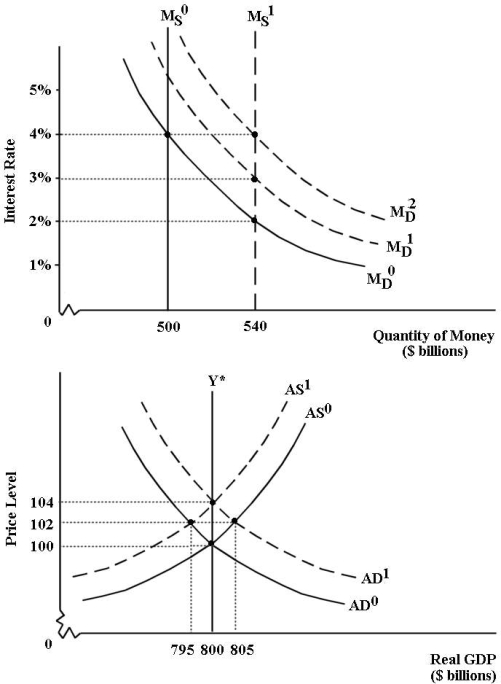
 FIGURE 27-5
0 0
-Refer to Figure 27-5. This economy begins in equilibrium with M S , M D and real GDP equal to potential
GDP with AD0 and AS0) . Now suppose there is an increase in the money supply to $540 billion. According to the Classical economists of the eighteenth and nineteenth centuries,
A) the neutrality of money holds in the long run, but in the short run changes in the money supply cause significant fluctuations of real GDP.
B) the neutrality of money holds in the long run, but in the short run changes in the money supply cause significant fluctuations in employment but not real GDP.
C) there is no connection between the ʺmoneyʺ and ʺrealʺ sides of the economy, and the only effect is a decrease in the interest rate.
D) there is no connection between the ʺmoneyʺ and ʺrealʺ sides of the economy, and the only effect is a rise in the price level.
E) such increases in the money supply cause long-run disequilibriums in the economy.
Correct Answer:

Verified
Q110: Suppose changes in the money supply only
Q124: Monetary policy will be least effective in
Q124: Q125: Other things being equal,the flatter the AS Q125: The proposition of long-run neutrality of money Q126: Other things being equal,the steeper the AS Q128: Consider the monetary transmission mechanism.Other things being Q129: Consider the monetary transmission mechanism.Other things being Q132: The effectiveness of monetary policy in bringing Q135: The hypothesis in economics known as hysteresis
Unlock this Answer For Free Now!
View this answer and more for free by performing one of the following actions

Scan the QR code to install the App and get 2 free unlocks

Unlock quizzes for free by uploading documents