A researcher wants to know whether athletic women are more flexible than non- athletic women. For this experiment, a woman who exercised vigorously at least four times per week was considered "athletic." Flexibility is measured in inches on a sit & reach box. Test the researcher's claim using the following summary statistics: 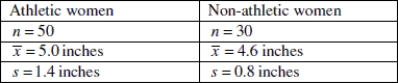 Assume that all conditions for testing have been met. Report the test statistic and p- value. At the 1% significance level, state your decision regarding the null hypothesis and your conclusion about the original claim. Round all values to the nearest thousandth.
A) t = - 1.623; p = 0.054; Reject the null hypothesis; there is strong evidence to suggest that athletic women are more flexible than non- athletic women.
B) t = - 1.623; p = 0.108; Reject the null hypothesis; there is strong evidence to suggest that athletic women are more flexible than non- athletic women.
C) t =1.623; p = 0.108; Reject the null hypothesis; there is not strong evidence to suggest that athletic women are more flexible than non- athletic women.
D) t =1.623; p = 0.054; Fail to reject the null hypothesis; there is not strong evidence to suggest that athletic women are more flexible than non- athletic women.
Correct Answer:

Verified
Q1: Use the following information to answer the
Q2: Suppose a consumer product researcher wanted to
Q4: Which of the following statements is not
Q5: Use the following information to answer the
Q6: Use the following information to answer the
Q7: Use the following information to answer the
Q8: Use the following information to answer the
Q9: Choose the statement that best describes what
Q10: The college GPA's of identical twins are
Q11: The weights at birth of five randomly
Unlock this Answer For Free Now!
View this answer and more for free by performing one of the following actions

Scan the QR code to install the App and get 2 free unlocks

Unlock quizzes for free by uploading documents