A 68-year-old woman comes to the office due to recurrent bacterial sinusitis, pneumonia, and urinary tract infections over the past several months. The patient has no prior medical conditions or history of severe infections in childhood. She does not use tobacco, alcohol, or illicit drugs. Temperature is 36.6 C (97.9 F) , blood pressure is 130/76 mm Hg, and pulse is 72/min. On physical examination, the lungs are clear to auscultation, heart sounds are normal, and the abdomen is soft and nontender with no hepatosplenomegaly. Laboratory testing reveals normocytic normochromic anemia. Bone marrow aspirate shows an increased number of cells, as shown below. 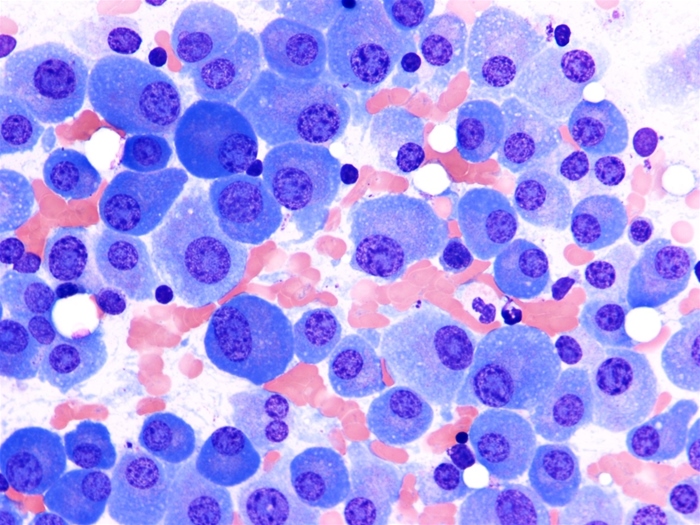 Which of the following is the most likely cause of this patient's increased susceptibility to infections?
A) Aberrant lysosomal transport and fusion in leukocytes
B) Decreased production of functional immunoglobulins
C) Defective adhesion and transmigration of leukocytes
D) Impaired formation of membrane attack complex
E) Impaired phagocytic ability to generate superoxide
Correct Answer:

Verified
Q87: A 10-year-old girl is brought to the
Q88: A 32-year-old woman comes to the allergy
Q89: Researchers are investigating the use of immune
Q90: A 19-year-old man comes to the office
Q91: A 23-year-old man is referred to the
Q93: A 28-year-old primigravid woman comes to the
Q94: A 67-year-old man comes to the office
Q95: A 40-year-old woman, gravida 4 para 4,
Q96: Pharmacology researchers develop a novel immunotherapy to
Q97: A newborn girl is admitted to the
Unlock this Answer For Free Now!
View this answer and more for free by performing one of the following actions

Scan the QR code to install the App and get 2 free unlocks

Unlock quizzes for free by uploading documents