A 60-year-old woman comes to the physician with 10 days of diffuse itching. A rash began on her hands and quickly spread to involve her wrists, arms, and axillae. She has difficulty sleeping and complains of intense itching in these areas. She works in a day care center and primarily takes care of children age 2-5. The patient has no other medical conditions and takes no chronic medications. Vital signs are normal. Her BMI is 24 kg/m2. Skin examination shows small erythematous papules on the palms with excoriations, scattered vesicles, and pustules on the finger webs, palms, and wrist creases, as seen in the image below. She has similar lesions in her axillary skin folds bilaterally. The remainder of the examination is within normal limits. 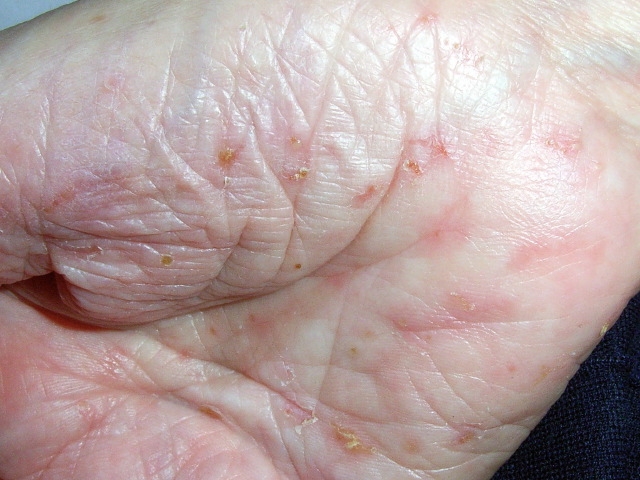 Which of the following is the most likely finding on skin sampling of this patient's lesions?
A) Budding yeast
B) Molluscum bodies
C) Multinucleated giant cells
D) Necrotic keratinocytes in the epidermis
E) Sarcoptes scabiei mite and eggs
Correct Answer:

Verified
Q6: A 46-year-old man comes to the office
Q7: A 68-year-old woman comes to the office
Q8: A 3-year-old boy is brought to the
Q9: A 55-year-old man comes to the emergency
Q10: A 62-year-old man is brought to the
Q12: A 22-year-old man comes to the office
Q13: A 38-year-old woman comes to the office
Q14: A 73-year-old woman comes to the physician
Q15: A 36-year-old man comes to the office
Q16: A 3-year-old boy is brought to the
Unlock this Answer For Free Now!
View this answer and more for free by performing one of the following actions

Scan the QR code to install the App and get 2 free unlocks

Unlock quizzes for free by uploading documents