A 16-year-old girl is brought to the emergency department because of progressively increasing nausea, vomiting and right upper quadrant pain. She was initially seen in the emergency department 24 hours ago for nausea and vomiting but was discharged when her examination and laboratory studies were unremarkable. At today's visit, the patient reveals, "I am so upset. My boyfriend broke up with me and I have been taking a lot of pain medication to relieve my pain." Temperature is 37.1 C (98.8 F) , blood pressure is 108/70 mm Hg, pulse is 102/min, and respirations are 16/min. Pulse oximetry is 98% on room air. On examination, scleral icterus and marked right upper quadrant tenderness are present. Pupils are normal in size and reactive to light. Neurologic examination shows no abnormalities. Laboratory results are as follows: 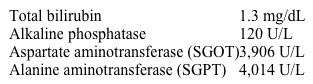 Which of the following is the most likely underlying mechanism of drug toxicity in this patient?
A) Cytotoxic T-cell response to hepatocyte proteins
B) Drug-mediated inhibition of bile flow
C) Drug metabolite-induced mitochondrial dysfunction
D) Drug-induced disruption of fatty acid metabolism
E) Reactive oxygen species-induced stellate cell activation
Correct Answer:

Verified
Q364: A 65-year-old man is brought to the
Q365: A group of investigators is studying the
Q366: A 34-year-old kidney transplant patient treated with
Q367: A 68-year-old man comes to the office
Q368: A large, multinational drug corporation conducts a
Q370: A 78-year-old man was found to have
Q371: A 57-year-old Caucasian male with severe pyelonephritis
Q372: A clinical trial is being conducted to
Q373: Three alpha-agonist drugs are tested as potential
Q374: A new aminoglycoside antibiotic is developed that
Unlock this Answer For Free Now!
View this answer and more for free by performing one of the following actions

Scan the QR code to install the App and get 2 free unlocks

Unlock quizzes for free by uploading documents