A 52-year-old woman with extensive pelvic ovarian cancer comes to the emergency department because of difficulty with urination. She has noticed decreasing urine volumes for the past two weeks. She denies dysuria, hematuria, or flank pain. Her other medical problems include hypertension and type 2 diabetes. Her current medications include metformin and lisinopril. She has had no urine output over the last 12 hours.
Her blood pressure is 142/70 mm Hg and pulse is 89/min. Lungs are clear on auscultation. Her abdomen is modestly distended and demonstrates fullness in both lower quadrants without a discrete mass. She has 2+ pitting bilateral lower extremity edema to the mid-shin.
Laboratory results are as follows: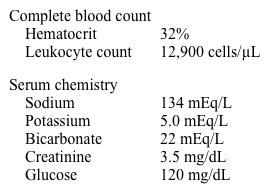
Insertion of a Foley catheter yields no urine. An ultrasound reveals grade 3 bilateral ureteric dilation. A urology consultant is able to advance pigtail catheters into both ureters from the bladder. Her urine output after catheter insertion improves to 600 cc/hr over the next two hours.
Which of the following is the best next step in management for this patient?
A) 1/4 normal saline to match urine output
B) 1/2 normal saline to match urine output
C) 1/2 normal saline at 75% urine output
D) Desmopressin (DDAVP)
E) Normal saline at 200 cc/hr
Correct Answer:

Verified
Q196: A 23-year-old woman comes to the emergency
Q197: A 43-year-old man comes to the hospital
Q198: A 33-year-old man with a history of
Q199: An 18-year-old male has been brought to
Q200: A 45-year-old homeless man is found unresponsive
Q202: An 18-year-old man is brought to the
Q203: A 70-year-old woman presents to the emergency
Q204: A 34-year-old woman comes to the emergency
Q205: A 36-year-old man with known HIV infection
Q206: A 28-year-old woman recently completed her first
Unlock this Answer For Free Now!
View this answer and more for free by performing one of the following actions

Scan the QR code to install the App and get 2 free unlocks

Unlock quizzes for free by uploading documents