A 76-year-old woman comes to the emergency department due to fatigue, nausea, and abdominal pain for the past 2 weeks. She feels weak and has not been eating much. She also has "black spots" in her vision when she watches television. Medical history includes hypertension, type 2 diabetes mellitus, persistent atrial fibrillation, myocardial infarction with coronary artery bypass grafting 10 years ago, and ischemic cardiomyopathy with an ejection fraction of 30%. The patient was hospitalized 6 months ago with an episode of decompensated heart failure but has had no recent illnesses. Medications include aspirin, furosemide, valsartan, carvedilol, atorvastatin, spironolactone, digoxin, warfarin, and insulin.
Temperature is 36.7 C (98 F) , blood pressure is 120/74 mm Hg, and pulse is 50/min. Mucous membranes are dry and the neck veins are flat. The lungs are clear to auscultation. Heart sounds are regular with a faint ejection systolic murmur present over the aortic area. The abdomen is soft with mild, diffuse tenderness over the epigastric area with deep palpation. Neurologic examination is unremarkable.
Laboratory results are as follows: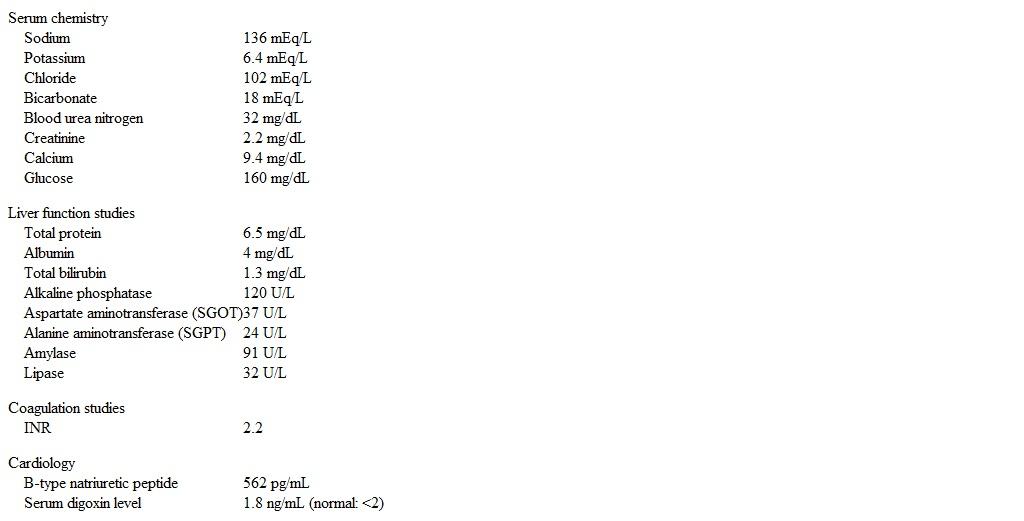 ECG shows a regular narrow-complex rhythm at 48/min, no P waves, and occasional ventricular premature beats. While in the emergency department, the patient also has an asymptomatic 9-beat run of nonsustained ventricular tachycardia that resolves spontaneously.
Which of the following is the best treatment for this patient?
A) Calcium gluconate
B) Digoxin-specific antibody (Fab) fragments
C) Insulin and dextrose
D) Intravenous amiodarone
E) Intravenous glucagon
Correct Answer:

Verified
Q1: A 68-year-old woman is admitted to the
Q2: A 78-year-old man is brought to the
Q3: A study evaluates the role of MRI
Q4: A 62-year-old woman comes to the emergency
Q5: A 42-year-old woman is evaluated for palpitations.
Q7: A 31-year-old farmer is hospitalized with a
Q8: A 72-year-old veteran is admitted to the
Q9: A 63-year-old man is scheduled for coronary
Q10: A 53-year-old woman is hospitalized with acute
Q11: A 55-year-old construction worker is brought to
Unlock this Answer For Free Now!
View this answer and more for free by performing one of the following actions

Scan the QR code to install the App and get 2 free unlocks

Unlock quizzes for free by uploading documents