Solved

A 72-Year-Old Man Comes to the Office 4 Weeks Following

Question 52

Multiple Choice

A 72-year-old man comes to the office 4 weeks following discharge from the hospital due to an episode of acute decompensated heart failure.  The patient feels much better now but claims that he gets tired easily.  He becomes short of breath after walking a few blocks on a level surface.  He has a history of myocardial infarction, coronary artery bypass grafting, ischemic cardiomyopathy, hypertension, hyperlipidemia, and type 2 diabetes mellitus.  The patient has had several hospital admissions for decompensated heart failure over the past 2 years.  His home medications include aspirin, carvedilol, sacubitril-valsartan, atorvastatin, furosemide, and insulin.
Temperature is 37.2 C (99 F) , blood pressure is 128/76 mm Hg, pulse is 76/min, and respirations are 16/min.  Pulse oximetry is 94% on room air.  The patient is in no apparent respiratory distress.  Jugular venous pressure is measured at 8 cm H2O.  Lung examination reveals clear lung fields with decreased breath sounds at the bases.  Cardiac examination reveals normal S1 and S2 along with a 2/6 holosystolic murmur heard over the cardiac apex.  There is minimal pitting edema around the ankles.
Laboratory results are as follows:

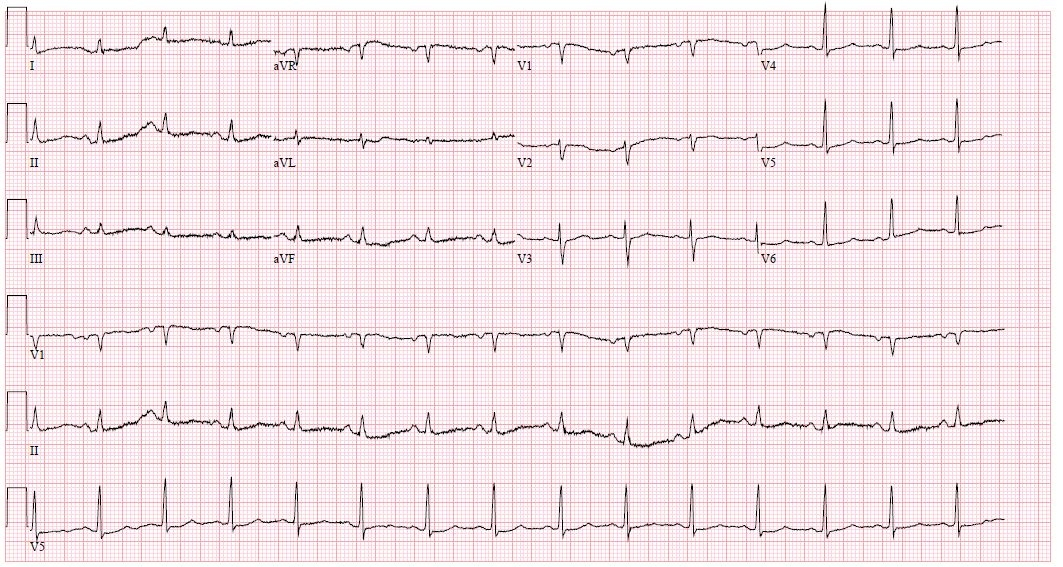
A 72-year-old man comes to the office 4 weeks following discharge from the hospital due to an episode of acute decompensated heart failure.  The patient feels much better now but claims that he gets tired easily.  He becomes short of breath after walking a few blocks on a level surface.  He has a history of myocardial infarction, coronary artery bypass grafting, ischemic cardiomyopathy, hypertension, hyperlipidemia, and type 2 diabetes mellitus.  The patient has had several hospital admissions for decompensated heart failure over the past 2 years.  His home medications include aspirin, carvedilol, sacubitril-valsartan, atorvastatin, furosemide, and insulin. Temperature is 37.2 C (99 F) , blood pressure is 128/76 mm Hg, pulse is 76/min, and respirations are 16/min.  Pulse oximetry is 94% on room air.  The patient is in no apparent respiratory distress.  Jugular venous pressure is measured at 8 cm H<sub>2</sub>O.  Lung examination reveals clear lung fields with decreased breath sounds at the bases.  Cardiac examination reveals normal S1 and S2 along with a 2/6 holosystolic murmur heard over the cardiac apex.  There is minimal pitting edema around the ankles. Laboratory results are as follows:   ECG is shown in the exhibit.   A recent echocardiogram showed a mildly dilated left ventricular cavity with akinesis of the anterior and anteroseptal walls as well as a left ventricular ejection fraction of 30%. Which of the following additional treatments would most benefit this patient? A) Biventricular pacing B) Digoxin C) Hydralazine D) Metolazone E) Spironolactone ECG is shown in the exhibit. A 72-year-old man comes to the office 4 weeks following discharge from the hospital due to an episode of acute decompensated heart failure.  The patient feels much better now but claims that he gets tired easily.  He becomes short of breath after walking a few blocks on a level surface.  He has a history of myocardial infarction, coronary artery bypass grafting, ischemic cardiomyopathy, hypertension, hyperlipidemia, and type 2 diabetes mellitus.  The patient has had several hospital admissions for decompensated heart failure over the past 2 years.  His home medications include aspirin, carvedilol, sacubitril-valsartan, atorvastatin, furosemide, and insulin. Temperature is 37.2 C (99 F) , blood pressure is 128/76 mm Hg, pulse is 76/min, and respirations are 16/min.  Pulse oximetry is 94% on room air.  The patient is in no apparent respiratory distress.  Jugular venous pressure is measured at 8 cm H<sub>2</sub>O.  Lung examination reveals clear lung fields with decreased breath sounds at the bases.  Cardiac examination reveals normal S1 and S2 along with a 2/6 holosystolic murmur heard over the cardiac apex.  There is minimal pitting edema around the ankles. Laboratory results are as follows:   ECG is shown in the exhibit.   A recent echocardiogram showed a mildly dilated left ventricular cavity with akinesis of the anterior and anteroseptal walls as well as a left ventricular ejection fraction of 30%. Which of the following additional treatments would most benefit this patient? A) Biventricular pacing B) Digoxin C) Hydralazine D) Metolazone E) Spironolactone A recent echocardiogram showed a mildly dilated left ventricular cavity with akinesis of the anterior and anteroseptal walls as well as a left ventricular ejection fraction of 30%.
Which of the following additional treatments would most benefit this patient?


A) Biventricular pacing
B) Digoxin
C) Hydralazine
D) Metolazone
E) Spironolactone

Correct Answer:

verifed

Verified

Unlock this answer now
Get Access to more Verified Answers free of charge

Related Questions

Unlock this Answer For Free Now!

View this answer and more for free by performing one of the following actions

qr-code

Scan the QR code to install the App and get 2 free unlocks

upload documents

Unlock quizzes for free by uploading documents