Solved

A 62-Year-Old Man Complains of a Black Lesion and Severe

Question 133

Multiple Choice

A 62-year-old man complains of a black lesion and severe pain in his left leg.  Initially the lesion was red, but over the past 3 days it has become black.  He has end-stage renal disease due to diabetic nephropathy and has been on hemodialysis for the last 10 years.  The patient's past medical history is also significant for hypertension, gout, and previous episodes of deep venous thrombosis requiring lifelong anticoagulation with warfarin.
His vitals signs are within normal limits.  The leg lesion is shown in the picture below.
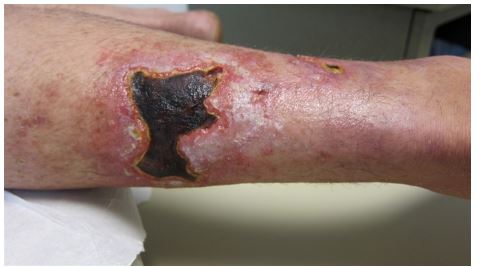
A 62-year-old man complains of a black lesion and severe pain in his left leg.  Initially the lesion was red, but over the past 3 days it has become black.  He has end-stage renal disease due to diabetic nephropathy and has been on hemodialysis for the last 10 years.  The patient's past medical history is also significant for hypertension, gout, and previous episodes of deep venous thrombosis requiring lifelong anticoagulation with warfarin. His vitals signs are within normal limits.  The leg lesion is shown in the picture below.   The lesion is exquisitely tender, but the area is not warm to palpation.  Femoral and other peripheral pulses are 2+ bilaterally.  There is no lymphadenopathy and no other skin lesions are noted.  The remainder of the physical examination is within normal limits. Laboratory results are as follows:   Which of the following is the most likely diagnosis? A) Calciphylaxis B) Cholesterol atheroembolism C) Necrobiosis lipoidica D) Pyoderma gangrenosum E) Warfarin-induced skin necrosis
The lesion is exquisitely tender, but the area is not warm to palpation.  Femoral and other peripheral pulses are 2+ bilaterally.  There is no lymphadenopathy and no other skin lesions are noted.  The remainder of the physical examination is within normal limits.
Laboratory results are as follows:
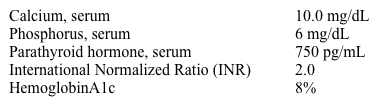
A 62-year-old man complains of a black lesion and severe pain in his left leg.  Initially the lesion was red, but over the past 3 days it has become black.  He has end-stage renal disease due to diabetic nephropathy and has been on hemodialysis for the last 10 years.  The patient's past medical history is also significant for hypertension, gout, and previous episodes of deep venous thrombosis requiring lifelong anticoagulation with warfarin. His vitals signs are within normal limits.  The leg lesion is shown in the picture below.   The lesion is exquisitely tender, but the area is not warm to palpation.  Femoral and other peripheral pulses are 2+ bilaterally.  There is no lymphadenopathy and no other skin lesions are noted.  The remainder of the physical examination is within normal limits. Laboratory results are as follows:   Which of the following is the most likely diagnosis? A) Calciphylaxis B) Cholesterol atheroembolism C) Necrobiosis lipoidica D) Pyoderma gangrenosum E) Warfarin-induced skin necrosis
Which of the following is the most likely diagnosis?


A) Calciphylaxis
B) Cholesterol atheroembolism
C) Necrobiosis lipoidica
D) Pyoderma gangrenosum
E) Warfarin-induced skin necrosis

Correct Answer:

verifed

Verified

Unlock this answer now
Get Access to more Verified Answers free of charge

Related Questions

Unlock this Answer For Free Now!

View this answer and more for free by performing one of the following actions

qr-code

Scan the QR code to install the App and get 2 free unlocks

upload documents

Unlock quizzes for free by uploading documents