A 56-year-old man comes to the physician with progressive shortness of breath over the past 4 months. He gets significantly short of breath after walking 2-3 blocks. He does not use tobacco.
On examination, blood pressure is 144/90 mm Hg, heart rate is 84/min, respirations are 16/min, and pulse oximetry is 91% on room air. Neck veins are flat in the sitting position. The skin of the fingers and hands appears thickened with a few ulcerations at the fingertips. Fine bibasilar crackles are heard on chest examination. There is no peripheral edema.
Chest x-ray reveals bilateral interstitial markings, most prominent at the bases.
Which of the following is most likely to be seen on pulmonary function testing?
FEV1 = Forced expiratory volume in 1 second; FVC = Forced vital capacity; DLCO = Diffusing capacity for carbon monoxide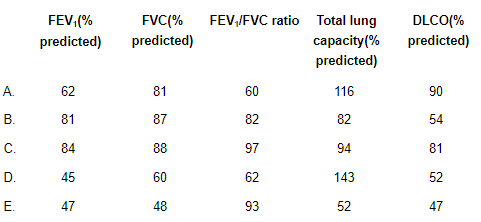
A) A
B) B
C) C
D) D
E) E
Correct Answer:

Verified
Q720: A 65-year-old man with moderate chronic obstructive
Q721: A 20-year-old man comes to the physician
Q722: A 53-year-old woman is evaluated for fatigue,
Q723: A 23-year-old man comes to the office
Q724: A 72 year-old man with a history
Q726: A 32-year-old primigravida at 24 weeks gestation
Q727: A 46-year-old man with kyphoscoliosis comes to
Q728: An 18-year-old man comes to the office
Q729: A 57-year-old man comes to the physician
Q730: A 57-year-old man comes to the physician
Unlock this Answer For Free Now!
View this answer and more for free by performing one of the following actions

Scan the QR code to install the App and get 2 free unlocks

Unlock quizzes for free by uploading documents