An 80-year-old woman was admitted from a nursing home for progressive lethargy. She was in her usual state of health until she developed constipation three days ago. She was given several doses of lactulose and subsequently developed diarrhea that persisted for 24-48 hours. Since that time, she has refused to leave her bed and has become progressively less responsive.
She is known to have significant cognitive impairment, osteoporosis, hypertension, degenerative joint disease, and mild COPD. She has not taken any medications for two days.
Her temperature is 36.5 C (97.7 F) , blood pressure is 90/45 mm Hg, pulse is 115/min, and respirations are 16/min. She appears lethargic but arousable. Her mucous membranes are dry and her skin turgor is markedly diminished. Her neck is supple. Cardiac, lung, and abdominal examinations reveal no significant findings. She moves all her extremities well and the deep tendon reflexes are 2+ and symmetric.
The patient's labs reveal: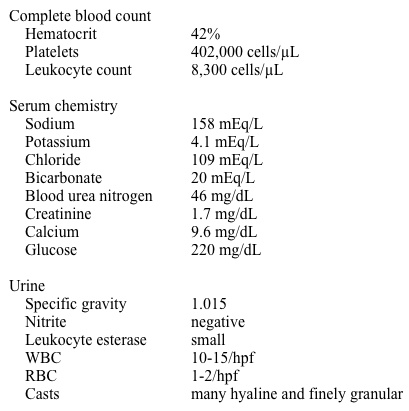
Her EKG shows sinus tachycardia and tall T waves in anterior precordial leads.
Which of the following is the best initial therapy for this patient?
A) Desmopressin
B) Free water supplementation
C) Intravenous antibiotics
D) Isotonic fluids
E) Treatment of hyperglycemia
Correct Answer:

Verified
Q755: A 22-year-old man comes to the physician
Q756: A 40-year-old man seeks evaluation for edema.
Q757: A 70-year-old man seeks advice for continuing
Q758: A 47-year-old man comes to the office
Q759: A 64-year-old woman comes to the office
Q761: A 76-year-old woman who has resided in
Q762: A 43-year-old African-American man with known HIV
Q763: A 75-year-old man comes to the office
Q764: An 80-year-old man comes to the physician
Q765: A 68-year-old man with chronic kidney disease
Unlock this Answer For Free Now!
View this answer and more for free by performing one of the following actions

Scan the QR code to install the App and get 2 free unlocks

Unlock quizzes for free by uploading documents