Solved

A 20-Year-Old Woman Comes to the Office Due to Atraumatic

Question 822

Multiple Choice

A 20-year-old woman comes to the office due to atraumatic heel pain over the last week.  For the past 6-8 months, the patient has also experienced bilateral hip pain that has progressively worsened and now awakens her during the early-morning hours.  When this occurs, she gets up and walks around for a few minutes before going back to sleep.  The patient also has difficulty tying her shoelaces in the morning due to back pain and stiffness; however, she does not feel limited when performing other daytime activities.  She has tried over-the-counter pain medications and found ibuprofen to be more effective than acetaminophen.  A year ago, she had an episode of intense pain, photophobia, and redness involving her left eye, which improved with corticosteroid eye drops.  The patient also occasionally has mouth ulcers, usually around the time of her menstrual periods.  Family history is significant for breast cancer in her mother and multiple sclerosis in her aunt.  The patient does not use tobacco, alcohol, or illicit drugs.  She is sexually active and uses oral contraceptives for birth control.
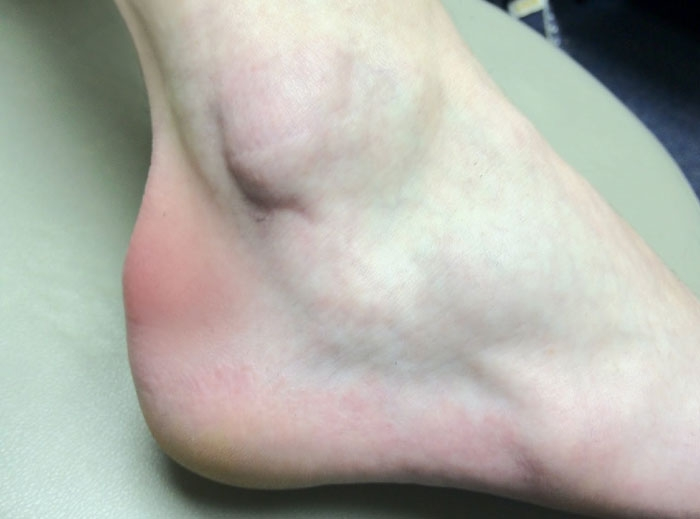
Vital signs are normal.  The oral mucosa is moist with mild tonsillar swelling, but there are no ulcers or other lesions.  There is tenderness and swelling of the heel, as shown in the exhibit. A 20-year-old woman comes to the office due to atraumatic heel pain over the last week.  For the past 6-8 months, the patient has also experienced bilateral hip pain that has progressively worsened and now awakens her during the early-morning hours.  When this occurs, she gets up and walks around for a few minutes before going back to sleep.  The patient also has difficulty tying her shoelaces in the morning due to back pain and stiffness; however, she does not feel limited when performing other daytime activities.  She has tried over-the-counter pain medications and found ibuprofen to be more effective than acetaminophen.  A year ago, she had an episode of intense pain, photophobia, and redness involving her left eye, which improved with corticosteroid eye drops.  The patient also occasionally has mouth ulcers, usually around the time of her menstrual periods.  Family history is significant for breast cancer in her mother and multiple sclerosis in her aunt.  The patient does not use tobacco, alcohol, or illicit drugs.  She is sexually active and uses oral contraceptives for birth control. Vital signs are normal.  The oral mucosa is moist with mild tonsillar swelling, but there are no ulcers or other lesions.  There is tenderness and swelling of the heel, as shown in the exhibit.   Examination of the ankle and other joints shows no synovitis or effusion.  Flexion and external rotation of the hip joints elicits intense pain at the gluteal region. Laboratory results are as follows:   Which of the following is the best next step in evaluation of this patient's condition? A) Anti-double-stranded DNA assay B) Cervical swab culture for Neisseria gonorrhoeae C) Chest x-ray D) Pathergy testing E) X-ray of the pelvis Examination of the ankle and other joints shows no synovitis or effusion.  Flexion and external rotation of the hip joints elicits intense pain at the gluteal region.
Laboratory results are as follows:

A 20-year-old woman comes to the office due to atraumatic heel pain over the last week.  For the past 6-8 months, the patient has also experienced bilateral hip pain that has progressively worsened and now awakens her during the early-morning hours.  When this occurs, she gets up and walks around for a few minutes before going back to sleep.  The patient also has difficulty tying her shoelaces in the morning due to back pain and stiffness; however, she does not feel limited when performing other daytime activities.  She has tried over-the-counter pain medications and found ibuprofen to be more effective than acetaminophen.  A year ago, she had an episode of intense pain, photophobia, and redness involving her left eye, which improved with corticosteroid eye drops.  The patient also occasionally has mouth ulcers, usually around the time of her menstrual periods.  Family history is significant for breast cancer in her mother and multiple sclerosis in her aunt.  The patient does not use tobacco, alcohol, or illicit drugs.  She is sexually active and uses oral contraceptives for birth control. Vital signs are normal.  The oral mucosa is moist with mild tonsillar swelling, but there are no ulcers or other lesions.  There is tenderness and swelling of the heel, as shown in the exhibit.   Examination of the ankle and other joints shows no synovitis or effusion.  Flexion and external rotation of the hip joints elicits intense pain at the gluteal region. Laboratory results are as follows:   Which of the following is the best next step in evaluation of this patient's condition? A) Anti-double-stranded DNA assay B) Cervical swab culture for Neisseria gonorrhoeae C) Chest x-ray D) Pathergy testing E) X-ray of the pelvis Which of the following is the best next step in evaluation of this patient's condition?


A) Anti-double-stranded DNA assay
B) Cervical swab culture for Neisseria gonorrhoeae
C) Chest x-ray
D) Pathergy testing
E) X-ray of the pelvis

Correct Answer:

verifed

Verified

Unlock this answer now
Get Access to more Verified Answers free of charge

Related Questions

Unlock this Answer For Free Now!

View this answer and more for free by performing one of the following actions

qr-code

Scan the QR code to install the App and get 2 free unlocks

upload documents

Unlock quizzes for free by uploading documents