A 42-year-old woman comes to the physician with 6 months of progressively worsening exertional dyspnea. She is unable to climb two flights of stairs without becoming short of breath. She also complains of dry cough, weight loss, and fatigue. She describes finger tingling and numbness when exposed to colder temperatures. Her past medical history is significant for acid reflux disease and diabetes mellitus. Her medications include metformin and omeprazole. She does not smoke cigarettes.
Her blood pressure is 155/80 mm Hg and her pulse is 86/min. Oxygen saturation is 94% on room air. Small ulcers are seen at the fingertips bilaterally. Jugular venous pressure is estimated at 6 mm H2O. There are no heart murmurs. Inspiratory fine crackles are heard on auscultation at lung bases. There is no organomegaly.
Laboratory results are as follows: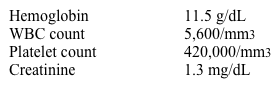
Chest x-ray shows bilateral reticular opacities.
Which of the following antibodies is most likely to be positive in this patient?
A) Anticitrullinated peptide antibodies
B) Anti-DNA topoisomerase I antibodies
C) Antimitochondrial antibodies
D) Antineutrophil cytoplasmic antibodies
E) Antisynthetase antibodies
Correct Answer:

Verified
Q847: A 25-year-old woman comes to the office
Q848: A 52-year-old woman with known rheumatoid factor-positive
Q849: A 36-year-old woman is seen in a
Q850: A 55-year-old man comes to the physician
Q851: A 36-year-old woman comes to the physician
Q853: A 30-year-old woman comes to the physician
Q854: A 55-year-old woman comes to the physician
Q855: A 35-year-old woman comes to the physician
Q856: A 65-year-old woman with a history of
Q857: A 55-year-old man comes to the physician
Unlock this Answer For Free Now!
View this answer and more for free by performing one of the following actions

Scan the QR code to install the App and get 2 free unlocks

Unlock quizzes for free by uploading documents