A 70-year-old man comes to the physician with muscle pains and weakness over the last several weeks. He now has difficulty getting up from a chair and climbing stairs. He has no fever, weight loss, vision changes, or shortness of breath.
The patient's other medical problems include hyperlipidemia, gout, hypertension, chronic kidney disease, and degenerative joint disease of the hips and knees. His medications include lisinopril, allopurinol, colchicine, atorvastatin, and acetaminophen.
Vital signs are within normal limits. Examination shows some tenderness to palpation of his thighs and weakness of both thighs to extension and flexion. Deep-tendon reflexes are symmetrically diminished at the patellar tendons and absent at the Achilles tendons. Peripheral pulses are normal.
Laboratory results are as follows: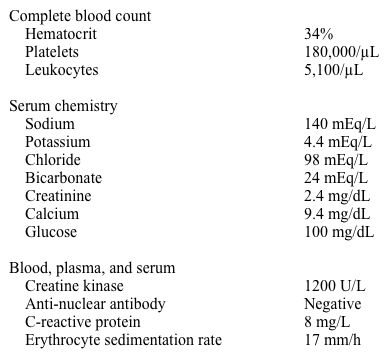
Electromyogram shows slowed sensory and motor nerve conduction velocities and small-amplitude, short-duration polyphasic waves.
A quadriceps muscle biopsy demonstrates widespread cytoplasmic vacuolization but no inflammation.
What is the most likely explanation for this patient's symptoms?
A) Atorvastatin
B) Colchicine
C) Diabetic amyotrophy
D) Hypothyroidism
E) Polymyositis
Correct Answer:

Verified
Q841: A 45-year-old woman is evaluated in the
Q842: A 36-year-old man with known ankylosing spondylitis
Q843: A 35-year-old immigrant from Turkey comes to
Q844: A 55-year-old woman comes to the physician
Q845: A 20-year-old woman comes to the physician
Q847: A 25-year-old woman comes to the office
Q848: A 52-year-old woman with known rheumatoid factor-positive
Q849: A 36-year-old woman is seen in a
Q850: A 55-year-old man comes to the physician
Q851: A 36-year-old woman comes to the physician
Unlock this Answer For Free Now!
View this answer and more for free by performing one of the following actions

Scan the QR code to install the App and get 2 free unlocks

Unlock quizzes for free by uploading documents