A 70-year-old man comes to the physician complaining of 4-6 months of almost continuous urinary dribbling. It occurs during the day and at night and is progressively worsening. He has no dysuria or hematuria. The patient has a 20-year history of type 2 diabetes, hypertension, alcoholic hepatitis, and coronary artery disease. He had a gastric emptying study done a few weeks ago due to continuous nausea and early satiety. He had laser photocoagulation of both eyes for diabetic retinopathy. The patient has a 50-pack-year smoking history and drinks 4-6 beers daily. His medications include insulin glargine, lispro insulin, metformin, aspirin, metoprolol, lisinopril, and erythromycin. Physical examination shows a normal-size prostate, decreased sensation in both legs below the knees, and absent Achilles tendon and knee reflexes bilaterally. Postvoid residual volume is 550 mL. Urinalysis results are as follows: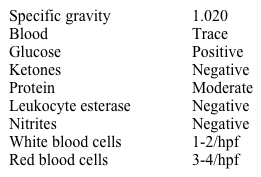 Which of the following is the most likely cause of this patient's incontinence?
A) Diabetic nephropathy
B) Neurogenic bladder dysfunction
C) Overflow incontinence due to medication
D) Overflow incontinence from bladder outlet obstruction
E) Pelvic floor muscle weakness
F) Urethral instability
G) Urinary diverticulum
H) Urinary fistula
I) Urinary tract infection
Correct Answer:

Verified
Q145: A 25-year-old man comes to the clinic
Q146: A 54-year-old woman comes to the office
Q147: A 34-year-old sexually active female comes to
Q148: A 56-year-old man comes to the office
Q149: A 42-year-old woman comes to the office
Q151: A 24-year-old woman comes to the office
Q152: A 23-year-old woman comes to the physician
Q153: A 68-year-old woman comes to the office
Q154: A 54-year-old man comes to the office
Q155: A 78-year-old woman comes to the office
Unlock this Answer For Free Now!
View this answer and more for free by performing one of the following actions

Scan the QR code to install the App and get 2 free unlocks

Unlock quizzes for free by uploading documents