A 45-year-old woman comes to the emergency department due to 3 days of fever, malaise, progressive dyspnea on exertion, dry cough, abdominal pain, and watery diarrhea. Her loose stools this morning were accompanied by bright red blood. The patient underwent allogeneic renal transplantation 6 months ago and is currently taking tacrolimus, mycophenolate, and prednisone. Two months ago, she developed severe leukopenia, which resolved after discontinuing trimethoprim-sulfamethoxazole and valganciclovir. She does not use tobacco, alcohol, or illicit drugs. Temperature is 38.9 C (102 F) , blood pressure is 110/70 mm Hg, pulse is 114/min, and respirations are 22/min. Physical examination shows bilateral lung crackles and diffuse abdominal tenderness. Gross blood is seen on rectal examination. Laboratory results are as follows: 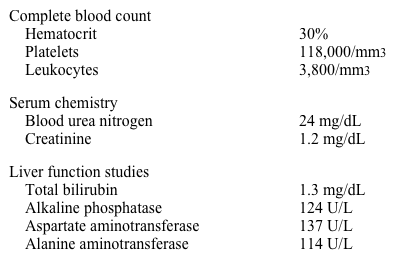 Urinalysis is normal. Chest x-ray reveals bilateral interstitial infiltrates. Which of the following is the most likely cause of this patient's current condition?
A) Aspergillus fumigatus
B) Candida albicans
C) Cryptosporidium
D) Cytomegalovirus
E) Influenza
F) Legionella pneumophila
G) Mycoplasma pneumoniae
H) Pneumocystis jirovecii
Correct Answer:

Verified
Q1239: A 16-year-old boy is brought to the
Q1240: A 74-year-old man comes to the office
Q1241: A 42-year-old man with a history of
Q1242: A 42-year-old man comes to the office
Q1243: A 28-year-old woman comes to the emergency
Q1245: A 32-year-old man comes to the physician
Q1246: A 35-year-old male from Wisconsin presents to
Q1247: A 34-year-old man comes to the office
Q1248: A 26-year-old man comes to the office
Q1249: A 67-year-old man is brought to the
Unlock this Answer For Free Now!
View this answer and more for free by performing one of the following actions

Scan the QR code to install the App and get 2 free unlocks

Unlock quizzes for free by uploading documents