A 32-year-old man with a known history of recreational substance abuse is brought to the emergency department. The patient was found by a friend on the floor of his apartment with a pool of urine around him. He has been previously hospitalized for alcohol intoxication. The patient is confused, not oriented to time or place, and does not recall recent events. Temperature is 37.3 C (99.1 F) , blood pressure is 90/70 mm Hg, pulse is 67/min, and respirations are 12/min. He is drowsy and moves all his extremities. The pupils are small. Skin is mottled over the upper back, buttocks, and posterior thighs. Cardiopulmonary examination is normal. The abdomen is soft and nontender. Laboratory findings are the following: 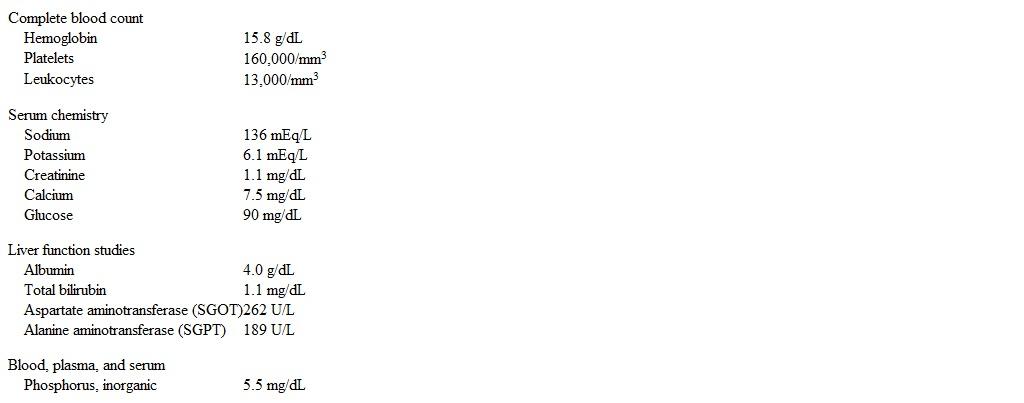 Urine toxicology screen is positive for opioids. Over the next 2 days, this patient is at greatest risk for which of the following?
A) Acute kidney injury
B) Intracranial hemorrhage
C) Necrotizing fasciitis
D) Osmotic demyelination syndrome
E) Splenic infarction
Correct Answer:

Verified
Q1530: A 37-year-old woman comes to the office
Q1531: A 60-year-old man is hospitalized with multiple
Q1532: A 45-year-old man is evaluated in the
Q1533: A 56-year-old man comes to the emergency
Q1534: A 57-year-old man comes to the physician
Q1536: A 34-year-old male is recovering from head
Q1537: A 45-year-old man is brought to the
Q1538: A 54-year-old woman is admitted to the
Q1539: A 50-year-old man comes to the emergency
Q1540: A 44-year-old woman, gravida 2 para 2,
Unlock this Answer For Free Now!
View this answer and more for free by performing one of the following actions

Scan the QR code to install the App and get 2 free unlocks

Unlock quizzes for free by uploading documents