An 80-year-old woman is brought to the emergency department due to progressive confusion, generalized weakness, and unsteadiness for the past several days. The patient had a right femoral fracture 4 months ago and underwent hip surgery. She has been using a walker to ambulate since coming home from a physical rehabilitation facility 3 weeks ago. She has had no fever, chest pain, vomiting, diarrhea, or dysuria. The patient's medical problems include hypertension, hyperlipidemia, coronary artery disease, transient ischemic attack, and persistent atrial fibrillation. Her medications include aspirin, warfarin, metoprolol, and a statin. Temperature is 37.2 C (99 F) , blood pressure is 140/90 mm Hg, pulse is 72/min and irregular, and respirations are 14/min. CT scan of the head without contrast is shown below. 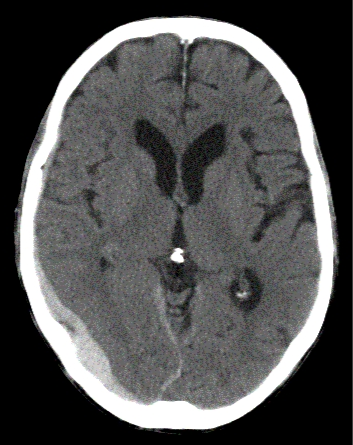 Which of the following is the most likely cause of this patient's condition?
A) Dislodged cardiac thrombus
B) Hyalinosis of the small vessels
C) Impairment of cerebrospinal fluid absorption
D) Injury of the middle meningeal artery
E) Rupture of an aneurysm
F) Shearing of the white matter tracts
G) Tearing of the bridging veins
H) Thrombosis of the posterior cerebral artery
I) Tumor of the arachnoid cells
Correct Answer:

Verified
Q133: A 47-year-old man is brought to the
Q134: A 21-year-old man comes to the emergency
Q135: A 62-year-old man with hypertension and stage
Q136: A 30-year-old woman comes to the office
Q137: A 67-year-old man is brought to the
Q139: A 17-year-old girl is brought to the
Q140: A 47-year-old man comes to the emergency
Q141: A 52-year-old woman comes to the office
Q142: A 69-year-old man comes to the office
Q143: A 15-year-old girl is brought to an
Unlock this Answer For Free Now!
View this answer and more for free by performing one of the following actions

Scan the QR code to install the App and get 2 free unlocks

Unlock quizzes for free by uploading documents